
Facility Management Past present and future of the

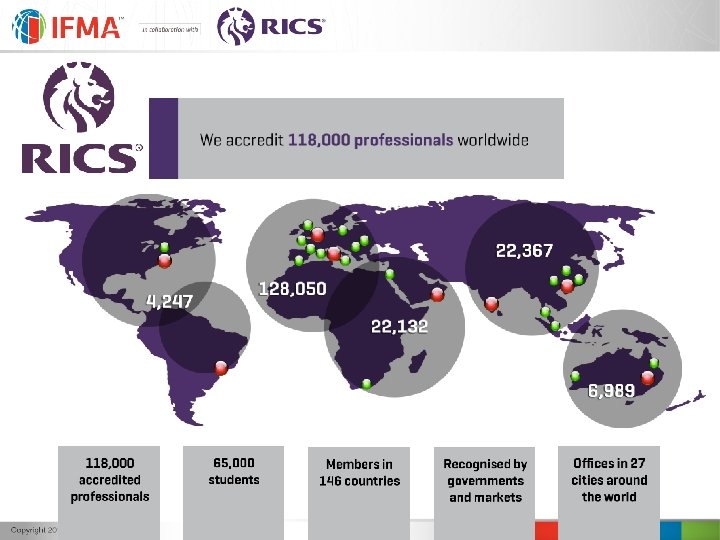

- Slides: 29
Facility Management Past, present and future of the industry
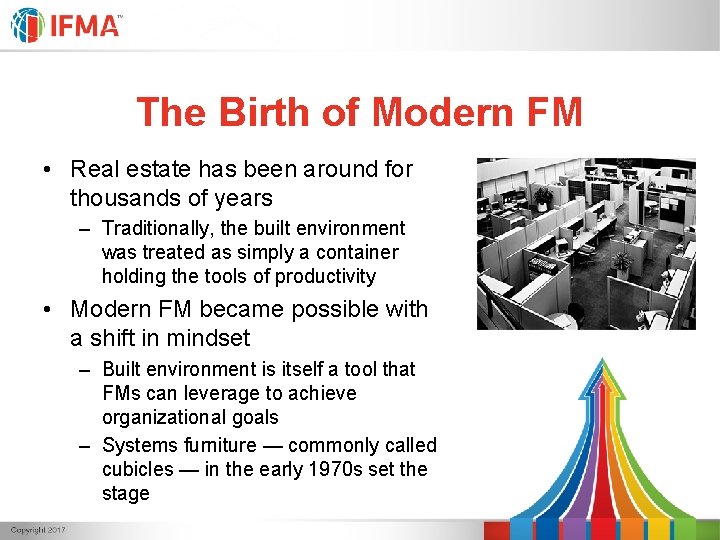
The Birth of Modern FM • Real estate has been around for thousands of years – Traditionally, the built environment was treated as simply a container holding the tools of productivity • Modern FM became possible with a shift in mindset – Built environment is itself a tool that FMs can leverage to achieve organizational goals – Systems furniture — commonly called cubicles — in the early 1970 s set the stage
The Birth of Modern FM • IFMA was founded in 1980 to create a global FM community and find shared solutions to shared challenges – – – Professional development and credentials Research and benchmarking Events and networking Public and government advocacy to elevate FM Local and global support for FM mission • Today IFMA has more than 24, 000 members in 104 countries – 133 regional chapters – 14 industry councils – 6 communities based on areas of interest
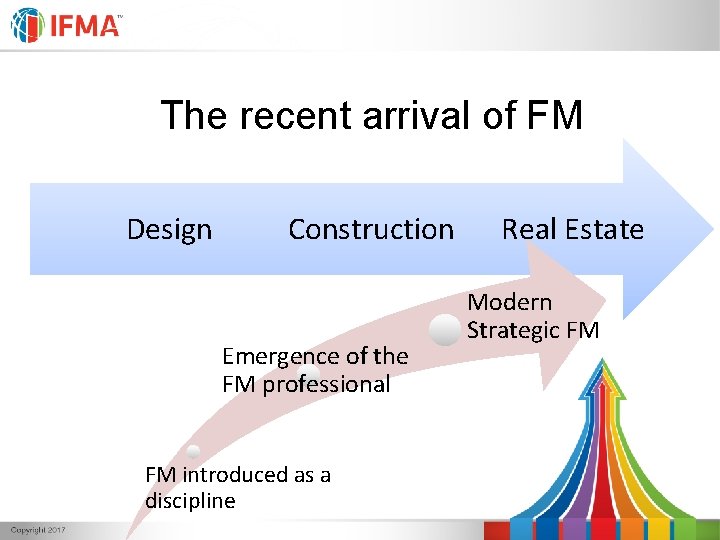
The recent arrival of FM Design Construction Emergence of the FM professional FM introduced as a discipline Real Estate Modern Strategic FM
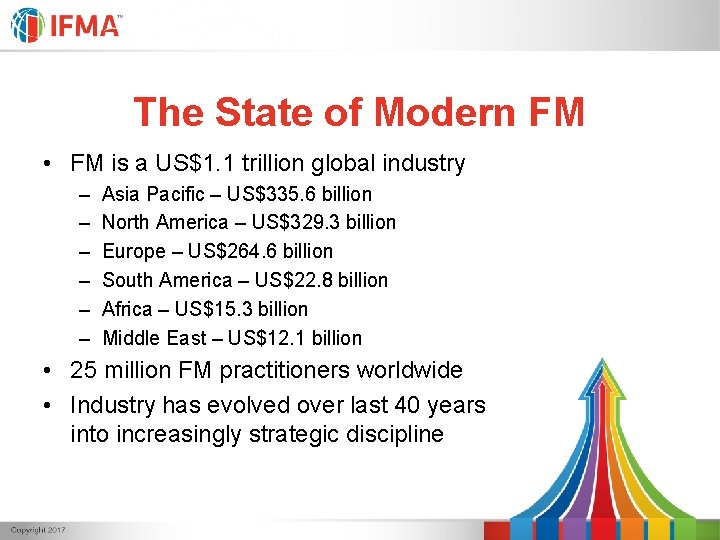
The State of Modern FM • FM is a US$1. 1 trillion global industry – – – Asia Pacific – US$335. 6 billion North America – US$329. 3 billion Europe – US$264. 6 billion South America – US$22. 8 billion Africa – US$15. 3 billion Middle East – US$12. 1 billion • 25 million FM practitioners worldwide • Industry has evolved over last 40 years into increasingly strategic discipline
The State of Modern FM • Challenge: Fragmentation – Different protocols across organizations/regions means inefficiency – 40 competing FM organizations • Challenge: Isolation – FM often left out of big-picture design, construction and real estate conversations means facilities that look good on paper but fail to perform • Challenge: Attracting next generation of talent
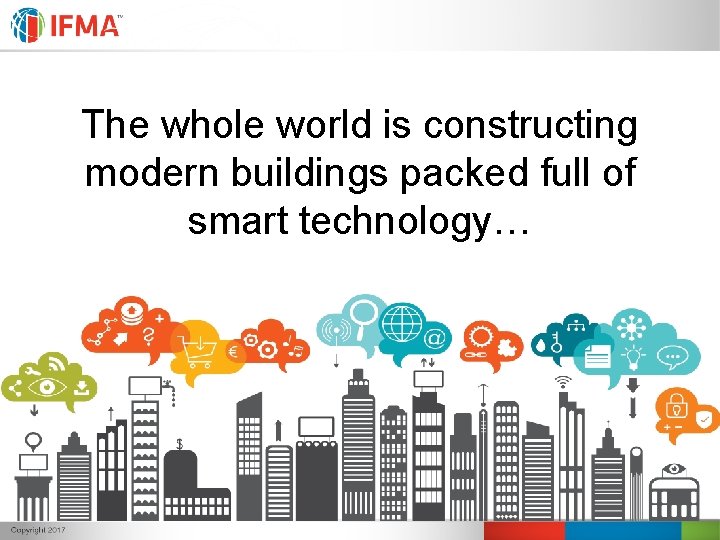
The whole world is constructing modern buildings packed full of smart technology…
Smart Buildings Are the Future • 1 Trillion sensors by 2025 • 120 building sensors in operation for every person alive.
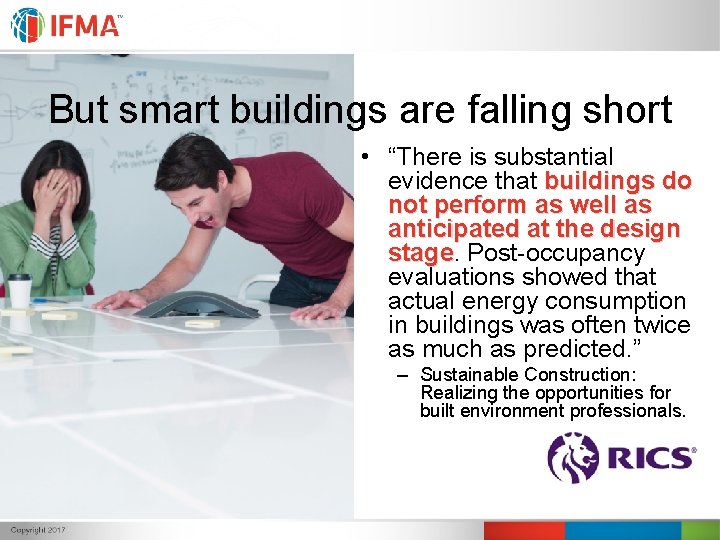
But smart buildings are falling short • “There is substantial evidence that buildings do not perform as well as anticipated at the design stage Post-occupancy evaluations showed that actual energy consumption in buildings was often twice as much as predicted. ” – Sustainable Construction: Realizing the opportunities for built environment professionals.
The “performance gap” • Many reasons smart buildings are not performing as effectively as expected. • Record amounts of data, but disconnected from anything useful. • Smart technology not performing as expected or being used as intended. • Focus remains on the building and the technology – We certify the buildings themselves as green or smart.
What is missing? People. • “An EPA official noted that finding and retaining facility energy managers with the appropriate level of expertise is important but challenging; without effective energy management, agencies could have difficulty achieving certain EISA energy and water management requirements. ” – U. S. Government Accountability Office report 10 -22
The Future of FM • Industry unification – Consistency in the practice and standards of FM – FM credentials that demonstrate knowledge and skills • Industry integration – FM joins larger built environment conversation: real estate, design, construction, valuation, etc. – Operational realities no longer an afterthought • FM as a career of choice
The IFMA-RICS collaboration
The IFMA-RICS collaboration … • … is the largest leap in the evolution of FM since IFMA was founded. • … covers the built environment from conception through disposition. • … offers the support of a truly global network of staff, offices and resources. • … increases the profile and visibility of FM professionals and the industry. • … is not a finished product, but a shared vision for an exciting new way forward for FM.
The IFMA-RICS collaboration Why collaborate? • Combined resources of IFMA and RICS represent the largest FM service support organization in the world • Unite the global FM community • Integrate FM strategies across all aspects of the building life cycle • Drive pervasive recognition of FM as a career of choice
The IFMA-RICS collaboration How are we collaborating? • One-stop-shop for FM training, education and professional development needs • Common approach to global FM standards • Expanded FM professional network • FM conferences and events in key world regions • Industry-leading FM content, knowledge and research resources
Benefits: Individual FM Practitioners For the 25 million people working in FM, the future is bright: • Global recognition and demand for FM credentials • Increased understanding of the value FM offers • Skillset in demand around the world and across facility types
Convenient Professional Development Online education • Online courses • On demand recordings • Webinars Classroom courses • Courses for FMP, SFP & CFM • Essentials of FM Accredited Degree Programs
Benefits: Businesses, Employers Organizations stand to gain: • Effective FM solutions, efficiency and savings • True life cycle planning • Larger talent pool for hiring
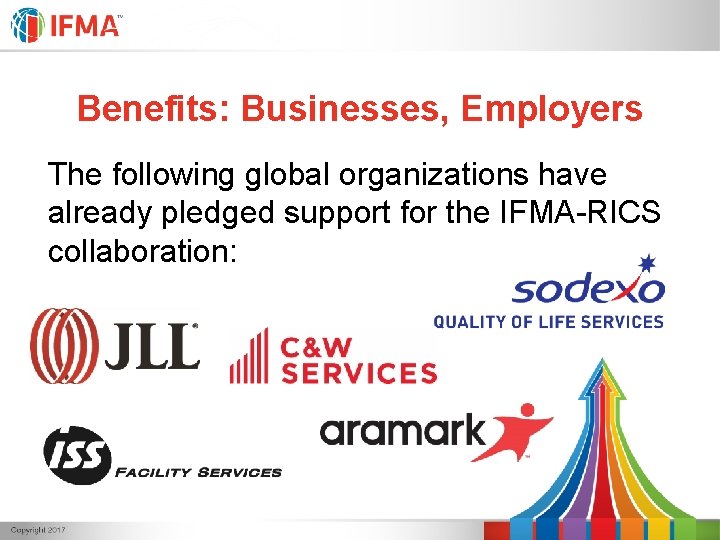
Benefits: Businesses, Employers The following global organizations have already pledged support for the IFMA-RICS collaboration:
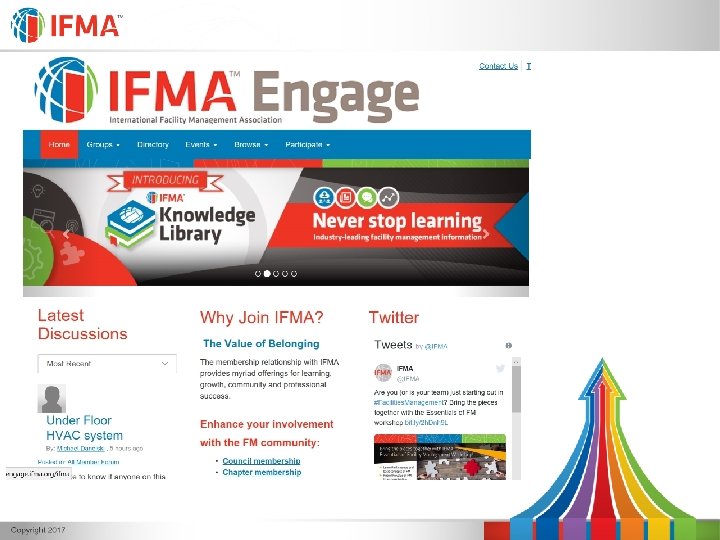
Knowledge Library Cut through the noise… • All content in the Knowledge Library is curated and vetted by FM experts To find what you need • Articles, benchmarking, blogs, case studies, how tos, videos, podcasts, presentations, research, scope of work, webinars, white papers and more…
Benefits: The FM Industry The IFMA-RICS collaboration will elevate the FM industry to new heights: • Consistent, reliable professional expectations and standards for FM • Less internal disagreement among FM governing bodies • Industry energy focused on shared advancements
Three new ISO standards for FM • FM industry is learning to speak the same professional language. • April, 2017 – ISO 41011: 2017, Facility management – Vocabulary – ISO 41012: 2017, Facility management – Guidance on strategic sourcing and the development of agreements • July 2017 – ISO/TR 41013: 2017, Facility management – Scope, key concepts and benefits
Industry events
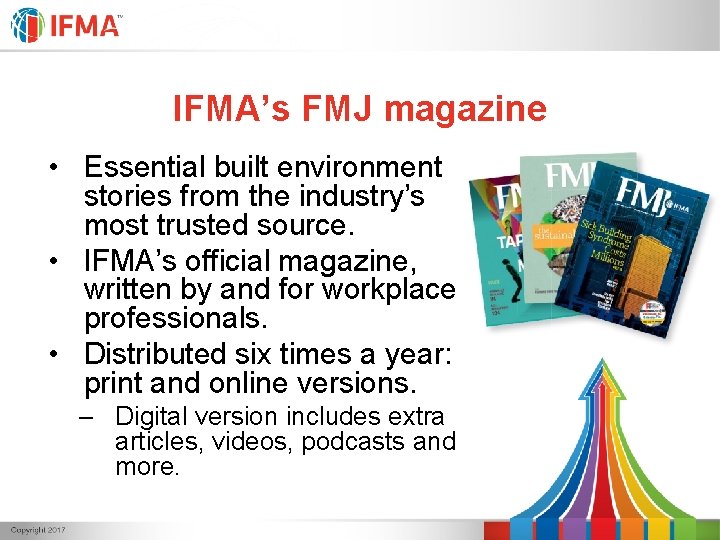
IFMA’s FMJ magazine • Essential built environment stories from the industry’s most trusted source. • IFMA’s official magazine, written by and for workplace professionals. • Distributed six times a year: print and online versions. – Digital version includes extra articles, videos, podcasts and more.
Questions?