
Facility Layout Configuration of departments work centres and
- Slides: 12
Facility Layout Configuration of departments, work centres and equipment, with particular emphasis on movement of work through the system Why Important? • • • Require substantial investment of money & effort Involve long term commitment Have significant impact on the cost and /efficiency of operations Two basic types of layout: • Product • Process
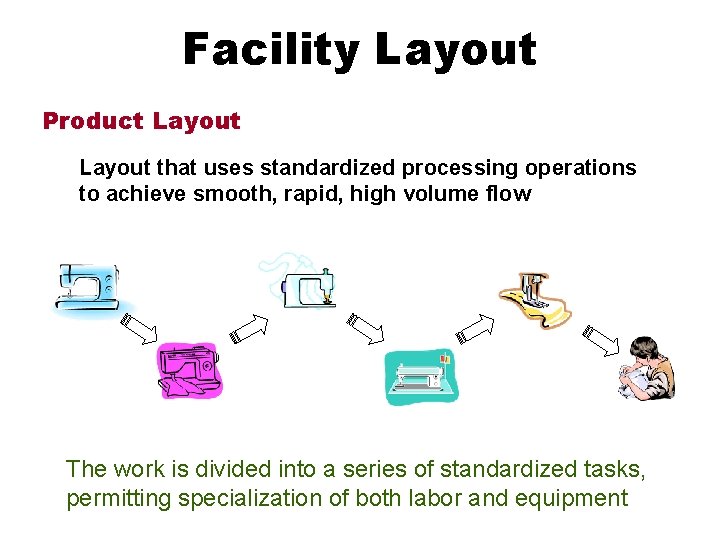
Facility Layout Product Layout that uses standardized processing operations to achieve smooth, rapid, high volume flow The work is divided into a series of standardized tasks, permitting specialization of both labor and equipment
Facility Layout Advantages • • High rates of output Low unit cost due to high volume Low material handling cost per unit High utilization of labor & equipment Limitations • Repetitive work – boring & fatigue • System is fairly inflexible • System is highly susceptible to breakdown
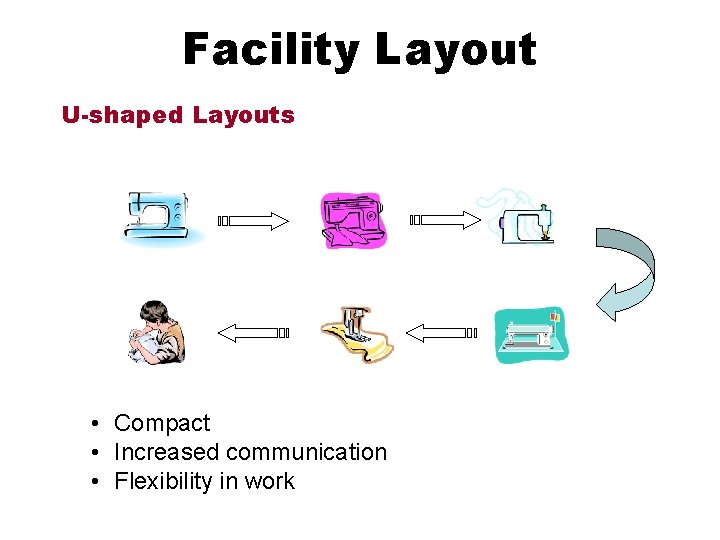
Facility Layout U-shaped Layouts • Compact • Increased communication • Flexibility in work
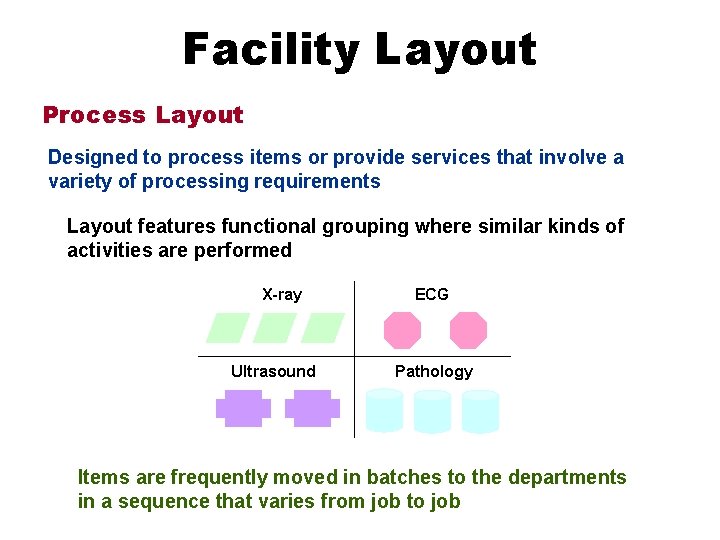
Facility Layout Process Layout Designed to process items or provide services that involve a variety of processing requirements Layout features functional grouping where similar kinds of activities are performed X-ray Ultrasound ECG Pathology Items are frequently moved in batches to the departments in a sequence that varies from job to job
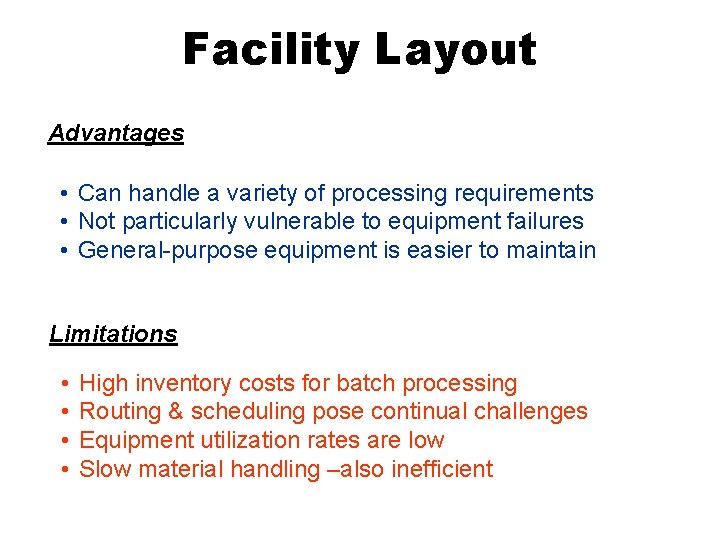
Facility Layout Advantages • Can handle a variety of processing requirements • Not particularly vulnerable to equipment failures • General-purpose equipment is easier to maintain Limitations • • High inventory costs for batch processing Routing & scheduling pose continual challenges Equipment utilization rates are low Slow material handling –also inefficient
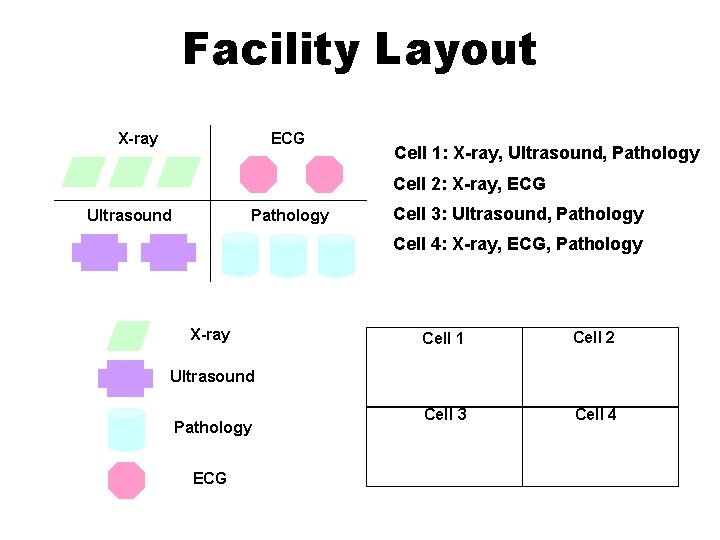
Facility Layout ECG X-ray Cell 1: X-ray, Ultrasound, Pathology Cell 2: X-ray, ECG Ultrasound Pathology Cell 3: Ultrasound, Pathology Cell 4: X-ray, ECG, Pathology X-ray Cell 1 Cell 2 Cell 3 Cell 4 Ultrasound Pathology ECG
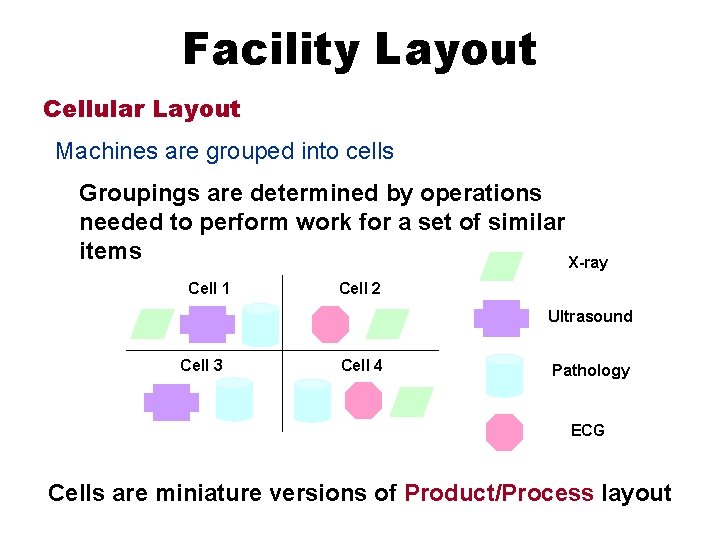
Facility Layout Cellular Layout Machines are grouped into cells Groupings are determined by operations needed to perform work for a set of similar items X-ray Cell 1 Cell 2 Ultrasound Cell 3 Cell 4 Pathology ECG Cells are miniature versions of Product/Process layout
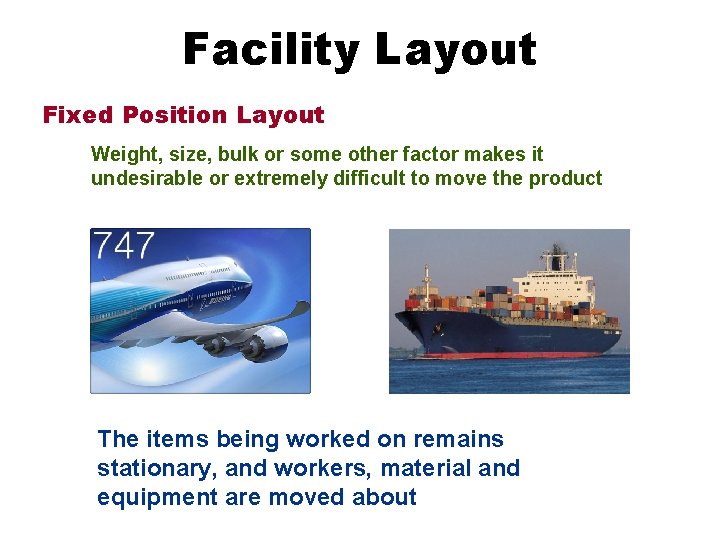
Facility Layout Fixed Position Layout Weight, size, bulk or some other factor makes it undesirable or extremely difficult to move the product The items being worked on remains stationary, and workers, material and equipment are moved about
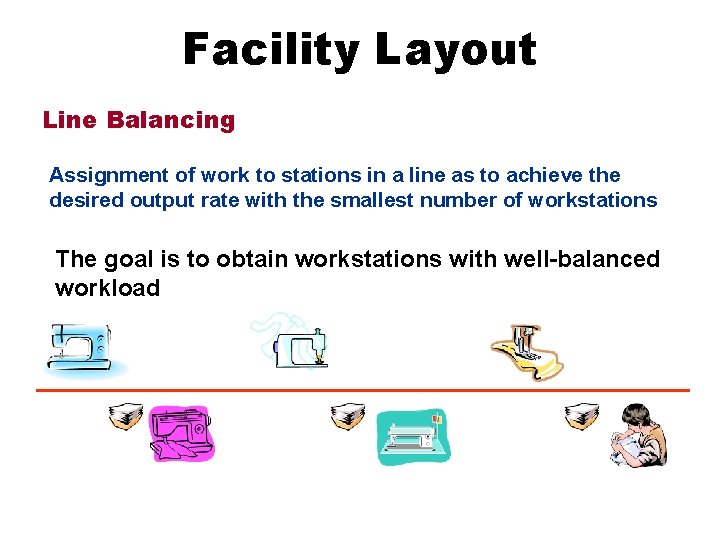
Facility Layout Line Balancing Assignment of work to stations in a line as to achieve the desired output rate with the smallest number of workstations The goal is to obtain workstations with well-balanced workload
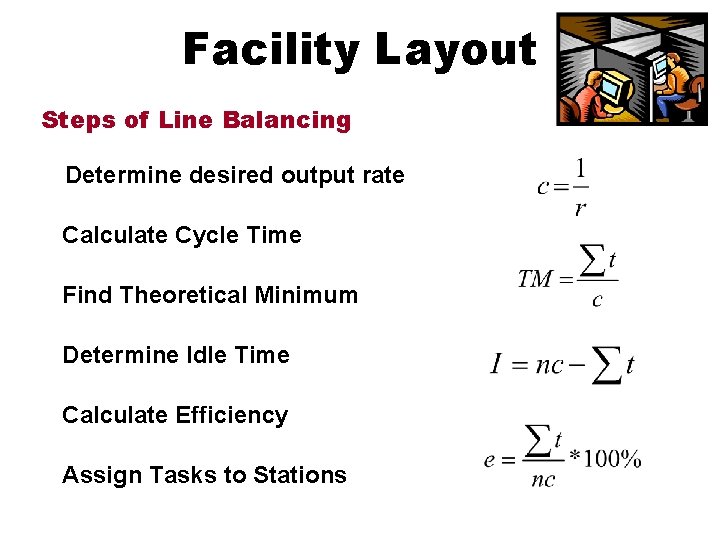
Facility Layout Steps of Line Balancing Determine desired output rate Calculate Cycle Time Find Theoretical Minimum Determine Idle Time Calculate Efficiency Assign Tasks to Stations
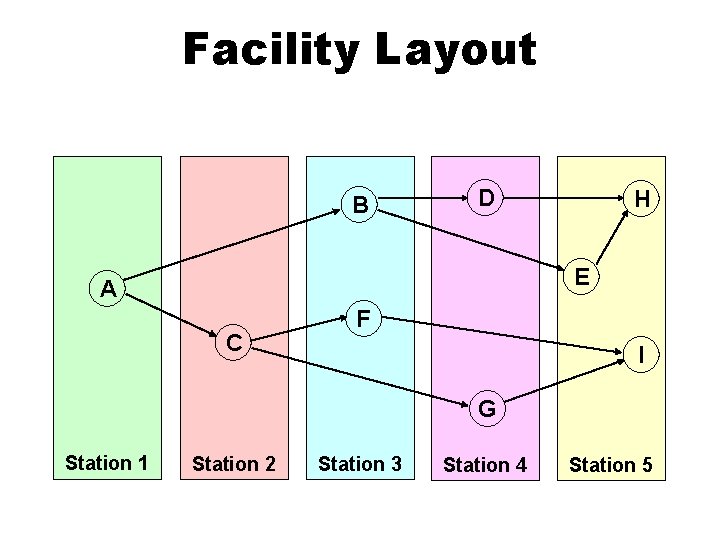
Facility Layout B D H E A C F I G Station 1 Station 2 Station 3 Station 4 Station 5