
Facility for Rare Isotope Beams Update Thomas Glasmacher
Facility for Rare Isotope Beams Update Thomas Glasmacher FRIB Laboratory Director 23 March 2018 This material is based upon work supported by the U. S. Department of Energy Office of Science under Cooperative Agreement DE-SC 0000661, the State of Michigan and Michigan State University designs and establishes FRIB as a DOE Office of Science National User Facility in support of the mission of the Office of Nuclear Physics.
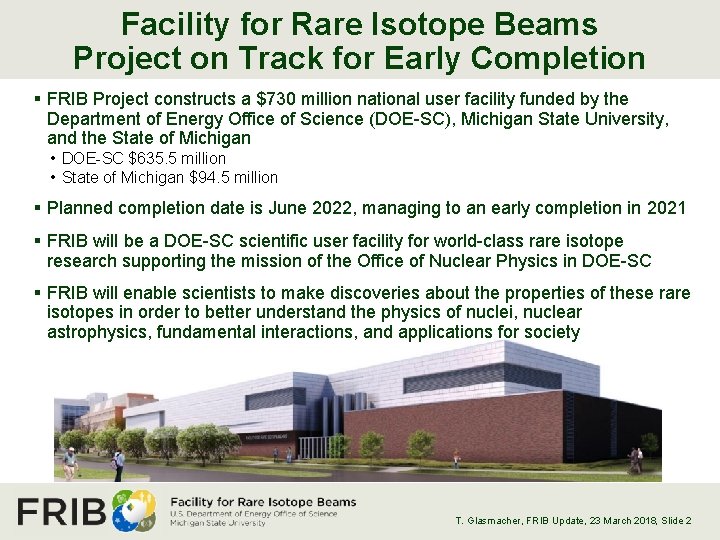
Facility for Rare Isotope Beams Project on Track for Early Completion § FRIB Project constructs a $730 million national user facility funded by the Department of Energy Office of Science (DOE-SC), Michigan State University, and the State of Michigan • DOE-SC $635. 5 million • State of Michigan $94. 5 million § Planned completion date is June 2022, managing to an early completion in 2021 § FRIB will be a DOE-SC scientific user facility for world-class rare isotope research supporting the mission of the Office of Nuclear Physics in DOE-SC § FRIB will enable scientists to make discoveries about the properties of these rare isotopes in order to better understand the physics of nuclei, nuclear astrophysics, fundamental interactions, and applications for society T. Glasmacher, FRIB Update, 23 March 2018, Slide 2
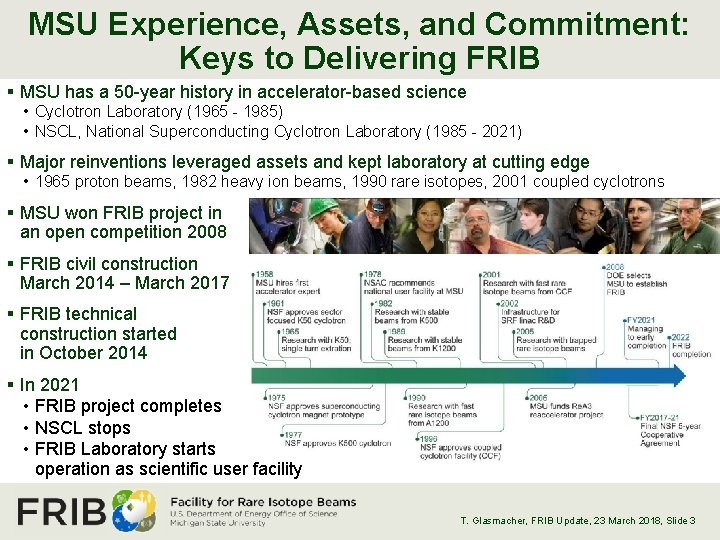
MSU Experience, Assets, and Commitment: Keys to Delivering FRIB § MSU has a 50 -year history in accelerator-based science • Cyclotron Laboratory (1965 - 1985) • NSCL, National Superconducting Cyclotron Laboratory (1985 - 2021) § Major reinventions leveraged assets and kept laboratory at cutting edge • 1965 proton beams, 1982 heavy ion beams, 1990 rare isotopes, 2001 coupled cyclotrons § MSU won FRIB project in an open competition 2008 § FRIB civil construction March 2014 – March 2017 § FRIB technical construction started in October 2014 § In 2021 • FRIB project completes • NSCL stops • FRIB Laboratory starts operation as scientific user facility T. Glasmacher, FRIB Update, 23 March 2018, Slide 3
FRIB Enables Scientists to Make Discoveries Properties of atomic nuclei • Develop a predictive model of nuclei and their interactions • Many-body quantum problem: intellectual overlap to mesoscopic science, quantum dots, atomic clusters, etc. Astrophysics: What happens inside stars? • Origin of the elements in the cosmos • Explosive environments: novae, supernovae, X-ray bursts … • Properties of neutron stars Tests of laws of nature • Effects of symmetry violations are amplified in certain nuclei Societal applications and benefits • Medicine, energy, material sciences, national security Science is aligned with national priorities articulated by • Nuclear Science Advisory Committee to DOE and NSF Long Range Plan for Nuclear Science (2015) • National Research Council Decadal Survey of Nuclear Physics (2012) • National Research Council Rare Isotope Science Assessment report (2006) T. Glasmacher, FRIB Update, 23 March 2018, Slide 4

1, 400 Users Engaged and Ready for Science www. fribusers. org § Scientific users organized in an independent FRIB Users Organization (FRIBUO) • Chartered organization with an elected executive committee • 1, 400 members (116 U. S. colleges and universities, 12 national laboratories, 52 countries) as of January 2018 • 19 working groups on instruments § External Science Advisory Committee Argonne National Laboratory, August 2017 T. Glasmacher, FRIB Update, 23 March 2018, Slide 5
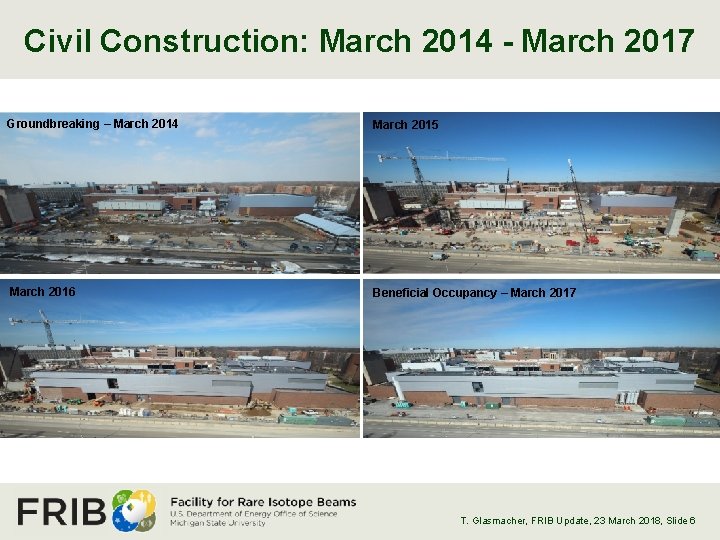
Civil Construction: March 2014 - March 2017 Groundbreaking – March 2014 March 2015 March 2016 Beneficial Occupancy – March 2017 T. Glasmacher, FRIB Update, 23 March 2018, Slide 6
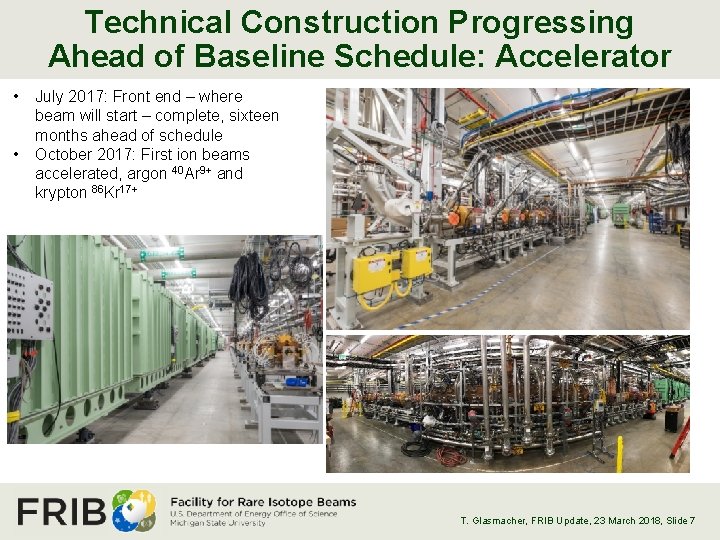
Technical Construction Progressing Ahead of Baseline Schedule: Accelerator • July 2017: Front end – where beam will start – complete, sixteen months ahead of schedule • October 2017: First ion beams accelerated, argon 40 Ar 9+ and krypton 86 Kr 17+ T. Glasmacher, FRIB Update, 23 March 2018, Slide 7

Technical Construction Progressing Ahead of Baseline Schedule: Cryogenic Plant December 2017: Cryogenic plant is complete, operational, and makes first liquid helium T. Glasmacher, FRIB Update, 23 March 2018, Slide 8
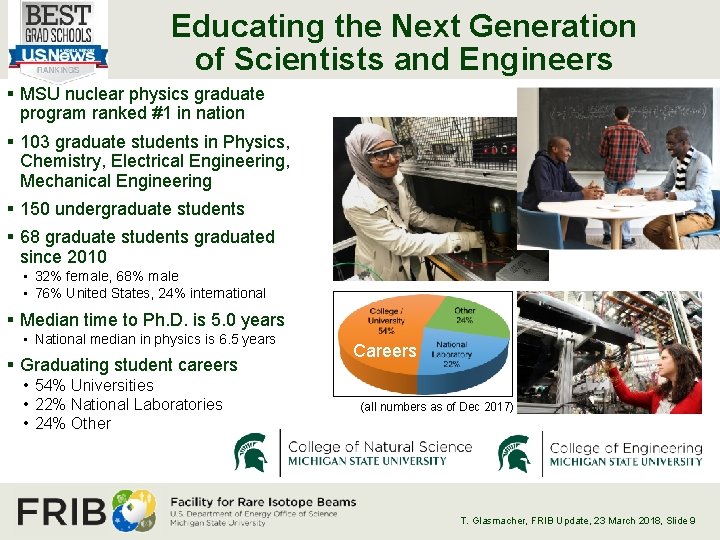
Educating the Next Generation of Scientists and Engineers § MSU nuclear physics graduate program ranked #1 in nation § 103 graduate students in Physics, Chemistry, Electrical Engineering, Mechanical Engineering § 150 undergraduate students § 68 graduate students graduated since 2010 • 32% female, 68% male • 76% United States, 24% international § Median time to Ph. D. is 5. 0 years • National median in physics is 6. 5 years § Graduating student careers • 54% Universities • 22% National Laboratories • 24% Other Careers (all numbers as of Dec 2017) T. Glasmacher, FRIB Update, 23 March 2018, Slide 9
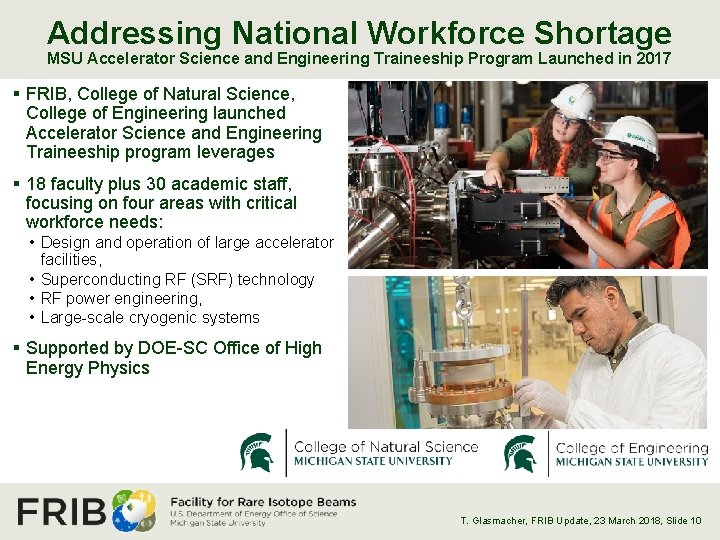
Addressing National Workforce Shortage MSU Accelerator Science and Engineering Traineeship Program Launched in 2017 § FRIB, College of Natural Science, Students at the laboratory College of Engineering launched § 80 graduate students (Aug 2017) Science and Engineering • Accelerator 62 domestic (77%), 18 international (23%) • Traineeship 20 women (25%) program leverages • 9 minority (AA/AI/His) 18 faculty plus 30 §§Graduating student careers academic staff, • focusing 59% universities on four areas with critical • 23% national laboratories workforce needs: • 18% other • Design and operation of large accelerator facilities, • Superconducting RF (SRF) technology • RF power engineering, • Large-scale cryogenic systems § Supported by DOE-SC Office of High Energy Physics T. Glasmacher, FRIB Update, 23 March 2018, Slide 10
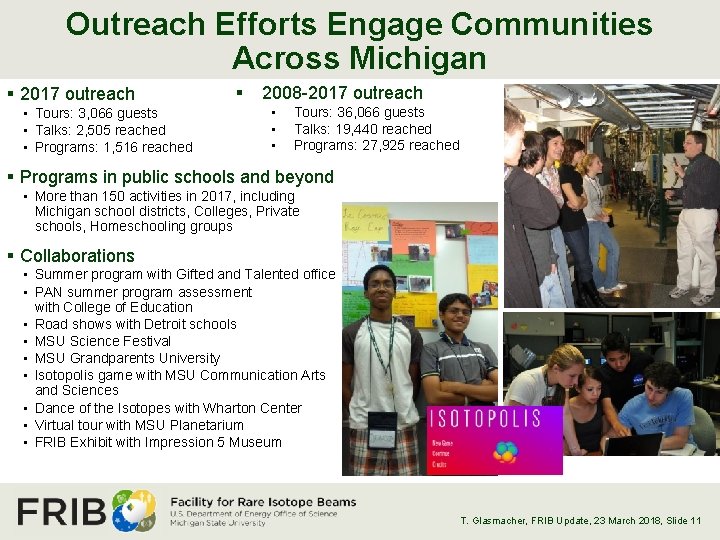
Outreach Efforts Engage Communities Across Michigan § 2017 outreach • Tours: 3, 066 guests • Talks: 2, 505 reached • Programs: 1, 516 reached § 2008 -2017 outreach • • • Tours: 36, 066 guests Talks: 19, 440 reached Programs: 27, 925 reached § Programs in public schools and beyond • More than 150 activities in 2017, including Michigan school districts, Colleges, Private schools, Homeschooling groups § Collaborations • Summer program with Gifted and Talented office • PAN summer program assessment with College of Education • Road shows with Detroit schools • MSU Science Festival • MSU Grandparents University • Isotopolis game with MSU Communication Arts and Sciences • Dance of the Isotopes with Wharton Center • Virtual tour with MSU Planetarium • FRIB Exhibit with Impression 5 Museum T. Glasmacher, FRIB Update, 23 March 2018, Slide 11
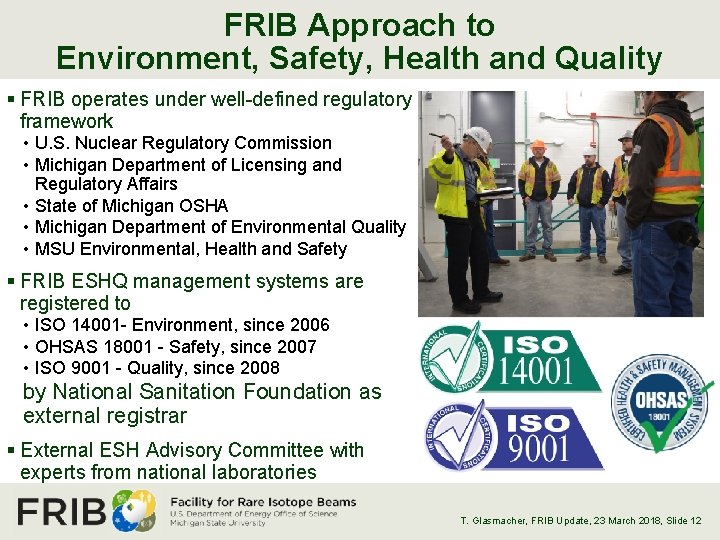
FRIB Approach to Environment, Safety, Health and Quality § FRIB operates under well-defined regulatory framework • U. S. Nuclear Regulatory Commission • Michigan Department of Licensing and Regulatory Affairs • State of Michigan OSHA • Michigan Department of Environmental Quality • MSU Environmental, Health and Safety § FRIB ESHQ management systems are registered to • ISO 14001 - Environment, since 2006 • OHSAS 18001 - Safety, since 2007 • ISO 9001 - Quality, since 2008 by National Sanitation Foundation as external registrar § External ESH Advisory Committee with experts from national laboratories T. Glasmacher, FRIB Update, 23 March 2018, Slide 12
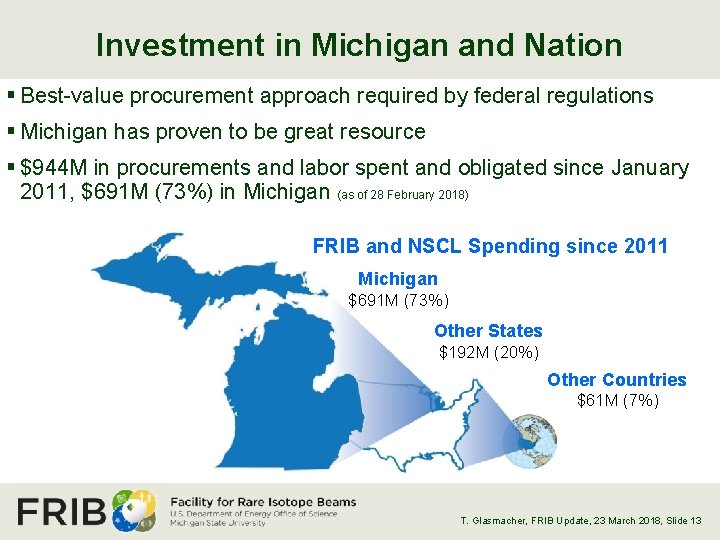
Investment in Michigan and Nation § Best-value procurement approach required by federal regulations § Michigan has proven to be great resource § $944 M in procurements and labor spent and obligated since January 2011, $691 M (73%) in Michigan (as of 28 February 2018) FRIB and NSCL Spending since 2011 Michigan $691 M (73%) Other States $192 M (20%) Other Countries $61 M (7%) T. Glasmacher, FRIB Update, 23 March 2018, Slide 13
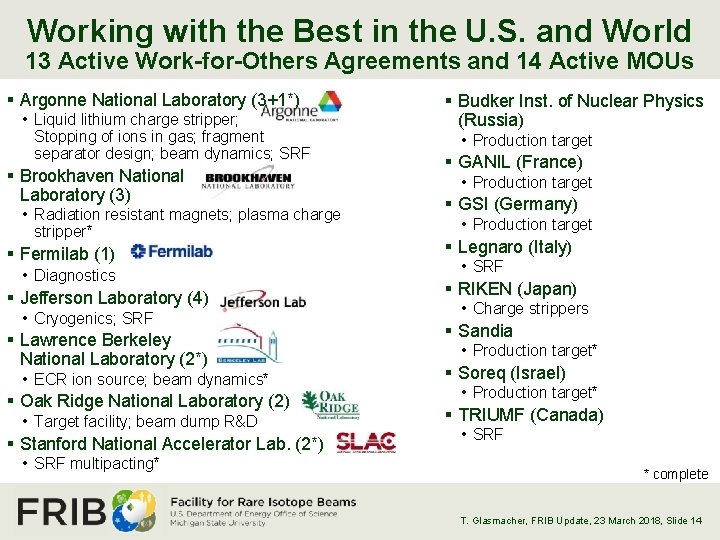
Working with the Best in the U. S. and World 13 Active Work-for-Others Agreements and 14 Active MOUs § Argonne National Laboratory (3+1*) • Liquid lithium charge stripper; Stopping of ions in gas; fragment separator design; beam dynamics; SRF § Brookhaven National Laboratory (3) • Radiation resistant magnets; plasma charge stripper* § Fermilab (1) • Diagnostics § Jefferson Laboratory (4) • Cryogenics; SRF § Lawrence Berkeley National Laboratory (2*) • ECR ion source; beam dynamics* § Oak Ridge National Laboratory (2) • Target facility; beam dump R&D § Stanford National Accelerator Lab. (2*) • SRF multipacting* § Budker Inst. of Nuclear Physics (Russia) • Production target § GANIL (France) • Production target § GSI (Germany) • Production target § Legnaro (Italy) • SRF § RIKEN (Japan) • Charge strippers § Sandia • Production target* § Soreq (Israel) • Production target* § TRIUMF (Canada) • SRF * complete T. Glasmacher, FRIB Update, 23 March 2018, Slide 14
Summary § FRIB is a game changer for nuclear science • World’s most powerful rare isotope research facility • Users are engaged and ready for science § FRIB is managed well and transparently • FRIB gets excellent reviews from DOE-SC • Good relations with MSU, DOE-SC, State of Michigan, and region • Externally registered ISO 9001, 14001 and OHSAS 18001 management programs § Project is on schedule and on budget, 84% complete • Civil construction started in March 2014, beneficial occupancy reached in March 2017 • Technical construction started in October 2014, progressing ahead of baseline schedule § Managing to early completion in 2021 • CD-4 (project completion) is June 2022 § FRIB will benefit the nation, Michigan, and MSU • • Educating next-generation scientists and engineers, addressing workforce needs Outreach programs and collaborations Job creation, technology transfer to industry Knowledge economy jobs and talent in the future T. Glasmacher, FRIB Update, 23 March 2018, Slide 15
- Slides: 15