
Facility Design Week 2 Product Process and Equipment

- Slides: 29
Facility Design – Week 2 Product, Process and Equipment Design and Analysis By Anastasia Lidya Maukar
Data required for developing good layouts • Product Analysis • Process Analysis 2
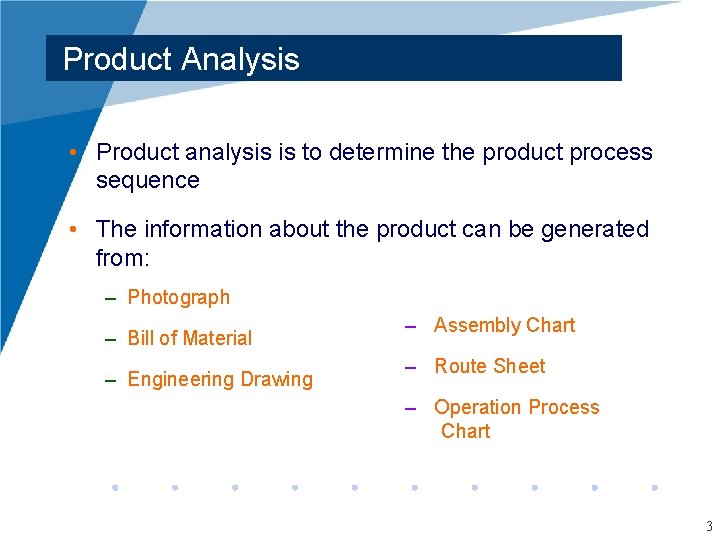
Product Analysis • Product analysis is to determine the product process sequence • The information about the product can be generated from: – Photograph – Bill of Material – Engineering Drawing – Assembly Chart – Route Sheet – Operation Process Chart 3
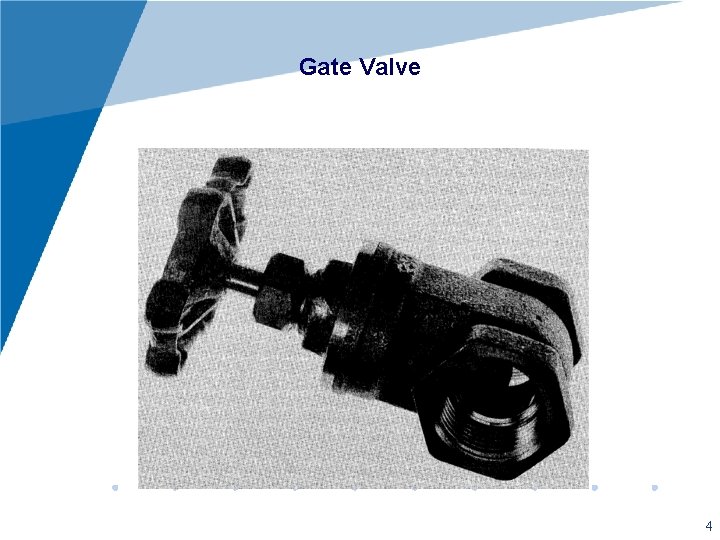
Gate Valve 4
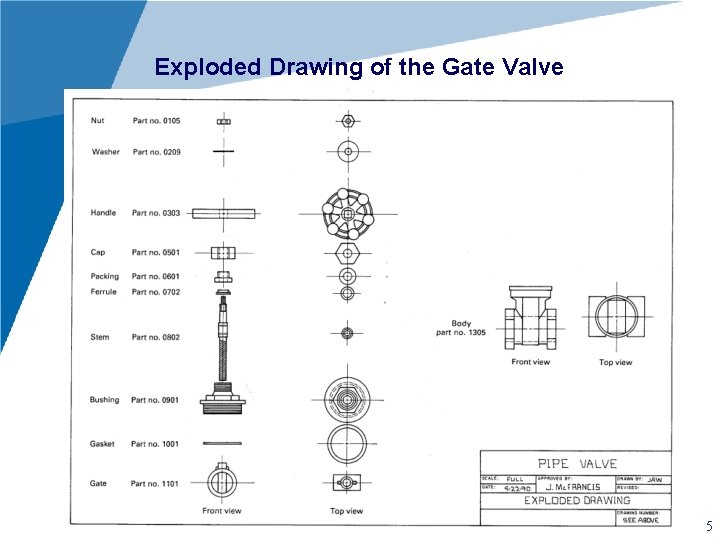
Exploded Drawing of the Gate Valve 5
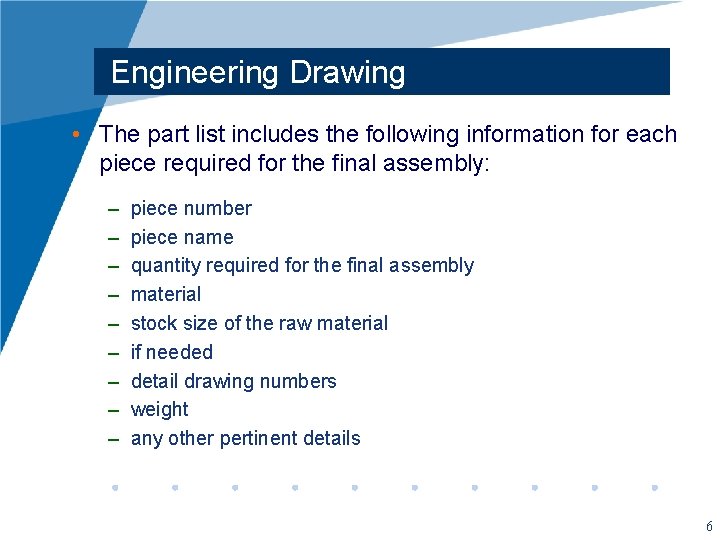
Engineering Drawing • The part list includes the following information for each piece required for the final assembly: – – – – – piece number piece name quantity required for the final assembly material stock size of the raw material if needed detail drawing numbers weight any other pertinent details 6
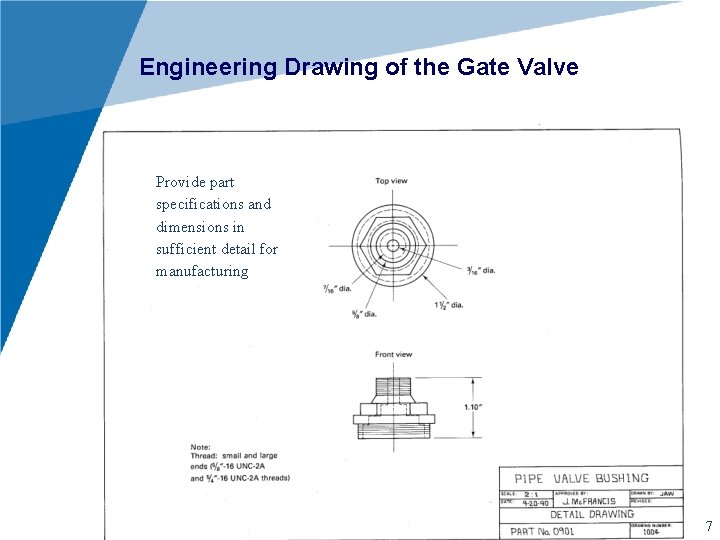
Engineering Drawing of the Gate Valve Provide part specifications and dimensions in sufficient detail for manufacturing 7
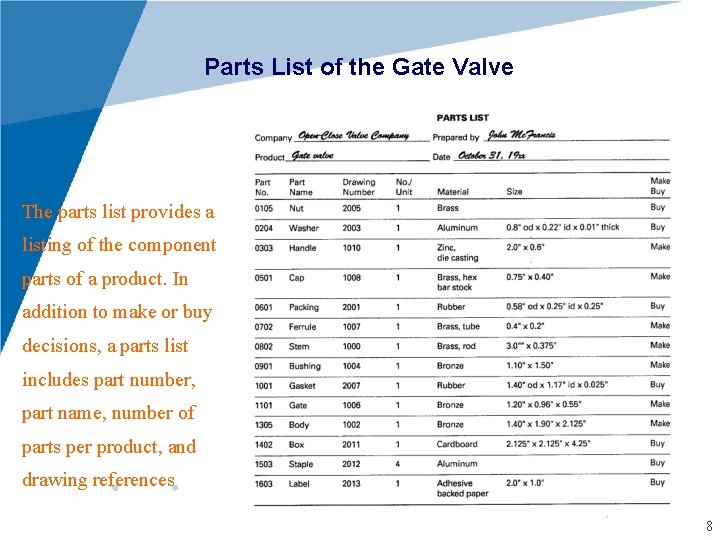
Parts List of the Gate Valve The parts list provides a listing of the component parts of a product. In addition to make or buy decisions, a parts list includes part number, part name, number of parts per product, and drawing references 8
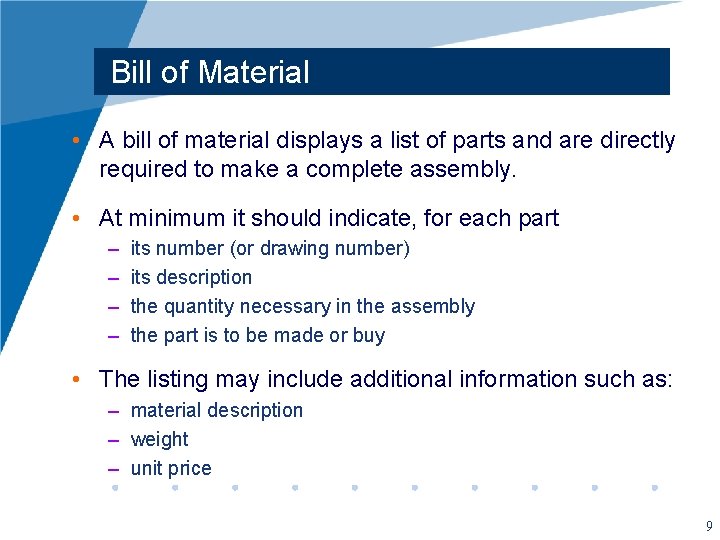
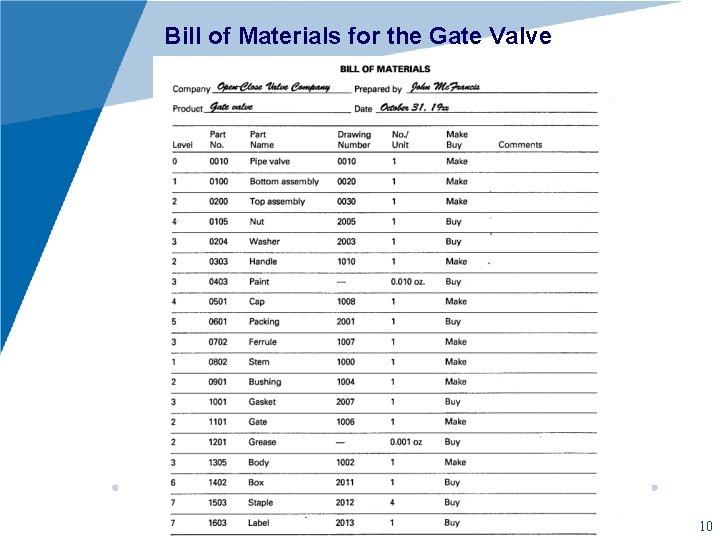
Bill of Material • A bill of material displays a list of parts and are directly required to make a complete assembly. • At minimum it should indicate, for each part – – its number (or drawing number) its description the quantity necessary in the assembly the part is to be made or buy • The listing may include additional information such as: – material description – weight – unit price 9
Bill of Materials for the Gate Valve 10
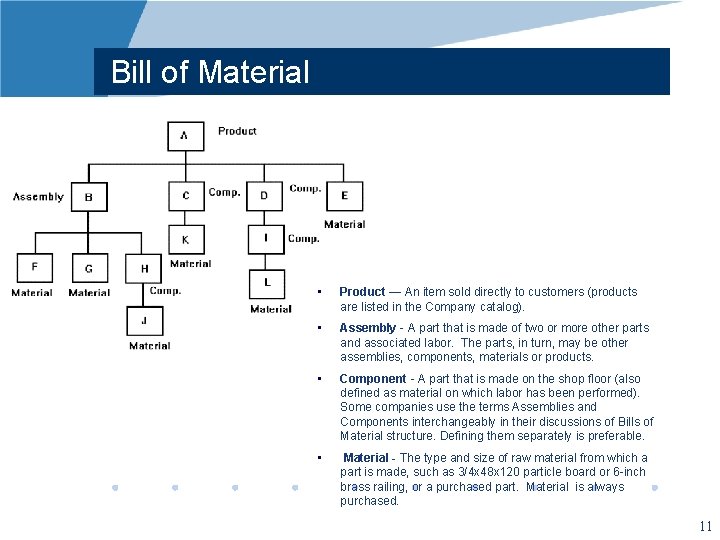
Bill of Material • Product — An item sold directly to customers (products are listed in the Company catalog). • Assembly - A part that is made of two or more other parts and associated labor. The parts, in turn, may be other assemblies, components, materials or products. • Component - A part that is made on the shop floor (also defined as material on which labor has been performed). Some companies use the terms Assemblies and Components interchangeably in their discussions of Bills of Material structure. Defining them separately is preferable. • Material - The type and size of raw material from which a part is made, such as 3/4 x 48 x 120 particle board or 6 -inch brass railing, or a purchased part. Material is always purchased. 11
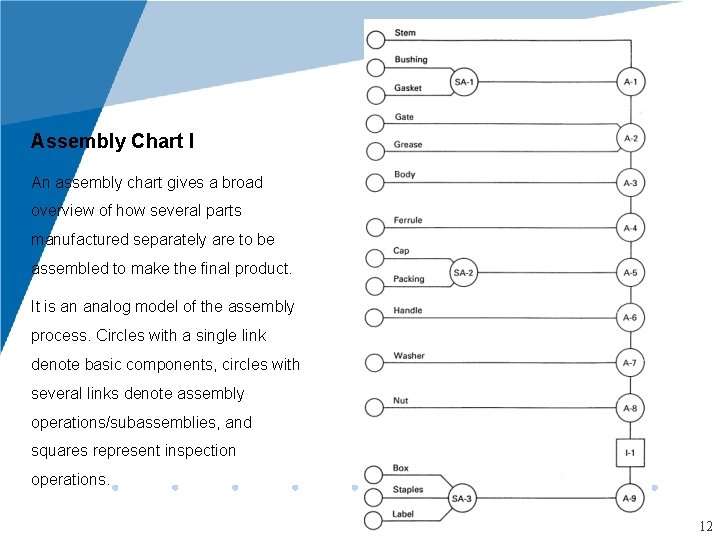
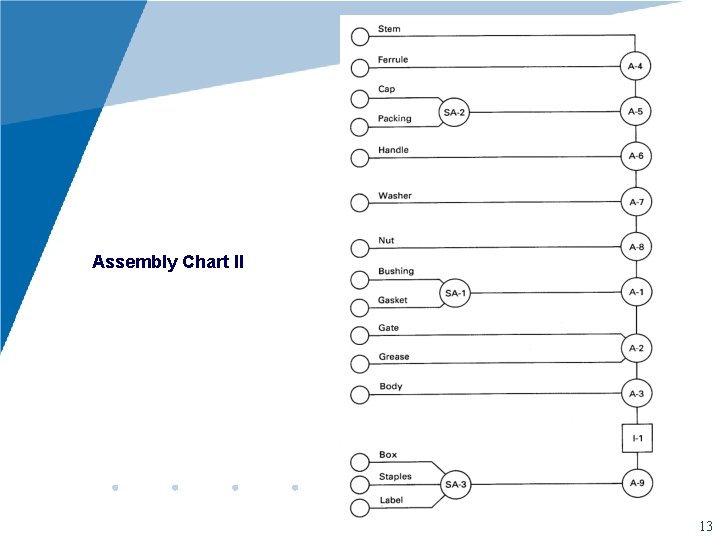
Assembly Chart I An assembly chart gives a broad overview of how several parts manufactured separately are to be assembled to make the final product. It is an analog model of the assembly process. Circles with a single link denote basic components, circles with several links denote assembly operations/subassemblies, and squares represent inspection operations. 12
Assembly Chart II 13
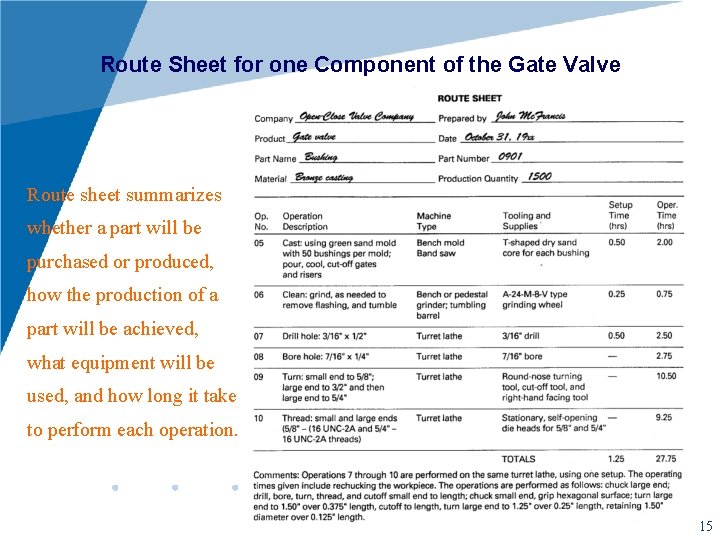
Route Sheet • A route sheet specifies the operations required for a part as well as the sequence of the machines visited for these operations. • It may also provide the set-up time for each machine, processing time and labor time. • It shows how a part is to be produced, which machine are needed, the tools to use, estimated setup times for the machines and production in terms of the number of units expected per hour from each machine. • One routing sheet is required for each part in the assembly. 14
Route Sheet for one Component of the Gate Valve Route sheet summarizes whether a part will be purchased or produced, how the production of a part will be achieved, what equipment will be used, and how long it take to perform each operation. 15
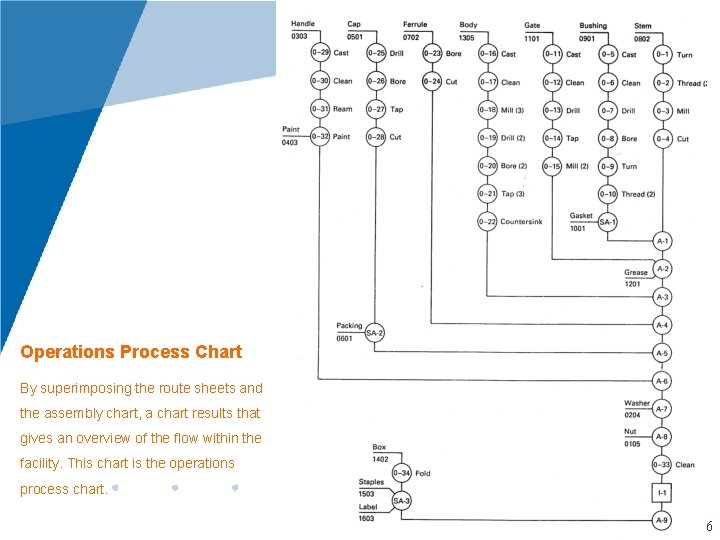
Operations Process Chart By superimposing the route sheets and the assembly chart, a chart results that gives an overview of the flow within the facility. This chart is the operations process chart. 16
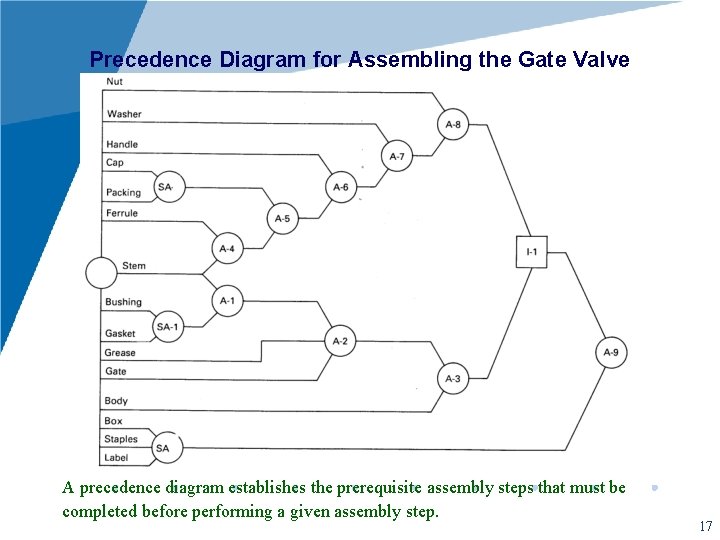
Precedence Diagram for Assembling the Gate Valve A precedence diagram establishes the prerequisite assembly steps that must be completed before performing a given assembly step. 17
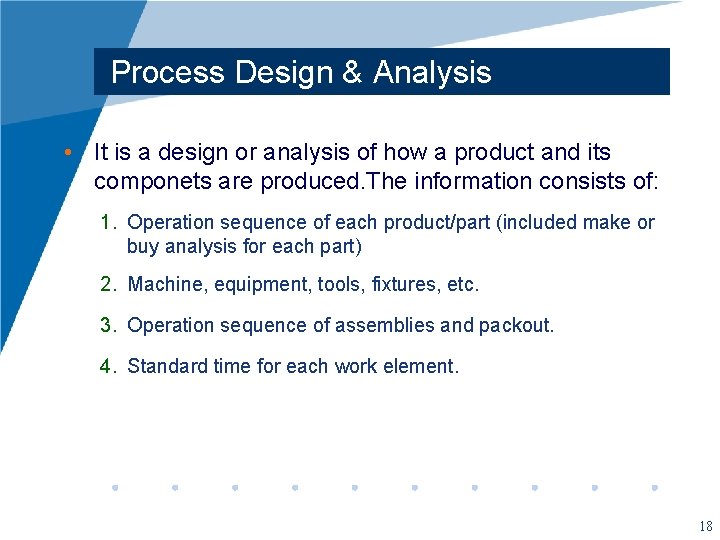
Process Design & Analysis • It is a design or analysis of how a product and its componets are produced. The information consists of: 1. Operation sequence of each product/part (included make or buy analysis for each part) 2. Machine, equipment, tools, fixtures, etc. 3. Operation sequence of assemblies and packout. 4. Standard time for each work element. 18
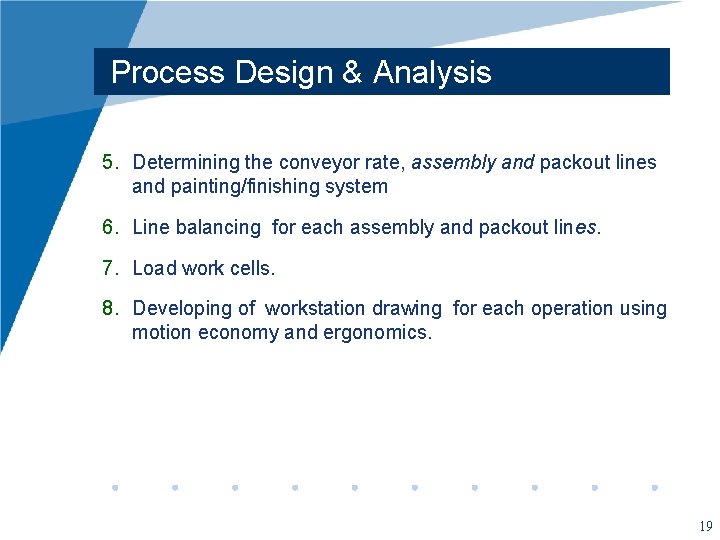
Process Design & Analysis 5. Determining the conveyor rate, assembly and packout lines and painting/finishing system 6. Line balancing for each assembly and packout lines. 7. Load work cells. 8. Developing of workstation drawing for each operation using motion economy and ergonomics. 19
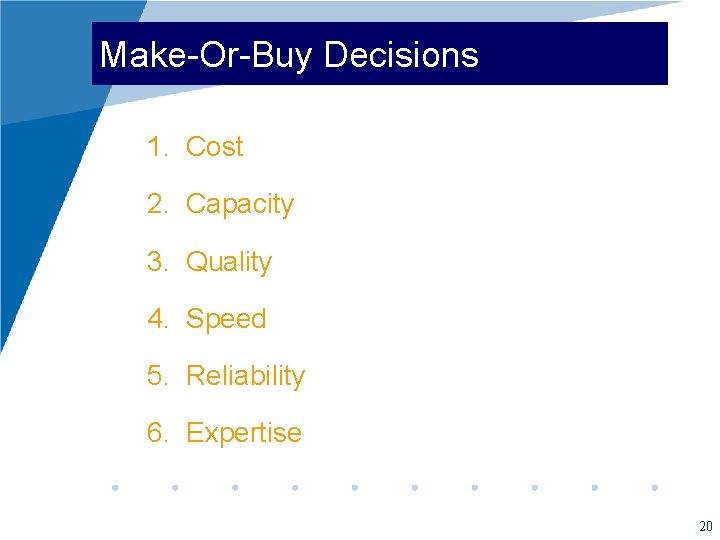
Make-Or-Buy Decisions 1. Cost 2. Capacity 3. Quality 4. Speed 5. Reliability 6. Expertise 20
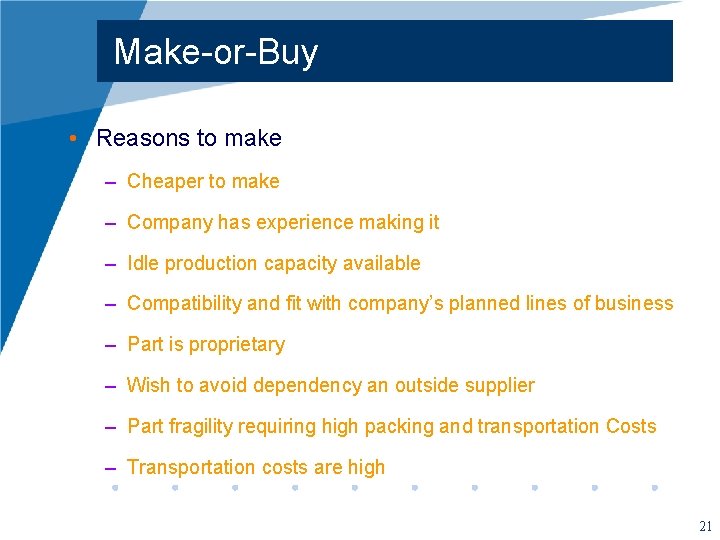
Make-or-Buy • Reasons to make – Cheaper to make – Company has experience making it – Idle production capacity available – Compatibility and fit with company’s planned lines of business – Part is proprietary – Wish to avoid dependency an outside supplier – Part fragility requiring high packing and transportation Costs – Transportation costs are high 21
Make-or-Buy • Reasons to buy – Cheaper to buy – Production facilities are unavailable – Avoid fluctuating or seasonal demand – Inexperience with manufacturing process – Existence and availability of suppliers – Maintain existing supplier relationship – Higher reliability and quality 22
Machine & Equipment Selection • The Number of Machines Needed? These questions can be answered when we know: – How many finished goods are needed per day? – Which machine runs what parts? – What is the time standard for each operation? 23
Machine & Equipment Selection • Advantage: – Make efficient use of capital equipment purchase budget – Make efficient use of maintenance and operating budget – Increase machine utilization – Make efficient use of available space 24
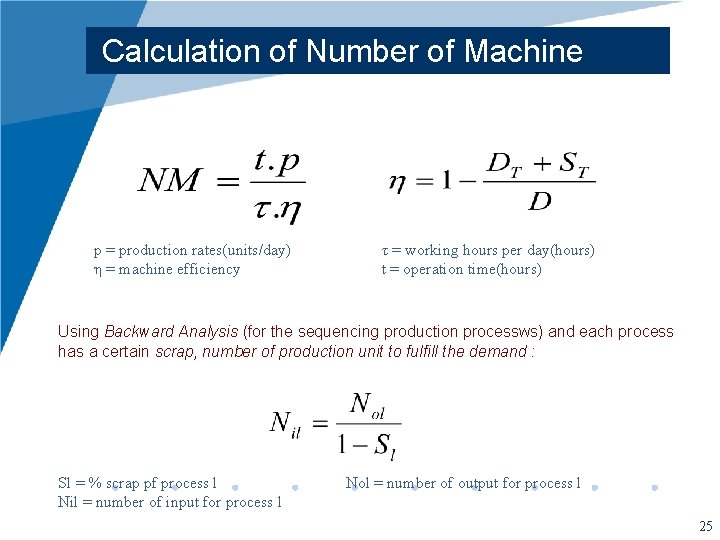
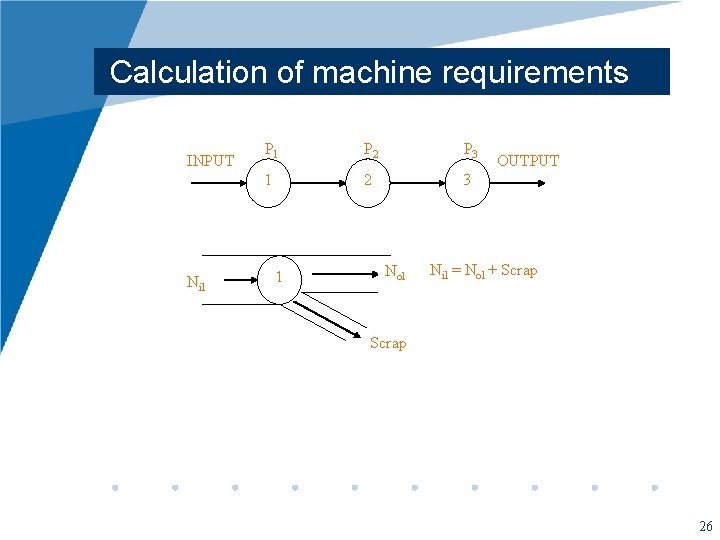
Calculation of Number of Machine p = production rates(units/day) η = machine efficiency τ = working hours per day(hours) t = operation time(hours) Using Backward Analysis (for the sequencing production processws) and each process has a certain scrap, number of production unit to fulfill the demand : Sl = % scrap pf process l Nil = number of input for process l Nol = number of output for process l 25
Calculation of machine requirements INPUT Nil P 1 P 2 P 3 1 2 3 1 Nol OUTPUT Nil = Nol + Scrap 26
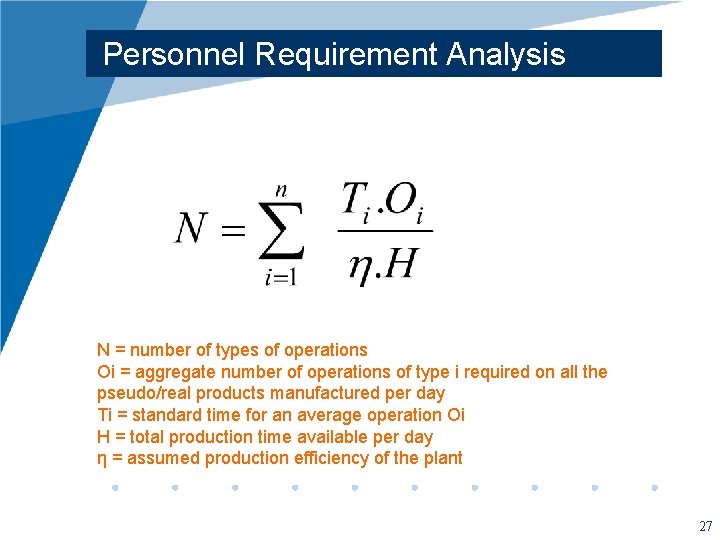
Personnel Requirement Analysis N = number of types of operations Oi = aggregate number of operations of type i required on all the pseudo/real products manufactured per day Ti = standard time for an average operation Oi H = total production time available per day η = assumed production efficiency of the plant 27
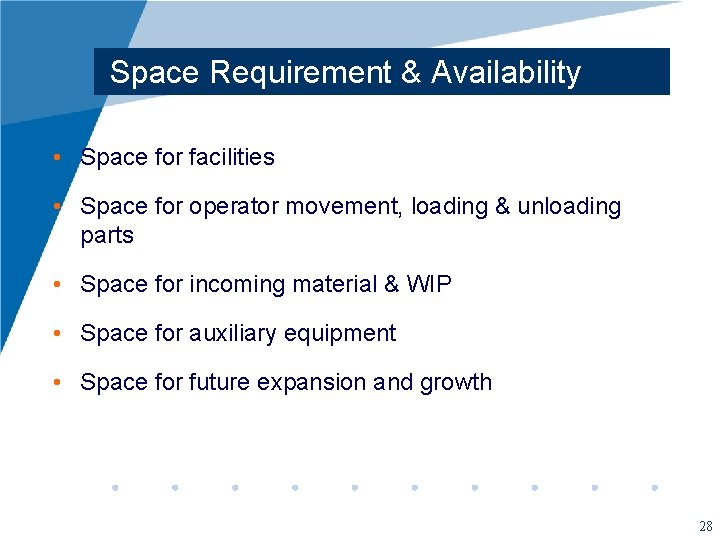
Space Requirement & Availability • Space for facilities • Space for operator movement, loading & unloading parts • Space for incoming material & WIP • Space for auxiliary equipment • Space for future expansion and growth 28
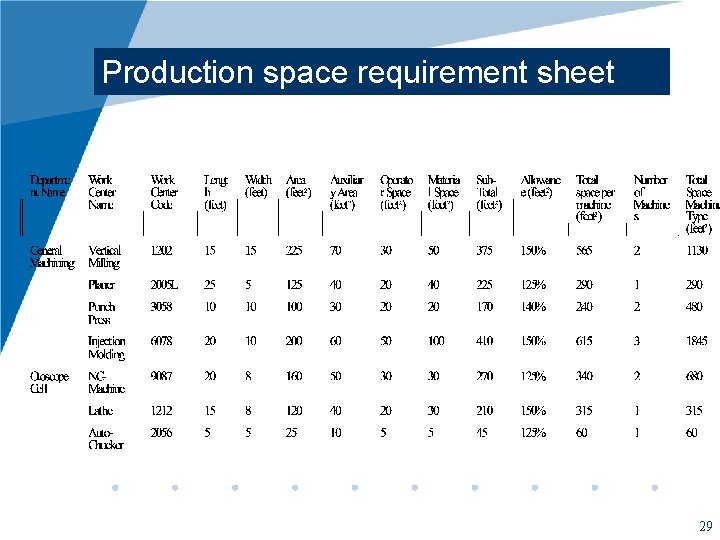
Production space requirement sheet 29