
Facilitators Joan Clark Deputy Head Primary Aisha Lone
- Slides: 15
Facilitators Joan Clark Deputy Head Primary Aisha Lone Head of Arabic Development SEF: Evidence Gathering • PSHE • Curriculum • Protection and Support • Leadership and Management
SEF Evidence Gathering: Curriculum Evidence gathering techniques and sources: • PSHE • Curriculum • Protection and Support • Leadership and Management Focus area: Curriculum
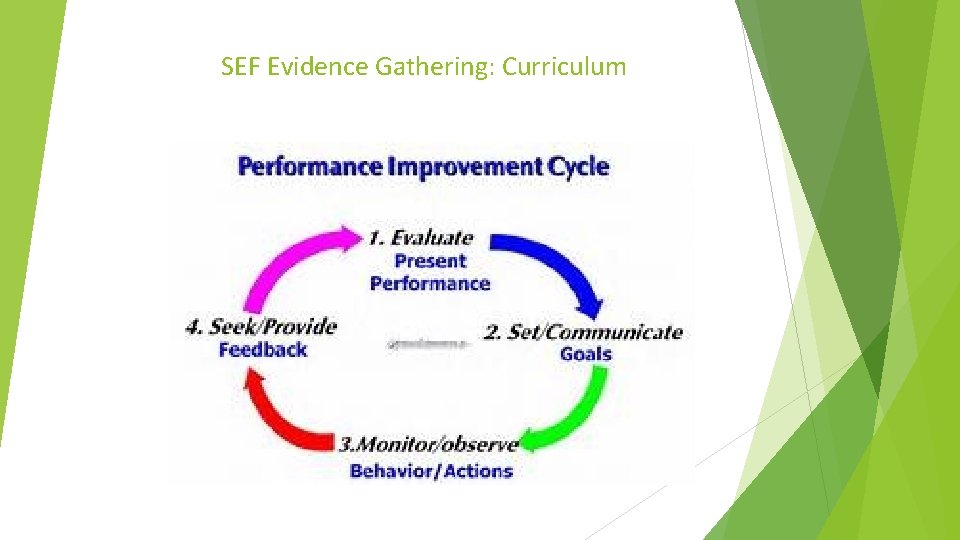
SEF Evidence Gathering: Curriculum
SEF Evidence Gathering: Curriculum Aims for session: • To develop a systematic evidence gathering tool which can be applied across all SEF sections: where are we now? • Identify supporting evidence available and measure against standard: where are we now? where do we need to be? • To broaden evidence base available for SEF sections (in context of curriculum) • To develop a system for gap analysis to improve future SEF evidence gathering and writing to meet standard: how will we get there?
SEF Evidence Gathering: Curriculum General principles • Curriculum should be aligned with TIMSS/PISA standards • Take note of National Agenda targets when gathering evidence and writing SEF • Gather evidence on how curriculum supports all groups of students, eg high/lower abilities, SEND, EAL, Emiratis, male/female, Arabic A students • Ensure you have addressed and can evidence: • innovation • enterprise • inclusion Evidence can be events, activities, processes, documents, actions
SEF Evidence Gathering: Curriculum A note on innovation…. 1 Central to National Agenda and Vision 2021 and is extremely important within UAE target by 2021 – move from Rank of 41 in 2016 to top ten by 2021 Has separate section in DSIB report! (Current handbook p 12) Appears in: 1. 3 Learning skills 2. 3 Social responsibility and innovation skills 3. 1 Teaching and assessment 4. 2 Curriculum adaptation 6. 1 Leadership and management
Innovation My role in school is innovation which links to 6. 1 Leadership and Management. Involvement as Special Project Leader whilst having the role of class teacher, which then developed into Head of Arabic Development. Trouble shooter- identifying and creatively addressing areas for further development. THE FOLLOWING PROCESS AND PRACTICAL IDEAS CAN BE TRANSFERRED TO OTHER CURRICULUM AREAS.
4. 2. 1 Curriculum Modification and Assessment. Curriculum modified ensuring links to locality and contextualizing learning. Assessment results analysed and used to produce learning reviews. Next steps inform and shape future planning. ( Teaching and Learning )
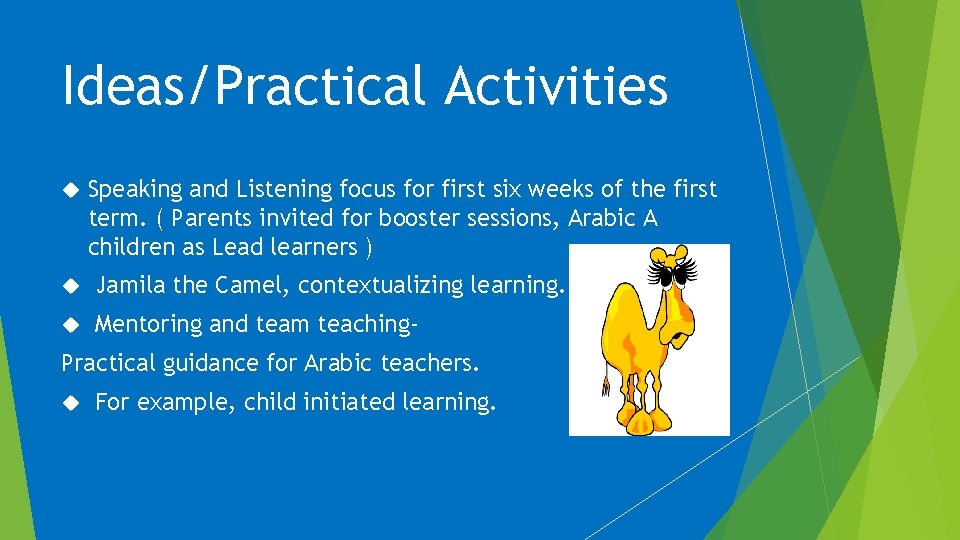
Ideas/Practical Activities Speaking and Listening focus for first six weeks of the first term. ( Parents invited for booster sessions, Arabic A children as Lead learners ) Jamila the Camel, contextualizing learning. Mentoring and team teaching- Practical guidance for Arabic teachers. For example, child initiated learning.
Setting Different approaches were put into place in order to meet the needs of all learners of varying abilities. Ability based sets. Mixed ability class with designated year lead Arabic teacher. Enrichment classes for high achievers and booster sessions for beginners in Arabic. Specialist Arabic teacher in Foundation Stage, embedding Arabic through dual teaching. b. After evaluation- children were set in Years of Study. Both beginners and enrichment classes could be set and the rest of the sets require a differentiated approach.
SEF Evidence Gathering: Curriculum A note on innovation…. 2 • How do you facilitate curricular innovation as a process embedded in your practice? • How have you actually innovated to do things differently within the curriculum? (And how do you evaluate? ) • How do you teach/provide opportunities for students to innovate, eg: • take the lead in initiatives? • devise/implement ideas? • problem solve and think creatively? • how does ethos support students’ creativity and innovation? Think/pair/share – current practice & how to develop
SEF Evidence Gathering: Curriculum – two themes • Curriculum documents, planners: • • the curriculum as it is documented on paper – mainly 4. 1 Curriculum in action/implementation: • how the curriculum is translated into students’ learning experiences – mainly 4. 2 Both aspects must be covered and evidenced.
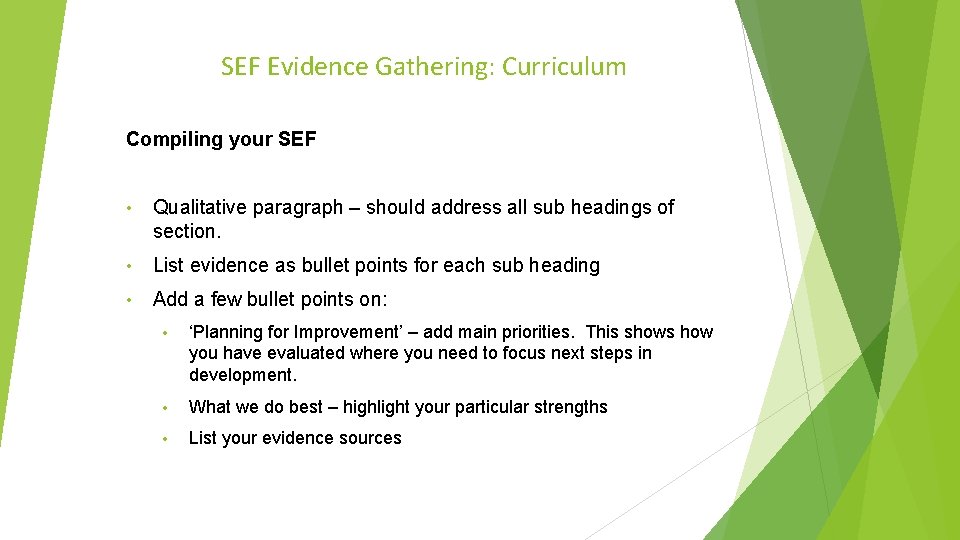
SEF Evidence Gathering: Curriculum Compiling your SEF • Qualitative paragraph – should address all sub headings of section. • List evidence as bullet points for each sub heading • Add a few bullet points on: • ‘Planning for Improvement’ – add main priorities. This shows how you have evaluated where you need to focus next steps in development. • What we do best – highlight your particular strengths • List your evidence sources
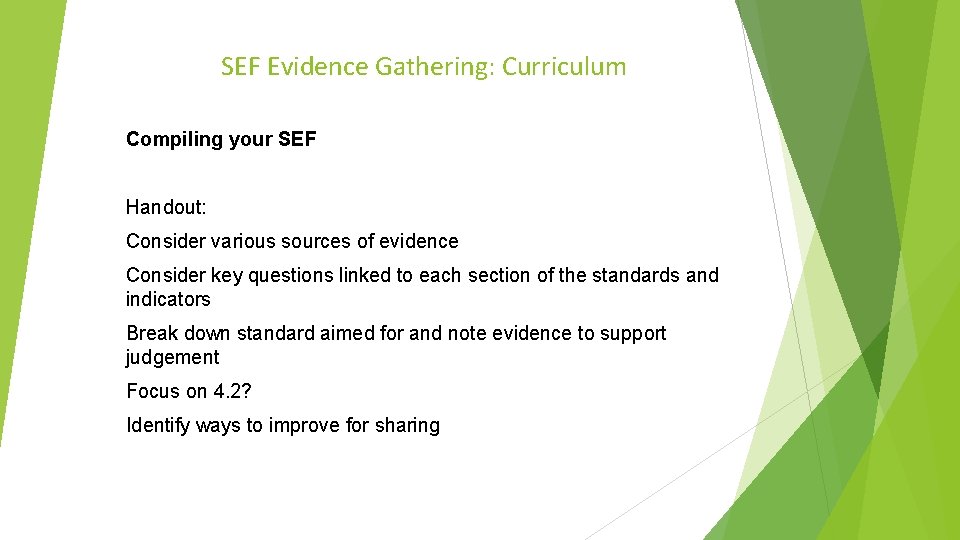
SEF Evidence Gathering: Curriculum Compiling your SEF Handout: Consider various sources of evidence Consider key questions linked to each section of the standards and indicators Break down standard aimed for and note evidence to support judgement Focus on 4. 2? Identify ways to improve for sharing
SEF Evidence Gathering: Curriculum • Feedback • Q&A