
Facilitators guide to running roleplay exercises 1 Introduce
- Slides: 5
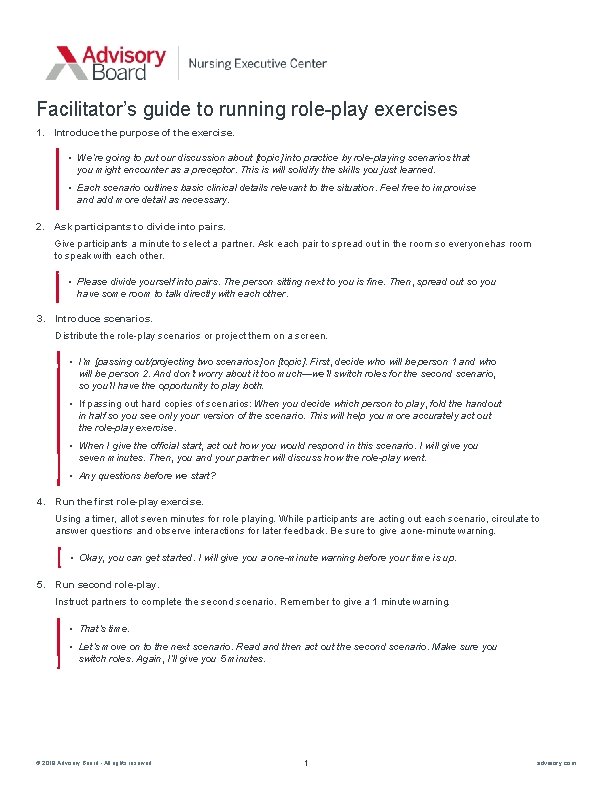
Facilitator’s guide to running role-play exercises 1. Introduce the purpose of the exercise. • We’re going to put our discussion about [topic] into practice by role-playing scenarios that you might encounter as a preceptor. This is will solidify the skills you just learned. • Each scenario outlines basic clinical details relevant to the situation. Feel free to improvise and add more detail as necessary. 2. Ask participants to divide into pairs. Give participants a minute to select a partner. Ask each pair to spread out in the room so everyone has room to speak with each other. • Please divide yourself into pairs. The person sitting next to you is fine. Then, spread out so you have some room to talk directly with each other. 3. Introduce scenarios. Distribute the role-play scenarios or project them on a screen. • I’m [passing out/projecting two scenarios] on [topic]. First, decide who will be person 1 and who will be person 2. And don’t worry about it too much—we’ll switch roles for the second scenario, so you’ll have the opportunity to play both. • If passing out hard copies of scenarios: When you decide which person to play, fold the handout in half so you see only your version of the scenario. This will help you more accurately act out the role-play exercise. • When I give the official start, act out how you would respond in this scenario. I will give you seven minutes. Then, you and your partner will discuss how the role-play went. • Any questions before we start? 4. Run the first role-play exercise. Using a timer, allot seven minutes for role playing. While participants are acting out each scenario, circulate to answer questions and observe interactions for later feedback. Be sure to give a one-minute warning. • Okay, you can get started. I will give you a one-minute warning before your time is up. 5. Run second role-play. Instruct partners to complete the second scenario. Remember to give a 1 minute warning. • That’s time. • Let’s move on to the next scenario. Read and then act out the second scenario. Make sure you switch roles. Again, I’ll give you 5 minutes. © 2019 Advisory Board • All rights reserved 1 advisory. com
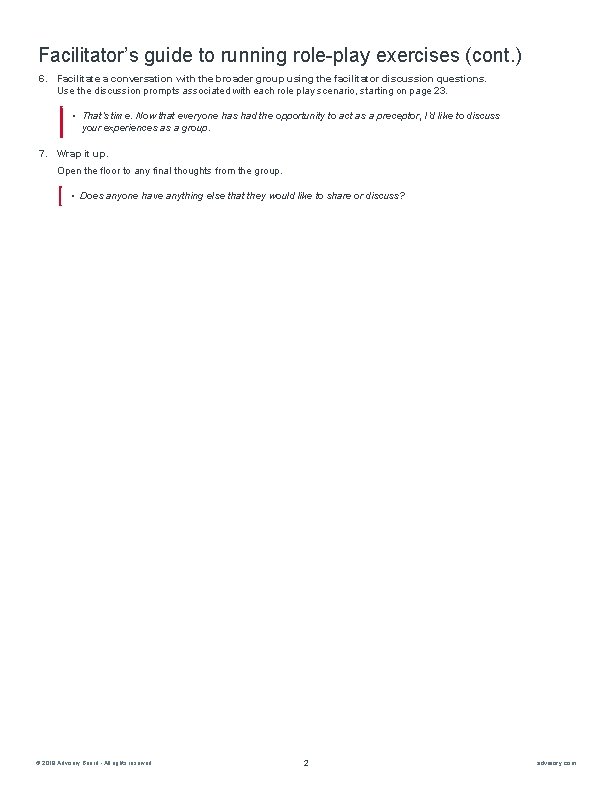
Facilitator’s guide to running role-play exercises (cont. ) 6. Facilitate a conversation with the broader group using the facilitator discussion questions. Use the discussion prompts associated with each role play scenario, starting on page 23. • That’s time. Now that everyone has had the opportunity to act as a preceptor, I’d like to discuss your experiences as a group. 7. Wrap it up. Open the floor to any final thoughts from the group. • Does anyone have anything else that they would like to share or discuss? © 2019 Advisory Board • All rights reserved 2 advisory. com
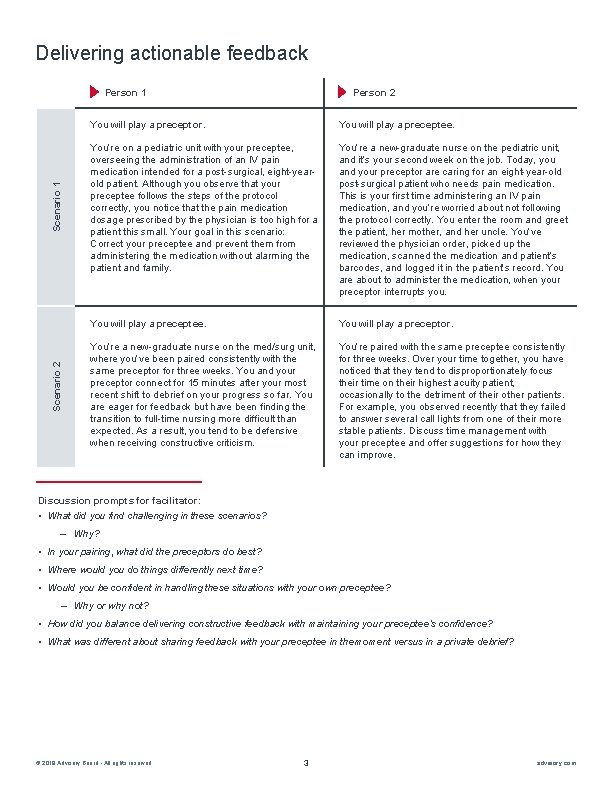
Delivering actionable feedback Scenario 2 Scenario 1 Person 2 You will play a preceptor. You will play a preceptee. You’re on a pediatric unit with your preceptee, overseeing the administration of an IV pain medication intended for a post-surgical, eight-yearold patient. Although you observe that your preceptee follows the steps of the protocol correctly, you notice that the pain medication dosage prescribed by the physician is too high for a patient this small. Your goal in this scenario: Correct your preceptee and prevent them from administering the medication without alarming the patient and family. You’re a new-graduate nurse on the pediatric unit, and it’s your second week on the job. Today, you and your preceptor are caring for an eight-year-old post-surgical patient who needs pain medication. This is your first time administering an IV pain medication, and you’re worried about not following the protocol correctly. You enter the room and greet the patient, her mother, and her uncle. You’ve reviewed the physician order, picked up the medication, scanned the medication and patient’s barcodes, and logged it in the patient’s record. You are about to administer the medication, when your preceptor interrupts you. You will play a preceptee. You will play a preceptor. You’re a new-graduate nurse on the med/surg unit, where you’ve been paired consistently with the same preceptor for three weeks. You and your preceptor connect for 15 minutes after your most recent shift to debrief on your progress so far. You are eager for feedback but have been finding the transition to full-time nursing more difficult than expected. As a result, you tend to be defensive when receiving constructive criticism. You’re paired with the same preceptee consistently for three weeks. Over your time together, you have noticed that they tend to disproportionately focus their time on their highest acuity patient, occasionally to the detriment of their other patients. For example, you observed recently that they failed to answer several call lights from one of their more stable patients. Discuss time management with your preceptee and offer suggestions for how they can improve. Discussion prompts for facilitator: • What did you find challenging in these scenarios? ‒ Why? • In your pairing, what did the preceptors do best? • Where would you do things differently next time? • Would you be confident in handling these situations with your own preceptee? ‒ Why or why not? • How did you balance delivering constructive feedback with maintaining your preceptee’s confidence? • What was different about sharing feedback with your preceptee in the moment versus in a private debrief? © 2019 Advisory Board • All rights reserved 3 advisory. com
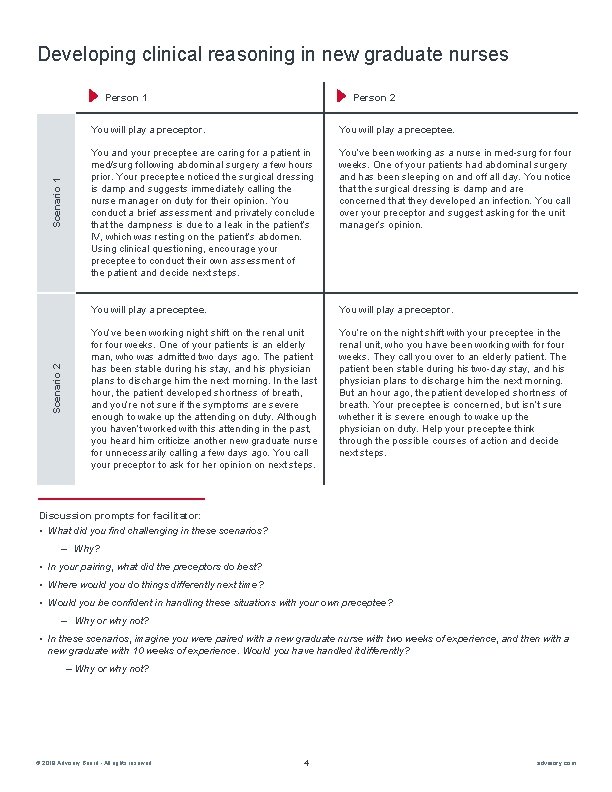
Developing clinical reasoning in new graduate nurses Scenario 2 Scenario 1 Person 2 You will play a preceptor. You will play a preceptee. You and your preceptee are caring for a patient in med/surg following abdominal surgery a few hours prior. Your preceptee noticed the surgical dressing is damp and suggests immediately calling the nurse manager on duty for their opinion. You conduct a brief assessment and privately conclude that the dampness is due to a leak in the patient’s IV, which was resting on the patient’s abdomen. Using clinical questioning, encourage your preceptee to conduct their own assessment of the patient and decide next steps. You’ve been working as a nurse in med-surg for four weeks. One of your patients had abdominal surgery and has been sleeping on and off all day. You notice that the surgical dressing is damp and are concerned that they developed an infection. You call over your preceptor and suggest asking for the unit manager’s opinion. You will play a preceptee. You will play a preceptor. You’ve been working night shift on the renal unit for four weeks. One of your patients is an elderly man, who was admitted two days ago. The patient has been stable during his stay, and his physician plans to discharge him the next morning. In the last hour, the patient developed shortness of breath, and you’re not sure if the symptoms are severe enough to wake up the attending on duty. Although you haven’t worked with this attending in the past, you heard him criticize another new graduate nurse for unnecessarily calling a few days ago. You call your preceptor to ask for her opinion on next steps. You’re on the night shift with your preceptee in the renal unit, who you have been working with for four weeks. They call you over to an elderly patient. The patient been stable during his two-day stay, and his physician plans to discharge him the next morning. But an hour ago, the patient developed shortness of breath. Your preceptee is concerned, but isn’t sure whether it is severe enough to wake up the physician on duty. Help your preceptee think through the possible courses of action and decide next steps. Discussion prompts for facilitator: • What did you find challenging in these scenarios? ‒ Why? • In your pairing, what did the preceptors do best? • Where would you do things differently next time? • Would you be confident in handling these situations with your own preceptee? ‒ Why or why not? • In these scenarios, imagine you were paired with a new graduate nurse with two weeks of experience, and then with a new graduate with 10 weeks of experience. Would you have handled it differently? – Why or why not? © 2019 Advisory Board • All rights reserved 4 advisory. com
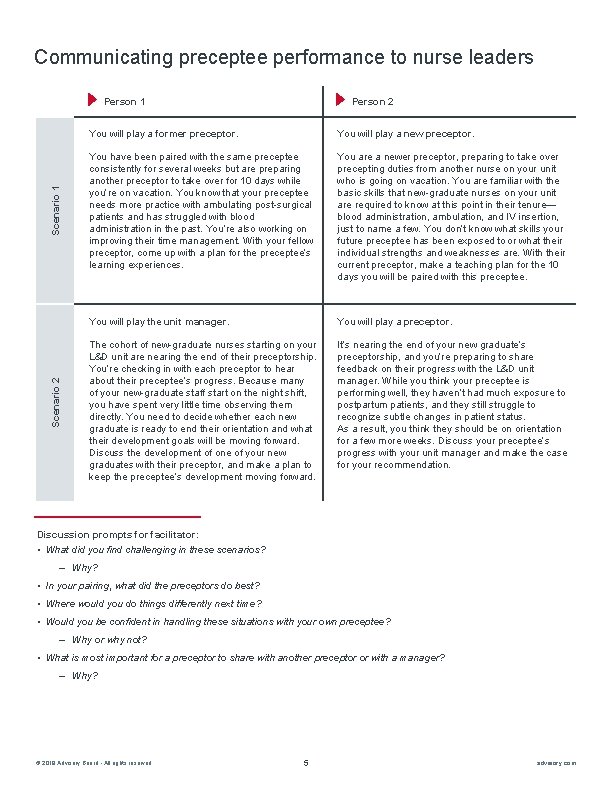
Communicating preceptee performance to nurse leaders Scenario 2 Scenario 1 Person 2 You will play a former preceptor. You will play a new preceptor. You have been paired with the same preceptee consistently for several weeks but are preparing another preceptor to take over for 10 days while you’re on vacation. You know that your preceptee needs more practice with ambulating post-surgical patients and has struggled with blood administration in the past. You’re also working on improving their time management. With your fellow preceptor, come up with a plan for the preceptee’s learning experiences. You are a newer preceptor, preparing to take over precepting duties from another nurse on your unit who is going on vacation. You are familiar with the basic skills that new-graduate nurses on your unit are required to know at this point in their tenure— blood administration, ambulation, and IV insertion, just to name a few. You don’t know what skills your future preceptee has been exposed to or what their individual strengths and weaknesses are. With their current preceptor, make a teaching plan for the 10 days you will be paired with this preceptee. You will play the unit manager. You will play a preceptor. The cohort of new-graduate nurses starting on your L&D unit are nearing the end of their preceptorship. You’re checking in with each preceptor to hear about their preceptee’s progress. Because many of your new-graduate staff start on the night shift, you have spent very little time observing them directly. You need to decide whether each new graduate is ready to end their orientation and what their development goals will be moving forward. Discuss the development of one of your new graduates with their preceptor, and make a plan to keep the preceptee’s development moving forward. It’s nearing the end of your new graduate’s preceptorship, and you’re preparing to share feedback on their progress with the L&D unit manager. While you think your preceptee is performing well, they haven’t had much exposure to postpartum patients, and they still struggle to recognize subtle changes in patient status. As a result, you think they should be on orientation for a few more weeks. Discuss your preceptee’s progress with your unit manager and make the case for your recommendation. Discussion prompts for facilitator: • What did you find challenging in these scenarios? ‒ Why? • In your pairing, what did the preceptors do best? • Where would you do things differently next time? • Would you be confident in handling these situations with your own preceptee? ‒ Why or why not? • What is most important for a preceptor to share with another preceptor or with a manager? ‒ Why? © 2019 Advisory Board • All rights reserved 5 advisory. com