
Facilitator Training Introduction to the Model Why do
- Slides: 23
Facilitator Training Introduction to the Model
Why do we need a model? To help the facilitator avoid the negative group dynamics that can limit the success of a support group. • A support group can operate with a will of its own and take the group down an unproductive path • Sometimes a group can pull even the most experienced facilitator off course
Why do people go to a support group? • To leave feeling better than when they came • To feel that they contributed and that they were supported • To feel that they have something in common with others
What do they want at a support group? • • A safe place To not be judged Boundaries that are enforced Capable facilitators
NAMI Connection Recovery Support Groups Are led by trained facilitators, using: • Strategies • Structures • Processes They are capable facilitators, not therapists!
A capable facilitator • Asks group members to agree to share responsibility for maintaining the Group Guidelines • Sustains clear membership boundaries • Clarifies goals, that is, our Principles of Support • Identifies the common issues of the group in a positive and optimistic manner • Develops communication skills that encourage group participation
Group Guidelines
Principles of Support
NAMI Connection strategies, structures and group processes This model assures an effective support group meeting.
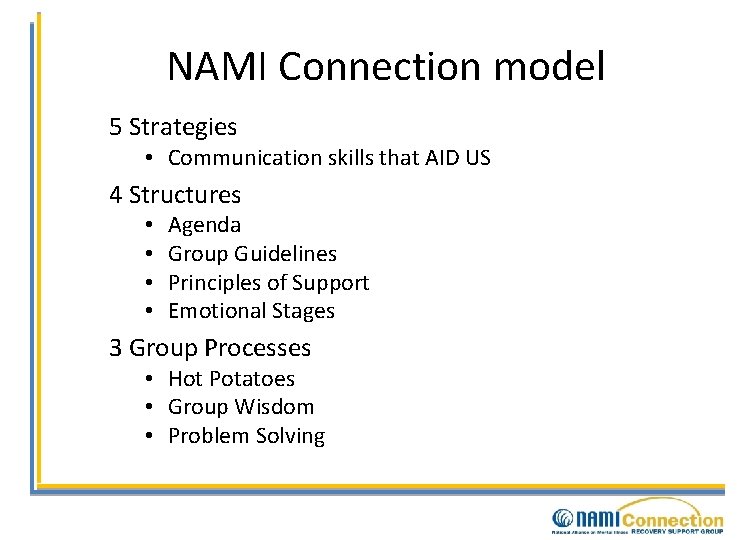
NAMI Connection model 5 Strategies • Communication skills that AID US 4 Structures • • Agenda Group Guidelines Principles of Support Emotional Stages 3 Group Processes • Hot Potatoes • Group Wisdom • Problem Solving
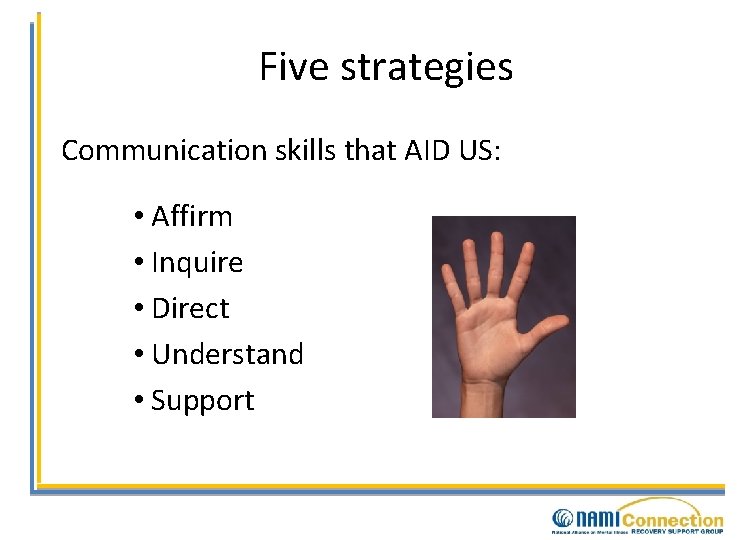
Five strategies Communication skills that AID US: • Affirm • Inquire • Direct • Understand • Support
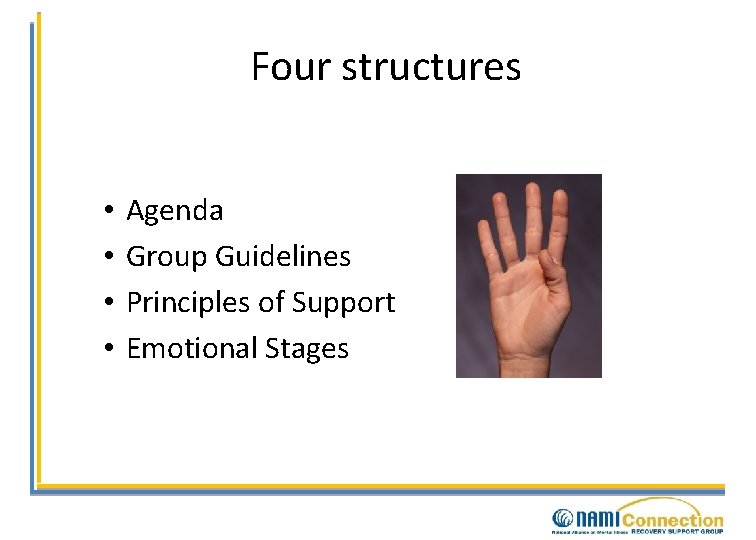
Four structures • • Agenda Group Guidelines Principles of Support Emotional Stages
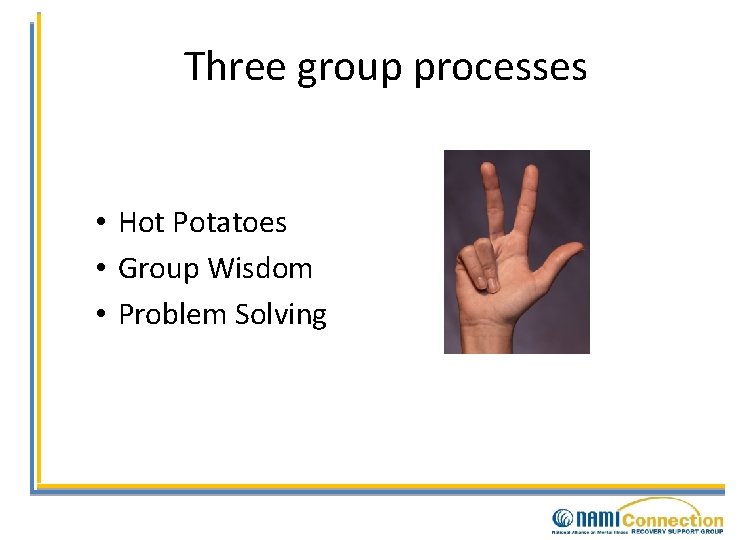
Three group processes • Hot Potatoes • Group Wisdom • Problem Solving
Rules when using the NAMI Connection model • Facilitators always use the Facilitator Guides • Facilitators pay close attention to the steps and cardinal rules on each guide
Agenda • Always start and stop on time • Always start Check In with the facilitators to model the 1 to 2 minute time limit
Group Guidelines • Don’t scold; be directive • Always model respect for the member being disrespectful • Remember, it’s normal for people to forget guidelines in support groups
Principles of Support • Never lecture or instruct the group about principles • Get the group talking about these universals
Emotional Stages of Recovery • Never tell a participant where they are • Always ask them what stage they think they are in • Direct the group’s attention to what the participant needs in that stage and discuss how those needs can be met
Hot Potatoes • Never avoid discussing a traumatic event when it comes up in a support group • Traumatic events need to be detoxified • The NAMI Connection process for handling these hot topics is called Hot Potatoes
Group Wisdom • Group Wisdom is a process through which participants share resources and knowledge gained from past experiences • Always ask members what they know that is constructive, practical and helpful
Problem Solving • When doing problem solving, you will shift to a directive leadership style • Do not use the Problem Solving Process for illness-related symptoms or nonresponsiveness to medications
Remember, as a capable facilitator you are present to help the group meet its needs, not to have the group help you meet yours.
What to expect at this training • To learn by doing • To make mistakes; it’s part of the learning process • To practice the strategies, structures, and group processes outlined for you in this presentation • To have fun!