
FACILITATOR NOTES FOR ADAPTING THE SLIDES These slides
![POLICY LINKING FOR MEASURING GLOBAL LEARNING OUTCOMES WITH THE [ASSESSMENT(S)] CONTENT FACILITATOR TRAINING Lead](https://slidetodoc.com/presentation_image_h2/0eb097e43b1681c9f9e2a3790dc8c0ef/image-2.jpg "POLICY LINKING FOR MEASURING GLOBAL LEARNING OUTCOMES WITH THE [ASSESSMENT(S)] CONTENT FACILITATOR TRAINING Lead")
![TRAINING SUMMARY Session 3 – [August 14] • The alignment activity – Task 1](https://slidetodoc.com/presentation_image_h2/0eb097e43b1681c9f9e2a3790dc8c0ef/image-4.jpg "TRAINING SUMMARY Session 3 – [August 14] • The alignment activity – Task 1")
![THE PRESENTATION ON THE [ASSESSMENT]: OBJECTIVES AND WORKSHOP CONTEXTUALIZATION The objective of this session](https://slidetodoc.com/presentation_image_h2/0eb097e43b1681c9f9e2a3790dc8c0ef/image-8.jpg "THE PRESENTATION ON THE [ASSESSMENT]: OBJECTIVES AND WORKSHOP CONTEXTUALIZATION The objective of this session")
![THE PRESENTATION ON THE [ASSESSMENT]: CONTENT FACILITATOR ROLE During the review of the [Assessment],](https://slidetodoc.com/presentation_image_h2/0eb097e43b1681c9f9e2a3790dc8c0ef/image-9.jpg "THE PRESENTATION ON THE [ASSESSMENT]: CONTENT FACILITATOR ROLE During the review of the [Assessment],")
- Slides: 18
FACILITATOR NOTES FOR ADAPTING THE SLIDES These slides are intended to be used together with the workshop slides referenced in Annex E of the Toolkit. As with those slides, facilitators will need to update/adapt all slides marked with a yellow plus sign for use in their specific context. Instructions on how to do so are included in BOLD in the notes section of each slide in BOLD at the top of the slide. Facilitator notes are also included in the notes section. Brackets, like these [ ] have been used to designate areas that need updating/adapting on the actual slides
POLICY LINKING FOR MEASURING GLOBAL LEARNING OUTCOMES WITH THE [ASSESSMENT(S)] CONTENT FACILITATOR TRAINING Lead Facilitators: [names] Content Facilitators: [names] Workshop Dates: [dates]
TRAINING SUMMARY Session 1 • Objectives of the content facilitator training • Overview of policy linking • Objectives of the policy linking workshop • The Global Proficiency Framework Session 2 • The [Assessment] • [In-person workshop day 1 or remote workshop sessions 1 and 2]
TRAINING SUMMARY Session 3 – [August 14] • The alignment activity – Task 1 • The matching activity – Task 2 Session 4 – [August 14] • The benchmarking activity - Task 3 • [In-person workshop sessions 2 -5 or Remote workshop sessions 1 to 6]
OBJECTIVES FOR THE TRAINING By the end of this training, we aim to ensure content facilitators: • have a good understanding of the [Assessment] • have a good understanding of policy linking • have a good understanding of the Global Proficiency Framework • feel confident to lead the relevant sessions during the policy linking process
THE PRESENTATION ON THE GPF: OBJECTIVES AND WORKSHOP CONTEXTUALIZATION The objective of the [Workshop Day/Session] is to give an overview of policy linking and explain the GPF to participants. • Can you describe your understanding of the policy linking methodology? How might we clarify the methodology for panelists? • Can you describe your understanding of the purpose of the GPF? • Are there any terms in the GPF that are not common in your context? How might we better phrase those items to ensure panelists’ understanding? • What other challenges do you envision the panelists may have with understanding/using the GPF? • Do you think the slides we have used today will be suitable for the participants? • What is a suitable task to help panelists develop their understanding of the GPF?
THE PRESENTATION ON THE GPF: CONTENT FACILITATOR ROLE During the review of the GPF, your role will be to: • Ensure the panelists understand the purpose and organization of the GPF. • Ensure all terms used are contextualized to the local context for ease of understanding. • Help panelists to understand grade-level expectations around text-complexity (based on GPF Appendices A and B) and vocabulary (based on the local/national curriculum). • Understand that they should define minimally proficient learners according to the GPDs in the GPF; note a minimally proficient learner according to the GPF may be a very high performing learner in some contexts or vice-versa. • Based on the presentation today, do you feel confident to lead the session or would you prefer it to be led by [Lead Facilitators]?
THE PRESENTATION ON THE [ASSESSMENT]: OBJECTIVES AND WORKSHOP CONTEXTUALIZATION The objective of this session is to explain the assessment to participants. • Can you describe your understanding of how the [Assessment] is administered? • Do you think the slides we used today will be sufficient for explaining the [Assessment]? • We covered the assessment content, the administration arrangements, and the enumerator arrangements. Do you think we need to cover anything else? • What items do you think might prove confusing for panelists? • Sometimes panelists get caught up in talking about how they would modify assessment items to improve them. That is not useful in this workshop, as this assessment has already been finalized and used. How can we keep panelists on track during the workshop?
THE PRESENTATION ON THE [ASSESSMENT]: CONTENT FACILITATOR ROLE During the review of the [Assessment], your role will be to: • Ensure the panelists understand the purpose and organization of the [Assessment]. • Ensure panelists have a clear understanding of how the assessment is administered, including whether it is individually or group-administered, school- or homeadministered, and any timed components, conditional questions, etc. • Understand how minimally proficient learners from each performance level are likely to perform on the [Assessment] • Based on the presentation today, do you feel confident to lead the session or would you prefer it to be led by [Lead Facilitators]?
TASK 1 – ALIGNMENT: OBJECTIVES AND WORKSHOP CONTEXTUALIZATION The objective of this session is to explain Task 1 – Alignment to participants. • Can you describe your understanding of how the alignment process works? • Do you think the slides we used today will be sufficient for explaining the alignment process? • What aspects do you think might prove confusing for panelists? • Can you explain the difference between an item that is completely aligned versus one that is partially aligned? How about one that is not aligned? • How might we better explain the types of alignment to panelists?
TASK 1 – ALIGNMENT: CONTENT FACILITATOR ROLE During the review and completion of Task 1, your role will be to: • Ensure the panelists understand the purpose and process/steps of the task. • Ensure panelists understand the statements of knowledge and/or skill(s). • Ensure panelists understand the types of alignment. • Make sure panelists are making their ratings individually and independently. • Based on the presentation today, how comfortable do you feel answering questions about the alignment process and helping to guide panelists? • OTHER TASKS – After this session, we will collate responses and present them in the next session; we ask that you help lead the discussion of discrepancies in alignment. Tips on this discussion are included in Toolkit Table 9.
TASK 2 – MATCHING: OBJECTIVES AND WORKSHOP CONTEXTUALIZATION The objective of this session is to explain Task 2 – Matching to participants. • Can you describe your understanding of how the matching process works? • Do you think the slides we used today will be sufficient for explaining the matching process? • What aspects do you think might prove confusing for panelists? • Is it clear how the matching task builds off of the alignment task? • Is it clear how to select the lowest GPD necessary for answering an item when two GPDs align with the item?
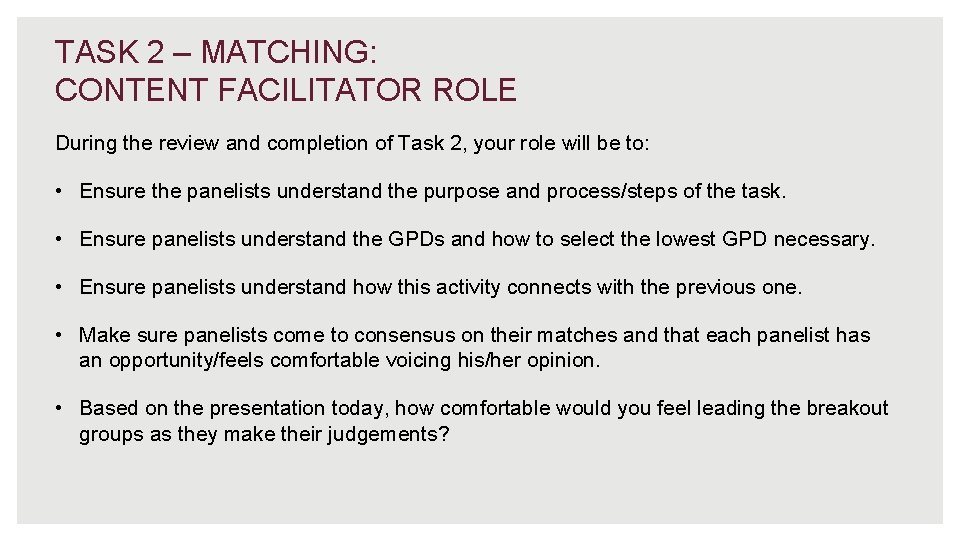
TASK 2 – MATCHING: CONTENT FACILITATOR ROLE During the review and completion of Task 2, your role will be to: • Ensure the panelists understand the purpose and process/steps of the task. • Ensure panelists understand the GPDs and how to select the lowest GPD necessary. • Ensure panelists understand how this activity connects with the previous one. • Make sure panelists come to consensus on their matches and that each panelist has an opportunity/feels comfortable voicing his/her opinion. • Based on the presentation today, how comfortable would you feel leading the breakout groups as they make their judgements?
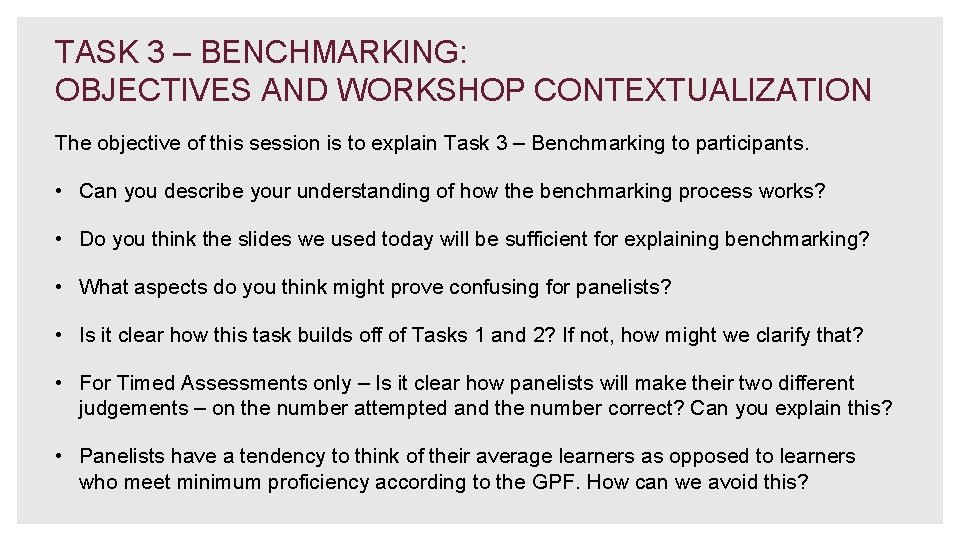
TASK 3 – BENCHMARKING: OBJECTIVES AND WORKSHOP CONTEXTUALIZATION The objective of this session is to explain Task 3 – Benchmarking to participants. • Can you describe your understanding of how the benchmarking process works? • Do you think the slides we used today will be sufficient for explaining benchmarking? • What aspects do you think might prove confusing for panelists? • Is it clear how this task builds off of Tasks 1 and 2? If not, how might we clarify that? • For Timed Assessments only – Is it clear how panelists will make their two different judgements – on the number attempted and the number correct? Can you explain this? • Panelists have a tendency to think of their average learners as opposed to learners who meet minimum proficiency according to the GPF. How can we avoid this?
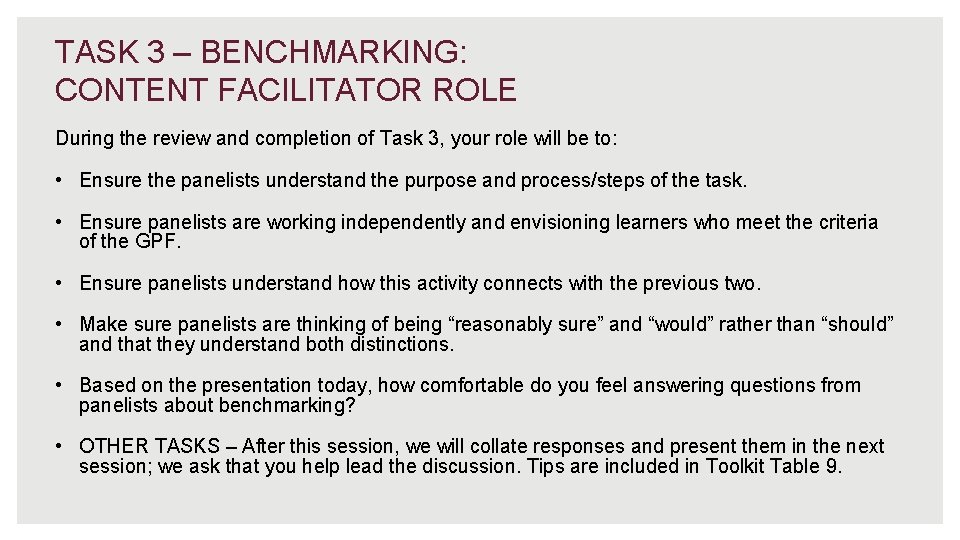
TASK 3 – BENCHMARKING: CONTENT FACILITATOR ROLE During the review and completion of Task 3, your role will be to: • Ensure the panelists understand the purpose and process/steps of the task. • Ensure panelists are working independently and envisioning learners who meet the criteria of the GPF. • Ensure panelists understand how this activity connects with the previous two. • Make sure panelists are thinking of being “reasonably sure” and “would” rather than “should” and that they understand both distinctions. • Based on the presentation today, how comfortable do you feel answering questions from panelists about benchmarking? • OTHER TASKS – After this session, we will collate responses and present them in the next session; we ask that you help lead the discussion. Tips are included in Toolkit Table 9.
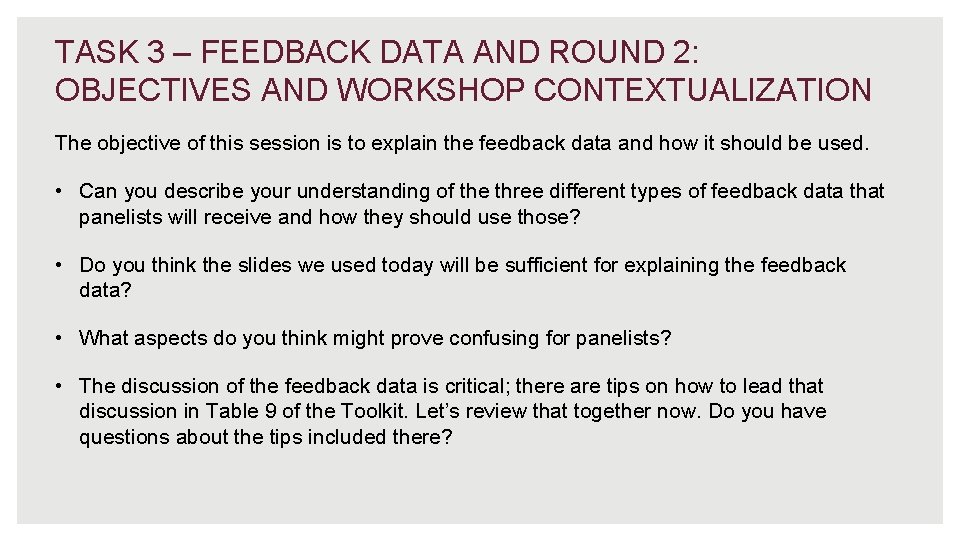
TASK 3 – FEEDBACK DATA AND ROUND 2: OBJECTIVES AND WORKSHOP CONTEXTUALIZATION The objective of this session is to explain the feedback data and how it should be used. • Can you describe your understanding of the three different types of feedback data that panelists will receive and how they should use those? • Do you think the slides we used today will be sufficient for explaining the feedback data? • What aspects do you think might prove confusing for panelists? • The discussion of the feedback data is critical; there are tips on how to lead that discussion in Table 9 of the Toolkit. Let’s review that together now. Do you have questions about the tips included there?
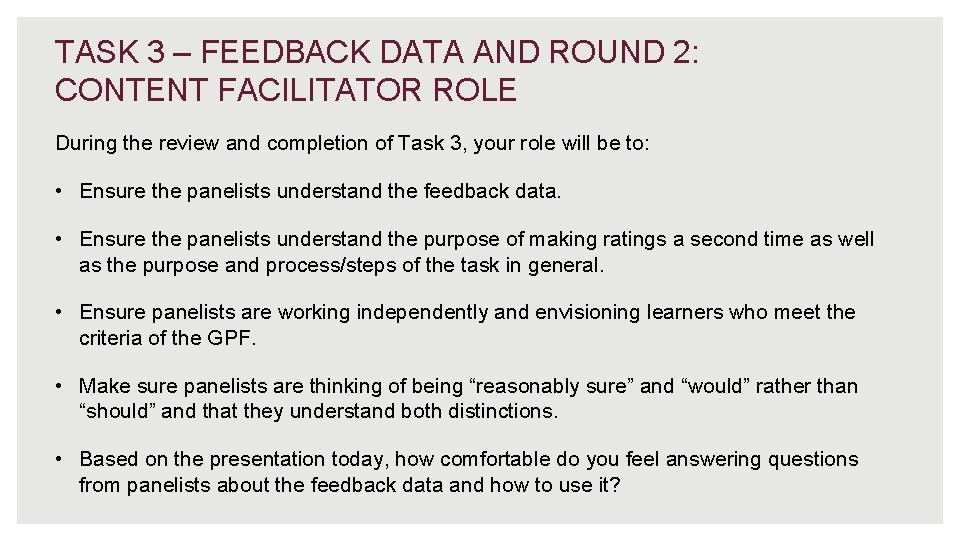
TASK 3 – FEEDBACK DATA AND ROUND 2: CONTENT FACILITATOR ROLE During the review and completion of Task 3, your role will be to: • Ensure the panelists understand the feedback data. • Ensure the panelists understand the purpose of making ratings a second time as well as the purpose and process/steps of the task in general. • Ensure panelists are working independently and envisioning learners who meet the criteria of the GPF. • Make sure panelists are thinking of being “reasonably sure” and “would” rather than “should” and that they understand both distinctions. • Based on the presentation today, how comfortable do you feel answering questions from panelists about the feedback data and how to use it?
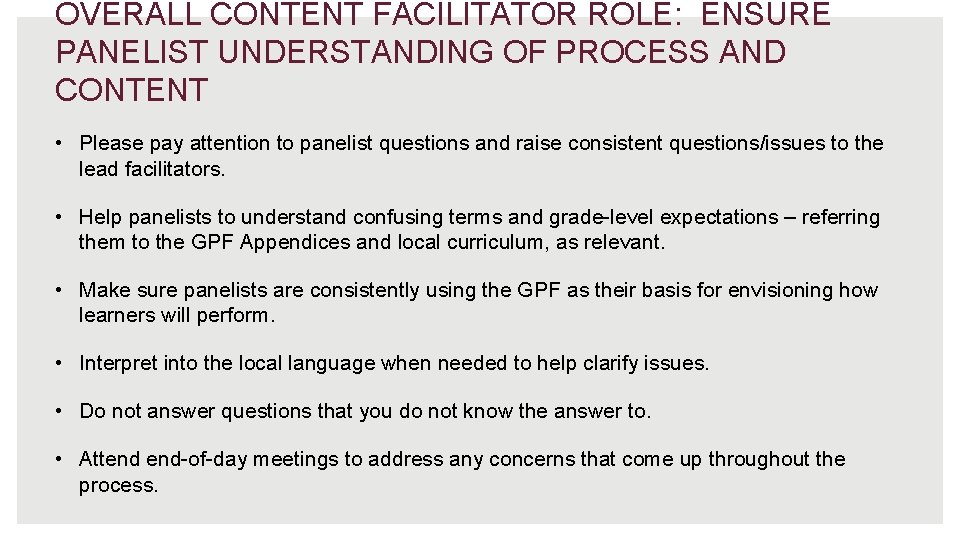
OVERALL CONTENT FACILITATOR ROLE: ENSURE PANELIST UNDERSTANDING OF PROCESS AND CONTENT • Please pay attention to panelist questions and raise consistent questions/issues to the lead facilitators. • Help panelists to understand confusing terms and grade-level expectations – referring them to the GPF Appendices and local curriculum, as relevant. • Make sure panelists are consistently using the GPF as their basis for envisioning how learners will perform. • Interpret into the local language when needed to help clarify issues. • Do not answer questions that you do not know the answer to. • Attend end-of-day meetings to address any concerns that come up throughout the process.