
FACEBOOK DEEPFAKES DETECTION CHALLENGE USING AI AND MACHINE
FACEBOOK DEEPFAKES DETECTION CHALLENGE USING AI AND MACHINE LEARNING MICHAEL LEONARDI, ASHUTOSH MISAR, SIVAKUMAR G. PILLAI, CHARLES TAPPERT, & AVERY LEIDER
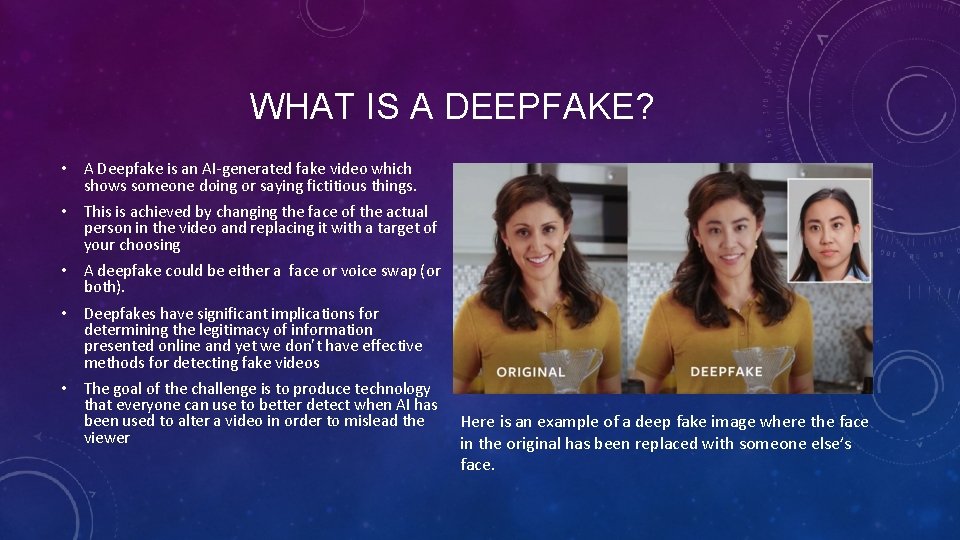
WHAT IS A DEEPFAKE? • A Deepfake is an AI-generated fake video which shows someone doing or saying fictitious things. • This is achieved by changing the face of the actual person in the video and replacing it with a target of your choosing • A deepfake could be either a face or voice swap (or both). • Deepfakes have significant implications for determining the legitimacy of information presented online and yet we don’t have effective methods for detecting fake videos • The goal of the challenge is to produce technology that everyone can use to better detect when AI has been used to alter a video in order to mislead the viewer Here is an example of a deep fake image where the face in the original has been replaced with someone else’s face.
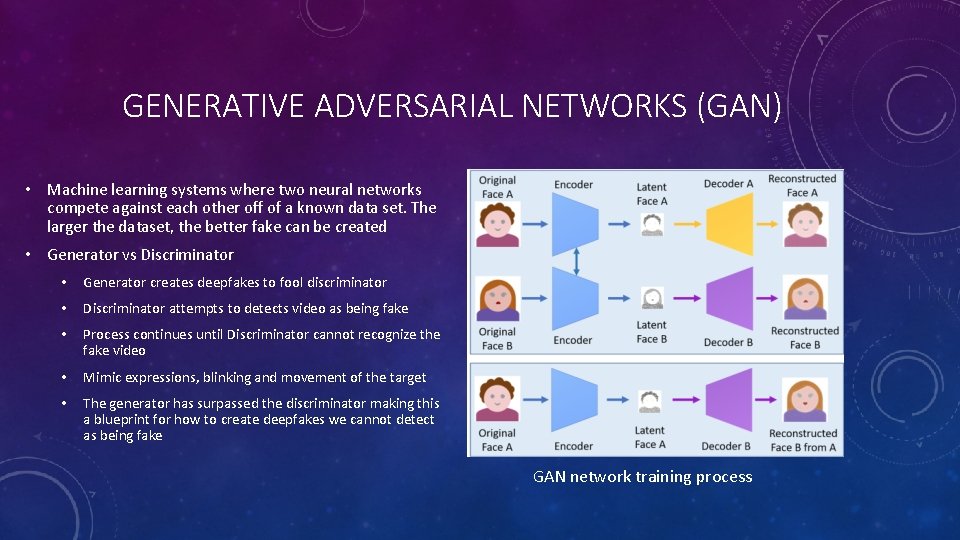
GENERATIVE ADVERSARIAL NETWORKS (GAN) • Machine learning systems where two neural networks compete against each other off of a known data set. The larger the dataset, the better fake can be created • Generator vs Discriminator • Generator creates deepfakes to fool discriminator • Discriminator attempts to detects video as being fake • Process continues until Discriminator cannot recognize the fake video • Mimic expressions, blinking and movement of the target • The generator has surpassed the discriminator making this a blueprint for how to create deepfakes we cannot detect as being fake GAN network training process
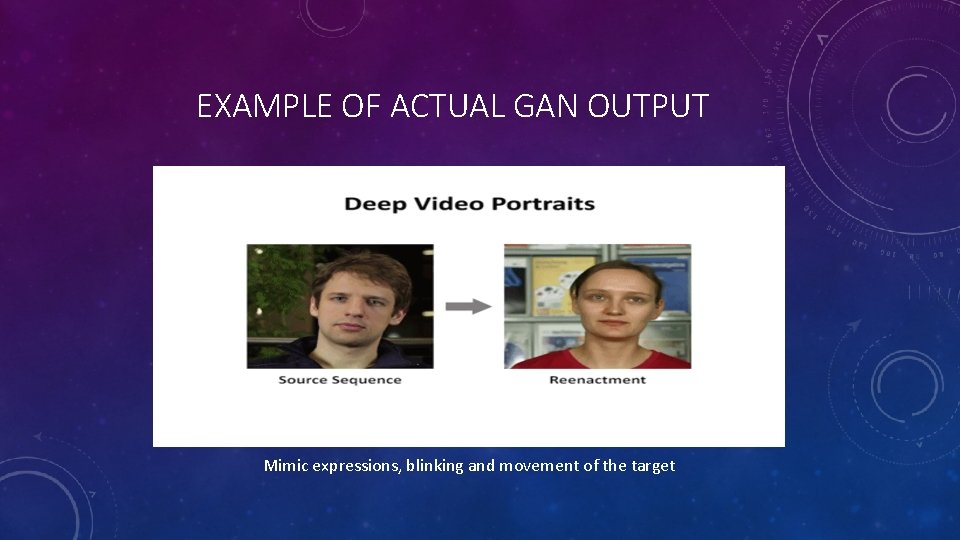
EXAMPLE OF ACTUAL GAN OUTPUT Mimic expressions, blinking and movement of the target
NOTABLE DEEPFAKE VIDEOS • President Trump lectures Belgium regarding climate change created by a Belgian political party. This damaged the US relationship with many Belgian politicians until it was shown to be fake • House speaker Nancy Pelosi giving a press conference appearing to be drunk and slurring words went viral and further agitated the feud between political parties ( President retweeted as mudslinging) • Facebook creator Mark Zuckerberg being interviewed where he stated that Facebook “owns its users” This was a result of the policy Facebook had created regarding removing fake videos from its sites • President Obama public service announcement being portrayed by comedian Jordan Peele where he says some outrageous things showing the danger deepfakes present

OVERALL VIDEO VIEWING STATISTICS VIA FORBES • One third of all online activity is spent watching videos • Over half of the video content viewed online is done via mobile device • 500 million hours of video are watched on youtube each day • 92% of mobile video viewers share videos with other people • Half a billion people watch videos on Facebook every day • The average person looks at a video on social media for less than 10 seconds • 85% of Facebook videos are watched without sound • Viewers retain 95% of the message when they watch it in a video
SOME POTENTIAL DEEPFAKE THREATS • Increased creation and circulation of fake news • Spreading inaccurate information quickly via social media • Negative impact on Presidential Candidates • Damage to International relations • False pornographic videos of celebrities (Scarlett Johansson already a victim) • Portraying infidelity of someone in a marriage • Showing different groups participating in heinous acts to increase resentment • Athletes participating in domestic violence or use of illegal substances
DEEPFAKE CREATION APPLICATIONS • Zao – Mobile Phone Application to create deep fakes within seconds- only available in China • Deepfakes Web β – web based service that uses deep learning to absorb the various complexities of face data • Avenge Them- Swap your face with your favorite Marvel Superhero or Character • Machine. Tube- Create Deepfakes from pre-defined models such as Nicholas Cage, Dwayne Johnson, Barack Obama, Kanye West and many others • Deep. Face. Lab- Used to train students to use machine learning and image synthesis to replace faces
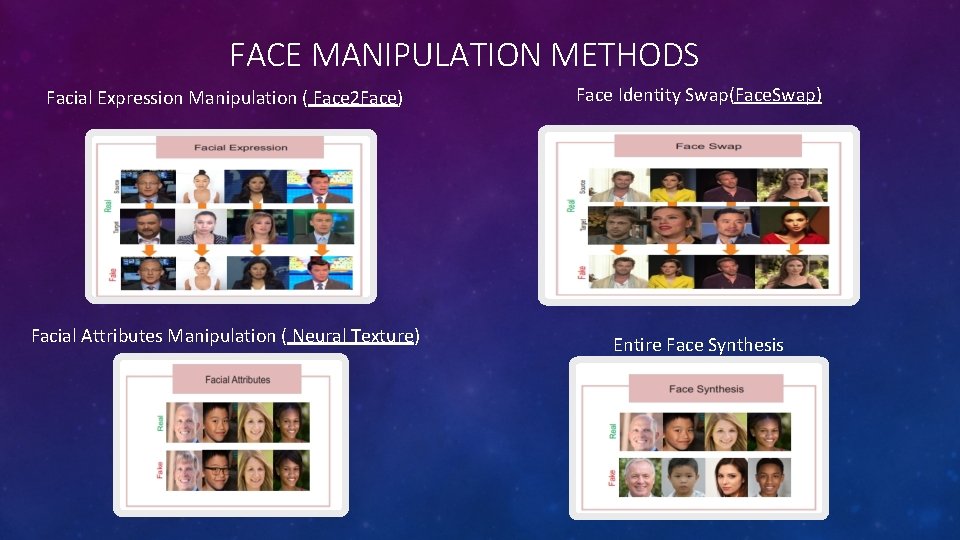
FACE MANIPULATION METHODS Facial Expression Manipulation ( Face 2 Face) Face Identity Swap(Face. Swap) Facial Attributes Manipulation ( Neural Texture) Entire Face Synthesis
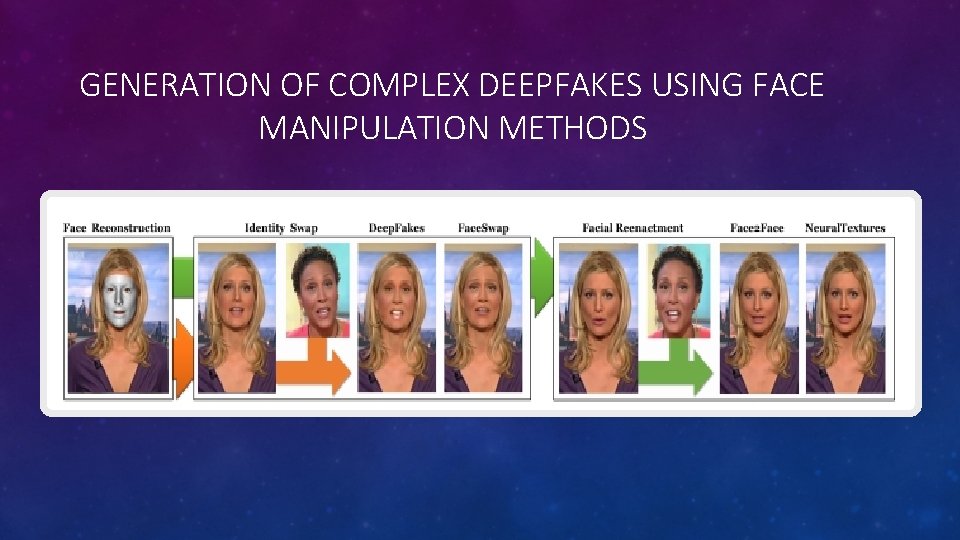
GENERATION OF COMPLEX DEEPFAKES USING FACE MANIPULATION METHODS
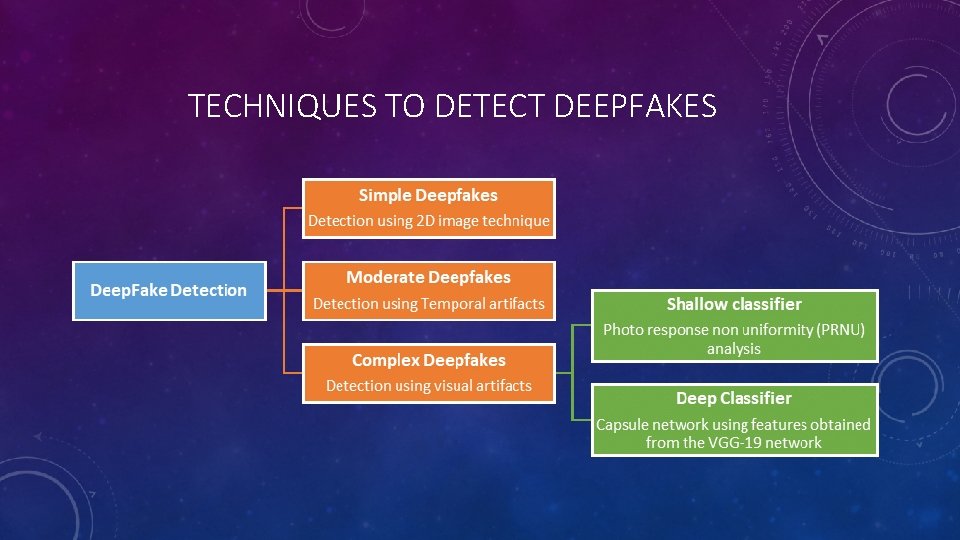
TECHNIQUES TO DETECT DEEPFAKES
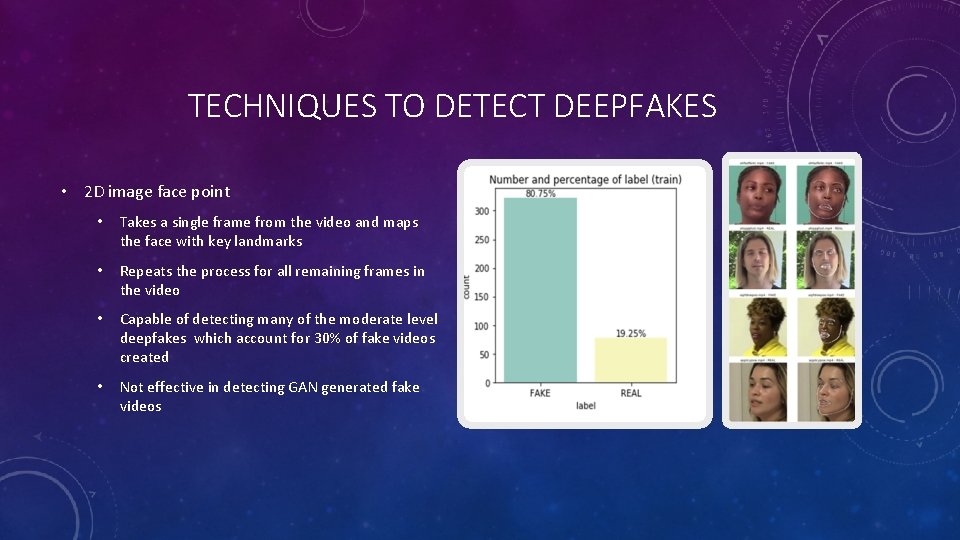
TECHNIQUES TO DETECT DEEPFAKES • 2 D image face point • Takes a single frame from the video and maps the face with key landmarks • Repeats the process for all remaining frames in the video • Capable of detecting many of the moderate level deepfakes which account for 30% of fake videos created • Not effective in detecting GAN generated fake videos
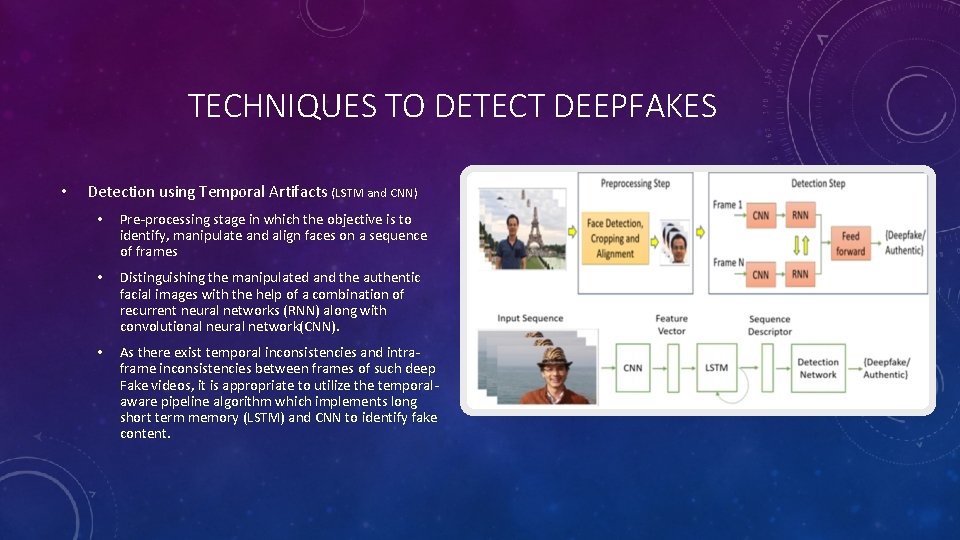
TECHNIQUES TO DETECT DEEPFAKES • Detection using Temporal Artifacts (LSTM and CNN) • Pre-processing stage in which the objective is to identify, manipulate and align faces on a sequence of frames • Distinguishing the manipulated and the authentic facial images with the help of a combination of recurrent neural networks (RNN) along with convolutional neural network(CNN). • As there exist temporal inconsistencies and intraframe inconsistencies between frames of such deep Fake videos, it is appropriate to utilize the temporalaware pipeline algorithm which implements long short term memory (LSTM) and CNN to identify fake content.
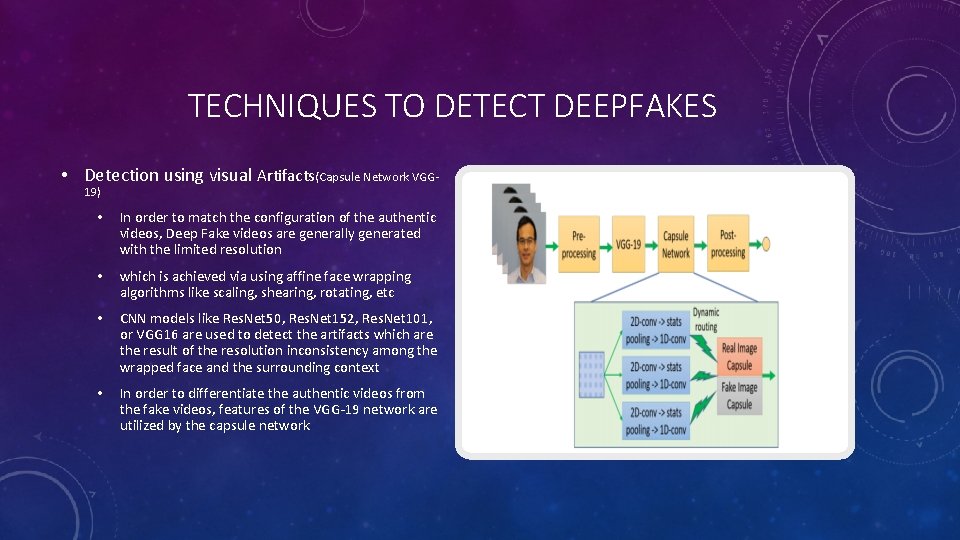
TECHNIQUES TO DETECT DEEPFAKES • Detection using visual Artifacts(Capsule Network VGG 19) • In order to match the configuration of the authentic videos, Deep Fake videos are generally generated with the limited resolution • which is achieved via using affine face wrapping algorithms like scaling, shearing, rotating, etc • CNN models like Res. Net 50, Res. Net 152, Res. Net 101, or VGG 16 are used to detect the artifacts which are the result of the resolution inconsistency among the wrapped face and the surrounding context • In order to differentiate the authentic videos from the fake videos, features of the VGG-19 network are utilized by the capsule network
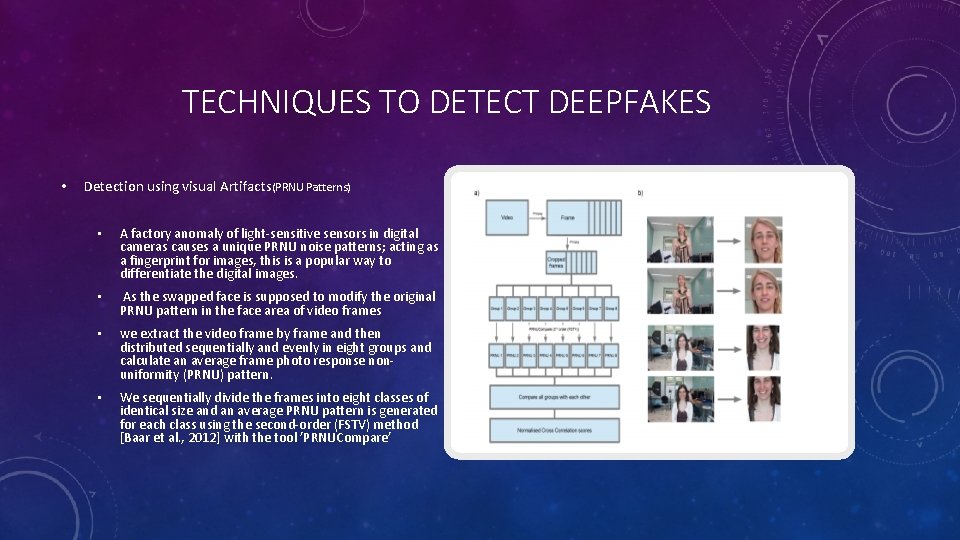
TECHNIQUES TO DETECT DEEPFAKES • Detection using visual Artifacts(PRNU Patterns) • A factory anomaly of light-sensitive sensors in digital cameras causes a unique PRNU noise patterns; acting as a fingerprint for images, this is a popular way to differentiate the digital images. • As the swapped face is supposed to modify the original PRNU pattern in the face area of video frames • we extract the video frame by frame and then distributed sequentially and evenly in eight groups and calculate an average frame photo response nonuniformity (PRNU) pattern. • We sequentially divide the frames into eight classes of identical size and an average PRNU pattern is generated for each class using the second-order (FSTV) method [Baar et al. , 2012] with the tool ’PRNUCompare’
CONCLUSIONS AND FURTHER RESEARCH Conclusions • In this study, we focused on the influence of using different methodologies in the detection of deepfake videos and proposing a homogenous benchmark for follow up work • In order to create better tools to detect deepfake videos several of the methods above will need to be combined to provide better analysis. • Combining the bi-spectral analysis of audio along with face warping artifacts within videos are examples of two phases of the mechanism which would begin a step by step process to help eliminate fake videos being posted. • 2 D images and moderate level deepfakes can be identified with image face point technique which accounts for 30% of the fake videos created Further Research • Data drift may be a key factor in identifying anomalies in deepfake videos based on the datasets used to create them. This theory would require further testing and the setup of a GAN network at Pace University • Incorporating audio bi-spectral analysis into deepfake video detection to distinguish human speech from synthesized speech as an identifier. • Improving on tools using tensor flow and identifiers such as the random forest algorithm to identify gradient decent within videos as an identifier.
- Slides: 17