
FACE It is the anterior aspect of the
- Slides: 52
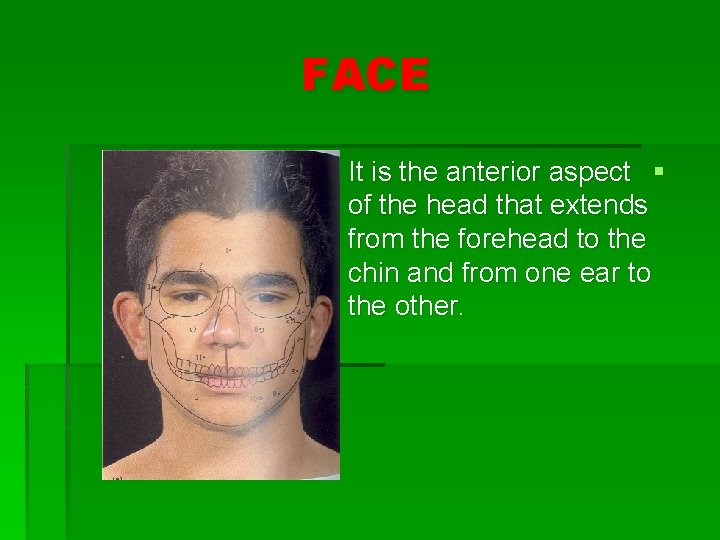
FACE It is the anterior aspect § of the head that extends from the forehead to the chin and from one ear to the other.
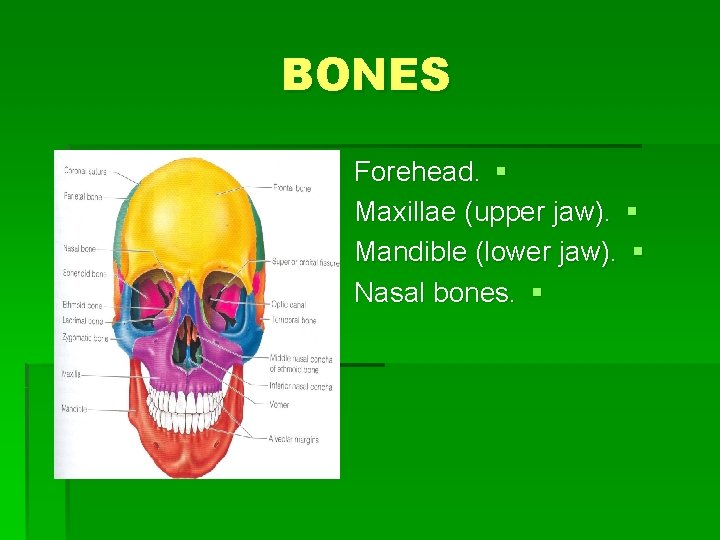
BONES Forehead. § Maxillae (upper jaw). § Mandible (lower jaw). § Nasal bones. §
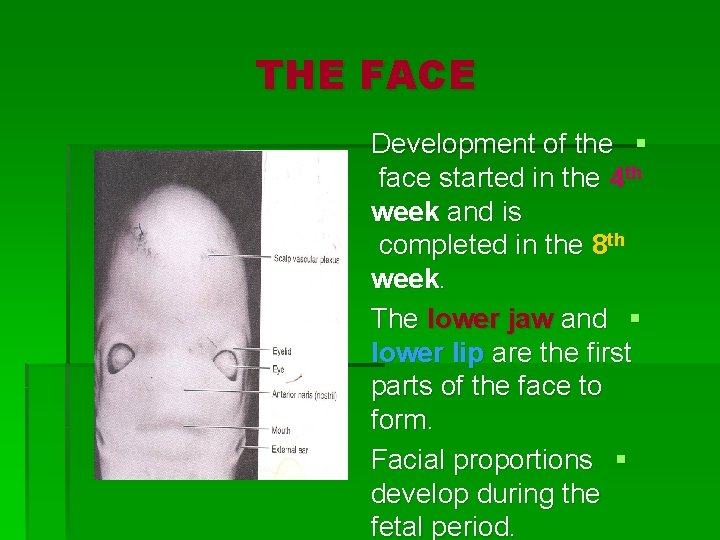
THE FACE Development of the § face started in the 4 th week and is completed in the 8 th week. The lower jaw and § lower lip are the first parts of the face to form. Facial proportions § develop during the fetal period.
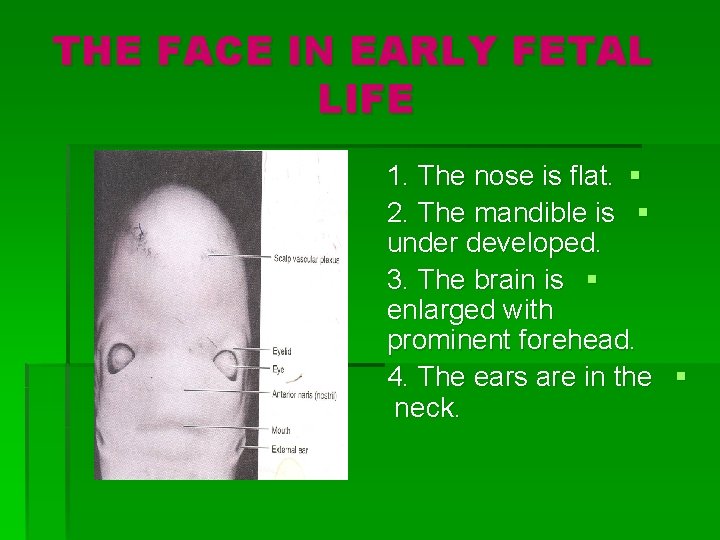
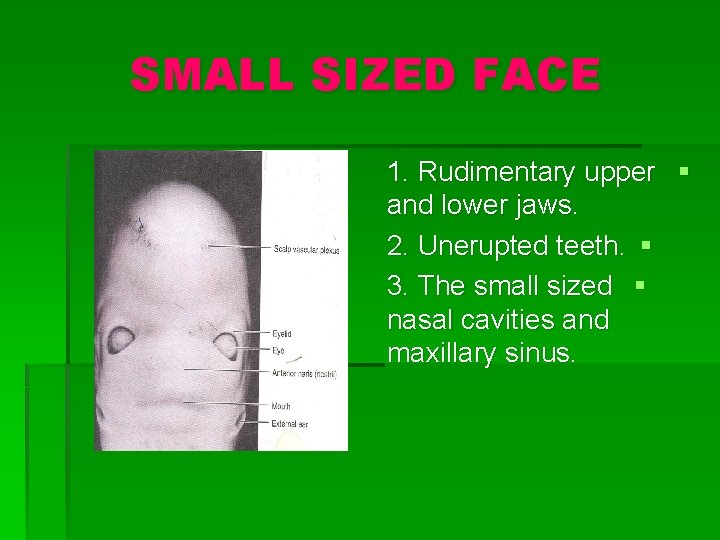
THE FACE IN EARLY FETAL LIFE 1. The nose is flat. § 2. The mandible is § under developed. 3. The brain is § enlarged with prominent forehead. 4. The ears are in the § neck.
SMALL SIZED FACE 1. Rudimentary upper § and lower jaws. 2. Unerupted teeth. § 3. The small sized § nasal cavities and maxillary sinus.
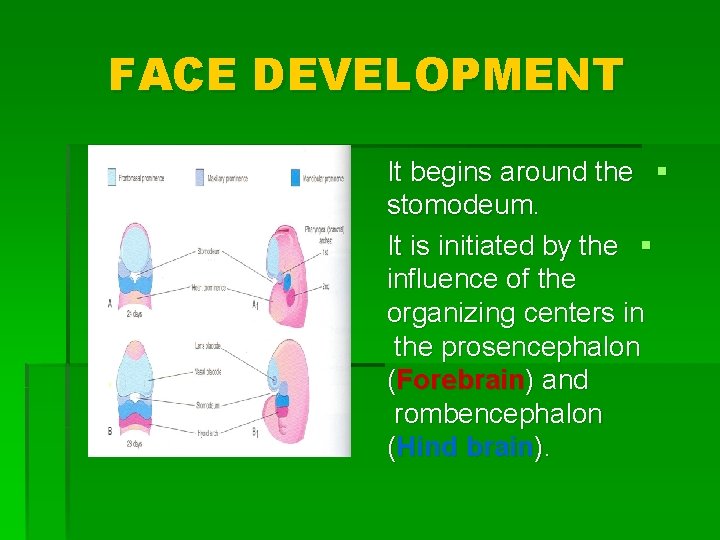
FACE DEVELOPMENT It begins around the § stomodeum. It is initiated by the § influence of the organizing centers in the prosencephalon (Forebrain) and rombencephalon (Hind brain).
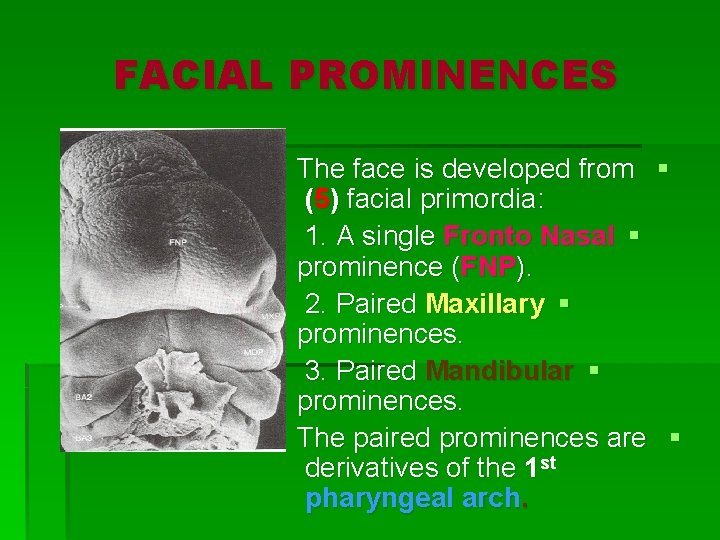
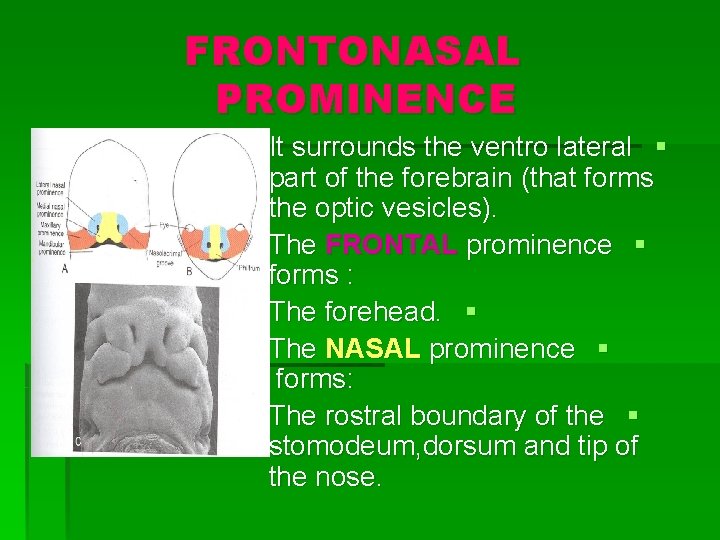
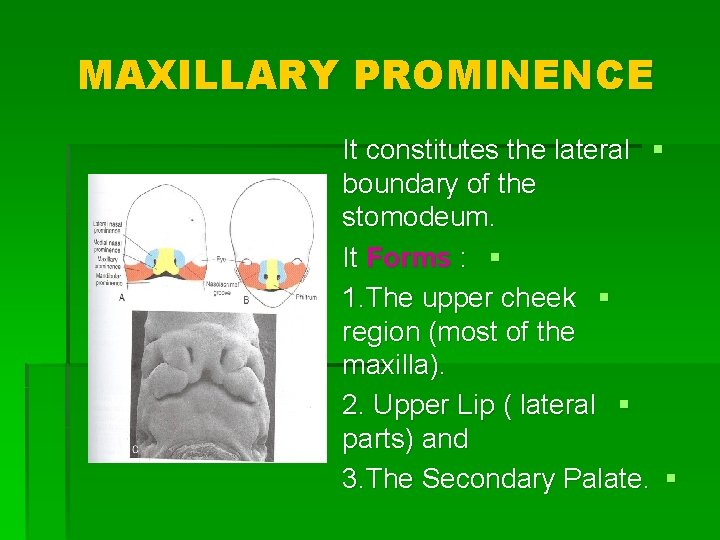
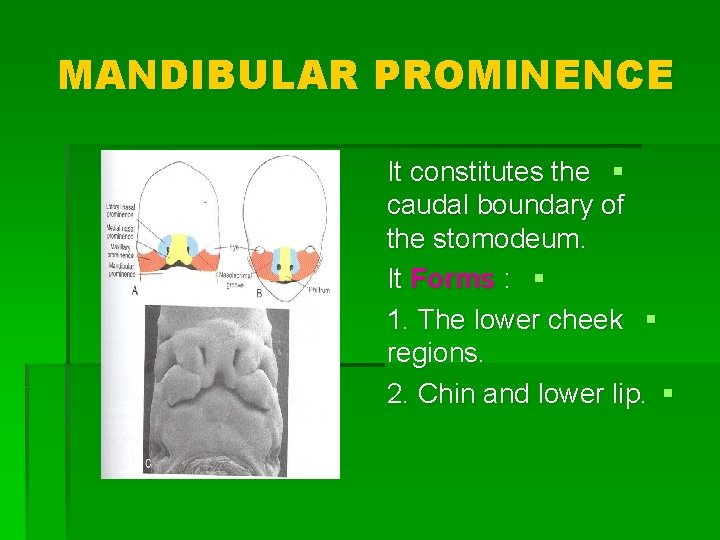
FACIAL PROMINENCES The face is developed from § (5) facial primordia: 1. A single Fronto Nasal § prominence (FNP). 2. Paired Maxillary § prominences. 3. Paired Mandibular § prominences. The paired prominences are § derivatives of the 1 st pharyngeal arch.
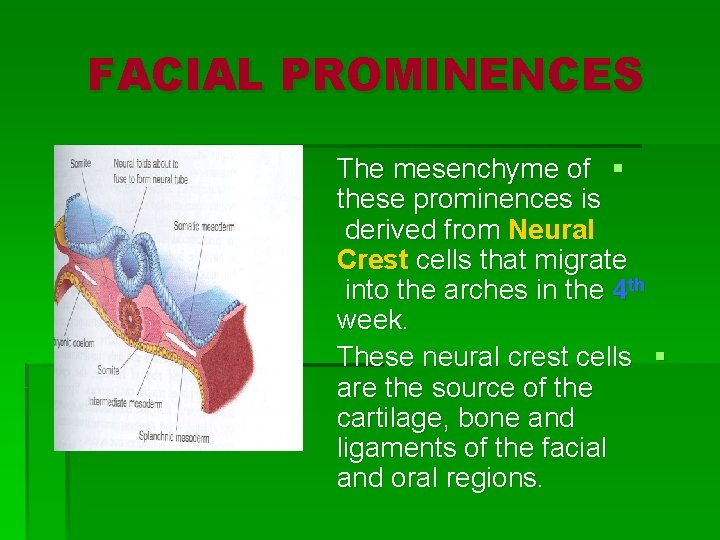
FACIAL PROMINENCES The mesenchyme of § these prominences is derived from Neural Crest cells that migrate into the arches in the 4 th week. These neural crest cells § are the source of the cartilage, bone and ligaments of the facial and oral regions.
FRONTONASAL PROMINENCE It surrounds the ventro lateral § part of the forebrain (that forms the optic vesicles). The FRONTAL prominence § forms : The forehead. § The NASAL prominence § forms: The rostral boundary of the § stomodeum, dorsum and tip of the nose.
MAXILLARY PROMINENCE It constitutes the lateral § boundary of the stomodeum. It Forms : § 1. The upper cheek § region (most of the maxilla). 2. Upper Lip ( lateral § parts) and 3. The Secondary Palate. §
MANDIBULAR PROMINENCE It constitutes the § caudal boundary of the stomodeum. It Forms : § 1. The lower cheek § regions. 2. Chin and lower lip. §
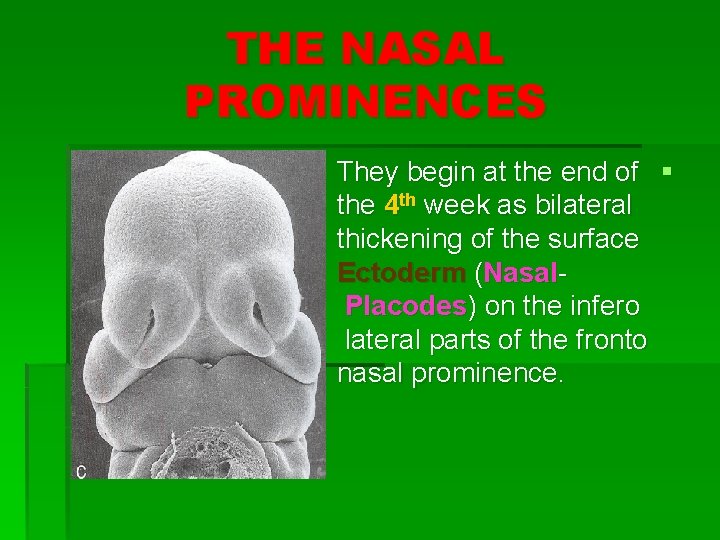
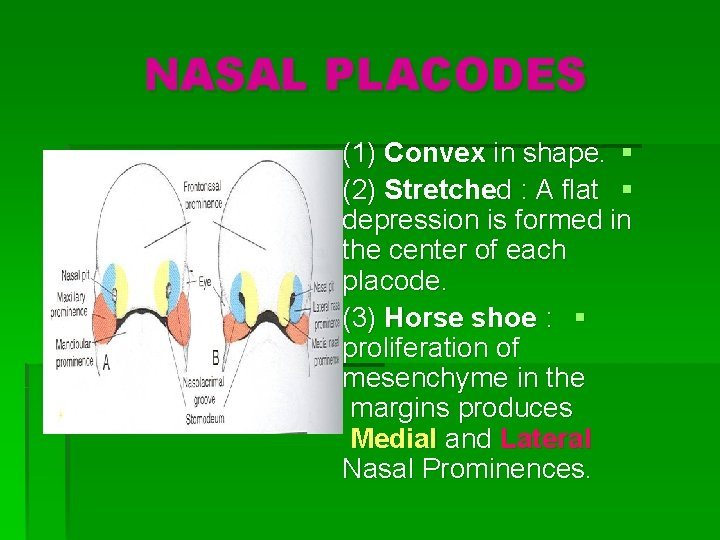
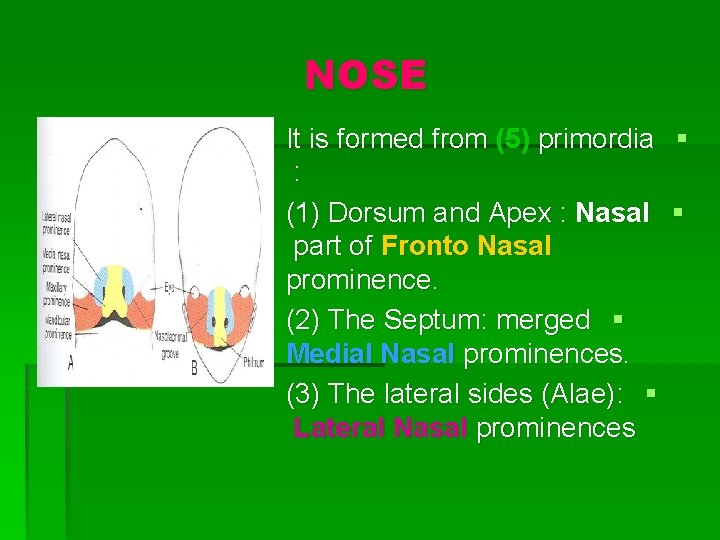
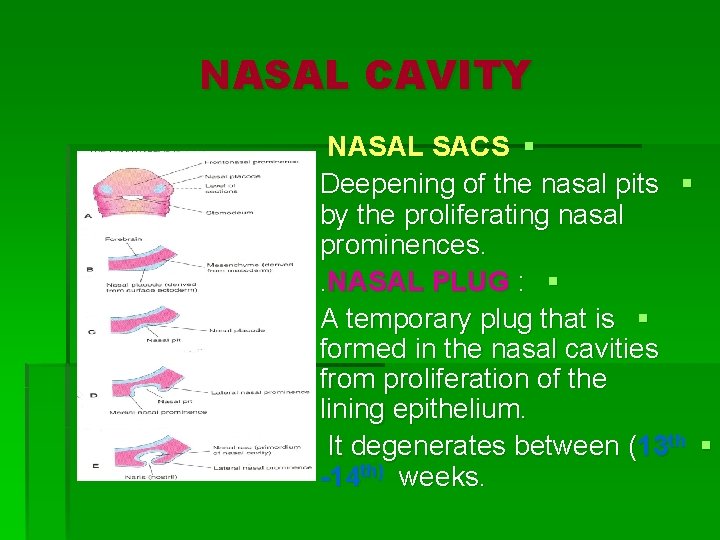
THE NASAL PROMINENCES They begin at the end of § the 4 th week as bilateral thickening of the surface Ectoderm (Nasal. Placodes) on the infero lateral parts of the fronto nasal prominence.
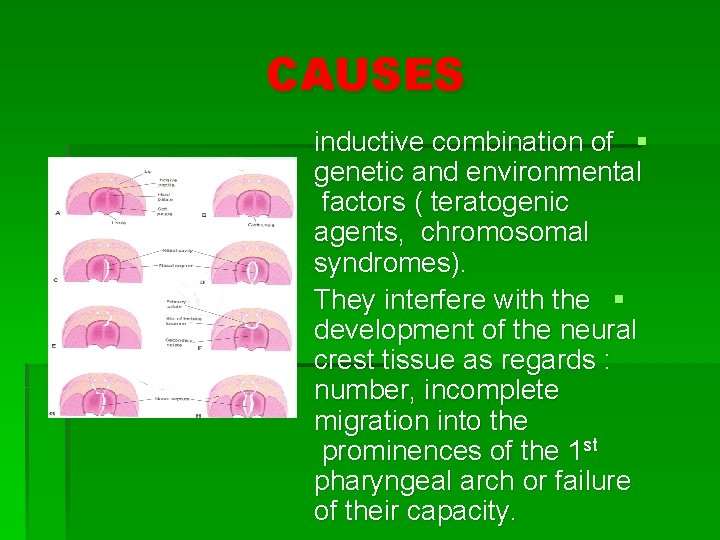
NASAL PLACODES (1) Convex in shape. § (2) Stretched : A flat § depression is formed in the center of each placode. (3) Horse shoe : § proliferation of mesenchyme in the margins produces Medial and Lateral Nasal Prominences.
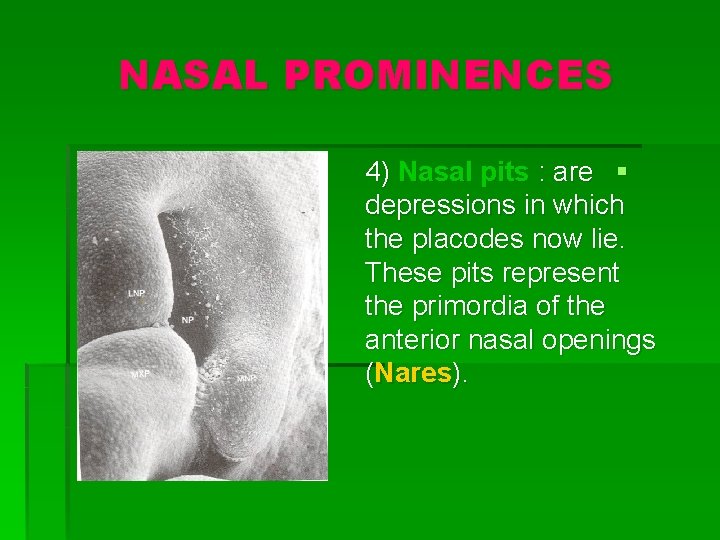
NASAL PROMINENCES 4) Nasal pits : are § depressions in which the placodes now lie. These pits represent the primordia of the anterior nasal openings (Nares).
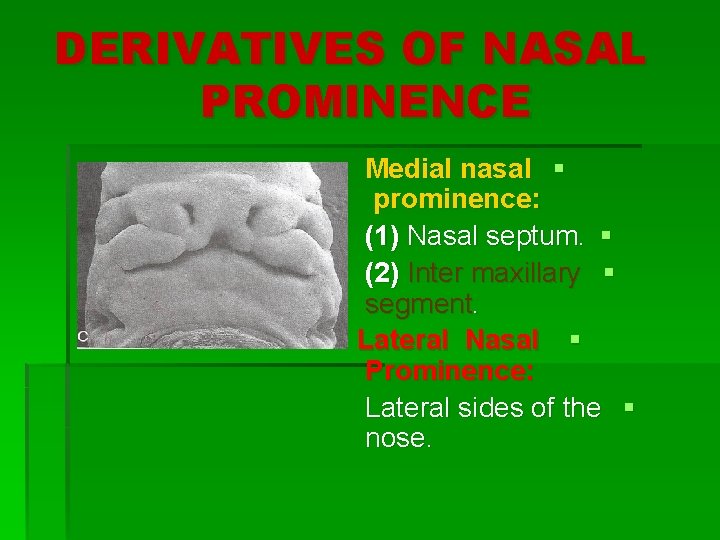
DERIVATIVES OF NASAL PROMINENCE Medial nasal § prominence: (1) Nasal septum. § (2) Inter maxillary § segment. Lateral Nasal § Prominence: Lateral sides of the § nose.
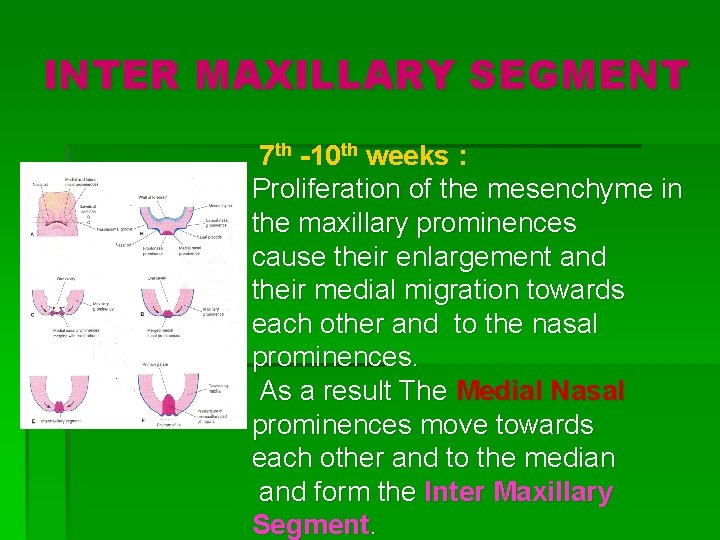
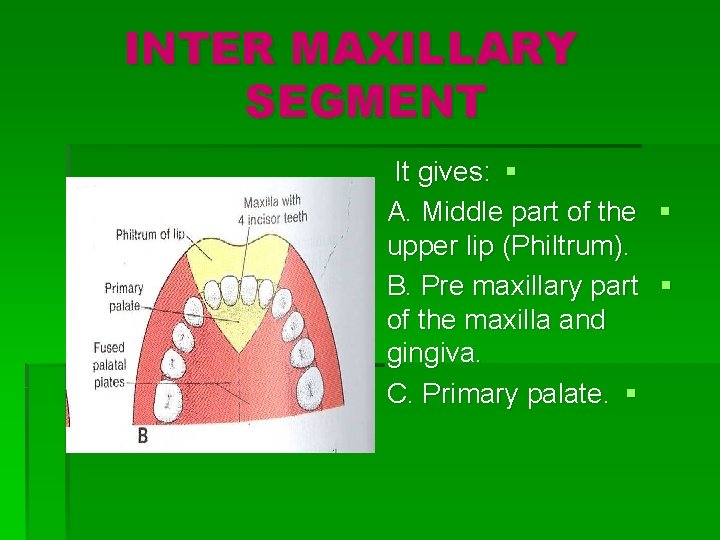
INTER MAXILLARY SEGMENT 7 th -10 th weeks : Proliferation of the mesenchyme in the maxillary prominences cause their enlargement and their medial migration towards each other and to the nasal prominences. As a result The Medial Nasal prominences move towards each other and to the median and form the Inter Maxillary Segment.
INTER MAXILLARY SEGMENT It gives: § A. Middle part of the § upper lip (Philtrum). B. Pre maxillary part § of the maxilla and gingiva. C. Primary palate. §
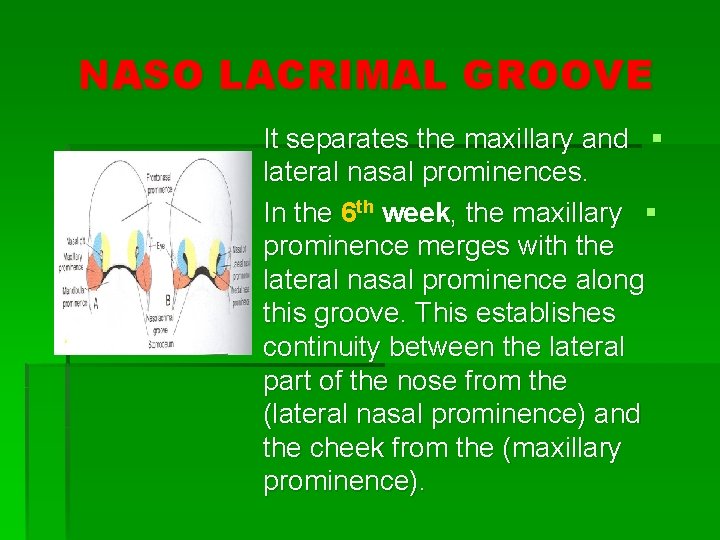
NASO LACRIMAL GROOVE It separates the maxillary and § lateral nasal prominences. In the 6 th week, the maxillary § prominence merges with the lateral nasal prominence along this groove. This establishes continuity between the lateral part of the nose from the (lateral nasal prominence) and the cheek from the (maxillary prominence).
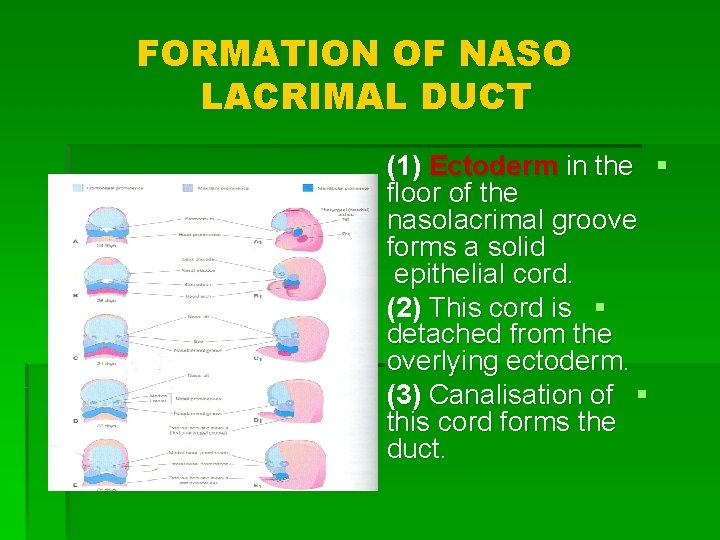
FORMATION OF NASO LACRIMAL DUCT (1) Ectoderm in the § floor of the nasolacrimal groove forms a solid epithelial cord. (2) This cord is § detached from the overlying ectoderm. (3) Canalisation of § this cord forms the duct.
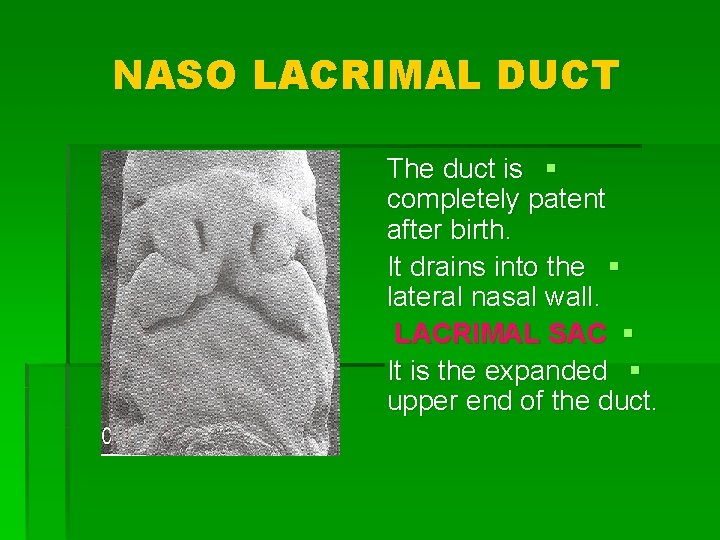
NASO LACRIMAL DUCT The duct is § completely patent after birth. It drains into the § lateral nasal wall. LACRIMAL SAC § It is the expanded § upper end of the duct.
NOSE It is formed from (5) primordia § : (1) Dorsum and Apex : Nasal § part of Fronto Nasal prominence. (2) The Septum: merged § Medial Nasal prominences. (3) The lateral sides (Alae): § Lateral Nasal prominences
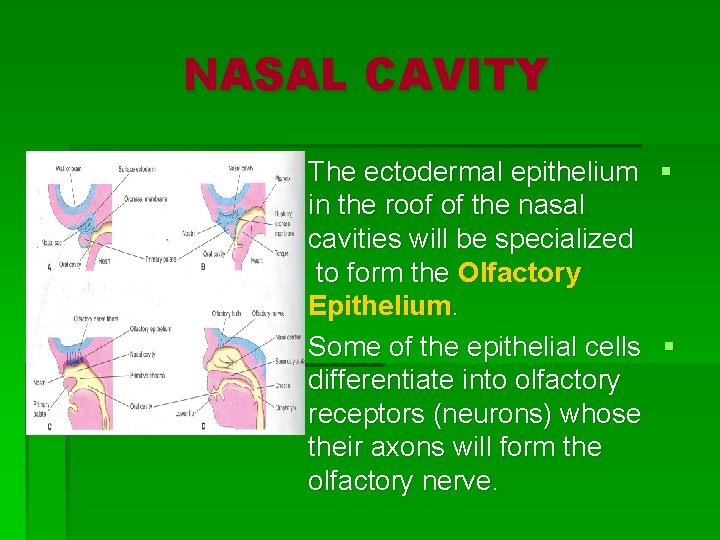
NASAL CAVITY NASAL SACS § Deepening of the nasal pits § by the proliferating nasal prominences. . NASAL PLUG : § A temporary plug that is § formed in the nasal cavities from proliferation of the lining epithelium. It degenerates between (13 th § -14 th) weeks.
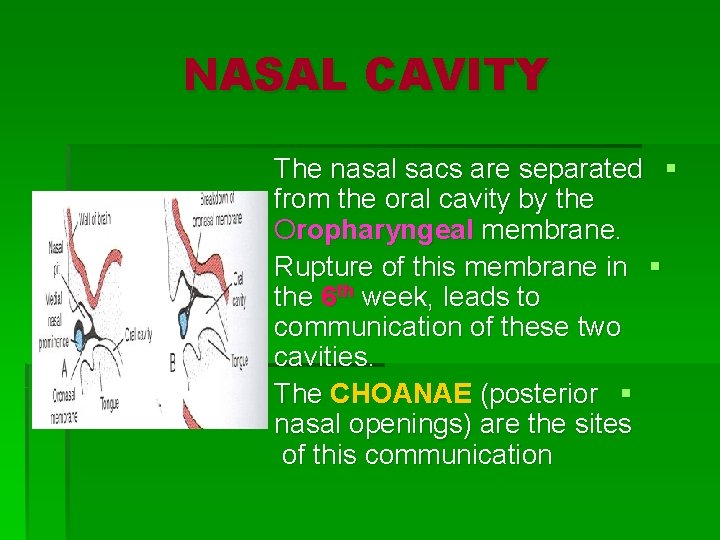
NASAL CAVITY The nasal sacs are separated § from the oral cavity by the Oropharyngeal membrane. Rupture of this membrane in § the 6 th week, leads to communication of these two cavities. The CHOANAE (posterior § nasal openings) are the sites of this communication
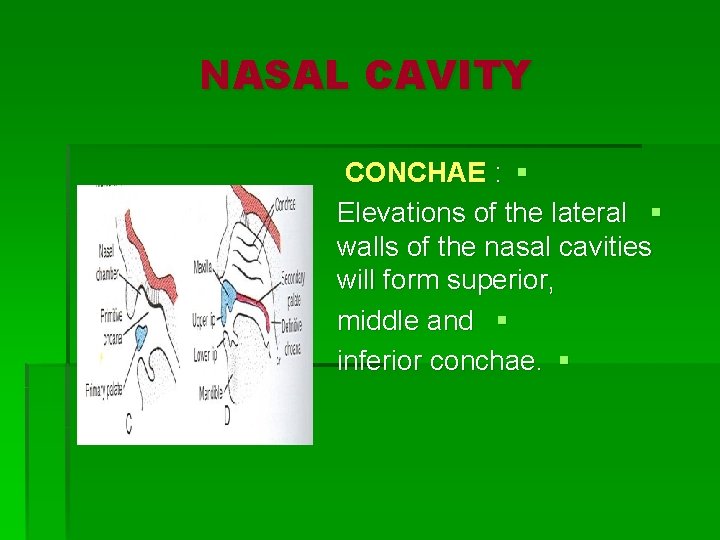
NASAL CAVITY CONCHAE : § Elevations of the lateral § walls of the nasal cavities will form superior, middle and § inferior conchae. §
NASAL CAVITY The ectodermal epithelium § in the roof of the nasal cavities will be specialized to form the Olfactory Epithelium. Some of the epithelial cells § differentiate into olfactory receptors (neurons) whose their axons will form the olfactory nerve.
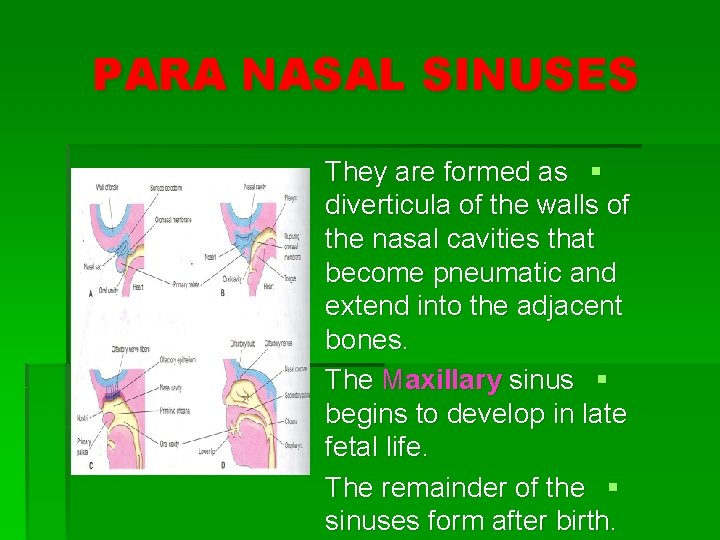
PARA NASAL SINUSES They are formed as § diverticula of the walls of the nasal cavities that become pneumatic and extend into the adjacent bones. The Maxillary sinus § begins to develop in late fetal life. The remainder of the § sinuses form after birth.
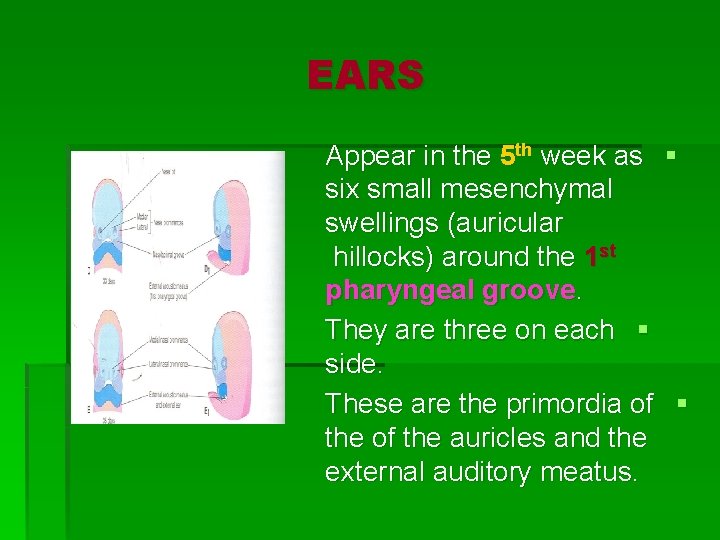
EARS Appear in the 5 th week as § six small mesenchymal swellings (auricular hillocks) around the 1 st pharyngeal groove. They are three on each § side. These are the primordia of § the of the auricles and the external auditory meatus.
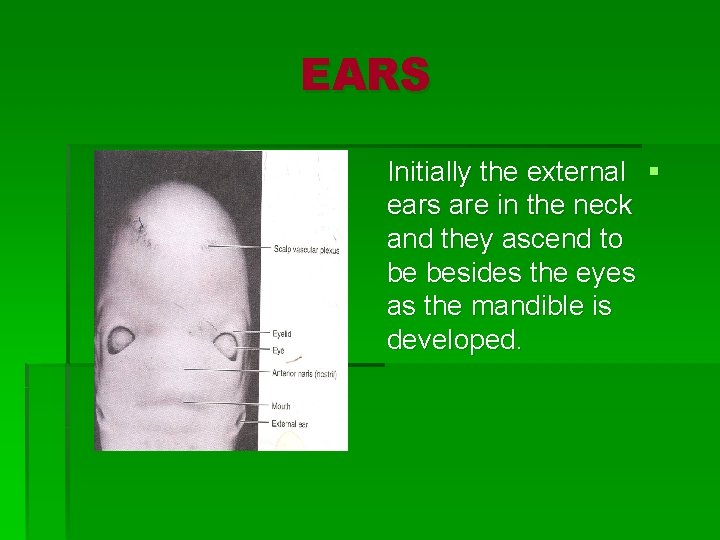
EARS Initially the external § ears are in the neck and they ascend to be besides the eyes as the mandible is developed.
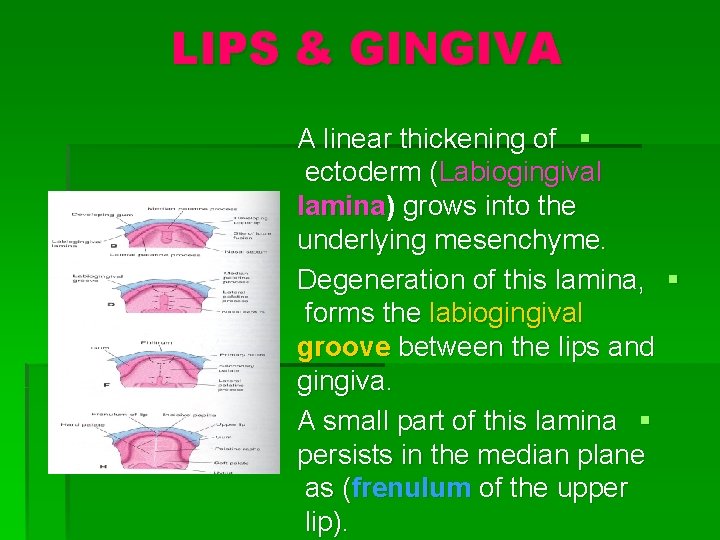
LIPS & GINGIVA A linear thickening of § ectoderm (Labiogingival lamina) grows into the underlying mesenchyme. Degeneration of this lamina, § forms the labiogingival groove between the lips and gingiva. A small part of this lamina § persists in the median plane as (frenulum of the upper lip).
BLOOD SUPPLY In the 7 th week, blood is shifted from the § internal carotid artery to the external carotid artery. This is because the primitive aortic arch is § transformed into the posnatal arterial arrangement.
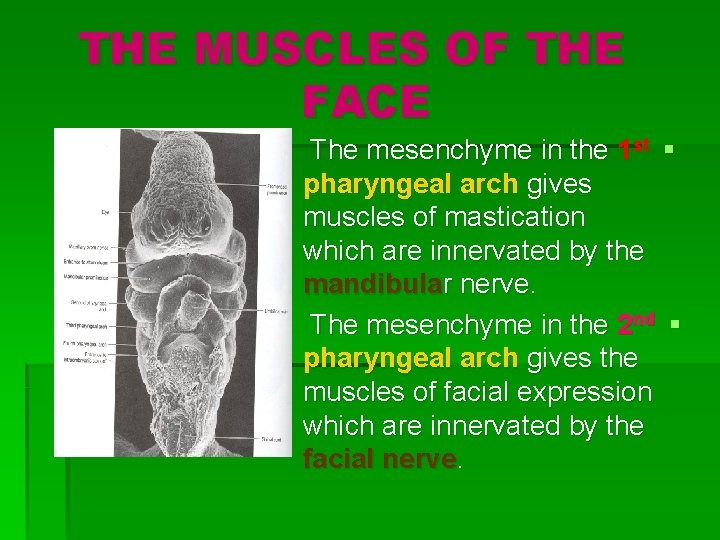
THE MUSCLES OF THE FACE The mesenchyme in the 1 st § pharyngeal arch gives muscles of mastication which are innervated by the mandibular nerve. The mesenchyme in the 2 nd § pharyngeal arch gives the muscles of facial expression which are innervated by the facial nerve.
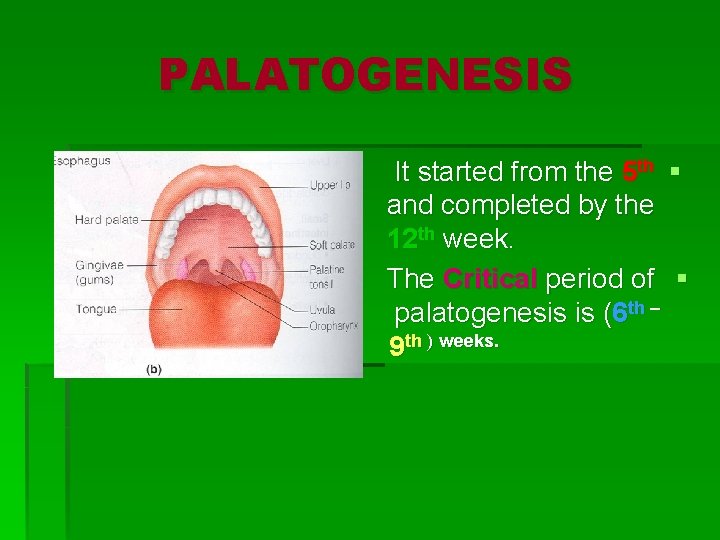
PALATOGENESIS It started from the 5 th § and completed by the 12 th week. The Critical period of § palatogenesis is (6 th – 9 th ) weeks.
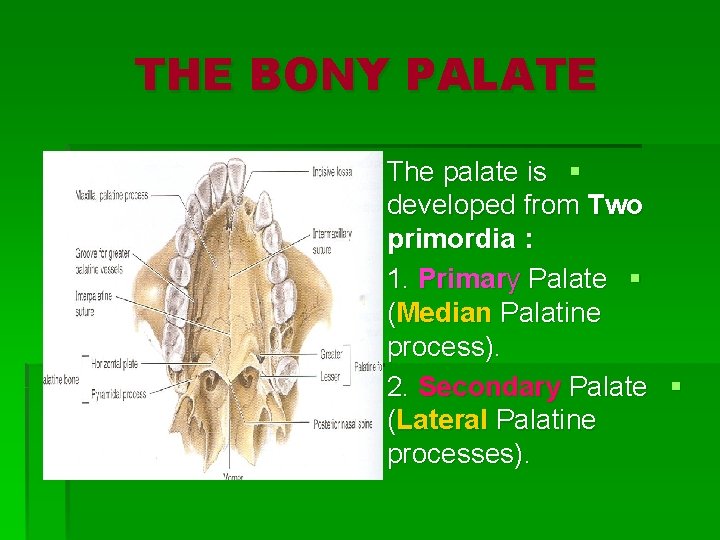
THE BONY PALATE The palate is § developed from Two primordia : 1. Primary Palate § (Median Palatine process). 2. Secondary Palate § (Lateral Palatine processes).
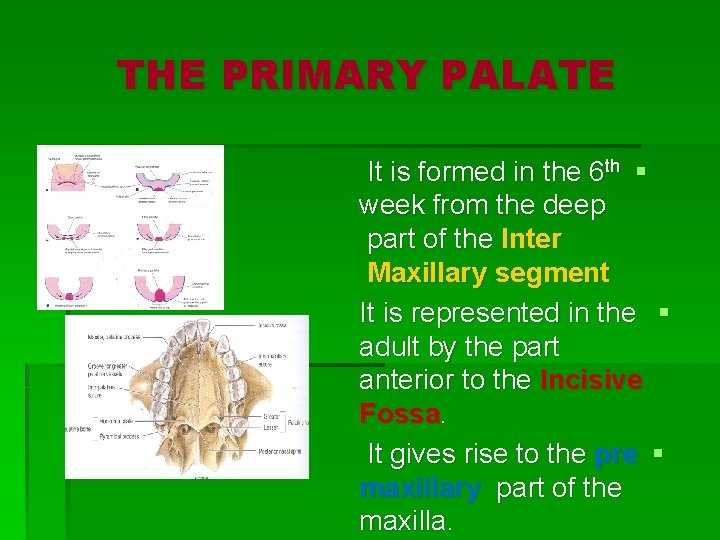
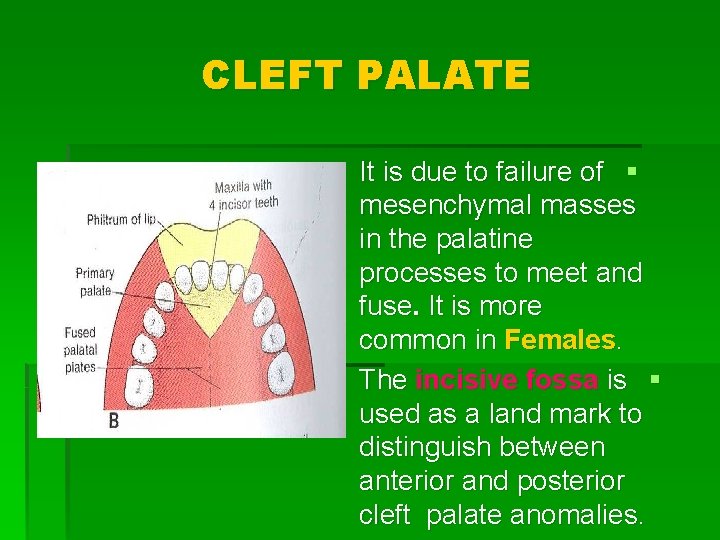
THE PRIMARY PALATE It is formed in the 6 th § week from the deep part of the Inter Maxillary segment It is represented in the § adult by the part anterior to the Incisive Fossa. It gives rise to the pre § maxillary part of the maxilla.
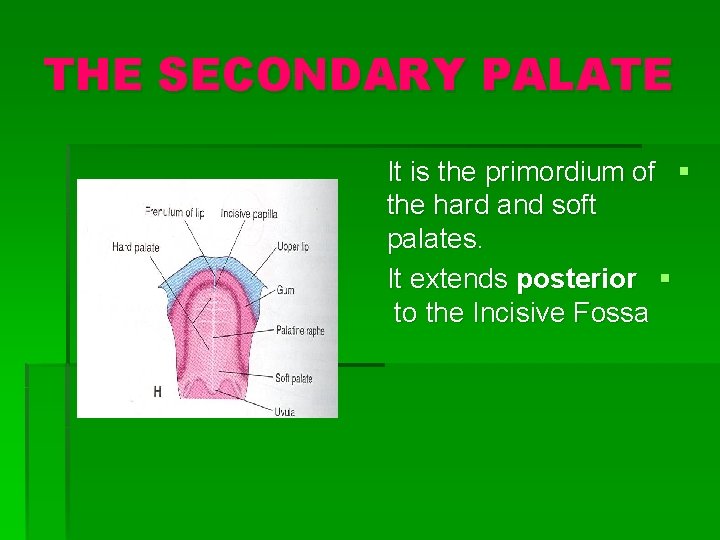
THE SECONDARY PALATE It is the primordium of § the hard and soft palates. It extends posterior § to the Incisive Fossa
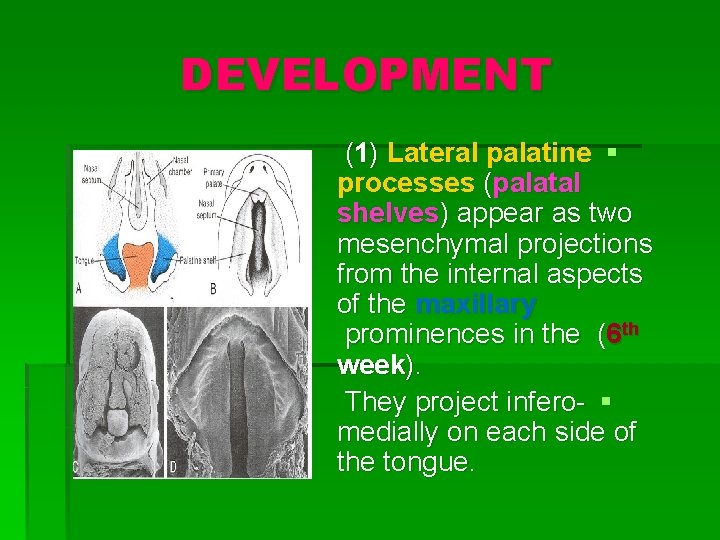
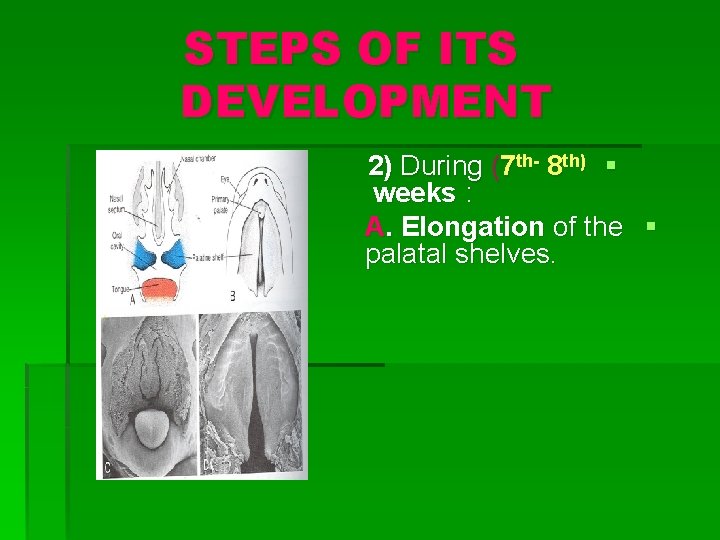
DEVELOPMENT (1) Lateral palatine § processes (palatal shelves) appear as two mesenchymal projections from the internal aspects of the maxillary prominences in the (6 th week). They project infero- § medially on each side of the tongue.
STEPS OF ITS DEVELOPMENT 2) During (7 th- 8 th) § weeks : A. Elongation of the § palatal shelves.
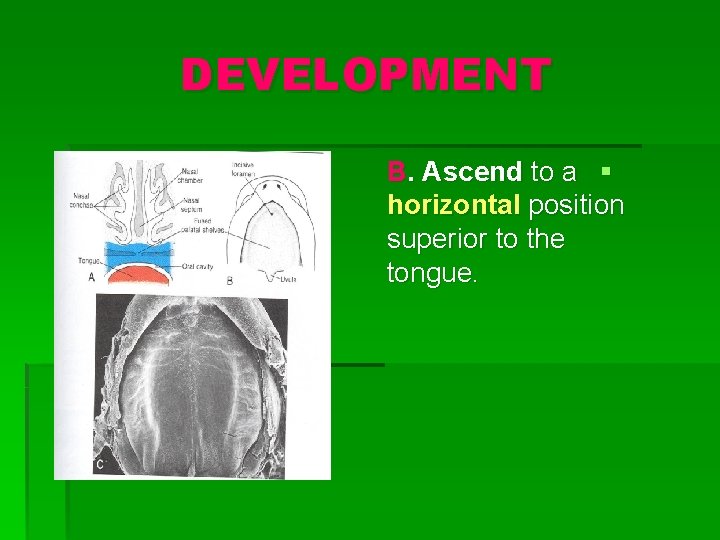
DEVELOPMENT B. Ascend to a § horizontal position superior to the tongue.
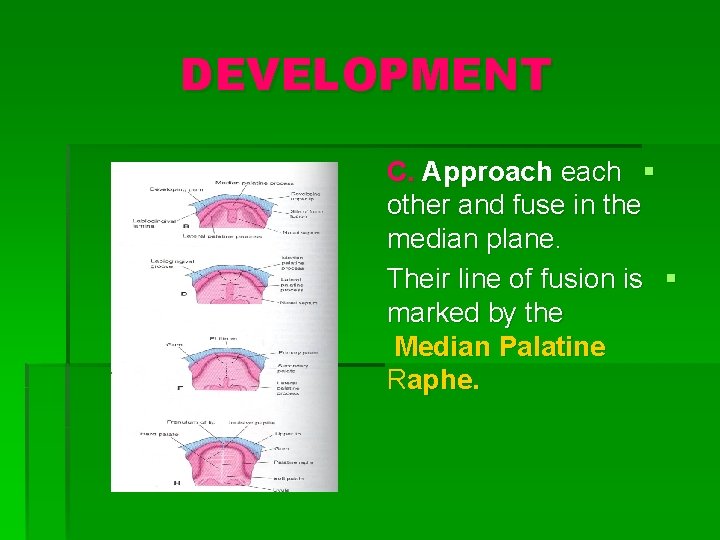
DEVELOPMENT C. Approach each § other and fuse in the median plane. Their line of fusion is § marked by the Median Palatine Raphe.
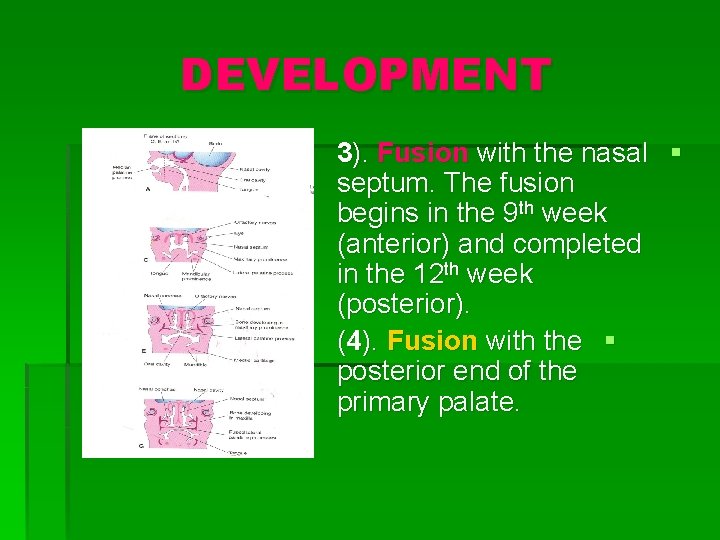
DEVELOPMENT 3). Fusion with the nasal § septum. The fusion begins in the 9 th week (anterior) and completed in the 12 th week (posterior). (4). Fusion with the § posterior end of the primary palate.
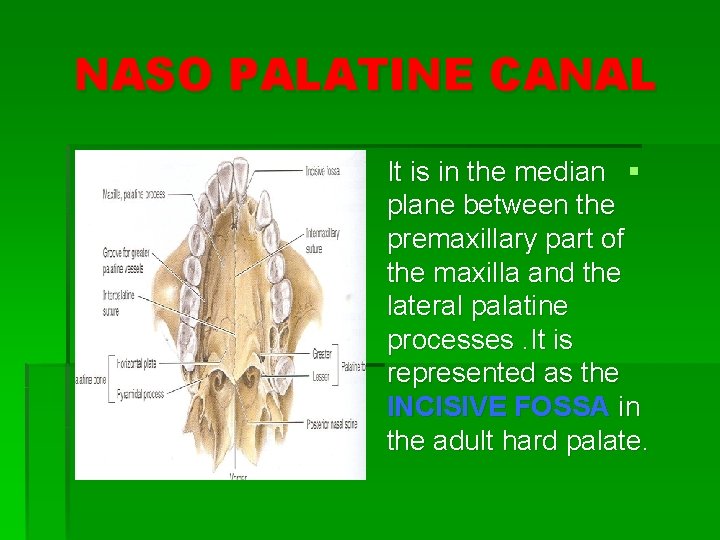
NASO PALATINE CANAL It is in the median § plane between the premaxillary part of the maxilla and the lateral palatine processes. It is represented as the INCISIVE FOSSA in the adult hard palate.
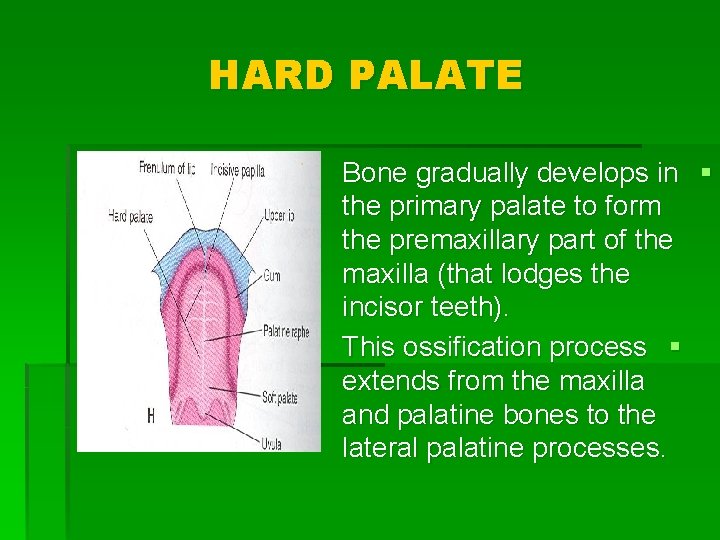
HARD PALATE Bone gradually develops in § the primary palate to form the premaxillary part of the maxilla (that lodges the incisor teeth). This ossification process § extends from the maxilla and palatine bones to the lateral palatine processes.
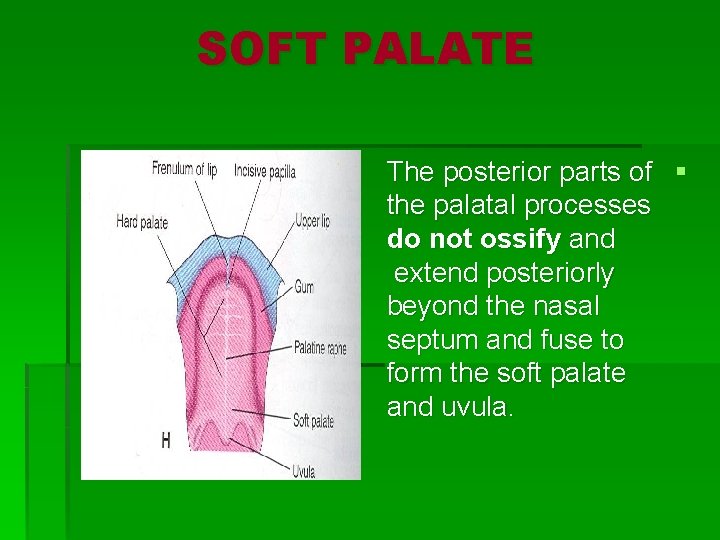
SOFT PALATE The posterior parts of § the palatal processes do not ossify and extend posteriorly beyond the nasal septum and fuse to form the soft palate and uvula.
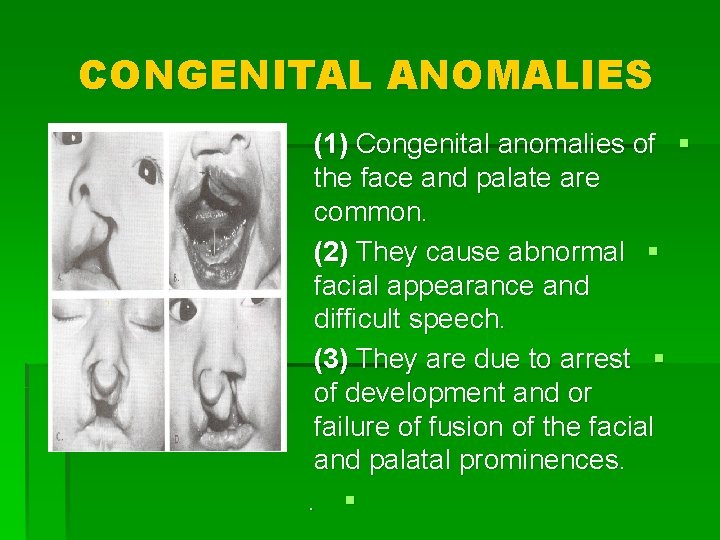
CONGENITAL ANOMALIES (1) Congenital anomalies of § the face and palate are common. (2) They cause abnormal § facial appearance and difficult speech. (3) They are due to arrest § of development and or failure of fusion of the facial and palatal prominences. . §
CAUSES inductive combination of § genetic and environmental factors ( teratogenic agents, chromosomal syndromes). They interfere with the § development of the neural crest tissue as regards : number, incomplete migration into the prominences of the 1 st pharyngeal arch or failure of their capacity.
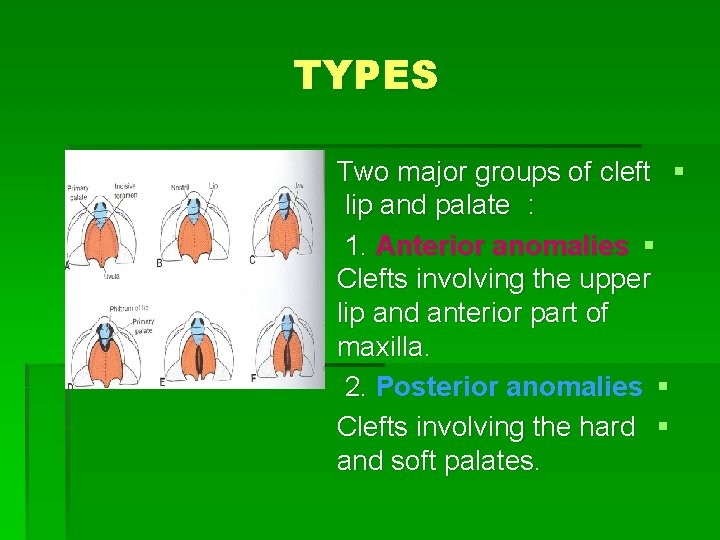
TYPES Two major groups of cleft § lip and palate : 1. Anterior anomalies § Clefts involving the upper lip and anterior part of maxilla. 2. Posterior anomalies § Clefts involving the hard § and soft palates.
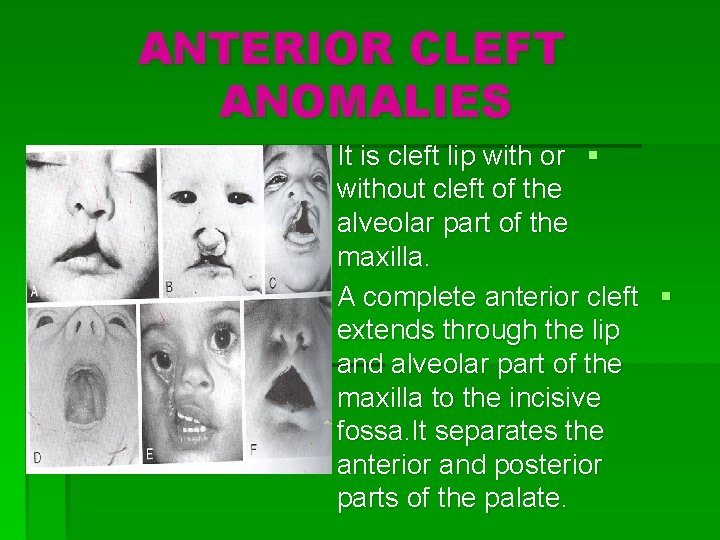
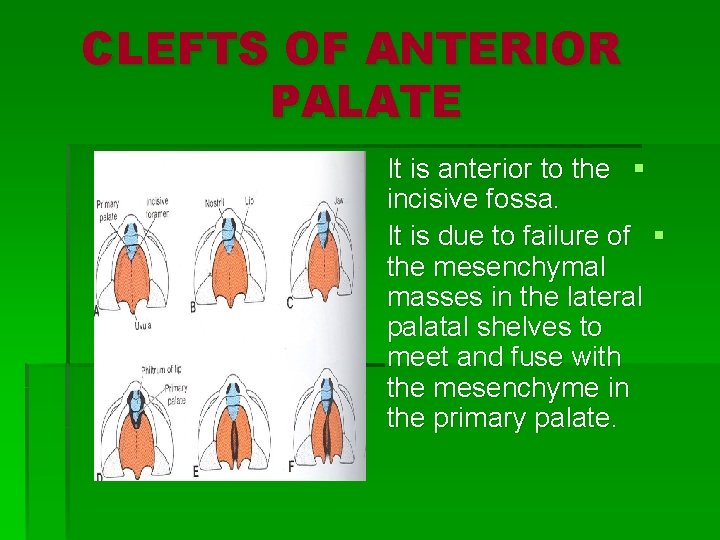
ANTERIOR CLEFT ANOMALIES It is cleft lip with or § without cleft of the alveolar part of the maxilla. A complete anterior cleft § extends through the lip and alveolar part of the maxilla to the incisive fossa. It separates the anterior and posterior parts of the palate.
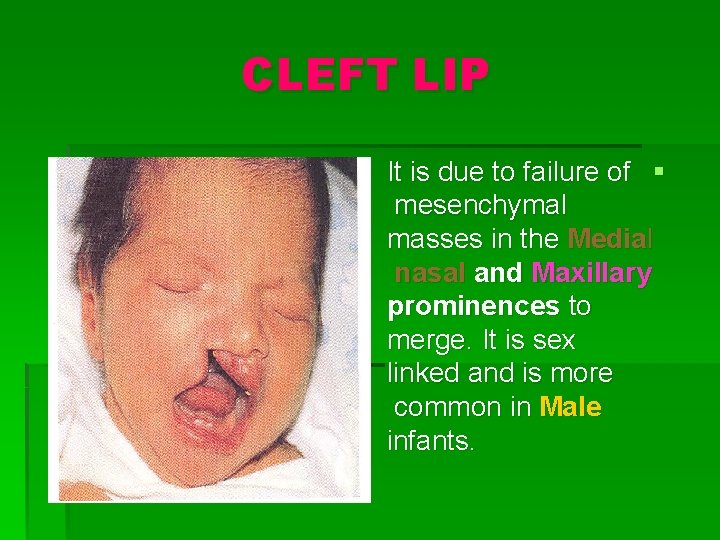
CLEFT LIP It is due to failure of § mesenchymal masses in the Medial nasal and Maxillary prominences to merge. It is sex linked and is more common in Male infants.
CLEFT PALATE It is due to failure of § mesenchymal masses in the palatine processes to meet and fuse. It is more common in Females. The incisive fossa is § used as a land mark to distinguish between anterior and posterior cleft palate anomalies.
CLEFTS OF ANTERIOR PALATE It is anterior to the § incisive fossa. It is due to failure of § the mesenchymal masses in the lateral palatal shelves to meet and fuse with the mesenchyme in the primary palate.
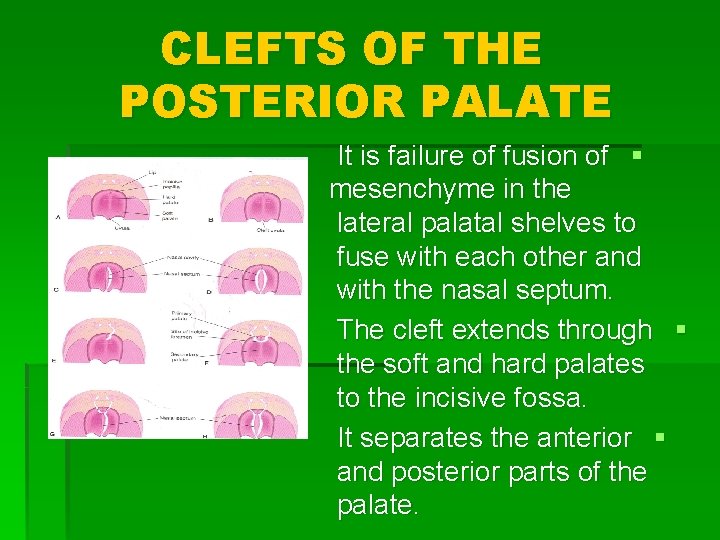
CLEFTS OF THE POSTERIOR PALATE It is failure of fusion of § mesenchyme in the lateral palatal shelves to fuse with each other and with the nasal septum. The cleft extends through § the soft and hard palates to the incisive fossa. It separates the anterior § and posterior parts of the palate.
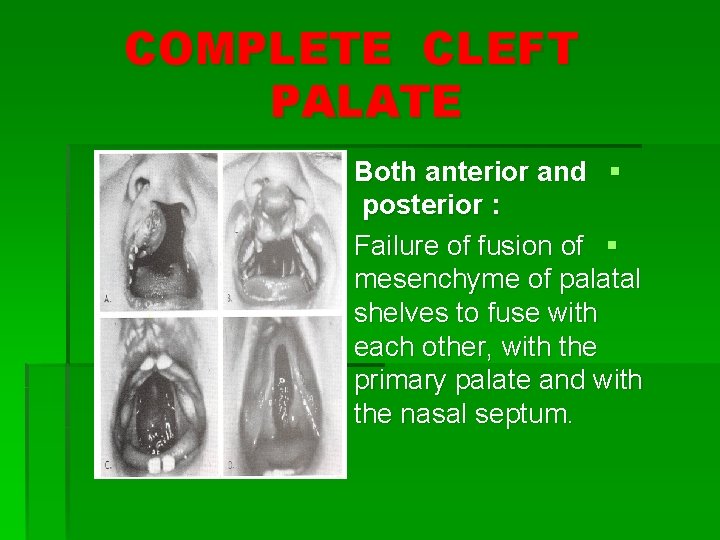
COMPLETE CLEFT PALATE Both anterior and § posterior : Failure of fusion of § mesenchyme of palatal shelves to fuse with each other, with the primary palate and with the nasal septum.