
FACE Future Adaptive Communication Environment Paul Dalsgaard Center
- Slides: 14
FACE Future Adaptive Communication Environment Paul Dalsgaard Center for Person. Kommunikation Aalborg University 3/1/2021 1
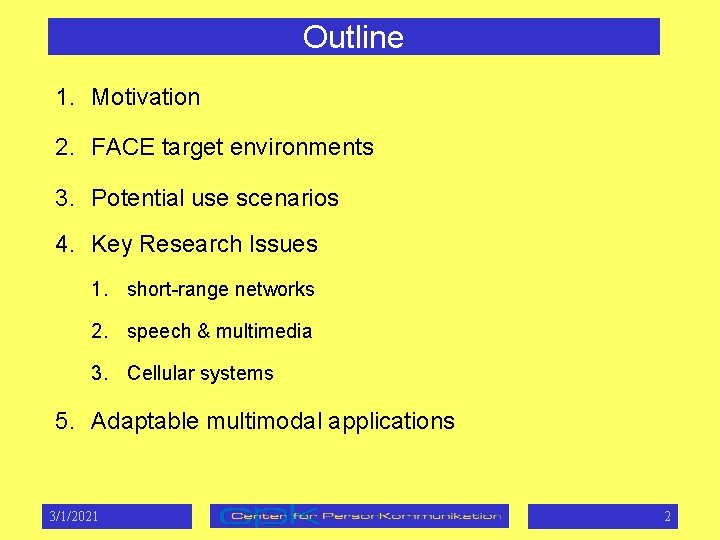
Outline 1. Motivation 2. FACE target environments 3. Potential use scenarios 4. Key Research Issues 1. short-range networks 2. speech & multimedia 3. Cellular systems 5. Adaptable multimodal applications 3/1/2021 2
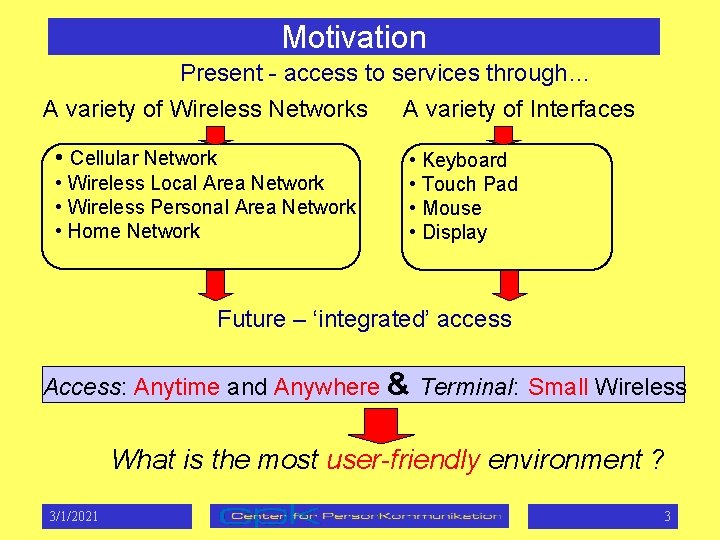
Motivation Present - access to services through… A variety of Wireless Networks • Cellular Network • Wireless Local Area Network • Wireless Personal Area Network • Home Network A variety of Interfaces • Keyboard • Touch Pad • Mouse • Display Future – ‘integrated’ access Access: Anytime and Anywhere & Terminal: Small Wireless What is the most user-friendly environment ? 3/1/2021 3
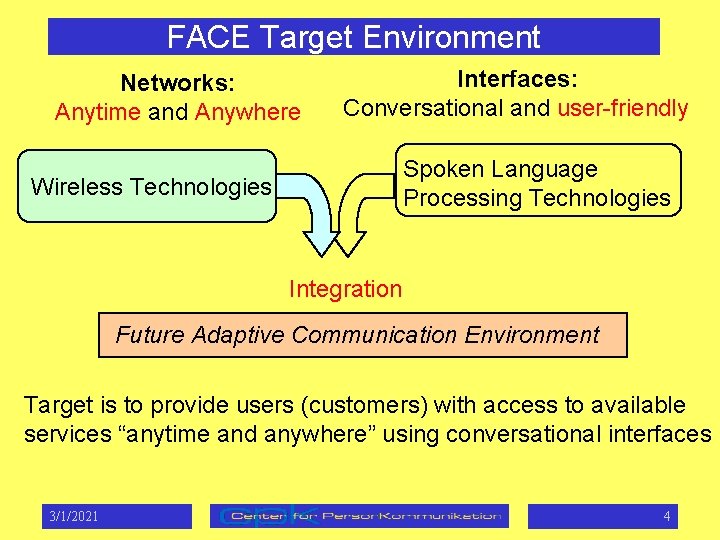
FACE Target Environment Networks: Anytime and Anywhere Interfaces: Conversational and user-friendly Spoken Language Processing Technologies Wireless Technologies Integration Future Adaptive Communication Environment Target is to provide users (customers) with access to available services “anytime and anywhere” using conversational interfaces 3/1/2021 4
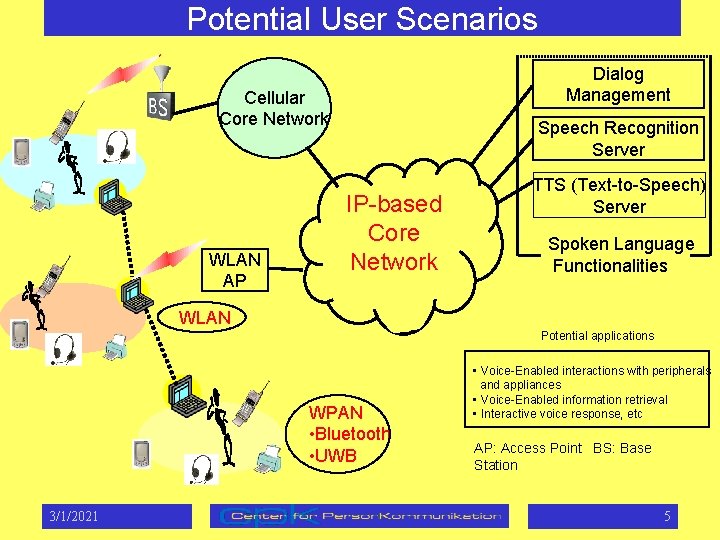
Potential User Scenarios Dialog Management Cellular Core Network WLAN AP Speech Recognition Server IP-based Core Network TTS (Text-to-Speech) Server Spoken Language Functionalities WLAN Potential applications WPAN • Bluetooth • UWB 3/1/2021 • Voice-Enabled interactions with peripherals and appliances • Voice-Enabled information retrieval • Interactive voice response, etc AP: Access Point BS: Base Station 5
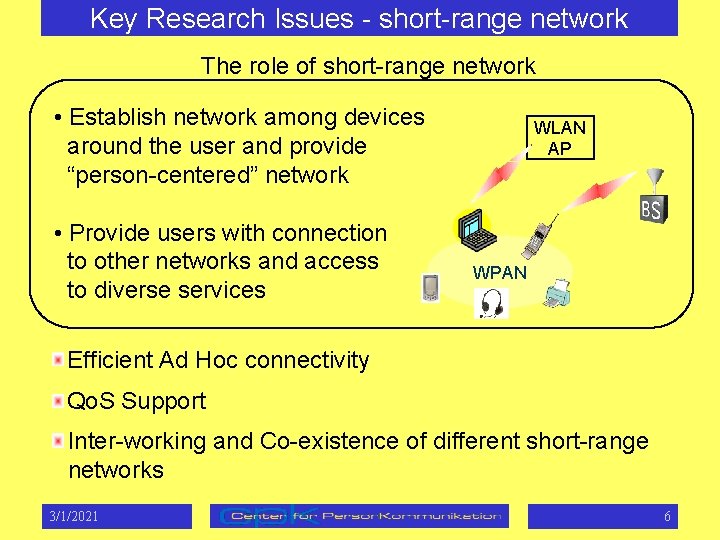
Key Research Issues - short-range network The role of short-range network • Establish network among devices around the user and provide “person-centered” network • Provide users with connection to other networks and access to diverse services WLAN AP WPAN Efficient Ad Hoc connectivity Qo. S Support Inter-working and Co-existence of different short-range networks 3/1/2021 6
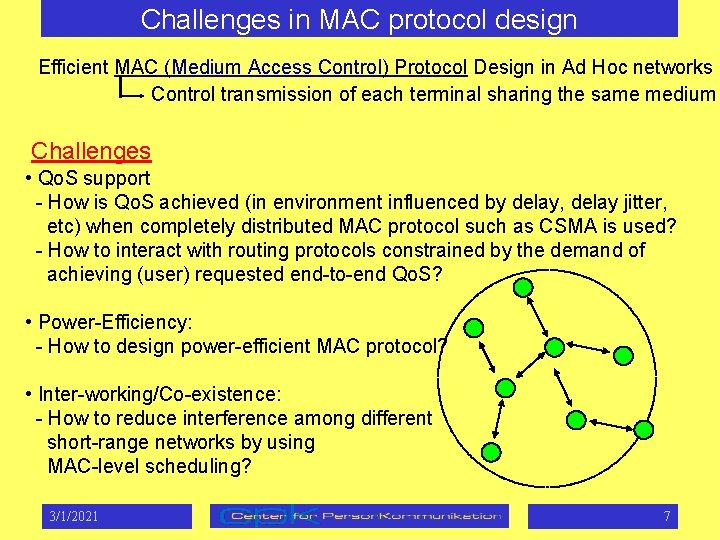
Challenges in MAC protocol design Efficient MAC (Medium Access Control) Protocol Design in Ad Hoc networks Control transmission of each terminal sharing the same medium Challenges • Qo. S support - How is Qo. S achieved (in environment influenced by delay, delay jitter, etc) when completely distributed MAC protocol such as CSMA is used? - How to interact with routing protocols constrained by the demand of achieving (user) requested end-to-end Qo. S? • Power-Efficiency: - How to design power-efficient MAC protocol? • Inter-working/Co-existence: - How to reduce interference among different short-range networks by using MAC-level scheduling? 3/1/2021 7
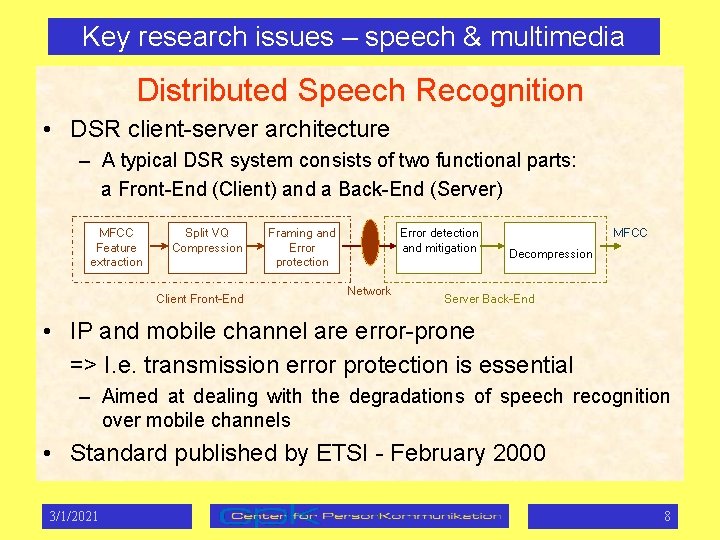
Key research issues – speech & multimedia Distributed Speech Recognition • DSR client-server architecture – A typical DSR system consists of two functional parts: a Front-End (Client) and a Back-End (Server) MFCC Feature extraction Split VQ Compression Client Front-End Framing and Error protection Error detection and mitigation Network MFCC Decompression Server Back-End • IP and mobile channel are error-prone => I. e. transmission error protection is essential – Aimed at dealing with the degradations of speech recognition over mobile channels • Standard published by ETSI - February 2000 3/1/2021 8
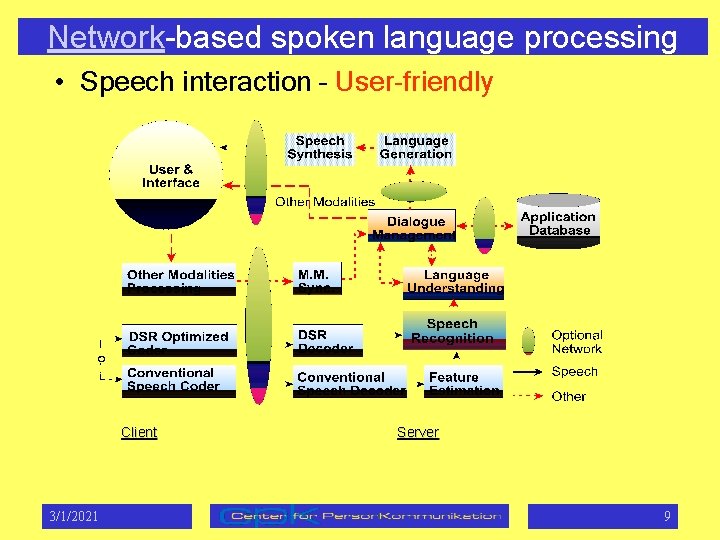
Network-based spoken language processing • Speech interaction – User-friendly Client 3/1/2021 Server 9
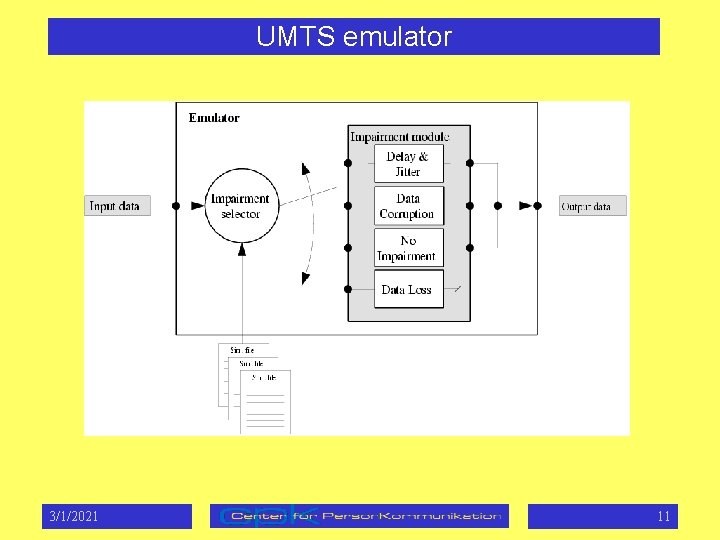
Key research issues – Cellular systems • Development of emulator for UMTS network behaviour • Investigating the performance of application layer protocols over a UMTS network • Application data sent through emulator for modification similar to real UMTS network • Evaluation and tests conducted in conjunction with DSR system 3/1/2021 10
UMTS emulator 3/1/2021 11
Speech results – so far • Frame-based error protection scheme – is able to better maintain the recognition rates, compared to the ETSI-DSR frame-pair scheme – at the cost of only a marginal increase in bit-rate, from 4, 800 bits/s to 5, 000 bits/s for which there is plenty of bandwidth available in GSM and higher bandwidth wireless channels • A FER-based OOV detection – has proven successful in maintaining a constant false rejection rate across a range of transmission error rates • Further research – The principle of exploiting information about the channel will be used to adapt dialogue, grammars and vocabularies => self-adaptable and re-configurable spoken language system. 3/1/2021 12
Adaptable multimodal applications • Exploiting information about the quality of transmission channel – e. g. fading channels, overloading services, congested networks and degraded acoustic environments • to adapt dialogues, applied grammars and vocabularies in DSR • Such further research will enable – Self-adaptability and graceful modification of the behaviour of a given dialogue application (as given by current quality of the channel) – The end-user is offered a system that give optimal “Perceived Quality of Service” ? Equal to User-friendliness ? 3/1/2021 13
Thank you for your attention 3/1/2021 14