
Face Detection Recognition and Pose Estimation By Vardan
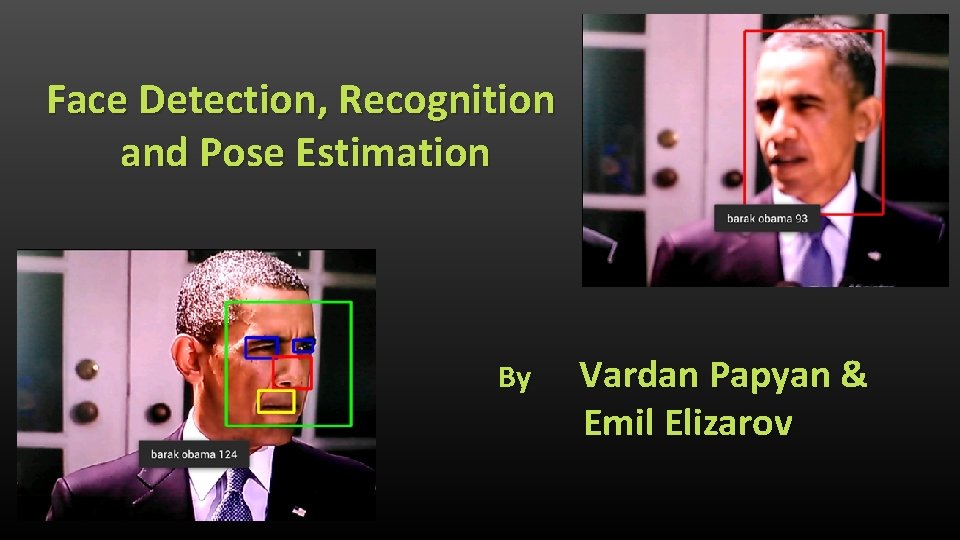
Face Detection, Recognition and Pose Estimation By Vardan Papyan & Emil Elizarov
Our project was divided into several parts • The first part was making an Android Application on Qualcomm’s phone using Open. CV library • The second part was analyzing the application’s accuracy • The third part was research in Matlab which included pose estimation and improved face recognition.
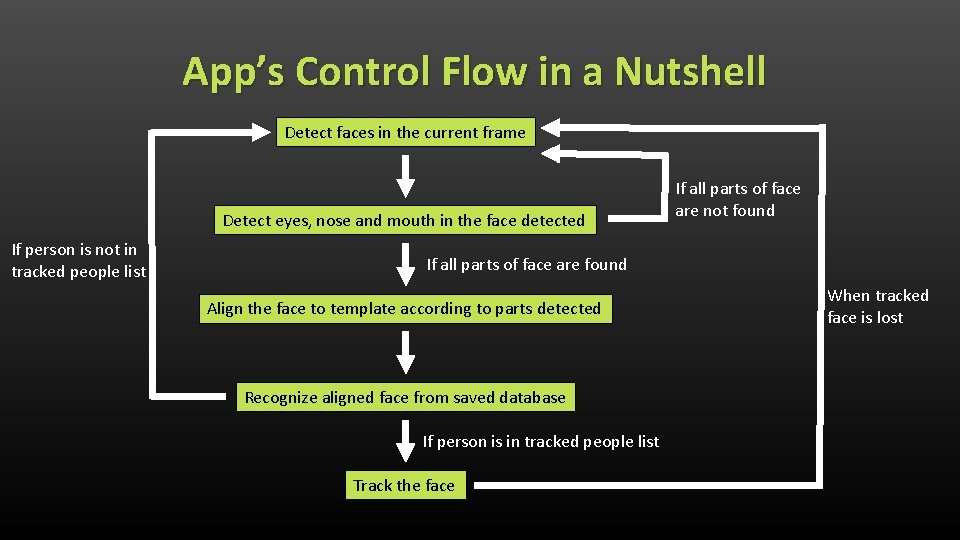
App’s Control Flow in a Nutshell Detect faces in the current frame Detect eyes, nose and mouth in the face detected If person is not in tracked people list If all parts of face are not found If all parts of face are found Align the face to template according to parts detected Recognize aligned face from saved database If person is in tracked people list Track the face When tracked face is lost
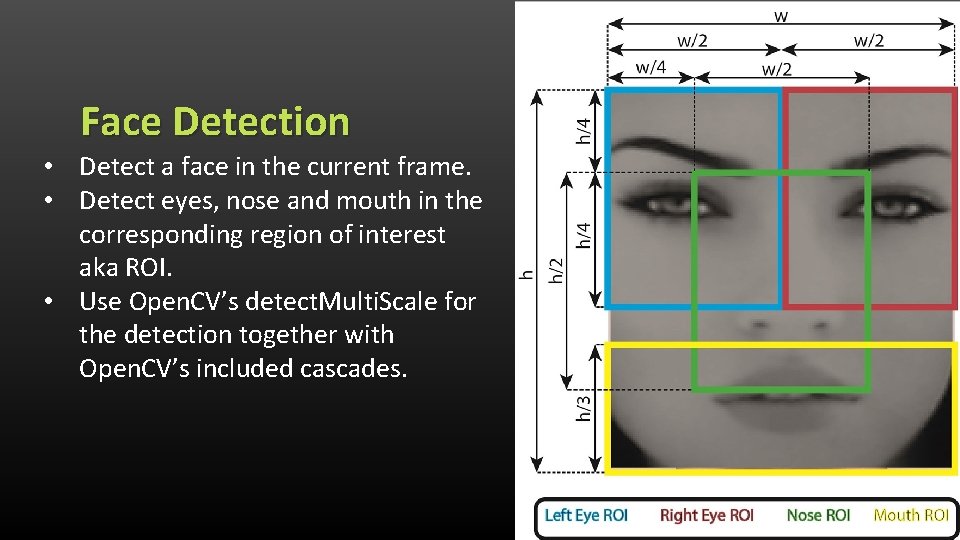
Face Detection • Detect a face in the current frame. • Detect eyes, nose and mouth in the corresponding region of interest aka ROI. • Use Open. CV’s detect. Multi. Scale for the detection together with Open. CV’s included cascades.

Face Aligment • Align the face to predetermined template of an average face • Use Open. CV’s warp. Affine function for the aligment.
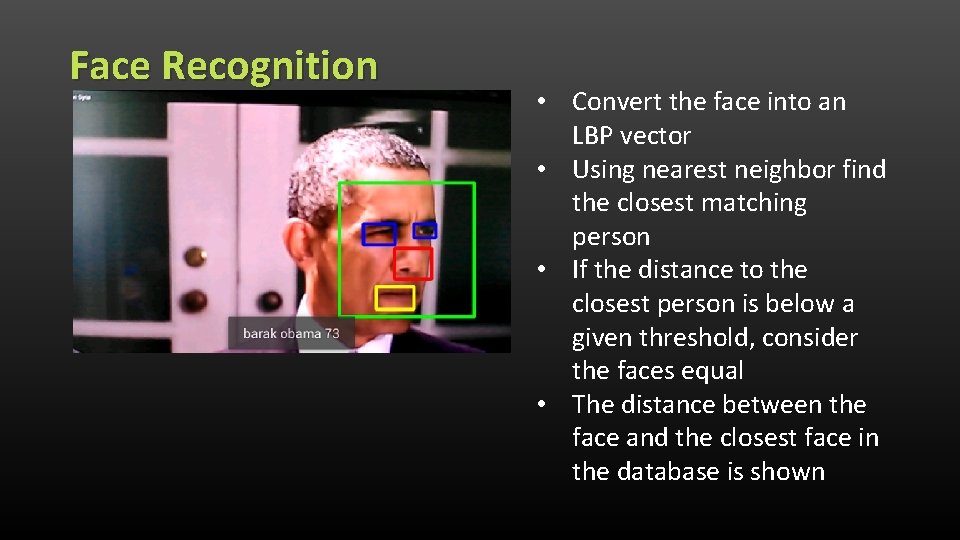
Face Recognition • Convert the face into an LBP vector • Using nearest neighbor find the closest matching person • If the distance to the closest person is below a given threshold, consider the faces equal • The distance between the face and the closest face in the database is shown
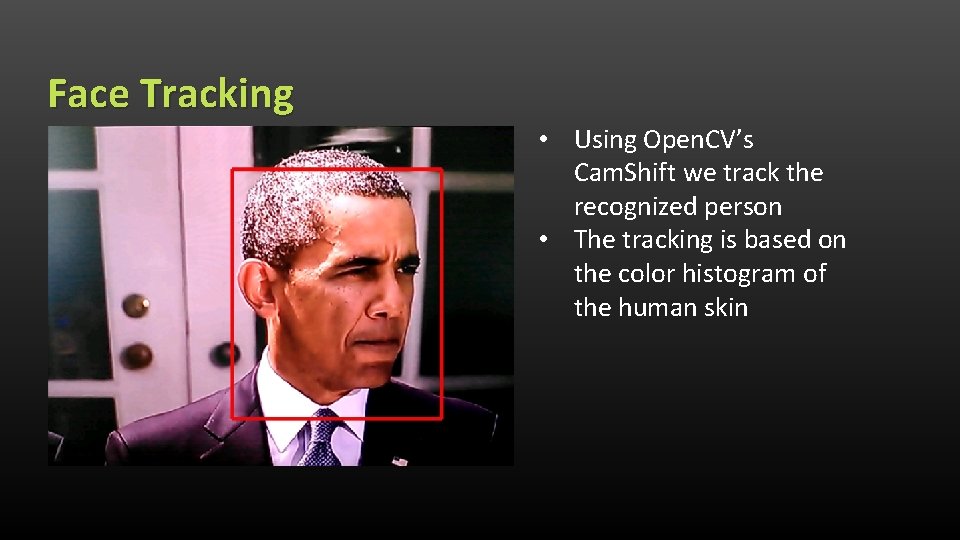
Face Tracking • Using Open. CV’s Cam. Shift we track the recognized person • The tracking is based on the color histogram of the human skin
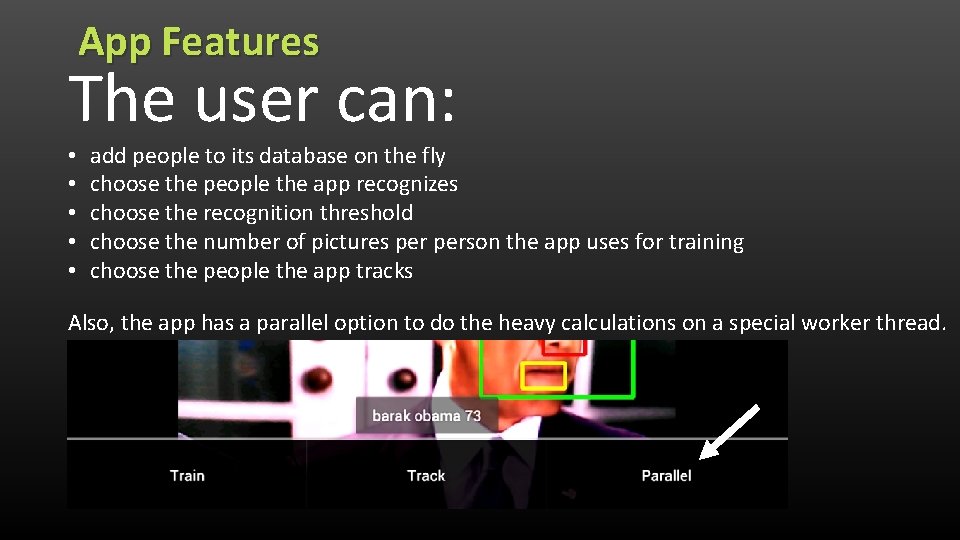
App Features The user can: • • • add people to its database on the fly choose the people the app recognizes choose the recognition threshold choose the number of pictures person the app uses for training choose the people the app tracks Also, the app has a parallel option to do the heavy calculations on a special worker thread.
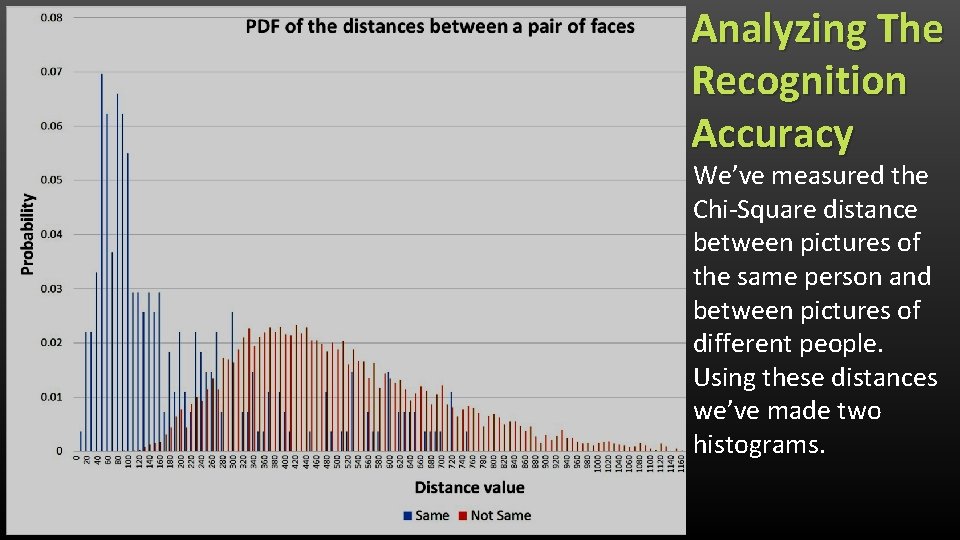
Analyzing The Recognition Accuracy We’ve measured the Chi-Square distance between pictures of the same person and between pictures of different people. Using these distances we’ve made two histograms.
ROC By choosing a threshold for determining whether two pictures are of the same person we receive a true positive rate and a false positive rate. We then choose different thresholds and receive the ROC curve.
MATLAB Research We’ve tried to achieve the following with our MATLAB research: • Face pose estimation using LDA. The three categories were frontal, left profile and right profile. • Improvement in face recognition accuracy using PCA and LDA.
Face Pose Estimation We’ve used LDA in order to reduce the dimensionality of our LBP representation for us to be able to classify the correct pose. This graph shows the L 2 norm distance between the dimensionally reduced vectors.
Face Recognition Improvement LDA Only Using LDA only in order to recognize faces yielded bad results. We could not separate same from not same properly.
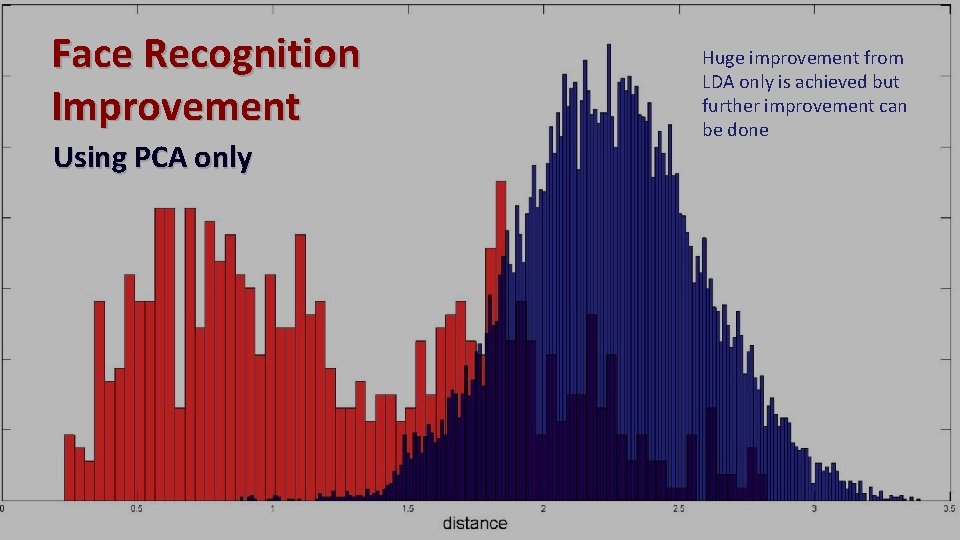
Face Recognition Improvement Using PCA only Huge improvement from LDA only is achieved but further improvement can be done
Face Recognition Improvement Using PCA and then LDA Best results achieved in the project
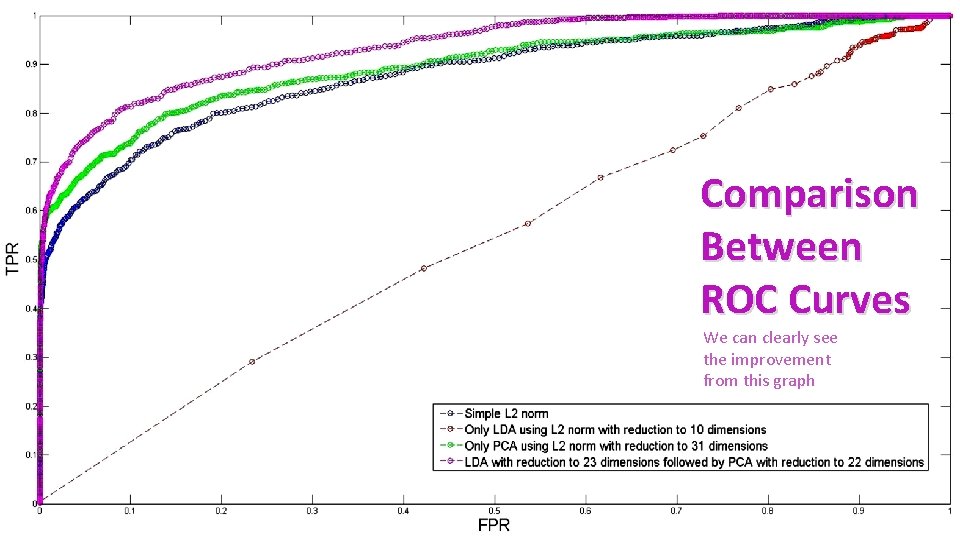
Comparison Between ROC Curves We can clearly see the improvement from this graph
- Slides: 16