
Face Classification A Specialized Benchmark Study Jiali Duan

Face Classification: A Specialized Benchmark Study Jiali Duan, Shengcai Liao, Shuai Zhou, and Stan Z. Li Center for Biometrics and Security Research Institute of Automation, Chinese Academy of Sciences

Introduction Face detection: foundations for high-level facial analysis Face Alignment Face Recognition Age Prediction
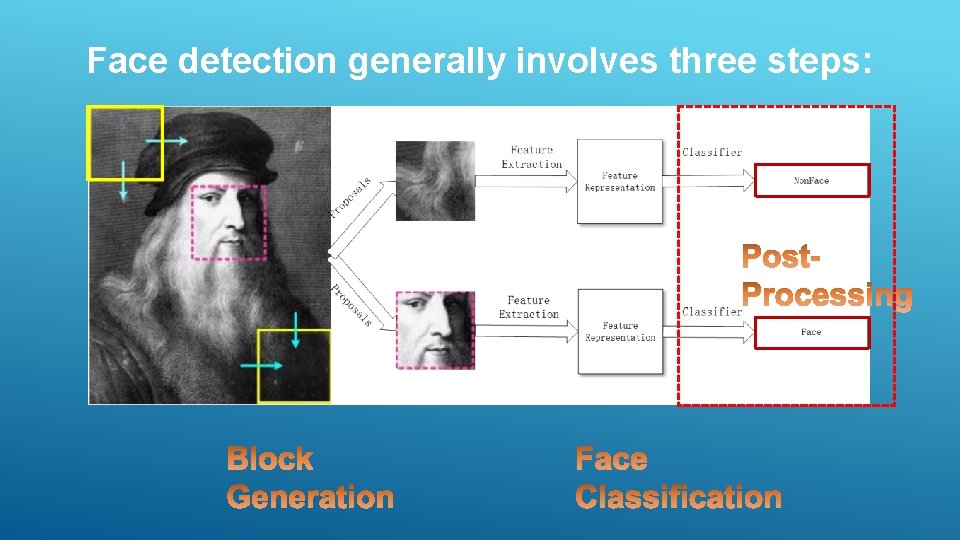
Face detection generally involves three steps:
Drawbacks of Existing Benchmarks 1. Performance of Face Classification itself is hard to determine Ø Face detection is largely influenced by block generation and post processing methods 2. Implementing and optimizing all the three steps results in a very heavy work
Contributions 1. Conducted a specialized benchmark study, focusing purely on face classification Ø A benchmark dataset with >3. 5 million samples 2. Reported performance of various feature extraction and classification methods Ø Poor performance even with CNN! 3. Dataset and code released
![Related Works 1. AFW [1] 2. FDDB [2] 3. WIDER FACE [3] [1] Zhu,](http://slidetodoc.com/presentation_image_h/75cf971cba2047f1e0e332f0ed8f8b6e/image-6.jpg "Related Works 1. AFW [1] 2. FDDB [2] 3. WIDER FACE [3] [1] Zhu,")
Related Works 1. AFW [1] 2. FDDB [2] 3. WIDER FACE [3] [1] Zhu, Xiangxin and Ramanan, Deva. Face detection, pose estimation, and landmark localization in the wild, CVPR 2012. [2] Vidit Jain and Erik Learned-Miller. FDDB: A Benchmark for Face Detection in Unconstrained Settings. Tech. Report: UM-CS-2010 -009, 2010 [3] Yang, Shuo and Luo, Ping and Loy, Chen Change and Tang, Xiaoou. WIDER FACE: A Face Detection Benchmark. CVPR 2016.
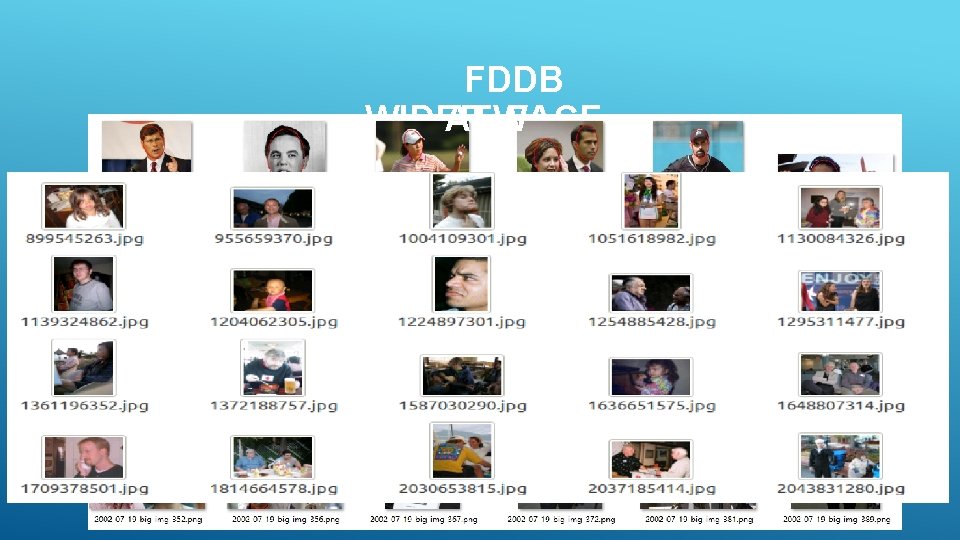
FDDB WIDER AFW FACE
The Proposed Face Classificaiton Benchmark (FCB) 1. RPN network is trained to extract face proposals [1, 2] 2. Generic object proposal generating methods such as [3] are not suitable Ø Rare true faces 1. Ren S, He K, Girshick R, et al. Faster R-CNN: Towards real-time object detec-tion with region proposal networks. NIPS 2015. 2. Jiang H, Learned-Miller E. Face Detection with the Faster R-CNN. ar. Xiv 2016. 3. Van de Sande K E A, Uijlings J R R, Gevers T, et al. Segmentation as selectivesearch for object recognition. ICCV 2011.
![Some Specifics 1. Using Zeiler and Fergus model [1] 2. Extracted from the WIDER](http://slidetodoc.com/presentation_image_h/75cf971cba2047f1e0e332f0ed8f8b6e/image-9.jpg "Some Specifics 1. Using Zeiler and Fergus model [1] 2. Extracted from the WIDER")
Some Specifics 1. Using Zeiler and Fergus model [1] 2. Extracted from the WIDER FACE [2] 1. Zeiler M D, Fergus R. Visualizing and understanding convolutional networks. ECCV 2014. 2. Yang, Shuo and Luo, Ping and Loy, Chen Change and Tang, Xiaoou. WIDER FACE: A Face Detection Benchmark. CVPR 2016.
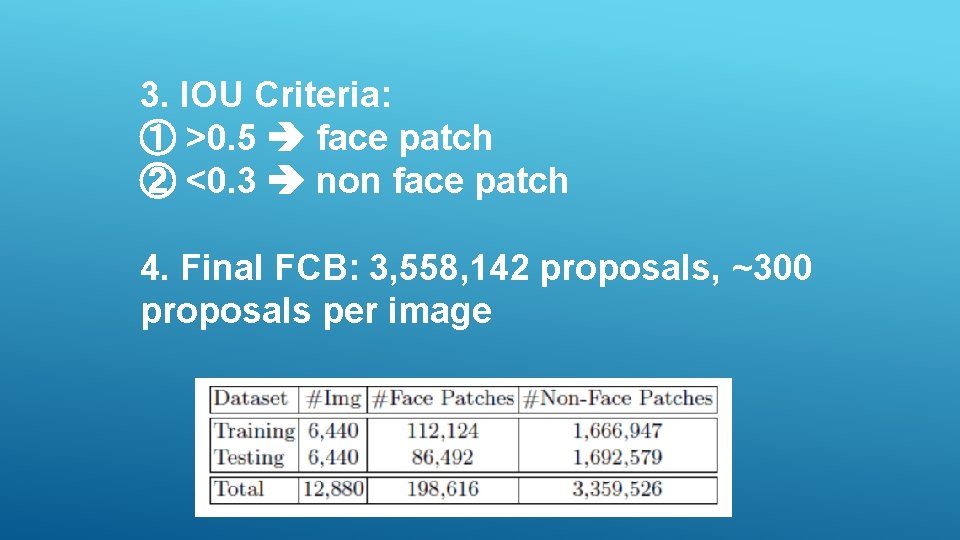
3. IOU Criteria: ① >0. 5 face patch ② <0. 3 non face patch 4. Final FCB: 3, 558, 142 proposals, ~300 proposals per image
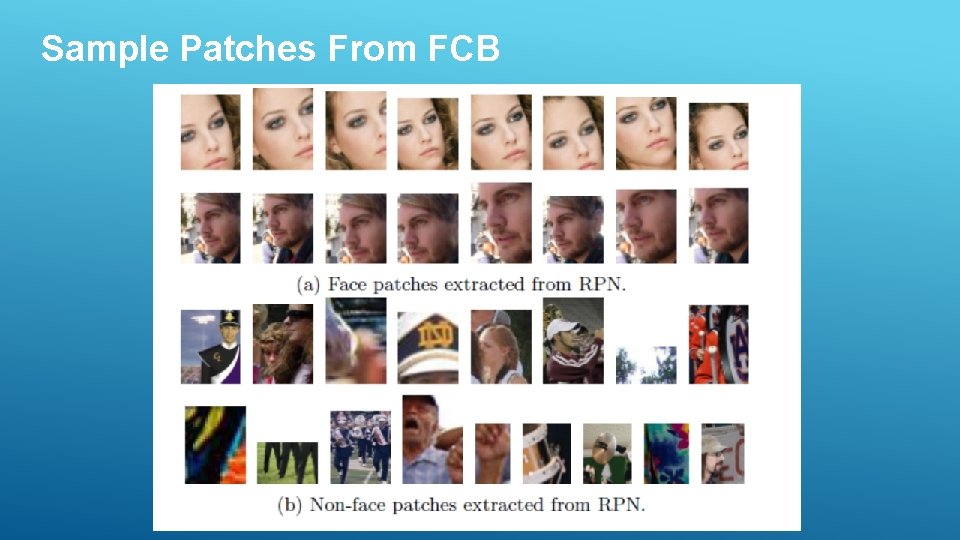
Sample Patches From FCB
Benchmark Protocol 1. Half for training, the other half for test 2. Evaluation metrics: FAR and TPR 3. Looking at FAR=10− 3 , FPPI ~= 0. 28
Evaluation Traditional Methods: 1. Features: LBP, MB-LBP, NPD, LOMO 2. Classifiers: SVM, DQT+Ada. Boost
![CNN Methods: 1. CIFAR-10 Net based binary classification CNN [1] 2. Cascade-CNN [2] 1.](http://slidetodoc.com/presentation_image_h/75cf971cba2047f1e0e332f0ed8f8b6e/image-14.jpg "CNN Methods: 1. CIFAR-10 Net based binary classification CNN [1] 2. Cascade-CNN [2] 1.")
CNN Methods: 1. CIFAR-10 Net based binary classification CNN [1] 2. Cascade-CNN [2] 1. The CIFAR-10 dataset, https: //www. cs. toronto. edu/~kriz/cifar. html 2. Li H, Lin Z, Shen X, et al. A convolutional neural network cascade for face detection, CVPR 2015.
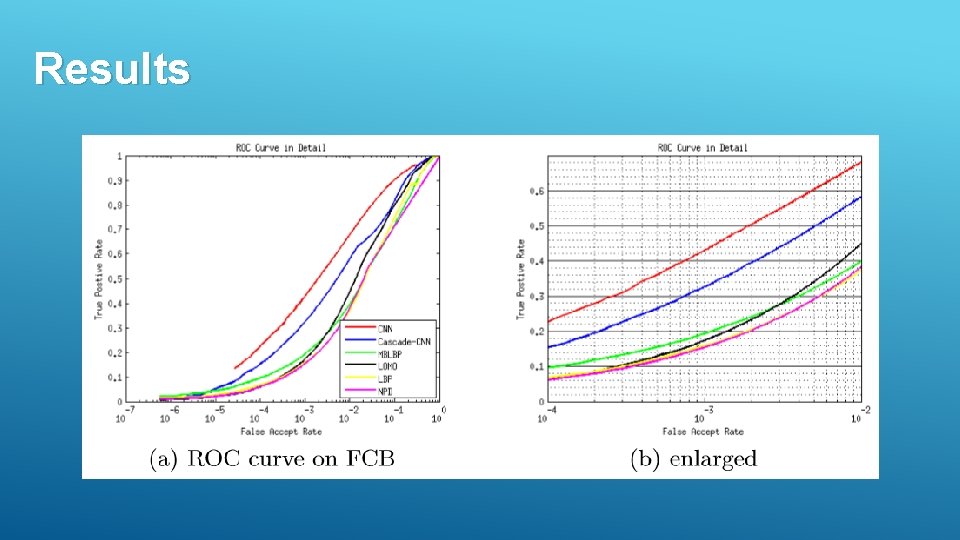
Results
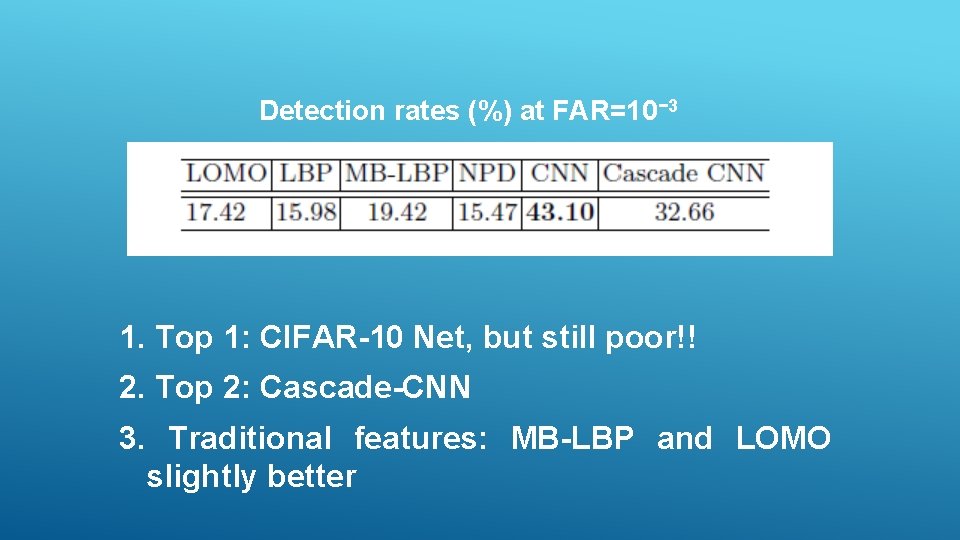
Detection rates (%) at FAR=10− 3 1. Top 1: CIFAR-10 Net, but still poor!! 2. Top 2: Cascade-CNN 3. Traditional features: MB-LBP and LOMO slightly better
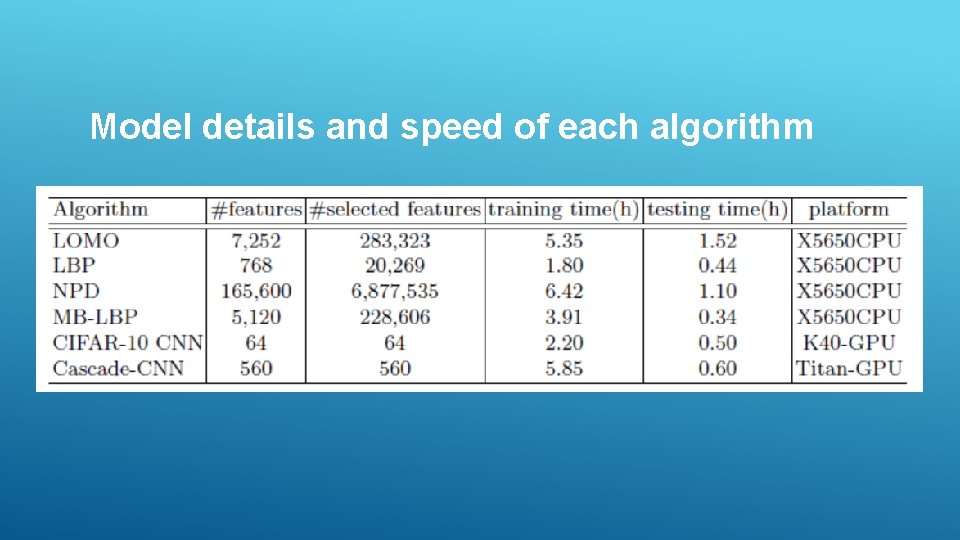
Model details and speed of each algorithm
Conclusions 1. A benchmark dataset Ø >3. 5 millions of samples Ø Face classification only Ø Data and code released 2. Face classification alone is still poor 3. Pre-processing and post-processing is important for face detection 4. Therefore, face classification needs to be separately evaluated

Face Classification: A Specialized Benchmark Study Jiali Duan, Shengcai Liao, Shuai Zhou, and Stan Z. Li Center for Biometrics and Security Research Institute of Automation, Chinese Academy of Sciences Project Page: https: //davidsonic. github. io/index/ccbr_2016
- Slides: 19