
Face and Brow presentations Dr Ali F AlAssadi

Face and Brow presentations Dr. Ali F. Al-Assadi Prof. of obstetrics & Gynecology Basra Medical College
Face presentation; • Occur 1: 300 -500 deliveries. • Causes: • A- primary: (before the onset of labor) 1. The most common is normal fetus actively holds its head extended ( in 50% of cases). 2. Anencephaly. 3. Prematurity. 4. Contracted pelvis. 5. Multiple pregnancies. 6. Cord around neck or neck tumors. 7. Polyhydramnios. 8. Multiparity. • B-Secondary: (the commonest) arise during labour eg. Extension of brow to face.
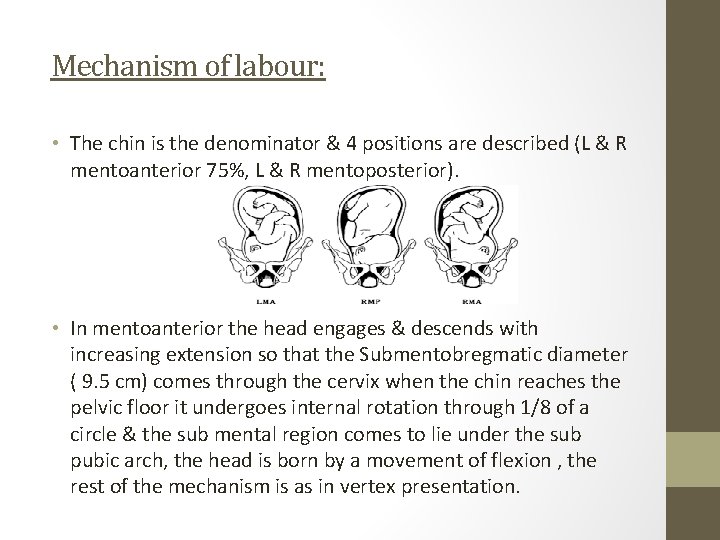
Mechanism of labour: • The chin is the denominator & 4 positions are described (L & R mentoanterior 75%, L & R mentoposterior). • In mentoanterior the head engages & descends with increasing extension so that the Submentobregmatic diameter ( 9. 5 cm) comes through the cervix when the chin reaches the pelvic floor it undergoes internal rotation through 1/8 of a circle & the sub mental region comes to lie under the sub pubic arch, the head is born by a movement of flexion , the rest of the mechanism is as in vertex presentation.
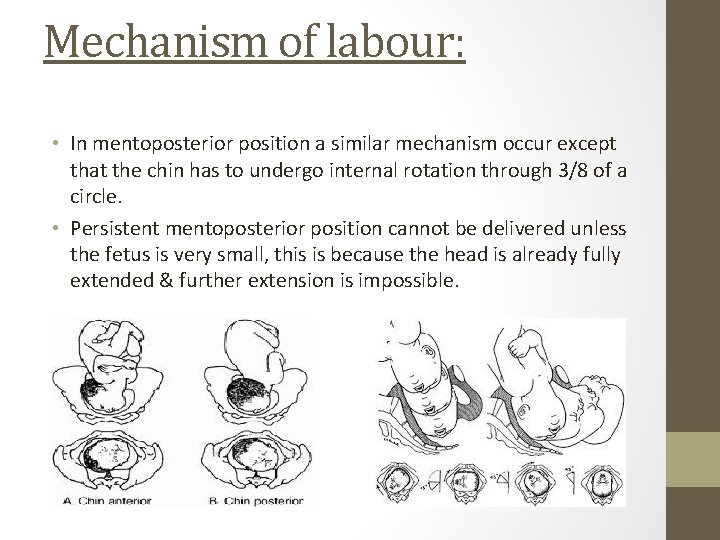
Mechanism of labour: • In mentoposterior position a similar mechanism occur except that the chin has to undergo internal rotation through 3/8 of a circle. • Persistent mentoposterior position cannot be delivered unless the fetus is very small, this is because the head is already fully extended & further extension is impossible.
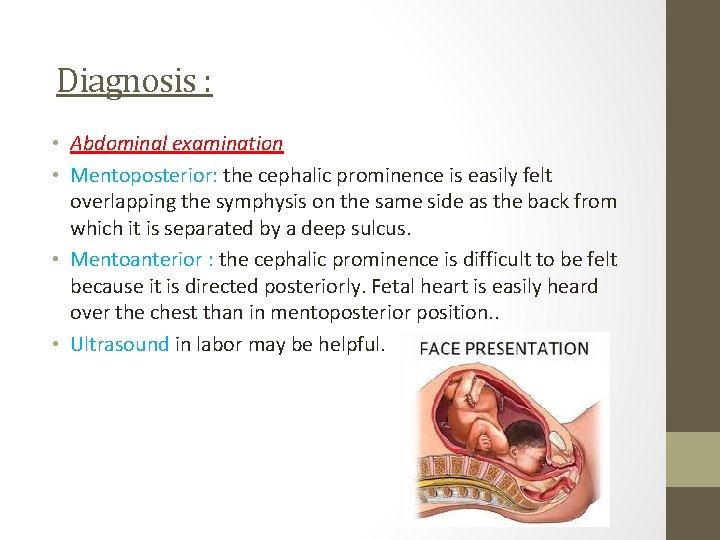
Diagnosis : • Abdominal examination • Mentoposterior: the cephalic prominence is easily felt overlapping the symphysis on the same side as the back from which it is separated by a deep sulcus. • Mentoanterior : the cephalic prominence is difficult to be felt because it is directed posteriorly. Fetal heart is easily heard over the chest than in mentoposterior position. . • Ultrasound in labor may be helpful.
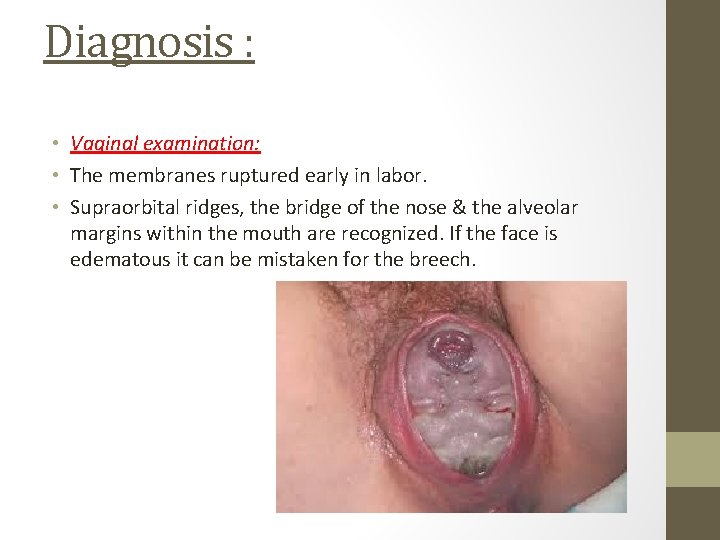
Diagnosis : • Vaginal examination: • The membranes ruptured early in labor. • Supraorbital ridges, the bridge of the nose & the alveolar margins within the mouth are recognized. If the face is edematous it can be mistaken for the breech.
Management • Fetal abnormality & contracted pelvis must be excluded. • CS is indicated in: 1. Old age primigravida. 2. Bad obstetric history. 3. Infertility. 4. Scared uterus. 5. PE 6. placenta previa. 7. Fetal weight > 3. 5 kg. • Epidural anesthesia or perineal infiltration is important for episiotomy or instrumental delivery.
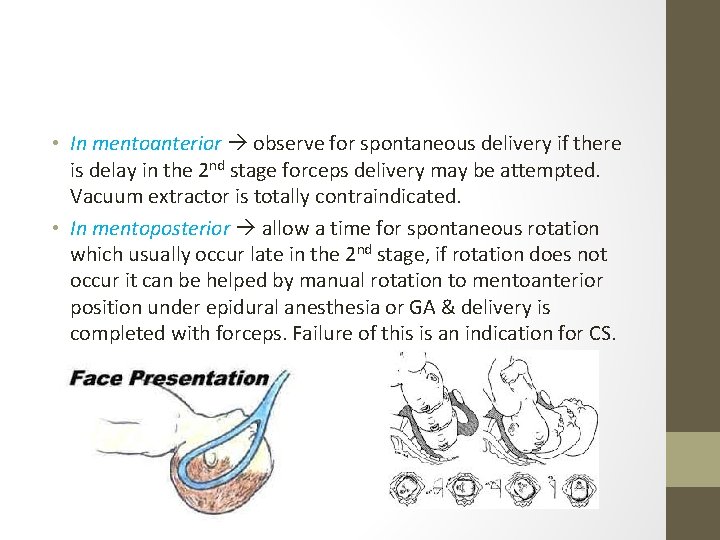
• In mentoanterior observe for spontaneous delivery if there is delay in the 2 nd stage forceps delivery may be attempted. Vacuum extractor is totally contraindicated. • In mentoposterior allow a time for spontaneous rotation which usually occur late in the 2 nd stage, if rotation does not occur it can be helped by manual rotation to mentoanterior position under epidural anesthesia or GA & delivery is completed with forceps. Failure of this is an indication for CS.
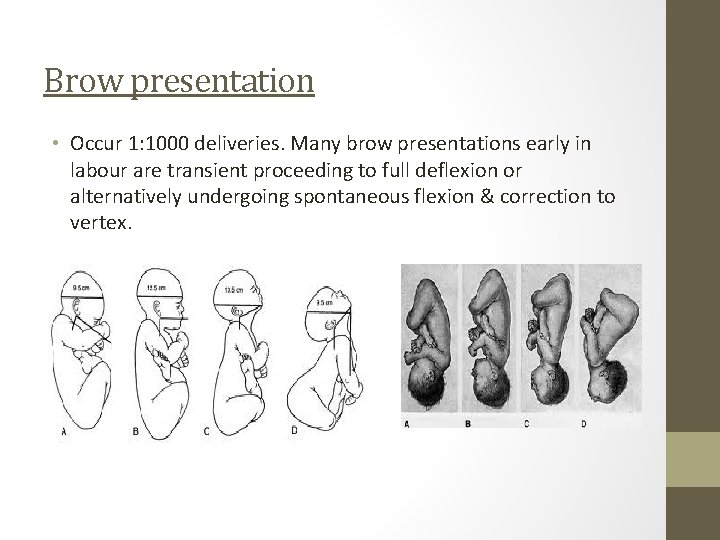
Brow presentation • Occur 1: 1000 deliveries. Many brow presentations early in labour are transient proceeding to full deflexion or alternatively undergoing spontaneous flexion & correction to vertex.
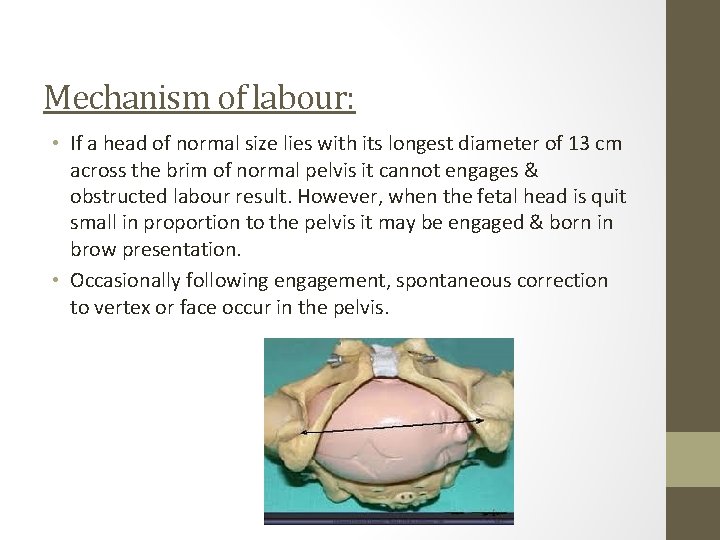
Mechanism of labour: • If a head of normal size lies with its longest diameter of 13 cm across the brim of normal pelvis it cannot engages & obstructed labour result. However, when the fetal head is quit small in proportion to the pelvis it may be engaged & born in brow presentation. • Occasionally following engagement, spontaneous correction to vertex or face occur in the pelvis.
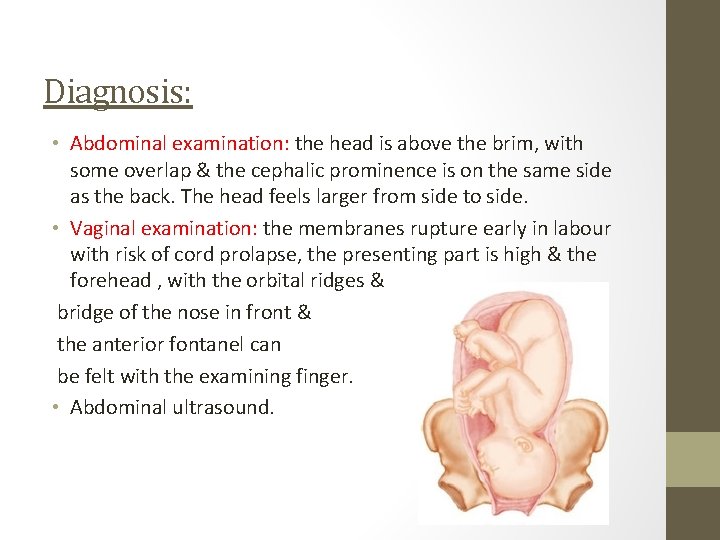
Diagnosis: • Abdominal examination: the head is above the brim, with some overlap & the cephalic prominence is on the same side as the back. The head feels larger from side to side. • Vaginal examination: the membranes rupture early in labour with risk of cord prolapse, the presenting part is high & the forehead , with the orbital ridges & bridge of the nose in front & the anterior fontanel can be felt with the examining finger. • Abdominal ultrasound.
Management: • If diagnosed during the antenatal period congenital malformations & CPD should be excluded otherwise nothing should be done, as in most cases the head will flex when labour starts & spontaneous delivery will occur. • If diagnosed early in labour & there is no evidence of severe CPD short trial of labour is permitted & this may results in further extension of the head to face presentation & engagement. If the head fails to engage or persistent brow presentation or if there is evidence of disproportion a CS is performed, which is done if fetal distress develop in labour.
- Slides: 12