
Fabry Disease Presentation in Children Dr Michal inbar
Fabry Disease. Presentation in Children Dr. Michal inbar Feigenberg April 10 th, 2019
• Fabry disease is a pan ethnic disorder characterized by a deficiency of the lysosomal enzyme α-galactosidase A, or α-GAL, which leads to accumulation of globotriaosylceramide (GL-3) with the resultant accumulation of glycosphingolipids in all cells and tissues. • Onset of symptoms can occur very early, although a diagnosis may not be confirmed until there has been considerable accumulation of GL-3. The average of diagnosis is approximately 30 years. • Some “atypical variants” who have few or none of the hallmark symptoms present much later in life (in adulthood) with isolated chronic kidney failure or left ventricular hyperthrophy (LVH). Biegstraaten et al. Orphanet Journal of Rare Diseases (2015) 10: 36

• Most classic Fabry cases result in death due to renal, cardiac, or cerebrovascular complications. • Average life expectancy of an effected male is 58. 2 years compared with 74. 7 years in the general population of the United States. • The life expectancy of females with Fabry disease was 75. 4 years, compared with 80. 0 years in the United States general population. Biegstraaten et al. Orphanet Journal of Rare Diseases (2015) 10: 36
• Fabry disease is X-linked, meaning there is no father-to-son transmission. • Affected fathers will pass the defective gene on to all of their daughters, but none of their sons. An affected father transmits the disease to his grandson through his carrier daughter. Biegstraaten et al. Orphanet Journal of Rare Diseases (2015) 10: 36 • Prevalence ranges of 40, 000 -117, 000. • More than 600 mutations have been recorded. Ellaway C. Transl Pediatr. (2016); 5(1): 37 -42.
Females are not just carriers… • Female heterozygotes can exhibit the same severity of symptoms but are usually more variable and tend to occur later than males. • Some females remain asymptomatic Ellaway C. Transl Pediatr. (2016); 5(1): 37 -42. • Females with Fabry disease manifesting clinical symptoms should be managed identically to males with symptomatic FD. • It has been established that females may develop multi-organ injury similar to male FD patients Hopkins et al, Molecular Genetics and Metabolism 117 (2016) 104– 113

Presentation in Children
• The primary disease process starts during early fetal development. • There is histopathological evidence of GL-3 accumulation in kidney, liver and nerve cells in affected males fetuses. • Corneal whorls have been detected in a 22 -week male fetus. Ellaway C. Transl Pediatr. (2016); 5(1): 37 -42. Picture just for illustration of a fetus taken from: https: //www. whattoexpect. com/pregnancy/fetal-development/fetal-sex-organs-reproductive-system/
• Children mainly presents with acroparaesthesia, angiokeratoma, heat intolerance, cornea verticillata and gastrointestinal symptoms. • The more serious complications occur in adulthood and include progressive renal failure, hypertrophic cardiomyopathy, cerebrovascular disease and reduced life expectancy. • The early symptoms are often non-specific and there is limited awareness of the disorder among clinicians. • Although not life-threatening these symptoms impact on the health, quality of life and function of affected children. Ellaway C. Transl Pediatr. (2016); 5(1): 37 -42.
• Registry data showed the median age of symptom onset in males was 6 and 9 years in females. • The most common presentation was episodic neuropathic pain (acroparaesthesia) at a median age of 7 years in males and a median age of 9 years in females. • Recurrent gastrointestinal symptoms were the second most common feature with median age of onset in males of 5 and 9. 5 years in females. • Hypohidrosis and heat intolerance are also common in the early stage of the disease. Ellaway C. Transl Pediatr. (2016); 5(1): 37 -42.
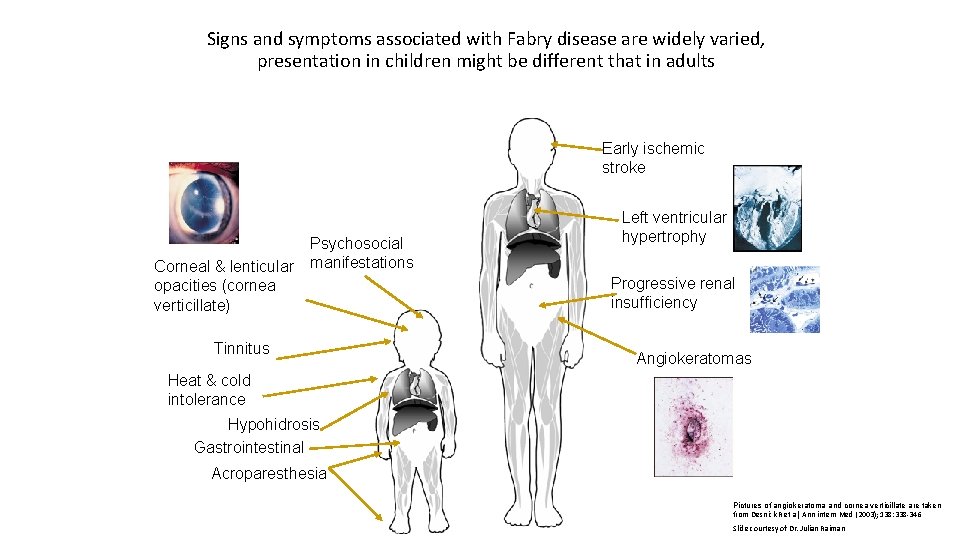
Signs and symptoms associated with Fabry disease are widely varied, presentation in children might be different that in adults Early ischemic stroke Corneal & lenticular opacities (cornea verticillate) Psychosocial manifestations Tinnitus Left ventricular hypertrophy Progressive renal insufficiency Angiokeratomas Heat & cold intolerance Hypohidrosis Gastrointestinal Acroparesthesia Pictures of angiokeratoma and cornea verticillate are taken from Desnick R et al, Ann intern Med (2003); 138: 338 -346 Slide courtesy of Dr. Julian Raiman
Pediatric presentation- Neuropathic pain • Acroparaesthesia is often described by patients as a chronic, tingling, burning sensation in the hands and feet. • Pain crisis is an episodic crises of agonizing pain, usually in the distal extremities. • Pain is triggered by exercise, fatigue, emotional stress, or rapid changes in temperature and humidity. • “Fabry crises” can last from minutes to days, and usually decrease in frequency or severity with increasing age. • Acroparaesthesia has been reported in children as young as 2 years Mehta &Hughes. Gene. Reviews (2017); Ellaway C. Transl Pediatr. (2016); 5(1): 37 -42.
Pediatric presentation- GI symptoms • Significant GI involvement has also been observed in children and can progress in severity with age • Boys tending to have increased severity and earlier presentation than girls • The symptoms present soon after the development of acroparesthesias and can be the initial symptom of Fabry disease in up to 20% of patients Zar-Kessler et al. Therap Adv Gastroenterol (2016). Vol. 9(4) 626 – 634 • Reported in up to 60% of children less than 10 years of age Ellaway C. Transl Pediatr. (2016); 5(1): 37 -42 • The earliest case reported I found was of a 3 - year-old boy with GI involvement Concolino et al. BMC Pediatr (2010). 10: 32
Pediatric presentation- Kidney disease • Although more common in adults, renal disease has been reported in children. • Children can present with unexplained microalbuminuria/proteinuria • Renal failure has been reported as early as 16 years • The deposition of GB 3 starts in early childhood before overt renal disease. • Renal damage is usually subclinical and identifiable only through renal biopsy. Ellaway C. Transl Pediatr. (2016); 5(1): 37 -42; Hopkin et al. Molecular Genetics and Metabolism (2016). 117 (2016) 104– 113
Pediatric presentation- cardiac presentation • Most FD cardiac complications manifest in adulthood • Evidence of early progressive heart damage can be seen in young male and female patients underscoring the need for regular comprehensive monitoring of all young patients with FD • In a cohort study of 22 children with FD, 3 children had progressive LVH Hopkin et al. Molecular Genetics and Metabolism (2016). 117 (2016) 104– 113
Pediatric presentation- ocular findings • Cornea verticillata is the most frequent ocular sign in FD occurring in over 70% of males and females including children making ophthalmological examination a useful tool for early diagnosis of Fabry disease. • It is very rare in individuals without Fabry disease. Ellaway C. Transl Pediatr. (2016); 5(1): 37 -42
Pediatric presentation- hearing loss • Less common presentation in children. • A study checking hearing loss (HR) in children with FD reviewed 113 audiograms of 47 children with FD (20 boys, median age at first audiogram 12. 0 (range 5. 1 -18. 0) years. • At baseline, slight/mild or moderate to severe HL was present in three children (6. 4%). Follow-up measurements showed that three additional children developed HL before the age of 18. Of these six children, five had sensorineural HL, most likely caused by FD. • Although a minority of children with FD show HL, their hearing thresholds are poorer than the reference values for normal-hearing children. Suntjens et al. J Inherit Metab Dis (2017). 40(5): 725 -731
Pediatric presentation- Central nervous system • Cerebrovascular events are extremely uncommon among children with FD • Regular central nervous system (CNS) monitoring using serial MRI is not recommended in children • MRI should be performed promptly if a pediatric patient experiences any neurological change that could potentially relate to stroke or a TIA Hopkin et al. Molecular Genetics and Metabolism (2016). 117 (2016) 104– 113
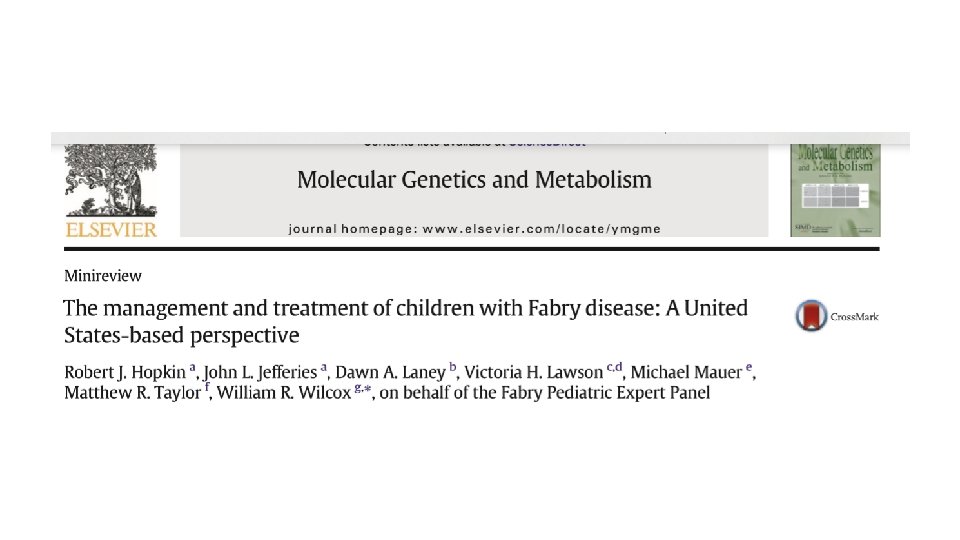
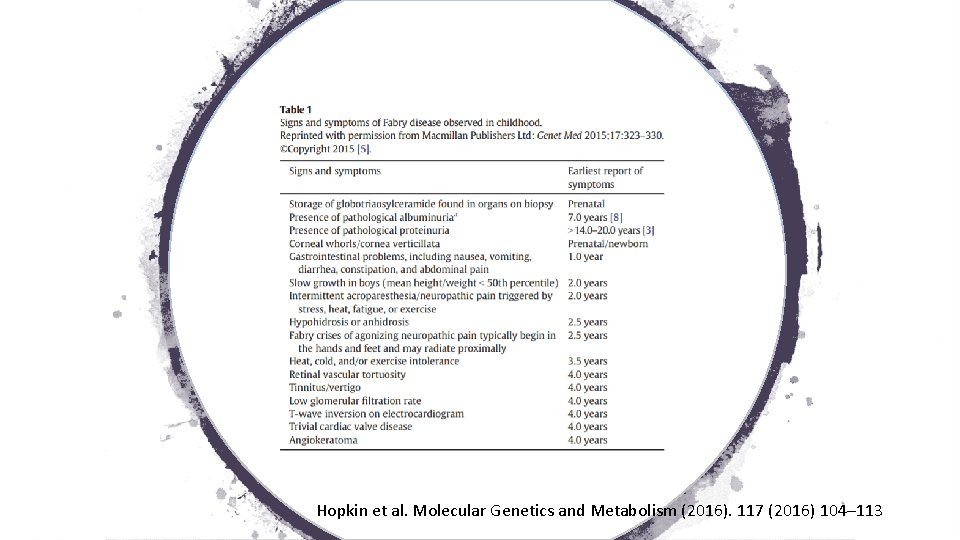
Hopkin et al. Molecular Genetics and Metabolism (2016). 117 (2016) 104– 113
• The diagnosis of Fabry disease is often delayed in the pediatric population. • The symptoms may appear in a nonspecific pattern in this age group, and often many years are required to identify the underlying nature of the complaints. • The cluster of symptoms experienced by children and adolescents with Fabry can negatively impact normal daily living activities. This may lead to psychosocial manifestations such as depression and anxiety Mehta &Hughes. Gene. Reviews (2017); Hopkin et al. MGM (2016). 117 (2016) 104– 113
Diagnosis • The diagnosis of Fabry disease requires the synthesis of clinical, biochemical, molecular and pathologic criteria. • None of the features of classical Fabry disease are diagnostic in their own right. Some features of Fabry disease (for example, nephropathy, hypertrophic cardiomyopathy, stroke) are very nonspecific with a broad differential diagnosis. • Other features of Fabry disease (like cornea verticillata, biopsy-proven angiokeratomas) have a more limited differential diagnosis although there are still conditions other than Fabry disease which can cause these more specific findings • It is recommended that a patient have at least 3 of the 4 criteria before making a diagnosis of Fabry disease Sirrs et al, 2017 Canadian Fabry Disease Guidelines
Treatment • Treatment for all patients involves control of risk factors and supportive care for issues related to living with a chronic disease. • Multidisciplinary follow-up is required • Neuropathic pain may respond to analgesics or anticonvulsants such as carbamazepine, gabapentin • Factors that are identified to trigger acute episodes of pain should be avoided • Diet modifications for GI symptoms Ellaway C. Transl Pediatr. (2016); 5(1): 37 -42; Hopkin et al. Molecular Genetics and Metabolism (2016). 117 (2016) 104– 113
Treatment • Disease specific treatment with enzyme replacement therapy (ERT) or chaperone therapy may have benefit for some individuals. 1. Recombinant human alpha-galactosidase A enzyme is available in two forms, agalsidase-alfa (Replagal™; Shire Inc. ; administered at a dose of 0. 2 mg/kg EOW) and agalsidase-beta (Fabrazyme®; Sanofi-Genzyme Corporation; administered at a dose of 1. 0 mg/kg EOW). ERT is approved for use in children. Siris et al. 2017 Canadian Fabry Disease Guidelines 2. Migalastat (Galafold; Amicus Therapeutics) is the first chaperone therapy for Fabry disease approved in Canada. It is approved for adults (>18 years). There is a clinical trial available for pediatric Fabry population in USA (ages 12 -17 yrs. )
ERT • ERT was the first form of disease specific therapy developed for Fabry disease. • ERT is appropriate for all patients with Fabry disease, regardless of mutation status. • A recent metanalysis indicated stability of renal and cardiac parameters in patients switched from agalsidase beta to agalsidase alfa during the interval of drug shortages Pisani et al, PLos. ONE 2017
ØEvidence of improvement with ERT: • Stabilization of Fabry nephropathy with stable proteinuria and glomerular filtration rate (GFR). • Stabilization of Fabry cardiomyopathy • Improvement in diarrhea, abdominal cramps or pain, nausea, vomiting and heartburn associated with Fabry disease.
ØClinical features of Fabry disease have not yet been shown to respond to ERT: • Stroke or TIAs • Depression • Hearing loss • Acroparesthesia ØSide Effects: • Development of infusion reactions characterized by fever, chills, rash, nausea and dyspnea. • Development of anti-agalsidase antibodies
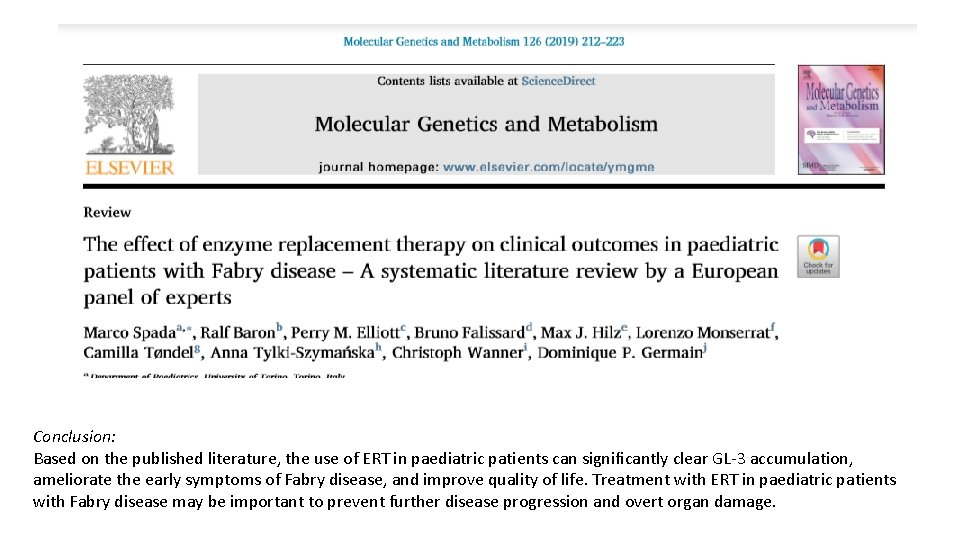
Conclusion: Based on the published literature, the use of ERT in paediatric patients can significantly clear GL-3 accumulation, ameliorate the early symptoms of Fabry disease, and improve quality of life. Treatment with ERT in paediatric patients with Fabry disease may be important to prevent further disease progression and overt organ damage.
• The use of enzyme replacement therapy in children is well-tolerated • However, due to its high cost, the timing of access to enzyme replacement therapy continues to be guided predominantly by country-specific treatment criteria Ellaway C. Transl Pediatr. (2016); 5(1): 37 -42 There are specific Canadian criteria regarding initiating treatment for patients Sirrs et al. 2017 Canadian Fabry Disease Guidelines
Enzyme Enhancement Therapy (Chaperone Therapy) • In many cases when compared to the normal, the disease is caused by a misfolding of the enzyme as a consequence of a missense mutation. • Under normal conditions this misfolded enzyme is recognized by the pre-existing intra cellular degradation systems and removed from the cell. • In the presence of a pharmacological chaperone, there is a stabilization of the misfolded enzyme which allows its safe passage through the ER and golgi to the lysosome where under the acidic environment the chaperone disassociates from the enzyme and the enzyme is able to function albeit at a reduced activity. • This principle of therapy has found favor potentially as a treatment option especially in cases where an improvement in residual activity of 5 to 10% has the potential of significantly altering the natural history of the disease Leidenheimer NJ & Ryder KG. pharmacological research (2014). 83: 10 -19
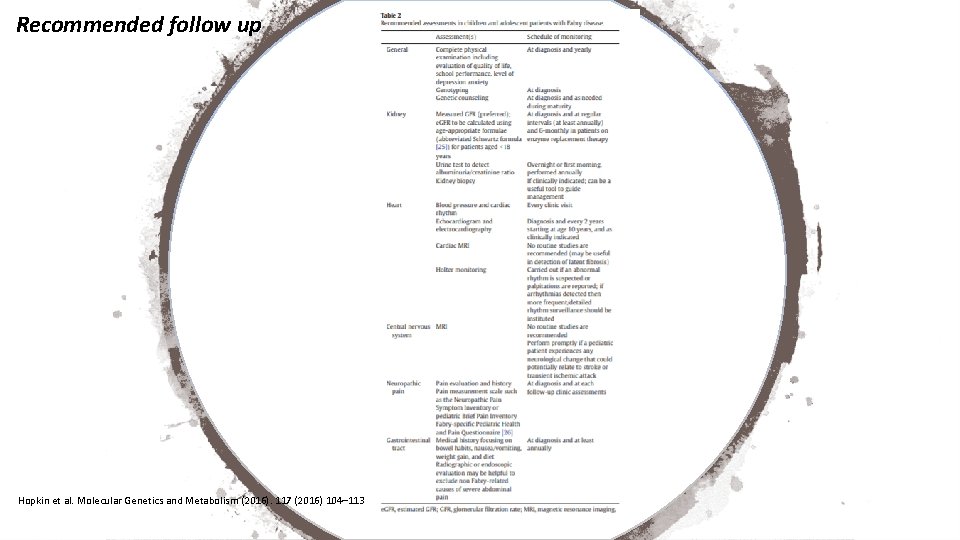
Recommended follow up Hopkin et al. Molecular Genetics and Metabolism (2016). 117 (2016) 104– 113
It has been reported that when the first family member is diagnosed with FD an average of 5 additional family members are also affected by the disease. Hopkin et al. Molecular Genetics and Metabolism (2016). 117 (2016) 104– 113 Therefore a detailed family history should be taken by an experienced health professional or genetic counselor in order to identify at-risk family members who should be tested.
Summary • Children with FD present differently than adults with FD • Diagnosis in children is challenging and many times delayed • Early diagnosis has implications for follow up, treatment and hence better outcomes • Education and awareness Questions?
- Slides: 32