
Fabrication and simulation of Novel Ultra Thin 3
Fabrication and simulation of Novel Ultra Thin 3 D Silicon Detector – Plasma Diagnostics for JET and ITER TOKAMAKS G. Pellegrini, J. Balbuena, E. Cabruja, M. Lozano, M. Ullan Centro Nacional de Microelectrónica CNM-IMB (CSIC) F. Garcia, R. Orava Helsinki Institute of Physics (HIP) Giulio Pellegrini
Outline • Applications • New detector concept • Simulation results • Fabrication technology • Conclusions Giulio Pellegrini 2
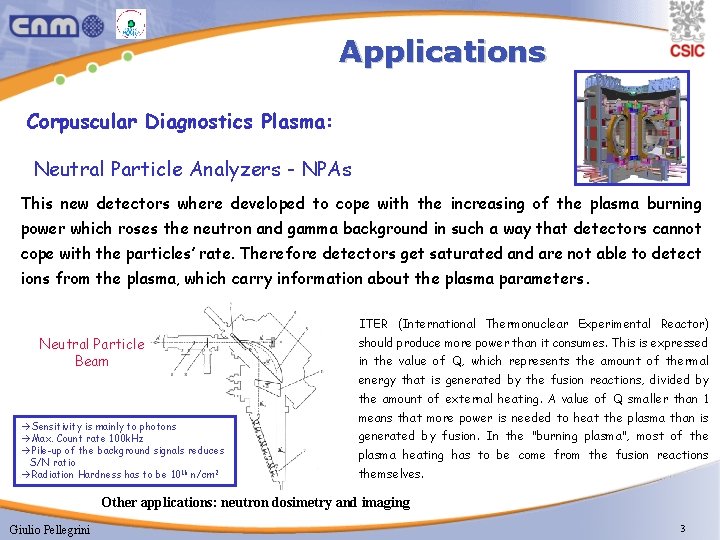
Applications Corpuscular Diagnostics Plasma: Neutral Particle Analyzers - NPAs This new detectors where developed to cope with the increasing of the plasma burning power which roses the neutron and gamma background in such a way that detectors cannot cope with the particles’ rate. Therefore detectors get saturated and are not able to detect ions from the plasma, which carry information about the plasma parameters. ITER (International Thermonuclear Experimental Reactor) Neutral Particle Beam should produce more power than it consumes. This is expressed in the value of Q, which represents the amount of thermal energy that is generated by the fusion reactions, divided by the amount of external heating. A value of Q smaller than 1 àSensitivity is mainly to photons àMax. Count rate 100 k. Hz àPile-up of the background signals reduces S/N ratio àRadiation Hardness has to be 1016 n/cm 2 means that more power is needed to heat the plasma than is generated by fusion. In the "burning plasma", most of the plasma heating has to be come from the fusion reactions themselves. Other applications: neutron dosimetry and imaging Giulio Pellegrini 3
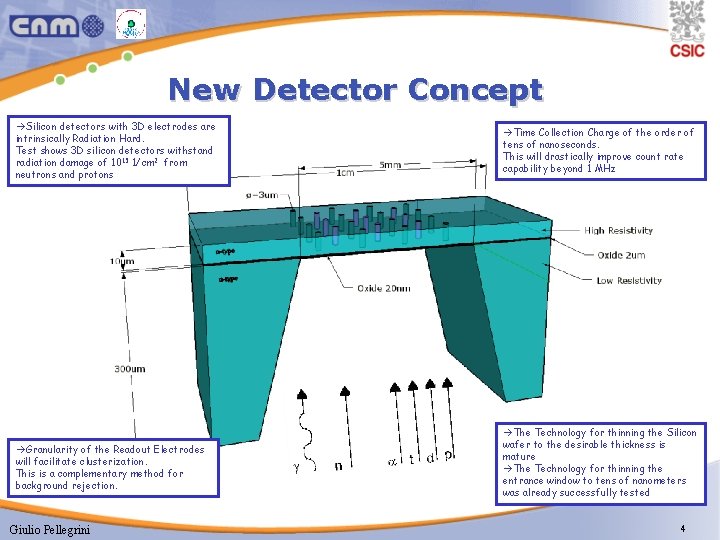
New Detector Concept àSilicon detectors with 3 D electrodes are intrinsically Radiation Hard. Test shows 3 D silicon detectors withstand radiation damage of 1015 1/cm 2 from neutrons and protons àTime Collection Charge of the order of tens of nanoseconds. This will drastically improve count rate capability beyond 1 MHz àGranularity of the Readout Electrodes will facilitate clusterization. This is a complementary method for background rejection. àThe Technology for thinning the Silicon wafer to the desirable thickness is mature àThe Technology for thinning the entrance window to tens of nanometers was already successfully tested Giulio Pellegrini 4
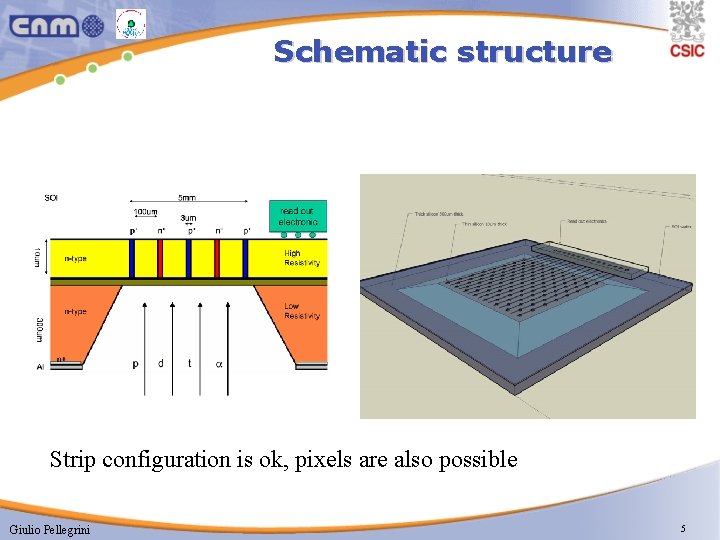
Schematic structure Strip configuration is ok, pixels are also possible Giulio Pellegrini 5
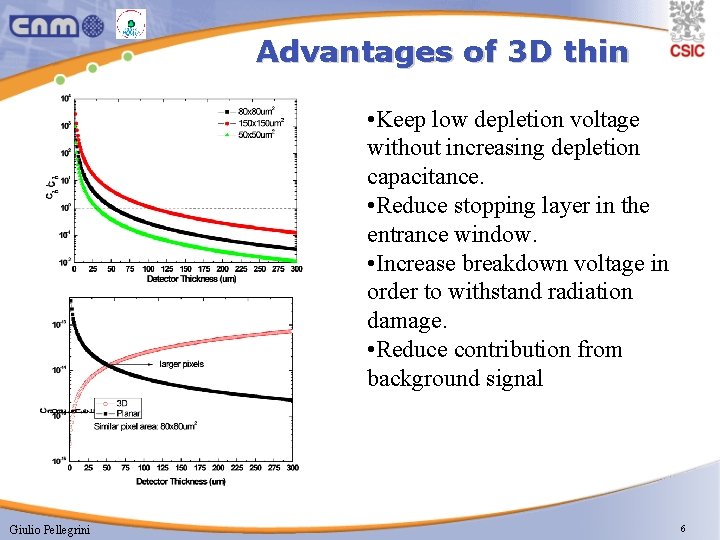
Advantages of 3 D thin • Keep low depletion voltage without increasing depletion capacitance. • Reduce stopping layer in the entrance window. • Increase breakdown voltage in order to withstand radiation damage. • Reduce contribution from background signal Giulio Pellegrini 6
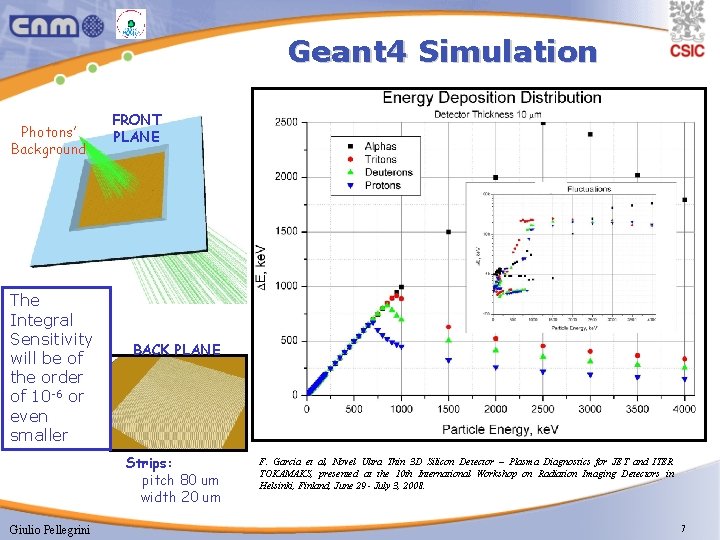
Geant 4 Simulation Photons’ Background The Integral Sensitivity will be of the order of 10 -6 or even smaller FRONT PLANE BACK PLANE Strips: pitch 80 um width 20 um Giulio Pellegrini F. Garcia et al, Novel Ultra Thin 3 D Silicon Detector – Plasma Diagnostics for JET and ITER TOKAMAKS, presented at the 10 th International Workshop on Radiation Imaging Detectors in Helsinki, Finland, June 29 - July 3, 2008. 7

Sentaurus Simulation • Square pitch: 80 um • Silicon substrate: n-type 1012 cm-3 • Holes collection at p+ electrode • Detector thickness 10 um • Oxide charge Giulio Pellegrini • Charge carriers swept horizontally towards the electrodes • Low full depletion: 3. 5 V • Short collection time: peak at 2. 1 ns 1011 cm-2 8
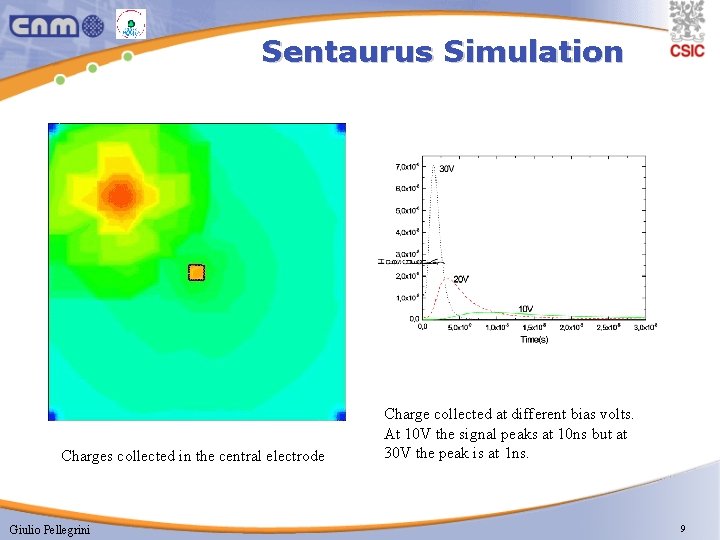
Sentaurus Simulation Charges collected in the central electrode Giulio Pellegrini Charge collected at different bias volts. At 10 V the signal peaks at 10 ns but at 30 V the peak is at 1 ns. 9
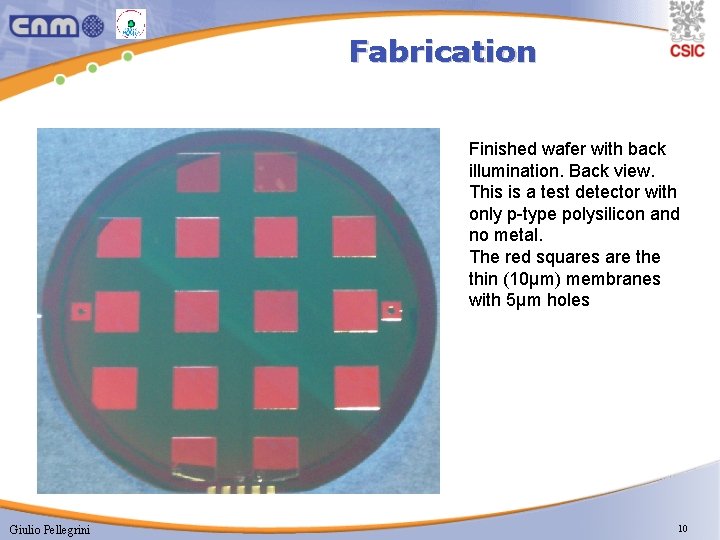
Fabrication Finished wafer with back illumination. Back view. This is a test detector with only p-type polysilicon and no metal. The red squares are thin (10µm) membranes with 5µm holes Giulio Pellegrini 10
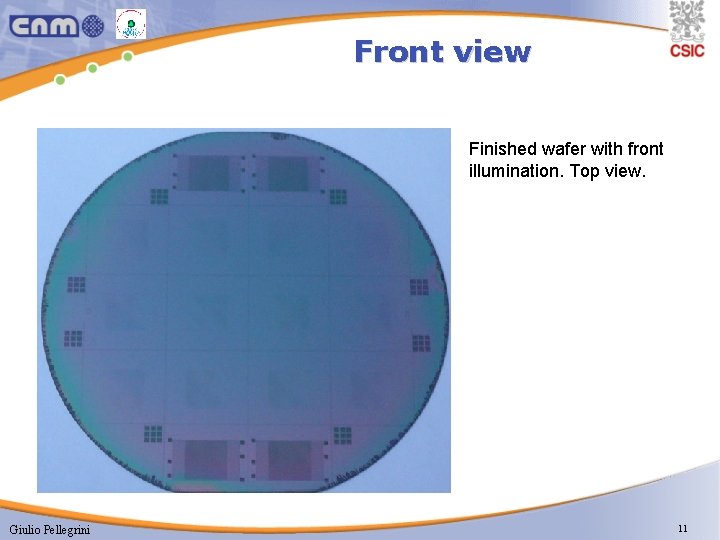
Front view Finished wafer with front illumination. Top view. Giulio Pellegrini 11
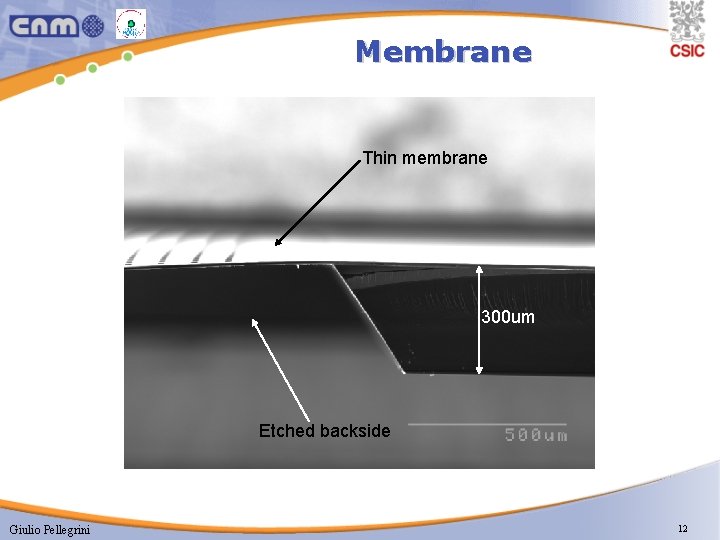
Membrane Thin membrane 300 um Etched backside Giulio Pellegrini 12
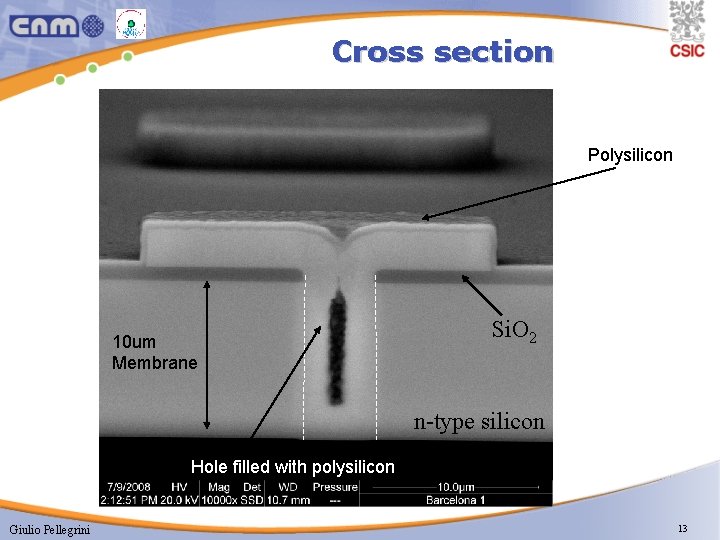
Cross section Polysilicon 10 um Membrane Si. O 2 n-type silicon Hole filled with polysilicon Giulio Pellegrini 13
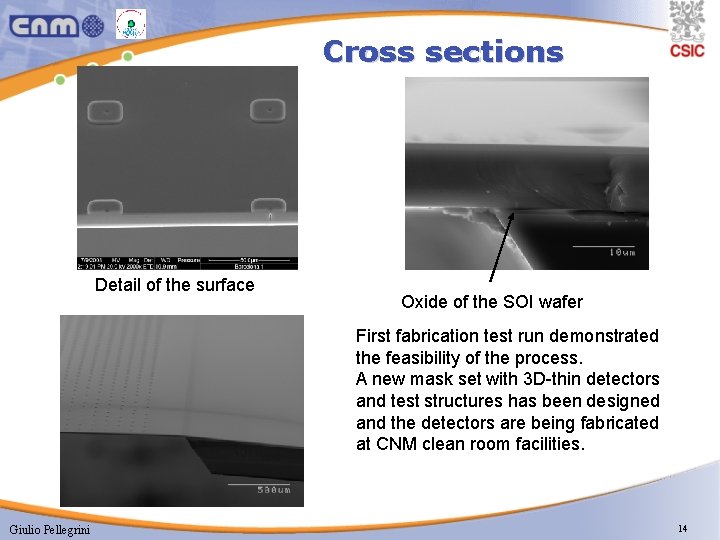
Cross sections Detail of the surface Oxide of the SOI wafer First fabrication test run demonstrated the feasibility of the process. A new mask set with 3 D-thin detectors and test structures has been designed and the detectors are being fabricated at CNM clean room facilities. Giulio Pellegrini 14
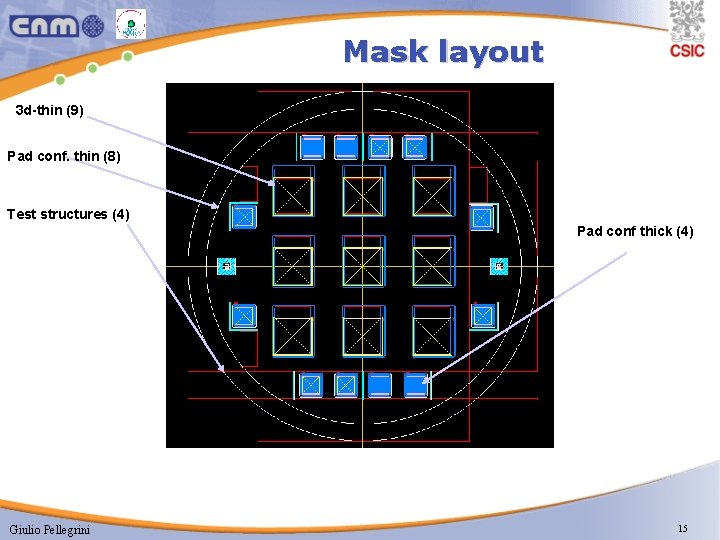
Mask layout 3 d-thin (9) Pad conf. thin (8) Test structures (4) Pad conf thick (4) Giulio Pellegrini 15
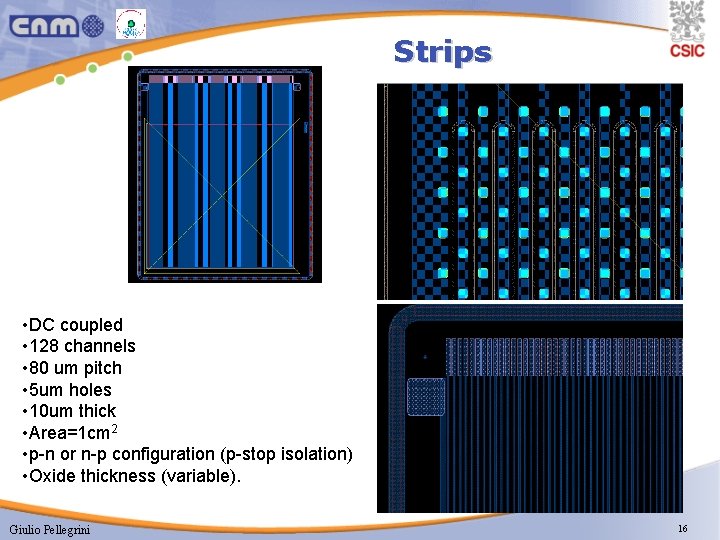
Strips • DC coupled • 128 channels • 80 um pitch • 5 um holes • 10 um thick • Area=1 cm 2 • p-n or n-p configuration (p-stop isolation) • Oxide thickness (variable). Giulio Pellegrini 16
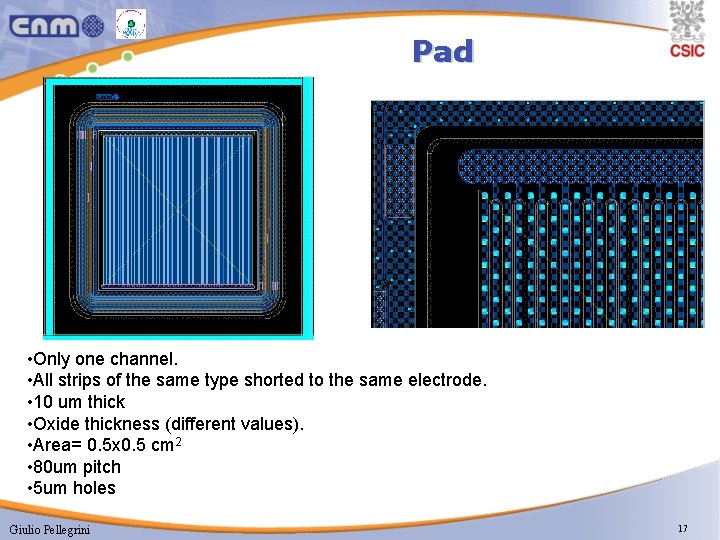
Pad • Only one channel. • All strips of the same type shorted to the same electrode. • 10 um thick • Oxide thickness (different values). • Area= 0. 5 x 0. 5 cm 2 • 80 um pitch • 5 um holes Giulio Pellegrini 17
Conclusions • The concept has been tested and fabrication has been performed. • Simulation shows full depletion of 3. 5 V and breakdown voltage of 150 V. • Signal collection time is on the order of 1 ns at 30 V biasing. • Detector capacitance for a single cell of the U 3 DTHIN two orders of magnitude smaller than planar one with the same thickness. • First complete fabrication run finished, to be tested. Giulio Pellegrini 18
- Slides: 18