
Fabrication and magnetic characterization of embedded permalloy structures
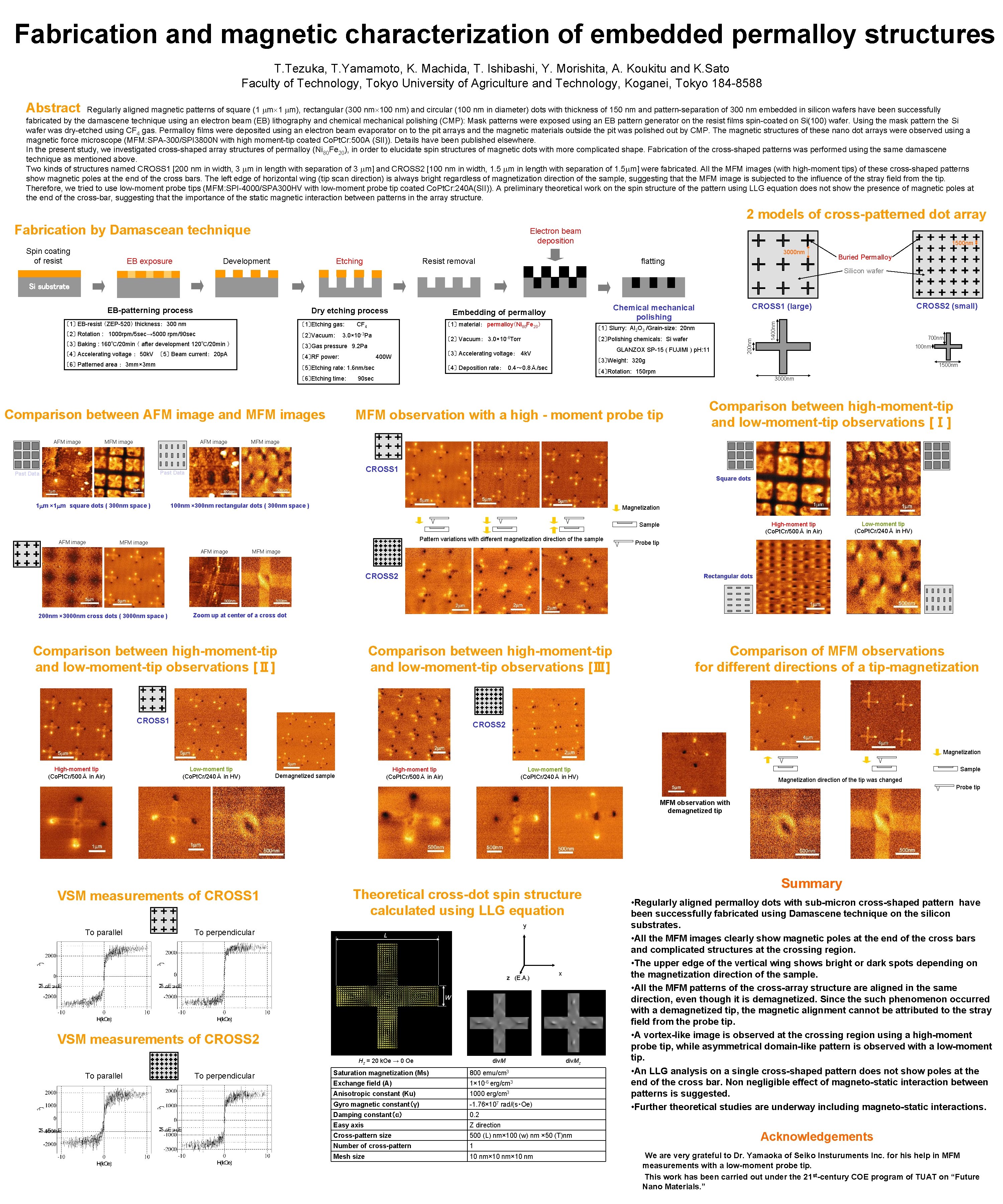
Fabrication and magnetic characterization of embedded permalloy structures T. Tezuka, T. Yamamoto, K. Machida, T. Ishibashi, Y. Morishita, A. Koukitu and K. Sato Faculty of Technology, Tokyo University of Agriculture and Technology, Koganei, Tokyo 184 -8588 Abstract Regularly aligned magnetic patterns of square (1 m 1 m), rectangular (300 nm 100 nm) and circular (100 nm in diameter) dots with thickness of 150 nm and pattern-separation of 300 nm embedded in silicon wafers have been successfully fabricated by the damascene technique using an electron beam (EB) lithography and chemical mechanical polishing (CMP): Mask patterns were exposed using an EB pattern generator on the resist films spin-coated on Si(100) wafer. Using the mask pattern the Si wafer was dry-etched using CF 4 gas. Permalloy films were deposited using an electron beam evaporator on to the pit arrays and the magnetic materials outside the pit was polished out by CMP. The magnetic structures of these nano dot arrays were observed using a magnetic force microscope (MFM: SPA-300/SPI 3800 N with high moment-tip coated Co. Pt. Cr: 500 A (SII)). Details have been published elsewhere. In the present study, we investigated cross-shaped array structures of permalloy (Ni 80 Fe 20), in order to elucidate spin structures of magnetic dots with more complicated shape. Fabrication of the cross-shaped patterns was performed using the same damascene technique as mentioned above. Two kinds of structures named CROSS 1 [200 nm in width, 3 m in length with separation of 3 m] and CROSS 2 [100 nm in width, 1. 5 m in length with separation of 1. 5 m] were fabricated. All the MFM images (with high-moment tips) of these cross-shaped patterns show magnetic poles at the end of the cross bars. The left edge of horizontal wing (tip scan direction) is always bright regardless of magnetization direction of the sample, suggesting that the MFM image is subjected to the influence of the stray field from the tip. Therefore, we tried to use low-moment probe tips (MFM: SPI-4000/SPA 300 HV with low-moment probe tip coated Co. Pt. Cr: 240 A(SII)). A preliminary theoretical work on the spin structure of the pattern using LLG equation does not show the presence of magnetic poles at the end of the cross-bar, suggesting that the importance of the static magnetic interaction between patterns in the array structure. 2 models of cross-patterned dot array Fabrication by Damascean technique Spin coating of resist Electron beam deposition 1500 nm 3000 nm EB exposure Development Etching Resist removal flatting Buried Permalloy Silicon wafer Si substrate 〔 1〕 EB-resist (ZEP-520) thickness: 300 nm 〔 1〕Etching gas: 〔 2〕 Rotation : 1000 rpm/5 sec→ 5000 rpm/90 sec 〔 2〕Vacuum: 3. 0× 10 -3 Pa 〔 3〕 Baking : 160℃/20 min ( after development 120℃/20 min ) 〔 3〕Gas pressure 9. 2 Pa 〔 4〕 Accelerating voltage : 50 k. V 〔 4〕RF power: 〔 5〕 Beam current: 20 p. A 〔 6〕 Patterned area : 3 mm× 3 mm CF 4 Comparison between AFM image and MFM images MFM image AFM image 1 mm × 1 mm square dots ( 300 nm space ) 〔 1〕 Slurry: Al 2 O 3 /Grain-size: 20 nm 〔 2〕Polishing chemicals: Si wafer 〔 2〕 Vacuum: 3. 0× 10 -6 Torr GLANZOX SP-15 ( FUJIMI ) p. H: 11 〔 3〕 Accelerating voltage: 4 k. V 400 W 〔 4〕 Deposition rate: 0. 4~ 0. 8Å/sec 〔 4〕Rotation: 150 rpm 3000 nm MFM observation with a high - moment probe tip Comparison between high-moment-tip and low-moment-tip observations [Ⅰ] MFM image CROSS 1 Square dots 100 nm × 300 nm rectangular dots ( 300 nm space ) Magnetization Pattern variations with different magnetization direction of the sample MFM image AFM image High-moment tip (Co. Pt. Cr/500Å in Air) Low-moment tip (Co. Pt. Cr/240Å in HV) Probe tip MFM image CROSS 2 200 nm × 3000 nm cross dots ( 3000 nm space ) 100 nm 1500 nm Sample AFM image 700 nm 〔 3〕Weight: 320 g 90 sec Past Data 〔 1〕 material: permalloy(Ni 80 Fe 20) 〔 5〕Etching rate: 1. 6 nm/sec 〔 6〕Etching time: AFM image Embedding of permalloy 1400 nm Dry etching process CROSS 2 (small) CROSS 1 (large) Chemical mechanical polishing 200 nm EB-patterning process Rectangular dots Zoom up at center of a cross dot Comparison between high-moment-tip and low-moment-tip observations [Ⅱ] Comparison between high-moment-tip and low-moment-tip observations [Ⅲ] CROSS 1 CROSS 2 Comparison of MFM observations for different directions of a tip-magnetization Magnetization High-moment tip (Co. Pt. Cr/500Å in Air) Low-moment tip (Co. Pt. Cr/240Å in HV) High-moment tip (Co. Pt. Cr/500Å in Air) Demagnetized sample Sample Low-moment tip (Co. Pt. Cr/240Å in HV) Magnetization direction of the tip was changed Probe tip MFM observation with demagnetized tip VSM measurements of CROSS 1 To parallel Theoretical cross-dot spin structure calculated using LLG equation y To perpendicular L z (E. A. ) x W VSM measurements of CROSS 2 Hz = 20 k. Oe → 0 Oe To parallel To perpendicular div. Mz Saturation magnetization (Ms) 800 emu/cm 3 Exchange field (A) 1× 10 -6 erg/cm 3 Anisotropic constant (Ku) 1000 erg/cm 3 Gyro magnetic constant(γ) -1. 76× 107 rad/(s・Oe) Damping constant(α) 0. 2 Easy axis Z direction Cross-pattern size 500 (L) nm× 100 (w) nm × 50 (T)nm Number of cross-pattern 1 Mesh size 10 nm× 10 nm Summary • Regularly aligned permalloy dots with sub-micron cross-shaped pattern have been successfully fabricated using Damascene technique on the silicon substrates. • All the MFM images clearly show magnetic poles at the end of the cross bars and complicated structures at the crossing region. • The upper edge of the vertical wing shows bright or dark spots depending on the magnetization direction of the sample. • All the MFM patterns of the cross-array structure aligned in the same direction, even though it is demagnetized. Since the such phenomenon occurred with a demagnetized tip, the magnetic alignment cannot be attributed to the stray field from the probe tip. • A vortex-like image is observed at the crossing region using a high-moment probe tip, while asymmetrical domain-like pattern is observed with a low-moment tip. • An LLG analysis on a single cross-shaped pattern does not show poles at the end of the cross bar. Non negligible effect of magneto-static interaction between patterns is suggested. • Further theoretical studies are underway including magneto-static interactions. Acknowledgements We are very grateful to Dr. Yamaoka of Seiko Insturuments Inc. for his help in MFM measurements with a low-moment probe tip. This work has been carried out under the 21 st-century COE program of TUAT on “Future Nano Materials. ”
- Slides: 1