
Fabrication Alignment tolerances and tolerance propagation and quality

Fabrication : - Alignment, tolerances and tolerance propagation, and quality assurance Simon’s thoughts/musings and HSX experiences Feb 05
1 Computer Design : CAD model • The coils and winding surfaces should be generated from the ORIGINAL computer model used to generate the magnetics – Feeds and busswork should be included in the model • A script file should be used to go from the computer to CAD or CAD to computer – Once generated, this is a non-changeable script ! – Generating appropriate input from CAD for a computer magnetics model is not trivial • The same coordinates used for NC machining should probably be used for checking and verification, and used in the CAD model – How many coordinate system does one use and keep track of ?
2 Scripts and coordinates • Create Scripts or Lisp files or ? ? for the CAD program – A script to move the coil or object and ALL reference points to correct coordinate system for the current operation – A script to reverse this to get everything, including measurements, back to the original coordinate system – Only these tested scripts are used on a copy of the original CAD design drawing for either direction – Keep a propagation-series of this drawing at each stage annotated to show what and where and why this differs from the previous version – Scripts provide reliable and reproducible and checkable design manipulation
2 Scripts and coordinates - #2 – Without an electronic design, measurement and tolerancing from CMM become very hard and difficult to trace • Comparisons of complicated surfaces and shapes are difficult to make • Measurements are often offset by a ball diameter when using the CMM probe • A line or set of points are measured, and then compared to a CAD-generated surface. • These measurements are then later used to generate a set of surfaces or filaments for computer modeling – Immediate comparison to CAD models needs to be made to verify winding etc. – CMM measurement output conversion to computer input needs to be possible
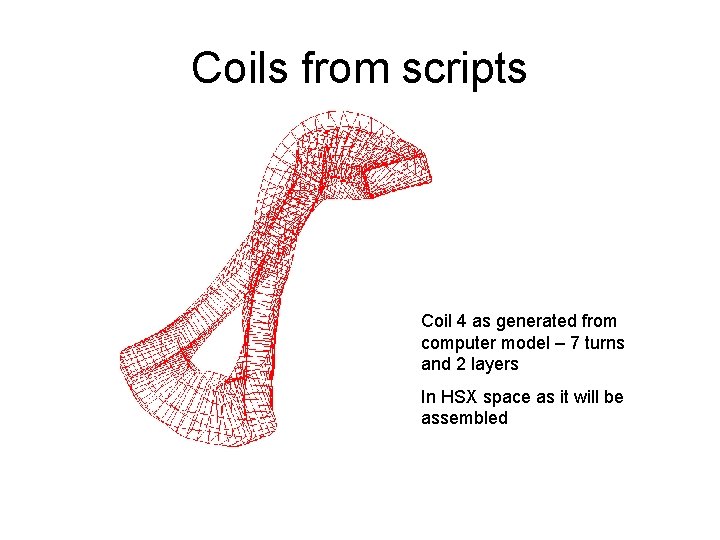
Coils from scripts Coil 4 as generated from computer model – 7 turns and 2 layers In HSX space as it will be assembled

Coils from scripts #2 Coil 4 in position for winding, generated from script – plus winding surfaces Coordinate system is built into winding base, plus reference marks inserted for winding form and for fabrication
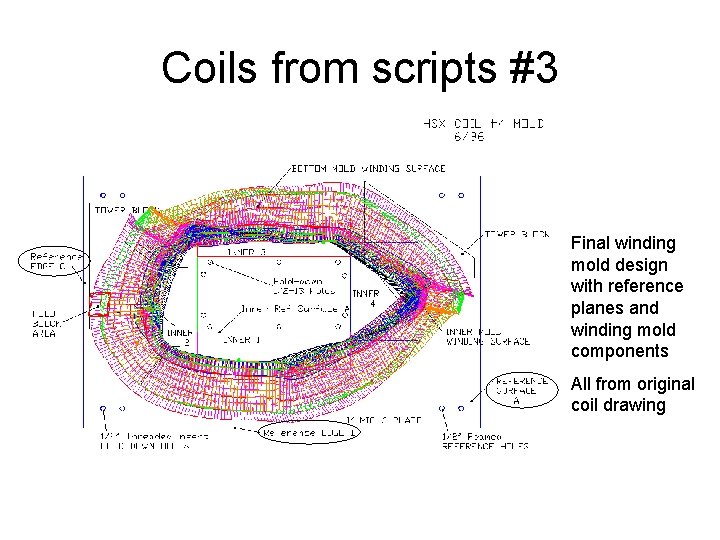
Coils from scripts #3 Final winding mold design with reference planes and winding mold components All from original coil drawing
3 Reference marks • One needs reference marks for each stage and each type of fabrication – Tooling balls for CNC mill/lathe and CMM for checking this stage – Tooling balls or detents for CMM checks during coil winding, and jigging fixtures for quick tolerance checks (David A’s go/no-go blocks) – Tooling balls or detents for CMM checks at assembly – Tooling balls or detents for finished assembly to check other components like port locations and orientations, diagnostic locations, etc.
3 Reference marks #2 • References need to be easily/sensibly accessible during each stage – A new set of measurements might be measured relative to a second or third order set of references, so errors will propagate unless original absolute reference marks are always accessible through all fabrication and assembly stages. – One really does not align a model in general, but aligns a set of reference points! Then measurements are performed relative to this alignment. So the reference points are crucial. It is difficult to have too many initial accurate reference points.
4 Tolerances • Fabrication and assembly has to have an allowable size/location for each measurable component or stage in fabrication, and an overall tolerance/allowance for a completed part – Each stage of fabrication • • • The winding mold Each turn of a winding Each layer of a winding Cross-overs and feeds The full coil The full assembly
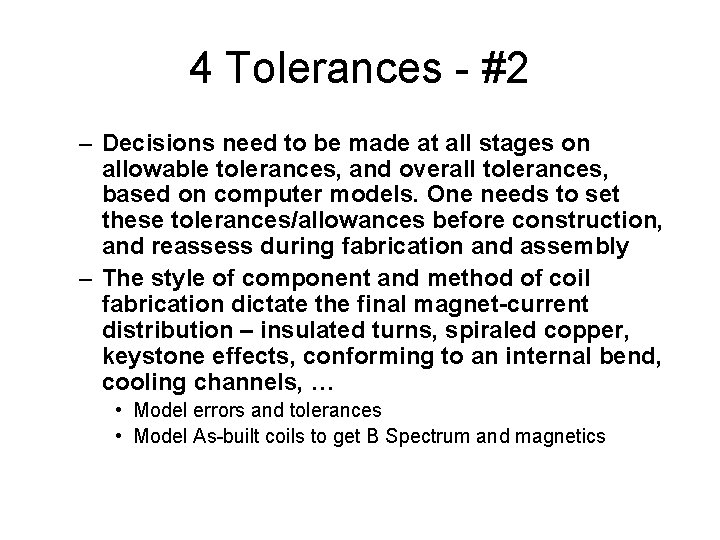
4 Tolerances - #2 – Decisions need to be made at all stages on allowable tolerances, and overall tolerances, based on computer models. One needs to set these tolerances/allowances before construction, and reassess during fabrication and assembly – The style of component and method of coil fabrication dictate the final magnet-current distribution – insulated turns, spiraled copper, keystone effects, conforming to an internal bend, cooling channels, … • Model errors and tolerances • Model As-built coils to get B Spectrum and magnetics
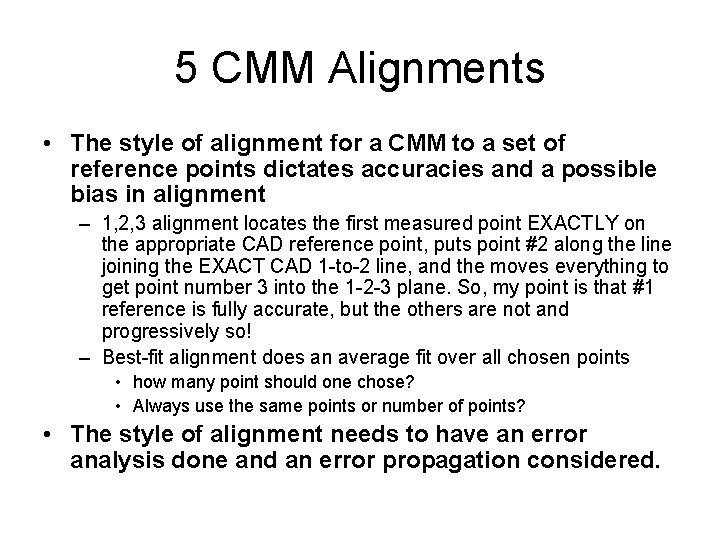
5 CMM Alignments • The style of alignment for a CMM to a set of reference points dictates accuracies and a possible bias in alignment – 1, 2, 3 alignment locates the first measured point EXACTLY on the appropriate CAD reference point, puts point #2 along the line joining the EXACT CAD 1 -to-2 line, and the moves everything to get point number 3 into the 1 -2 -3 plane. So, my point is that #1 reference is fully accurate, but the others are not and progressively so! – Best-fit alignment does an average fit over all chosen points • how many point should one chose? • Always use the same points or number of points? • The style of alignment needs to have an error analysis done and an error propagation considered.
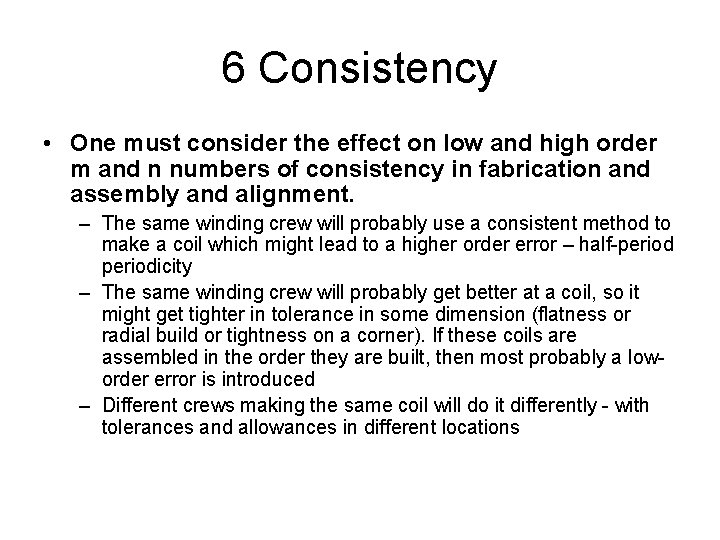
6 Consistency • One must consider the effect on low and high order m and n numbers of consistency in fabrication and assembly and alignment. – The same winding crew will probably use a consistent method to make a coil which might lead to a higher order error – half-periodicity – The same winding crew will probably get better at a coil, so it might get tighter in tolerance in some dimension (flatness or radial build or tightness on a corner). If these coils are assembled in the order they are built, then most probably a loworder error is introduced – Different crews making the same coil will do it differently - with tolerances and allowances in different locations
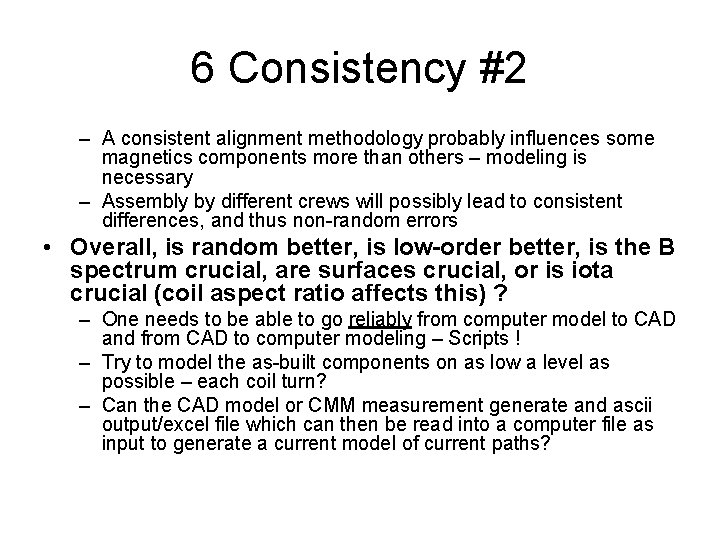
6 Consistency #2 – A consistent alignment methodology probably influences some magnetics components more than others – modeling is necessary – Assembly by different crews will possibly lead to consistent differences, and thus non-random errors • Overall, is random better, is low-order better, is the B spectrum crucial, are surfaces crucial, or is iota crucial (coil aspect ratio affects this) ? – One needs to be able to go reliably from computer model to CAD and from CAD to computer modeling – Scripts ! – Try to model the as-built components on as low a level as possible – each coil turn? – Can the CAD model or CMM measurement generate and ascii output/excel file which can then be read into a computer file as input to generate a current model of current paths?
7 Changes • If a design changes, these have to be signed-off by both the physicists and the engineers – ATF had a huge field error from an on-the-fly engineering change splitting the main coil-feed busswork to go around a support, which was not discussed with the physics crew. – One needs to build as the CAD model dictates, generated by the computer model if appropriate (coils and feeds) • Current paths dictate I and thus B • Supports affect alignment and assembly, and therefore B • Structures and breaks affect image current and eddy current and thus B • Final as-built, or as intended to be built, components need to be reverse engineered (from scripts) into the computer model • Finite-mu modeling is difficult. What is acceptable?
- Slides: 15