
Fabric System Architecture Design two distinct board designs

Fabric System Architecture • Design: two distinct board designs; replicate and connect – modularity allows us to build any configuration of size 2 n • Board 1: Quad Raw Board • Board 2: I/O & Memory Board
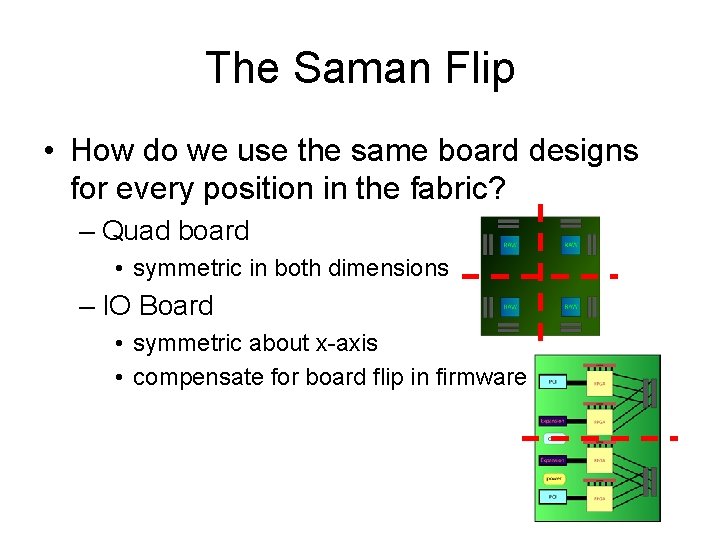
The Saman Flip • How do we use the same board designs for every position in the fabric? – Quad board • symmetric in both dimensions – IO Board • symmetric about x-axis • compensate for board flip in firmware
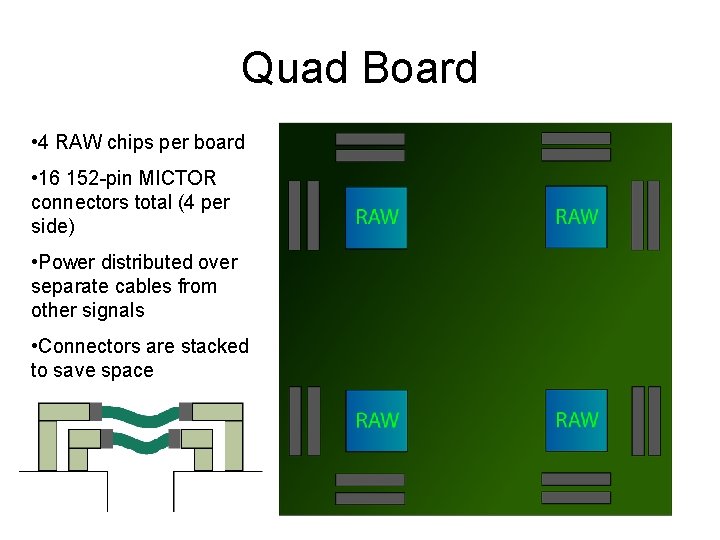
Quad Board • 4 RAW chips per board • 16 152 -pin MICTOR connectors total (4 per side) • Power distributed over separate cables from other signals • Connectors are stacked to save space
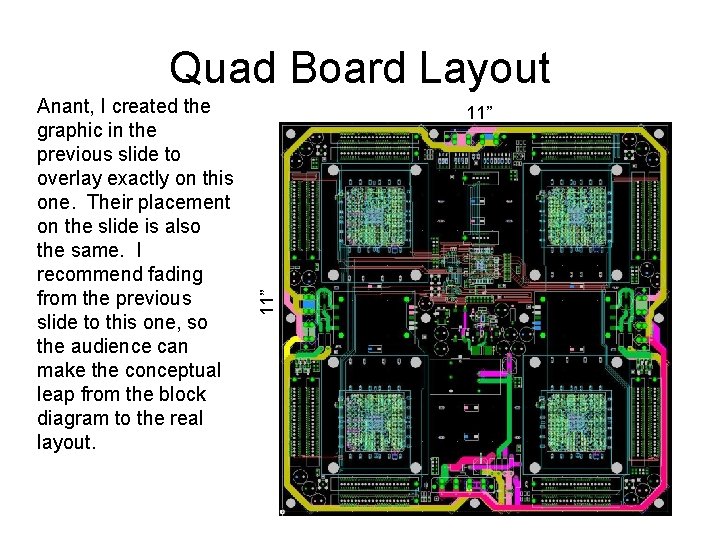
Quad Board Layout 11” Anant, I created the graphic in the previous slide to overlay exactly on this one. Their placement on the slide is also the same. I recommend fading from the previous slide to this one, so the audience can make the conceptual leap from the block diagram to the real layout.
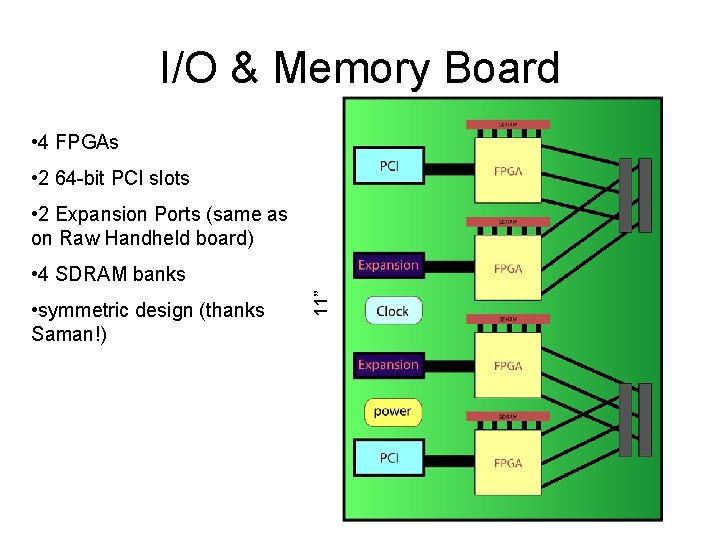
I/O & Memory Board • 4 FPGAs • 2 64 -bit PCI slots • 2 Expansion Ports (same as on Raw Handheld board) • symmetric design (thanks Saman!) 11” • 4 SDRAM banks
Here’s the IO Board schematic in case you want to use it…
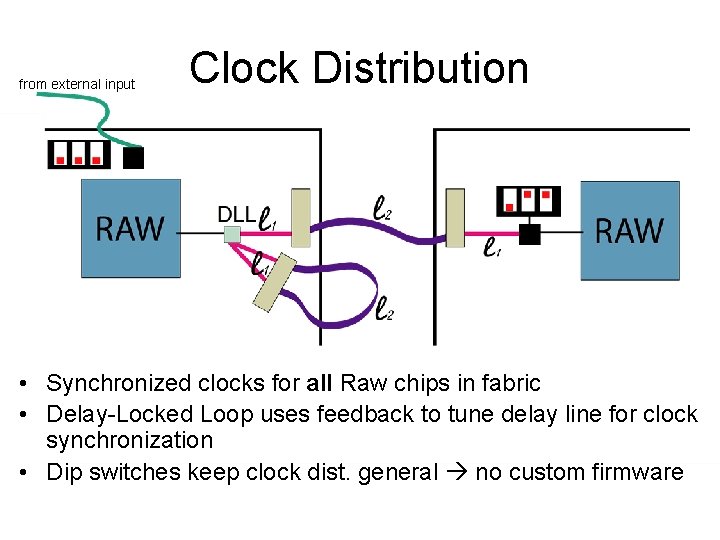
from external input Clock Distribution • Synchronized clocks for all Raw chips in fabric • Delay-Locked Loop uses feedback to tune delay line for clock synchronization • Dip switches keep clock dist. general no custom firmware
Power Distribution • 48 V distributed to all boards, then downconverted • DC-DC converters on each board – 1. 8 V Raw core – 1. 5 V Raw I/O – 3 V other logic – 1. 5 V is also further down converted to 0. 75 V supply for HSTL termination • System-wide power supply can be up to 3 k. W
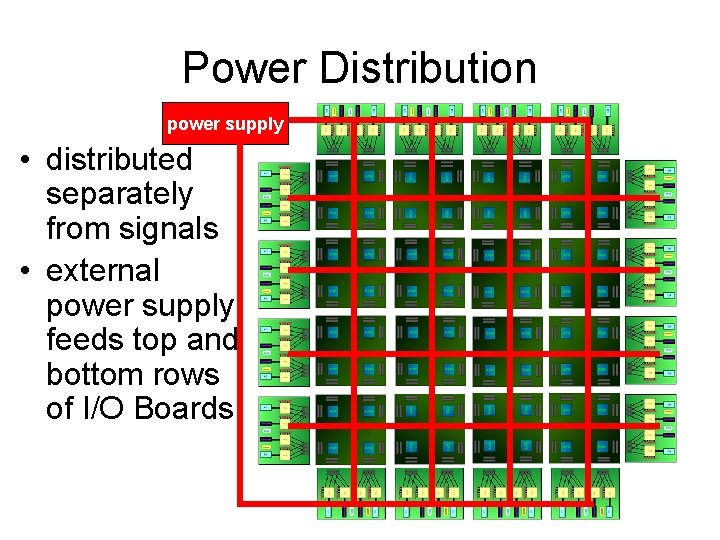
Power Distribution power supply • distributed separately from signals • external power supply feeds top and bottom rows of I/O Boards
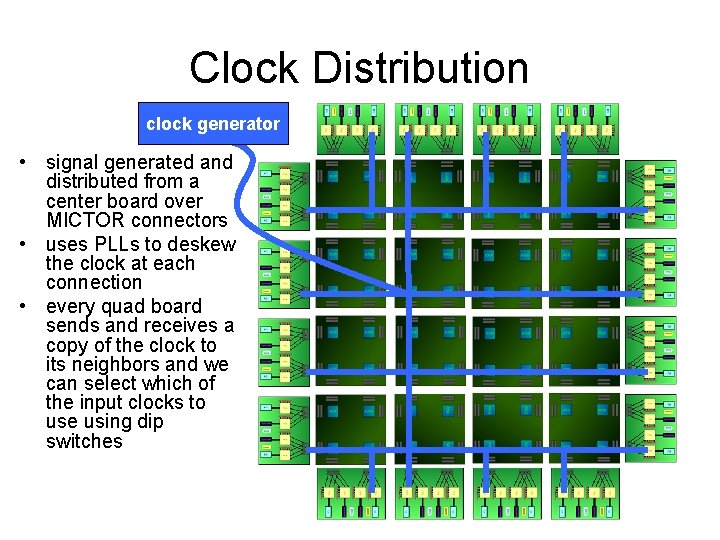
Clock Distribution clock generator • signal generated and distributed from a center board over MICTOR connectors • uses PLLs to deskew the clock at each connection • every quad board sends and receives a copy of the clock to its neighbors and we can select which of the input clocks to use using dip switches
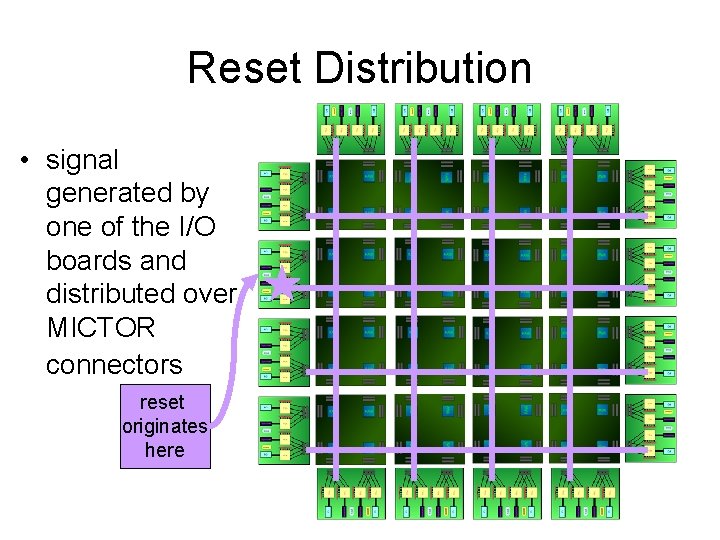
Reset Distribution • signal generated by one of the I/O boards and distributed over MICTOR connectors reset originates here
- Slides: 11