
Fabric Filter Sizing Klinzing et al German Design

Fabric Filter Sizing Klinzing et al. - (German Design)
Points to be Made • • Undersizing will create excessive pressure loss. Oversizing will cost more and overloads system. The gas/cloth ratio is very important. Pressure drop across the filter is about 10 mbar.

Gas/Cloth Ratio
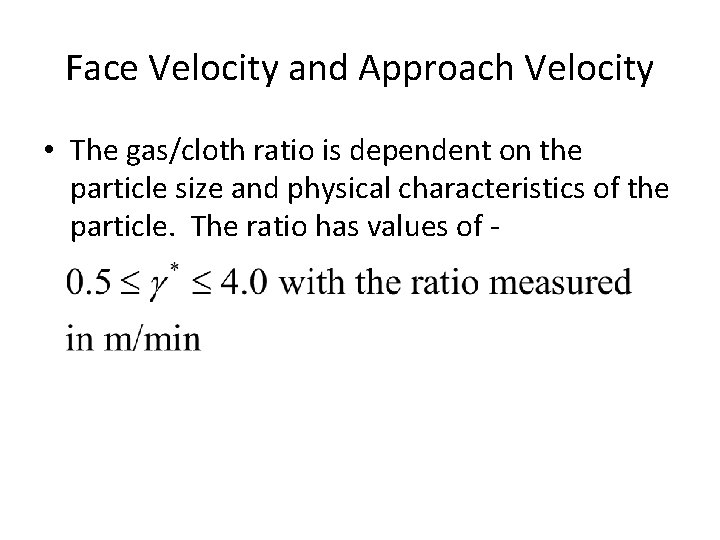
Face Velocity and Approach Velocity • The gas/cloth ratio is dependent on the particle size and physical characteristics of the particle. The ratio has values of -
• Low values of the ratio imply large filtration area and are used for cohesive materials. • Generalized plots have the dust concentration taken into account in units of kg/m 3.
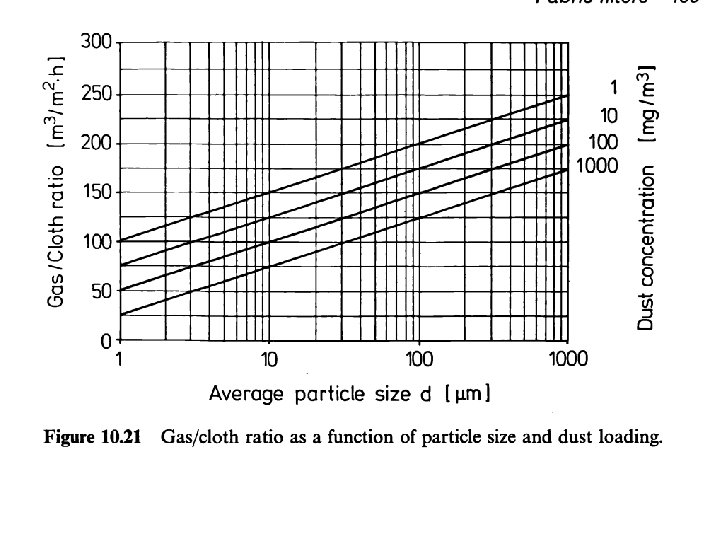
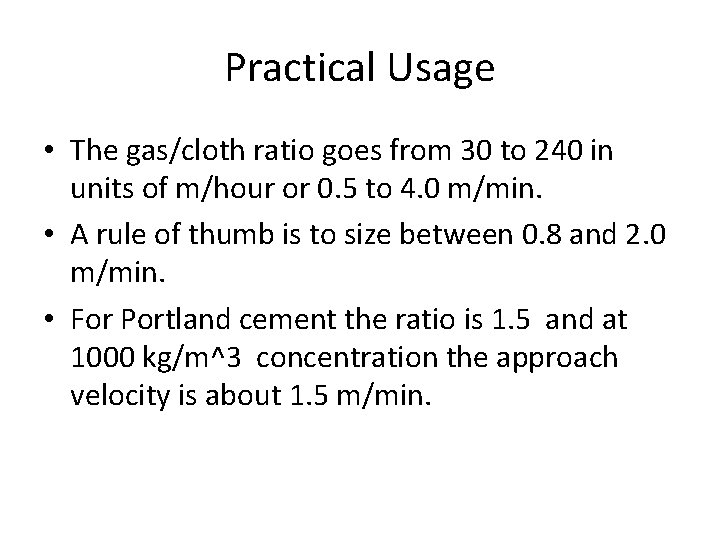
Practical Usage • The gas/cloth ratio goes from 30 to 240 in units of m/hour or 0. 5 to 4. 0 m/min. • A rule of thumb is to size between 0. 8 and 2. 0 m/min. • For Portland cement the ratio is 1. 5 and at 1000 kg/m^3 concentration the approach velocity is about 1. 5 m/min.
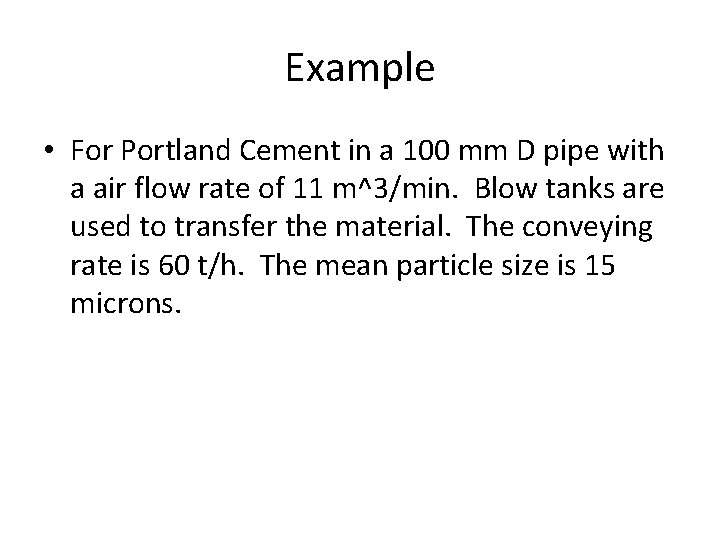
Example • For Portland Cement in a 100 mm D pipe with a air flow rate of 11 m^3/min. Blow tanks are used to transfer the material. The conveying rate is 60 t/h. The mean particle size is 15 microns.
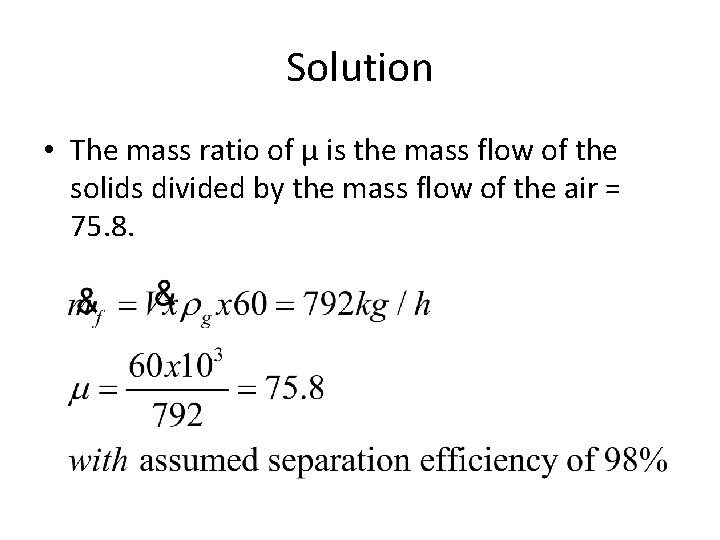
Solution • The mass ratio of μ is the mass flow of the solids divided by the mass flow of the air = 75. 8.
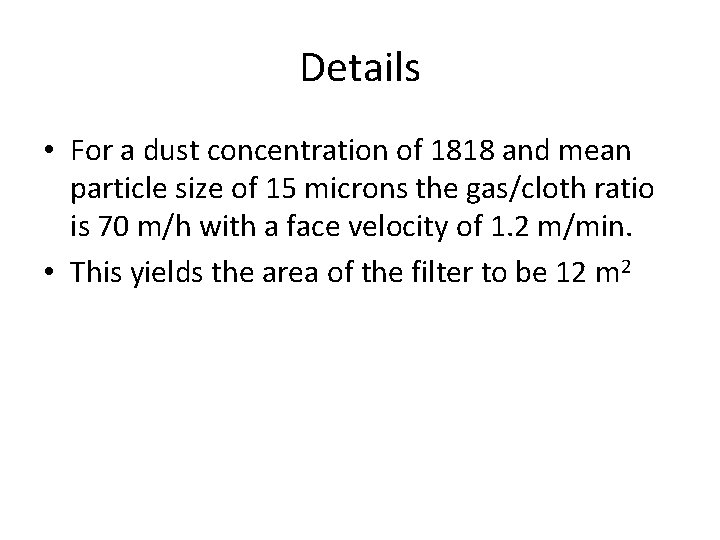
Details • For a dust concentration of 1818 and mean particle size of 15 microns the gas/cloth ratio is 70 m/h with a face velocity of 1. 2 m/min. • This yields the area of the filter to be 12 m 2
Final Suggestion • Suggested to chose an 12 m^2 filter which is a stock size.
- Slides: 11