
Fables and Allegories An Introduction to Animal Farm
Fables and Allegories An Introduction to Animal Farm

The Tortoise and the Hare: a Fable

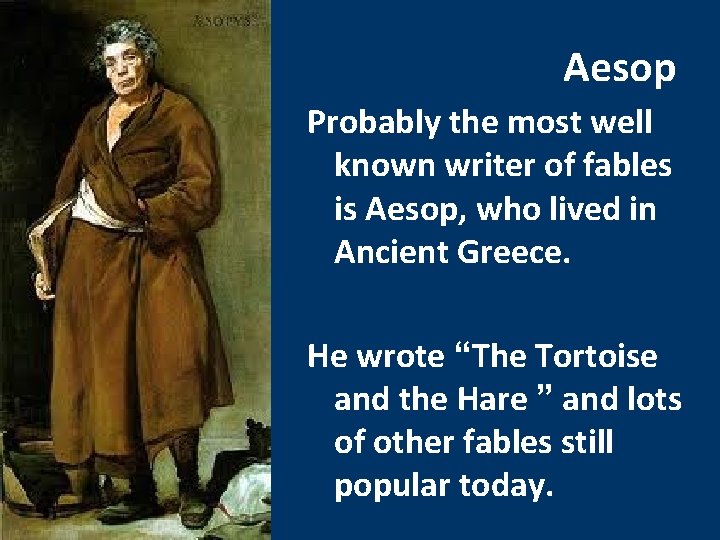
Aesop Probably the most well known writer of fables is Aesop, who lived in Ancient Greece. He wrote “The Tortoise and the Hare ” and lots of other fables still popular today.
Quotations from Aesop • Don’t cry over spilt milk. • Don’t count your chickens before they’ve hatched. • Beware the wolf in sheep’s clothing. • Appearances are often deceiving. • Birds of a feather flock together. • Slow and steady wins the race.
Fable • Fables are very short • Fables feature nonhuman characters who have been personified to an extreme – such as animals, plants, inanimate objects, mythical creatures, or forces of nature who think, talk, act, fight, disobey, and obey • Fables end with a short moral lesson
“The Tortoise and the Hare” is a Fable! • It is very short • The animal characters talk, think, plan, and feel • It teaches a moral or lesson: despite natural talents, perseverance, hard work, and focus can win the day
Allegory • Allegories are forms of extended metaphors, which continue throughout the whole text • An allegory is a piece of “art”work in which every part has at least two meanings: – the literal meaning – and an abstract or symbolic meaning • The underlying meaning of an allegory has social, religious, or political significance

The “Tortoise and the Hare” is an Allegory, too! Literal Meaning Hare Symbolic Meaning = Naturally gifted Tortoise = No natural talent Race = Life
What human characteristics do the hare and tortoise have? What human characteristics do we associate with pigs? Horses? Monkeys? Dogs?
What animal are you most similar to? What characteristics do you share with this animal?
Satire • Ridicules people, practices, governments, or institutions in order to reveal their weaknesses and provoke improvement • Uses wit, ridicule, irony, sarcasm, parody, reversal, and hyperbole • Reader must be careful to pay attention to hints and clues of the reality of the situation beyond the façade of a seemingly innocent story
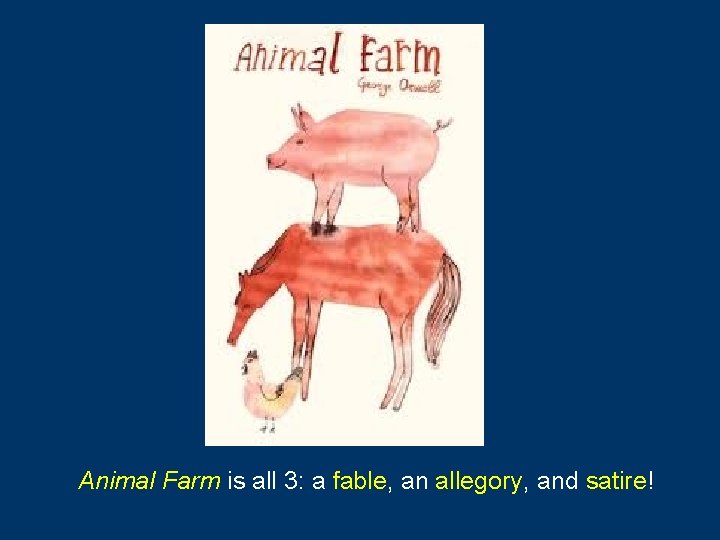
Animal Farm is all 3: a fable, an allegory, and satire!
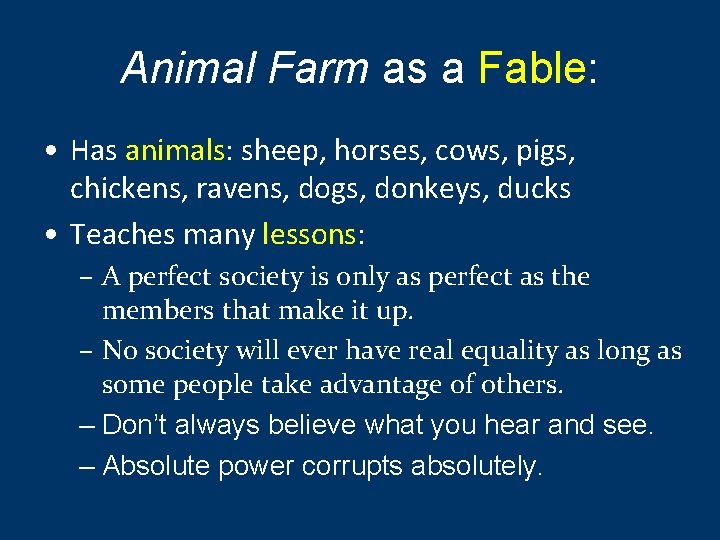
Animal Farm as a Fable: • Has animals: sheep, horses, cows, pigs, chickens, ravens, dogs, donkeys, ducks • Teaches many lessons: – A perfect society is only as perfect as the members that make it up. – No society will ever have real equality as long as some people take advantage of others. – Don’t always believe what you hear and see. – Absolute power corrupts absolutely.
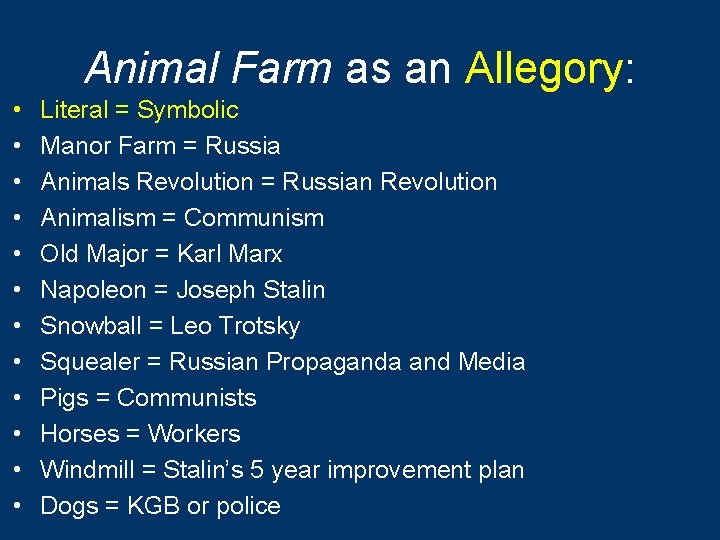
Animal Farm as an Allegory: • • • Literal = Symbolic Manor Farm = Russia Animals Revolution = Russian Revolution Animalism = Communism Old Major = Karl Marx Napoleon = Joseph Stalin Snowball = Leo Trotsky Squealer = Russian Propaganda and Media Pigs = Communists Horses = Workers Windmill = Stalin’s 5 year improvement plan Dogs = KGB or police
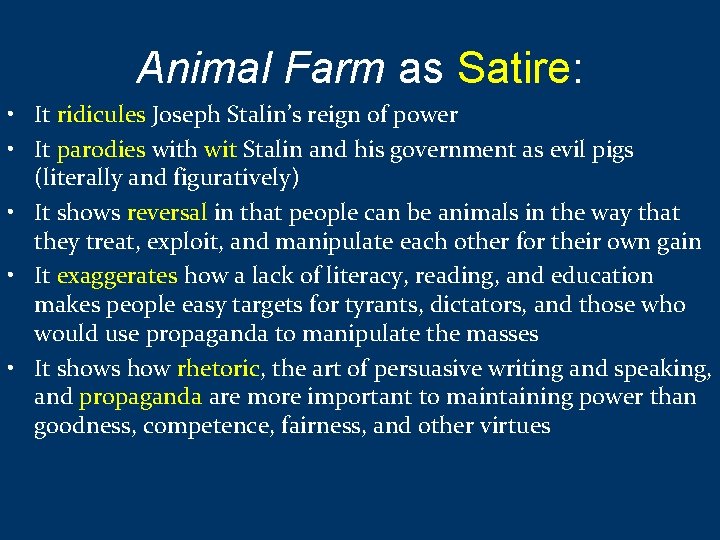
Animal Farm as Satire: • It ridicules Joseph Stalin’s reign of power • It parodies with wit Stalin and his government as evil pigs (literally and figuratively) • It shows reversal in that people can be animals in the way that they treat, exploit, and manipulate each other for their own gain • It exaggerates how a lack of literacy, reading, and education makes people easy targets for tyrants, dictators, and those who would use propaganda to manipulate the masses • It shows how rhetoric, the art of persuasive writing and speaking, and propaganda are more important to maintaining power than goodness, competence, fairness, and other virtues
- Slides: 18