
FAA Safety Risk Management SRM Presented By Eldridge
FAA Safety Risk Management (SRM) Presented By: Eldridge Frazier Date: October 12, 2016 Federal Aviation Administration
Topics • • • SMS and the SRM Component SRM Process SRM Report Risk Acceptance SRM Resources SRM October 12, 2016 Federal Aviation Administration 1
SRM Team Overview • SRM Project Lead • SRM Team Facilitator • SRM Team Members/Subject Matter Experts SRM October 12, 2016 Federal Aviation Administration 2
SRM Team Objective • This team is assembled to conduct a safety risk assessment on the identified Planned Change (ROMIO Demonstration) • The team will use the SRM process and definitions outlined in FAA Order 8040. 4 A, Safety Risk Management Policy SRM October 12, 2016 Federal Aviation Administration 3

SRM Overview • One of the four SMS components • Formalized, proactive approach to system safety • Means to identify, analyze, assess, and control safety risk in the aerospace system • Five step process that provides supporting information for decisionmakers SRM October 12, 2016 Federal Aviation Administration 4
SRM Process Outcomes • Document proposed changes, regardless of their anticipated safety impact • Identify, analyze, and assess hazards associated with a proposed change or current operations • Define safety requirements and reduce the identified risks to the acceptable level • Develop a plan (based on defined safety performance measures) to continuously assess the safety performance of the change and mitigation strategies • Accept predicted residual risk prior to change implementation SRM October 12, 2016 Federal Aviation Administration 5
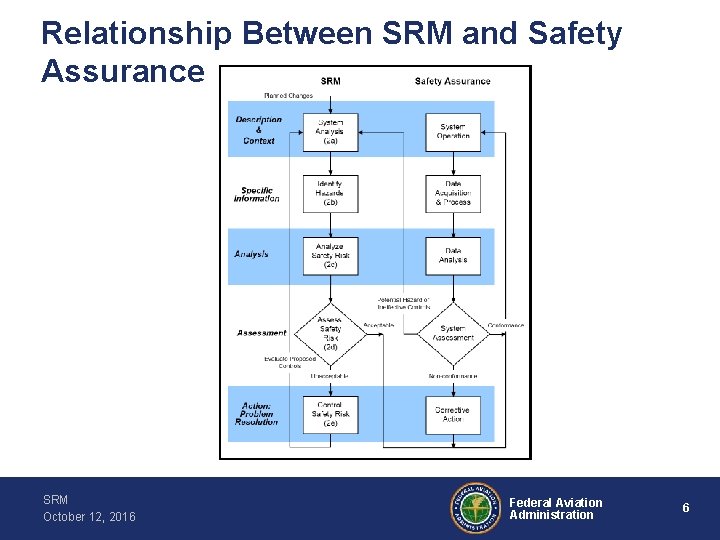
Relationship Between SRM and Safety Assurance SRM October 12, 2016 Federal Aviation Administration 6
FAA Order 8040. 4 A, Safety Risk Management Policy • Published in April 2012 • Formalizes the use of SRM across the FAA • Establishes common terms and processes used to analyze, assess, and accept safety risk • Describes the specific steps when performing SRM • Enables communication and coordination across FAA organizations for enhanced safety risk decision making • Recognizes that FAA organizations have unique missions and requirements; allows flexibility in the application of SRM • Update (8040. 4 B) currently in process with a plan to publish June 30, 2016 SRM October 12, 2016 Federal Aviation Administration 7
SRM Process
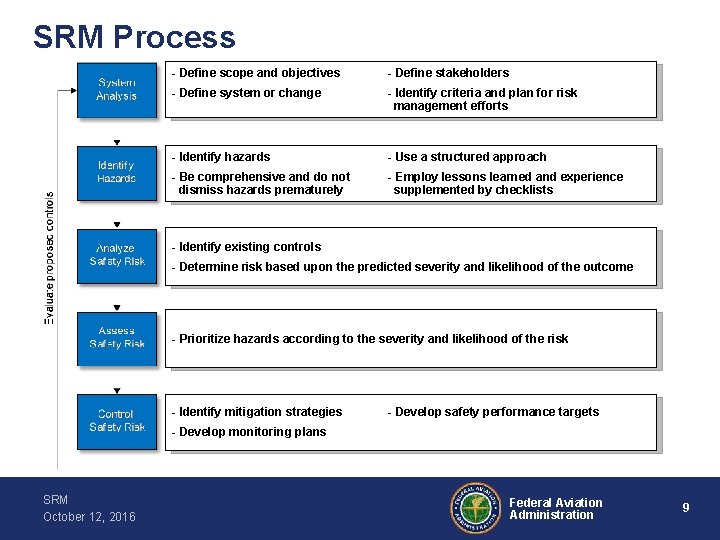
SRM Process - Define scope and objectives - Define stakeholders - Define system or change - Identify criteria and plan for risk management efforts - Identify hazards - Use a structured approach - Be comprehensive and do not dismiss hazards prematurely - Employ lessons learned and experience supplemented by checklists - Identify existing controls - Determine risk based upon the predicted severity and likelihood of the outcome - Prioritize hazards according to the severity and likelihood of the risk - Identify mitigation strategies - Develop safety performance targets - Develop monitoring plans SRM October 12, 2016 Federal Aviation Administration 9
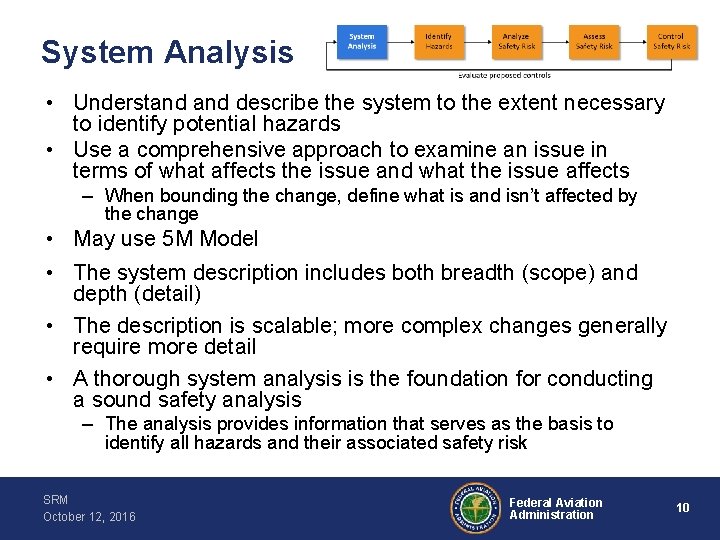
System Analysis • Understand describe the system to the extent necessary to identify potential hazards • Use a comprehensive approach to examine an issue in terms of what affects the issue and what the issue affects – When bounding the change, define what is and isn’t affected by the change • May use 5 M Model • The system description includes both breadth (scope) and depth (detail) • The description is scalable; more complex changes generally require more detail • A thorough system analysis is the foundation for conducting a sound safety analysis – The analysis provides information that serves as the basis to identify all hazards and their associated safety risk SRM October 12, 2016 Federal Aviation Administration 10
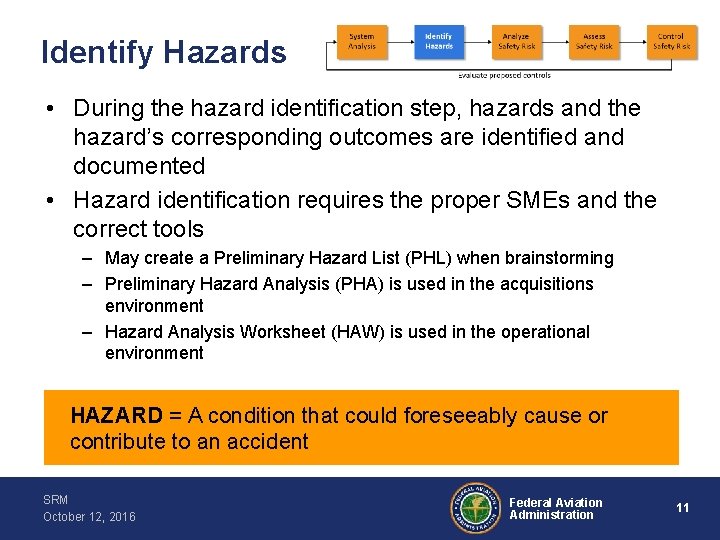
Identify Hazards • During the hazard identification step, hazards and the hazard’s corresponding outcomes are identified and documented • Hazard identification requires the proper SMEs and the correct tools – May create a Preliminary Hazard List (PHL) when brainstorming – Preliminary Hazard Analysis (PHA) is used in the acquisitions environment – Hazard Analysis Worksheet (HAW) is used in the operational environment HAZARD = A condition that could foreseeably cause or contribute to an accident SRM October 12, 2016 Federal Aviation Administration 11
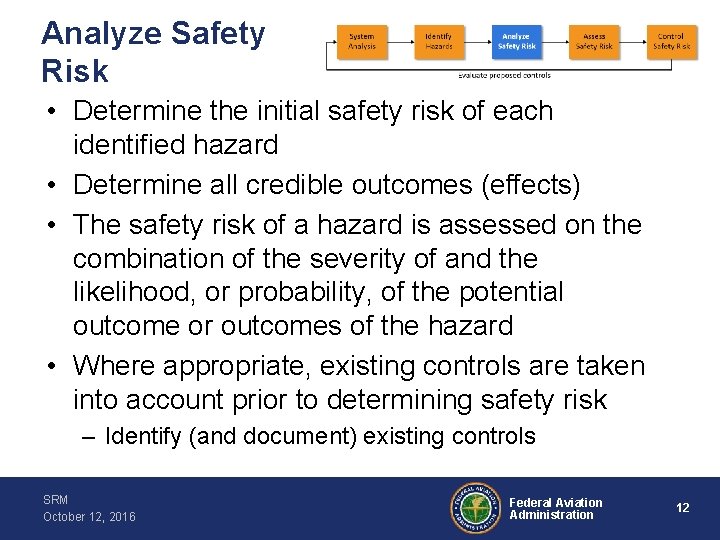
Analyze Safety Risk • Determine the initial safety risk of each identified hazard • Determine all credible outcomes (effects) • The safety risk of a hazard is assessed on the combination of the severity of and the likelihood, or probability, of the potential outcome or outcomes of the hazard • Where appropriate, existing controls are taken into account prior to determining safety risk – Identify (and document) existing controls SRM October 12, 2016 Federal Aviation Administration 12
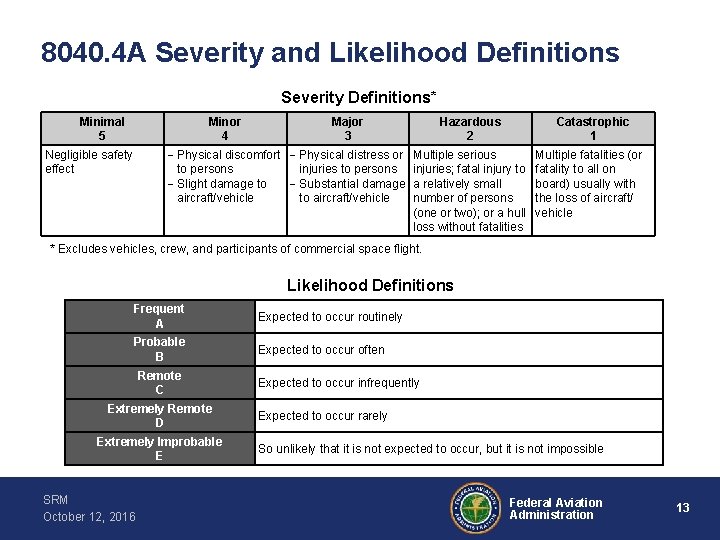
8040. 4 A Severity and Likelihood Definitions Severity Definitions* Minimal 5 Minor 4 Major 3 Physical discomfort Physical distress or to persons injuries to persons Slight damage to Substantial damage aircraft/vehicle to aircraft/vehicle Negligible safety effect Hazardous 2 Catastrophic 1 Multiple serious injuries; fatal injury to a relatively small number of persons (one or two); or a hull loss without fatalities Multiple fatalities (or fatality to all on board) usually with the loss of aircraft/ vehicle * Excludes vehicles, crew, and participants of commercial space flight. Likelihood Definitions Frequent A Expected to occur routinely Probable B Expected to occur often Remote C Extremely Remote D Extremely Improbable E SRM October 12, 2016 Expected to occur infrequently Expected to occur rarely So unlikely that it is not expected to occur, but it is not impossible Federal Aviation Administration 13
Assess Safety Risk • Plot each hazard’s associated safety on the risk matrix based on the severity and likelihood of the outcome – Remember single-point and common-cause failures • Determine the acceptability of the safety risk for each hazard – Acceptability is determined by comparing the analyzed risk to pre-defined levels of acceptable risk based on the severity and likelihood of a hazard's potential outcomes • A risk matrix can provide a visual depiction of this comparison and enables prioritization in the control of a hazard's risk SRM October 12, 2016 Federal Aviation Administration 14
![8040. 4 A Risk Matrix [Red] [Yellow] [Green] SRM October 12, 2016 Federal Aviation](http://slidetodoc.com/presentation_image_h2/886367e758f54426978572c897a98b3e/image-16.jpg "8040. 4 A Risk Matrix [Red] [Yellow] [Green] SRM October 12, 2016 Federal Aviation")
8040. 4 A Risk Matrix [Red] [Yellow] [Green] SRM October 12, 2016 Federal Aviation Administration 15
Control Safety Risk • Develop and manage options to deal with unacceptable safety risk • Effectively mitigating risk involves: – Identifying feasible mitigation options – Developing a risk mitigation plan and accepting the predicted residual risk – Developing a monitoring plan that details review cycles for evaluating the effectiveness of mitigations – Implementing and confirming the mitigations SRM October 12, 2016 Federal Aviation Administration 16
SRM Report
SRM Report Overview • SRM Report thoroughly describes the safety analysis of an issue/change • Documents the evidence to support whether the resolution of an issue or proposed change to the system is acceptable from a safety risk perspective • Contributes (from a programmatic or management perspective) to the decision to implement • The Office of Primary Responsibility (OPR) for the issue/change maintains all documentation associated with the SRM process for the life cycle of the system or change SRM October 12, 2016 Federal Aviation Administration 18
SRM Report Template • The template contains the following sections: – – – Executive Summary Section 1: Current System/System Baseline Section 2: Proposal Description Section 3: Safety Risk Management Planning and Impacted Organizations Section 4: Assumptions Section 5: Step 1: System Analysis Section 6: Step 2: Identified Hazards Section 7: Steps 3 & 4: Safety Risk Analysis & Assessment Section 8: Step 5: Control Safety Risk Section 9: Tracking and Monitoring of Hazards Section 10: Risk Acceptance (if applicable) Appendices SRM October 12, 2016 Federal Aviation Administration 19
SRM Report Signature • SRM Report is signed, via signed memo with the SRM Report attached, by: – The OPR Manager indicating agreement that the findings are valid and accurate and the appropriate process was followed – Manager(s)/Executive(s) accepting the residual risk and agreement to follow a comprehensive monitoring plan to verify predicted residual risk (if applicable) – Manager(s)/Executive(s) committing to implement the safety risk mitigations in accordance with the associated SRM Report controls • The OPR is responsible for obtaining the necessary signatures SRM October 12, 2016 Federal Aviation Administration 20
Risk Acceptance
Risk Acceptance • The appropriate management official accepts the risk associated with the identified hazard(s) • When an individual or organization accepts risk, it does not mean that the risk is eliminated • Some risk remains; however, the individual or organization has determined that the prediction of the residual risk is acceptable • Each Line of Business must establish the levels of management that can accept risk • When the responsibility to manage the risk spans across Lines of Business, the residual risk must be accepted by the appropriate management official in each affected Line of Business • The OPR is responsible for obtaining Risk Acceptance signatures on the SRM Report SRM October 12, 2016 Federal Aviation Administration 22
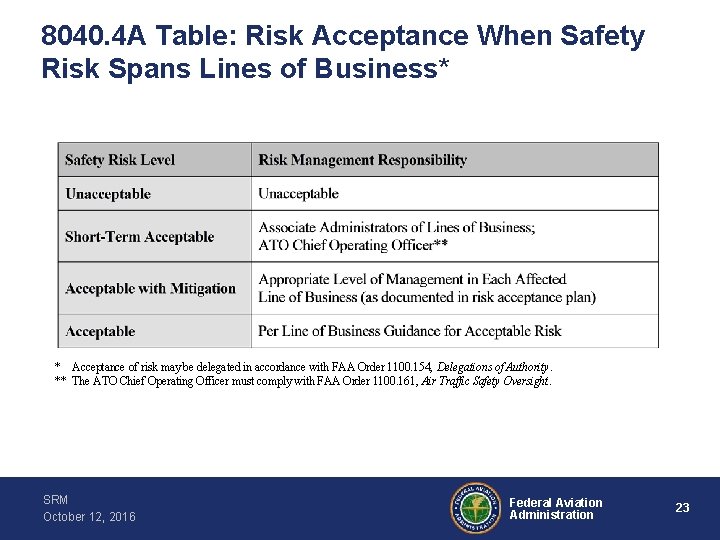
8040. 4 A Table: Risk Acceptance When Safety Risk Spans Lines of Business* * Acceptance of risk may be delegated in accordance with FAA Order 1100. 154, Delegations of Authority. ** The ATO Chief Operating Officer must comply with FAA Order 1100. 161, Air Traffic Safety Oversight. SRM October 12, 2016 Federal Aviation Administration 23
SRM Team Facilitator • Moderates the deliberation of the SRM Team – Solicits expert advice and builds consensus – Cultivates discussion among team members about potential hazards, risks, and mitigations – Limits influence on the safety risk assessment • Ensures compliance with the SRM process – Each step is completed – Team findings are recorded • Serves as neutral body, with no bias towards the discussions and conclusions of the team SRM October 12, 2016 Federal Aviation Administration 24
SRM Team Technical Writer • Documents notes from meetings • Writes SRM Report to document team process and findings SRM October 12, 2016 Federal Aviation Administration 25
SRM Team Member • Provides subject matter expertise – Uses technical expertise or operational responsibilities to analyze the issue/change under consideration • Analyzes and considers all relevant and available data to form a sound basis and rationale for the team deliberations • Has the authority to represent and make decisions for his/her respective organization • Coordinates with management in his/her organization • Is objective and safety-minded SRM October 12, 2016 Federal Aviation Administration 26
- Slides: 27