
F3 F4 and F5 Biswapati Jana Introduction As
F-3, F-4 and F-5 Biswapati Jana
Introduction As an alternative to the Out. Guess 0. 2 algorithm, Andreas Westfeld (2001) proposed an algorithm called F 3 which was considered even more secure. l Instead of avoiding embedding in DCT coefficients equal to 1, the F 3 algorithm permitted embedding in these regions, while it would still avoid embedding in zeros and the DC coefficients. l
Overview The algorithm embed the message data sequentially within c. l It did not embed directly in the least significant bits of the DCT coefficients, but instead took the absolute value of the coefficients first, before comparing them to the message bits. l If both the absolute value of the coefficient, and the message bit were the same, then no changes are made otherwise reduce by 1. l
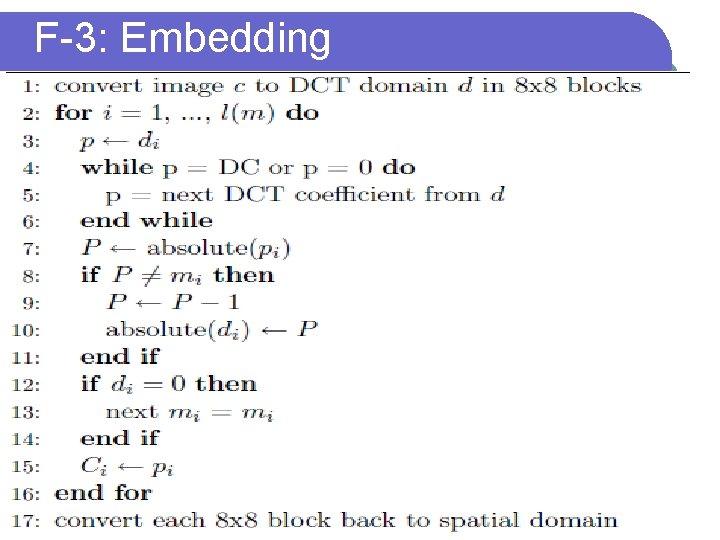
F-3: Embedding
F-3: Embedding It shows how the absolute value of the current coefficient is taken such that it can then be compared with the message bit mi. l If they are both the same then we can move on to the next di coefficient and attempt to embed the next mi value. l When P not equal mi, then the absolute value of P is reduced by 1 and inserted into di. l
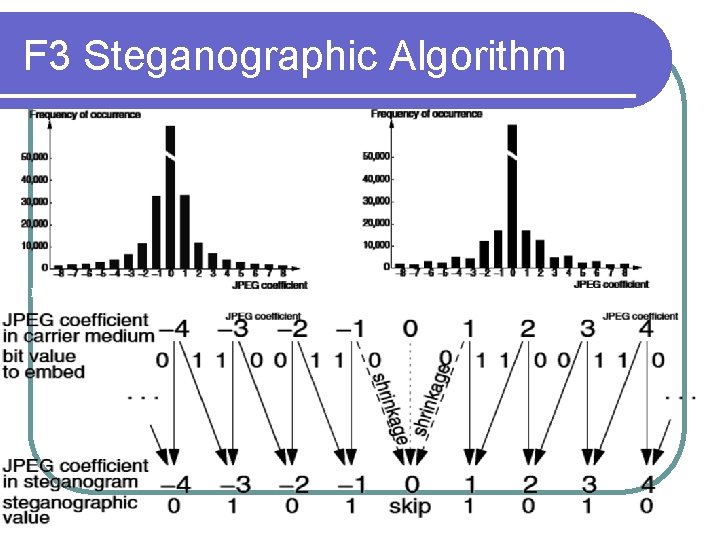
F 3 Steganographic Algorithm Fig 5 a: Histogram of JPEG coefficients after quantization Fig 5 b: F 3 produces a superior number of even coefficients
F-3: Decoding There is nothing to suggest that embedding on coefficient values equal to 1 is not permitted. l The decoding process for F 3 is slightly less complicated than encoding process because it does not concern the shrinkage issue. l If the coefficient value is equal to zero, it does not attempt to retrieve mi. This is illustrated in line 4 of decoding algorithm. l
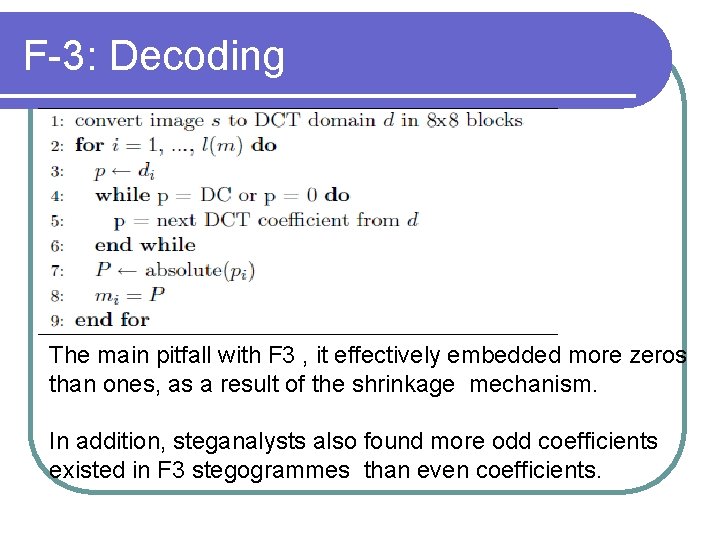
F-3: Decoding The main pitfall with F 3 , it effectively embedded more zeros than ones, as a result of the shrinkage mechanism. In addition, steganalysts also found more odd coefficients existed in F 3 stegogrammes than even coefficients.
F-4: Embedding The F 4 algorithm eliminates the two weaknesses of F 3 in one stroke by mapping negative coefficients to the steganographic value, where even-negative coefficients = 1, odd -negative coefficients = 0, even-positive coefficients = 0 and, odd-positive coefficients = 1. l This means that now, if we embed a 0 in a DCT coefficient equal to -3, the result will remain -3, where as it would have been modified to -2 using F 3. l
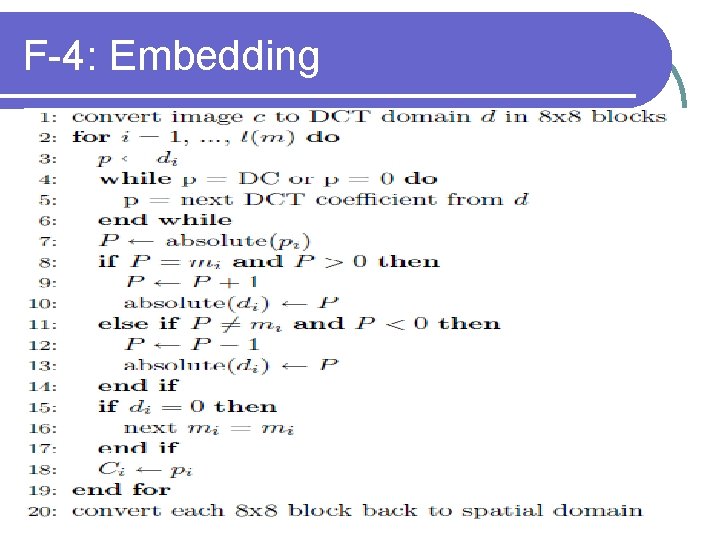
F-4: Embedding
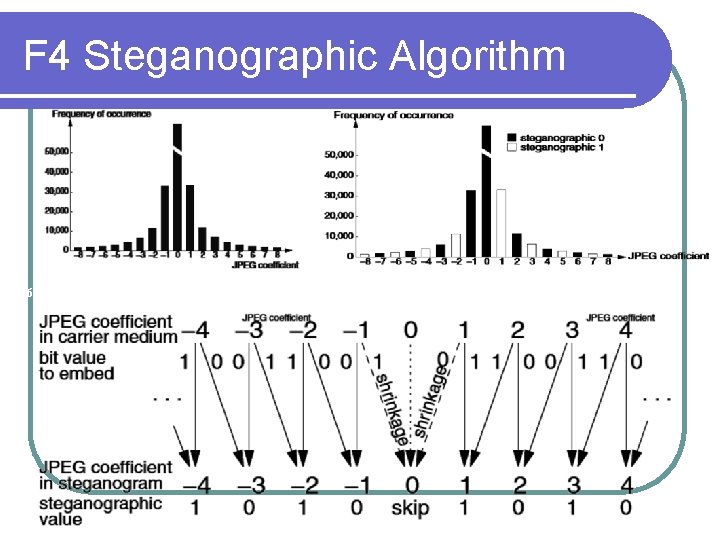
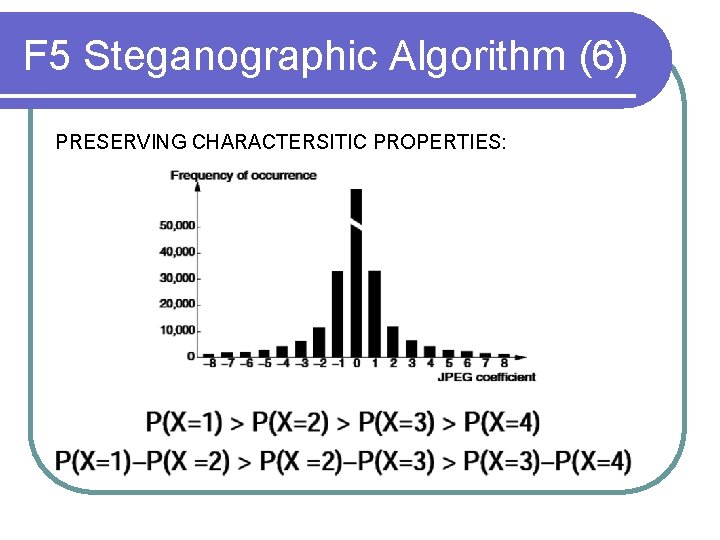
F 4 Steganographic Algorithm Fig 6 a: Histogram of JPEG coefficients after quantization Fig 6 b: Histogram of JPEG coefficients with F 4 interpretation of Steganographic values
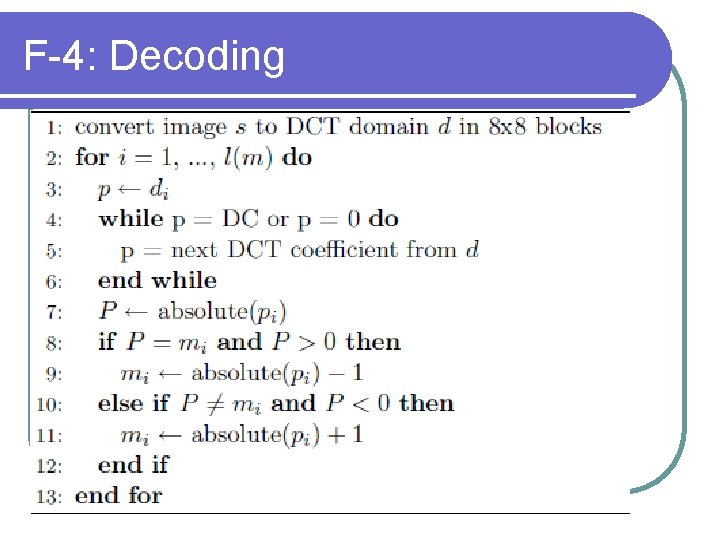
F-4: Decoding
F-4 : Algorithm F 4 eliminates 2 weakness in F 3 algorithm by mapping negative coefficients to the inverted steganographic value: even negative coefficients represent a steganographic one, odd negative a zero; even positive represents a zero, odd positive and even negative a one. Ø In Figure, each 2 bars of the same height represent coefficients with inverse steganographic value (steganographic zeros are black, steganographic ones white). Ø
F 4: - WEAKNESSES: • Embeds secret message data continuously resulting in changes to concentrate on the start of the file, and unused rest resides on the end. This phenomenon is called Continuous embedding. • For a very short secret message comprising of 217 bytes (1736 bits), F 4 changes 1157 places. This is shows that the number of bits changed is significantly more which is not a good feature for attack proof steganographic algorithm. A new mechanism is required to decrease the number of bit changes
F 5 Steganographic Algorithm (1) Overall algorithm is same as F 4 algorithm. Ø F 5 is enhanced version of F 4 algorithm with respect to 2 main features stated below which help in preventing statistical attacks and improving embedding efficiency: Ø Ø Ø PERMUTATIVE STRADDLING MATRIX ENCODING
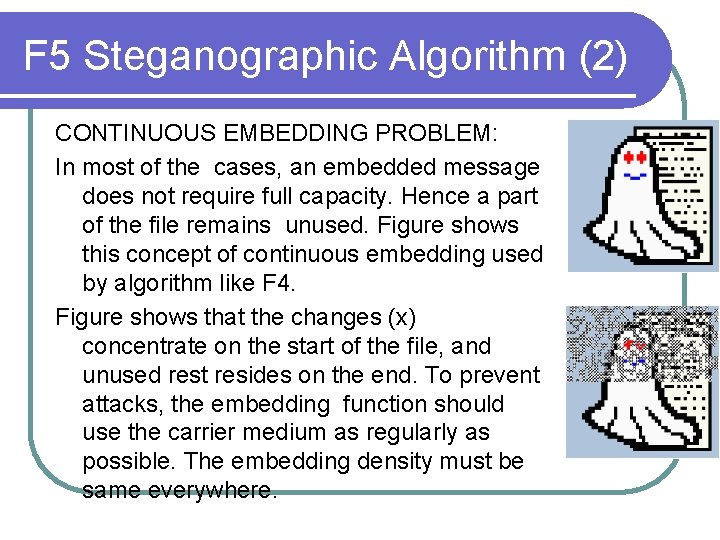
F 5 Steganographic Algorithm (2) CONTINUOUS EMBEDDING PROBLEM: In most of the cases, an embedded message does not require full capacity. Hence a part of the file remains unused. Figure shows this concept of continuous embedding used by algorithm like F 4. Figure shows that the changes (x) concentrate on the start of the file, and unused rest resides on the end. To prevent attacks, the embedding function should use the carrier medium as regularly as possible. The embedding density must be same everywhere.
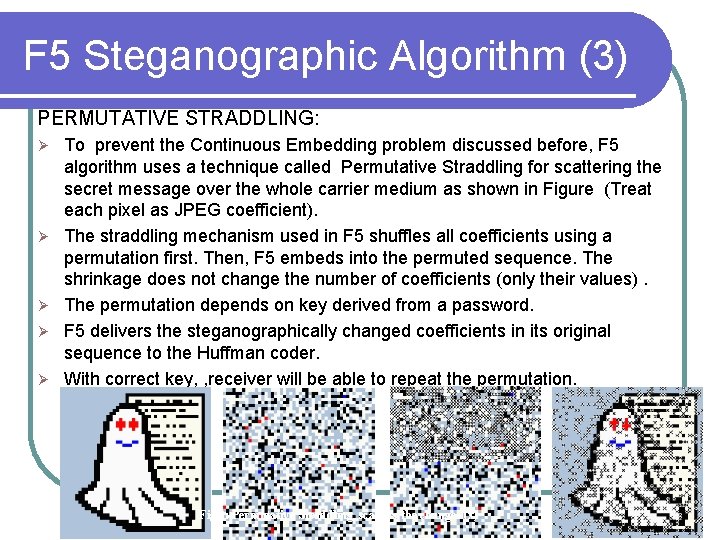
F 5 Steganographic Algorithm (3) PERMUTATIVE STRADDLING: Ø Ø Ø To prevent the Continuous Embedding problem discussed before, F 5 algorithm uses a technique called Permutative Straddling for scattering the secret message over the whole carrier medium as shown in Figure (Treat each pixel as JPEG coefficient). The straddling mechanism used in F 5 shuffles all coefficients using a permutation first. Then, F 5 embeds into the permuted sequence. The shrinkage does not change the number of coefficients (only their values). The permutation depends on key derived from a password. F 5 delivers the steganographically changed coefficients in its original sequence to the Huffman coder. With correct key, , receiver will be able to repeat the permutation. Fig 8: Permutative Straddling scatters the changes (x)
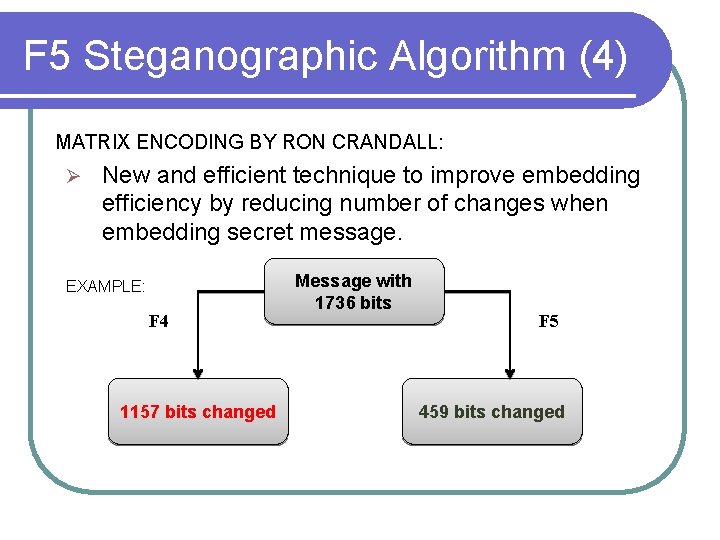
F 5 Steganographic Algorithm (4) MATRIX ENCODING BY RON CRANDALL: Ø New and efficient technique to improve embedding efficiency by reducing number of changes when embedding secret message. EXAMPLE: F 4 1157 bits changed Message with 1736 bits F 5 459 bits changed
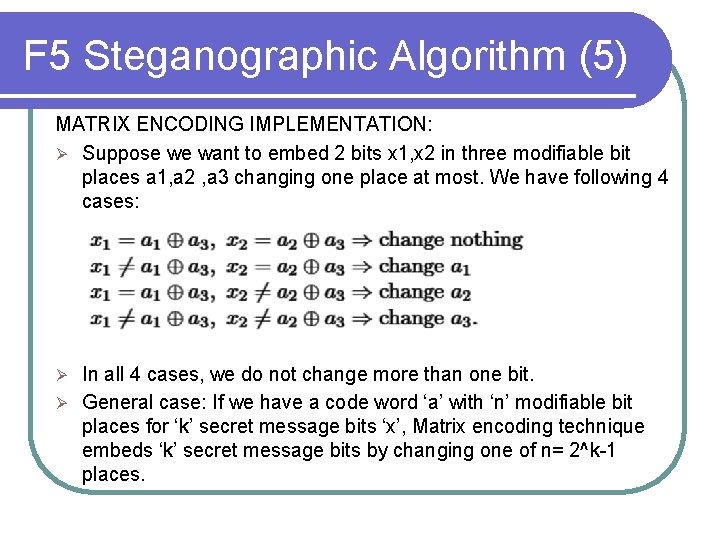
F 5 Steganographic Algorithm (5) MATRIX ENCODING IMPLEMENTATION: Ø Suppose we want to embed 2 bits x 1, x 2 in three modifiable bit places a 1, a 2 , a 3 changing one place at most. We have following 4 cases: In all 4 cases, we do not change more than one bit. Ø General case: If we have a code word ‘a’ with ‘n’ modifiable bit places for ‘k’ secret message bits ‘x’, Matrix encoding technique embeds ‘k’ secret message bits by changing one of n= 2^k-1 places. Ø
F 5 Steganographic Algorithm (6) PRESERVING CHARACTERSITIC PROPERTIES:
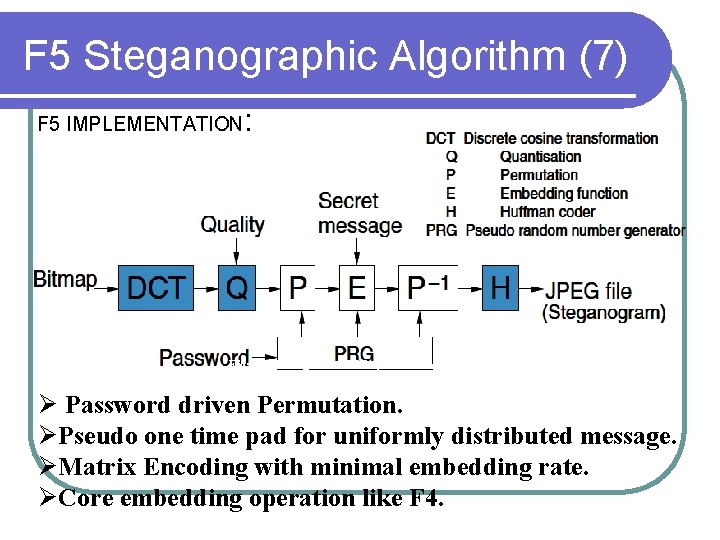
F 5 Steganographic Algorithm (7) F 5 IMPLEMENTATION : Fig: Block Diagram of F 5 Implementation Ø Password driven Permutation. ØPseudo one time pad for uniformly distributed message. ØMatrix Encoding with minimal embedding rate. ØCore embedding operation like F 4.
F 5 Steganographic Algorithm (8) F 5 Implementation Steps: Ø Start JPEG compression. Stop after the quantisation of coefficients. Ø Initialise a cryptographically strong random number generator with the key derived from the password. Ø Instantiate a permutation (two parameters: random generator and number of coefficients). Ø Determine the parameter k from the capacity of the carrier medium, and the length of the secret message. Ø Calculate the code word length n = 2^k − 1. Ø Embed the secret message with (1, n, k) matrix encoding Ø Implement inverse permutation. Ø Continue JPEG compression (Huffman coding etc. )
F 5 ADVANTAGES Ø F 5 has high embedding capacity (>13%) but can be pushed even further. Ø F 5 has high embedding efficiency. Ø Resistance against both visual and statistical attacks. Ø Uses a common image format and carrier medium (JPEG).
The End Thanks for Coming!
- Slides: 25