
F The lifting condensation level is the level
- Slides: 19
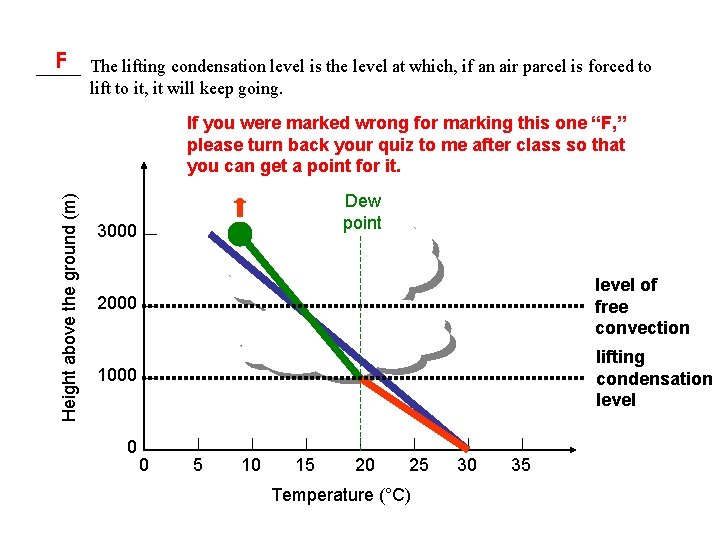
F The lifting condensation level is the level at which, if an air parcel is forced to _____ lift to it, it will keep going. Height above the ground (m) If you were marked wrong for marking this one “F, ” please turn back your quiz to me after class so that you can get a point for it. Dew point 3000 2000 level of free convection 1000 lifting condensation level 0 0 5 10 15 20 25 Temperature (°C) 30 35
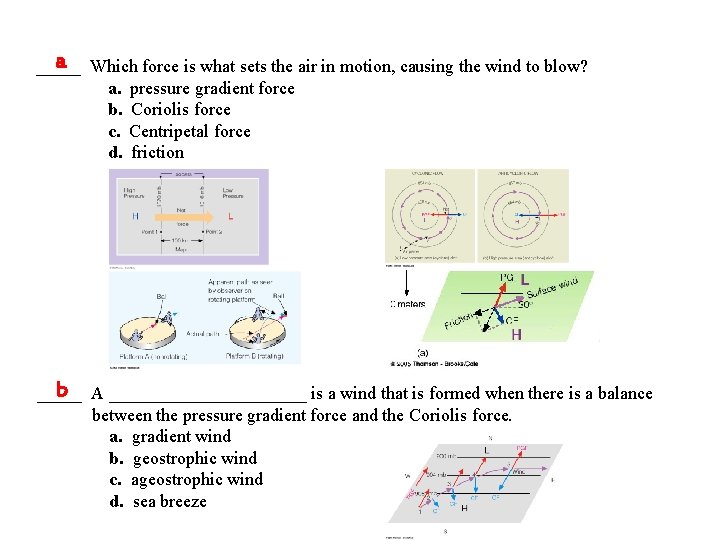
a Which force is what sets the air in motion, causing the wind to blow? _____ a. pressure gradient force b. Coriolis force c. Centripetal force d. friction b A ___________ is a wind that is formed when there is a balance _____ between the pressure gradient force and the Coriolis force. a. gradient wind b. geostrophic wind c. ageostrophic wind d. sea breeze
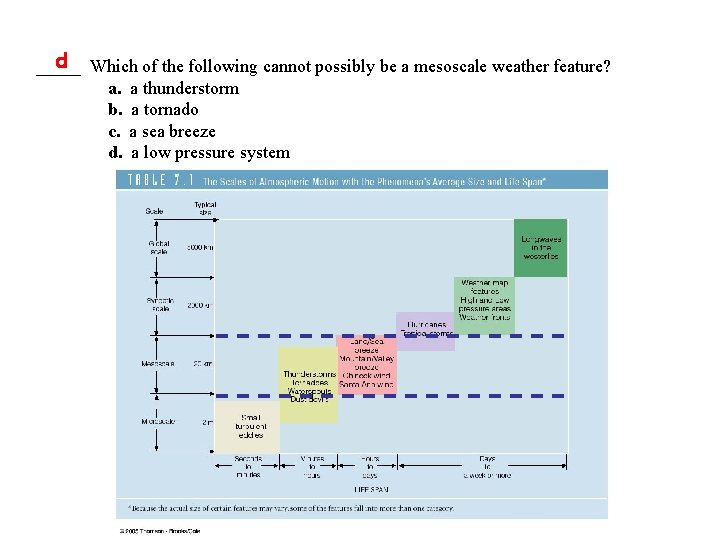
d Which of the following cannot possibly be a mesoscale weather feature? _____ a. a thunderstorm b. a tornado c. a sea breeze d. a low pressure system
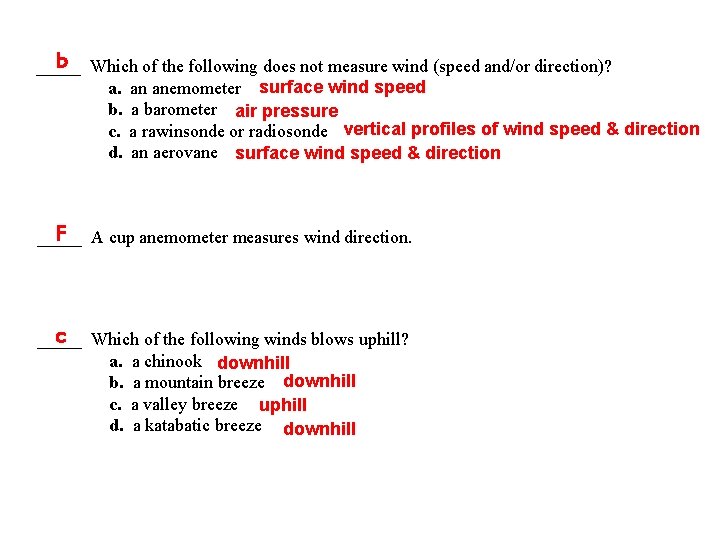
b Which of the following does not measure wind (speed and/or direction)? _____ a. an anemometer surface wind speed b. a barometer air pressure c. a rawinsonde or radiosonde vertical profiles of wind speed & direction d. an aerovane surface wind speed & direction F A cup anemometer measures wind direction. _____ c Which of the following winds blows uphill? _____ a. a chinook downhill b. a mountain breeze downhill c. a valley breeze uphill d. a katabatic breeze downhill
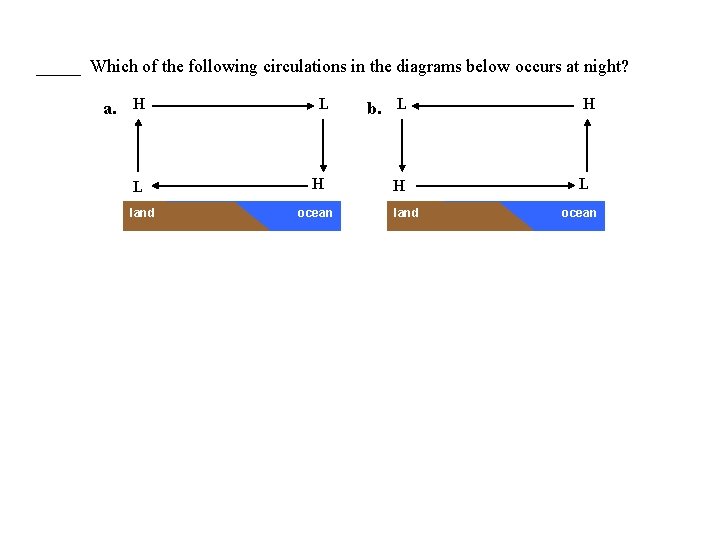
_____ Which of the following circulations in the diagrams below occurs at night? a. H L land L H ocean b. L H land H L ocean
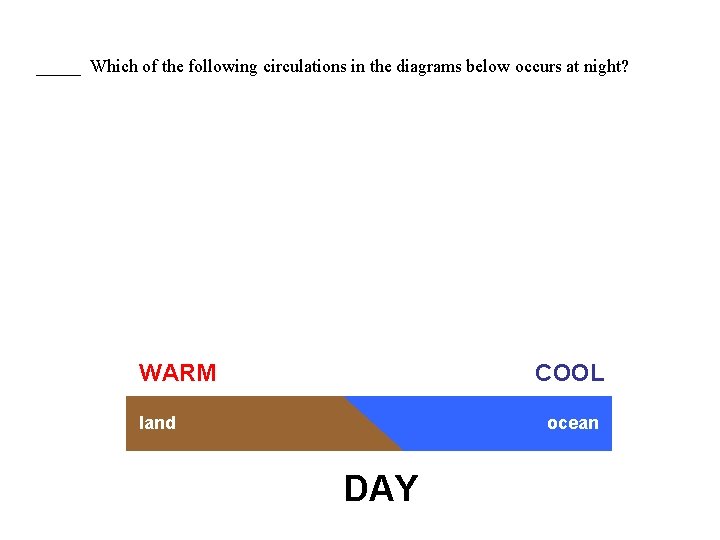
_____ Which of the following circulations in the diagrams below occurs at night? WARM COOL land ocean DAY
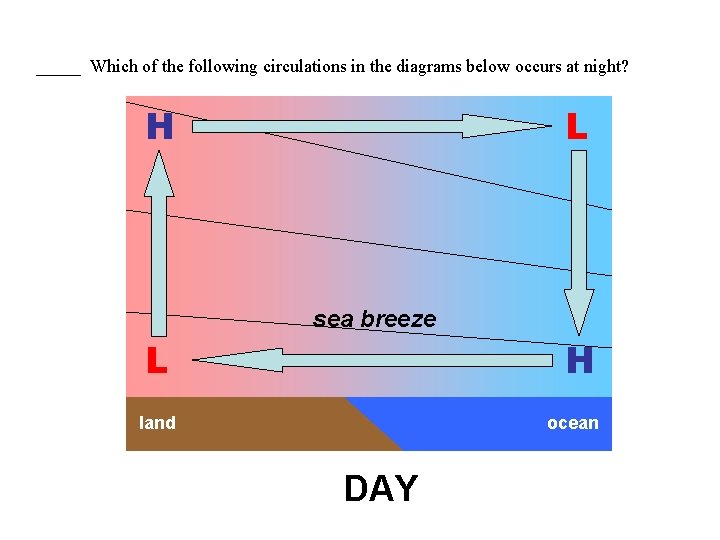
_____ Which of the following circulations in the diagrams below occurs at night? H L sea breeze L H land ocean DAY
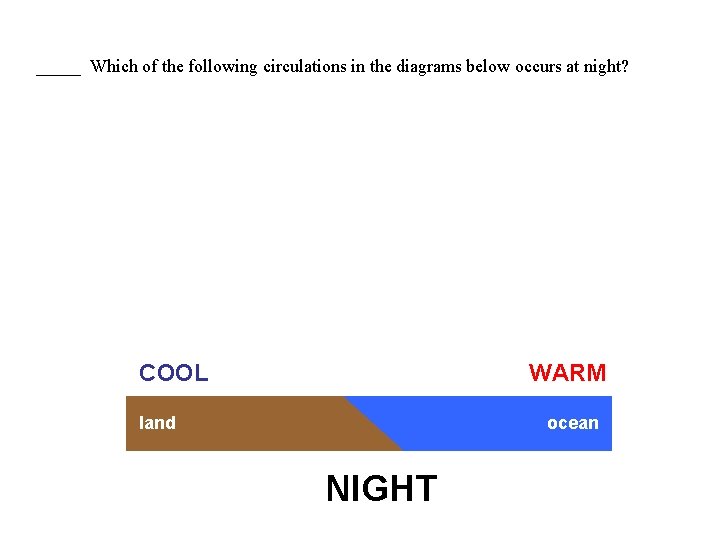
_____ Which of the following circulations in the diagrams below occurs at night? COOL WARM land ocean NIGHT
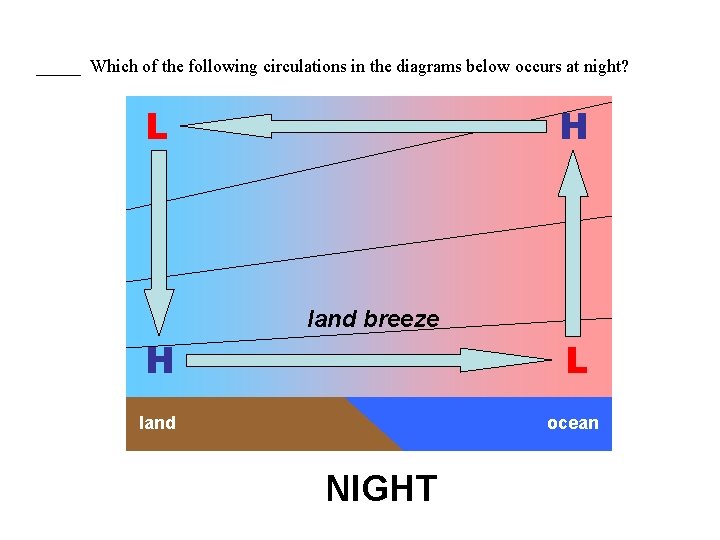
_____ Which of the following circulations in the diagrams below occurs at night? L H land breeze H L land ocean NIGHT
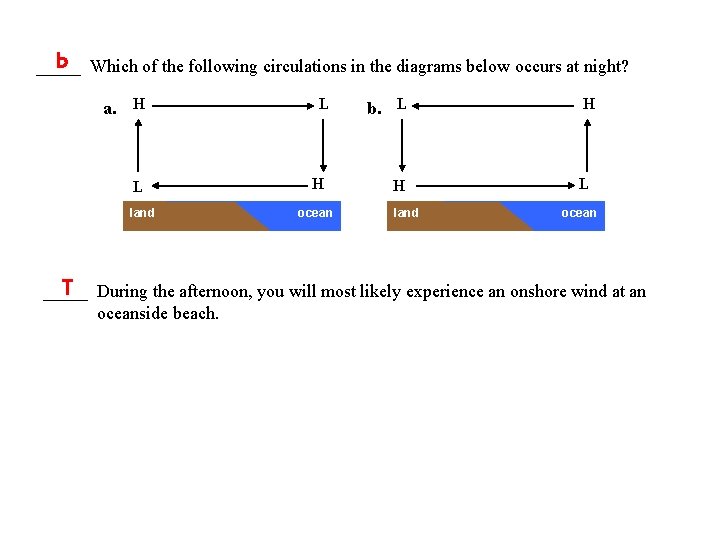
b Which of the following circulations in the diagrams below occurs at night? _____ a. H L land L H ocean b. L H land H L ocean T During the afternoon, you will most likely experience an onshore wind at an _____ oceanside beach.
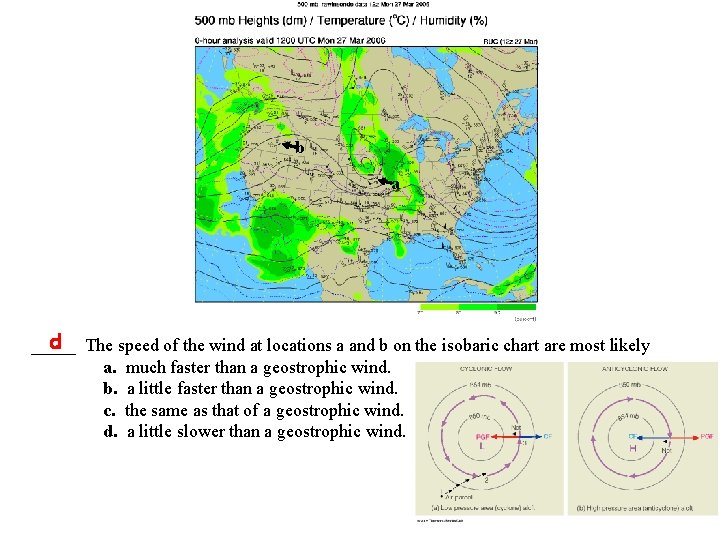
b a d The speed of the wind at locations a and b on the isobaric chart are most likely _____ a. much faster than a geostrophic wind. b. a little faster than a geostrophic wind. c. the same as that of a geostrophic wind. d. a little slower than a geostrophic wind.
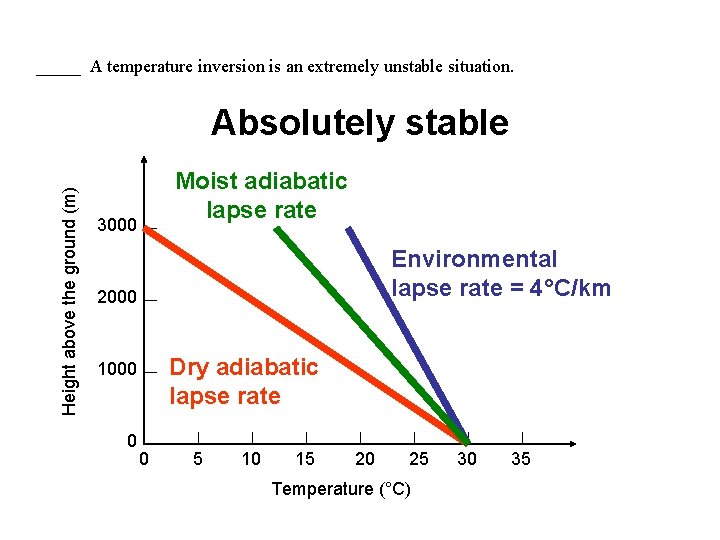
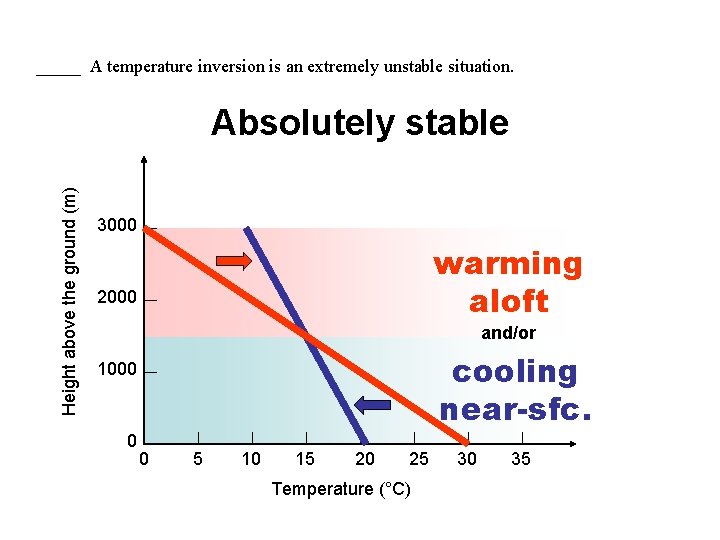
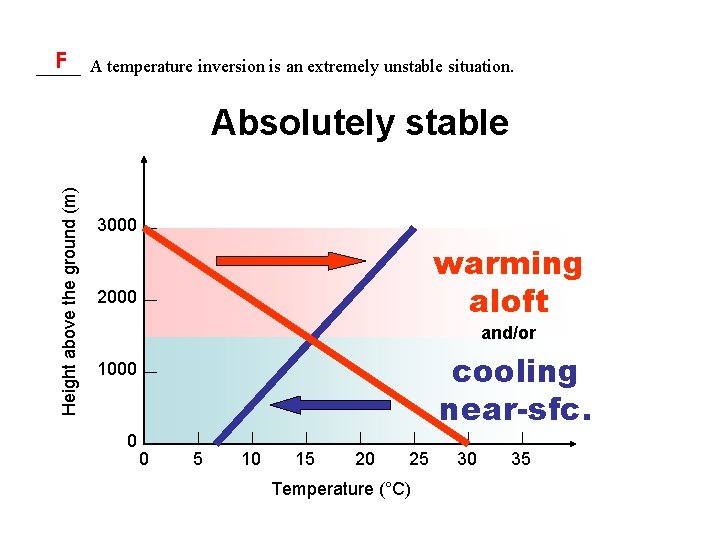
_____ A temperature inversion is an extremely unstable situation. Height above the ground (m) Absolutely stable Moist adiabatic lapse rate 3000 Environmental lapse rate = 4°C/km 2000 Dry adiabatic lapse rate 1000 0 0 5 10 15 20 25 Temperature (°C) 30 35
_____ A temperature inversion is an extremely unstable situation. Height above the ground (m) Absolutely stable 3000 warming aloft 2000 and/or cooling near-sfc. 1000 0 0 5 10 15 20 25 Temperature (°C) 30 35
F A temperature inversion is an extremely unstable situation. _____ Height above the ground (m) Absolutely stable 3000 warming aloft 2000 and/or cooling near-sfc. 1000 0 0 5 10 15 20 25 Temperature (°C) 30 35
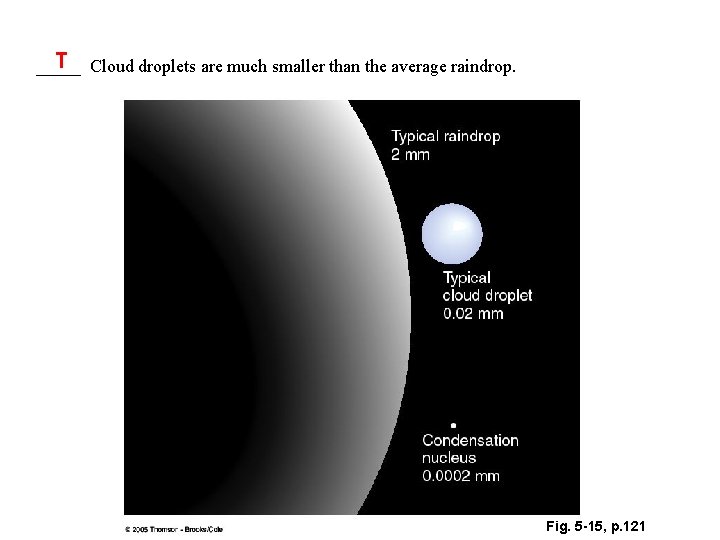
T Cloud droplets are much smaller than the average raindrop. _____ Fig. 5 -15, p. 121
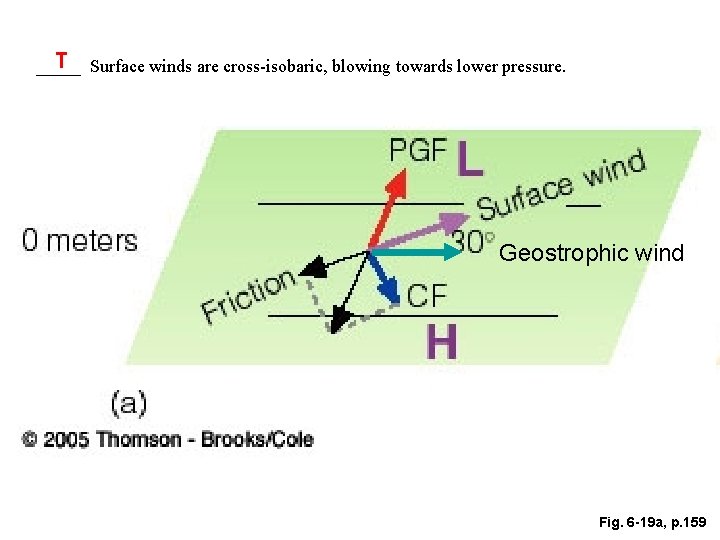
T Surface winds are cross-isobaric, blowing towards lower pressure. _____ Geostrophic wind Fig. 6 -19 a, p. 159
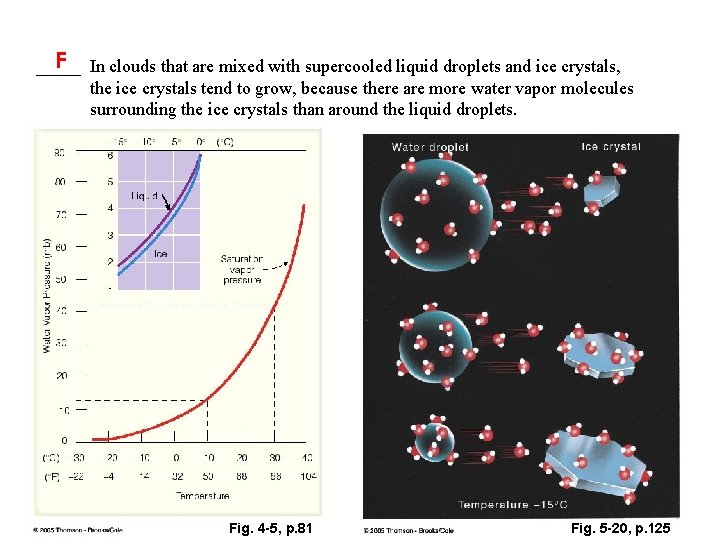
F In clouds that are mixed with supercooled liquid droplets and ice crystals, _____ the ice crystals tend to grow, because there are more water vapor molecules surrounding the ice crystals than around the liquid droplets. Fig. 4 -5, p. 81 Fig. 5 -20, p. 125
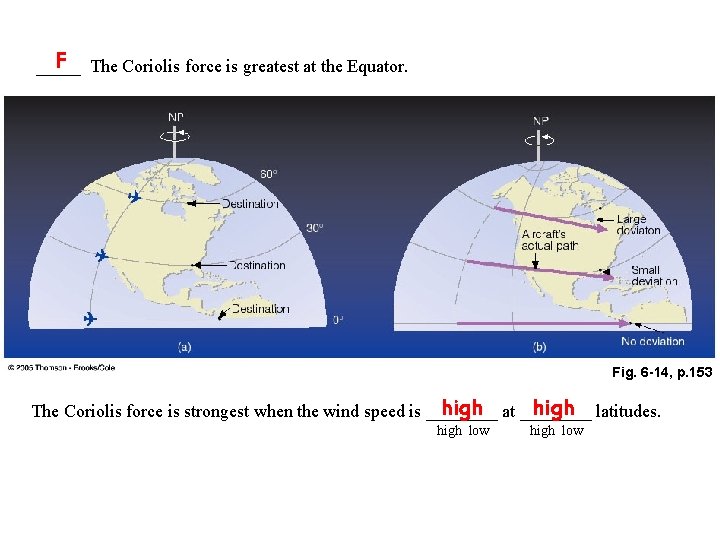
F The Coriolis force is greatest at the Equator. _____ Fig. 6 -14, p. 153 high at ____ high latitudes. The Coriolis force is strongest when the wind speed is ____ high low
stratiform In a stable atmosphere, one would expect to see _________ clouds. stratiform cumuliform