
f MRI in Impaired Consciousness Future diagnostic opportunities

- Slides: 19
f. MRI in Impaired Consciousness Future diagnostic opportunities and ethical challenges Christian Schwarzbauer Aberdeen Biomedical Imaging Centre 7 th May 2010
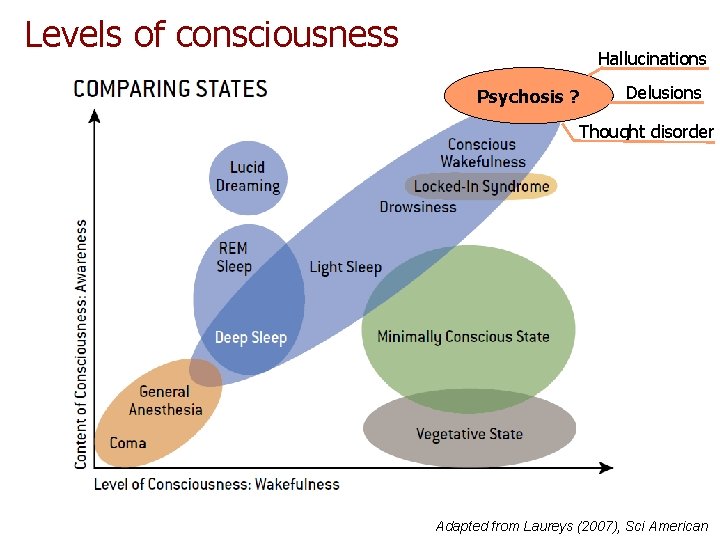
Levels of consciousness Hallucinations Psychosis ? Delusions Thought disorder Adapted from Laureys (2007), Sci American
Example 1: f. MRI in Schizophrenia
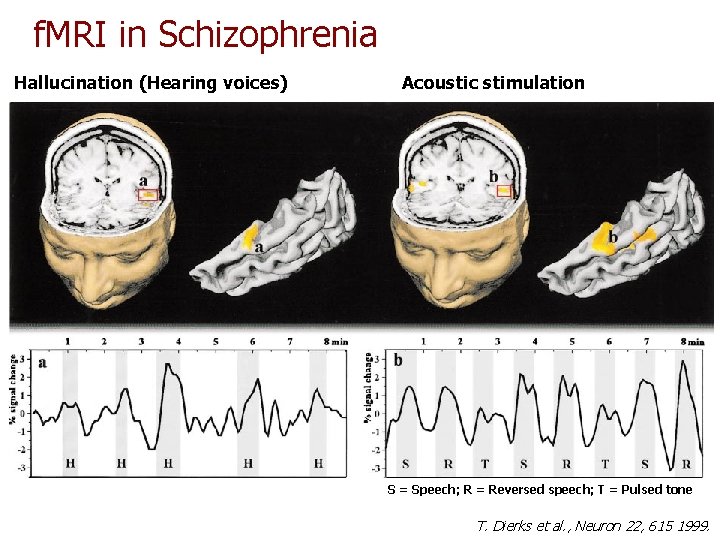
f. MRI in Schizophrenia Hallucination (Hearing voices) Acoustic stimulation S = Speech; R = Reversed speech; T = Pulsed tone T. Dierks et al. , Neuron 22, 615 1999.
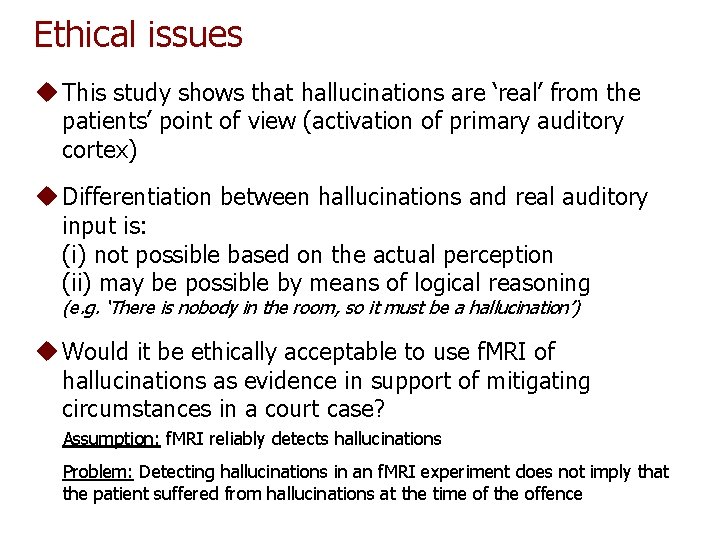
Ethical issues u This study shows that hallucinations are ‘real’ from the patients’ point of view (activation of primary auditory cortex) u Differentiation between hallucinations and real auditory input is: (i) not possible based on the actual perception (ii) may be possible by means of logical reasoning (e. g. ‘There is nobody in the room, so it must be a hallucination’) u Would it be ethically acceptable to use f. MRI of hallucinations as evidence in support of mitigating circumstances in a court case? Assumption: f. MRI reliably detects hallucinations Problem: Detecting hallucinations in an f. MRI experiment does not imply that the patient suffered from hallucinations at the time of the offence
Example 2: f. MRI in Vegetative State
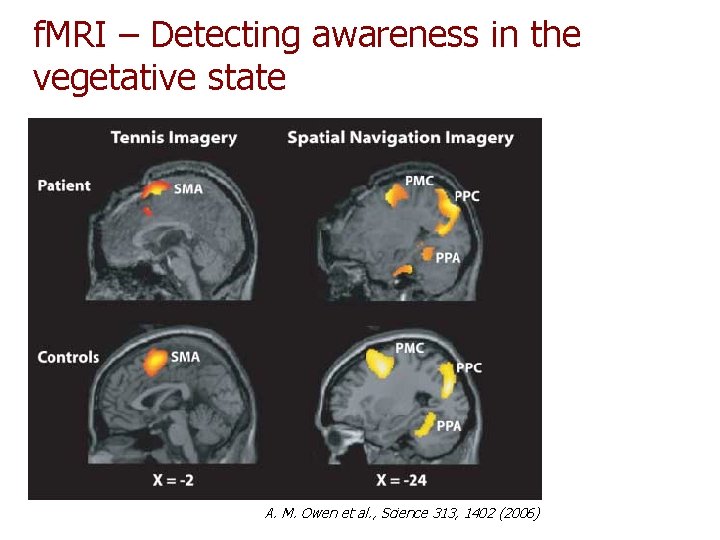
f. MRI – Detecting awareness in the vegetative state A. M. Owen et al. , Science 313, 1402 (2006)
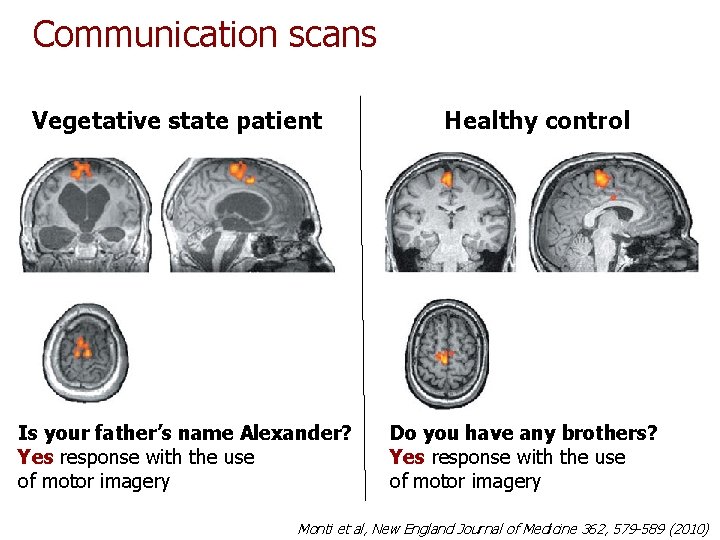
Communication scans Vegetative state patient Is your father’s name Alexander? Yes response with the use of motor imagery Healthy control Do you have any brothers? Yes response with the use of motor imagery Monti et al, New England Journal of Medicine 362, 579 -589 (2010)
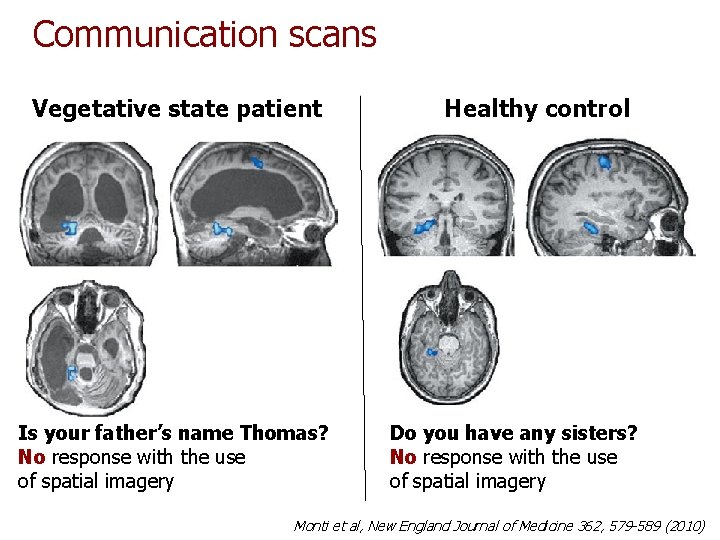
Communication scans Vegetative state patient Is your father’s name Thomas? No response with the use of spatial imagery Healthy control Do you have any sisters? No response with the use of spatial imagery Monti et al, New England Journal of Medicine 362, 579 -589 (2010)
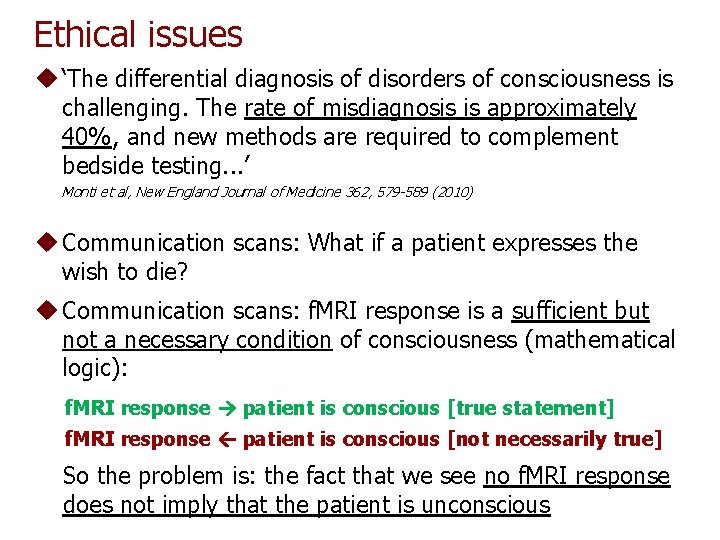
Ethical issues u ‘The differential diagnosis of disorders of consciousness is challenging. The rate of misdiagnosis is approximately 40%, and new methods are required to complement bedside testing. . . ’ Monti et al, New England Journal of Medicine 362, 579 -589 (2010) u Communication scans: What if a patient expresses the wish to die? u Communication scans: f. MRI response is a sufficient but not a necessary condition of consciousness (mathematical logic): f. MRI response patient is conscious [true statement] f. MRI response patient is conscious [not necessarily true] So the problem is: the fact that we see no f. MRI response does not imply that the patient is unconscious
Future diagnostic opportunities
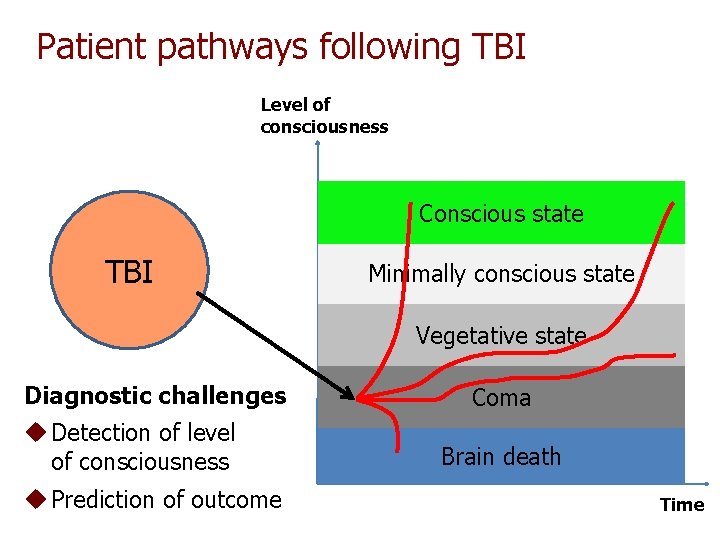
Patient pathways following TBI Level of consciousness Conscious state TBI Minimally conscious state Vegetative state Diagnostic challenges u Detection of level of consciousness u Prediction of outcome Coma Brain death Time
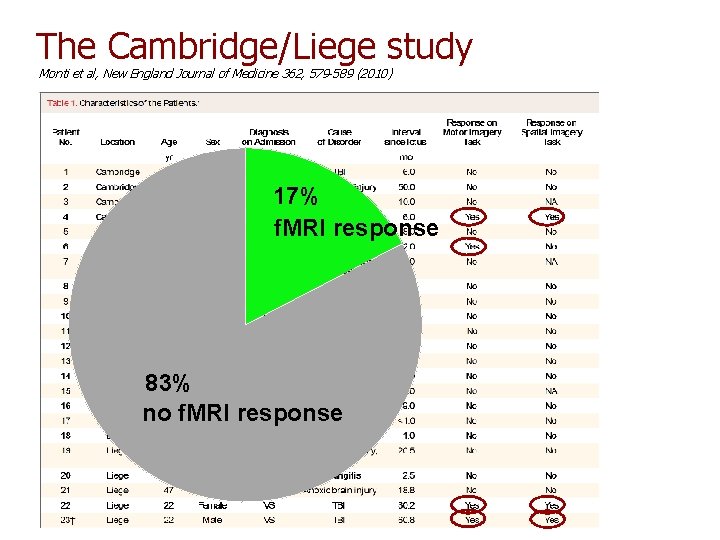
The Cambridge/Liege study Monti et al, New England Journal of Medicine 362, 579 -589 (2010) 17% f. MRI response 83% no f. MRI response
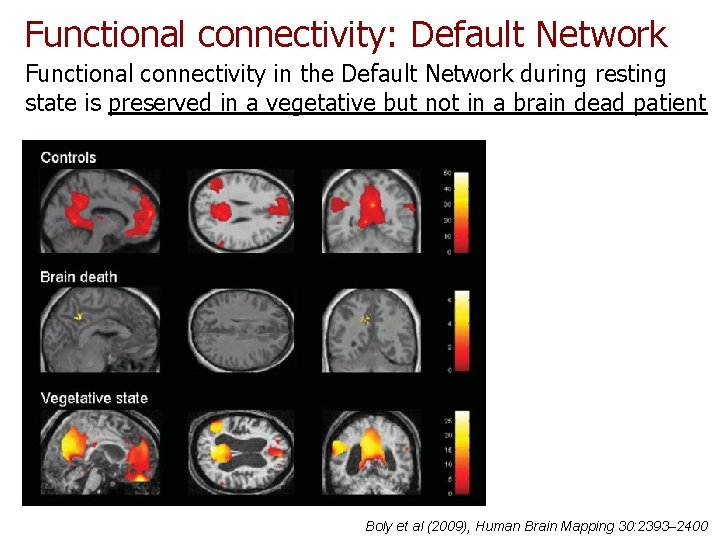
Functional connectivity: Default Network Functional connectivity in the Default Network during resting state is preserved in a vegetative but not in a brain dead patient Boly et al (2009), Human Brain Mapping 30: 2393– 2400
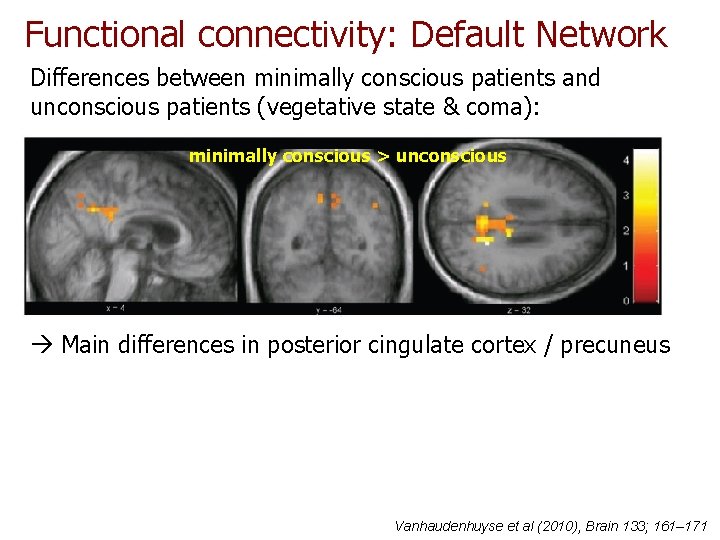
Functional connectivity: Default Network Differences between minimally conscious patients and unconscious patients (vegetative state & coma): minimally conscious > unconscious Main differences in posterior cingulate cortex / precuneus Vanhaudenhuyse et al (2010), Brain 133; 161– 171
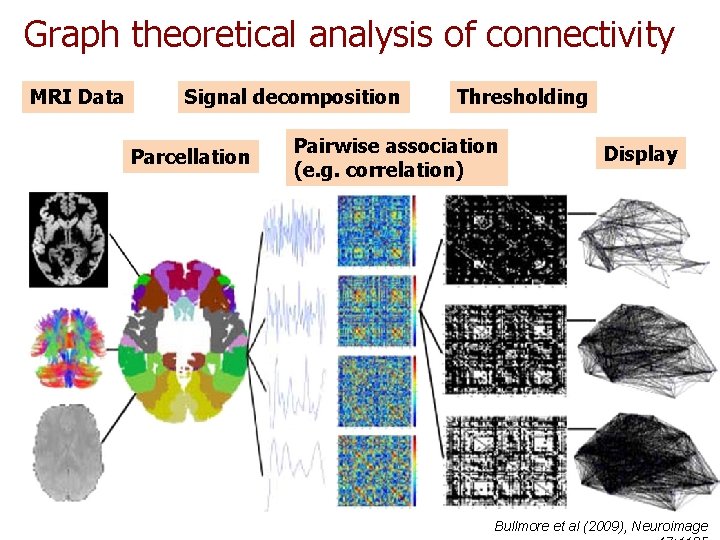
Graph theoretical analysis of connectivity MRI Data Signal decomposition Parcellation Thresholding Pairwise association (e. g. correlation) Display Bullmore et al (2009), Neuroimage
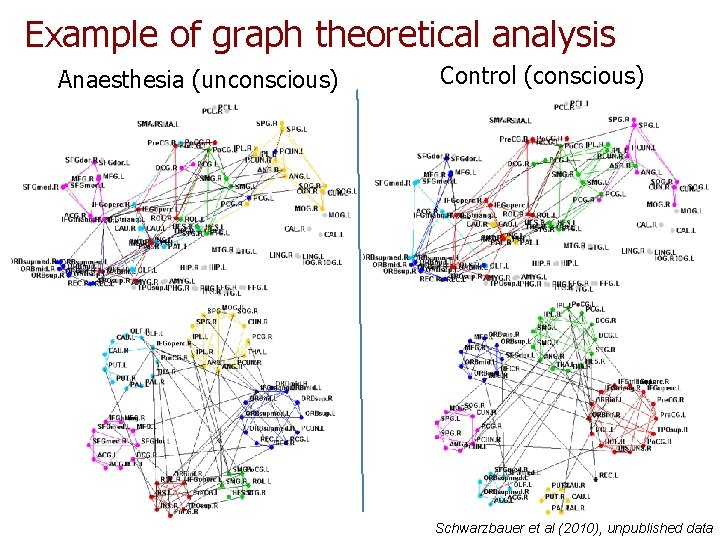
Example of graph theoretical analysis Anaesthesia (unconscious) Control (conscious) Schwarzbauer et al (2010), unpublished data
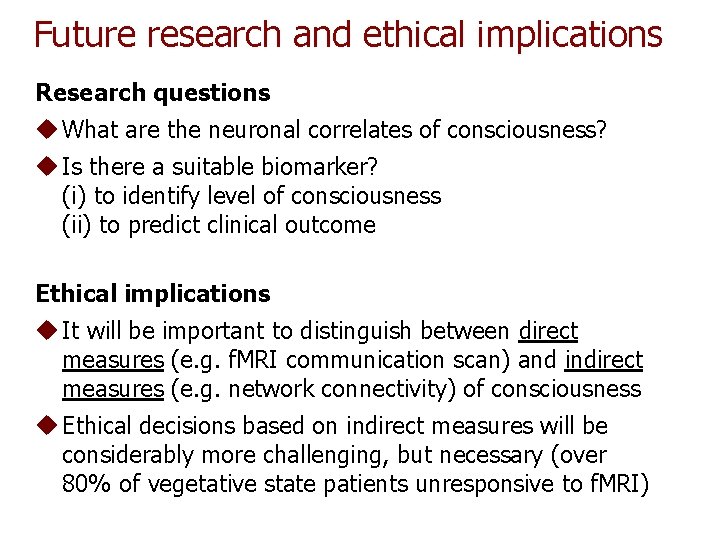
Future research and ethical implications Research questions u What are the neuronal correlates of consciousness? u Is there a suitable biomarker? (i) to identify level of consciousness (ii) to predict clinical outcome Ethical implications u It will be important to distinguish between direct measures (e. g. f. MRI communication scan) and indirect measures (e. g. network connectivity) of consciousness u Ethical decisions based on indirect measures will be considerably more challenging, but necessary (over 80% of vegetative state patients unresponsive to f. MRI)
Thank you c. schwarzbauer@abdn. ac. uk