
f MRI Biological Basis and Experiment Design Lecture
f. MRI: Biological Basis and Experiment Design Lecture 8: Pulse sequences, Take 2 • • Gradient echo review K-space review Slice selection K-space navigation – Bandwidth – Echo time – Read-out time
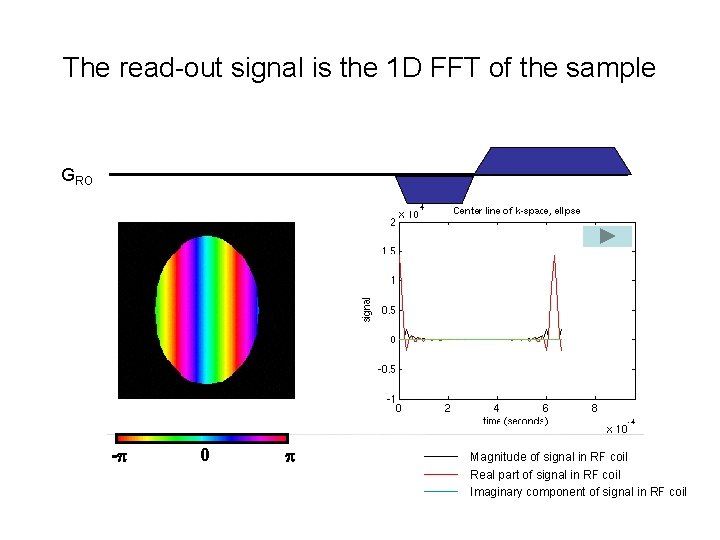
The read-out signal is the 1 D FFT of the sample GRO - 0 Magnitude of signal in RF coil Real part of signal in RF coil Imaginary component of signal in RF coil
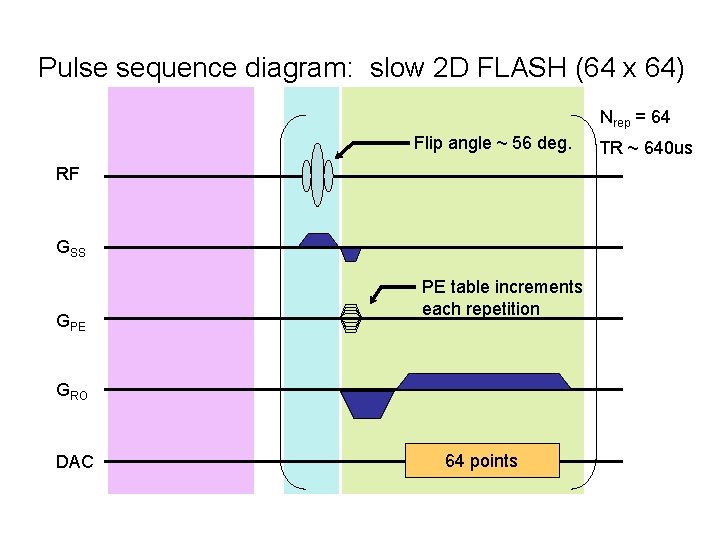
Pulse sequence diagram: slow 2 D FLASH (64 x 64) Nrep = 64 Flip angle ~ 56 deg. RF GSS GPE PE table increments each repetition GRO DAC 64 points TR ~ 640 us
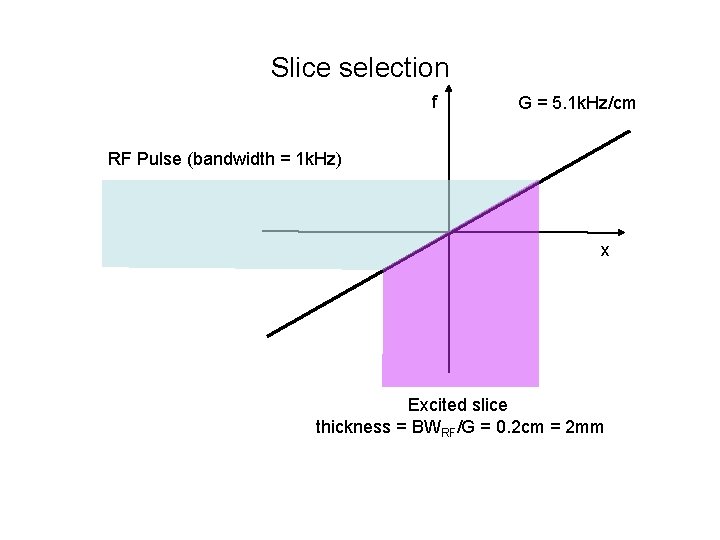
Slice selection f G = 5. 1 k. Hz/cm RF Pulse (bandwidth = 1 k. Hz) x Excited slice thickness = BWRF/G = 0. 2 cm = 2 mm
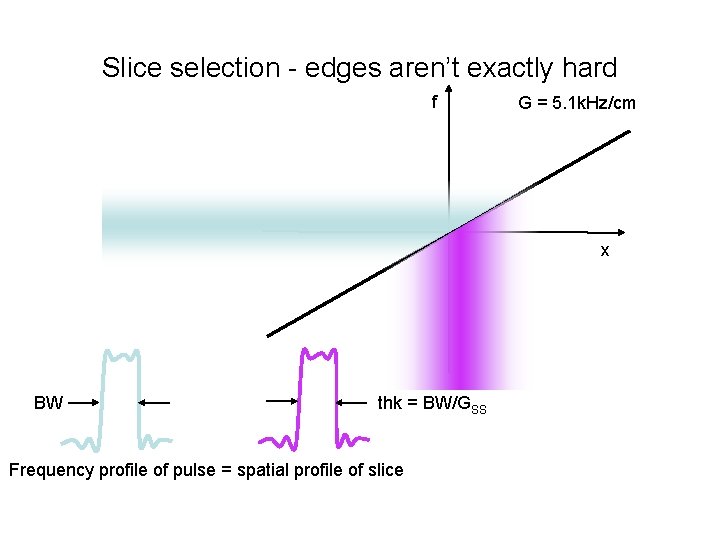
Slice selection - edges aren’t exactly hard f G = 5. 1 k. Hz/cm x BW thk = BW/GSS Frequency profile of pulse = spatial profile of slice
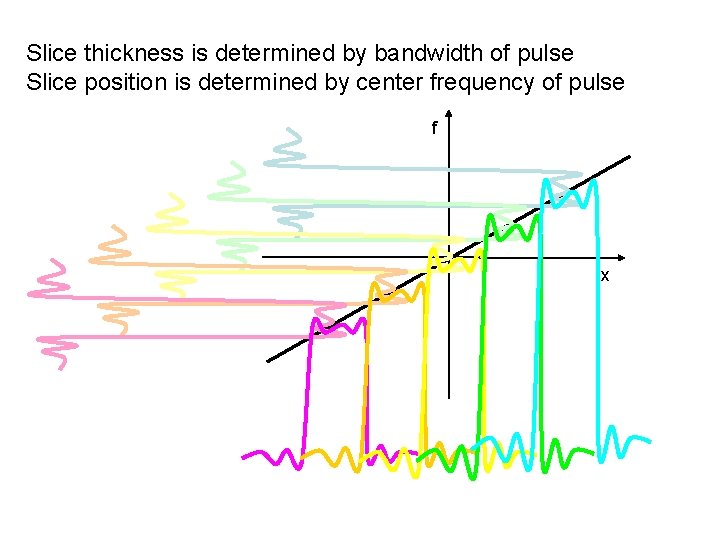
Slice thickness is determined by bandwidth of pulse Slice position is determined by center frequency of pulse f x
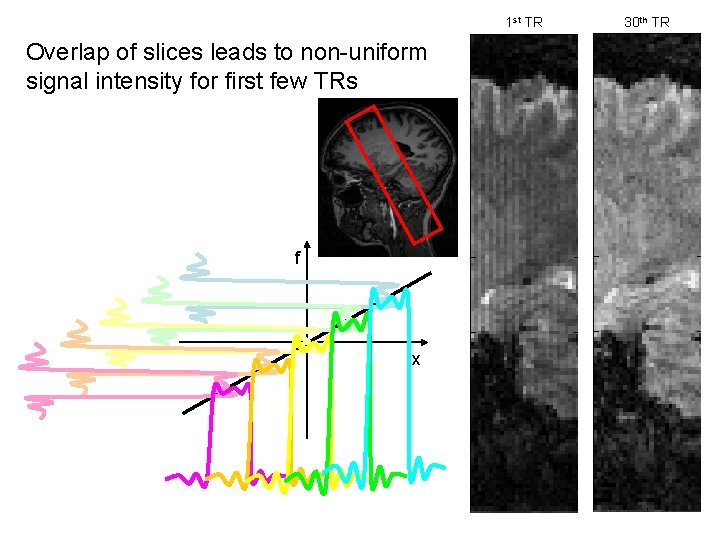
1 st TR Overlap of slices leads to non-uniform signal intensity for first few TRs f x 30 th TR
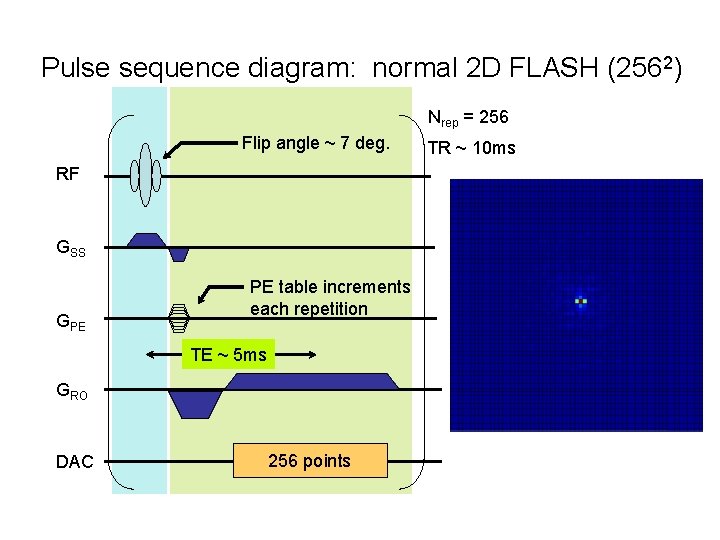
Pulse sequence diagram: normal 2 D FLASH (2562) Nrep = 256 Flip angle ~ 7 deg. RF GSS GPE PE table increments each repetition TE ~ 5 ms GRO DAC 256 points TR ~ 10 ms
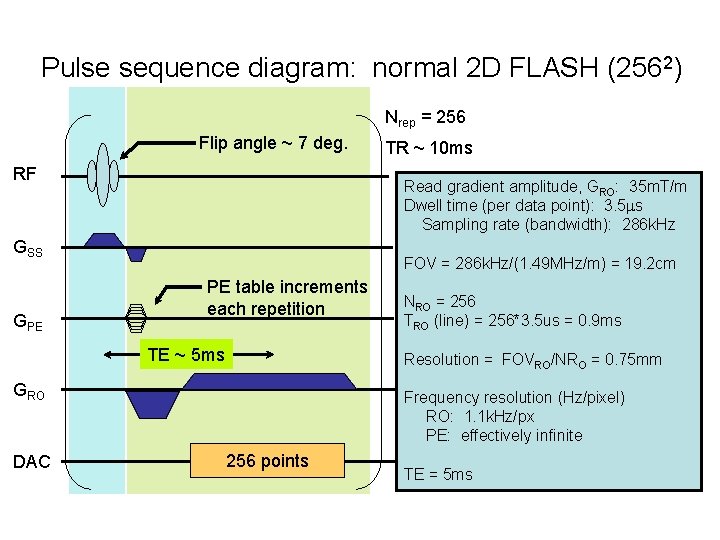
Pulse sequence diagram: normal 2 D FLASH (2562) Nrep = 256 Flip angle ~ 7 deg. RF Read gradient amplitude, GRO: 35 m. T/m Dwell time (per data point): 3. 5 s Sampling rate (bandwidth): 286 k. Hz GSS GPE FOV = 286 k. Hz/(1. 49 MHz/m) = 19. 2 cm PE table increments each repetition TE ~ 5 ms NRO = 256 TRO (line) = 256*3. 5 us = 0. 9 ms Resolution = FOVRO/NRO = 0. 75 mm GRO DAC TR ~ 10 ms Frequency resolution (Hz/pixel) RO: 1. 1 k. Hz/px PE: effectively infinite 256 points TE = 5 ms
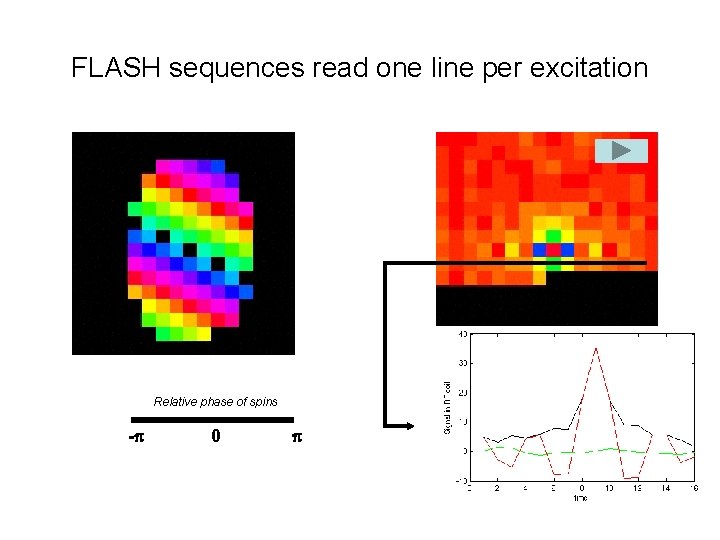
FLASH sequences read one line per excitation Relative phase of spins - 0
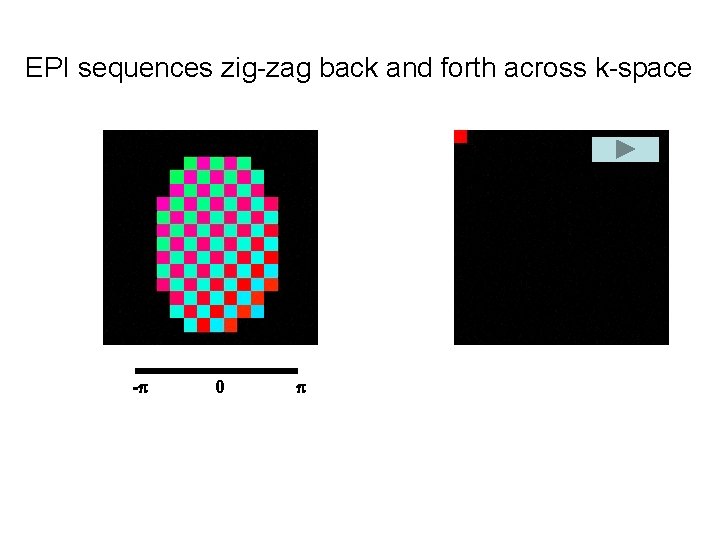
EPI sequences zig-zag back and forth across k-space - 0
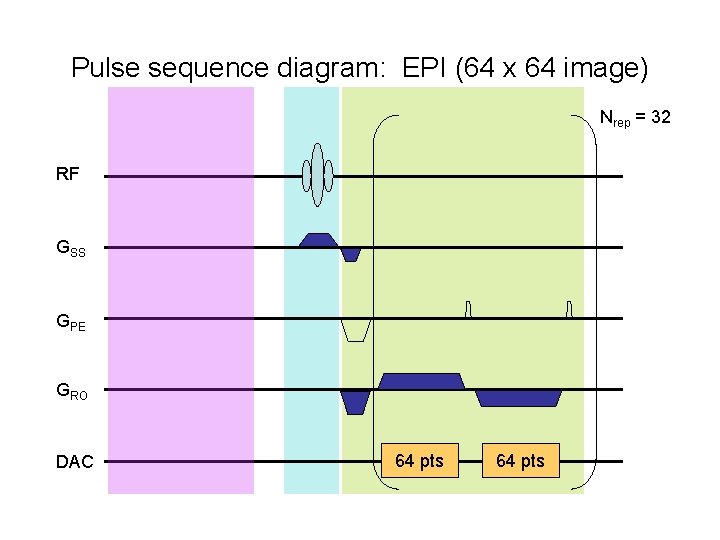
Pulse sequence diagram: EPI (64 x 64 image) Nrep = 32 RF GSS GPE GRO DAC 64 pts
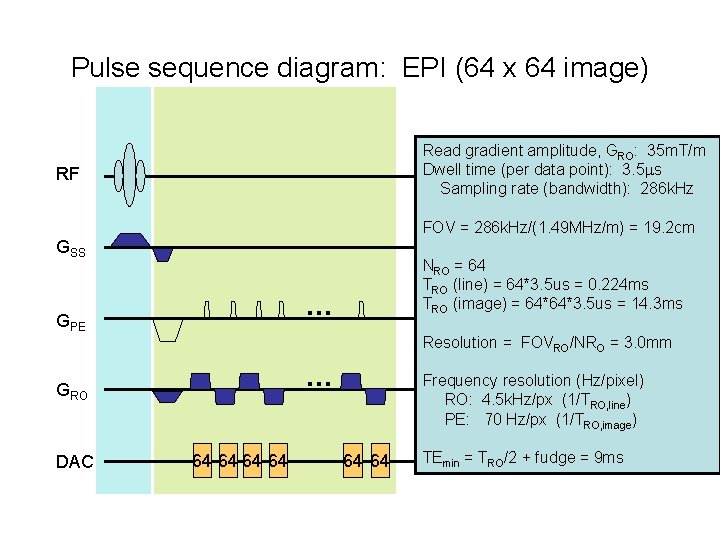
Pulse sequence diagram: EPI (64 x 64 image) Read gradient amplitude, GRO: 35 m. T/m Dwell time (per data point): 3. 5 s Sampling rate (bandwidth): 286 k. Hz RF FOV = 286 k. Hz/(1. 49 MHz/m) = 19. 2 cm GSS … GPE Resolution = FOVRO/NRO = 3. 0 mm … GRO DAC NRO = 64 TRO (line) = 64*3. 5 us = 0. 224 ms TRO (image) = 64*64*3. 5 us = 14. 3 ms 64 64 Frequency resolution (Hz/pixel) RO: 4. 5 k. Hz/px (1/TRO, line) PE: 70 Hz/px (1/TRO, image) 64 64 TEmin = TRO/2 + fudge = 9 ms
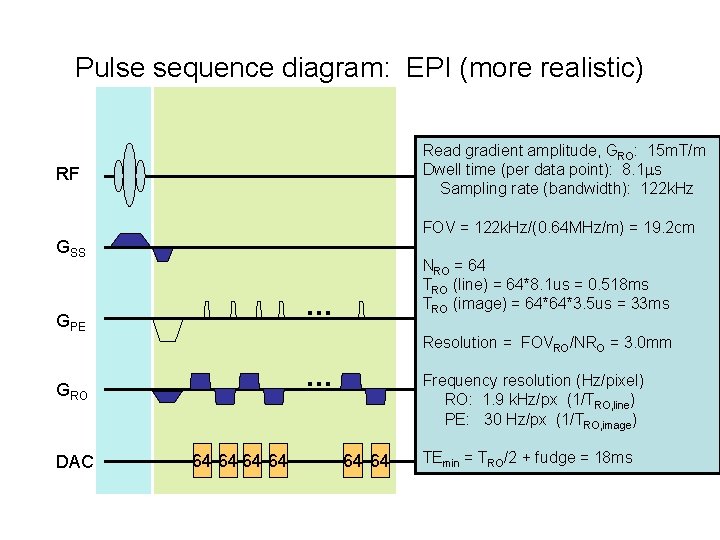
Pulse sequence diagram: EPI (more realistic) Read gradient amplitude, GRO: 15 m. T/m Dwell time (per data point): 8. 1 s Sampling rate (bandwidth): 122 k. Hz RF FOV = 122 k. Hz/(0. 64 MHz/m) = 19. 2 cm GSS … GPE Resolution = FOVRO/NRO = 3. 0 mm … GRO DAC NRO = 64 TRO (line) = 64*8. 1 us = 0. 518 ms TRO (image) = 64*64*3. 5 us = 33 ms 64 64 Frequency resolution (Hz/pixel) RO: 1. 9 k. Hz/px (1/TRO, line) PE: 30 Hz/px (1/TRO, image) 64 64 TEmin = TRO/2 + fudge = 18 ms
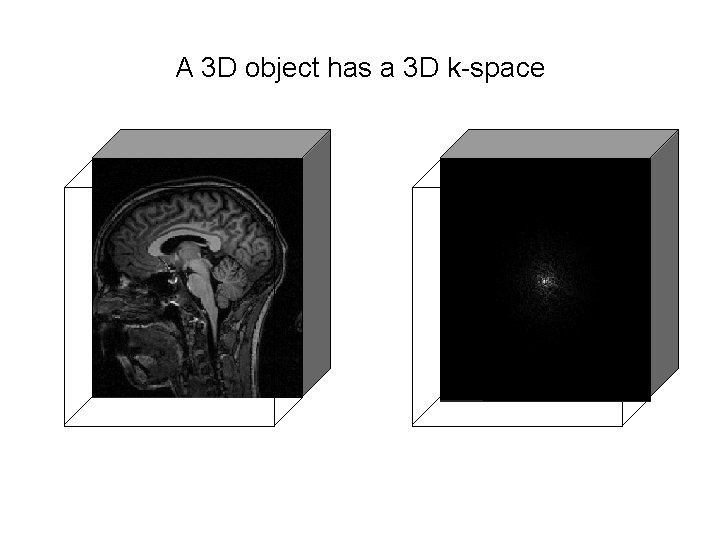
A 3 D object has a 3 D k-space
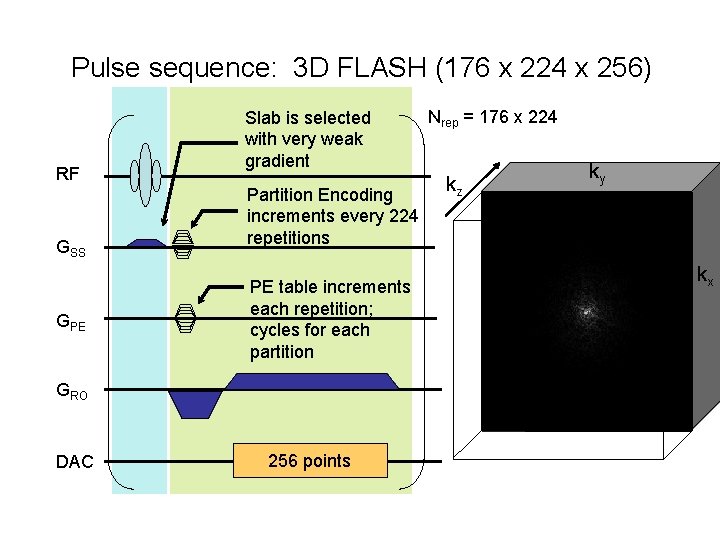
Pulse sequence: 3 D FLASH (176 x 224 x 256) RF GSS GPE Slab is selected with very weak gradient Partition Encoding increments every 224 repetitions PE table increments each repetition; cycles for each partition GRO DAC 256 points Nrep = 176 x 224 kz ky kx
- Slides: 16