
F distribution The F distribution is the probability
F distribution The F distribution is the probability distribution associated with the f statistic. In this lesson, we show to compute an f statistic and how to find probabilities associated with specific f statistic values.
Here are the steps required to compute an f statistic: Select a random sample of size n 1 from a normal population, having a standard deviation equal to σ1. Select an independent random sample of size n 2 from a normal population, having a standard deviation equal to σ2.
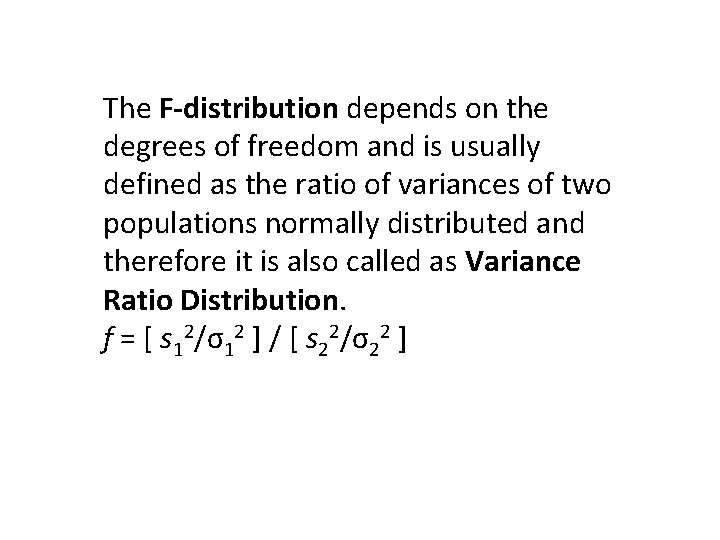
The F-distribution depends on the degrees of freedom and is usually defined as the ratio of variances of two populations normally distributed and therefore it is also called as Variance Ratio Distribution. f = [ s 12/σ12 ] / [ s 22/σ22 ]

Properties of F-Distribution There are several properties of F-distribution which are explained below: • The F-distribution is positively skewed and with the increase in the degrees of freedom ν 1 and ν 2, its skewness decreases. • The shape of the F-distribution depends on its parameters ν 1 and ν 2 degrees of freedom. • The easiest way to find the value of a particular f statistic is to use the F Distribution Calculator.
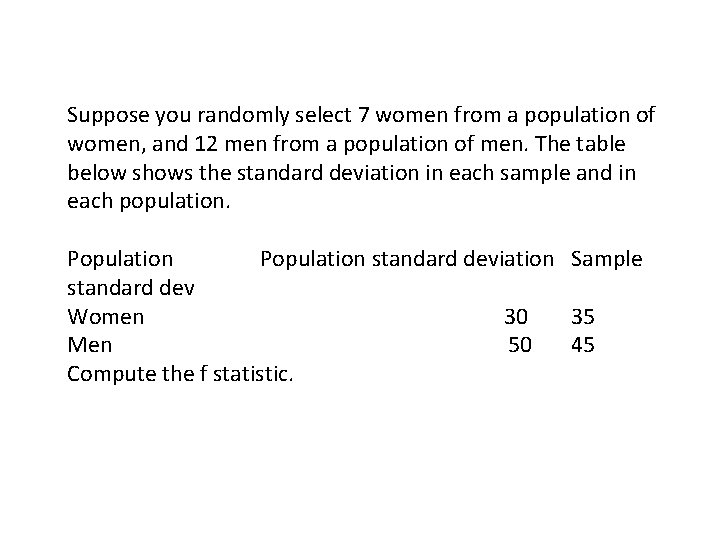
Suppose you randomly select 7 women from a population of women, and 12 men from a population of men. The table below shows the standard deviation in each sample and in each population. Population standard deviation Sample standard dev Women 30 35 Men 50 45 Compute the f statistic.

Solution A: The f statistic can be computed from the population and sample standard deviations, using the following equation: f = [ s 12/σ12 ] / [ s 22/σ22 ] where σ1 is the standard deviation of population 1, s 1 is the standard deviation of the sample drawn from population 1, σ2 is the standard deviation of population 2, and s 1 is the standard deviation of the sample drawn from population 2.
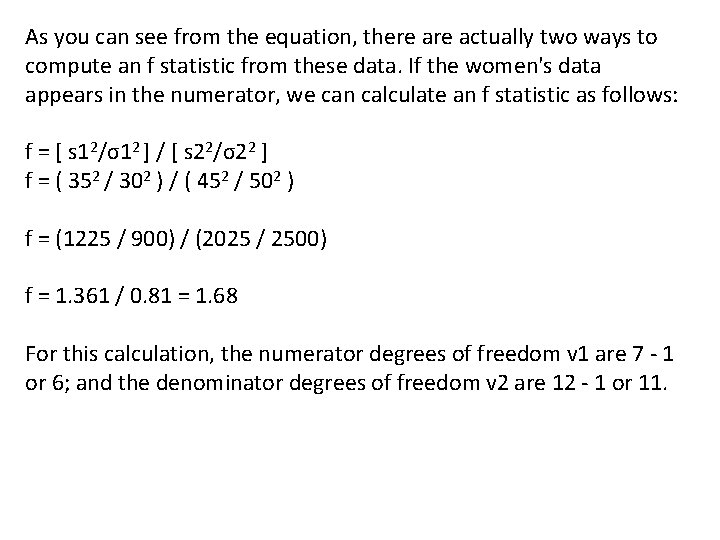
As you can see from the equation, there actually two ways to compute an f statistic from these data. If the women's data appears in the numerator, we can calculate an f statistic as follows: f = [ s 12/σ12 ] / [ s 22/σ22 ] f = ( 352 / 302 ) / ( 452 / 502 ) f = (1225 / 900) / (2025 / 2500) f = 1. 361 / 0. 81 = 1. 68 For this calculation, the numerator degrees of freedom v 1 are 7 - 1 or 6; and the denominator degrees of freedom v 2 are 12 - 1 or 11.

On the other hand, if the men's data appears in the numerator, we can calculate an f statistic as follows: f = ( 452 / 502 ) / ( 352 / 302 ) f = (2025 / 2500) / (1225 / 900)
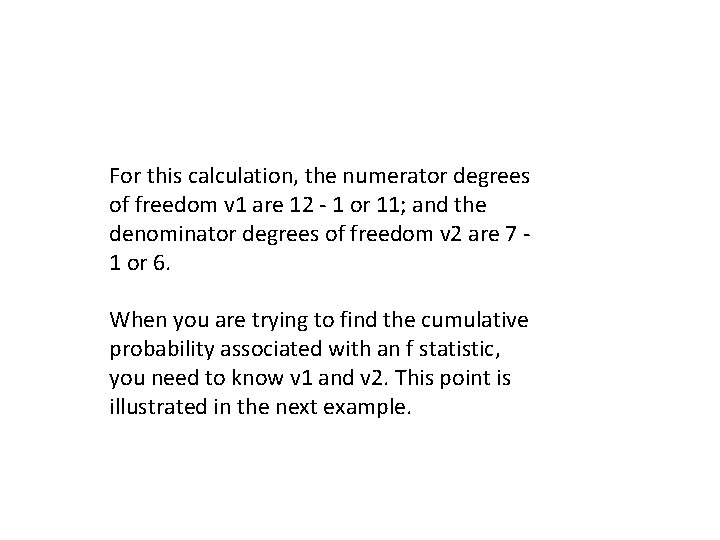
For this calculation, the numerator degrees of freedom v 1 are 12 - 1 or 11; and the denominator degrees of freedom v 2 are 7 1 or 6. When you are trying to find the cumulative probability associated with an f statistic, you need to know v 1 and v 2. This point is illustrated in the next example.
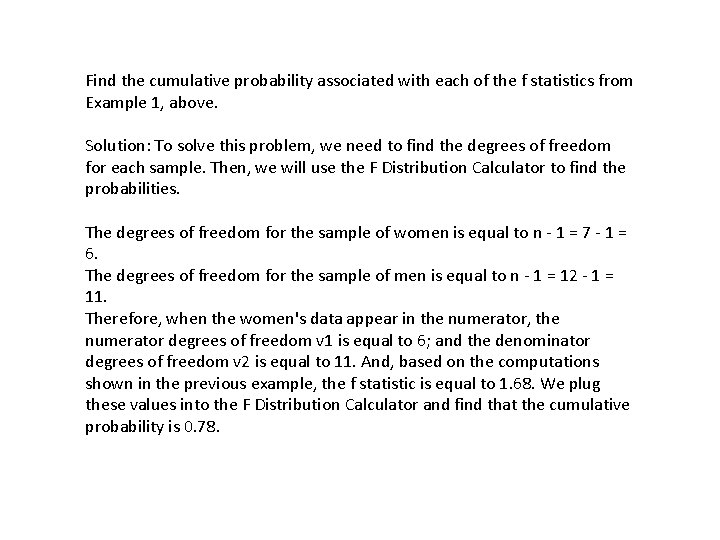
Find the cumulative probability associated with each of the f statistics from Example 1, above. Solution: To solve this problem, we need to find the degrees of freedom for each sample. Then, we will use the F Distribution Calculator to find the probabilities. The degrees of freedom for the sample of women is equal to n - 1 = 7 - 1 = 6. The degrees of freedom for the sample of men is equal to n - 1 = 12 - 1 = 11. Therefore, when the women's data appear in the numerator, the numerator degrees of freedom v 1 is equal to 6; and the denominator degrees of freedom v 2 is equal to 11. And, based on the computations shown in the previous example, the f statistic is equal to 1. 68. We plug these values into the F Distribution Calculator and find that the cumulative probability is 0. 78.

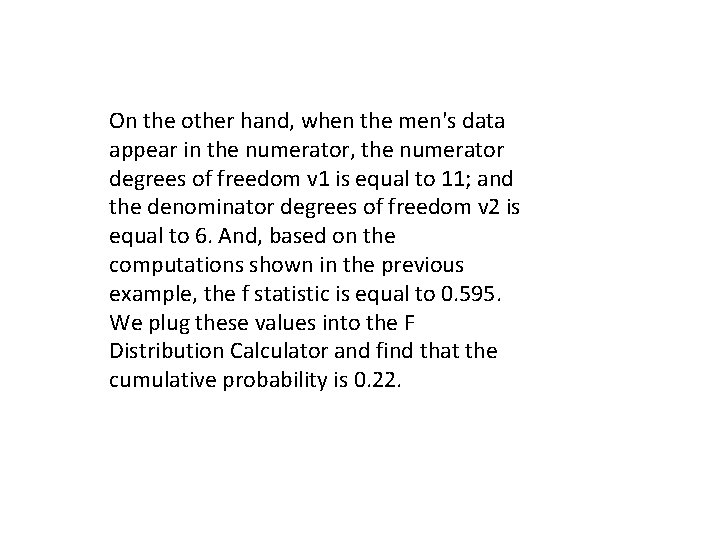
On the other hand, when the men's data appear in the numerator, the numerator degrees of freedom v 1 is equal to 11; and the denominator degrees of freedom v 2 is equal to 6. And, based on the computations shown in the previous example, the f statistic is equal to 0. 595. We plug these values into the F Distribution Calculator and find that the cumulative probability is 0. 22.
- Slides: 13