
F Chopin Prelude No 15 in D flat
- Slides: 18
F. Chopin: Prelude No. 15 in D flat major, Op. 28 (also known as the ‘raindrop’ prelude) AIMS - In the study of this set work you will learn about: � The Romantic period and the main hallmarks of the style � Some background to the life and works of Frederic Chopin � The ‘prelude’ � ABA (ternary) form � How the prelude is constructed, through an analysis of the music � The key features of the music
The Romantic Era (c. 1800 – 1900) Piano Prelude No. 15 in D flat major, Op. 28 �Known as the ‘Raindrop’ prelude �The piece is by Chopin
The Romantic Era (c. 1800 -1900) An era reflecting an interest in ideas inspired by �nature �magic �the supernatural �mystery ‘Romantic’ music is concerned with expressing a intense feelings and emotions Music from this time often tells a story. E. g. “The Sorcerer’s Apprentice” by Dukas
The Romantic era (c. 1800 -1900) Some famous ‘romantic’ composers were �Liszt �Wagner �Chopin �Berlioz
Features of the Romantic style �The music often tells a story (Programme music) �Long, sustained melody lines. In piano music, extensive use of sustaining pedal helps build the sound. �Chromatic harmony; Use of a wide range of chords and chromatic harmony. �Musical structures tend to be freer and less symmetrical than in the classical style �Contrasts in keys, melodies and dynamics are often very dramatic
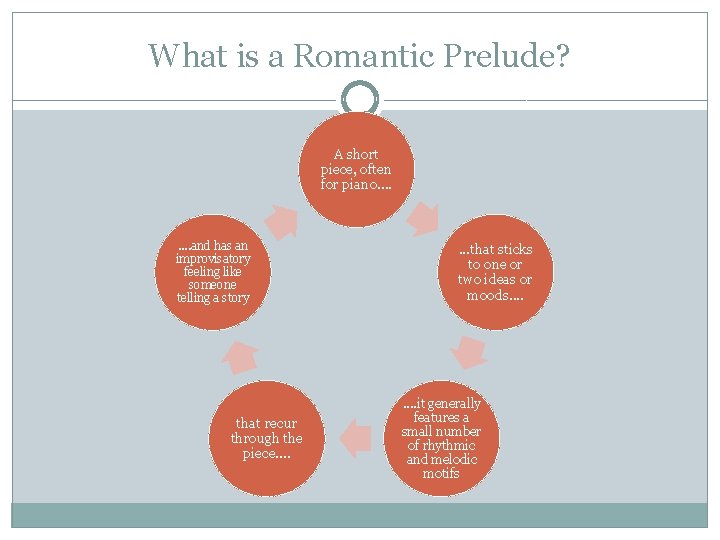
What is a Romantic Prelude? A short piece, often for piano. . . . and has an improvisatory feeling like someone telling a story that recur through the piece. . . . that sticks to one or two ideas or moods. . . . it generally features a small number of rhythmic and melodic motifs
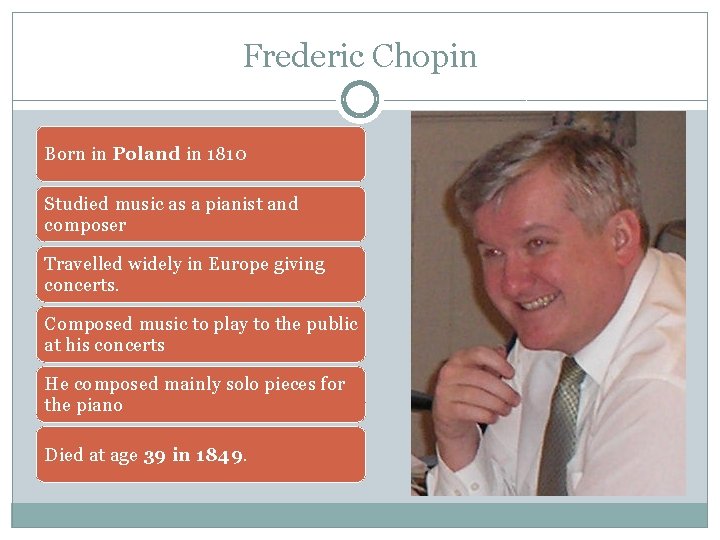
Frederic Chopin Born in Poland in 1810 Studied music as a pianist and composer Travelled widely in Europe giving concerts. Composed music to play to the public at his concerts He composed mainly solo pieces for the piano Died at age 39 in 1849.
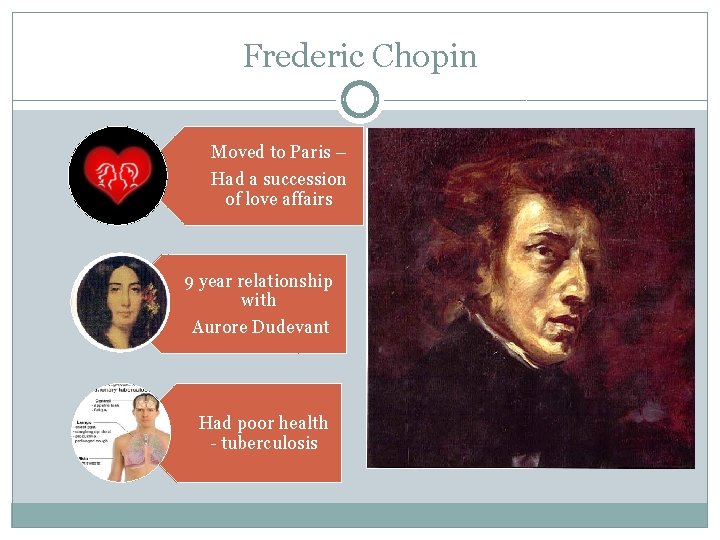
Frederic Chopin Moved to Paris – Had a succession of love affairs 9 year relationship with Aurore Dudevant Had poor health - tuberculosis
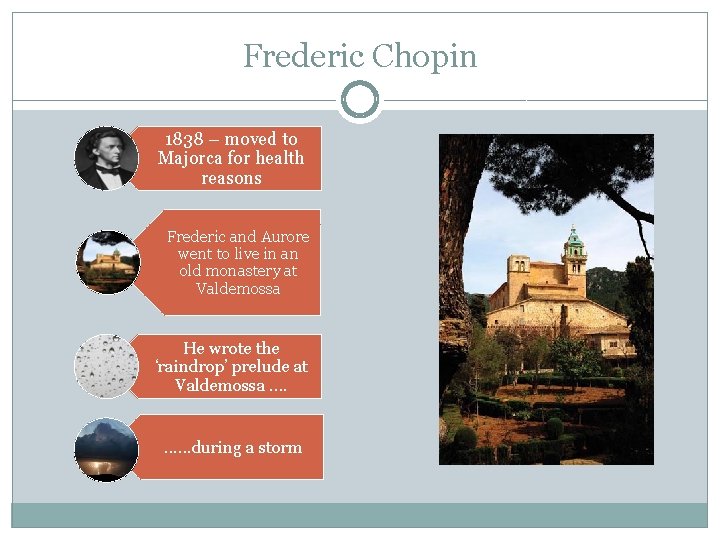
Frederic Chopin 1838 – moved to Majorca for health reasons Frederic and Aurore went to live in an old monastery at Valdemossa He wrote the ‘raindrop’ prelude at Valdemossa. . during a storm
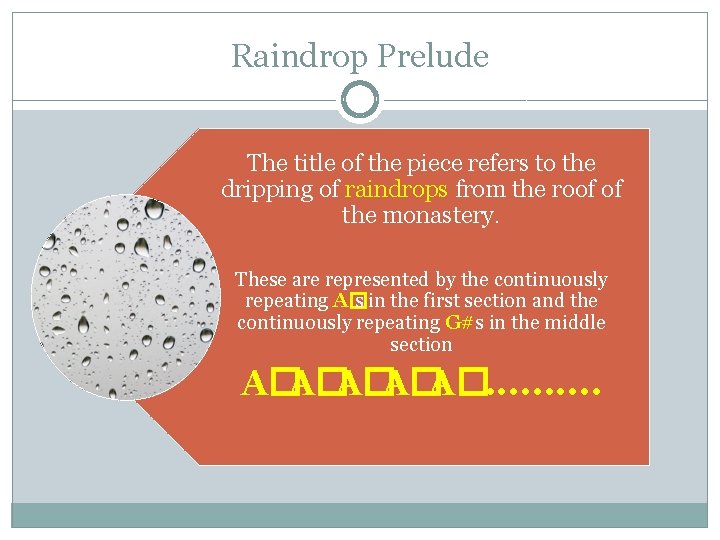
Raindrop Prelude The title of the piece refers to the dripping of raindrops from the roof of the monastery. These are represented by the continuously repeating A� s in the first section and the continuously repeating G#s in the middle section A�A�A�. .
Raindrop Prelude – Basic Points �Metre/Time signature - The prelude is in 4/4 time �Structure – the movement is in ABA form (ternary form) with a short codetta
Raindrop Prelude – Basic Points �Texture - is mainly homophonic, mostly melody and accompaniment. � Use of sustaining pedal to hold on notes �� = press pedal down and hold � �= release pedal
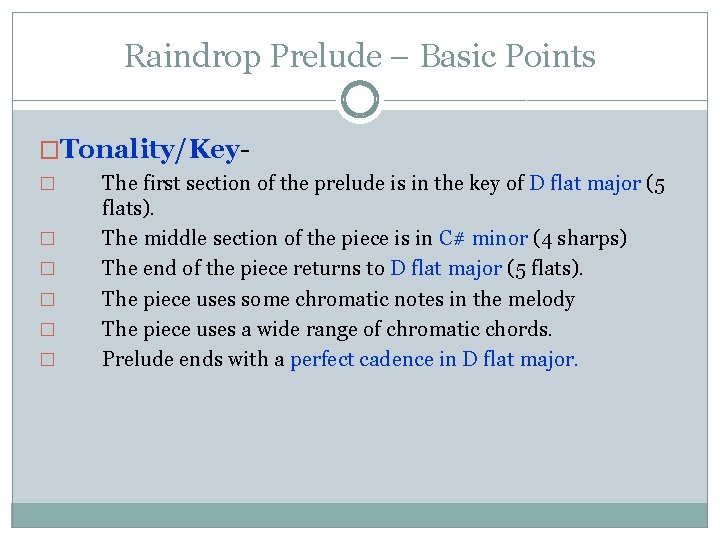
Raindrop Prelude – Basic Points �Tonality/Key� � � The first section of the prelude is in the key of D flat major (5 flats). The middle section of the piece is in C# minor (4 sharps) The end of the piece returns to D flat major (5 flats). The piece uses some chromatic notes in the melody The piece uses a wide range of chromatic chords. Prelude ends with a perfect cadence in D flat major.
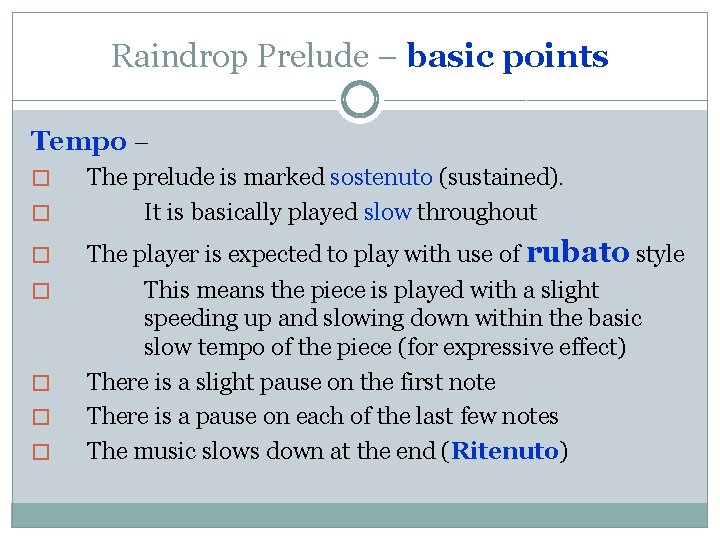
Raindrop Prelude – basic points Tempo – � � � � The prelude is marked sostenuto (sustained). It is basically played slow throughout The player is expected to play with use of rubato style This means the piece is played with a slight speeding up and slowing down within the basic slow tempo of the piece (for expressive effect) There is a slight pause on the first note There is a pause on each of the last few notes The music slows down at the end (Ritenuto)
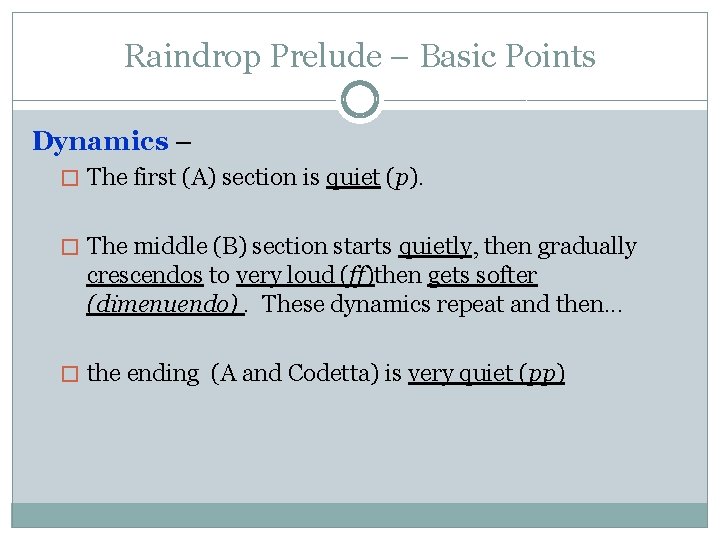
Raindrop Prelude – Basic Points Dynamics – � The first (A) section is quiet (p). � The middle (B) section starts quietly, then gradually crescendos to very loud (ff)then gets softer (dimenuendo). These dynamics repeat and then. . . � the ending (A and Codetta) is very quiet (pp)
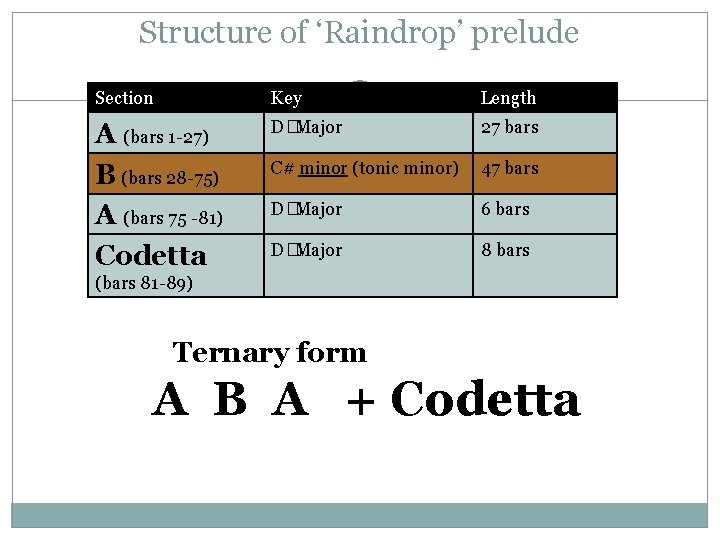
Structure of ‘Raindrop’ prelude Section Key Length A (bars 1 -27) B (bars 28 -75) A (bars 75 -81) Codetta D�Major 27 bars C# minor (tonic minor) 47 bars D�Major 6 bars D�Major 8 bars (bars 81 -89) Ternary form A B A + Codetta
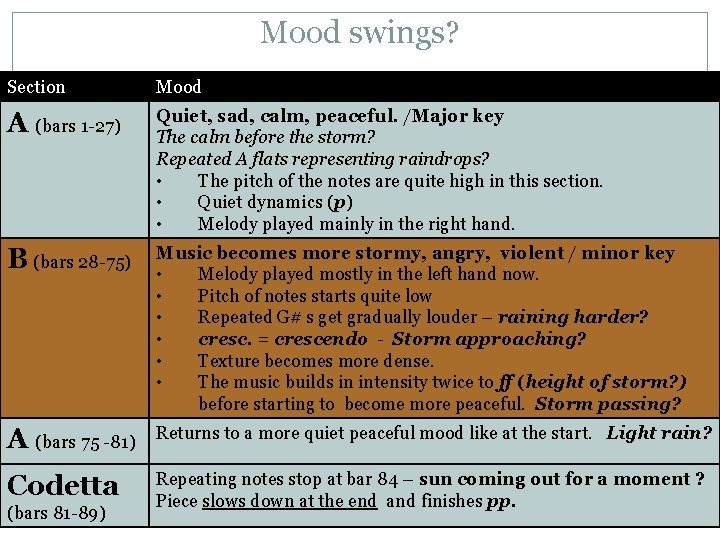
Mood swings? Section Mood A (bars 1 -27) Quiet, sad, calm, peaceful. /Major key The calm before the storm? Repeated A flats representing raindrops? • The pitch of the notes are quite high in this section. • Quiet dynamics (p) • Melody played mainly in the right hand. B (bars 28 -75) Music becomes more stormy, angry, violent / minor key • Melody played mostly in the left hand now. • Pitch of notes starts quite low • Repeated G# s get gradually louder – raining harder? • cresc. = crescendo - Storm approaching? • Texture becomes more dense. • The music builds in intensity twice to ff (height of storm? ) before starting to become more peaceful. Storm passing? A (bars 75 -81) Returns to a more quiet peaceful mood like at the start. Light rain? Codetta Repeating notes stop at bar 84 – sun coming out for a moment ? Piece slows down at the end and finishes pp. (bars 81 -89)
Tasks �Page 45. �Answer questions 1 -10 in full sentences