
F 28 DM Database Management Systems Query Optimisation

F 28 DM Database Management Systems Query Optimisation Monica Farrow monica@macs. hw. ac. uk Room: EMG 30, Ext: 4160 Material on Vision & my web page Content taken from HW lecturers, + books by Rob & Coronel, and by Connolly & Begg F 28 DM Query Optimization 1
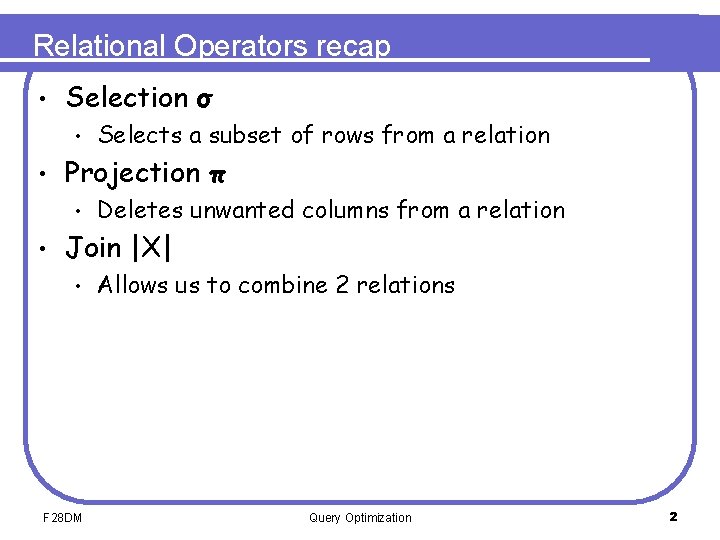
Relational Operators recap • Selection σ • • Projection π • • Selects a subset of rows from a relation Deletes unwanted columns from a relation Join |X| • F 28 DM Allows us to combine 2 relations Query Optimization 2
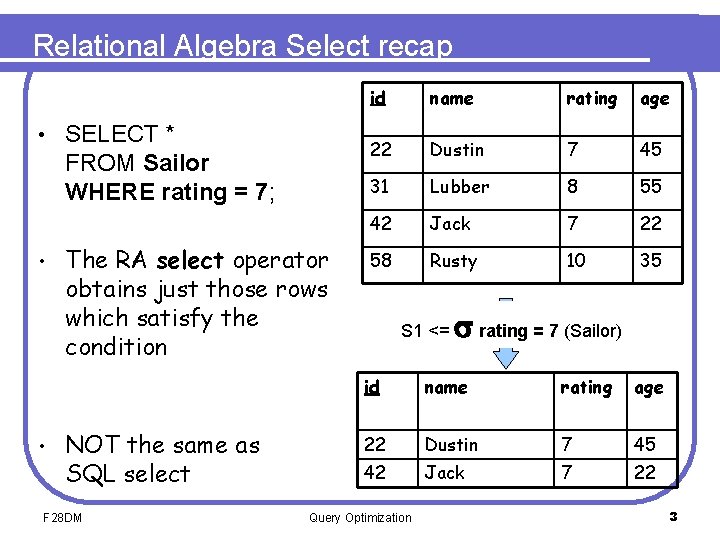
Relational Algebra Select recap • • • SELECT * FROM Sailor WHERE rating = 7; The RA select operator obtains just those rows which satisfy the condition NOT the same as SQL select F 28 DM id name rating age 22 Dustin 7 45 31 Lubber 8 55 42 Jack 7 22 58 Rusty 10 35 S 1 <= rating = 7 (Sailor) id name rating age 22 Dustin 7 45 42 Jack 7 22 Query Optimization 3
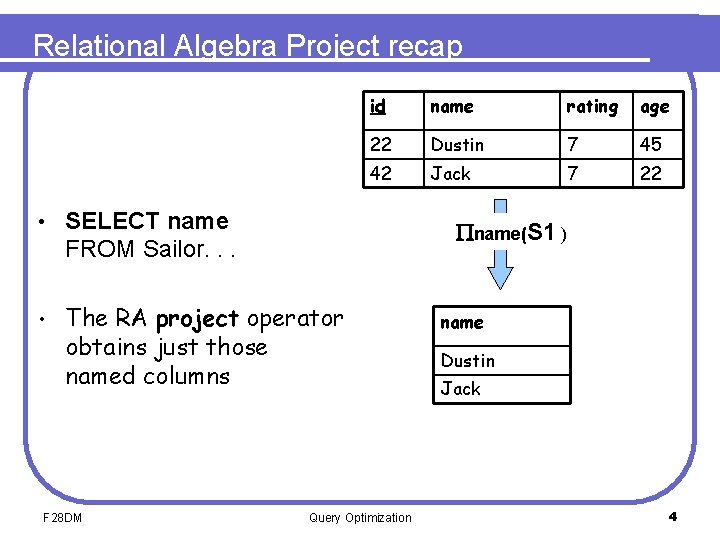
Relational Algebra Project recap • SELECT name FROM Sailor. . . • The RA project operator obtains just those named columns F 28 DM id name rating age 22 Dustin 7 45 42 Jack 7 22 name(S 1 ) Query Optimization name Dustin Jack 4
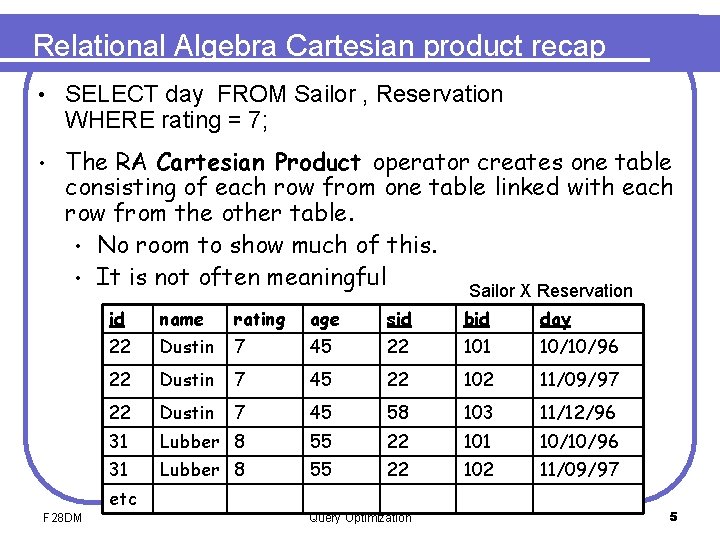
Relational Algebra Cartesian product recap • SELECT day FROM Sailor , Reservation WHERE rating = 7; • The RA Cartesian Product operator creates one table consisting of each row from one table linked with each row from the other table. • No room to show much of this. • It is not often meaningful Sailor X Reservation id name rating age sid bid day 22 Dustin 7 45 22 101 10/10/96 22 Dustin 7 45 22 102 11/09/97 22 Dustin 7 45 58 103 11/12/96 31 Lubber 8 55 22 101 10/10/96 31 Lubber 8 55 22 102 11/09/97 etc F 28 DM Query Optimization 5
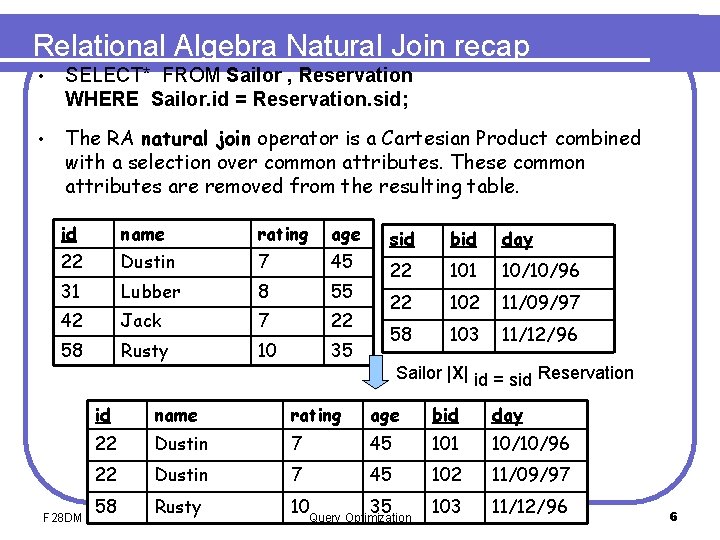
Relational Algebra Natural Join recap • SELECT* FROM Sailor , Reservation WHERE Sailor. id = Reservation. sid; • The RA natural join operator is a Cartesian Product combined with a selection over common attributes. These common attributes are removed from the resulting table. id name rating age 22 Dustin 7 45 31 Lubber 8 55 42 Jack 7 22 58 Rusty 10 35 sid bid day 22 101 10/10/96 22 102 11/09/97 58 103 11/12/96 Sailor |X| id = sid Reservation F 28 DM id name rating age bid day 22 Dustin 7 45 101 10/10/96 22 Dustin 7 45 102 11/09/97 58 Rusty 10 Query Optimization 35 103 11/12/96 6
Introduction to Query Optimisation • With declarative languages such as SQL, the user specifies what data is required • E. g. SELECT name FROM Sailor WHERE rating =7; rather than how it is to be retrieved. • E. g. RA select RA project name( rating = 7 (Sailor) ) • This relieves user of knowing what constitutes good execution strategy. • It also gives DBMS more control over system performance. F 28 DM Query Optimization © Pearson Education Limited 1995, 2005 7
Query Processing • Query Processing encompasses all the activities involved in retrieving data from the database. • Aims of QP: • • F 28 DM Transform query written in high-level language (e. g. SQL), into a correct and efficient execution strategy expressed in low-level language (implementing RA); Execute the strategy to retrieve the required data. Query Optimization © Pearson Education Limited 1995, 2005 8
Phases of Query Processing • QP has four main phases: • • F 28 DM decomposition (consisting of parsing and validation) and finally transforming the query into a RA tree; optimization; code generation; execution. © Pearson Education Limited 1995, 2005 Query Optimization 9
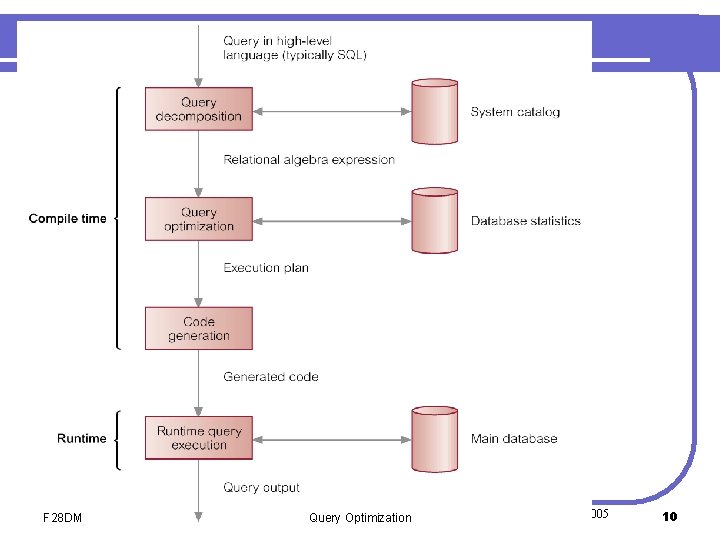
Phases of Query Processing F 28 DM Query Optimization© Pearson Education Limited 1995, 2005 10
Query Optimisation • Query Optimisation is the activity of choosing an efficient execution strategy for processing query. • There will be many equivalent transformations of the same high-level query. The aim of QO is to choose one that minimizes resource usage. • • • Generally, reduce total execution time of query. May also reduce response time of query. The problem is computationally intractable with a large number of relations, so the strategy adopted is reduced to finding a near optimum solution. F 28 DM Query Optimization© Pearson Education Limited 1995, 2005 11
Two techniques • There are 2 main techniques for query optimization: • • • Heuristic rules that order operations in a query; Comparing different strategies based on relative costs, and selecting one that minimizes resource usage. Disk access tends to be the dominant cost in query processing in a DBMS. F 28 DM Query Optimization © Pearson Education Limited 1995, 2005 12
Transforming the query into a query tree • Transform the query into a query tree • • F 28 DM Leaf node created for each base relation. Non-leaf node created for each intermediate relation produced by RA operation. Root of tree represents query result. Sequence is directed from leaves to root © Pearson Education Limited 1995, 2005 Query Optimization 13
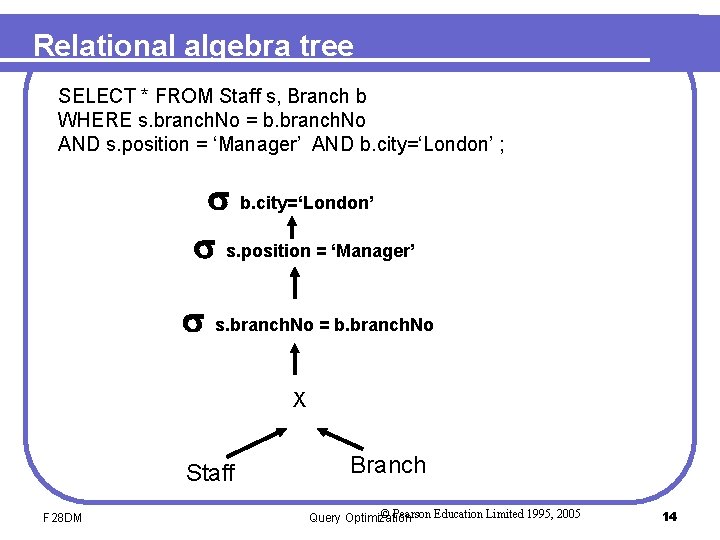
Relational algebra tree SELECT * FROM Staff s, Branch b WHERE s. branch. No = b. branch. No AND s. position = ‘Manager’ AND b. city=‘London’ ; b. city=‘London’ s. position = ‘Manager’ s. branch. No = b. branch. No X Staff F 28 DM Branch © Pearson Education Limited 1995, 2005 Query Optimization 14
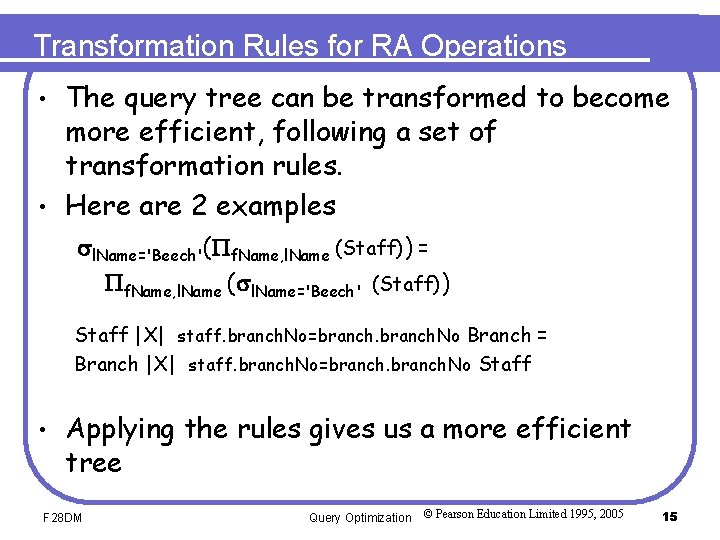
Transformation Rules for RA Operations The query tree can be transformed to become more efficient, following a set of transformation rules. • Here are 2 examples • l. Name='Beech'( f. Name, l. Name (Staff)) = f. Name, l. Name ( l. Name='Beech' (Staff)) Staff |X| staff. branch. No=branch. No Branch = Branch |X| staff. branch. No=branch. No Staff • Applying the rules gives us a more efficient tree F 28 DM Query Optimization © Pearson Education Limited 1995, 2005 15
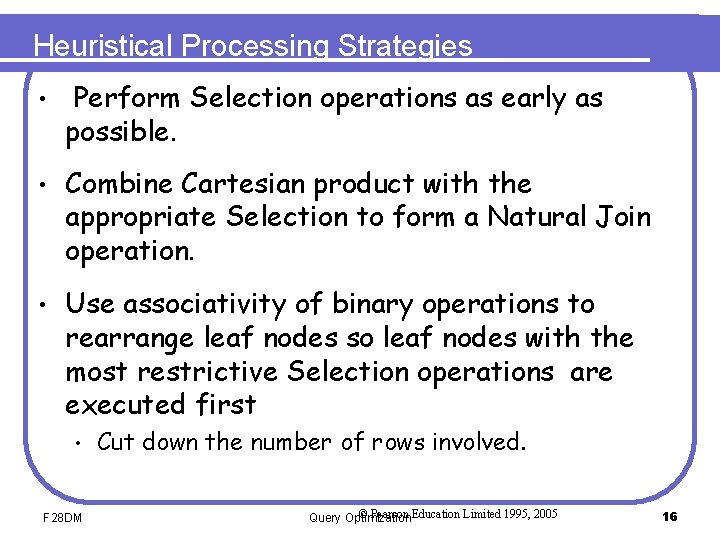
Heuristical Processing Strategies • Perform Selection operations as early as possible. • Combine Cartesian product with the appropriate Selection to form a Natural Join operation. • Use associativity of binary operations to rearrange leaf nodes so leaf nodes with the most restrictive Selection operations are executed first • F 28 DM Cut down the number of rows involved. © Pearson Education Limited 1995, 2005 Query Optimization 16
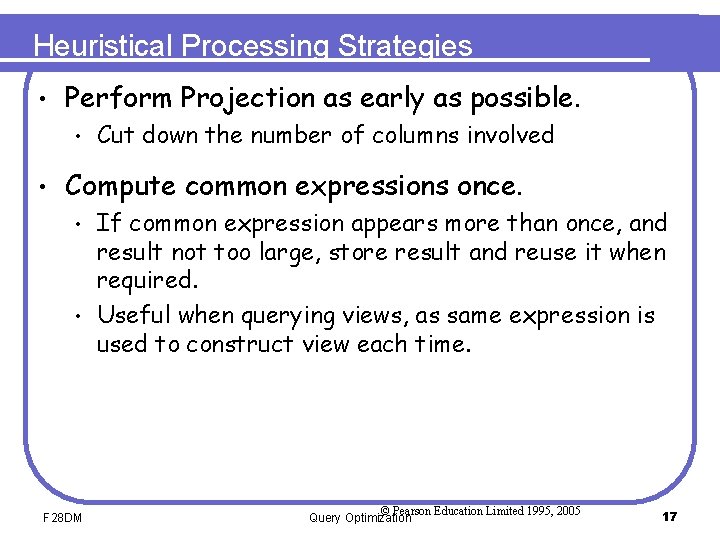
Heuristical Processing Strategies • Perform Projection as early as possible. • • Cut down the number of columns involved Compute common expressions once. • • F 28 DM If common expression appears more than once, and result not too large, store result and reuse it when required. Useful when querying views, as same expression is used to construct view each time. © Pearson Education Limited 1995, 2005 Query Optimization 17
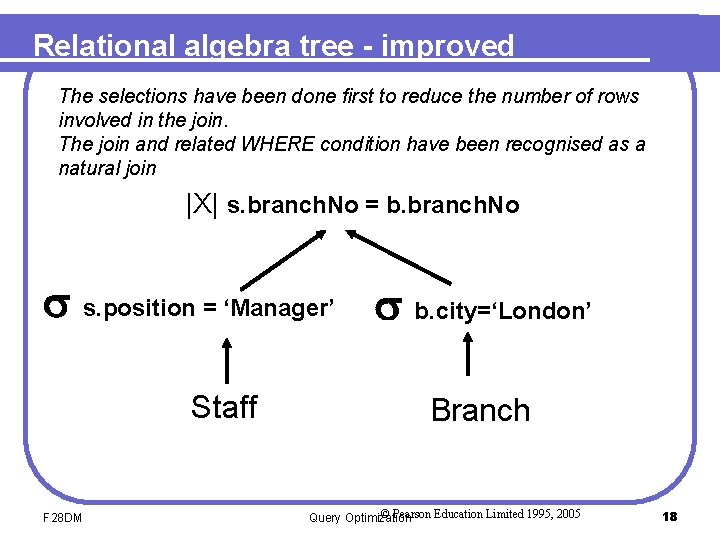
Relational algebra tree - improved The selections have been done first to reduce the number of rows involved in the join. The join and related WHERE condition have been recognised as a natural join |X| s. branch. No = b. branch. No s. position = ‘Manager’ b. city=‘London’ Staff F 28 DM Branch © Pearson Education Limited 1995, 2005 Query Optimization 18
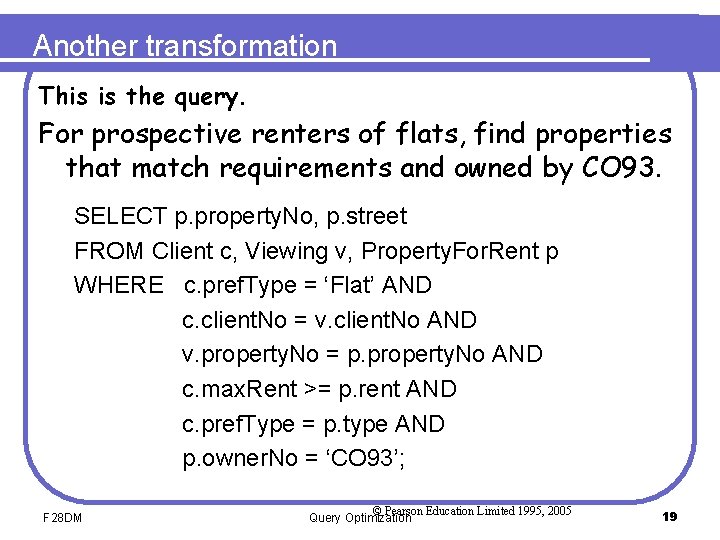
Another transformation This is the query. For prospective renters of flats, find properties that match requirements and owned by CO 93. SELECT p. property. No, p. street FROM Client c, Viewing v, Property. For. Rent p WHERE c. pref. Type = ‘Flat’ AND c. client. No = v. client. No AND v. property. No = p. property. No AND c. max. Rent >= p. rent AND c. pref. Type = p. type AND p. owner. No = ‘CO 93’; F 28 DM © Pearson Education Limited 1995, 2005 Query Optimization 19
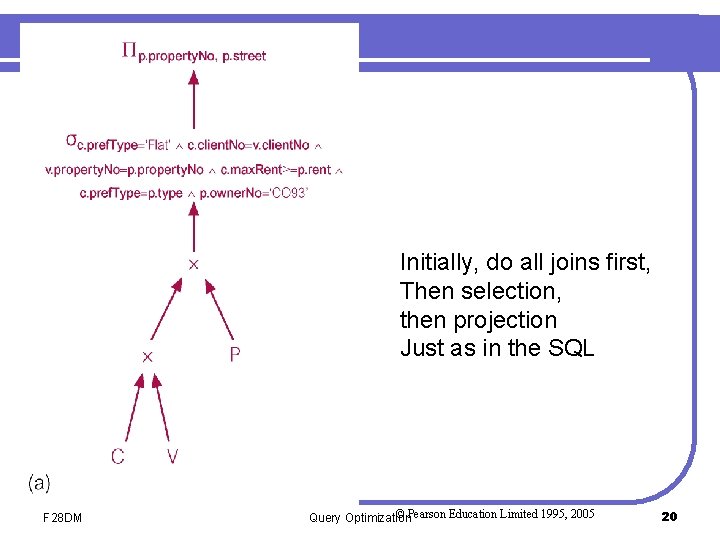
Exampl Initially, do all joins first, Then selection, then projection Just as in the SQL F 28 DM © Pearson Education Limited 1995, 2005 Query Optimization 20
Transformation challenge • Using common sense and the heuristic processing strategies, transform the query tree, shown on the previous slide, to be more efficient • • F 28 DM Recognise natural joins Minimise rows and columns wherever possible, partly by moving selections and projections down Query Optimization 21
COST ESTIMATION for RA Operations • There are many different ways of implementing RA operations. • The aim of QO is to choose the most efficient one. • • • F 28 DM Use formulae that estimate costs for a number of options, and select one with lowest cost. Consider only cost of disk access, which is usually dominant cost in QP. Many estimates are based on cardinality of the relation (i. e. how many), so need to be able to estimate this. Query Optimization © Pearson Education Limited 1995, 2005 22
Database Statistics • Success of estimation depends on amount and currency of statistical information DBMS holds. • Keeping statistics current can be problematic. • • If statistics updated every time a tuple is changed, this would impact on performance. DBMS could update statistics on a periodic basis, for example nightly, or whenever the system is idle. F 28 DM © Pearson Education Limited 1995, 2005 Query Optimization 23
Updating Statistics • Here are typical statistics kept • For a relation • • For an attribute • • • Number of distinct values, min, mix, Selection cardinality – avg num of records satisfying an equality condition For an index • F 28 DM Number of tuples, number of tuples per block, number of blocks Number of levels, number of leaf blocks © Pearson Education Limited 1995, 2005 Query Optimization 24
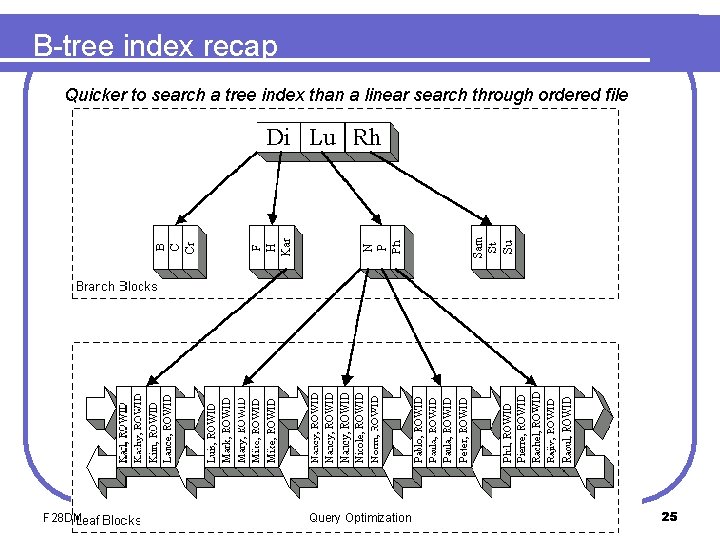
B-tree index recap Quicker to search a tree index than a linear search through ordered file F 28 DM Query Optimization 25
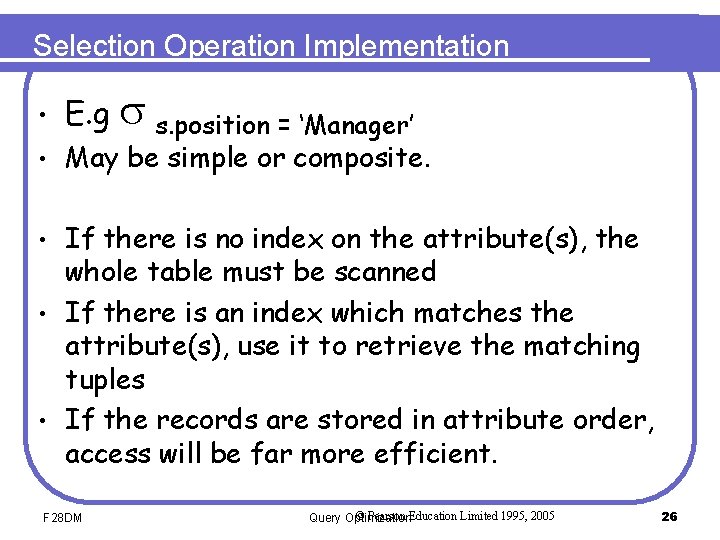
Selection Operation Implementation s. position = ‘Manager’ • E. g • May be simple or composite. If there is no index on the attribute(s), the whole table must be scanned • If there is an index which matches the attribute(s), use it to retrieve the matching tuples • If the records are stored in attribute order, access will be far more efficient. • F 28 DM © Pearson Education Limited 1995, 2005 Query Optimization 26
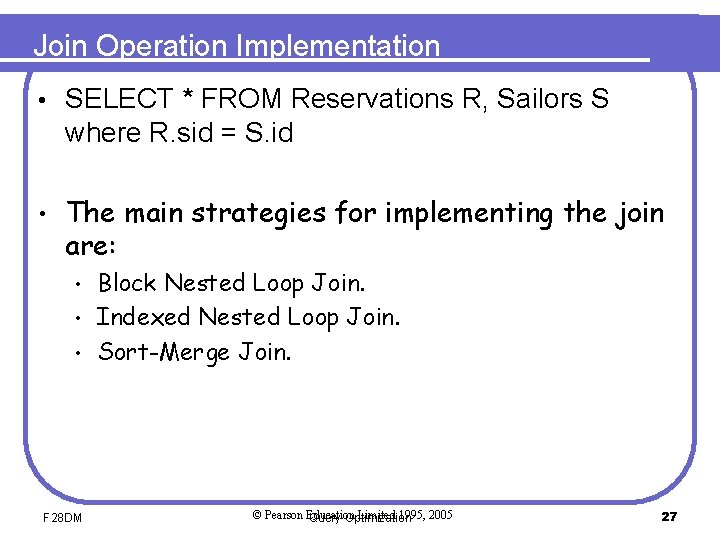
Join Operation Implementation • SELECT * FROM Reservations R, Sailors S where R. sid = S. id • The main strategies for implementing the join are: • • • F 28 DM Block Nested Loop Join. Indexed Nested Loop Join. Sort-Merge Join. © Pearson Education Limited 1995, 2005 Query Optimization 27
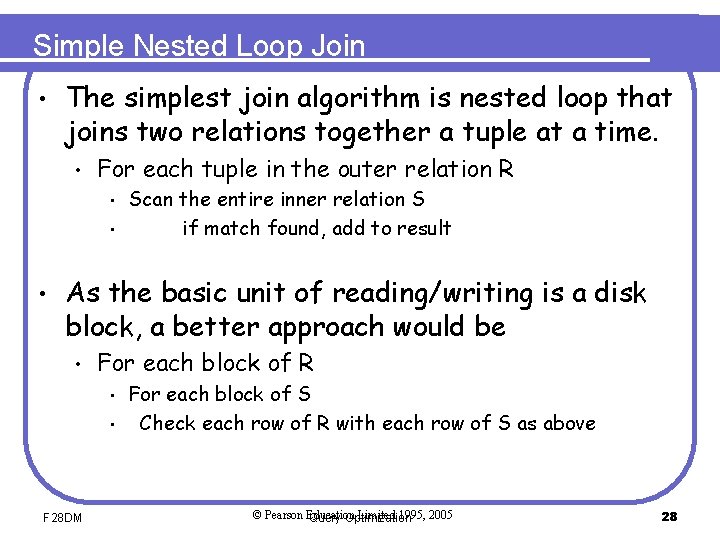
Simple Nested Loop Join • The simplest join algorithm is nested loop that joins two relations together a tuple at a time. • For each tuple in the outer relation R • • • Scan the entire inner relation S if match found, add to result As the basic unit of reading/writing is a disk block, a better approach would be • For each block of R • • F 28 DM For each block of S Check each row of R with each row of S as above © Pearson Education Limited 1995, 2005 Query Optimization 28
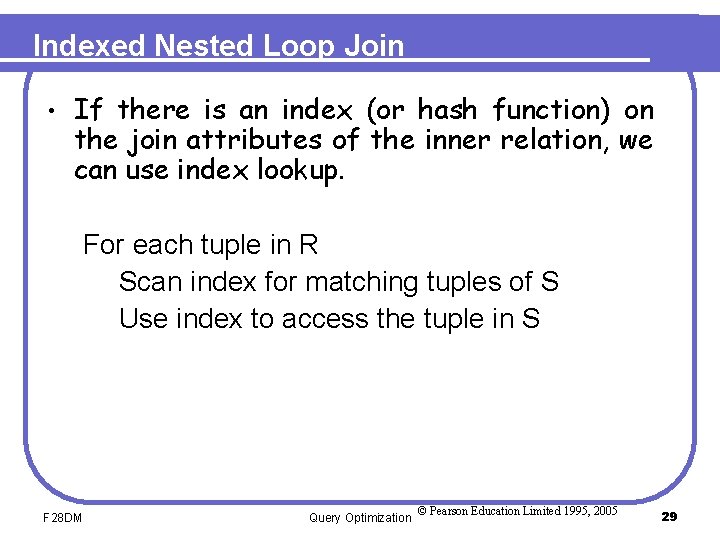
Indexed Nested Loop Join • If there is an index (or hash function) on the join attributes of the inner relation, we can use index lookup. For each tuple in R Scan index for matching tuples of S Use index to access the tuple in S F 28 DM Query Optimization © Pearson Education Limited 1995, 2005 29
Sort-Merge Join • The most efficient join is when both relations are sorted on the join attributes, then ‘merge’ by scanning through both looking for matching values • This only works if the join is on equality Sort R on join attribute i Sort S on join attribute j Scan files concurrently, matching records with same join attribute F 28 DM Query Optimization © Pearson Education Limited 1995, 2005 30
Projection Operation Implementation • E. g. SELECT sid, bid FROM Reservations • To implement projection need to: (1) Remove attributes that are not required • This is straightforward • If an index contains all the wanted attributes in its search key, use the index rather than the base table F 28 DM © Pearson Education Limited 1995, 2005 Query Optimization 31
Projection – eliminate duplicates (2) Eliminate any duplicate tuples produced from previous step. This is only required if projection attributes do not include a key. • A sailor could have reserved the same boat on different days Sorting is the standard approach • There also hash-based techniques • F 28 DM Query Optimization 32
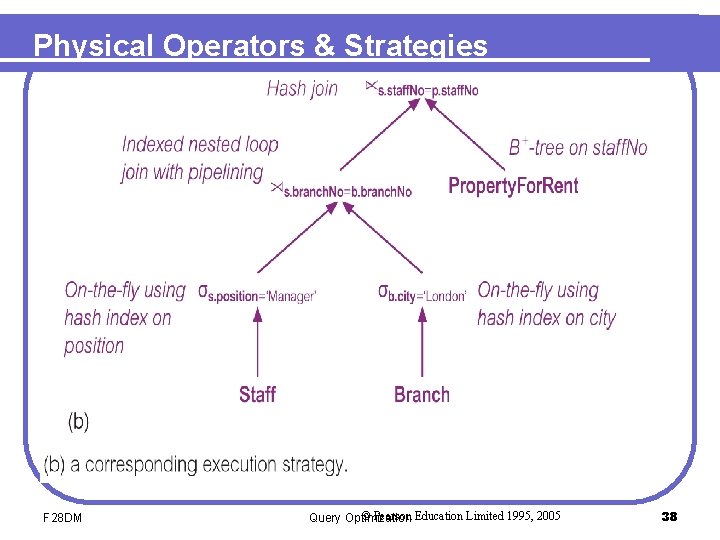
Pipelining • Materialization • • The output of one operation is stored in a temporary relation for processing by next. Pipelining or on-the-fly processing • • • F 28 DM Pipeline results of one operation to another without creating temporary relation. Saves on cost of creating temporary relations and reading results back in again. Generally, a pipeline is implemented as separate process or thread. © Pearson Education Limited 1995, 2005 Query Optimization 33
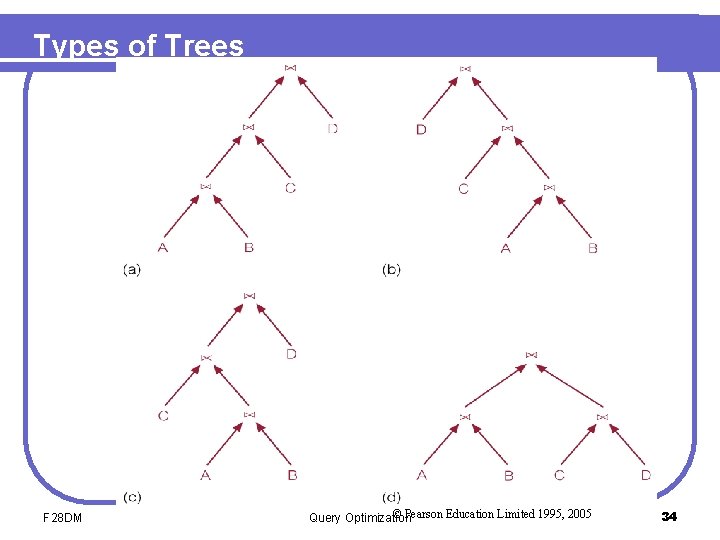
Types of Trees F 28 DM © Pearson Education Limited 1995, 2005 Query Optimization 34
Pipelining & left-deep trees • For each tuple of outer relation, need to examine entire inner relation. This inner relation can’t be pipe-lined and must always be materialized. • This makes left-deep trees (like a) appealing, because then the inner relations are always base relations. • Reduces search space for optimum strategy, and allows QO to use dynamic processing. F 28 DM © Pearson Education Limited 1995, 2005 Query Optimization 35
Physical Operators & Strategies • Physical operator • refers to specific algorithm that implements a logical operation, such as selection or join. • For example, can use sort-merge join to implement the join operation. • Annotating a query tree with physical operators produces an execution strategy (or query evaluation plan or access plan). F 28 DM © Pearson Education Limited 1995, 2005 Query Optimization 36
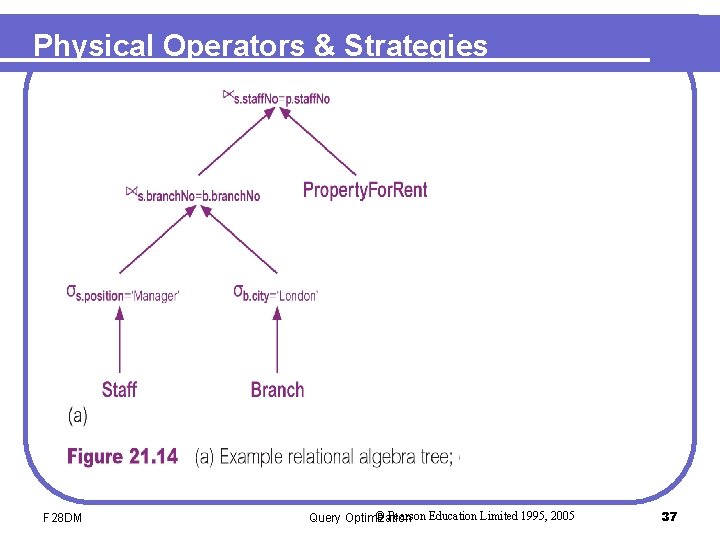
Physical Operators & Strategies F 28 DM © Pearson Education Limited 1995, 2005 Query Optimization 37
Physical Operators & Strategies F 28 DM © Pearson Education Limited 1995, 2005 Query Optimization 38
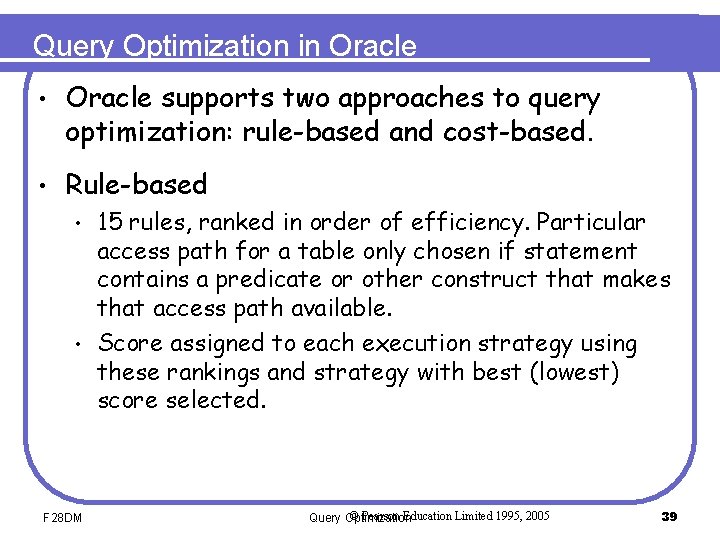
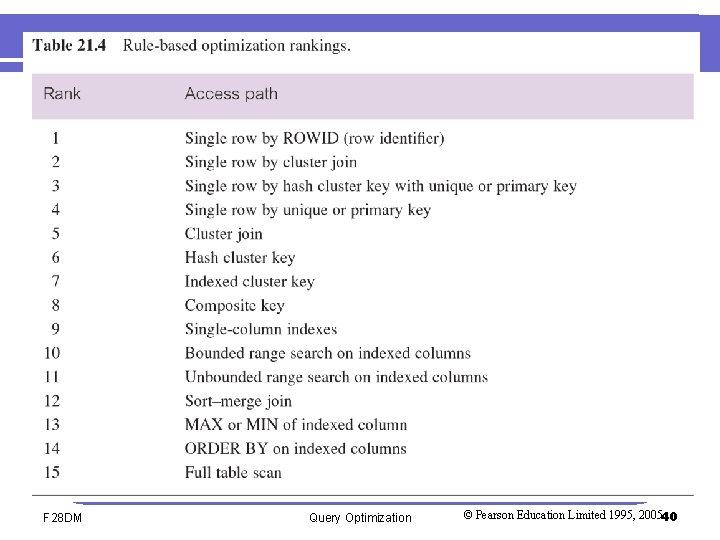
Query Optimization in Oracle • Oracle supports two approaches to query optimization: rule-based and cost-based. • Rule-based • • F 28 DM 15 rules, ranked in order of efficiency. Particular access path for a table only chosen if statement contains a predicate or other construct that makes that access path available. Score assigned to each execution strategy using these rankings and strategy with best (lowest) score selected. © Pearson Education Limited 1995, 2005 Query Optimization 39
QO in Oracle – Rule-Based F 28 DM Query Optimization © Pearson Education Limited 1995, 200540
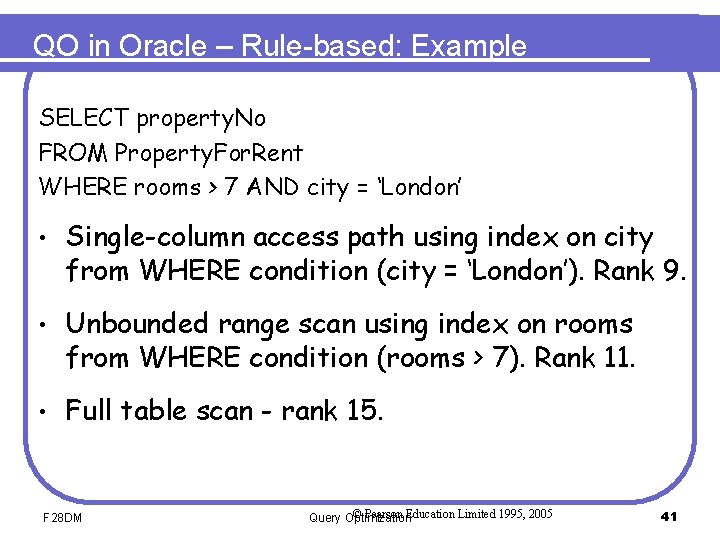
QO in Oracle – Rule-based: Example SELECT property. No FROM Property. For. Rent WHERE rooms > 7 AND city = ‘London’ • Single-column access path using index on city from WHERE condition (city = ‘London’). Rank 9. • Unbounded range scan using index on rooms from WHERE condition (rooms > 7). Rank 11. • Full table scan - rank 15. F 28 DM © Pearson Education Limited 1995, 2005 Query Optimization 41
QO in Oracle – Cost-Based • The cost-based optimizer selects the strategy that requires minimal resource use necessary to process all rows accessed by query • User can select whether minimal resource usage is based on throughput (producing all rows ) or based on response time (producing the first row). • • The user can provide hints on decisions such as access path or join operator. • They can view the execution plan. F 28 DM © Pearson Education Limited 1995, 2005 Query Optimization 42
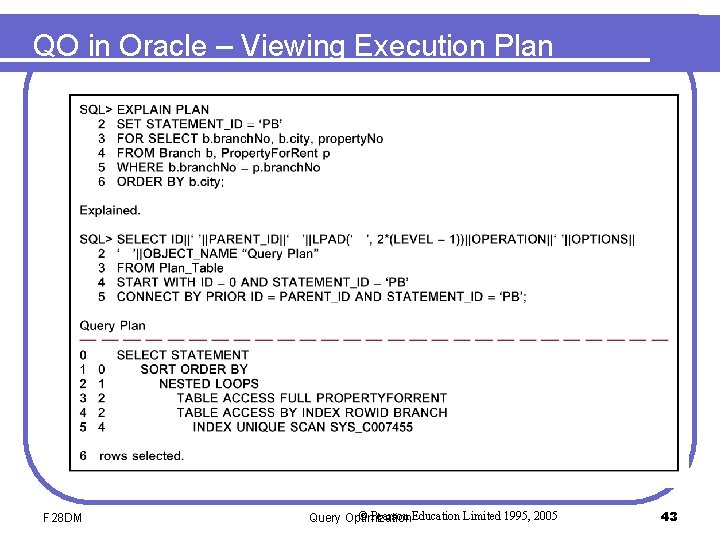
QO in Oracle – Viewing Execution Plan F 28 DM © Pearson Education Limited 1995, 2005 Query Optimization 43
QO in Oracle – Statistics • The cost-based optimizer depends on statistics for all tables, clusters, and indexes accessed by query. • It is the users’ responsibility to generate these statistics and keep them current. • Oracle uses a histogram of data values to assist decisions F 28 DM © Pearson Education Limited 1995, 2005 Query Optimization 44
Summary Query optimization (QO) is an important task in a relational DBMS • Understanding of QO is necessary to understand the impact • • Of a given database design (relations, indexes) On the workload given by a set of queries QO has 2 parts • Enumeration of alternative plans • • Estimation of cost of enumerated plans • • • Pruning of search space : left-deep plans only Size of results Cost of each plan node Key issues – query trees, operator implementation, use of indexes F 28 DM Query Optimization 45
- Slides: 45