
EYFS Summer 1 Once upon a time Curriculum
- Slides: 4
EYFS Summer 1 Once upon a time Curriculum Driver: Literacy Create Explore Discover
EYFS Summer 1 – Once upon a time Key Curriculum Driver: Literacy Other Curriculum Areas: PSED Rationale: Once upon a time will provide children with a love of reading and a thirst for reading and a variety of texts. Once upon a time will also provide many opportunities for children to look at different texts and different authors, an opportunity to write in different genres and the ability to use story language in their independent writing. By the end of this topic, most children will: • Have an excellent knowledge and understanding of different texts and genres. • The ability to use story language in their independent writing. • The ability to use phonic knowledge in their writing. • Use their phonic knowledge to read HF words and irregular common words. Children’s knowledge will be shown by: Writing: Writes more complex sentences. Begin to break the flow of speech into words. Hears and says initial and final letter sounds in words. Writes own names and other things such as labels. Purposeful Outcome – Added by class teachers after completeing topic web. Create Explore Discover
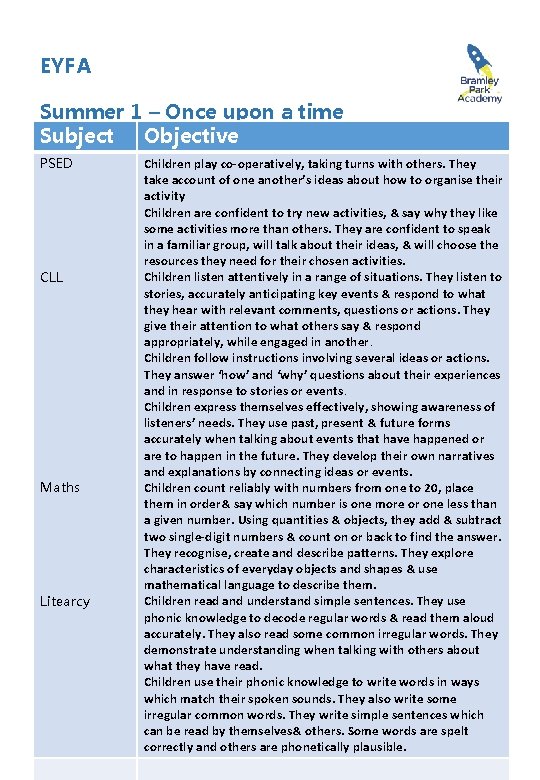
EYFA Summer 1 – Once upon a time Subject Objective PSED CLL Maths Litearcy Children play co-operatively, taking turns with others. They take account of one another’s ideas about how to organise their activity Children are confident to try new activities, & say why they like some activities more than others. They are confident to speak in a familiar group, will talk about their ideas, & will choose the resources they need for their chosen activities. Children listen attentively in a range of situations. They listen to stories, accurately anticipating key events & respond to what they hear with relevant comments, questions or actions. They give their attention to what others say & respond appropriately, while engaged in another. Children follow instructions involving several ideas or actions. They answer ‘how’ and ‘why’ questions about their experiences and in response to stories or events. Children express themselves effectively, showing awareness of listeners’ needs. They use past, present & future forms accurately when talking about events that have happened or are to happen in the future. They develop their own narratives and explanations by connecting ideas or events. Children count reliably with numbers from one to 20, place them in order& say which number is one more or one less than a given number. Using quantities & objects, they add & subtract two single-digit numbers & count on or back to find the answer. They recognise, create and describe patterns. They explore characteristics of everyday objects and shapes & use mathematical language to describe them. Children read and understand simple sentences. They use phonic knowledge to decode regular words & read them aloud accurately. They also read some common irregular words. They demonstrate understanding when talking with others about what they have read. Children use their phonic knowledge to write words in ways which match their spoken sounds. They also write some irregular common words. They write simple sentences which can be read by themselves& others. Some words are spelt correctly and others are phonetically plausible.
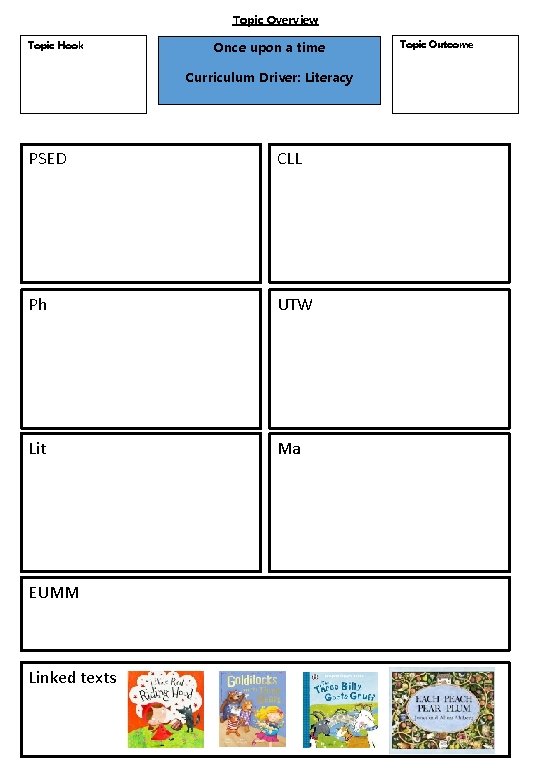
Topic Overview Topic Hook Once upon a time Curriculum Driver: Literacy PSED CLL Ph UTW Lit Ma EUMM Linked texts Topic Outcome