
EYFS Safeguarding Briefing Spring 2021 Jo Barclay Head
EYFS Safeguarding Briefing Spring 2021 Jo Barclay, Head of Education Safeguarding and Wellbeing

Agenda • Safeguarding update • Transition to new setting • Prevent • Training framework • Reporting and recording concerns • Essex Safeguarding Children Board • • Introduction to the Essex Safeguarding Children Board Child Safeguarding Practice Reviews (CSPRs) Learning from CSPRs Support with Early Help
Transition • CP files: – ‘tidy’ files (remove duplicate papers, ensure in chronological order, provide a chronology, ensure papers stapled where required, ensure no other children named) – File should not be sent to new setting until end of term, although information can be shared in order to ensure appropriate support in place • Start discussions about vulnerable pupils: – Include new setting in meetings where they are already taking place – Consider a TAF to for transition planning (where there is no existing meeting cycle) – Identify key person for child at new setting
Prevent update • February 2021 - UK Threat Level decreased to SUBSTANTIAL • Right-wing extremism – Conspiracy theories – Patriotic Alternative (EHE) – Hundred Handers (leafletting) • www. Act. Early. uk • Still waiting for replacement for WRAP training
EYS Training Framework • Need to support settings by strengthening safeguarding arrangements and aligning to schools • Arrangements will take effect from September 2021: – All DLs will undertake level 3 training – Preferred provider is Juniper Education (as has local context) – All level 3 training will be whole day training – All DLs and Deputy DLs will attend level 3 training at least every 2 years – should also access regular and relevant updates – All staff working directly with children will attend level 2 training – should be annually, with regular and relevant updates
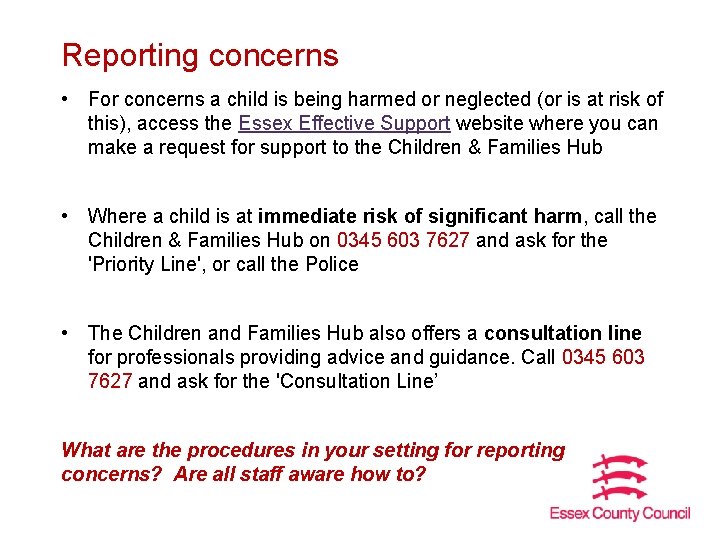
Reporting concerns • For concerns a child is being harmed or neglected (or is at risk of this), access the Essex Effective Support website where you can make a request for support to the Children & Families Hub • Where a child is at immediate risk of significant harm, call the Children & Families Hub on 0345 603 7627 and ask for the 'Priority Line', or call the Police • The Children and Families Hub also offers a consultation line for professionals providing advice and guidance. Call 0345 603 7627 and ask for the 'Consultation Line’ What are the procedures in your setting for reporting concerns? Are all staff aware how to?
Welcome to the Children and Familes Hub
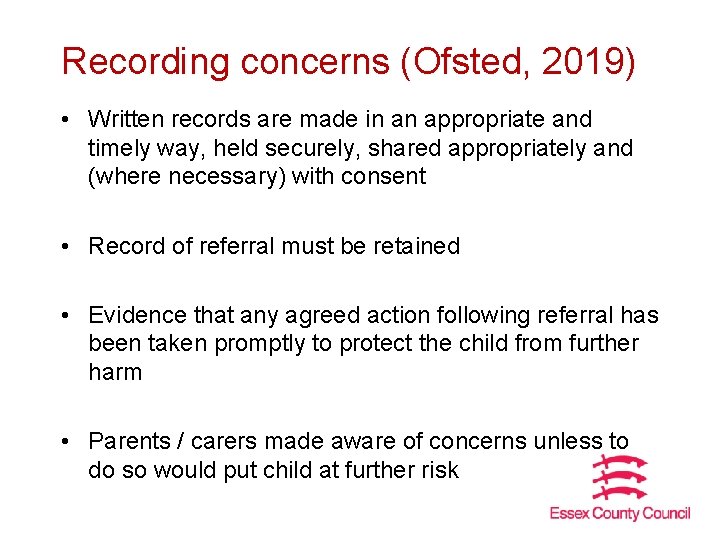
Recording concerns (Ofsted, 2019) • Written records are made in an appropriate and timely way, held securely, shared appropriately and (where necessary) with consent • Record of referral must be retained • Evidence that any agreed action following referral has been taken promptly to protect the child from further harm • Parents / carers made aware of concerns unless to do so would put child at further risk
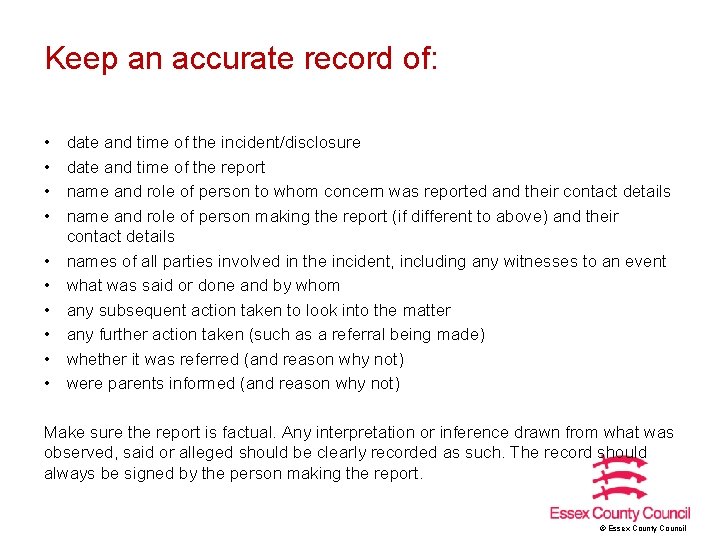
Keep an accurate record of: • • • date and time of the incident/disclosure date and time of the report name and role of person to whom concern was reported and their contact details name and role of person making the report (if different to above) and their contact details names of all parties involved in the incident, including any witnesses to an event what was said or done and by whom any subsequent action taken to look into the matter any further action taken (such as a referral being made) whether it was referred (and reason why not) were parents informed (and reason why not) Make sure the report is factual. Any interpretation or inference drawn from what was observed, said or alleged should be clearly recorded as such. The record should always be signed by the person making the report. © Essex County Council
Recording concerns • How do you advise parents of your policy around reporting and recording – Safeguarding / CP policy – Home / Setting Agreement – website • Are you confident all staff know how to identify and report concerns? Are all staff aware of specific safeguarding issues? How do you evidence this? • What do you include on a CP file? • • Attendance Behaviour Mental health Bullying
Recording concerns, one • Do you record rationale for decision-making? • Do you record advice received? By whom? • Do you hold all emails / notes of discussions / meetings on the CP file? • Do you record when you have shared information with other partners (and why? ) • Do you have only individual CP files, no family files and hold all information in one place?
Recording concerns, two • Electronic / paper records? • How do governors (or other appropriate body) ensure appropriate records are kept? • ‘DELAY OR NEGLIGENCE IN PASSING ON CONCERNS TO THE RELEVANT AGENCIES’ (Ofsted 2019) – how do you evidence effective processes in your setting? • How are you recording ‘early help’? • Where is the child’s voice in your records? • How do you evidence (appropriate) feedback to staff?
Reviewing concerns Where is the check in the system? How are cases reviewed? • Cumulative concerns = ‘persistent’ abuse = referral? • Re-assessment of concern • Is the situation improving? • Is risk being addressed? • Are professionals being challenged if required where agreed action is not taken? • Is someone speaking to the child to check current situation? • How do you evidence the review process?
EYS website • Model templates to support reporting and recording • Safeguarding audit • Model child protection policies • Guidance on CP file transfer / ‘receipt’ for file transfer • Key documents and resources • Termly briefings
Head of Education Safeguarding and Wellbeing: jo. barclay@essex. gov. uk 033301 31078 Education Safeguarding Adviser: matthew. lewis@essex. gov. uk 033301 31072
Essex Safeguarding Children Board (ESCB) Karen Hammett, Practice Development Manager Karen. Hammett@essex. gov. uk This presentation is only for use within your organisation not for wider distribution
‘Working Together’ (2018) “effective safeguarding of children can only be achieved by putting children at the centre of the system, and by every individual and agency playing their full part, working together to meet the needs of our most vulnerable children. ” This presentation is only for use within your organisation not for wider distribution
Essex Safeguarding Children Board The ESCB is the name for the new Multi-Agency Safeguarding Arrangements (MASA) in Essex. Under the arrangements there are seven agencies in Essex who are jointly responsible by law for keeping children safe. These are called the Statutory Partners and they are the key decision makers who form the ESCB Executive and are responsible for the direction of travel (with identified relevant partners). https: //www. escb. co. uk/media/2453/induction-pack-july-2020. pdf This presentation is only for use within your organisation not for wider distribution
Independent Chair/Facilitator The Statutory Partners (the decision makers) elected for the ESCB Executive Board to be chaired by an Independent Chair Facilitator and appointed David Archibald in 2019. Whilst his role does not hold any statutory responsibilities he provides a strong independent voice, ensuring that the ESCB operates effectively in promoting the safeguarding, wellbeing and interests of children and young people in Essex. This presentation is only for use within your organisation not for wider distribution
Purpose of ESCB • Ensure children are safeguarded and their welfare promoted • Partner agencies collaborate, share vision for how to achieve improved outcomes for vulnerable children. They must also challenge appropriately and hold one another to account effectively • Early identification and analysis of new safeguarding issues and emerging risks This presentation is only for use within your organisation not for wider distribution
Purpose of ESCB 2 • Learning is promoted and embedded in a way that local services for children and families can become more reflective and implement changes to practice • Information is shared effectively to facilitate more accurate and timely decision making for children and families This presentation is only for use within your organisation not for wider distribution
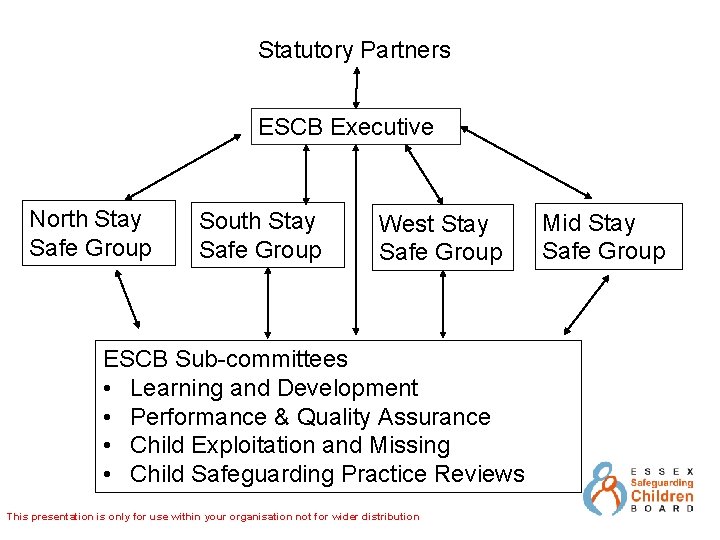
Statutory Partners ESCB Executive North Stay Safe Group South Stay Safe Group West Stay Safe Group ESCB Sub-committees • Learning and Development • Performance & Quality Assurance • Child Exploitation and Missing • Child Safeguarding Practice Reviews This presentation is only for use within your organisation not for wider distribution Mid Stay Safe Group
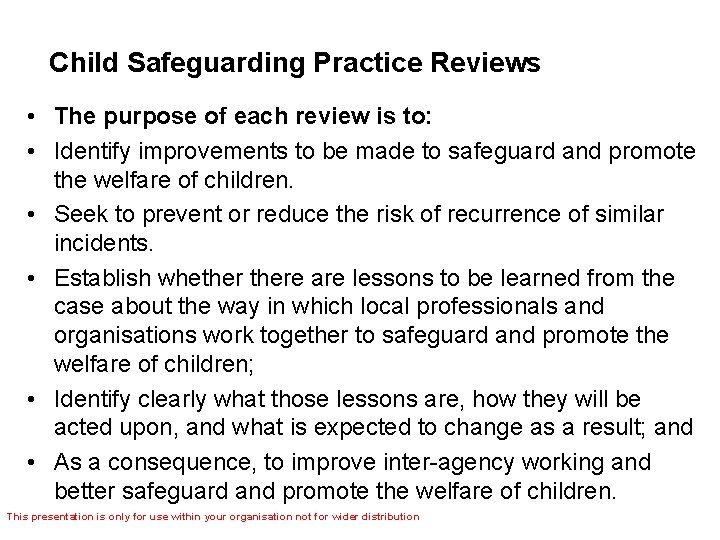
Child Safeguarding Practice Reviews • The purpose of each review is to: • Identify improvements to be made to safeguard and promote the welfare of children. • Seek to prevent or reduce the risk of recurrence of similar incidents. • Establish whethere are lessons to be learned from the case about the way in which local professionals and organisations work together to safeguard and promote the welfare of children; • Identify clearly what those lessons are, how they will be acted upon, and what is expected to change as a result; and • As a consequence, to improve inter-agency working and better safeguard and promote the welfare of children. This presentation is only for use within your organisation not for wider distribution
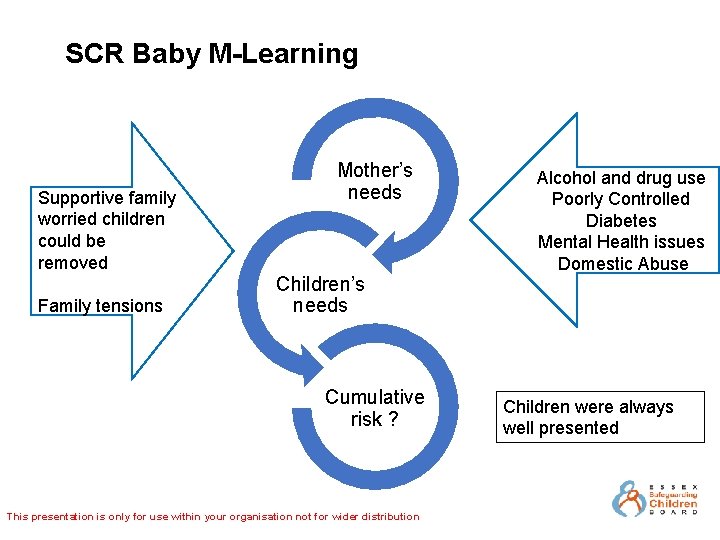
SCR Baby M-Learning Supportive family worried children could be removed Family tensions Mother’s needs Children’s needs Cumulative risk ? This presentation is only for use within your organisation not for wider distribution Alcohol and drug use Poorly Controlled Diabetes Mental Health issues Domestic Abuse Children were always well presented
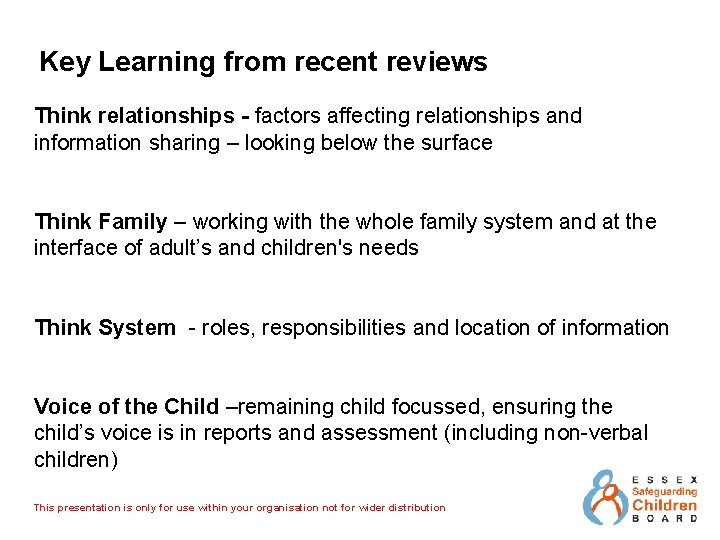
Key Learning from recent reviews Think relationships - factors affecting relationships and information sharing – looking below the surface Think Family – working with the whole family system and at the interface of adult’s and children's needs Think System - roles, responsibilities and location of information Voice of the Child –remaining child focussed, ensuring the child’s voice is in reports and assessment (including non-verbal children) This presentation is only for use within your organisation not for wider distribution
Key Learning from recent reviews 2 • How do we maintain curiosity when parents/families assure us things are better/going well? (Respectful uncertainty) • How do we ensure a co-ordinated approach for adults and children with complex health needs? • How can we encourage conversations about culture and beliefs? • Including understanding relationships and dynamics across the whole family system, including factors that may influence relationships with professionals • Having tricky conversations with families in difficult situations • The use/denial/misuse of alcohol by parents/carers This presentation is only for use within your organisation not for wider distribution
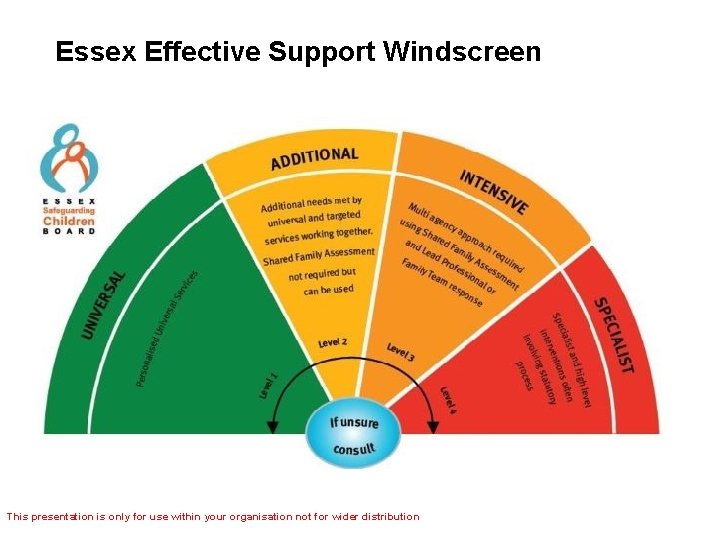
Essex Effective Support Windscreen This presentation is only for use within your organisation not for wider distribution
Early Help makes a difference Team Around the Family-TAF Support from the TAFSO to facilitate this, you can contact the TAFSO@essex. gov. uk (there is one TAFSO per quadrant) Early help drop-in currently being piloted in North (Tuesdays 12 -1 pm) and South Essex (Wednesday 12. 30 -1. 30 pm) If you would like more information; North- Lee. bailey@essex. gov. uk South- Harriet. Pickering@essex. gov. uk This presentation is only for use within your organisation not for wider distribution
Learning and Development Opportunities • All learning and development opportunities are advertised on the ESCB website www. escb. co. uk • Some courses are free, others have a fee • Online exploitation awareness campaign running this week on social media • If you want to sign up to receive ESCB bulletins then email escb. comms@essex. gov. uk This presentation is only for use within your organisation not for wider distribution
Useful websites § www. escb. co. uk – SET Procedures and other polices, learning and development opportunities, information and resources § https: //setdab. org/ § https: //learning. nspcc. org. uk/ § http: //www. barnardos. org. uk/ § https: //www. ceop. police. uk/safety-centre/ § https: //www. thinkuknow. co. uk/ This presentation is only for use within your organisation not for wider distribution
- Slides: 30