
EYFS Proposed ELGs Amanda James Thinking Spaces thinkingspacesconsultancygmail
- Slides: 19
EYFS Proposed ELGs Amanda James 'Thinking Spaces' thinkingspacesconsultancy@gmail. com
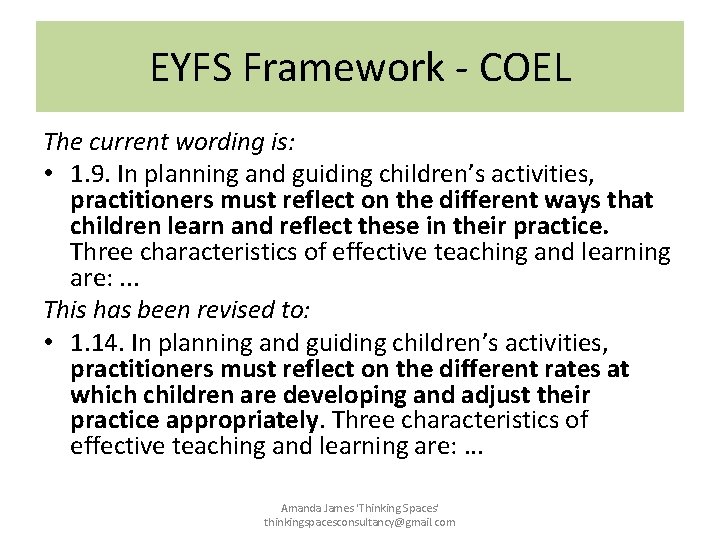
EYFS Framework - COEL The current wording is: • 1. 9. In planning and guiding children’s activities, practitioners must reflect on the different ways that children learn and reflect these in their practice. Three characteristics of effective teaching and learning are: . . . This has been revised to: • 1. 14. In planning and guiding children’s activities, practitioners must reflect on the different rates at which children are developing and adjust their practice appropriately. Three characteristics of effective teaching and learning are: . . . Amanda James 'Thinking Spaces' thinkingspacesconsultancy@gmail. com
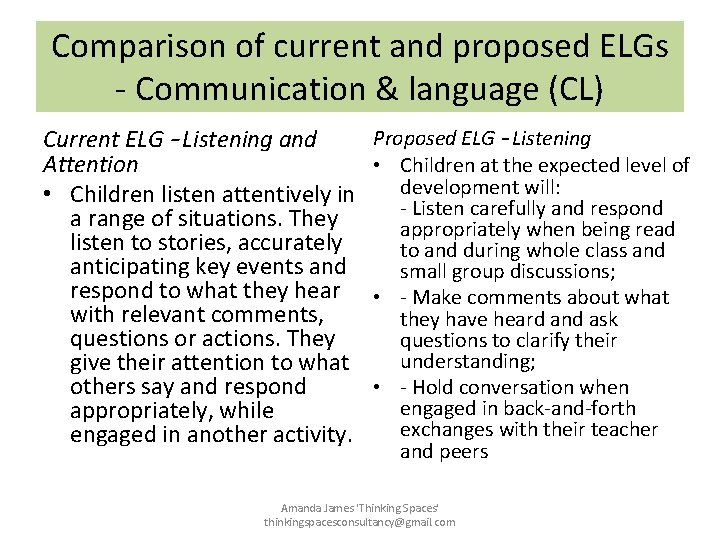
Comparison of current and proposed ELGs - Communication & language (CL) Current ELG – Listening and Attention • Children listen attentively in a range of situations. They listen to stories, accurately anticipating key events and respond to what they hear with relevant comments, questions or actions. They give their attention to what others say and respond appropriately, while engaged in another activity. Proposed ELG – Listening • Children at the expected level of development will: - Listen carefully and respond appropriately when being read to and during whole class and small group discussions; • - Make comments about what they have heard and ask questions to clarify their understanding; • - Hold conversation when engaged in back-and-forth exchanges with their teacher and peers Amanda James 'Thinking Spaces' thinkingspacesconsultancy@gmail. com
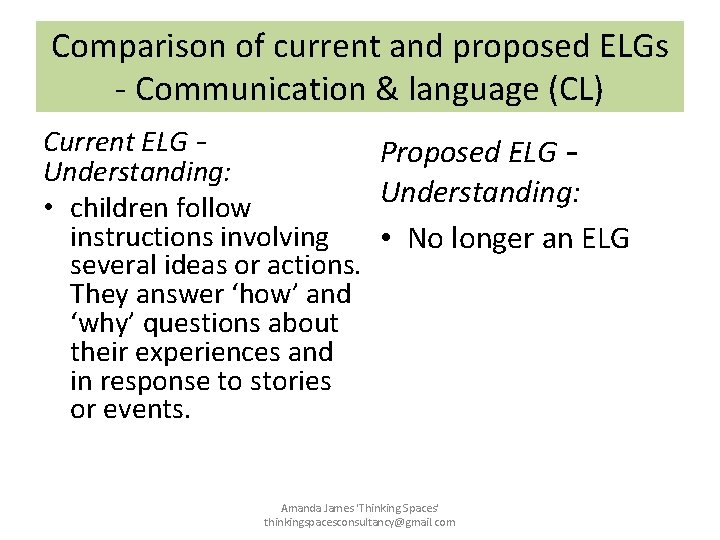
Comparison of current and proposed ELGs - Communication & language (CL) Current ELG – Proposed ELG – Understanding: • children follow instructions involving • No longer an ELG several ideas or actions. They answer ‘how’ and ‘why’ questions about their experiences and in response to stories or events. Amanda James 'Thinking Spaces' thinkingspacesconsultancy@gmail. com
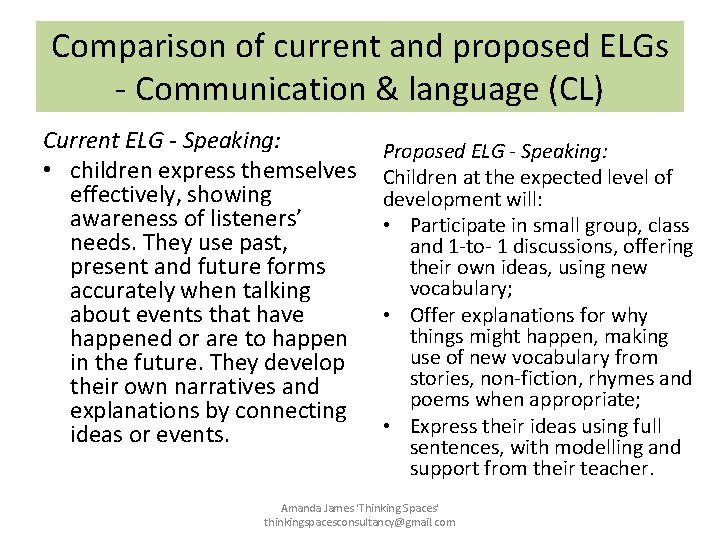
Comparison of current and proposed ELGs - Communication & language (CL) Current ELG - Speaking: • children express themselves effectively, showing awareness of listeners’ needs. They use past, present and future forms accurately when talking about events that have happened or are to happen in the future. They develop their own narratives and explanations by connecting ideas or events. Proposed ELG - Speaking: Children at the expected level of development will: • Participate in small group, class and 1 -to- 1 discussions, offering their own ideas, using new vocabulary; • Offer explanations for why things might happen, making use of new vocabulary from stories, non-fiction, rhymes and poems when appropriate; • Express their ideas using full sentences, with modelling and support from their teacher. Amanda James 'Thinking Spaces' thinkingspacesconsultancy@gmail. com
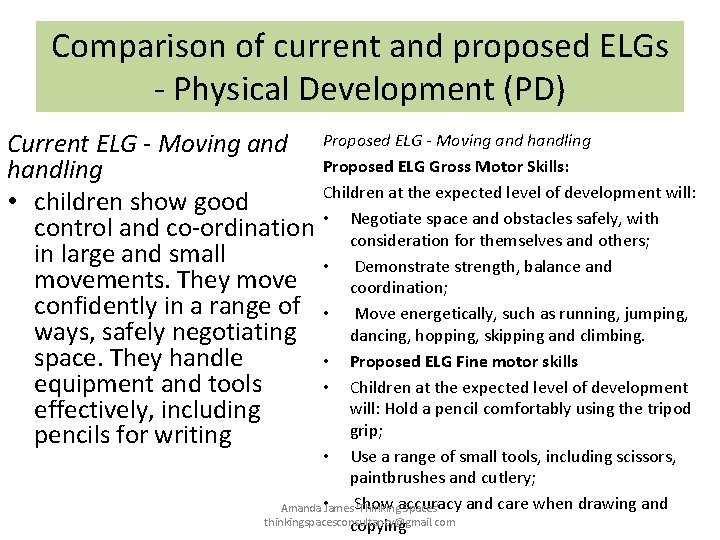
Comparison of current and proposed ELGs - Physical Development (PD) Current ELG - Moving and Proposed ELG - Moving and handling Proposed ELG Gross Motor Skills: handling Children at the expected level of development will: • children show good space and obstacles safely, with control and co-ordination • Negotiate consideration for themselves and others; in large and small • Demonstrate strength, balance and movements. They move coordination; confidently in a range of • Move energetically, such as running, jumping, ways, safely negotiating dancing, hopping, skipping and climbing. space. They handle • Proposed ELG Fine motor skills equipment and tools • Children at the expected level of development will: Hold a pencil comfortably using the tripod effectively, including grip; pencils for writing Use a range of small tools, including scissors, paintbrushes and cutlery; and care when drawing and Amanda • James. Show 'Thinkingaccuracy Spaces' thinkingspacesconsultancy@gmail. com copying •
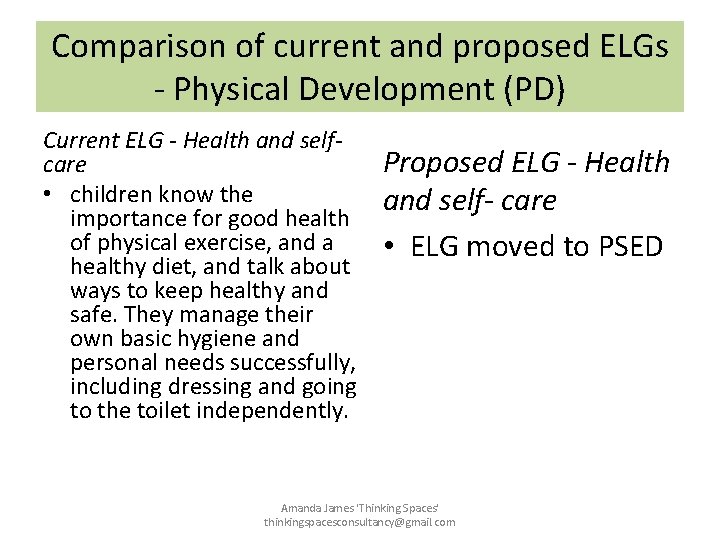
Comparison of current and proposed ELGs - Physical Development (PD) Current ELG - Health and selfcare • children know the importance for good health of physical exercise, and a healthy diet, and talk about ways to keep healthy and safe. They manage their own basic hygiene and personal needs successfully, including dressing and going to the toilet independently. Proposed ELG - Health and self- care • ELG moved to PSED Amanda James 'Thinking Spaces' thinkingspacesconsultancy@gmail. com
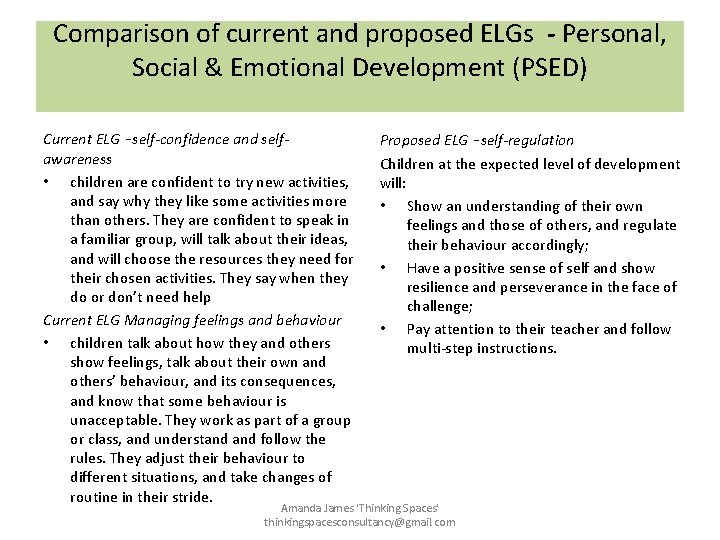
Comparison of current and proposed ELGs - Personal, Social & Emotional Development (PSED) Current ELG – self-confidence and selfawareness • children are confident to try new activities, and say why they like some activities more than others. They are confident to speak in a familiar group, will talk about their ideas, and will choose the resources they need for their chosen activities. They say when they do or don’t need help Current ELG Managing feelings and behaviour • children talk about how they and others show feelings, talk about their own and others’ behaviour, and its consequences, and know that some behaviour is unacceptable. They work as part of a group or class, and understand follow the rules. They adjust their behaviour to different situations, and take changes of routine in their stride. Proposed ELG – self-regulation Children at the expected level of development will: • Show an understanding of their own feelings and those of others, and regulate their behaviour accordingly; • Have a positive sense of self and show resilience and perseverance in the face of challenge; • Pay attention to their teacher and follow multi-step instructions. Amanda James 'Thinking Spaces' thinkingspacesconsultancy@gmail. com
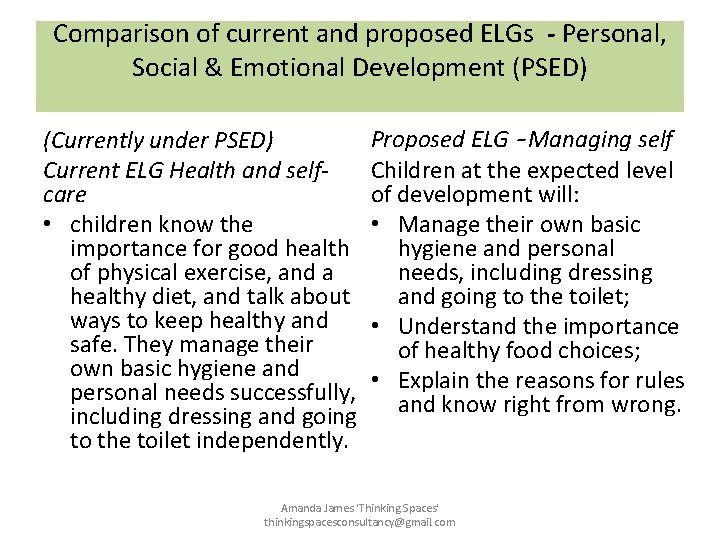
Comparison of current and proposed ELGs - Personal, Social & Emotional Development (PSED) (Currently under PSED) Current ELG Health and selfcare • children know the importance for good health of physical exercise, and a healthy diet, and talk about ways to keep healthy and safe. They manage their own basic hygiene and personal needs successfully, including dressing and going to the toilet independently. Proposed ELG – Managing self Children at the expected level of development will: • Manage their own basic hygiene and personal needs, including dressing and going to the toilet; • Understand the importance of healthy food choices; • Explain the reasons for rules and know right from wrong. Amanda James 'Thinking Spaces' thinkingspacesconsultancy@gmail. com
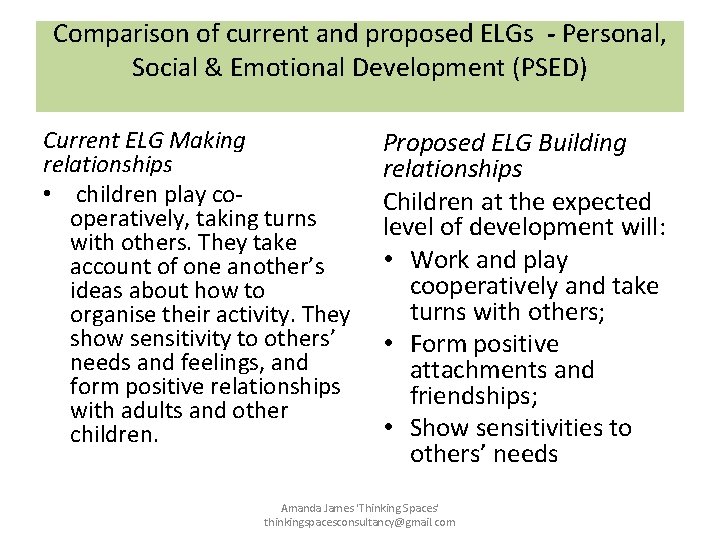
Comparison of current and proposed ELGs - Personal, Social & Emotional Development (PSED) Current ELG Making relationships • children play cooperatively, taking turns with others. They take account of one another’s ideas about how to organise their activity. They show sensitivity to others’ needs and feelings, and form positive relationships with adults and other children. Proposed ELG Building relationships Children at the expected level of development will: • Work and play cooperatively and take turns with others; • Form positive attachments and friendships; • Show sensitivities to others’ needs Amanda James 'Thinking Spaces' thinkingspacesconsultancy@gmail. com
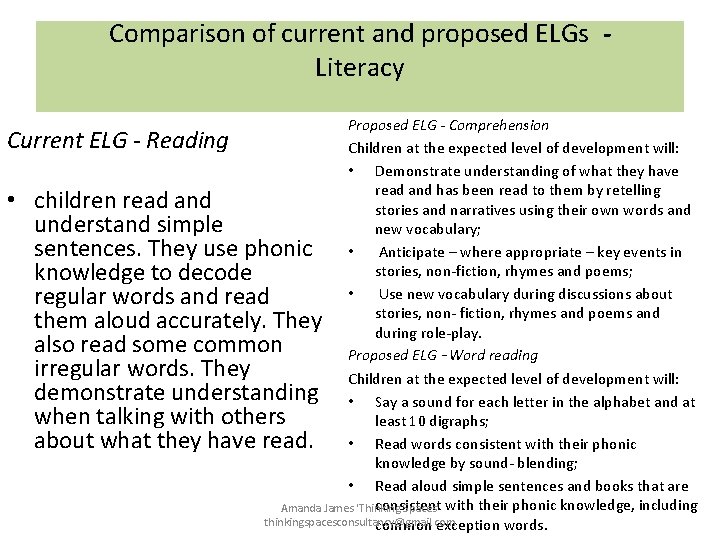
Comparison of current and proposed ELGs Literacy Proposed ELG - Comprehension Current ELG - Reading Children at the expected level of development will: • Demonstrate understanding of what they have read and has been read to them by retelling • children read and stories and narratives using their own words and understand simple new vocabulary; sentences. They use phonic • Anticipate – where appropriate – key events in stories, non-fiction, rhymes and poems; knowledge to decode • Use new vocabulary during discussions about regular words and read stories, non- fiction, rhymes and poems and them aloud accurately. They during role-play. also read some common Proposed ELG – Word reading irregular words. They Children at the expected level of development will: demonstrate understanding • Say a sound for each letter in the alphabet and at when talking with others least 10 digraphs; about what they have read. • Read words consistent with their phonic knowledge by sound- blending; • Read aloud simple sentences and books that are consistent Amanda James 'Thinking Spaces' with their phonic knowledge, including thinkingspacesconsultancy@gmail. common exception words.
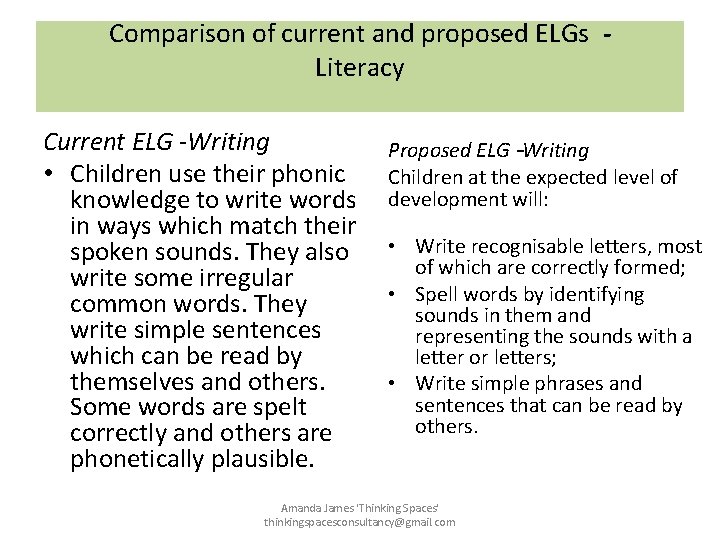
Comparison of current and proposed ELGs Literacy Current ELG -Writing • Children use their phonic knowledge to write words in ways which match their spoken sounds. They also write some irregular common words. They write simple sentences which can be read by themselves and others. Some words are spelt correctly and others are phonetically plausible. Proposed ELG –Writing Children at the expected level of development will: • Write recognisable letters, most of which are correctly formed; • Spell words by identifying sounds in them and representing the sounds with a letter or letters; • Write simple phrases and sentences that can be read by others. Amanda James 'Thinking Spaces' thinkingspacesconsultancy@gmail. com
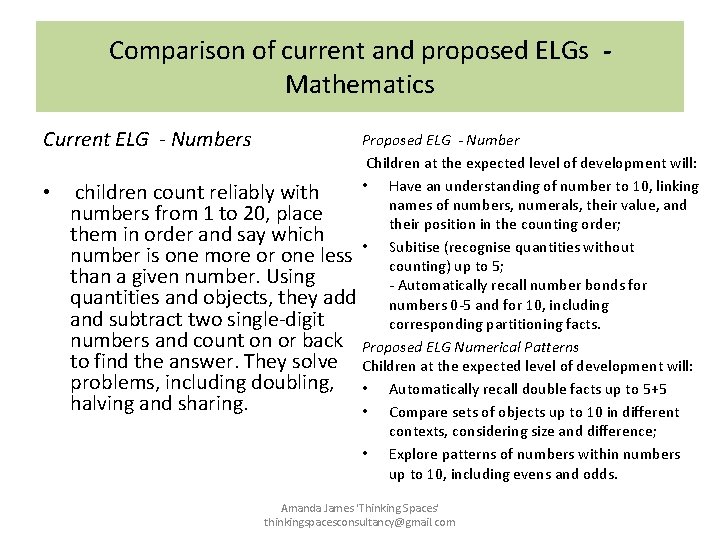
Comparison of current and proposed ELGs Mathematics Current ELG - Numbers • children count reliably with numbers from 1 to 20, place them in order and say which number is one more or one less than a given number. Using quantities and objects, they add and subtract two single-digit numbers and count on or back to find the answer. They solve problems, including doubling, halving and sharing. Proposed ELG - Number Children at the expected level of development will: • Have an understanding of number to 10, linking names of numbers, numerals, their value, and their position in the counting order; • Subitise (recognise quantities without counting) up to 5; - Automatically recall number bonds for numbers 0 -5 and for 10, including corresponding partitioning facts. Proposed ELG Numerical Patterns Children at the expected level of development will: • Automatically recall double facts up to 5+5 • Compare sets of objects up to 10 in different contexts, considering size and difference; • Explore patterns of numbers within numbers up to 10, including evens and odds. Amanda James 'Thinking Spaces' thinkingspacesconsultancy@gmail. com
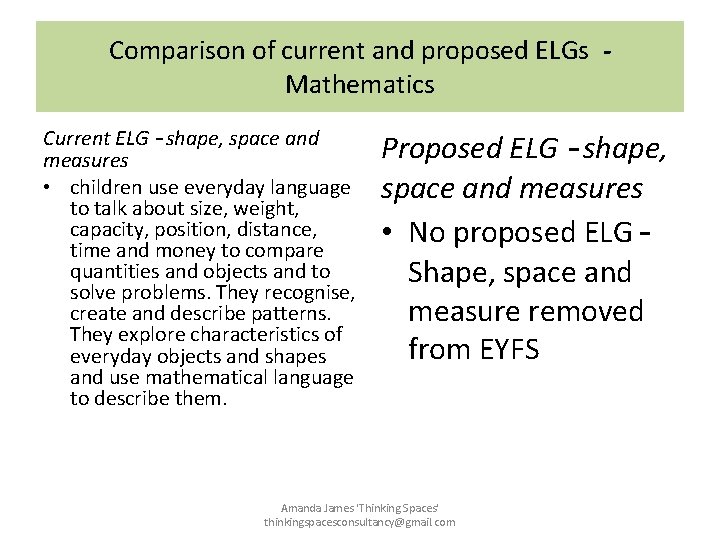
Comparison of current and proposed ELGs Mathematics Current ELG – shape, space and measures • children use everyday language to talk about size, weight, capacity, position, distance, time and money to compare quantities and objects and to solve problems. They recognise, create and describe patterns. They explore characteristics of everyday objects and shapes and use mathematical language to describe them. Proposed ELG – shape, space and measures • No proposed ELG – Shape, space and measure removed from EYFS Amanda James 'Thinking Spaces' thinkingspacesconsultancy@gmail. com
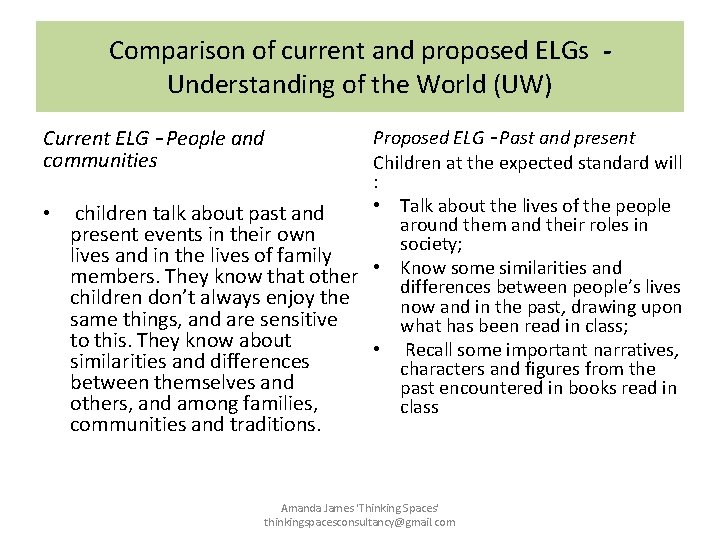
Comparison of current and proposed ELGs Understanding of the World (UW) Current ELG – People and communities Proposed ELG – Past and present Children at the expected standard will : • Talk about the lives of the people • children talk about past and around them and their roles in present events in their own society; lives and in the lives of family some similarities and members. They know that other • Know differences between people’s lives children don’t always enjoy the now and in the past, drawing upon same things, and are sensitive what has been read in class; to this. They know about • Recall some important narratives, similarities and differences characters and figures from the between themselves and past encountered in books read in others, and among families, class communities and traditions. Amanda James 'Thinking Spaces' thinkingspacesconsultancy@gmail. com
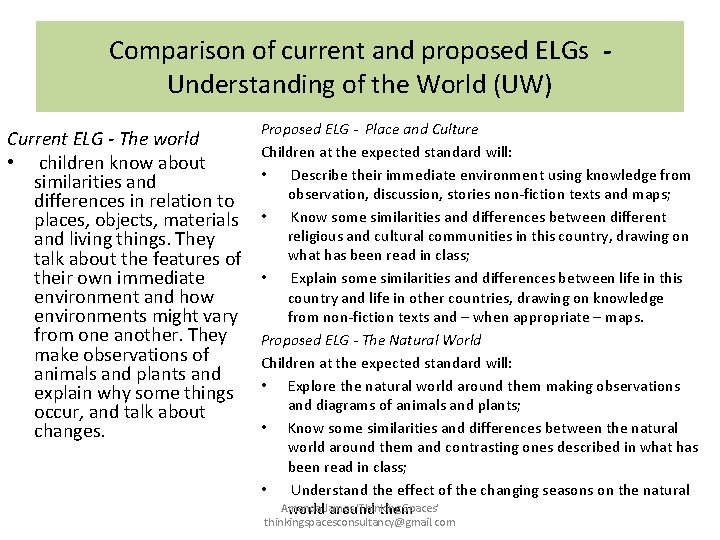
Comparison of current and proposed ELGs Understanding of the World (UW) Current ELG - The world • children know about similarities and differences in relation to places, objects, materials and living things. They talk about the features of their own immediate environment and how environments might vary from one another. They make observations of animals and plants and explain why some things occur, and talk about changes. Proposed ELG - Place and Culture Children at the expected standard will: • Describe their immediate environment using knowledge from observation, discussion, stories non-fiction texts and maps; • Know some similarities and differences between different religious and cultural communities in this country, drawing on what has been read in class; • Explain some similarities and differences between life in this country and life in other countries, drawing on knowledge from non-fiction texts and – when appropriate – maps. Proposed ELG - The Natural World Children at the expected standard will: • Explore the natural world around them making observations and diagrams of animals and plants; • Know some similarities and differences between the natural world around them and contrasting ones described in what has been read in class; • Understand the effect of the changing seasons on the natural Amanda 'Thinking Spaces' world. James around them thinkingspacesconsultancy@gmail. com
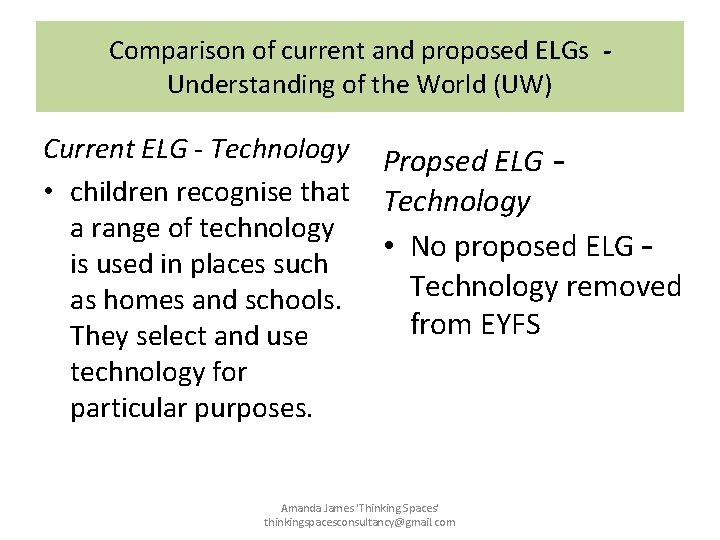
Comparison of current and proposed ELGs Understanding of the World (UW) Current ELG - Technology • children recognise that a range of technology is used in places such as homes and schools. They select and use technology for particular purposes. Propsed ELG – Technology • No proposed ELG – Technology removed from EYFS Amanda James 'Thinking Spaces' thinkingspacesconsultancy@gmail. com
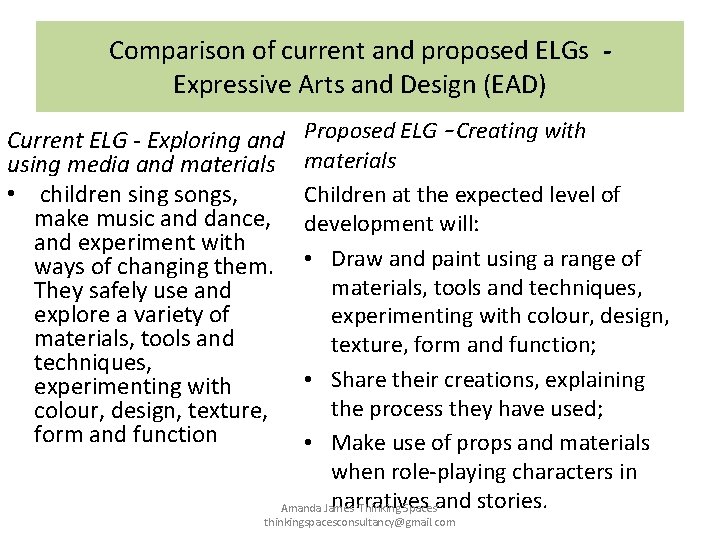
Comparison of current and proposed ELGs Expressive Arts and Design (EAD) Proposed ELG – Creating with materials Children at the expected level of development will: • Draw and paint using a range of materials, tools and techniques, experimenting with colour, design, texture, form and function; • Share their creations, explaining the process they have used; • Make use of props and materials when role-playing characters in narratives Amanda James 'Thinking Spaces'and stories. Current ELG - Exploring and using media and materials • children sing songs, make music and dance, and experiment with ways of changing them. They safely use and explore a variety of materials, tools and techniques, experimenting with colour, design, texture, form and function thinkingspacesconsultancy@gmail. com
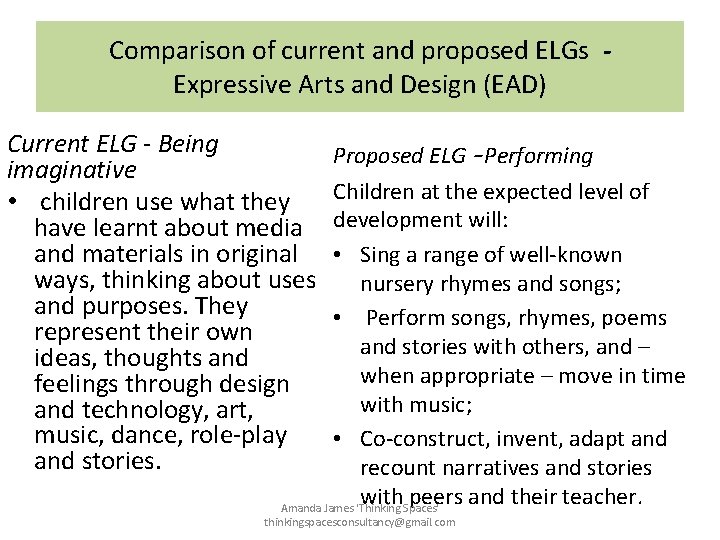
Comparison of current and proposed ELGs Expressive Arts and Design (EAD) Current ELG - Being imaginative • children use what they have learnt about media and materials in original ways, thinking about uses and purposes. They represent their own ideas, thoughts and feelings through design and technology, art, music, dance, role-play and stories. Proposed ELG – Performing Children at the expected level of development will: • Sing a range of well-known nursery rhymes and songs; • Perform songs, rhymes, poems and stories with others, and – when appropriate – move in time with music; • Co-construct, invent, adapt and recount narratives and stories with peers and their teacher. Amanda James 'Thinking Spaces' thinkingspacesconsultancy@gmail. com