
EYFS Autumn 1 people who help us Curriculum
- Slides: 5
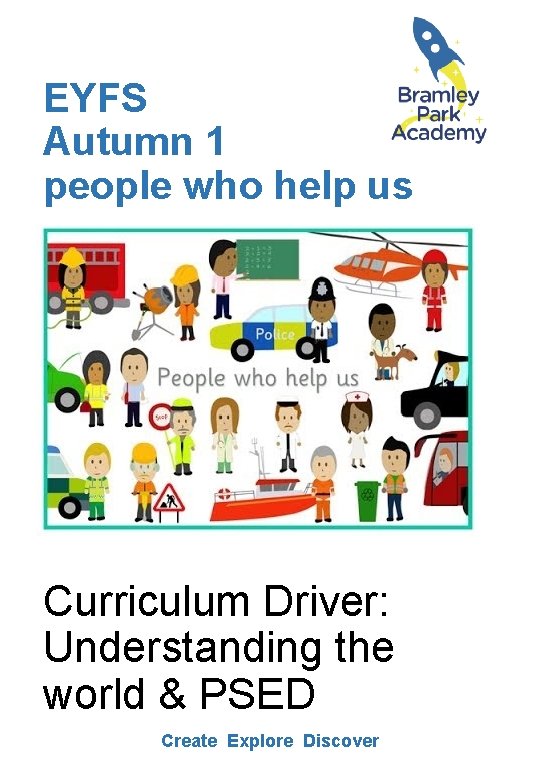
EYFS Autumn 1 people who help us Curriculum Driver: Understanding the world & PSED Create Explore Discover
EYFS Autumn 1 – People who help us Key Curriculum Driver: Understanding the world & PSED Other Curriculum Areas: PSED Rationale: People who help us will give children an in-depth insight into people who work in school and help us as well as people in the wider community and their jobs and how they can help us. People who help us will also provide many opportunities for engaging in role play activities and exploring different occupations and ways of life. By the end of this topic, most children will: Have an excellent knowledge and understanding of people in and around our school and what their roles are. • The ability to ask questions about peoples roles and responsibilities. • The ability to look closely at similarities and difference. • Maintain attention and listens for a short span. • Initiates conversations, attends to and takes account of what others say. • Confident to speak to others. Children’s knowledge will be shown by: Writing: Ascribing meanings to marks. Begin to break the flow of speech into words. Hears and says initial sounds in words. Writes own names and other things such as labels. Purposeful Outcome – Added by class teachers after completeing topic web. Create Explore Discover
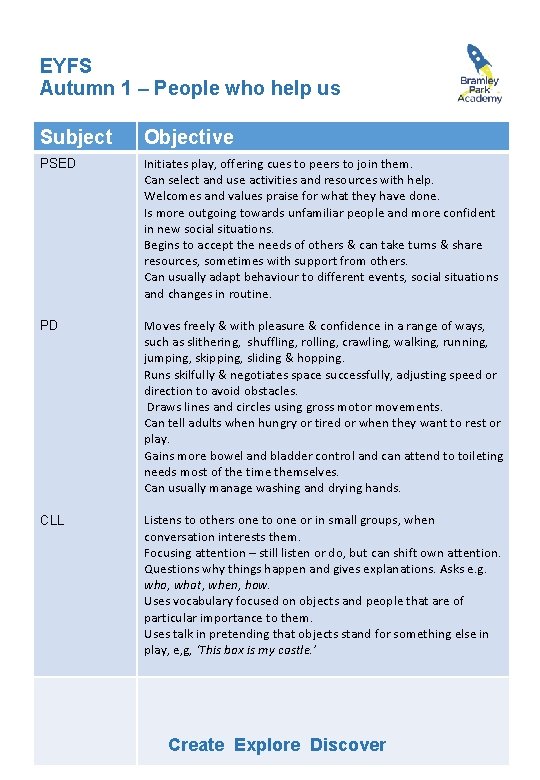
EYFS Autumn 1 – People who help us Subject Objective PSED Initiates play, offering cues to peers to join them. Can select and use activities and resources with help. Welcomes and values praise for what they have done. Is more outgoing towards unfamiliar people and more confident in new social situations. Begins to accept the needs of others & can take turns & share resources, sometimes with support from others. Can usually adapt behaviour to different events, social situations and changes in routine. PD Moves freely & with pleasure & confidence in a range of ways, such as slithering, shuffling, rolling, crawling, walking, running, jumping, skipping, sliding & hopping. Runs skilfully & negotiates space successfully, adjusting speed or direction to avoid obstacles. Draws lines and circles using gross motor movements. Can tell adults when hungry or tired or when they want to rest or play. Gains more bowel and bladder control and can attend to toileting needs most of the time themselves. Can usually manage washing and drying hands. CLL Listens to others one to one or in small groups, when conversation interests them. Focusing attention – still listen or do, but can shift own attention. Questions why things happen and gives explanations. Asks e. g. who, what, when, how. Uses vocabulary focused on objects and people that are of particular importance to them. Uses talk in pretending that objects stand for something else in play, e, g, ‘This box is my castle. ’ Create Explore Discover
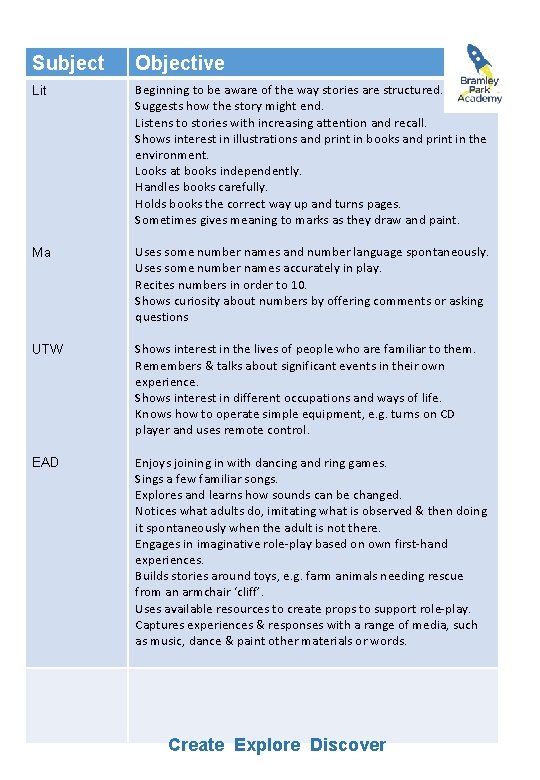
Subject Objective Lit Beginning to be aware of the way stories are structured. Suggests how the story might end. Listens to stories with increasing attention and recall. Shows interest in illustrations and print in books and print in the environment. Looks at books independently. Handles books carefully. Holds books the correct way up and turns pages. Sometimes gives meaning to marks as they draw and paint. Ma Uses some number names and number language spontaneously. Uses some number names accurately in play. Recites numbers in order to 10. Shows curiosity about numbers by offering comments or asking questions UTW Shows interest in the lives of people who are familiar to them. Remembers & talks about significant events in their own experience. Shows interest in different occupations and ways of life. Knows how to operate simple equipment, e. g. turns on CD player and uses remote control. EAD Enjoys joining in with dancing and ring games. Sings a few familiar songs. Explores and learns how sounds can be changed. Notices what adults do, imitating what is observed & then doing it spontaneously when the adult is not there. Engages in imaginative role-play based on own first-hand experiences. Builds stories around toys, e. g. farm animals needing rescue from an armchair ‘cliff’. Uses available resources to create props to support role-play. Captures experiences & responses with a range of media, such as music, dance & paint other materials or words. Create Explore Discover
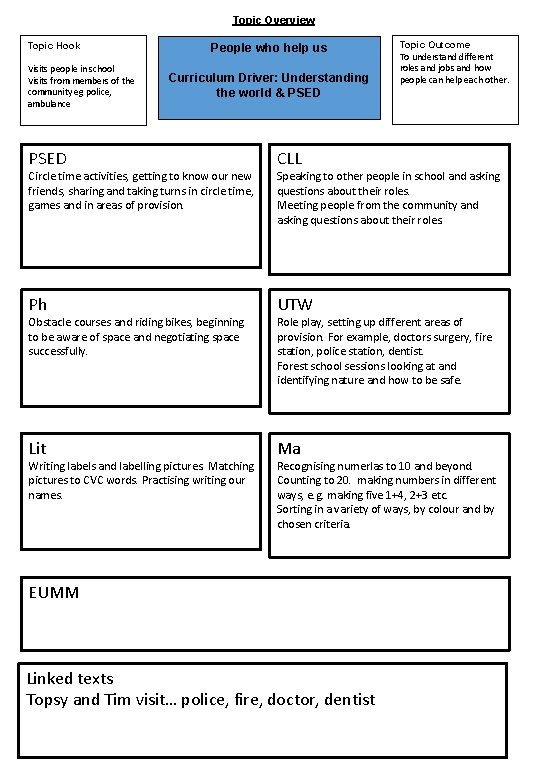
Topic Overview Topic Hook Visits people in school Visits from members of the community eg police, ambulance People who help us Curriculum Driver: Understanding the world & PSED CLL Ph UTW Lit Ma Circle time activities, getting to know our new friends, sharing and taking turns in circle time, games and in areas of provision. Obstacle courses and riding bikes, beginning to be aware of space and negotiating space successfully. Writing labels and labelling pictures. Matching pictures to CVC words. Practising writing our names. Topic Outcome To understand different roles and jobs and how people can help each other. Speaking to other people in school and asking questions about their roles. Meeting people from the community and asking questions about their roles. Role play, setting up different areas of provision. For example, doctors surgery, fire station, police station, dentist. Forest school sessions looking at and identifying nature and how to be safe. Recognising numerlas to 10 and beyond. Counting to 20. making numbers in different ways, e. g. making five 1+4, 2+3 etc. Sorting in a variety of ways, by colour and by chosen criteria. EUMM Linked texts Topsy and Tim visit… police, fire, doctor, dentist