
EYE STRUCTURE AND FUNCTION SUBJECT LIFE SCIENCES LEAD
EYE STRUCTURE AND FUNCTION SUBJECT : LIFE SCIENCES LEAD TEACHER : SOTSAKA. M DISTRICT : O. R TAMBO INLAND
Examination guidelines
LESSON OBJECTIVES • Study the structure and functions of different parts of the human eye. • Explain the structural adaptations for the various parts to perform their functions. • Explain Binocular vision and stereoscopic vision.

Terminology and definitions • Refraction: bending of light when light passes through a lens. • Photoreceptors: receptors in the eye that convert light stimuli into nerve impulses. - Photoreceptors are located on the retina of the eye and are called rod and cone cells. • Binocular vision: the process of looking at an object with both eyes, creating a single visual image. - Stereoscopic vision: the ability to see the depth and solidity of objects and create a three dimensional presentation of the object.
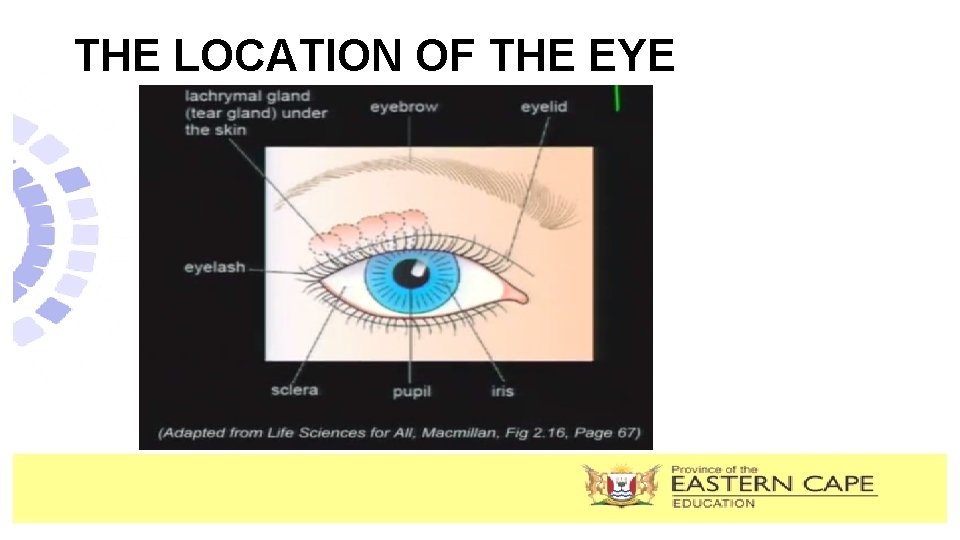
THE LOCATION OF THE EYE
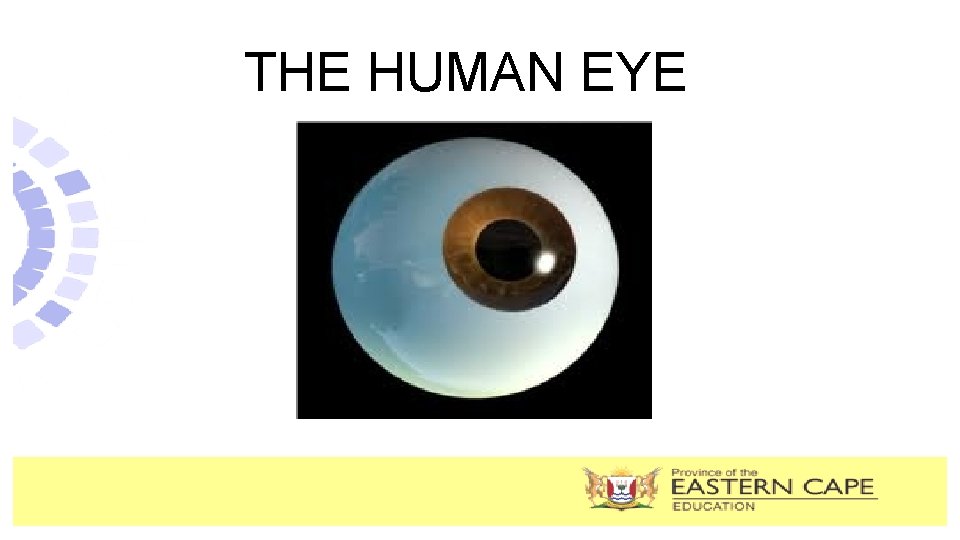
THE HUMAN EYE
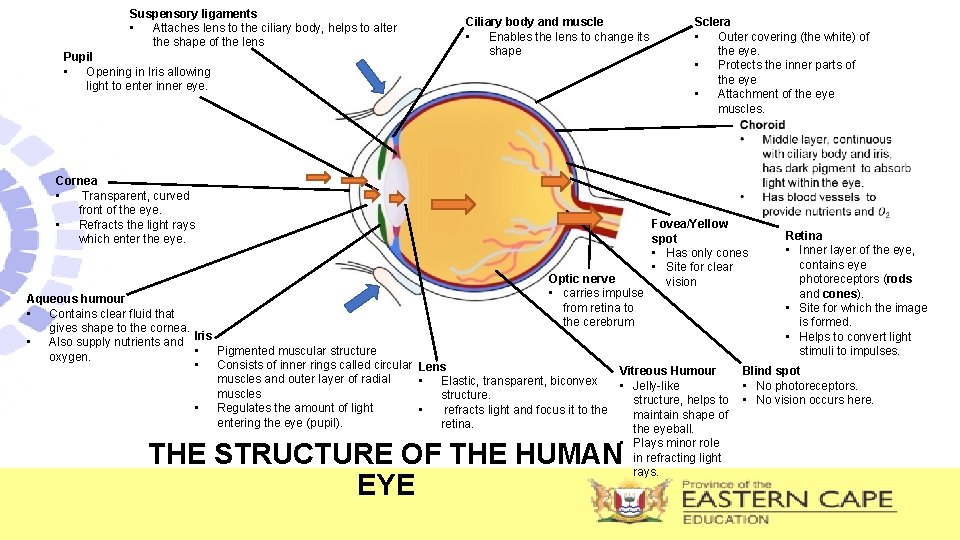
Suspensory ligaments • Attaches lens to the ciliary body, helps to alter the shape of the lens Pupil • Opening in Iris allowing light to enter inner eye. Ciliary body and muscle • Enables the lens to change its shape Cornea • Transparent, curved front of the eye. • Refracts the light rays which enter the eye. Optic nerve • carries impulse from retina to the cerebrum Aqueous humour • Contains clear fluid that gives shape to the cornea. Iris • Also supply nutrients and • Pigmented muscular structure oxygen. • Consists of inner rings called circular Lens muscles and outer layer of radial • Elastic, transparent, biconvex muscles structure. • Regulates the amount of light • refracts light and focus it to the entering the eye (pupil). retina. Sclera • Outer covering (the white) of the eye. • Protects the inner parts of the eye • Attachment of the eye muscles. Fovea/Yellow spot • Has only cones • Site for clear vision Vitreous Humour • Jelly-like structure, helps to maintain shape of the eyeball. • Plays minor role in refracting light rays. THE STRUCTURE OF THE HUMAN EYE Retina • Inner layer of the eye, contains eye photoreceptors (rods and cones). • Site for which the image is formed. • Helps to convert light stimuli to impulses. Blind spot • No photoreceptors. • No vision occurs here.

Process of seeing an object Light reflects on object pupil optic nerve lens conjunctiva vitreous humour cerebral cortex Cornea retina Aqueous humour rods cones

BINOCULAR VISION • Binocular vision is vison in which both eyes are used together • Our eyes are placed some distance apart, creating the ability to observe two separate images. Since each eye forms an image, the two images are combined to form a three dimensional (stereoscopic) presentation of the object. • One of the advantages of binocular vision is that it gives a wider field of view and helps the person to estimate the size, distance and depth (stereoscopic) of the object.
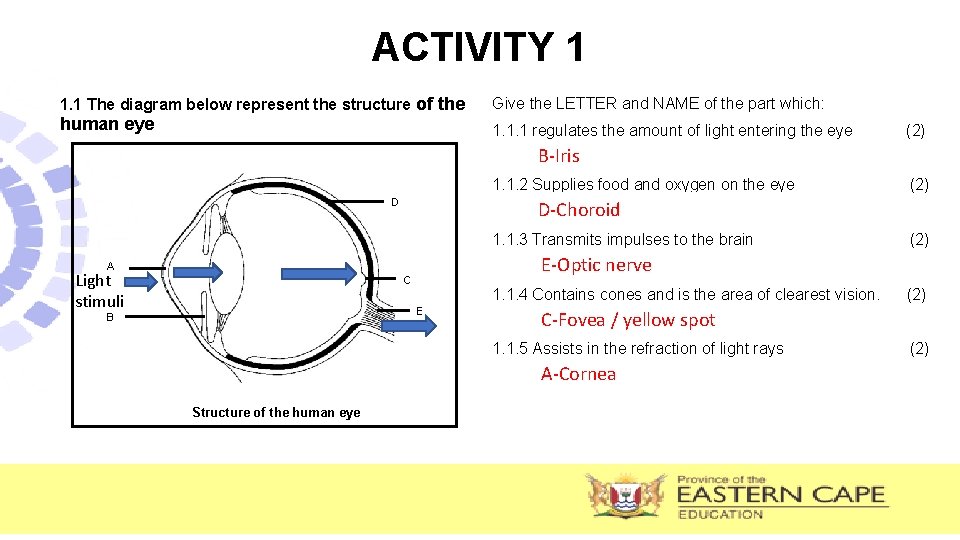
ACTIVITY 1 1. 1 The diagram below represent the structure of the human eye Give the LETTER and NAME of the part which: 1. 1. 1 regulates the amount of light entering the eye (2) B-Iris 1. 1. 2 Supplies food and oxygen on the eye D D-Choroid 1. 1. 3 Transmits impulses to the brain C 1. 1. 4 Contains cones and is the area of clearest vision. E B (2) C-Fovea / yellow spot 1. 1. 5 Assists in the refraction of light rays A-Cornea Structure of the human eye (2) E-Optic nerve A Light stimuli (2)
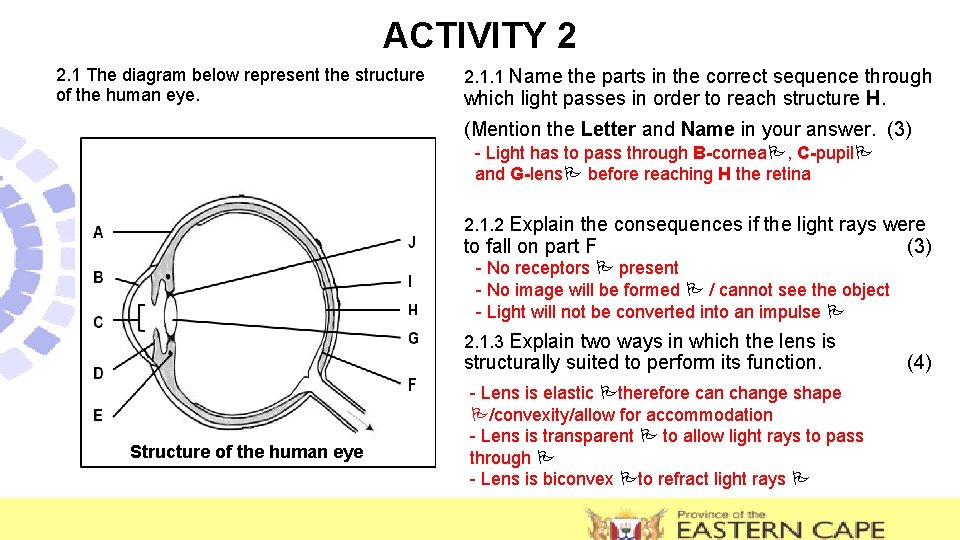
ACTIVITY 2 2. 1 The diagram below represent the structure of the human eye. 2. 1. 1 Name the parts in the correct sequence through which light passes in order to reach structure H. (Mention the Letter and Name in your answer. (3) - Light has to pass through B-cornea , C-pupil and G-lens before reaching H the retina 2. 1. 2 Explain the consequences if the light rays were to fall on part F (3) - No receptors present - No image will be formed / cannot see the object - Light will not be converted into an impulse 2. 1. 3 Explain two ways in which the lens is structurally suited to perform its function. Structure of the human eye - Lens is elastic therefore can change shape /convexity/allow for accommodation - Lens is transparent to allow light rays to pass through - Lens is biconvex to refract light rays (4)
- Slides: 11