
Eye Relaxed Determine the focal length of your


- Slides: 24
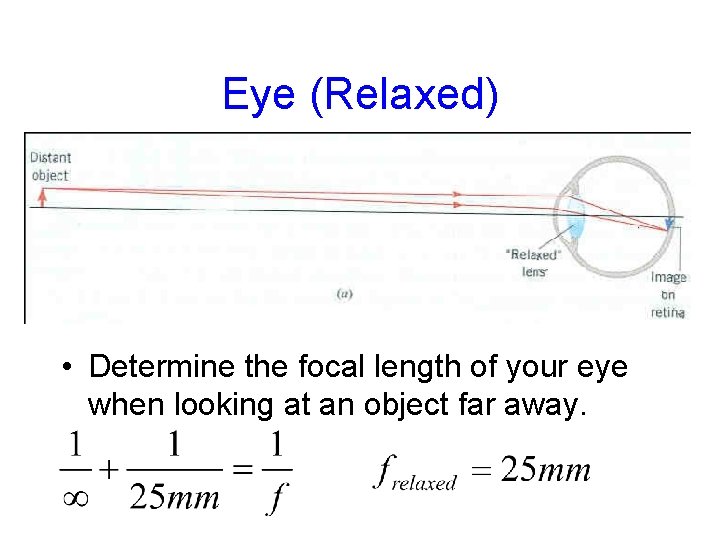
Eye (Relaxed) • Determine the focal length of your eye when looking at an object far away.
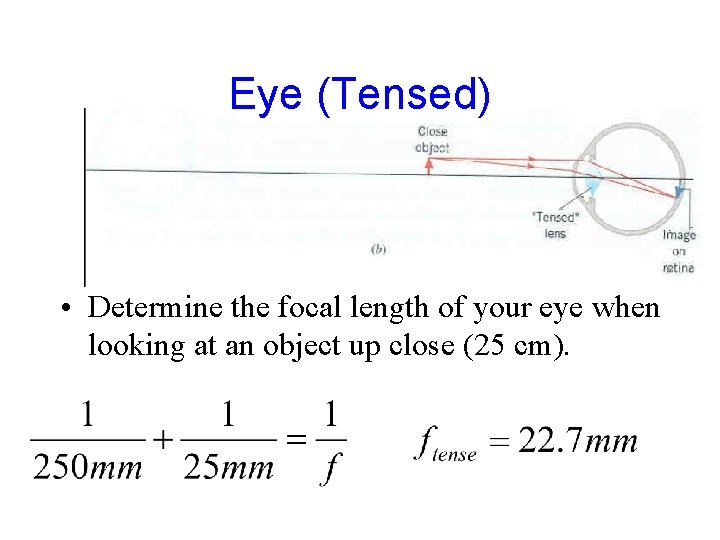
Eye (Tensed) • Determine the focal length of your eye when looking at an object up close (25 cm).
The Eye – Near and Far Points • The near point is the closest distance for which the lens can accommodate to focus light on the retina – Typically at age 10, this is about 18 cm – It increases with age, ~ 25 cm for an adult • The far point of the eye represents the largest distance for which the lens of the relaxed eye can focus light on the retina – Normal vision has a far point of infinity
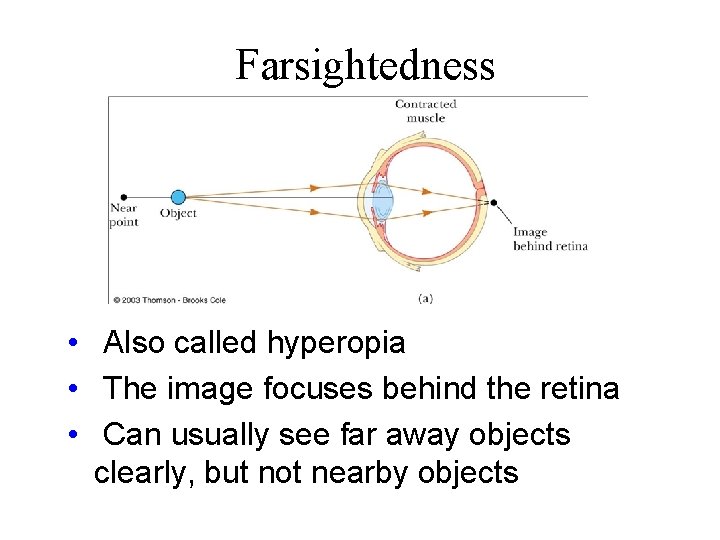
Farsightedness • Also called hyperopia • The image focuses behind the retina • Can usually see far away objects clearly, but not nearby objects
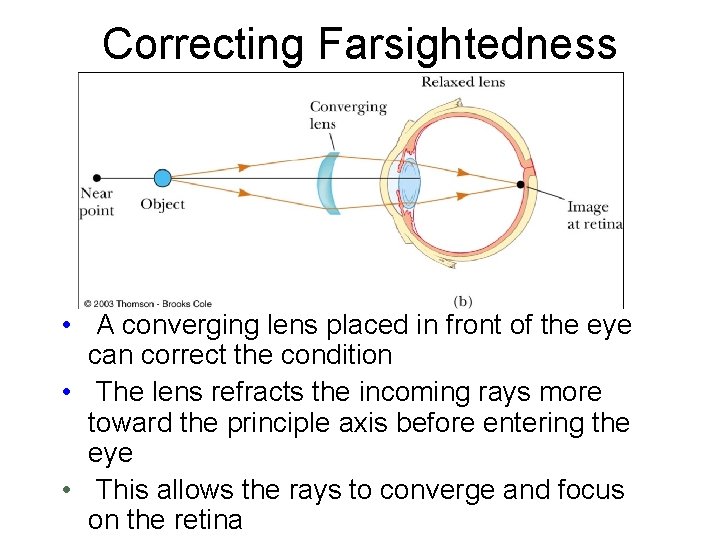
Correcting Farsightedness • A converging lens placed in front of the eye can correct the condition • The lens refracts the incoming rays more toward the principle axis before entering the eye • This allows the rays to converge and focus on the retina
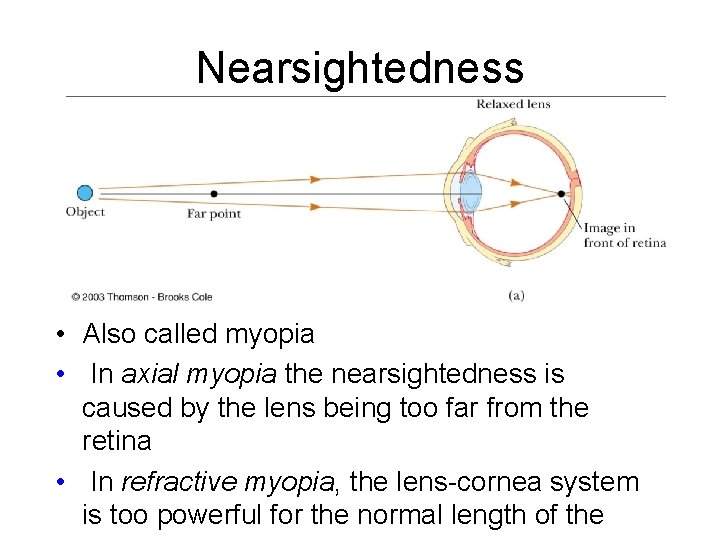
Nearsightedness • Also called myopia • In axial myopia the nearsightedness is caused by the lens being too far from the retina • In refractive myopia, the lens-cornea system is too powerful for the normal length of the
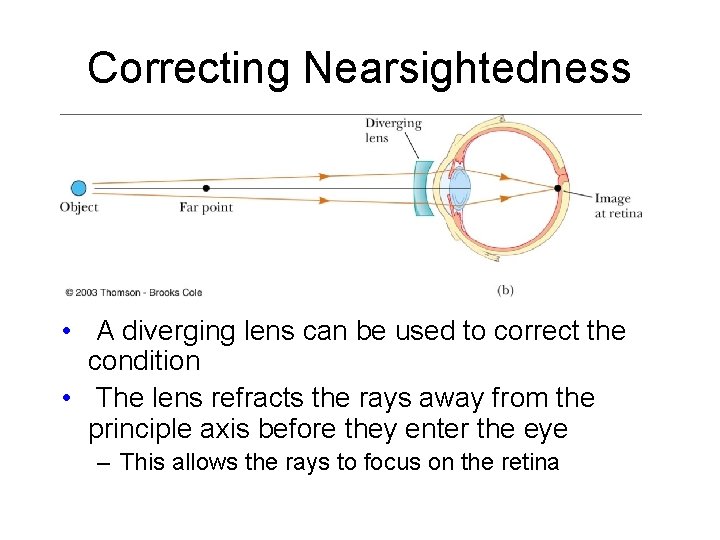
Correcting Nearsightedness • A diverging lens can be used to correct the condition • The lens refracts the rays away from the principle axis before they enter the eye – This allows the rays to focus on the retina
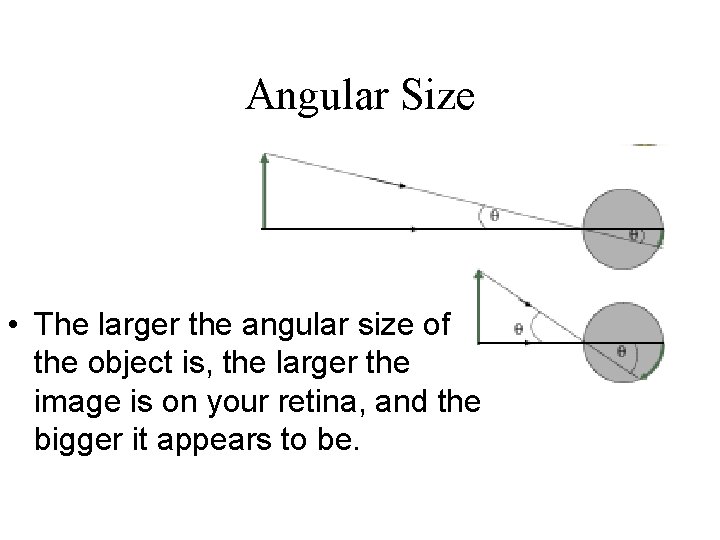
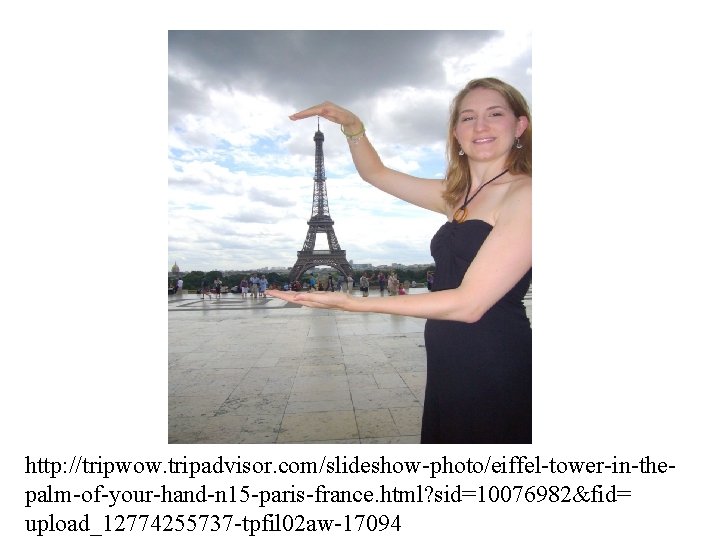
Angular Size • The larger the angular size of the object is, the larger the image is on your retina, and the bigger it appears to be.
http: //tripwow. tripadvisor. com/slideshow-photo/eiffel-tower-in-thepalm-of-your-hand-n 15 -paris-france. html? sid=10076982&fid= upload_12774255737 -tpfil 02 aw-17094
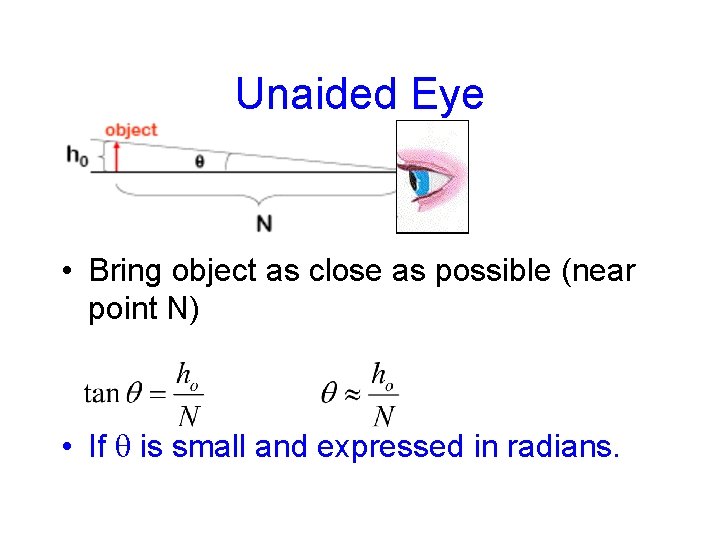
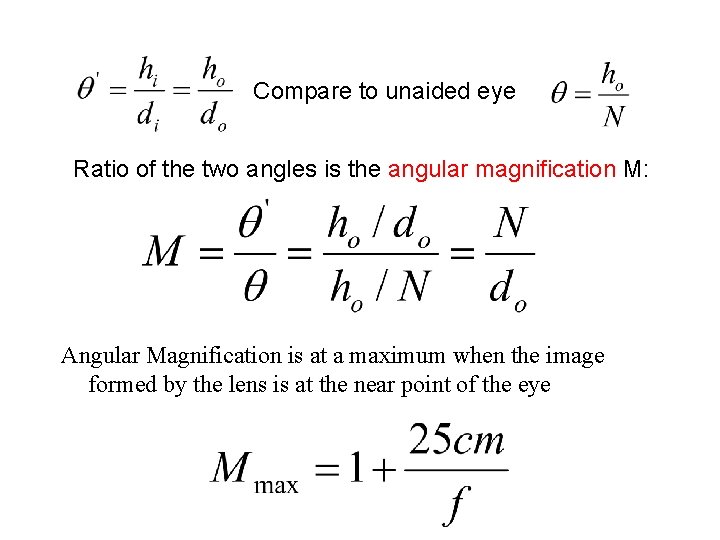
Unaided Eye • Bring object as close as possible (near point N) • If q is small and expressed in radians.
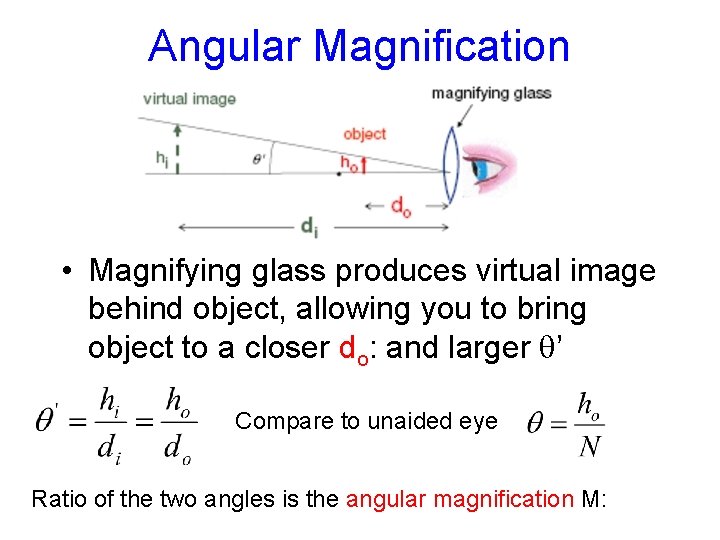
Angular Magnification • Magnifying glass produces virtual image behind object, allowing you to bring object to a closer do: and larger q’ Compare to unaided eye Ratio of the two angles is the angular magnification M:
Compare to unaided eye Ratio of the two angles is the angular magnification M: Angular Magnification is at a maximum when the image formed by the lens is at the near point of the eye
Compound Microscope • A compound microscope consists of two lenses – Gives greater magnification than a single lens – The objective lens has a short focal length, ƒo<1 cm – The ocular lens (eyepiece) has a focal length, ƒe of a few cm
Compound Microscope, cont • The lens are separated by a distance L • L is much greater than either focal length • The approach to analysis is the same as for any two lenses in a row • The image formed by the first lens becomes the object for the second lens • The image seen by the eye, I 2, is virtual, inverted and very much enlarged
Other Considerations with a Microscope • The ability of an optical microscope to view an object depends on the size of the object relative to the wavelength of the light used to observe it – For example, you could not observe an atom (d » 0. 1 nm) with visible light (l» 500 nm)
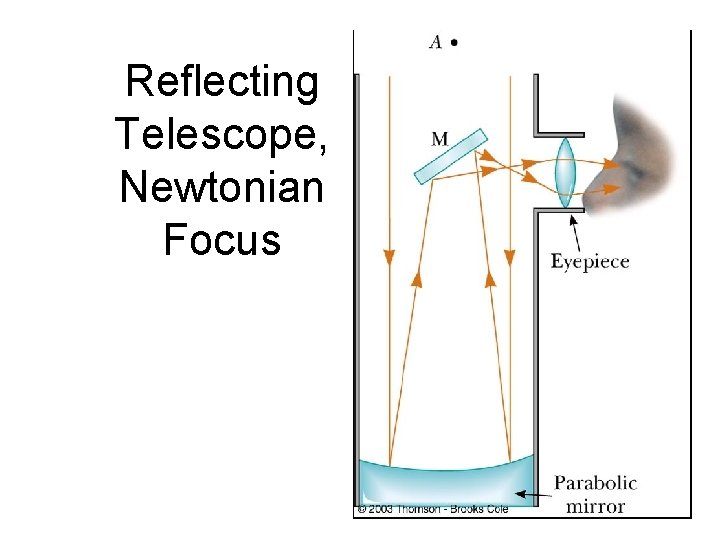
Telescopes • Two fundamental types of telescopes – Refracting telescope uses a combination of lens to form an image – Reflecting telescope uses a curved mirror and a lens to form an image • Telescopes can be analyzed by considering them to be two optical elements in a row • The image of the first element becomes the object of the second element
Refracting Telescope • The two lenses are arranged so that the objective forms a real, inverted image of a distant object • The image is near the focal point of the eyepiece • The two lenses are separated by the distance ƒo + ƒe which corresponds to the length of the tube • The eyepiece forms an enlarged, inverted image of the first image
Disadvantages of Refracting Telescopes • Large diameters are needed to study distant objects • Large lenses are difficult and expensive to manufacture • The weight of large lenses leads to sagging which produces aberrations
Reflecting Telescope, Newtonian Focus
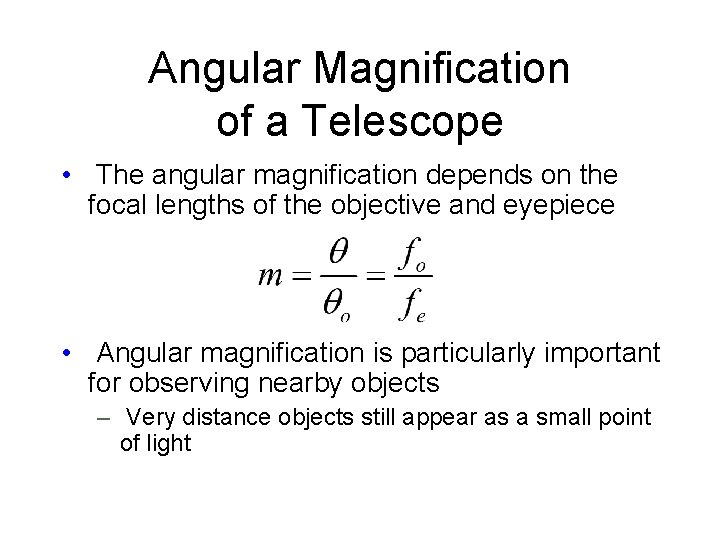
Angular Magnification of a Telescope • The angular magnification depends on the focal lengths of the objective and eyepiece • Angular magnification is particularly important for observing nearby objects – Very distance objects still appear as a small point of light
Aberrations • Read page 752.