
Eye movements during visual scanning tasks in Homonymous
- Slides: 1
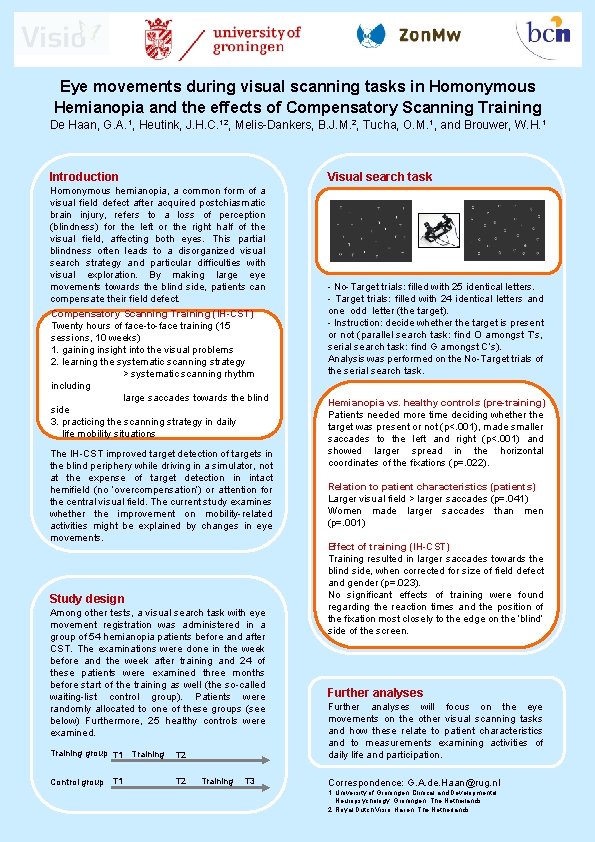
Eye movements during visual scanning tasks in Homonymous Hemianopia and the effects of Compensatory Scanning Training De Haan, G. A. 1, Heutink, J. H. C. 12, Melis-Dankers, B. J. M. 2, Tucha, O. M. 1, and Brouwer, W. H. 1 Introduction Visual search task Homonymous hemianopia, a common form of a visual field defect after acquired postchiasmatic brain injury, refers to a loss of perception (blindness) for the left or the right half of the visual field, affecting both eyes. This partial blindness often leads to a disorganized visual search strategy and particular difficulties with visual exploration. By making large eye movements towards the blind side, patients can compensate their field defect. Compensatory Scanning Training (IH-CST) Twenty hours of face-to-face training (15 sessions, 10 weeks) 1. gaining insight into the visual problems 2. learning the systematic scanning strategy > systematic scanning rhythm including large saccades towards the blind side 3. practicing the scanning strategy in daily life mobility situations The IH-CST improved target detection of targets in the blind periphery while driving in a simulator, not at the expense of target detection in intact hemifield (no ‘overcompensation’) or attention for the central visual field. The current study examines whether the improvement on mobility-related activities might be explained by changes in eye movements. Study design Among other tests, a visual search task with eye movement registration was administered in a group of 54 hemianopia patients before and after CST. The examinations were done in the week before and the week after training and 24 of these patients were examined three months before start of the training as well (the so-called waiting-list control group). Patients were randomly allocated to one of these groups (see below) Furthermore, 25 healthy controls were examined. Training group T 1 Training T 2 Control group T 1 T 2 Training T 3 - No-Target trials: filled with 25 identical letters. - Target trials: filled with 24 identical letters and one odd letter (the target). - Instruction: decide whether the target is present or not (parallel search task: find O amongst T’s, serial search task: find G amongst C’s). Analysis was performed on the No-Target trials of the serial search task. Hemianopia vs. healthy controls (pre-training) Patients needed more time deciding whether the target was present or not (p<. 001), made smaller saccades to the left and right (p<. 001) and showed larger spread in the horizontal coordinates of the fixations (p=. 022). Relation to patient characteristics (patients) Larger visual field > larger saccades (p=. 041) Women made larger saccades than men (p=. 001) Effect of training (IH-CST) Training resulted in larger saccades towards the blind side, when corrected for size of field defect and gender (p=. 023). No significant effects of training were found regarding the reaction times and the position of the fixation most closely to the edge on the ‘blind’ side of the screen. Further analyses will focus on the eye movements on the other visual scanning tasks and how these relate to patient characteristics and to measurements examining activities of daily life and participation. Correspondence: G. A. de. Haan@rug. nl 1. University of Groningen, Clinical and Developmental Neuropsychology, Groningen, The Netherlands 2. Royal Dutch Visio, Haren, The Netherlands