
Eye CHAPTER 12 Combining Forms for the Eye
Eye CHAPTER 12
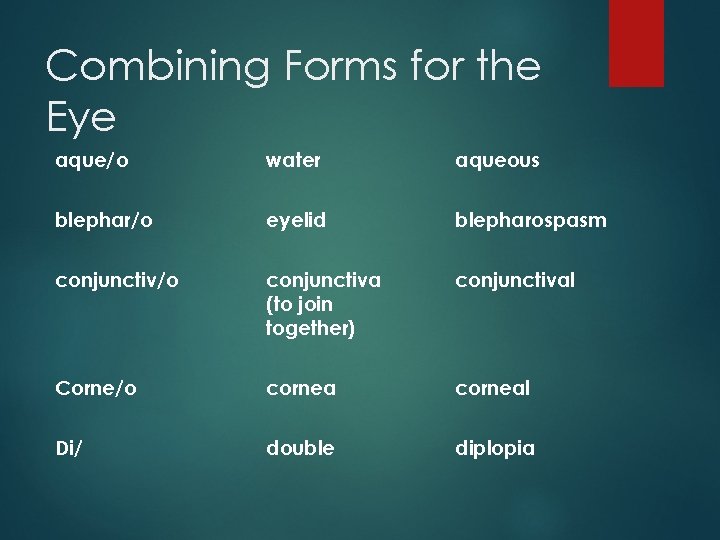
Combining Forms for the Eye aque/o water aqueous blephar/o eyelid blepharospasm conjunctiv/o conjunctiva (to join together) conjunctival Corne/o corneal Di/ double diplopia
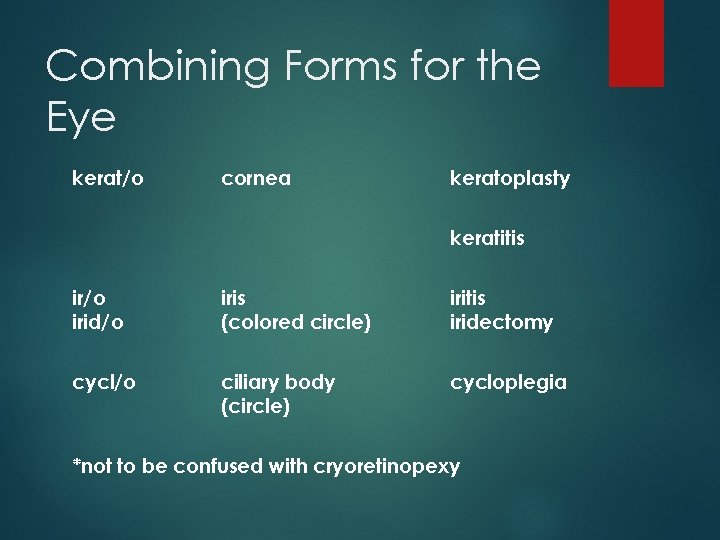
Combining Forms for the Eye kerat/o cornea keratoplasty keratitis ir/o irid/o iris (colored circle) iritis iridectomy cycl/o ciliary body (circle) cycloplegia *not to be confused with cryoretinopexy
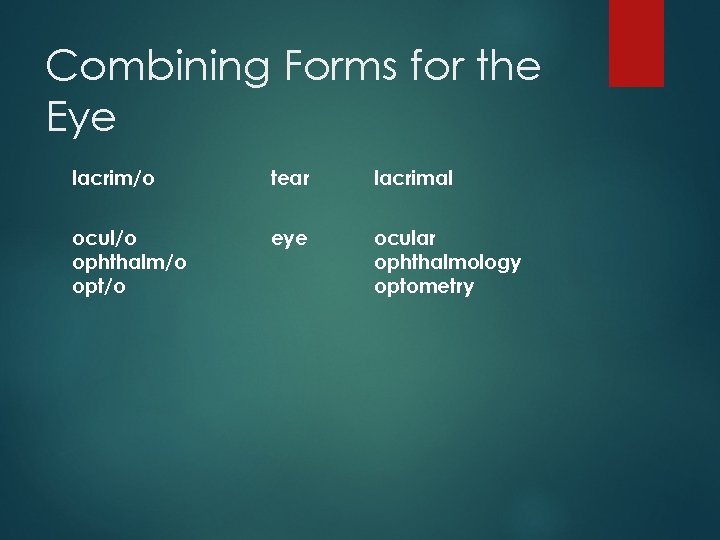
Combining Forms for the Eye lacrim/o tear lacrimal ocul/o ophthalm/o opt/o eye ocular ophthalmology optometry
Combining Forms for the Eye presby/o old age presbyopia Presbyopia = loss of accommodation, the inability of the eye to focus on near objects
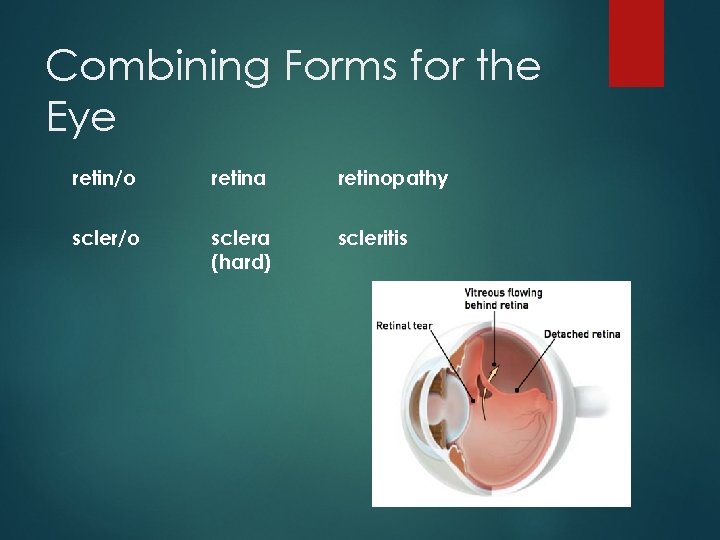
Combining Forms for the Eye retin/o retina retinopathy scler/o sclera (hard) scleritis
Eye Overview Sclera & Cornea make up the outer part of eye that help to refract light. Muscles of the iris, known as the pupil, regulate the amount of light Ciliary body are muscles behind the pupil that control the focusing ability of the lens This coordination projects a picture on the retina or layer of nerves made of rods and cones. The optic disk in the retina transmits the image to the brain.

Eye Overview cont’d Conjunctiva are mucous membranes lining the eyelids Covered by the eyelid (blepharo) Blepharoptosis = paralysis of eyelids Blepharoplasty = surgical repair of eyelids Blepharospasm = involuntary closing of eyelids Aqueous humor watery liquid secreted by the ciliary body to nourish the cornea, iris, and lens.

Parts of the Eye Retina Color sensitive type cells Dim light receptor cells Lens Iris Contracts and dilates; adjusts to brightness Conjunctiva Common condition affecting lens health Common childhood disease Optic Nerve Common condition affecting nerve health
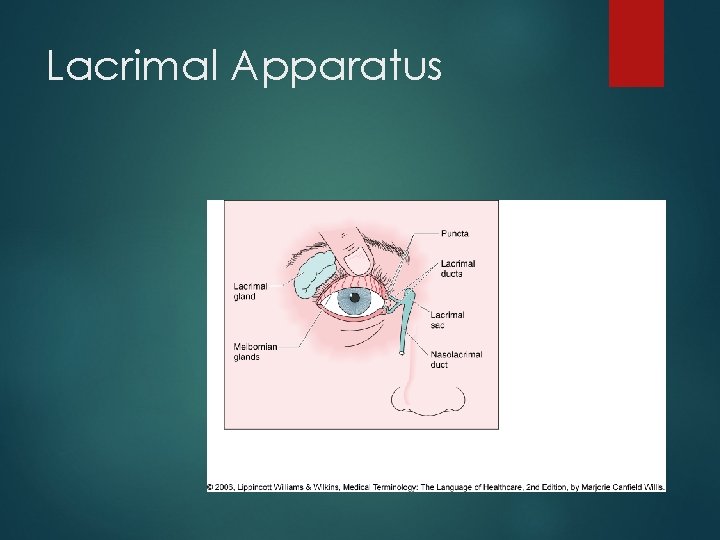
Lacrimal Apparatus

Hyperopia and Myopia Farsighted “cant see up-close” Nearsighted “cant see far away”
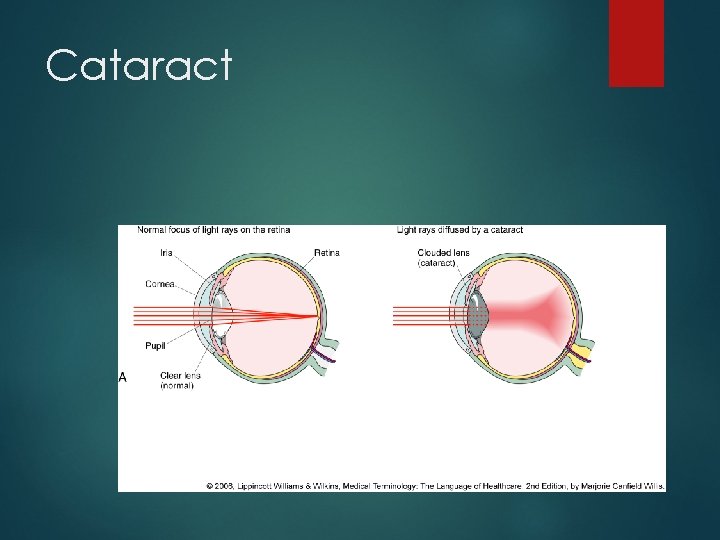
Cataract
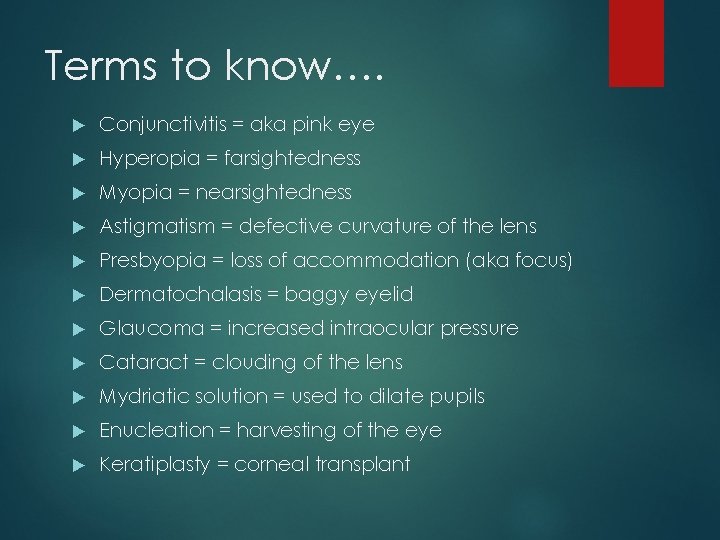
Terms to know…. Conjunctivitis = aka pink eye Hyperopia = farsightedness Myopia = nearsightedness Astigmatism = defective curvature of the lens Presbyopia = loss of accommodation (aka focus) Dermatochalasis = baggy eyelid Glaucoma = increased intraocular pressure Cataract = clouding of the lens Mydriatic solution = used to dilate pupils Enucleation = harvesting of the eye Keratiplasty = corneal transplant
Ear CHAPTER 13
Combining Forms for the Ear acous/o audi/o hearing acoustic audiometry aer/o air/gas aerotitis aur/i ot/o ear auricle otology *Otitis = inflammation of the ear, also distinguished by the outer, middle, or inner ear.
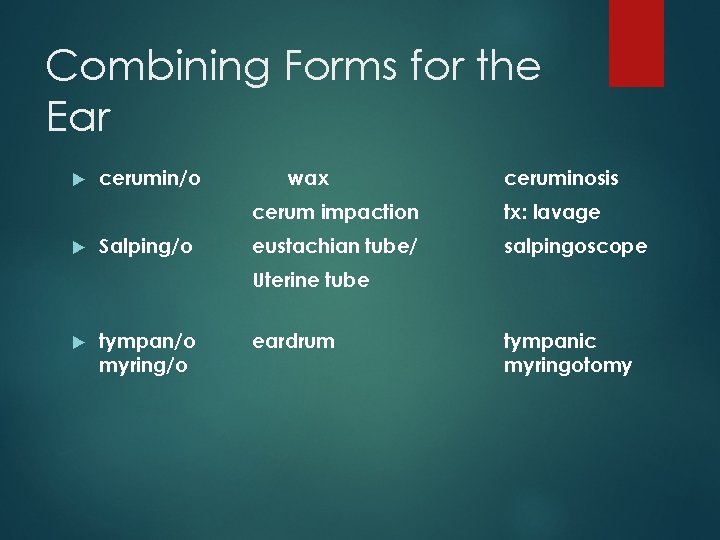
Combining Forms for the Ear cerumin/o Salping/o wax ceruminosis cerum impaction tx: lavage eustachian tube/ salpingoscope Uterine tube tympan/o myring/o eardrum tympanic myringotomy
Ear Overview Sense of hearing Three divisions: outer ear middle ear inner ear
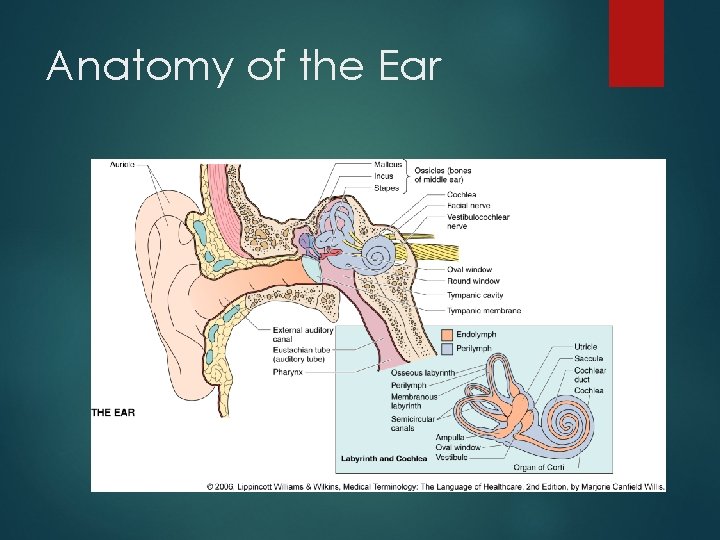
Anatomy of the Ear
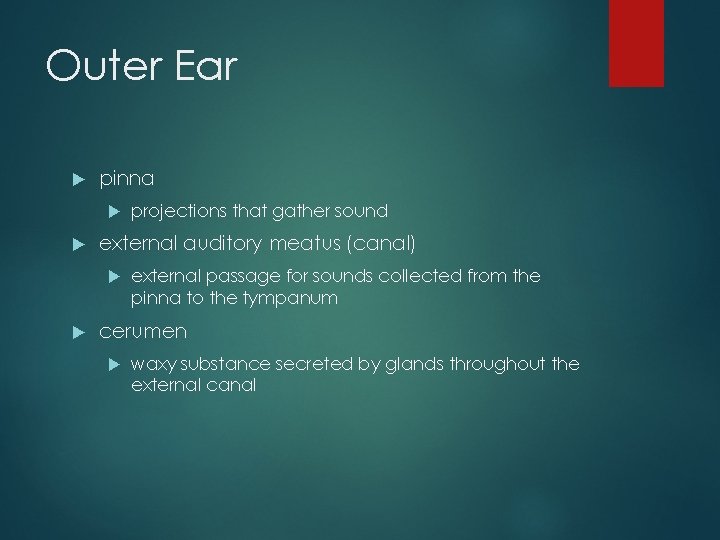
Outer Ear pinna external auditory meatus (canal) projections that gather sound external passage for sounds collected from the pinna to the tympanum cerumen waxy substance secreted by glands throughout the external canal
Middle Ear eustachian tube (auditory tube) provides a passageway to the throat allowing air to pass to and from outside the body important to maintaining equal air pressure tympanic membrane (TM) eardrum — receives sound collected in the external auditory canal and amplifies it through the middle ear to the malleus (hammer), incus (anvil), and stapes (stirrup) Otitismedia
Middle Ear mastoid process (continued) temporal bone projection behind the ear containing air cells that connect to the middle ear oval window membrane that covers the opening between the middle ear and inner ear
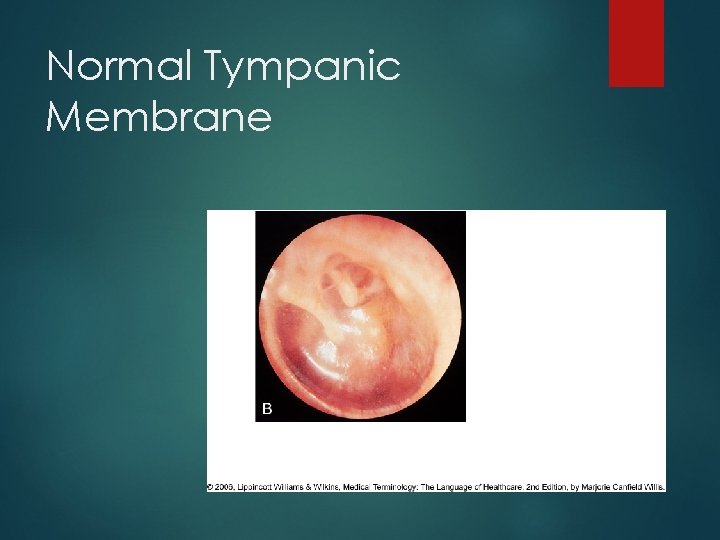
Normal Tympanic Membrane
Inner Ear Receives sound vibrations passed from the oval window to the cochlea perilymph coiled tubular structure that contains the organ of Corti fluid that fills the bony labyrinth of the ear endolymph fluid within the cochlear duct of the inner ear
Inner Ear organ of Corti (continued) contains receptors that receive vibrations and generate nerve impulses for hearing vestibule middle part of the inner ear that contain the utricle and the saccule
Inner Ear utricle larger of two sacs within the vestibule in the inner ear saccule (continued) smaller of the two sacs within the vestibule semicircular canals three canals within the inner ear that contain specialized receptors that generate nerve impulses with body movement
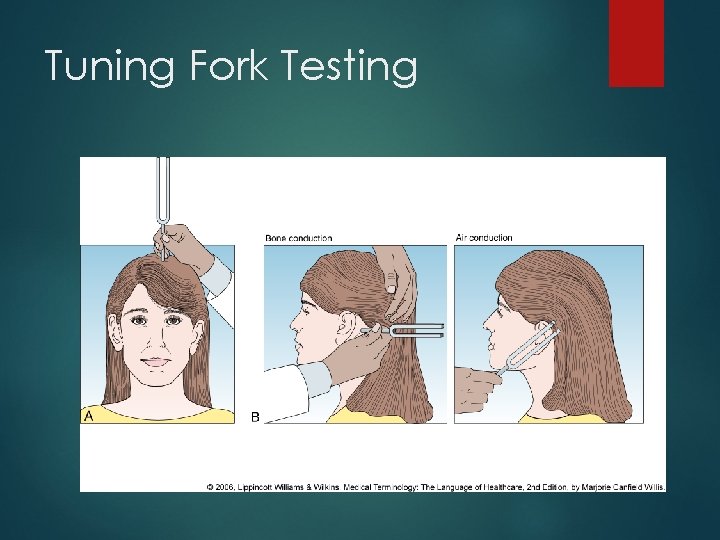
Tuning Fork Testing
Terms to know… Otalgia - earache Otorrhagia - bleeding from the ear Tinnitus – ringing or buzzing in the ear Vertigo - dizziness Myringitis – inflammation of the eardrum Mastoiditis – inflammation of mucosal lining behind the ear Myringotomy – surgical incision of the eardrum to relieve pressure and place a tube to prevent reaccumulation of fluid
Terms to know continued… Deafness Conductive hearing loss – blockage in the middle or outer ear. Sensorineural hearing loss – damage to the hair in the cochlea or auditory nerve damage Mixed hearing loss – conductive and sensorineural hearing loss Presbyacusis – age related hearing loss
- Slides: 28