
EY Working Scientifically 1 Tutor Sally Spicer S








- Slides: 40
EY Working Scientifically 1 Tutor: Sally Spicer S. L. Spicer@warwick. ac. uk
Research • • • Archer L. Osborne, J. Dewitt, J. , Dillon, J. , Wong, B. and Willis, B. (2013) ASPIRES Young people and career aspirations 10 -14. London: King’s College London Maule L. and Featonby D. (2016) Fifty Shades of Muddy Green Issue 35 : Science in School http: //www. scienceinschool. org/content/fifty-shadesmuddy-green Ofsted (2015) Improving science with the Lab 13 project: Irchester Community Primary
Teachers’ Standards TS 1 – 8 all apply to teaching science, a core subject • TS 1 High expectations that inspire, motivate and challenge pupils • TS 3 Good subject knowledge and curriculum knowledge • TS 4 Plan and teach well-structured lessons • TS 5 Adapt teaching to respond to strengths and needs of all pupils
Session Overview • Important Aspects of EY /Primary Science • Working scientifically: types of enquiry • National Curriculum -The Importance of Practical Scientific Enquiry • Observations and raising questions • Guess, prediction or hypothesis?
Primary NC Science 2014 KS 1 & 2 Purpose of study …all pupils should be taught essential aspects of the knowledge, methods, processes and uses of science … should be encouraged to understand how science can be used to explain what is occurring, predict how things will behave, and analyse causes
Important Aspects of EY/Primary Science 1) Enquiry Skills (NC working scientifically) • Use methods /strategies of scientists to find answers 2) Conceptual Knowledge and Understanding • Learn about important ‘big’ science ideas • Understand the world around them • Develop learning skills they will need throughout life. . . 3) Developing Social Skills and Positive Attitudes • Develop positive attitudes: Curiosity, awe and wonder, co-operation …
“We all have a responsibility to avoid stereotyping scientists as people in white coats!” Brian Cartwright (national lead for science with Ofsted) at NSLC, 21. 13
Science without practical is like swimming without water (SCORE 2009) Explore Report Question Discuss http: //www. score- education. org/media/3674/primary. pdf
Working Scientifically: Skittles! Explore Skittles - arrange 3 – 5 Skittles on a paper plate or in a petri dish placed on white paper • Predict: what will happen when you add water? • Observe -what happens? • Discuss – can you explain what you observe? How many different questions can you come up with? What if? …. When would …? How might … ? Why is. . ? Where could…? • Report findings/explanations; what could you explore next What basic skills might be developing? Misconceptions? SEND •
Aspects of science practical work Basic Skills: choosing and using ‘scientific’ equipment (eg measuring temperature, using hand lens, measuring distance or time taken) Observations: Using 5 senses, using aids, classifying (eg grouping, sorting, pattern seeking) Illustrations: Focussed activity to demonstrate a particular science idea Investigations: Learning methods & strategies for finding out science ideas
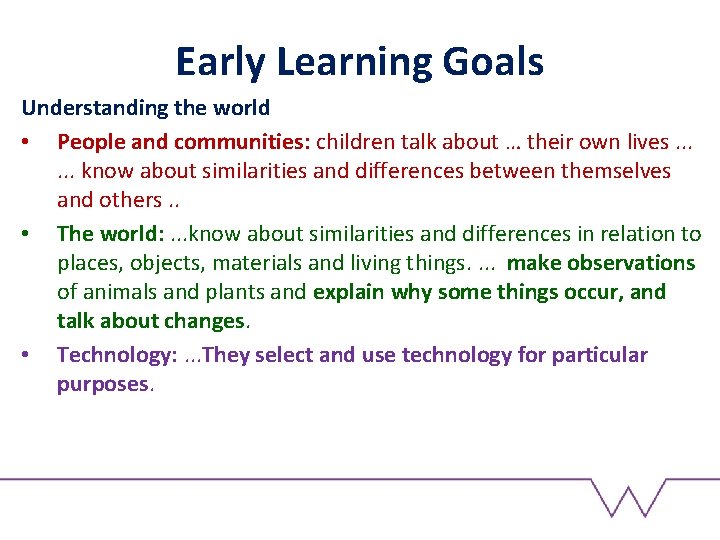
Early Learning Goals Understanding the world • People and communities: children talk about … their own lives. . . know about similarities and differences between themselves and others. . • The world: . . . know about similarities and differences in relation to places, objects, materials and living things. . make observations of animals and plants and explain why some things occur, and talk about changes. • Technology: . . . They select and use technology for particular purposes.
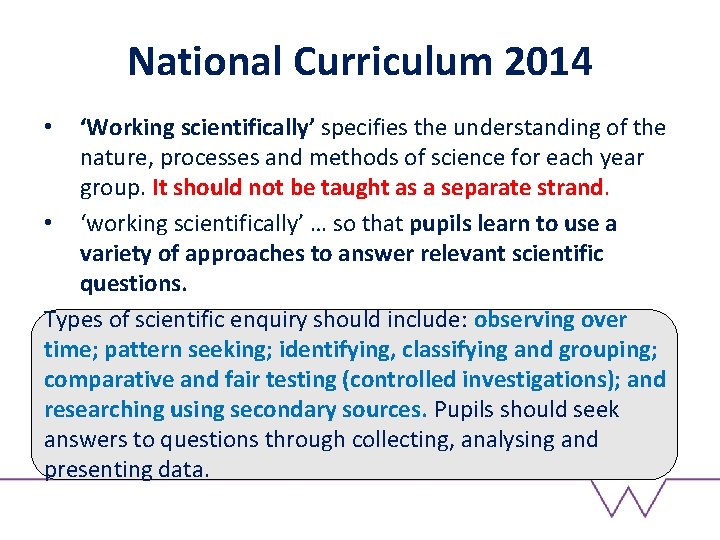
National Curriculum 2014 ‘Working scientifically’ specifies the understanding of the nature, processes and methods of science for each year group. It should not be taught as a separate strand. • ‘working scientifically’ … so that pupils learn to use a variety of approaches to answer relevant scientific questions. Types of scientific enquiry should include: observing over time; pattern seeking; identifying, classifying and grouping; comparative and fair testing (controlled investigations); and researching using secondary sources. Pupils should seek answers to questions through collecting, analysing and presenting data. •
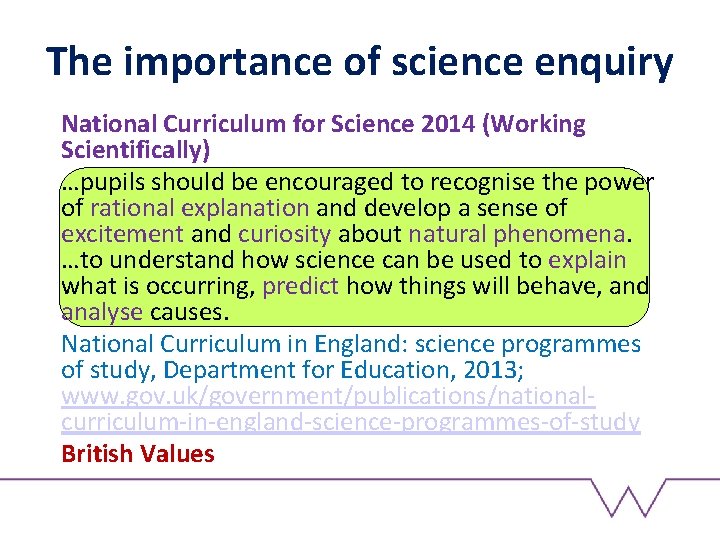
The importance of science enquiry National Curriculum for Science 2014 (Working Scientifically) …pupils should be encouraged to recognise the power of rational explanation and develop a sense of excitement and curiosity about natural phenomena. …to understand how science can be used to explain what is occurring, predict how things will behave, and analyse causes. National Curriculum in England: science programmes of study, Department for Education, 2013; www. gov. uk/government/publications/nationalcurriculum-in-england-science-programmes-of-study British Values
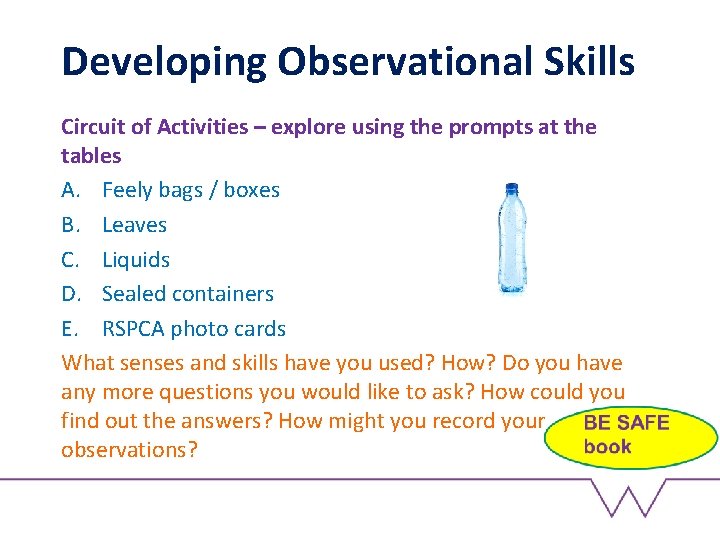
Developing Observational Skills Circuit of Activities – explore using the prompts at the tables A. Feely bags / boxes B. Leaves C. Liquids D. Sealed containers E. RSPCA photo cards What senses and skills have you used? How? Do you have any more questions you would like to ask? How could you find out the answers? How might you record your observations?
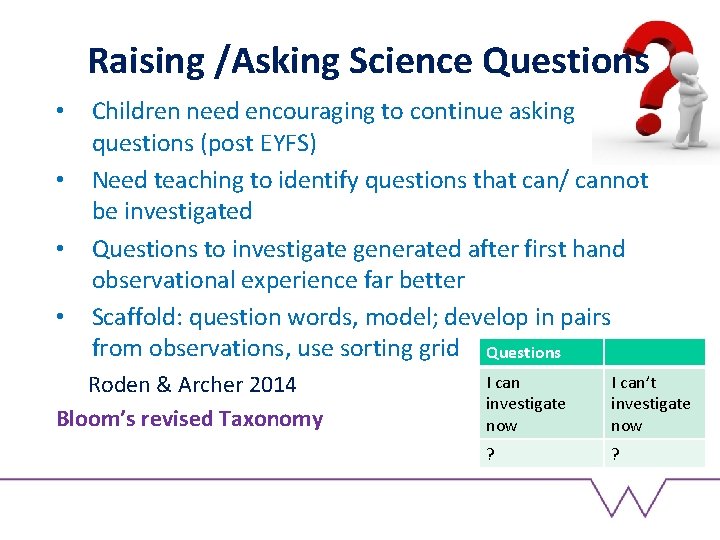
Raising /Asking Science Questions • • Children need encouraging to continue asking questions (post EYFS) Need teaching to identify questions that can/ cannot be investigated Questions to investigate generated after first hand observational experience far better Scaffold: question words, model; develop in pairs from observations, use sorting grid Questions Roden & Archer 2014 Bloom’s revised Taxonomy I can investigate now I can’t investigate now ? ?
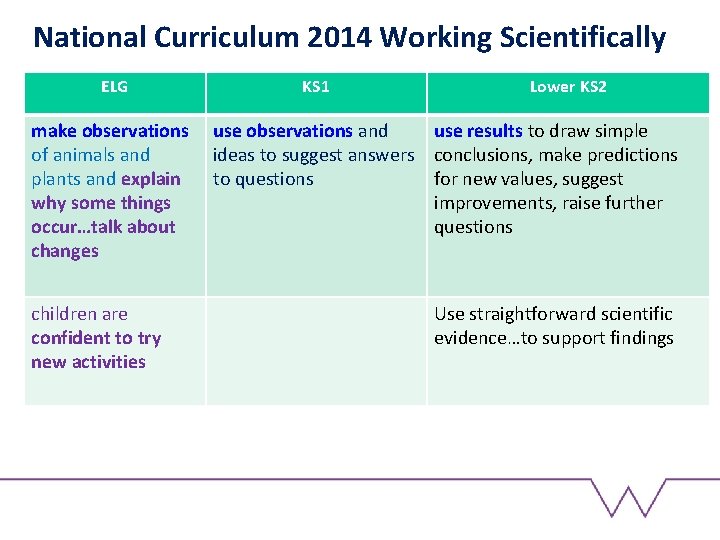
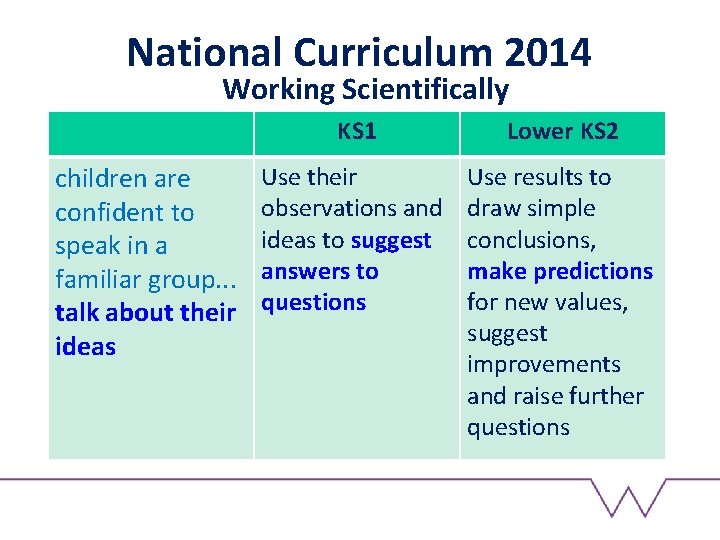
National Curriculum 2014 Working Scientifically ELG make observations of animals and plants and explain why some things occur…talk about changes children are confident to try new activities KS 1 Lower KS 2 use observations and use results to draw simple ideas to suggest answers conclusions, make predictions to questions for new values, suggest improvements, raise further questions Use straightforward scientific evidence…to support findings
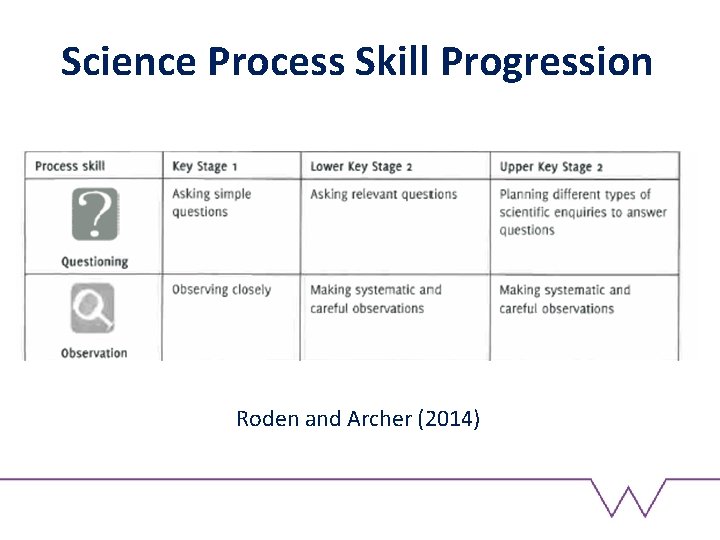
Science Process Skill Progression Roden and Archer (2014)
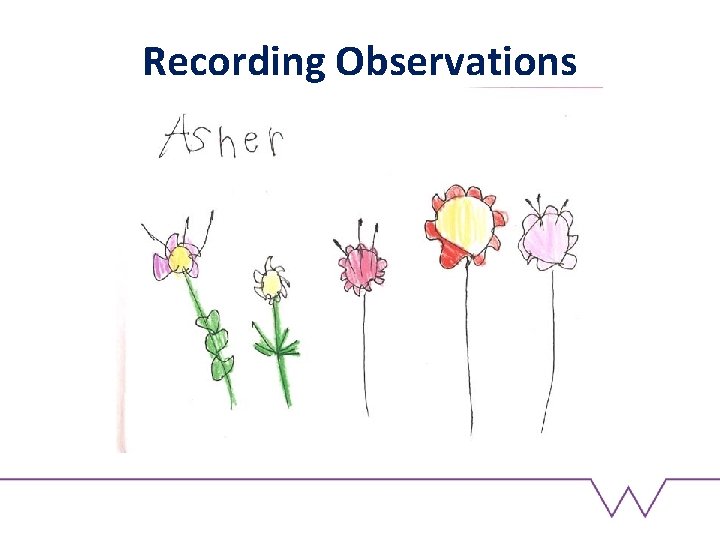
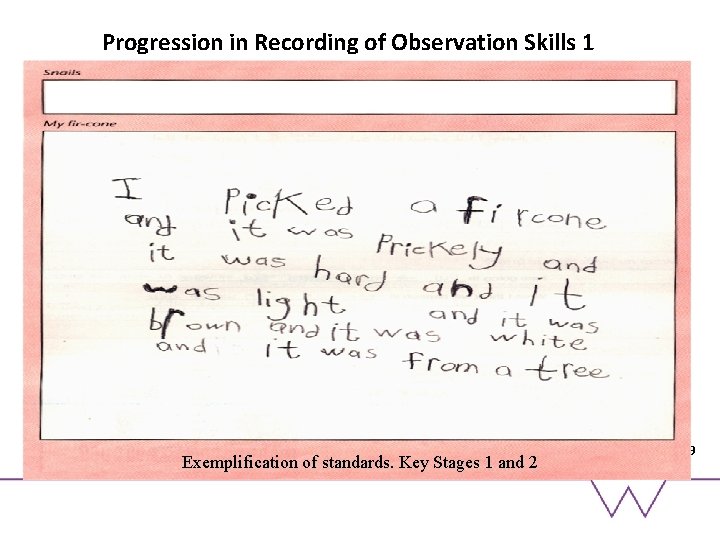
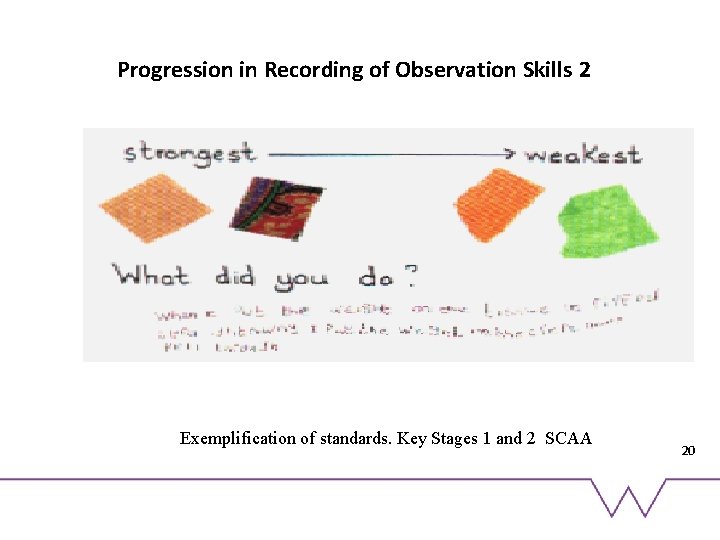
Recording Observations
Progression in Recording of Observation Skills 1 Exemplification of standards. Key Stages 1 and 2 19
Progression in Recording of Observation Skills 2 Exemplification of standards. Key Stages 1 and 2 SCAA 20
Scientific Knowledge and Understanding Pupils should be taught to use … practical scientific methods, processes and skills through the teaching of the programme of study content: Links from observation circuit to the NC (2014) for science: Year 1 Plants; Animals, Including humans Year 1 Everyday materials Year 4 Living things and their habitats; Animals, Including humans Year 4 Sound Year 6 Living things and their habitats
Investigating Magnets Task 1 Explore the collection of magnets (5 mins) Which objects are attracted to the magnet? What properties do they have in common? Task 2 Which is the strongest magnet? Devise a test to find out exactly how strong each magnet is? (15 mins) Does the size, shape, colour or any other factor affect how strong the magnet is? 22 What other tests are there? Groups share ideas
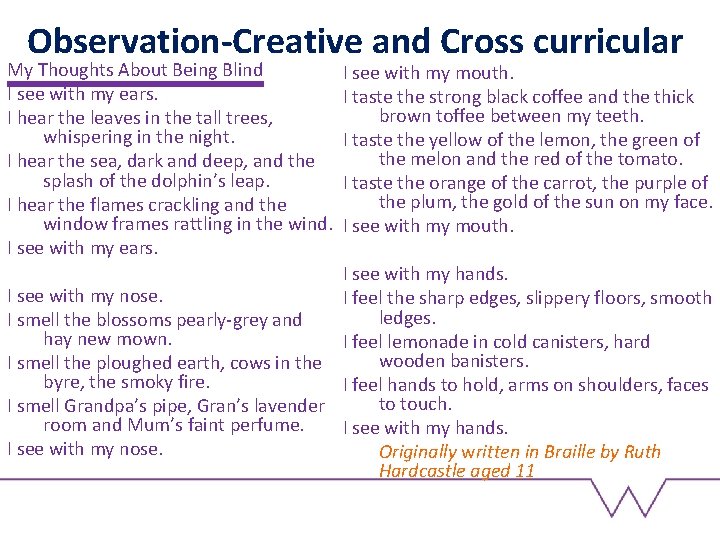
Observation-Creative and Cross curricular My Thoughts About Being Blind I see with my ears. I hear the leaves in the tall trees, whispering in the night. I hear the sea, dark and deep, and the splash of the dolphin’s leap. I hear the flames crackling and the window frames rattling in the wind. I see with my ears. I see with my nose. I smell the blossoms pearly-grey and hay new mown. I smell the ploughed earth, cows in the byre, the smoky fire. I smell Grandpa’s pipe, Gran’s lavender room and Mum’s faint perfume. I see with my nose. I see with my mouth. I taste the strong black coffee and the thick brown toffee between my teeth. I taste the yellow of the lemon, the green of the melon and the red of the tomato. I taste the orange of the carrot, the purple of the plum, the gold of the sun on my face. I see with my mouth. I see with my hands. I feel the sharp edges, slippery floors, smooth ledges. I feel lemonade in cold canisters, hard wooden banisters. I feel hands to hold, arms on shoulders, faces to touch. I see with my hands. Originally written in Braille by Ruth Hardcastle aged 11
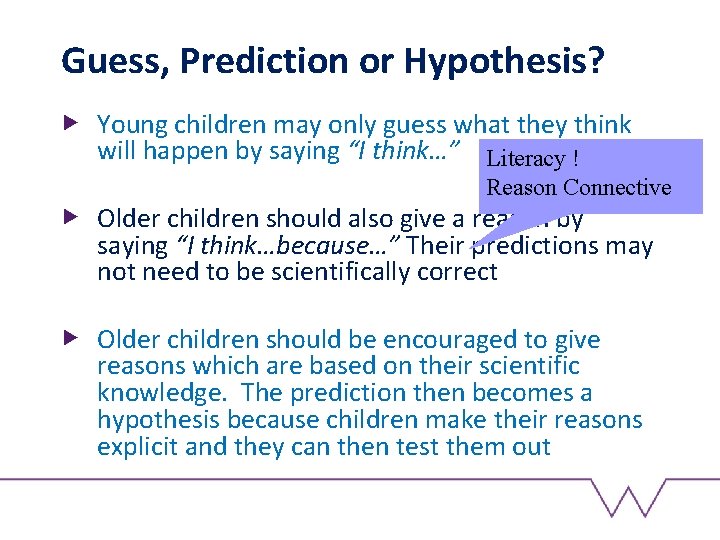
Guess, Prediction or Hypothesis? Young children may only guess what they think will happen by saying “I think…” Literacy ! Reason Connective Older children should also give a reason by saying “I think…because…” Their predictions may not need to be scientifically correct Older children should be encouraged to give reasons which are based on their scientific knowledge. The prediction then becomes a hypothesis because children make their reasons explicit and they can then test them out
National Curriculum 2014 Working Scientifically children are confident to speak in a familiar group. . . talk about their ideas KS 1 Lower KS 2 Use their observations and ideas to suggest answers to questions Use results to draw simple conclusions, make predictions for new values, suggest improvements and raise further questions
Predictions Many science activities can be preceded by giving the children an opportunity to predict what they think will happen It is often useful to encourage the children to record a prediction so that they can look back and see if their ideas have changed. Don’t make it a chore!
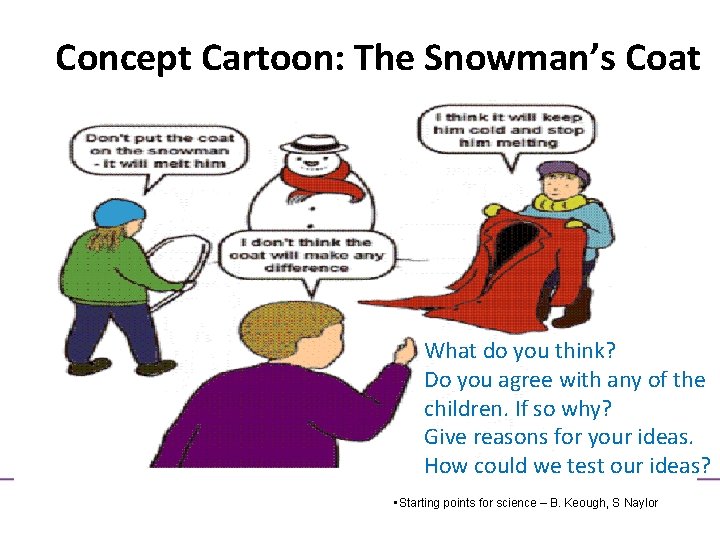
Concept Cartoon: The Snowman’s Coat What do you think? Do you agree with any of the children. If so why? Give reasons for your ideas. How could we test our ideas? • Starting points for science – B. Keough, S Naylor
Make your Predictions and Hypotheses ACTIVITIES • • • Balancing Beam Fruit Tea Bags Spinning Eggs Toothpicks Fizzy water and sultanas Glass and Arrows
Test your Predictions and Hypotheses Before starting the activity: – record your groups’ predictions – give reasons for your predictions (hypotheses) Test your predictions After testing your predictions discuss – Have you any new ideas or hypotheses as a result of your observations? – Do you need to do any further investigations to be more certain about your hypotheses? What previous ideas and science knowledge did you draw upon?
Why encourage children to predict what will happen? • Encourages ownership of the investigation and a vested interest in the outcome • Encourages them to think ahead and to make plans • Helps focus on the key variables by asking them to anticipate the relationship between them • Gives clues to the measurements that should be taken • Giving reasons for predictions encourages them either to describe their everyday experiences from which they have made a generalisation or to explain the scientific knowledge on which they have based their predictions
Strategies to Help Children make Predictions and Hypotheses Observing children as they play and work with materials Use of productive questions – What do you think …. ? – What could we do to…. . ? – What do you think will happen if…. ? Encourage the children to discuss their ideas
Progression in Predicting KS 1 L KS 2 U KS 2 Roden and Archer (2014) Theory to practice: Children of different ages were investigating how the size of a lump of jelly makes a difference to the time it takes to dissolve. They all thought that the little pieces would dissolve faster than the same amount of jelly in big lumps.
Progression in Predicting I think the little pieces will dissolve first because they are little I think the little pieces will dissolve first because my dad breaks it into little pieces before he makes jelly This child has made a simple prediction This child has made a prediction and tried to give a reason but has not given any more information. ‘it does it because it does, ’ Is a common response from younger children This child has made a prediction and given a reason based on the everyday experience of watching his dad make a jelly Goldsworthy, A. , Feasey, R. (1997), Making Sense of Primary Science Investigations. ASE
Progression in Predicting KS 2 I think the little pieces will dissolve first because little bits of sugar dissolve faster than a sugar lump and I think the same will happen with the jelly I think the little pieces will dissolve first because the water can attack them more easily. I think the little pieces will dissolve first because there’s more of the surface in touch with the water. This child has made a prediction and given a reason where he has used his knowledge of a similar everyday experience and applied it to a new situation This child has made a hypothesis which shows he is beginning to think about the way dissolving works This child has made a hypothesis which shows he is developing an understanding of the scientific concept that the greater the surface area means a faster dissolving rate Goldsworthy, A. , Feasey, R. (1997), Making Sense of Primary Science Investigations.
Maintaining Curiosity in Science Education Ofsted (2013) More time for scientific enquiry • The best schools ensured that pupils had sufficient time to be taught and subsequently develop the skills of scientific enquiry. • In the primary schools where pupils were taught science in a discrete lesson once a week, they had sufficient and regular opportunities to carry out practical investigations. As a result, they could revisit and relearn manipulative skills regularly enough for these to develop over time. • Some schools taught science within a crosscurricular topic but the best ones still made sure science practical work was weekly.
Considerations Developing the right attitudes through practical science takes time! ‘An attitude of willingness to take account of evidence does not result from a single activity or even several activities … may result from extended experiences in which the value of using evidence has been clear or from the example … of someone who showed this attitude in their behaviour. . . They are ‘caught’ rather than ‘taught’. . . showing an example of the behaviour in practice is a key action that teachers can take. … providing opportunity …to make choices that enable them to develop attitudes: reinforcing positive attitudes; and discussing attitude related behaviour. ’ (Harlen & Qualter 2009 cited Harlen, W. 2011 p 6 ASE Guide to primary science education) “ …science has not been taught frequently enough for enquiry skills to be developed. The expectation is that science should be taught weekly though no minimum time will be quoted. ” Brian Cartwright on Maintaining Curiosity, at NSLC, 21. 13
Plenary Trainees should have a better understanding of: • Important Aspects of EY /Primary Science • Working scientifically: types of enquiry • National Curriculum -The Importance of Practical Scientific Enquiry • Observations and raising questions • Guess, prediction or hypothesis?
Useful resources • ASE (Association for Science Education) http: //www. ase. org. uk/home/ • PSTT (Primary Science Teaching Trust) https: //pstt. org. uk/resources • CIEC Working Scientifically in the primary classroom: Progression of Enquiry Skills from EYFS to KS 3 www. ciec. org. uk • Practical work in primary science (SCORE 2009) free booklet http: //www. score-education. org/media/3674/primary. pdf • A frame work for practical science (SCORE 2009) http: //www. score-education. org/media/3662/framework. pdf
Bibliography • • Bianchi, L. , Feasey, R. (2011) Science Beyond the Classroom Boundaries. For 3 – 5 year olds. Mc. Graw Hill. Department for Education (2014) Statutory Framework for the Early Years Foundation Stage Setting the standards for learning, development and care for children from birth to five Department for Education (2013) National Curriculum in England: science programmes of study Department for Education (2013) The national curriculum in England; framework document: for teaching 1 September 2014 to 31 August 2015 Department for Education (2013) Teachers’ Standards Dunne, M. and Peacock, A. (2015) 2 nd Edition; Primary Science: A Guide to Teaching Practice; SAGE Harlen, W. ed (2010) ASE Guide to Primary Science Education. New Edition. ASE Hatfield. Howe, A. , Davies, D. , Mc. Mahon, K. , Towler, L. , Collier, C. , Scott, T. ( 2009) 2 nd ed Science 5 – 11. A Guide for Teachers. Routledge. London.
Bibliography cont. • • • Lakin, L. (2013) Developing independent Learning in Science. Practical ideas and activities for 7 -12 year olds Open University Press. Ofsted (2013) Maintaining Curiosity A survey into science education in schools; No. 130135 Ofsted (2013) Report Summary; Maintaining Curiosity A survey into science education in schools; No. 130135 Osborne, J. , Simon, S. , & Collins, S. (2003) Attitudes towards science: a review of the literature and its implications. International Journal of Science Education. 25 (9), 1049 – 1079 Roden, J. and Archer, J. (2014) Primary Science For Trainee Teachers; SAGE Wilson, H. , Mant, J. 2011 What makes an exemplary teacher of science? The pupils’ perspective. School Science Review. Vol 93: 342 ASE Hatfield. Herts. http: //www. ase. org. uk/home/