
Extreme Ultraviolet Light Sources MARK HRDY 12052017 BackgroundMotivation
Extreme Ultraviolet Light Sources MARK HRDY 12/05/2017

Background/Motivation ◦ Resolution Limit ◦ UV Light Generation ◦ EUV Introduction Technical Challenges: Outline ◦ ◦ ◦ Optics Masks/Pellicles Light Production Contamination Power Requirements Resists Current Outlook: ◦ ◦ Requirements Current Status Ongoing Concerns The Future of EUV Close: ◦ References ◦ Questions UNIVERSITY OF TEXAS - EUV SOURCES - M. HRDY 2

Background/Motivation UNIVERSITY OF TEXAS - EUV SOURCES - M. HRDY 3
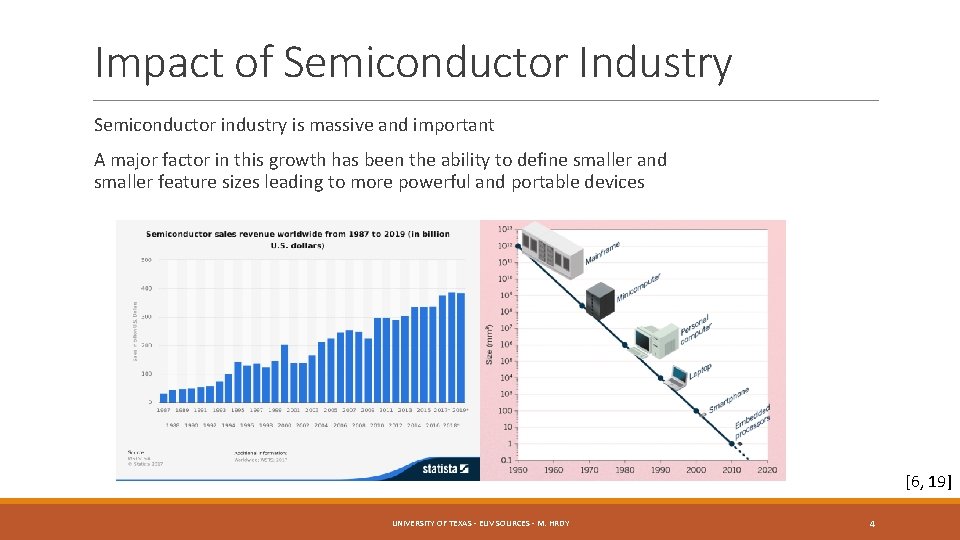
Impact of Semiconductor Industry Semiconductor industry is massive and important A major factor in this growth has been the ability to define smaller and smaller feature sizes leading to more powerful and portable devices [6, 19] UNIVERSITY OF TEXAS - EUV SOURCES - M. HRDY 4
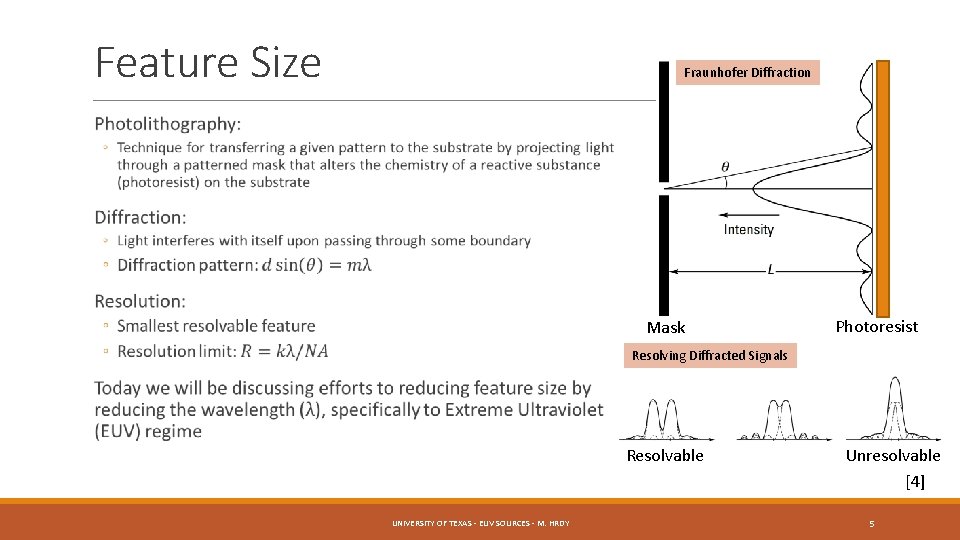
Feature Size Fraunhofer Diffraction Mask Photoresist Resolving Diffracted Signals Resolvable UNIVERSITY OF TEXAS - EUV SOURCES - M. HRDY Unresolvable [4] 5
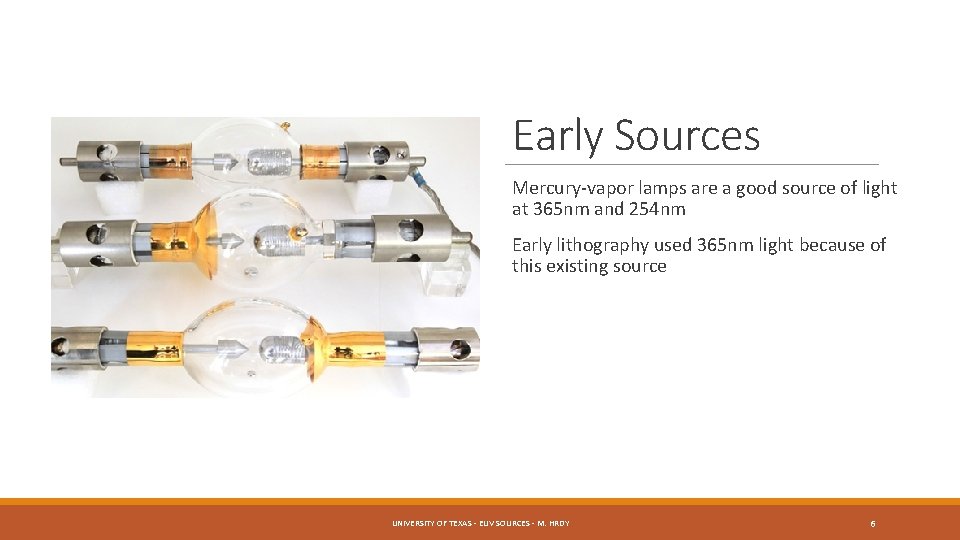
Early Sources Mercury-vapor lamps are a good source of light at 365 nm and 254 nm Early lithography used 365 nm light because of this existing source UNIVERSITY OF TEXAS - EUV SOURCES - M. HRDY 6
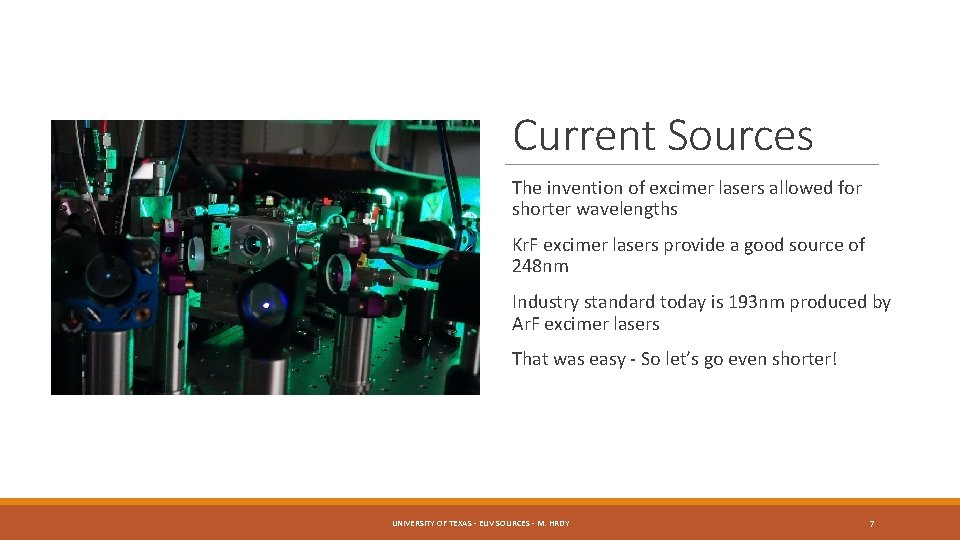
Current Sources The invention of excimer lasers allowed for shorter wavelengths Kr. F excimer lasers provide a good source of 248 nm Industry standard today is 193 nm produced by Ar. F excimer lasers That was easy - So let’s go even shorter! UNIVERSITY OF TEXAS - EUV SOURCES - M. HRDY 7
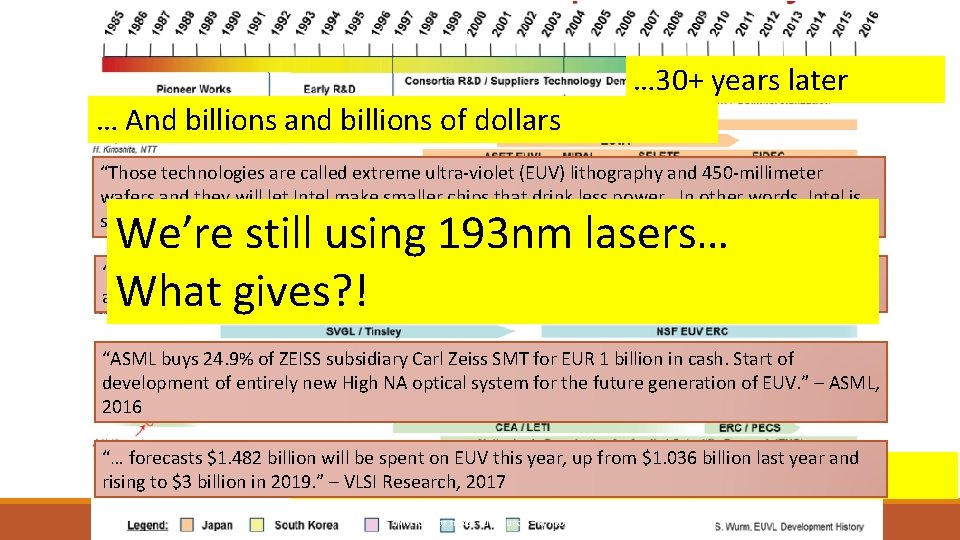
Enter Extreme Ultraviolet … 30+ years later … And billions and billions of dollars “Those technologies are called extreme ultra-violet (EUV) lithography and 450 -millimeter wafers and they will let Intel make smaller chips that drink less power. In other words, Intel is Engineers and scientists knew directionally where to spending $4. 1 billion to continue with Moore's Law. ” – Business Insider, 2012 We’re still using 193 nm lasers… go, but there was no light source. “In 2012, ASML also obtained a combined total of $1. 9 billion in R&D funds from Intel, Samsung and TSMC. ” – Semiconductor Engineering, 2014 What gives? ! One would need to be invented. “ASML buys 24. 9% of ZEISS subsidiary Carl Zeiss SMT for EUR 1 billion in cash. Start of development of entirely new High NA optical system for the future generation of EUV. ” – ASML, 2016 “… forecasts $1. 482 billion will be spent on EUV this year, up from $1. 036 billion last year and [9, 11, 12, 15, 22] rising to $3 billion in 2019. ” – VLSI Research, 2017 … with the whole world working on it UNIVERSITY OF TEXAS - EUV SOURCES - M. HRDY 8

Technical Challenges UNIVERSITY OF TEXAS - EUV SOURCES - M. HRDY 9
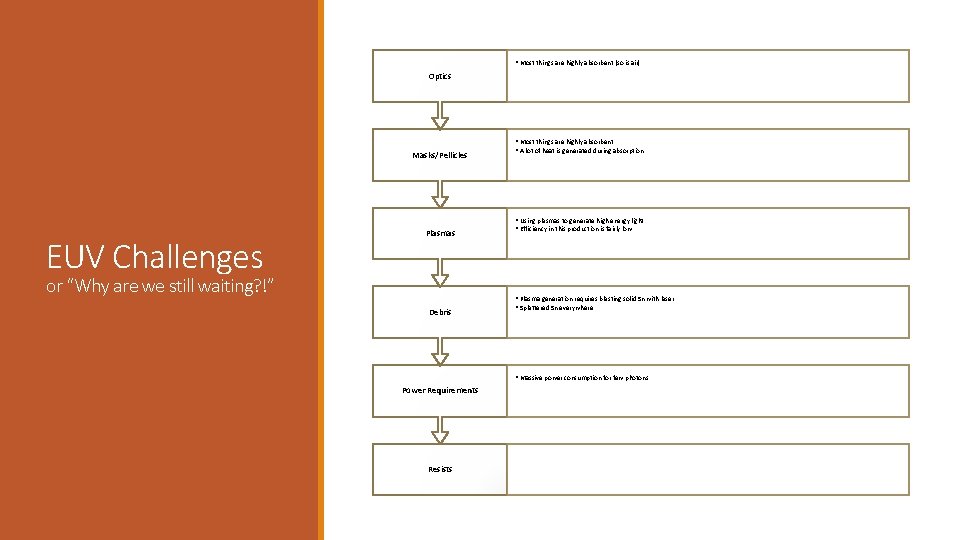
• Most things are highly absorbent (so is air) Optics Masks/Pellicles EUV Challenges Plasmas or “Why are we still waiting? !” Debris • Most things are highly absorbent • A lot of heat is generated during absorption • Using plasmas to generate high energy light • Efficiency in this production is fairly low • Plasma generation requires blasting solid Sn with laser • Splattered Sn everywhere • Massive power consumption for few photons Power Requirements Resists UNIVERSITY OF TEXAS - EUV SOURCES - M. HRDY 10
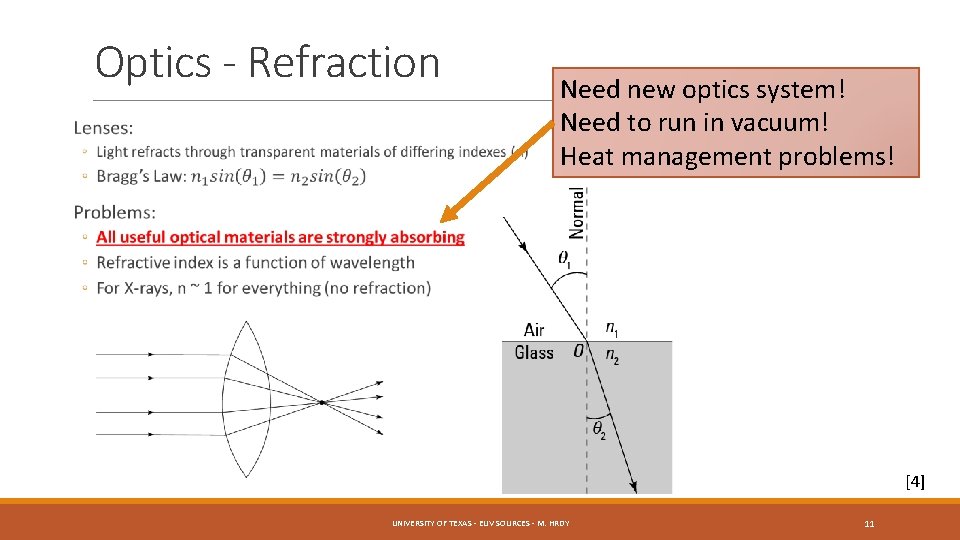
Optics - Refraction Need new optics system! Need to run in vacuum! Heat management problems! [4] UNIVERSITY OF TEXAS - EUV SOURCES - M. HRDY 11
![Optics - Reflection Note: any defect in the layers causes a dark spot! [8]](http://slidetodoc.com/presentation_image_h/f4a38253b13f40a55b76811a998daff3/image-12.jpg "Optics - Reflection Note: any defect in the layers causes a dark spot! [8]")
Optics - Reflection Note: any defect in the layers causes a dark spot! [8] UNIVERSITY OF TEXAS - EUV SOURCES - M. HRDY 12
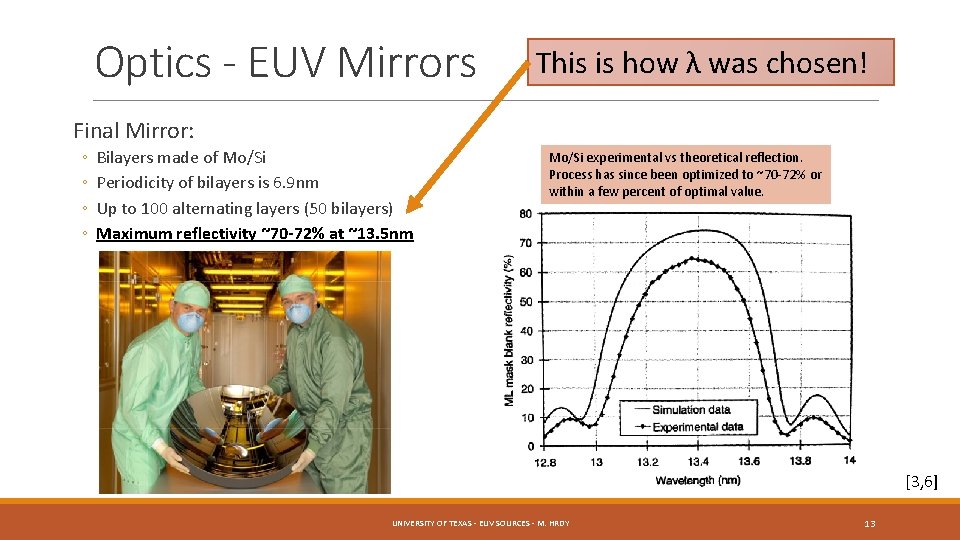
Optics - EUV Mirrors This is how λ was chosen! Final Mirror: ◦ ◦ Bilayers made of Mo/Si Periodicity of bilayers is 6. 9 nm Up to 100 alternating layers (50 bilayers) Maximum reflectivity ~70 -72% at ~13. 5 nm Mo/Si experimental vs theoretical reflection. Process has since been optimized to ~70 -72% or within a few percent of optimal value. [3, 6] UNIVERSITY OF TEXAS - EUV SOURCES - M. HRDY 13
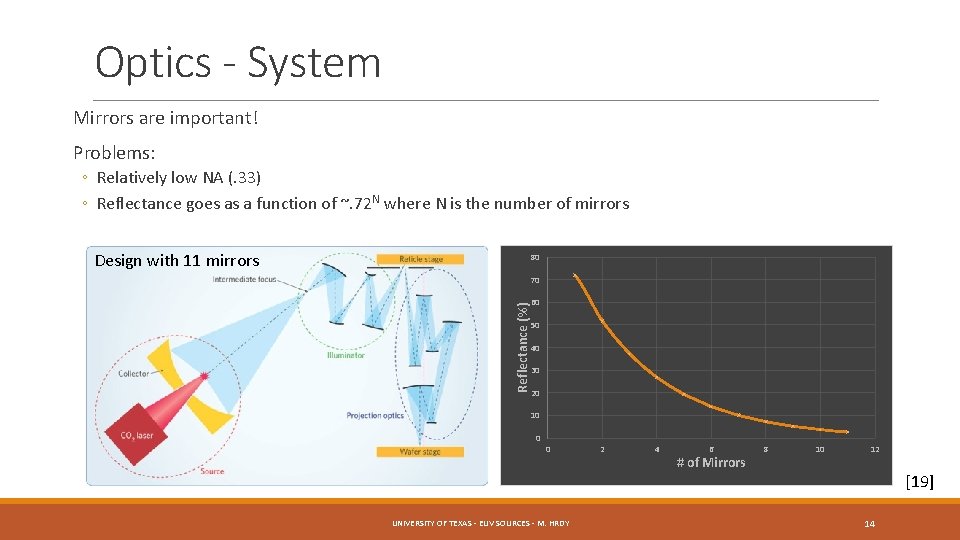
Optics - System Mirrors are important! Problems: ◦ Relatively low NA (. 33) ◦ Reflectance goes as a function of ~. 72 N where N is the number of mirrors Design with 11 mirrors 80 Reflectance (%) 70 60 50 40 30 20 10 0 0 UNIVERSITY OF TEXAS - EUV SOURCES - M. HRDY 2 4 6 # of Mirrors 8 10 12 [19] 14
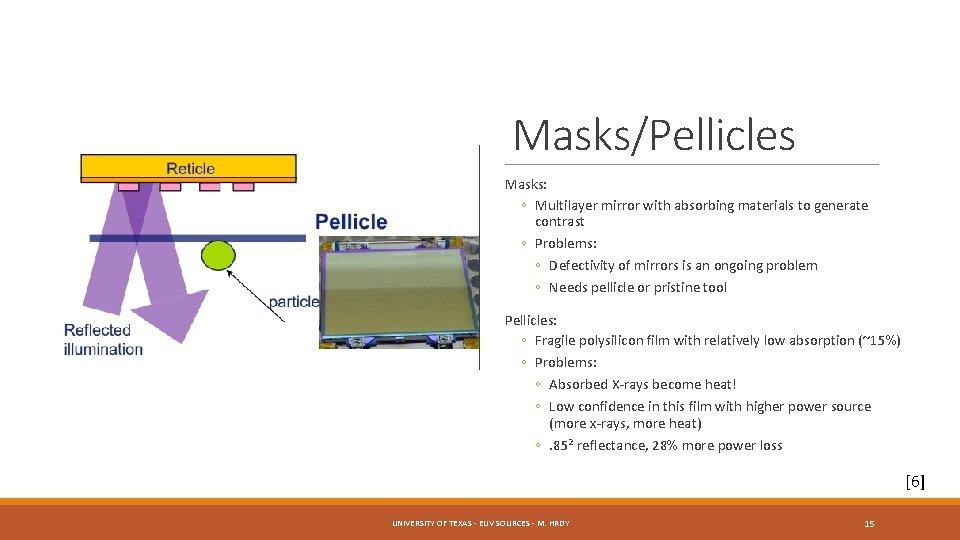
Masks/Pellicles Masks: ◦ Multilayer mirror with absorbing materials to generate contrast ◦ Problems: ◦ Defectivity of mirrors is an ongoing problem ◦ Needs pellicle or pristine tool Pellicles: ◦ Fragile polysilicon film with relatively low absorption (~15%) ◦ Problems: ◦ Absorbed X-rays become heat! ◦ Low confidence in this film with higher power source (more x-rays, more heat) ◦. 852 reflectance, 28% more power loss [6] UNIVERSITY OF TEXAS - EUV SOURCES - M. HRDY 15

Plasmas Need a method to heat the material Plasma Light Production: 1) 2) 3) 4) Heat material until electrons have more thermal energy than bonding energy Atoms shed their higher orbital electrons Ions are created where certain electron transitions dominate (for example Xe +10) These electron transitions emit characteristic wavelength (E = c/λ) Need the right emitting ions [2] UNIVERSITY OF TEXAS - EUV SOURCES - M. HRDY 16
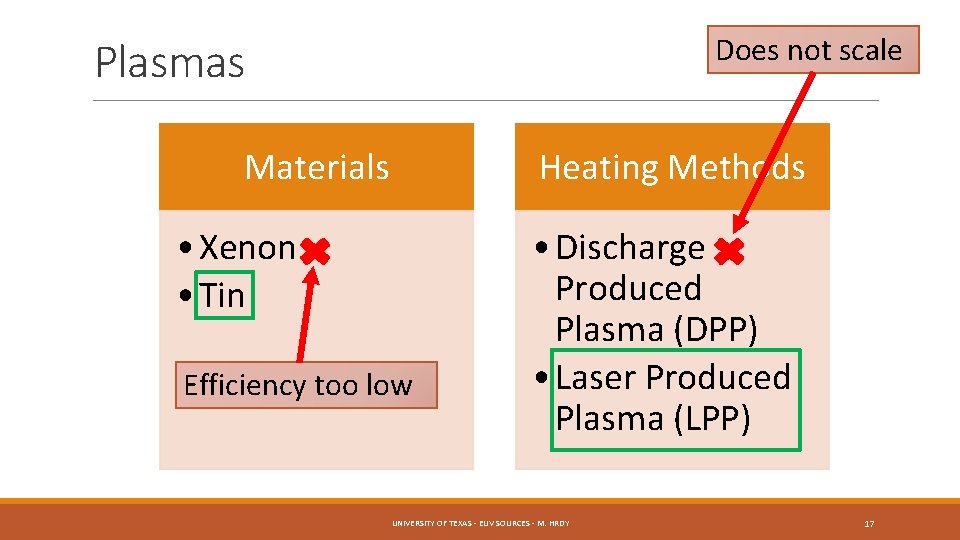
Does not scale Plasmas Materials Heating Methods • Xenon • Tin Efficiency too low • Discharge Produced Plasma (DPP) • Laser Produced Plasma (LPP) UNIVERSITY OF TEXAS - EUV SOURCES - M. HRDY 17
Plasmas - Sn Efficiency: ◦ Sn 8+ to Sn 12+ states contribute to emission ◦ Potential for much higher efficiencies than other sources Availability: ◦ Solid metal contamination seriously problematic ◦ Reflectance drops off drastically with thin Sn layer on optics ◦ Regular cleaning and potentially part replacement necessary Despite Sn being horrible for contamination, the efficiency is better than Xe, so Sn is plasma of choice. UNIVERSITY OF TEXAS - EUV SOURCES - M. HRDY 18
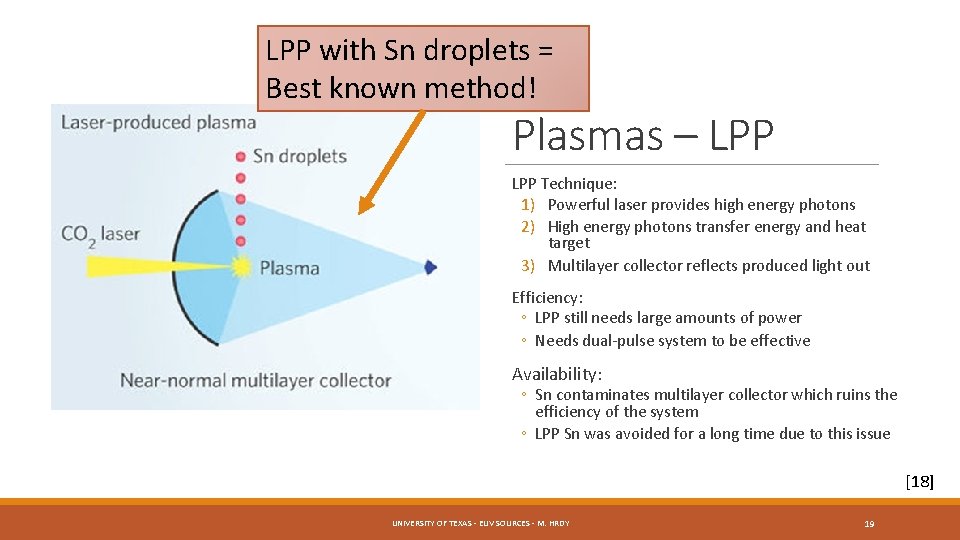
LPP with Sn droplets = Best known method! Plasmas – LPP Technique: 1) Powerful laser provides high energy photons 2) High energy photons transfer energy and heat target 3) Multilayer collector reflects produced light out Efficiency: ◦ LPP still needs large amounts of power ◦ Needs dual-pulse system to be effective Availability: ◦ Sn contaminates multilayer collector which ruins the efficiency of the system ◦ LPP Sn was avoided for a long time due to this issue [18] UNIVERSITY OF TEXAS - EUV SOURCES - M. HRDY 19
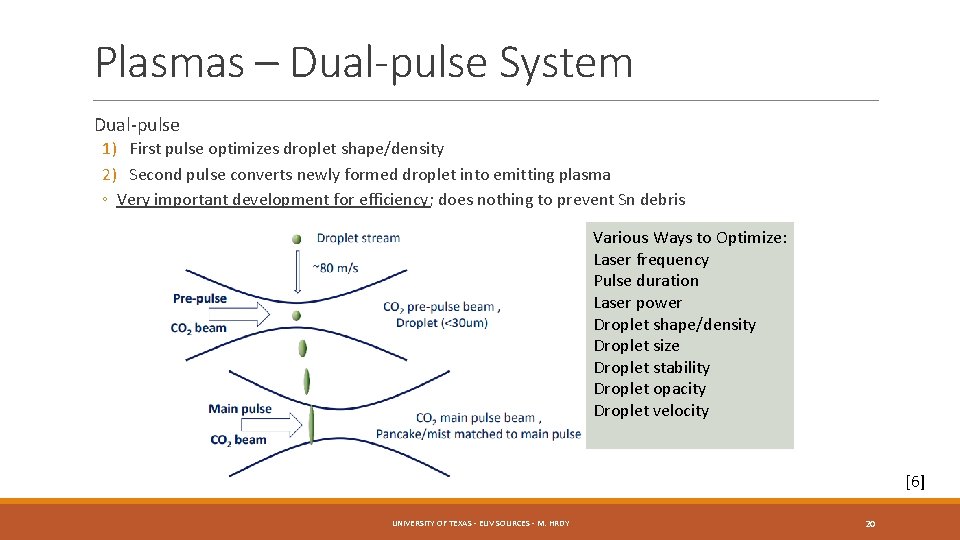
Plasmas – Dual-pulse System Dual-pulse 1) First pulse optimizes droplet shape/density 2) Second pulse converts newly formed droplet into emitting plasma ◦ Very important development for efficiency; does nothing to prevent Sn debris Various Ways to Optimize: Laser frequency Pulse duration Laser power Droplet shape/density Droplet size Droplet stability Droplet opacity Droplet velocity [6] UNIVERSITY OF TEXAS - EUV SOURCES - M. HRDY 20
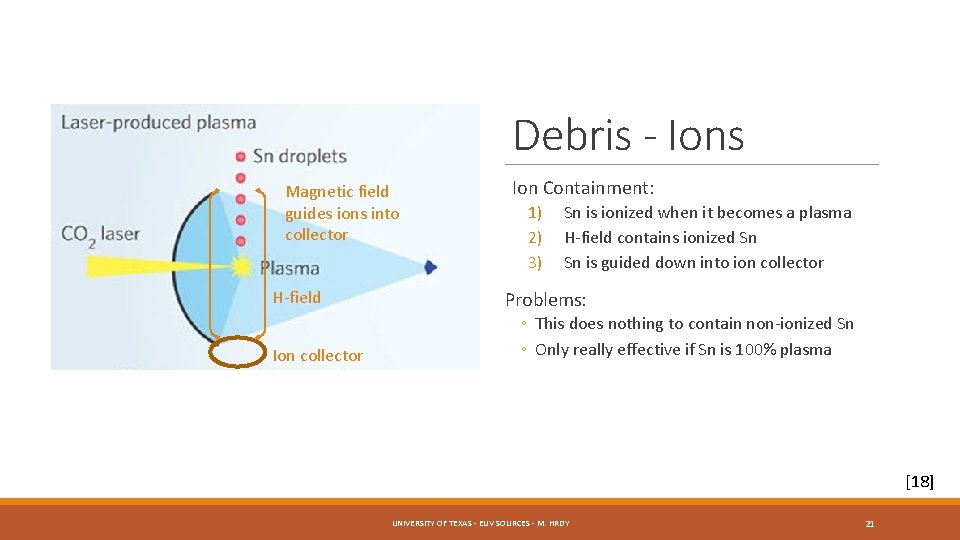
Debris - Ions Magnetic field guides ions into collector H-field Ion collector Ion Containment: 1) 2) 3) Sn is ionized when it becomes a plasma H-field contains ionized Sn Sn is guided down into ion collector Problems: ◦ This does nothing to contain non-ionized Sn ◦ Only really effective if Sn is 100% plasma [18] UNIVERSITY OF TEXAS - EUV SOURCES - M. HRDY 21
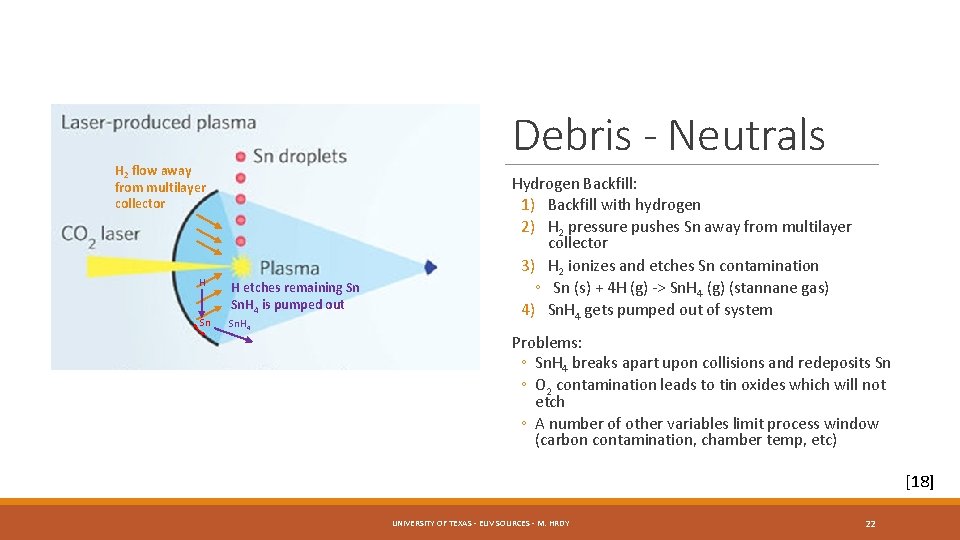
Debris - Neutrals H 2 flow away from multilayer collector H H etches remaining Sn Sn. H 4 is pumped out Sn Sn. H 4 Hydrogen Backfill: 1) Backfill with hydrogen 2) H 2 pressure pushes Sn away from multilayer collector 3) H 2 ionizes and etches Sn contamination ◦ Sn (s) + 4 H (g) -> Sn. H 4 (g) (stannane gas) 4) Sn. H 4 gets pumped out of system Problems: ◦ Sn. H 4 breaks apart upon collisions and redeposits Sn ◦ O 2 contamination leads to tin oxides which will not etch ◦ A number of other variables limit process window (carbon contamination, chamber temp, etc) [18] UNIVERSITY OF TEXAS - EUV SOURCES - M. HRDY 22
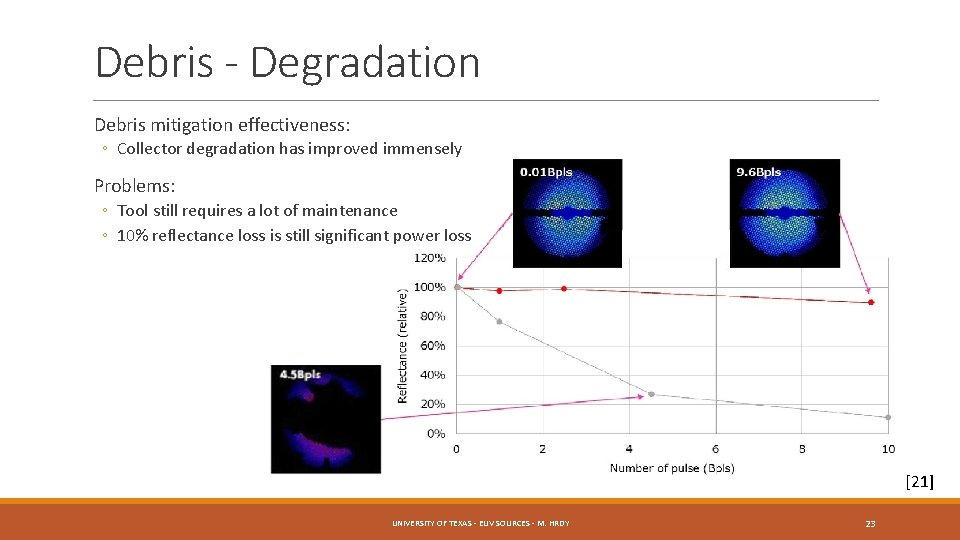
Debris - Degradation Debris mitigation effectiveness: ◦ Collector degradation has improved immensely Problems: ◦ Tool still requires a lot of maintenance ◦ 10% reflectance loss is still significant power loss [21] UNIVERSITY OF TEXAS - EUV SOURCES - M. HRDY 23
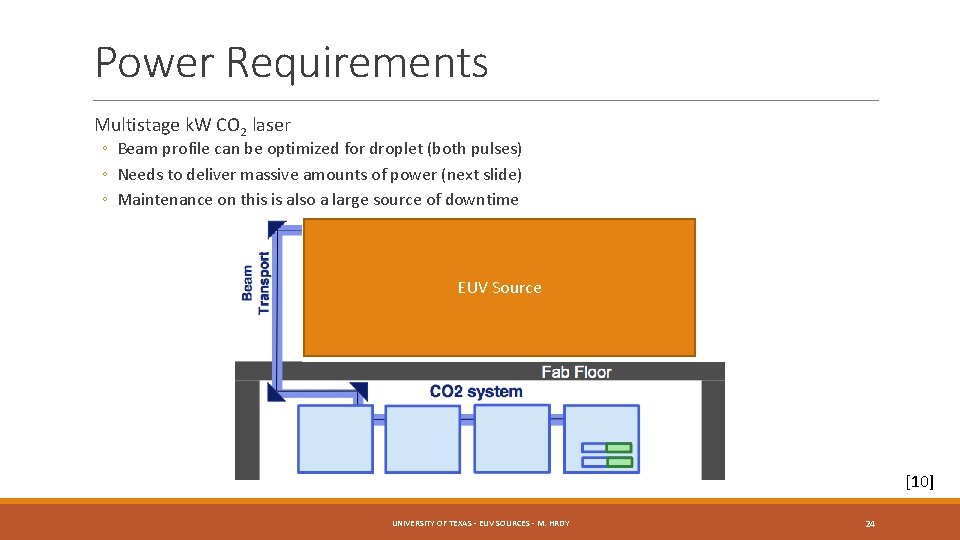
Power Requirements Multistage k. W CO 2 laser ◦ Beam profile can be optimized for droplet (both pulses) ◦ Needs to deliver massive amounts of power (next slide) ◦ Maintenance on this is also a large source of downtime EUV Source [10] UNIVERSITY OF TEXAS - EUV SOURCES - M. HRDY 24
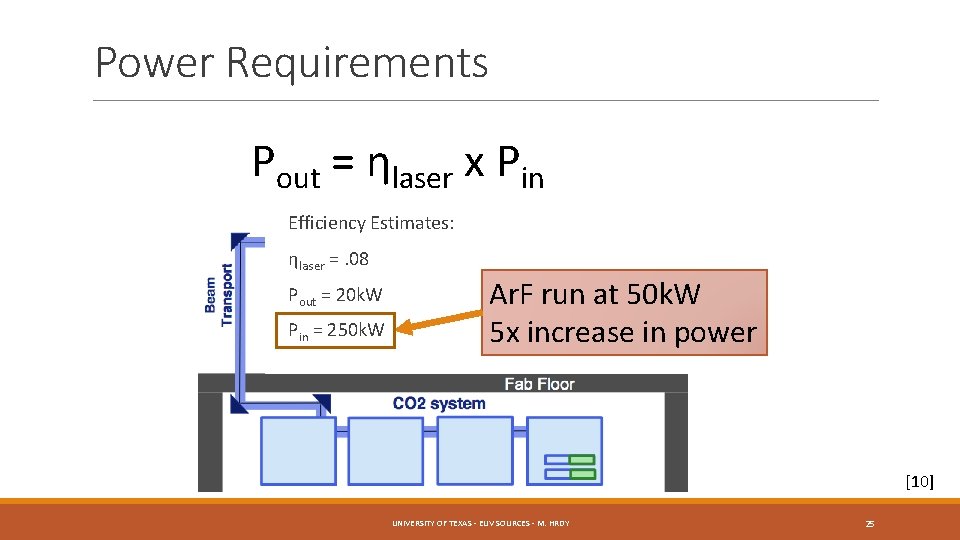
Power Requirements Pout = ηlaser x Pin Efficiency Estimates: ηlaser =. 08 Pout = 20 k. W Pin = 250 k. W Ar. F run at 50 k. W 5 x increase in power [10] UNIVERSITY OF TEXAS - EUV SOURCES - M. HRDY 25
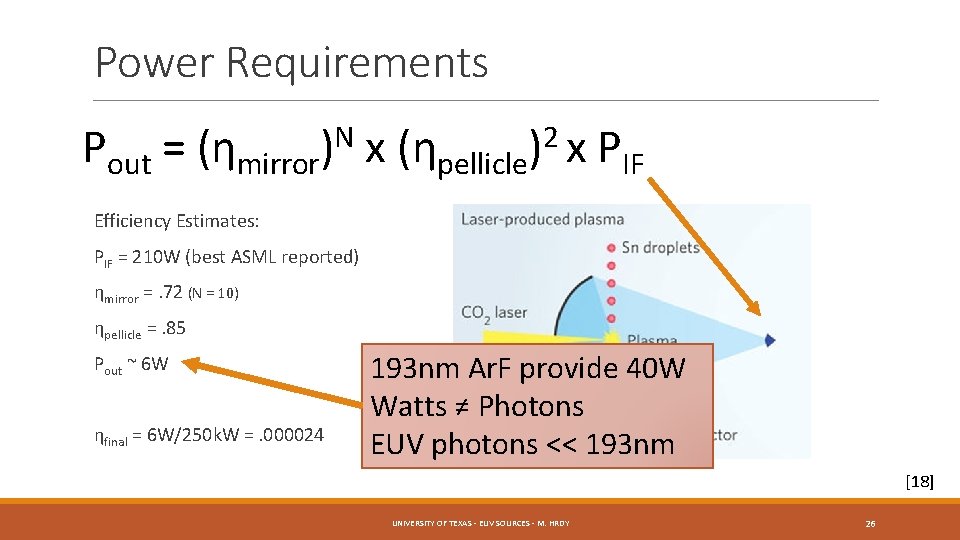
Power Requirements Pout = (ηmirror N ) x (η pellicle 2 ) x P IF Efficiency Estimates: PIF = 210 W (best ASML reported) ηmirror =. 72 (N = 10) ηpellicle =. 85 Pout ~ 6 W ηfinal = 6 W/250 k. W =. 000024 193 nm Ar. F provide 40 W Watts ≠ Photons EUV photons << 193 nm [18] UNIVERSITY OF TEXAS - EUV SOURCES - M. HRDY 26
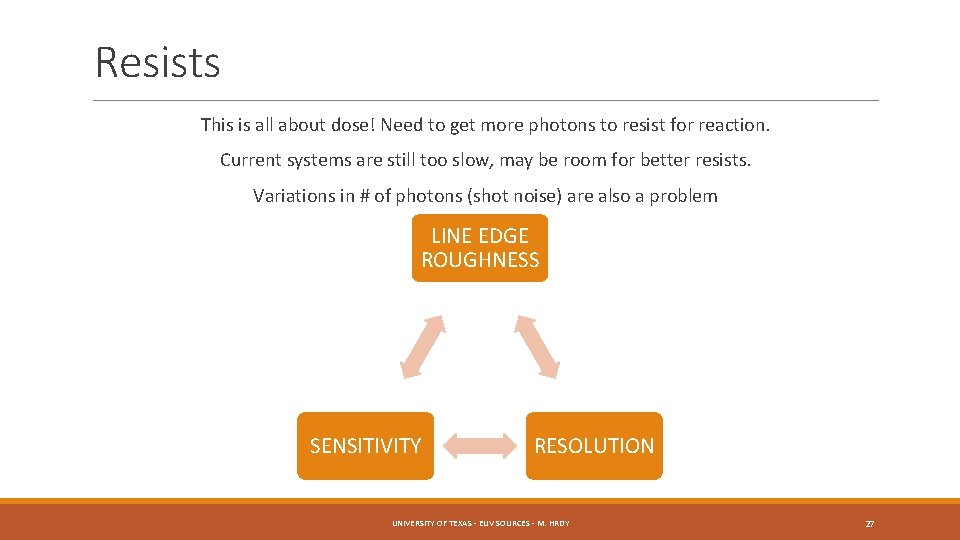
Resists This is all about dose! Need to get more photons to resist for reaction. Current systems are still too slow, may be room for better resists. Variations in # of photons (shot noise) are also a problem LINE EDGE ROUGHNESS SENSITIVITY RESOLUTION UNIVERSITY OF TEXAS - EUV SOURCES - M. HRDY 27

Current Outlook UNIVERSITY OF TEXAS - EUV SOURCES - M. HRDY 28
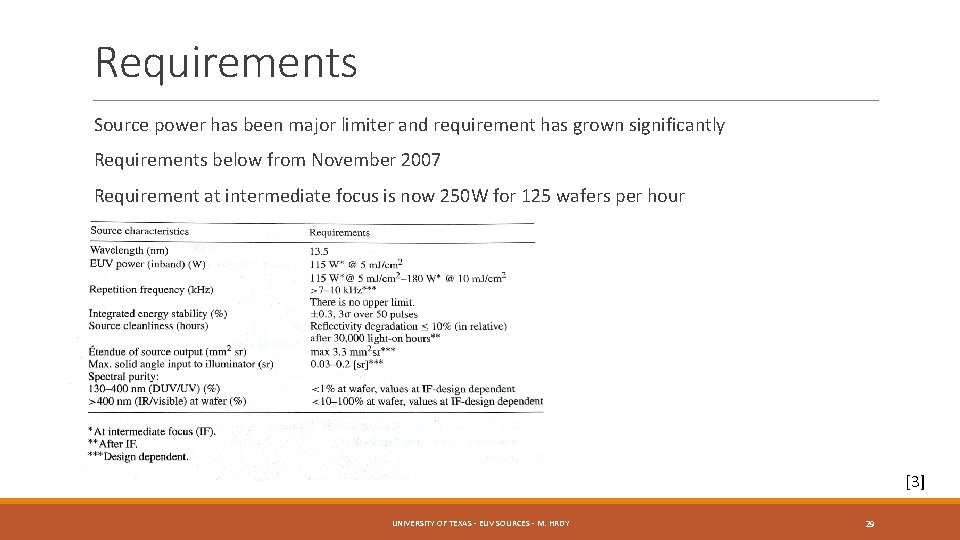
Requirements Source power has been major limiter and requirement has grown significantly Requirements below from November 2007 Requirement at intermediate focus is now 250 W for 125 wafers per hour [3] UNIVERSITY OF TEXAS - EUV SOURCES - M. HRDY 29
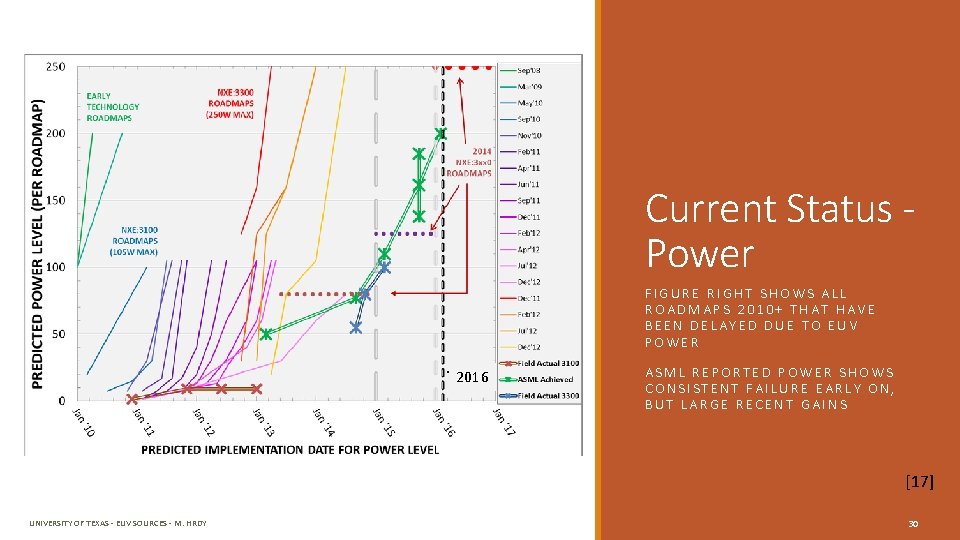
Current Status Power FIGURE RIGHT SHOWS ALL ROADMAPS 2010+ THAT HAVE BEEN DELAYED DUE TO EUV POWER 2016 ASML REPORTED POWER SHOWS CONSISTENT FAILURE EARLY ON, BUT LARGE RECENT GAINS [17] UNIVERSITY OF TEXAS - EUV SOURCES - M. HRDY 30
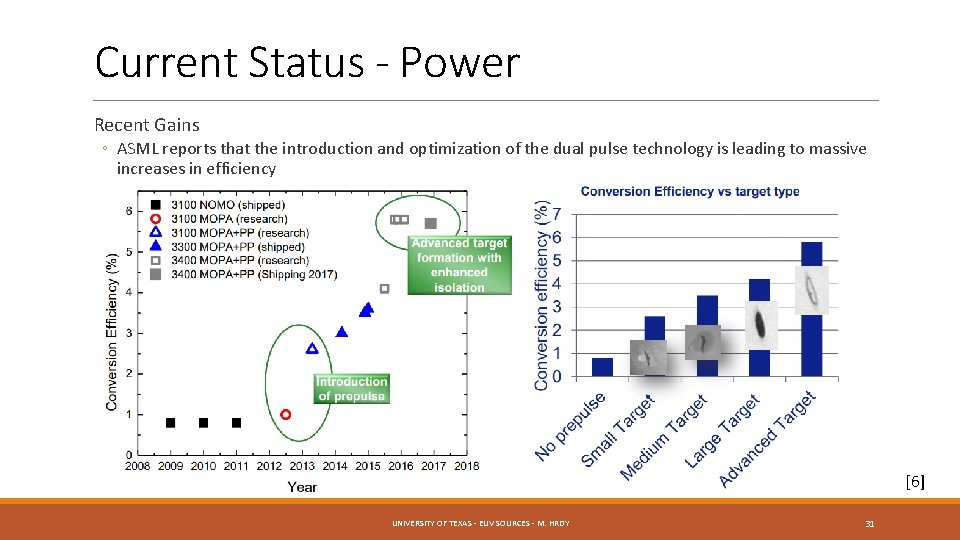
Current Status - Power Recent Gains ◦ ASML reports that the introduction and optimization of the dual pulse technology is leading to massive increases in efficiency [6] UNIVERSITY OF TEXAS - EUV SOURCES - M. HRDY 31
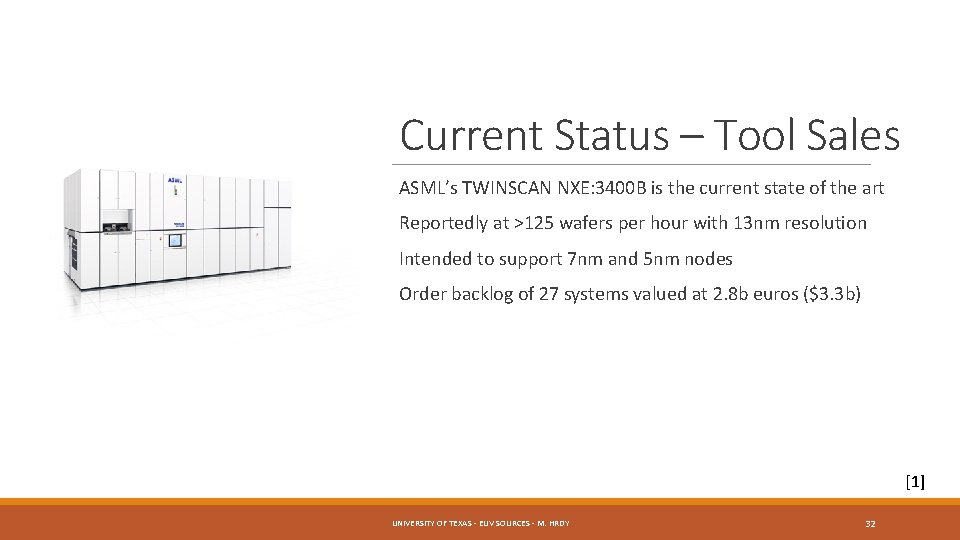
Current Status – Tool Sales ASML’s TWINSCAN NXE: 3400 B is the current state of the art Reportedly at >125 wafers per hour with 13 nm resolution Intended to support 7 nm and 5 nm nodes Order backlog of 27 systems valued at 2. 8 b euros ($3. 3 b) [1] UNIVERSITY OF TEXAS - EUV SOURCES - M. HRDY 32
Ongoing Concerns Optics: Power Requirements: ◦ Relatively low NA (. 33) ◦ Tools need to be working, not down for maintenance ◦ Next generation will likely have more mirrors and ◦ Need to demonstrate source power in the field more loss ◦ More power will be needed for next generations ◦ Production of mirrors is very slow Masks/Pellicles: ◦ Need greater availability of defect-free masks ◦ Needs to be able to withstand more power and more heat Resists: ◦ Need to be able to either get by with fewer photons or produce more Debris: ◦ Tools need to be working, not down for maintenance ◦ Uptime is still significantly lower than 193 nm (70% compared to 95%) ◦ Concerns about lifetime of various components UNIVERSITY OF TEXAS - EUV SOURCES - M. HRDY 33
The Future of EUV Concerns mentioned previously are still problematic Power and availability are ongoing issues Also hard to forget about all the missed goals of yesteryear However - Generally, the attitude seems optimistic EUV orders are increasing Source power increases reported by ASML are encouraging UNIVERSITY OF TEXAS - EUV SOURCES - M. HRDY 34

Close UNIVERSITY OF TEXAS - EUV SOURCES - M. HRDY 35
References 1) 2) 3) 4) 5) 6) 7) 8) 9) 10) 11) 12) ASML. (n. d. ). TWINSCAN NXE: 3350 B. Retrieved December 04, 2017, from https: //www. asml. com/products/systems/twinscan-nxe/twinscan 13) nxe 3350 b/en/s 46772? dfp_product_id=9546 Attwood, D. (1999). Soft X-Rays and Extreme Ultraviolet Radiation: Principles and 14) 15) Applications. New York, NY: Cambridge University Press. Bakshi, V. (Ed. ). (2009). EUV Lithography. Hoboken, NJ: John Wiley & Sons. Duree, G. (2011). Optics for dummies. Hoboken, NJ: Wiley 16) Elg, D. et al, "Magnetic mitigation of debris for EUV sources, " Proc. SPIE 8679, Extreme Ultraviolet (EUV) Lithography IV, 86792 M (1 April 2013) 17) Fomenkov, I. , (2017, June 15). 2017 International Workshop on EUV Lithography. In EUV Lithography: Progress in LPP Source Power Scaling and Availability. 18) Retrieved from https: //www. euvlitho. com/2017/P 5. pdf Global semiconductor industry market size 2019 | Statistic. Retrieved December 19) 04, 2017, from https: //www. statista. com/statistics/266973/global-semiconductor 20) sales-since-1988/ H. J. Levinson, Principles of Lithography, Second Edition, SPIE Press, Bellingham, WA (2005) 21) Lapedus, M. (2014, April 17). Billions And Billions Invested. Retrieved December 04, 2017, from https: //semiengineering. com/billions-and-billions-invested/ Lapedus, M. (2016, November 17). Why EUV Is So Difficult. Retrieved December 22) 04, 2017, from https: //semiengineering. com/why-euv-is-so-difficult/ Lapedus, M. (2017, September 25). Looming Issues And Tradeoffs For EUV. Retrieved December 04, 2017, from https: //semiengineering. com/issues-andtradeoffs-for-euv/ Merritt, R. (2017, October 10). Intel May Sit Out Race to EUV | EE Times. Retrieved December 04, 2017, from https: //www. eetimes. com/document. asp? doc_id=1332420&page_number=1 Mizoguchiet, H. , et al, "Performance of 250 W high-power HVM LPP-EUV source, " Proc. SPIE 10143, Extreme Ultraviolet (EUV) Lithography VIII, 101431 J (27 March 2017) Renk K. F. (2017) Gas Lasers. In: Basics of Laser Physics. Graduate Texts in Physics. Springer, Cham Russell, K. (2013, October 30). Intel Is Investing Billions Of Dollars Into This Unproven Technology. Retrieved December 04, 2017, from http: //www. businessinsider. com/intel-is-investing-billions-inthis-tech-2013 -10 Sporre, J. R. , et al, "Collector optic in-situ Sn removal using hydrogen plasma, " Proc. SPIE 8679, Extreme Ultraviolet (EUV) Lithography IV, 86792 H (8 April 2013); doi: 10. 1117/12. 2012584 Tomie, T, "Tin laser-produced plasma as the light source for extreme ultraviolet lithography highvolume manufacturing: history, ideal plasma, present status, and prospects, " J. Micro/Nanolith. 11(2) 021109 (21 May 2012) Turkot, B. , et al, "EUV progress toward HVM readiness, " Proc. SPIE 9776, Extreme Ultraviolet (EUV) Lithography VII, 977602 (18 March 2016) Wagner, C. , & Harned, N. (2010). EUV lithography: Lithography gets extreme. Nature Photonics, 4(1), 24 -26. doi: 10. 1038/nphoton. 2009. 251 Waldrop, M. M. (2016). The chips are down for Moore’s law. Nature News, 530(7589). Retrieved December 4, 2017, from http: //www. nature. com/news/the-chips-are-down-for-moore-s-law 1. 19338#/ref-link-5 Yabu, T. , et al, "Key components development progress updates of the 250 W high power LPP-EUV light source, " Proc. SPIE 10450, International Conference on Extreme Ultraviolet Lithography 2017, 104501 C (16 October 2017) Yen, A, "EUV Lithography: From the Very Beginning to the Eve of Manufacturing, " Proc. SPIE 9776, Extreme Ultraviolet (EUV) Lithography VII, 977632 (16 June 2016) UNIVERSITY OF TEXAS - EUV SOURCES - M. HRDY 36

Questions UNIVERSITY OF TEXAS - EUV SOURCES - M. HRDY 37

Supplemental UNIVERSITY OF TEXAS - EUV SOURCES - M. HRDY 38
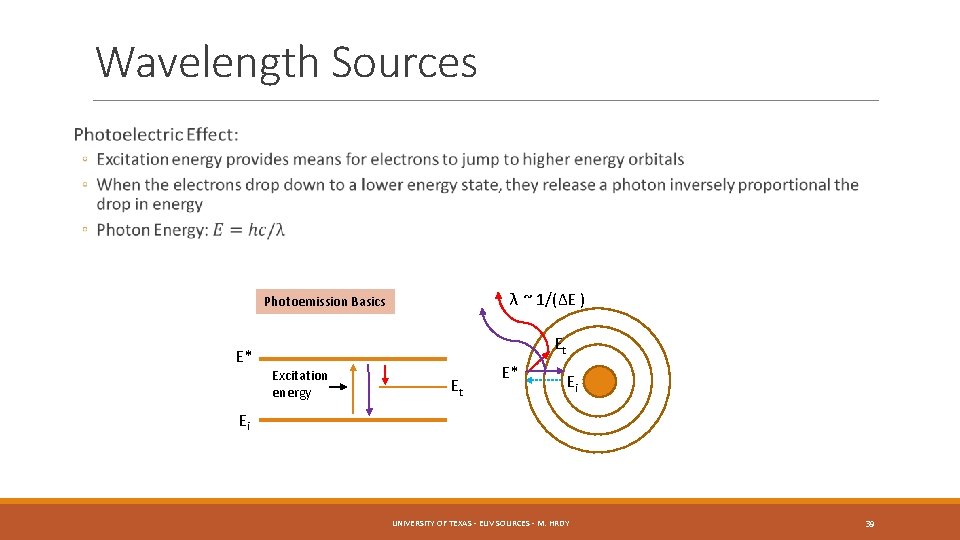
Wavelength Sources λ ~ 1/(ΔE ) Photoemission Basics E* Et Excitation energy Et E* Ei Ei UNIVERSITY OF TEXAS - EUV SOURCES - M. HRDY 39
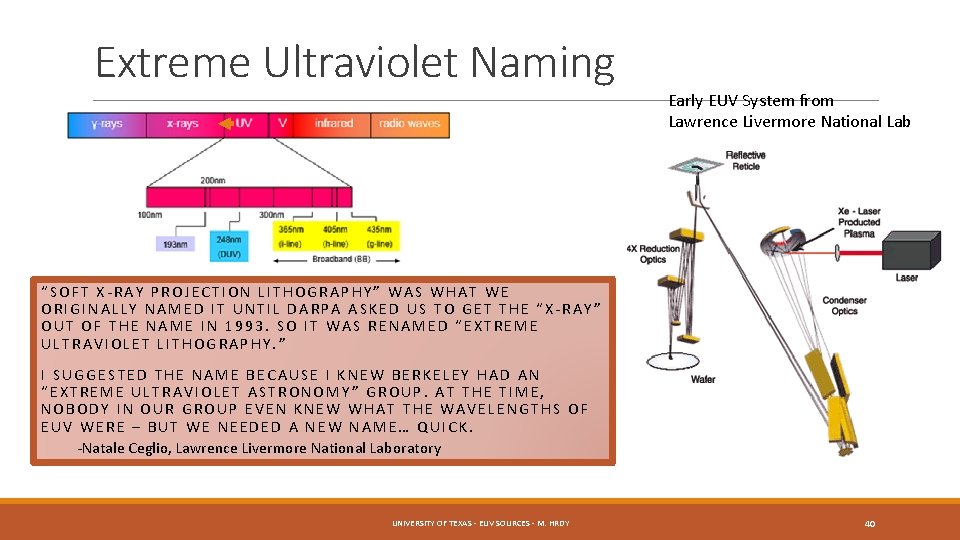
Extreme Ultraviolet Naming Early EUV System from Lawrence Livermore National Lab “SOFT X-RAY PROJECTION LITHOGRAPHY” WAS WHAT WE ORIGINALLY NAMED IT UNTIL DARPA ASKED US TO GET THE “X-RAY” OUT OF THE NAME IN 1993. SO IT WAS RENAMED “EXTREME ULTRAVIOLET LITHOGRAPHY. ” I SUGGESTED THE NAME BECAUSE I KNEW BERKELEY HAD AN “EXTREME ULTRAVIOLET ASTRONOMY” GROUP. AT THE TIME, NOBODY IN OUR GROUP EVEN KNEW WHAT THE WAVELENGTHS OF EUV WERE – BUT WE NEEDED A NEW NAME… QUICK. -Natale Ceglio, Lawrence Livermore National Laboratory UNIVERSITY OF TEXAS - EUV SOURCES - M. HRDY 40
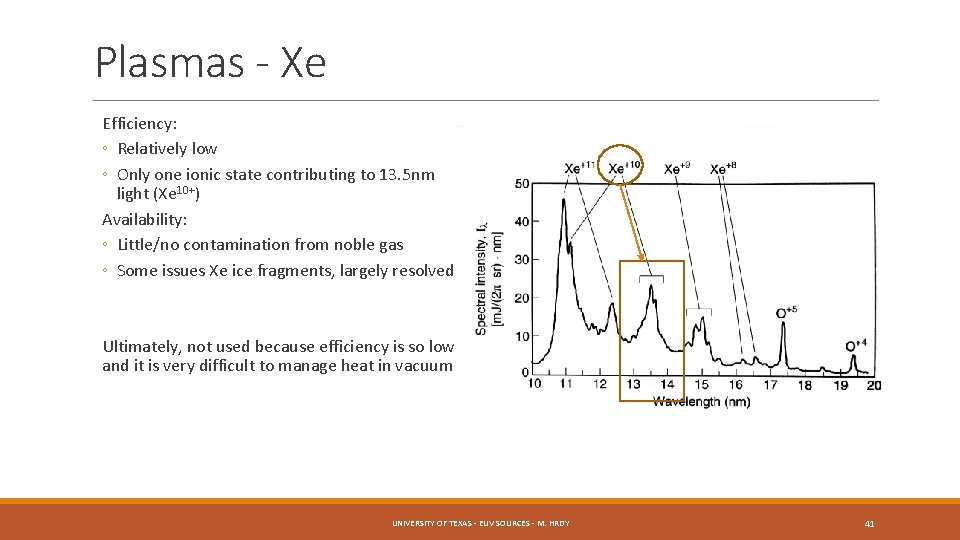
Plasmas - Xe Efficiency: ◦ Relatively low ◦ Only one ionic state contributing to 13. 5 nm light (Xe 10+) Availability: ◦ Little/no contamination from noble gas ◦ Some issues Xe ice fragments, largely resolved Ultimately, not used because efficiency is so low and it is very difficult to manage heat in vacuum UNIVERSITY OF TEXAS - EUV SOURCES - M. HRDY 41
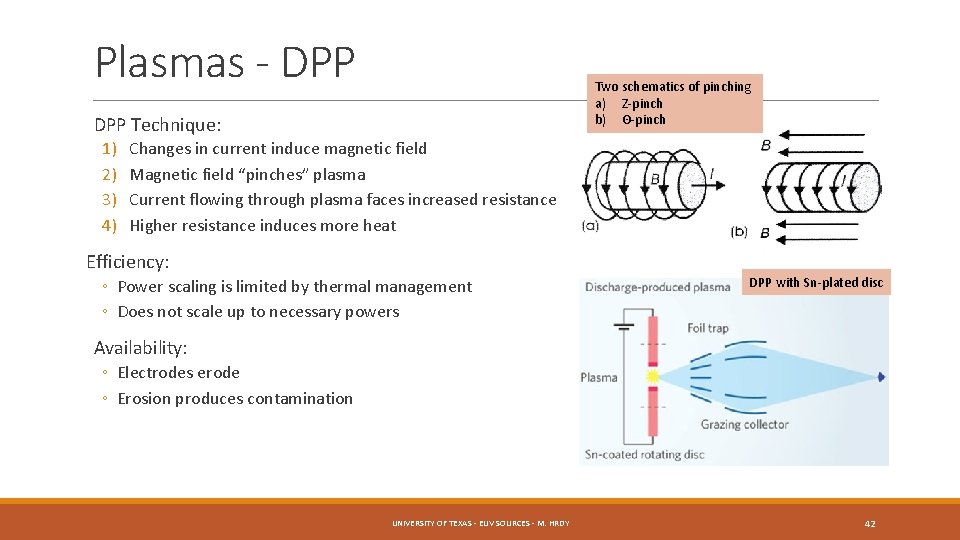
Plasmas - DPP Two schematics of pinching a) Z-pinch b) Θ-pinch DPP Technique: 1) 2) 3) 4) Changes in current induce magnetic field Magnetic field “pinches” plasma Current flowing through plasma faces increased resistance Higher resistance induces more heat Efficiency: ◦ Power scaling is limited by thermal management ◦ Does not scale up to necessary powers DPP with Sn-plated disc Availability: ◦ Electrodes erode ◦ Erosion produces contamination UNIVERSITY OF TEXAS - EUV SOURCES - M. HRDY 42
- Slides: 42