
Extreme scale parallel and distributed systems High performance
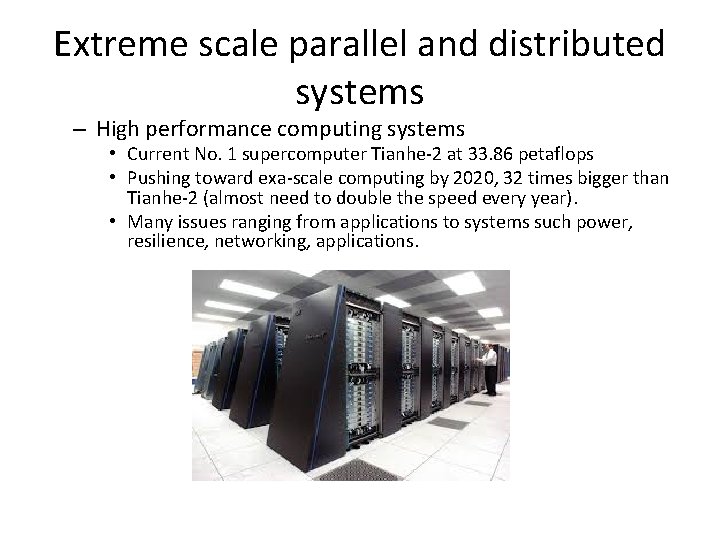
Extreme scale parallel and distributed systems – High performance computing systems • Current No. 1 supercomputer Tianhe-2 at 33. 86 petaflops • Pushing toward exa-scale computing by 2020, 32 times bigger than Tianhe-2 (almost need to double the speed every year). • Many issues ranging from applications to systems such power, resilience, networking, applications.
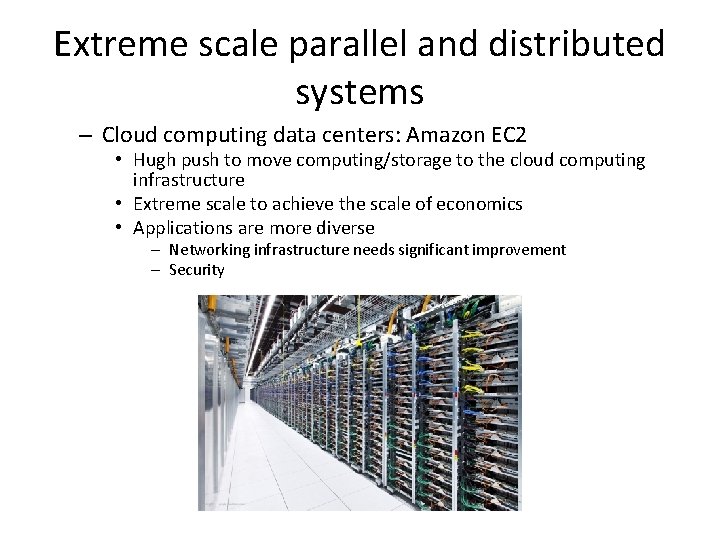
Extreme scale parallel and distributed systems – Cloud computing data centers: Amazon EC 2 • Hugh push to move computing/storage to the cloud computing infrastructure • Extreme scale to achieve the scale of economics • Applications are more diverse – Networking infrastructure needs significant improvement – Security
Extreme scale parallel and distributed systems – Big data platforms: hadoop cluster? • Huge hype • Not clear what is beyond the traditional HPC and cloud computing platforms.
Issues related to extreme scale systems • How to use the systems – Programming paradigms • What changes when the scale becomes big? • How to build the systems – Hardware and systems issues • What changes when the scale becomes big?
Programming for extreme scale PDS • Ease of use. vs. performance • Distributed memory programming – Message Passing Interface (MPI) – Mapreduce (Hadoop) • Hybrid shared memory and distributed memory programming – Matching the architecture -- CMP+SMP clusters – Hybrid Open. MP+MPI • GPU/MIC programming and hybrid programming – More potential to achieve exa-scale within power limit – GPU, MIC – Hybrid GPU/MIC + MPI
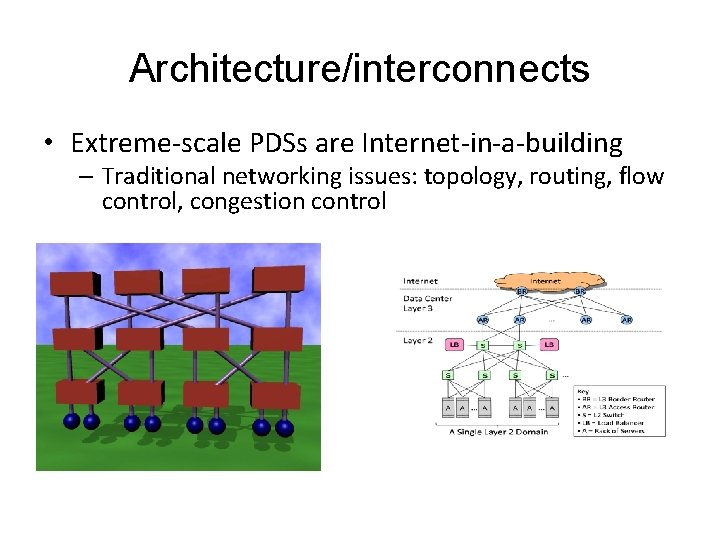
Architecture/interconnects • Extreme-scale PDSs are Internet-in-a-building – Traditional networking issues: topology, routing, flow control, congestion control
Architecture/interconnects • Current and Emerging network architectures – Infini. Band 10/100 -G E (technology) – Openflow and software defined networks (network architecture) – Recent topology/routing proposals for extreme scale systems • Achieving performance requirement with the budget constraints.
System software and communication sub-systems – Parallel IO systems – Topology aware job allocation and node mapping – Communication protocols – One-sided. vs. two-sided communications – Collective communication algorithms
Performance models and evaluation methods • Performance modeling techniques for networks/systems/applications. • Workload characterization. • Application tracing • Challenges in simulation and modeling of large scale systems using realistic workloads
Resilience and power-awareness • System and application resilience techniques and analysis • Fault tolerance techniques in hardware and software • Resource management for system resilience and availability. • Energy efficient HPC • Energy efficient data centers
This course • Targets students who are interested in research and development in large scale sytems. – Go through the recent advances in these subjects, and bring you up-to-date in research in this area in general. – Introduce software, algorithmic, and analytical tools and techniques that are necessary to perform research in this area.
- Slides: 11