
Extreme High Vacuum The Need Production and Measurement

- Slides: 31
Extreme High Vacuum: The Need, Production, and Measurement Marcy Stutzman, Philip Adderley, Matt Poelker Thomas Jefferson National Accelerator Facility (Jefferson Lab) Polarized Electron Gun Group Newport News, Virginia Run by JSA for the US DOE
What is XHV • Extreme High Vacuum P < 1 x 10 -10 Pa = 1 x 10 -12 mbar = 7. 5 x 10 -13 Torr • Baked, metal systems, low outgassing, coatings to reduce outgassing • Combinations of pumping Ion, Getter, Cryo, Titanium Sublimation, Turbo • Measurement: Ionization gauges Thomas Jefferson National Accelerator Facility Operated by JSA for the US DOE Marcy Stutzman AVS 53 rd International Symposium 14 November 2006
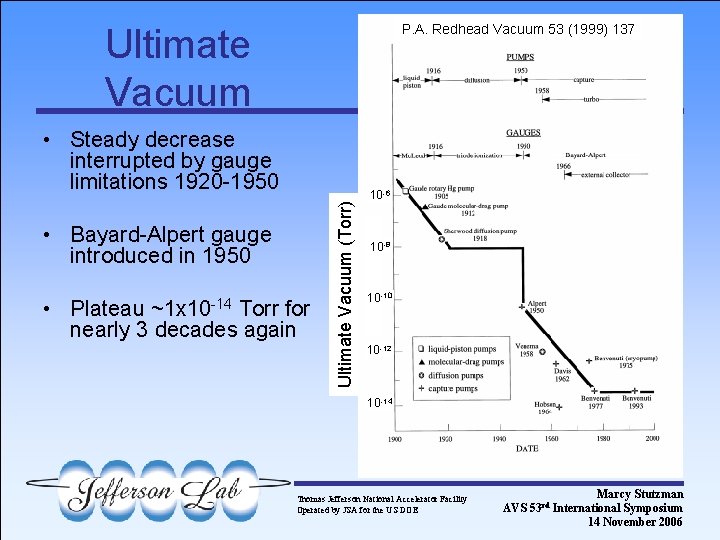
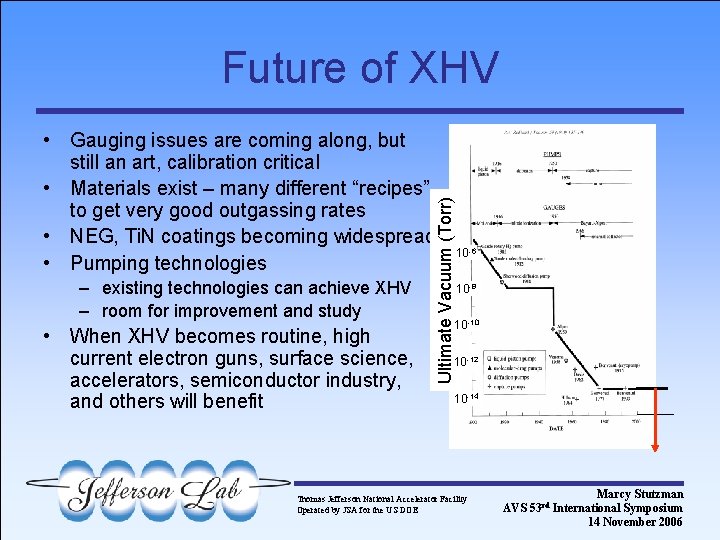
P. A. Redhead Vacuum 53 (1999) 137 Ultimate Vacuum • Bayard-Alpert gauge introduced in 1950 • Plateau Torr for nearly 3 decades again ~1 x 10 -14 Ultimate Vacuum (Torr) • Steady decrease interrupted by gauge limitations 1920 -1950 10 -6 10 -8 10 -10 10 -12 10 -14 Thomas Jefferson National Accelerator Facility Operated by JSA for the US DOE Marcy Stutzman AVS 53 rd International Symposium 14 November 2006
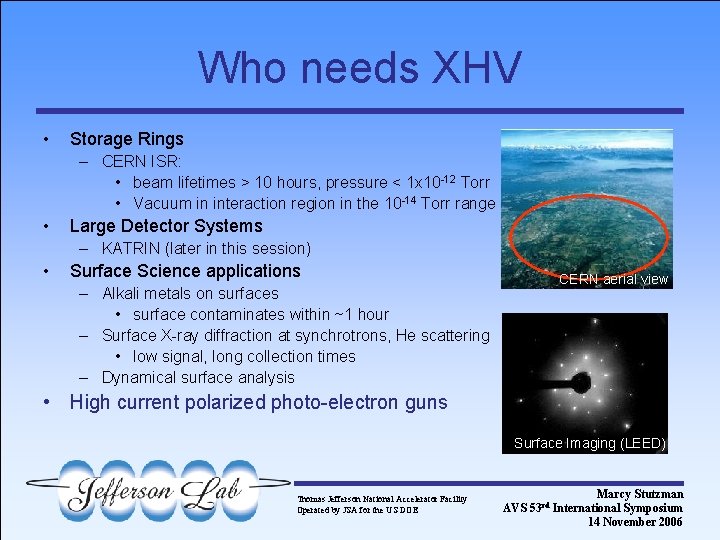
Who needs XHV • Storage Rings – CERN ISR: • beam lifetimes > 10 hours, pressure < 1 x 10 -12 Torr • Vacuum in interaction region in the 10 -14 Torr range • Large Detector Systems – KATRIN (later in this session) • Surface Science applications – Alkali metals on surfaces • surface contaminates within ~1 hour – Surface X-ray diffraction at synchrotrons, He scattering • low signal, long collection times – Dynamical surface analysis CERN aerial view • High current polarized photo-electron guns Surface Imaging (LEED) Thomas Jefferson National Accelerator Facility Operated by JSA for the US DOE Marcy Stutzman AVS 53 rd International Symposium 14 November 2006
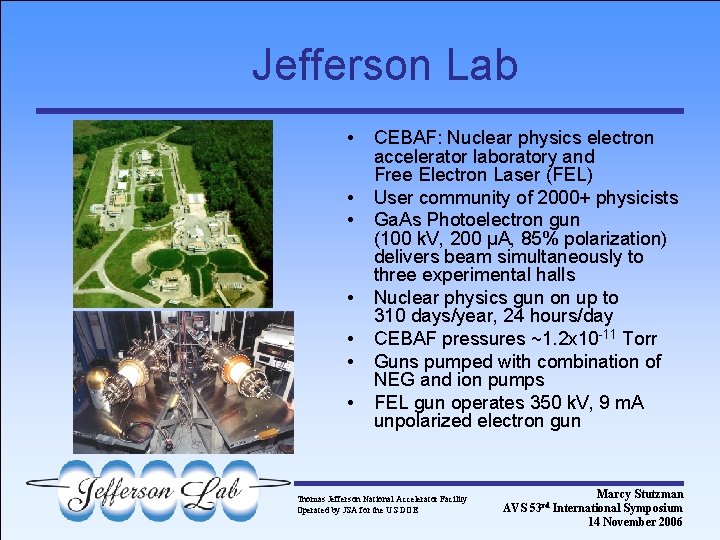
Jefferson Lab • • CEBAF: Nuclear physics electron accelerator laboratory and Free Electron Laser (FEL) User community of 2000+ physicists Ga. As Photoelectron gun (100 k. V, 200 μA, 85% polarization) delivers beam simultaneously to three experimental halls Nuclear physics gun on up to 310 days/year, 24 hours/day CEBAF pressures ~1. 2 x 10 -11 Torr Guns pumped with combination of NEG and ion pumps FEL gun operates 350 k. V, 9 m. A unpolarized electron gun Thomas Jefferson National Accelerator Facility Operated by JSA for the US DOE Marcy Stutzman AVS 53 rd International Symposium 14 November 2006
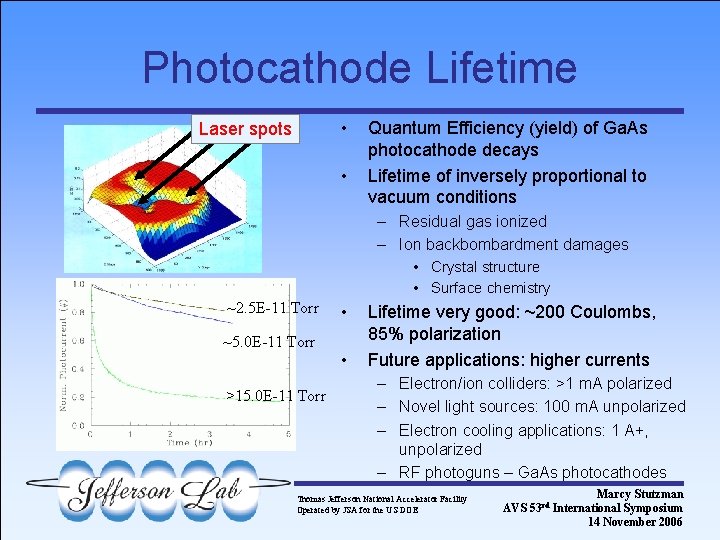
Photocathode Lifetime • Laser spots • Quantum Efficiency (yield) of Ga. As photocathode decays Lifetime of inversely proportional to vacuum conditions – Residual gas ionized – Ion backbombardment damages • Crystal structure • Surface chemistry ~2. 5 E-11 Torr ~5. 0 E-11 Torr >15. 0 E-11 Torr • • Lifetime very good: ~200 Coulombs, 85% polarization Future applications: higher currents – Electron/ion colliders: >1 m. A polarized – Novel light sources: 100 m. A unpolarized – Electron cooling applications: 1 A+, unpolarized – RF photoguns – Ga. As photocathodes Thomas Jefferson National Accelerator Facility Operated by JSA for the US DOE Marcy Stutzman AVS 53 rd International Symposium 14 November 2006
Materials and Preparation • Low outgassing – – Stainless Steel Titanium alloys Aluminum OFHC Copper, Cu/Be alloys • 300 series austenitic steels (304 L, 316 LN) – low carbon, 316 series adds Mo for strength • Coatings to reduce outgassing • Coatings to add pumping Thomas Jefferson National Accelerator Facility Operated by JSA for the US DOE Marcy Stutzman AVS 53 rd International Symposium 14 November 2006
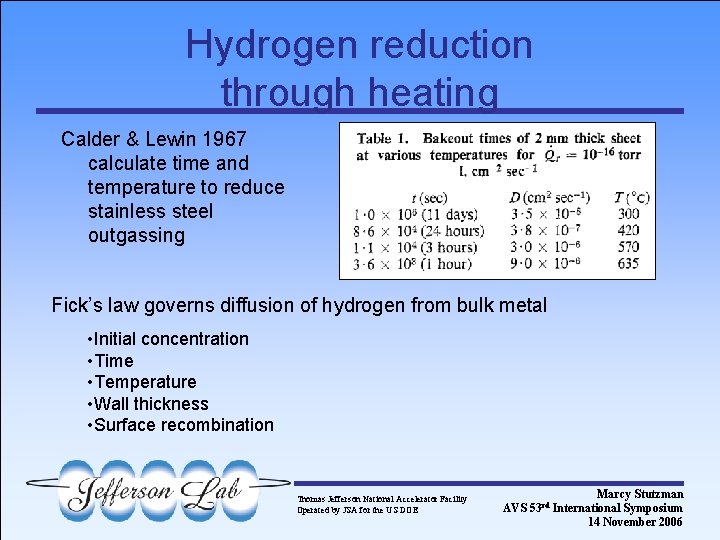
Hydrogen reduction through heating Calder & Lewin 1967 calculate time and temperature to reduce stainless steel outgassing Fick’s law governs diffusion of hydrogen from bulk metal • Initial concentration • Time • Temperature • Wall thickness • Surface recombination Thomas Jefferson National Accelerator Facility Operated by JSA for the US DOE Marcy Stutzman AVS 53 rd International Symposium 14 November 2006
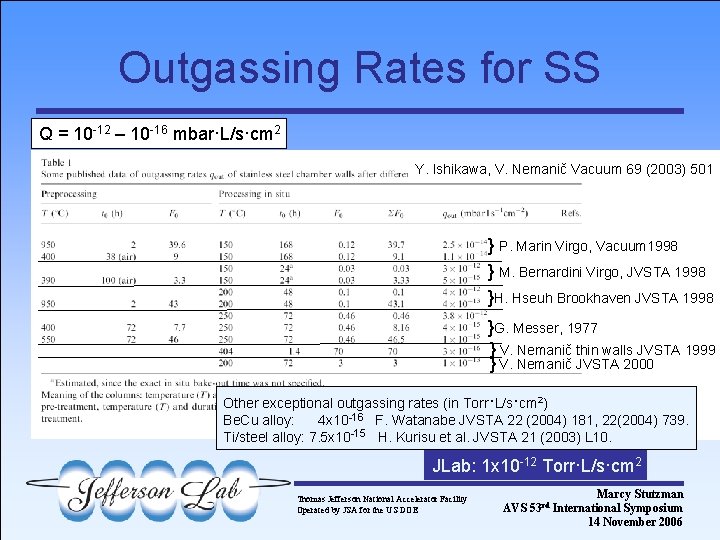
Outgassing Rates for SS Q = 10 -12 – 10 -16 mbar·L/s·cm 2 Y. Ishikawa, V. Nemanič Vacuum 69 (2003) 501 } P. Marin Virgo, Vacuum 1998 } M. Bernardini Virgo, JVSTA 1998 }H. Hseuh Brookhaven JVSTA 1998 }G. Messer, 1977 } V. Nemanič thin walls JVSTA 1999 } V. Nemanič JVSTA 2000 Other exceptional outgassing rates (in Torr·L/s·cm 2) Be. Cu alloy: 4 x 10 -16 F. Watanabe JVSTA 22 (2004) 181, 22(2004) 739. Ti/steel alloy: 7. 5 x 10 -15 H. Kurisu et al. JVSTA 21 (2003) L 10. JLab: 1 x 10 -12 Torr·L/s·cm 2 Thomas Jefferson National Accelerator Facility Operated by JSA for the US DOE Marcy Stutzman AVS 53 rd International Symposium 14 November 2006
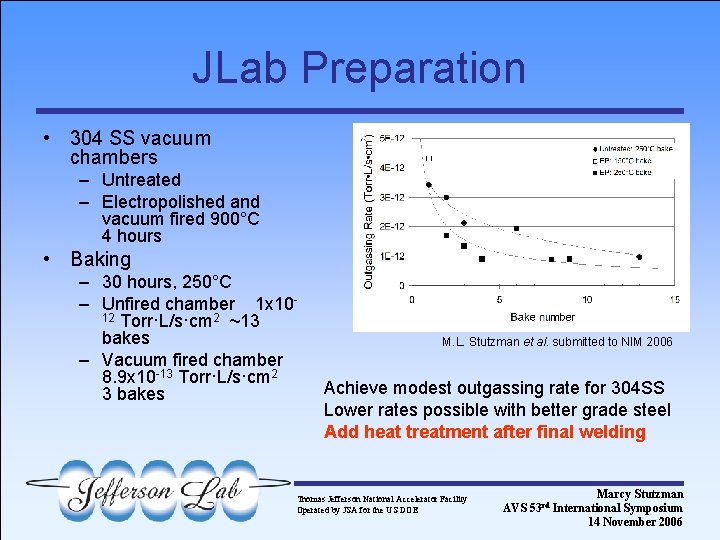
JLab Preparation • 304 SS vacuum chambers – Untreated – Electropolished and vacuum fired 900°C 4 hours • Baking – 30 hours, 250°C – Unfired chamber 1 x 10¹² Torr·L/s·cm 2 ~13 bakes – Vacuum fired chamber 8. 9 x 10 -13 Torr·L/s·cm 2 3 bakes M. L. Stutzman et al. submitted to NIM 2006 Achieve modest outgassing rate for 304 SS Lower rates possible with better grade steel Add heat treatment after final welding Thomas Jefferson National Accelerator Facility Operated by JSA for the US DOE Marcy Stutzman AVS 53 rd International Symposium 14 November 2006
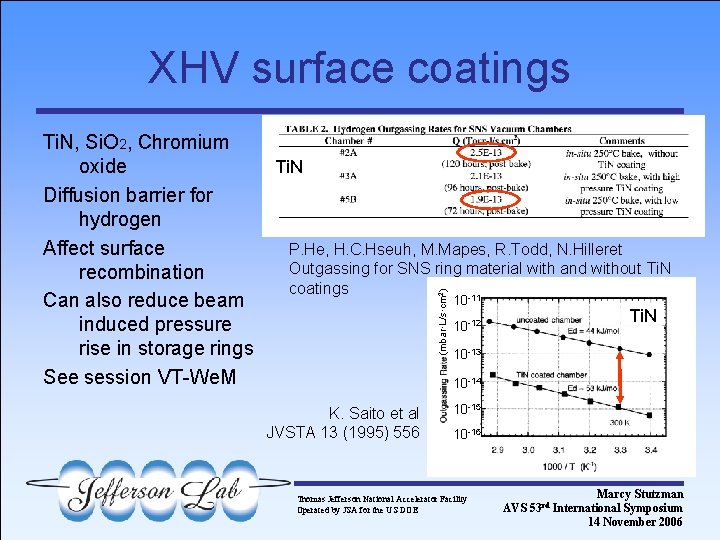
XHV surface coatings Ti. N P. He, H. C. Hseuh, M. Mapes, R. Todd, N. Hilleret Outgassing for SNS ring material with and without Ti. N coatings -11 (mbar·L/s·cm 2) Ti. N, Si. O 2, Chromium oxide Diffusion barrier for hydrogen Affect surface recombination Can also reduce beam induced pressure rise in storage rings See session VT-We. M 10 10 -12 Ti. N 10 -13 10 -14 K. Saito et al JVSTA 13 (1995) 556 10 -15 10 -16 Thomas Jefferson National Accelerator Facility Operated by JSA for the US DOE Marcy Stutzman AVS 53 rd International Symposium 14 November 2006
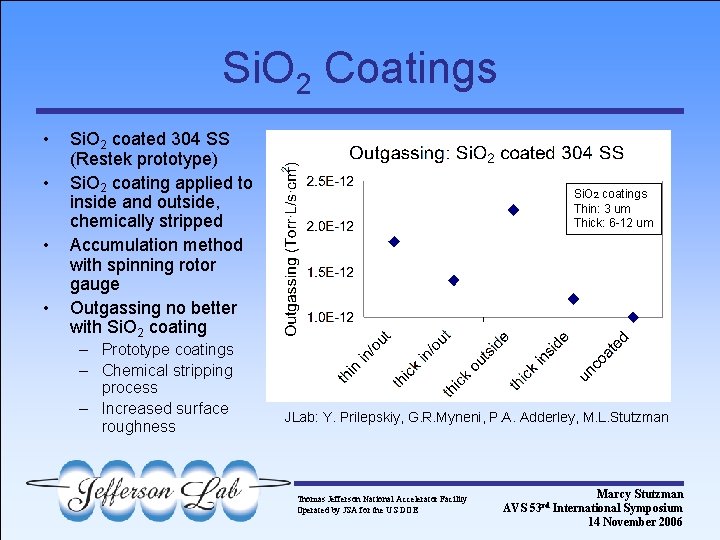
Si. O 2 Coatings • • Si. O 2 coated 304 SS (Restek prototype) Si. O 2 coating applied to inside and outside, chemically stripped Accumulation method with spinning rotor gauge Outgassing no better with Si. O 2 coating – Prototype coatings – Chemical stripping process – Increased surface roughness Si. O 2 coatings Thin: 3 um Thick: 6 -12 um JLab: Y. Prilepskiy, G. R. Myneni, P. A. Adderley, M. L. Stutzman Thomas Jefferson National Accelerator Facility Operated by JSA for the US DOE Marcy Stutzman AVS 53 rd International Symposium 14 November 2006
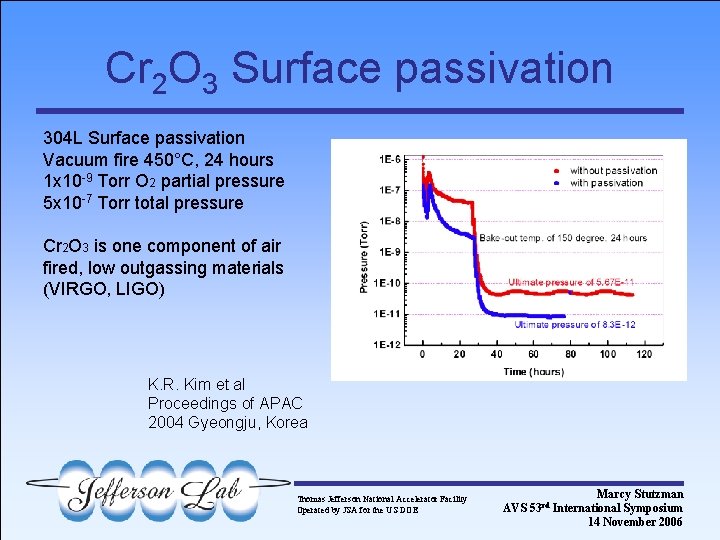
Cr 2 O 3 Surface passivation 304 L Surface passivation Vacuum fire 450°C, 24 hours 1 x 10 -9 Torr O 2 partial pressure 5 x 10 -7 Torr total pressure Cr 2 O 3 is one component of air fired, low outgassing materials (VIRGO, LIGO) K. R. Kim et al Proceedings of APAC 2004 Gyeongju, Korea Thomas Jefferson National Accelerator Facility Operated by JSA for the US DOE Marcy Stutzman AVS 53 rd International Symposium 14 November 2006
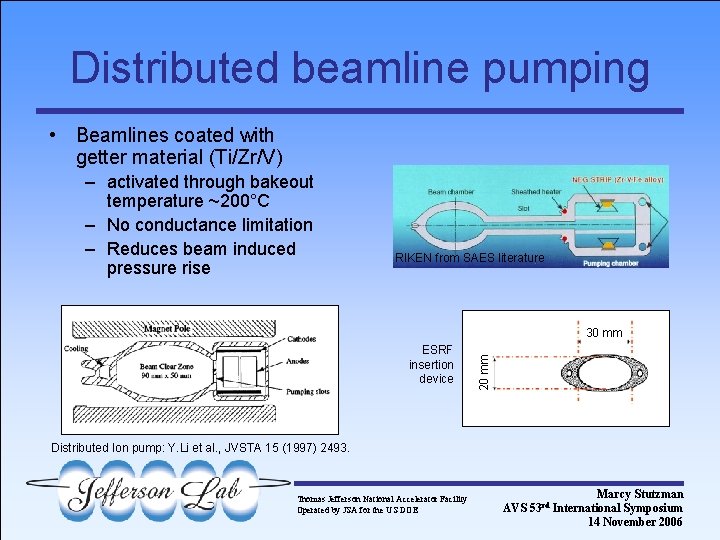
Distributed beamline pumping • Beamlines coated with getter material (Ti/Zr/V) – activated through bakeout temperature ~200°C – No conductance limitation – Reduces beam induced pressure rise RIKEN from SAES literature ESRF insertion device 20 mm 30 mm Distributed Ion pump: Y. Li et al. , JVSTA 15 (1997) 2493. Thomas Jefferson National Accelerator Facility Operated by JSA for the US DOE Marcy Stutzman AVS 53 rd International Symposium 14 November 2006
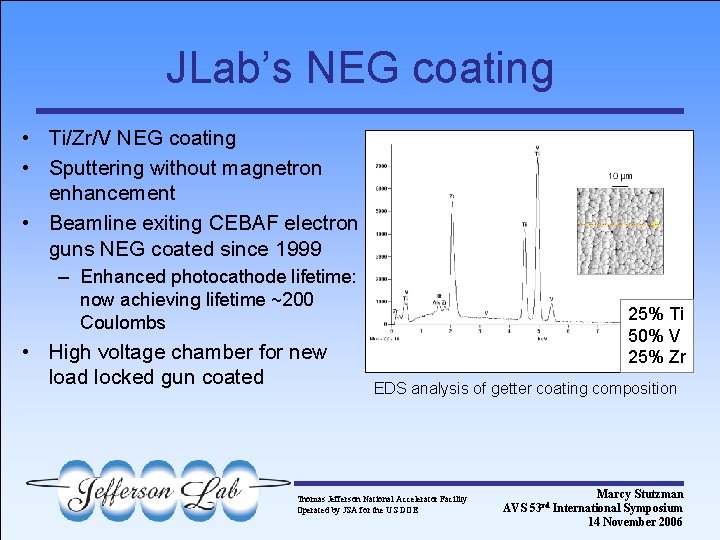
JLab’s NEG coating • Ti/Zr/V NEG coating • Sputtering without magnetron enhancement • Beamline exiting CEBAF electron guns NEG coated since 1999 – Enhanced photocathode lifetime: now achieving lifetime ~200 Coulombs • High voltage chamber for new load locked gun coated 25% Ti 50% V 25% Zr EDS analysis of getter coating composition Thomas Jefferson National Accelerator Facility Operated by JSA for the US DOE Marcy Stutzman AVS 53 rd International Symposium 14 November 2006
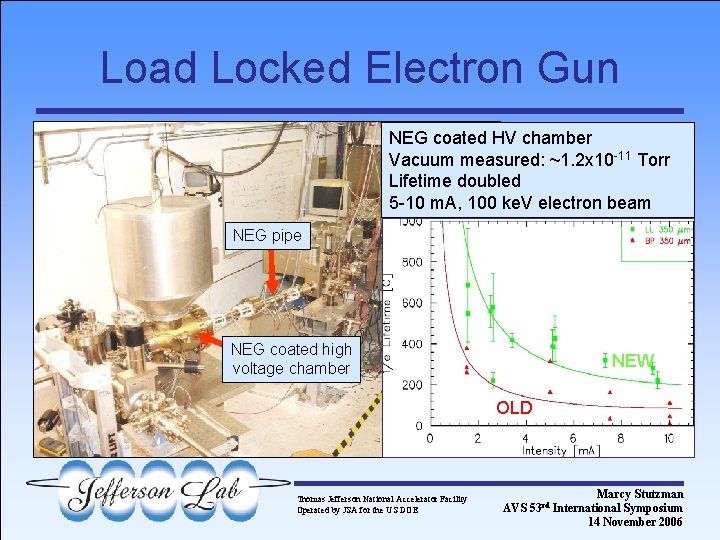
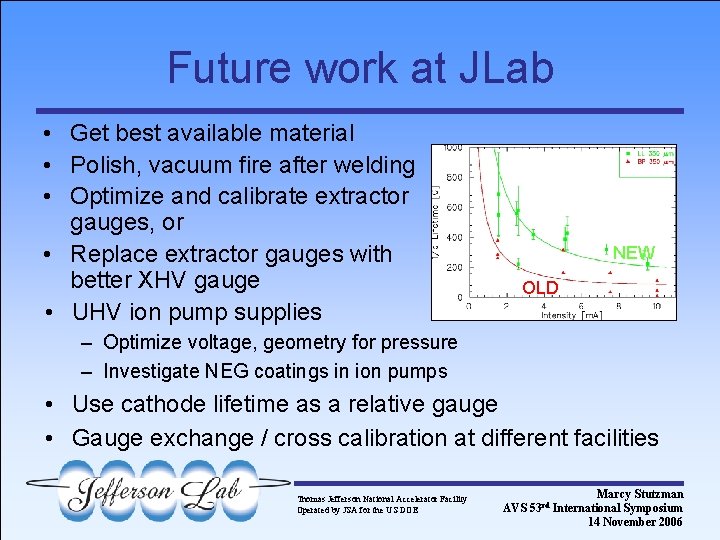
Load Locked Electron Gun NEG coated HV chamber Vacuum measured: ~1. 2 x 10 -11 Torr Lifetime doubled 5 -10 m. A, 100 ke. V electron beam NEG pipe NEG coated high voltage chamber NEW OLD Thomas Jefferson National Accelerator Facility Operated by JSA for the US DOE Marcy Stutzman AVS 53 rd International Symposium 14 November 2006
Pumps for XHV • Ion pumps – Ion pump performance vs. voltage – Ion pump current monitor at UHV pressures – Getter coating ion pumps • NEG – Great pumping for hydrogen, also pumps CO, N 2 – Don’t pump methane, noble gasses – Question about pump speed at base pressure • Ti Sublimation • Cryo pumps • Turbo pumps – cascaded pumps Thomas Jefferson National Accelerator Facility Operated by JSA for the US DOE Marcy Stutzman AVS 53 rd International Symposium 14 November 2006
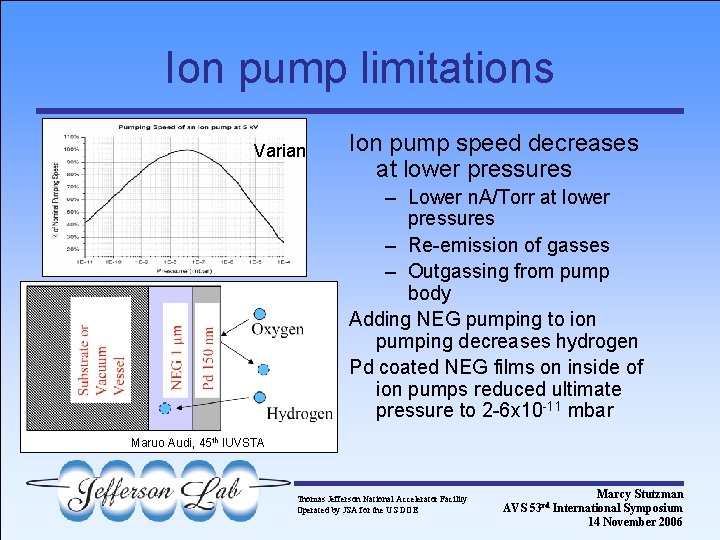
Ion pump limitations Varian Ion pump speed decreases at lower pressures – Lower n. A/Torr at lower pressures – Re-emission of gasses – Outgassing from pump body Adding NEG pumping to ion pumping decreases hydrogen Pd coated NEG films on inside of ion pumps reduced ultimate pressure to 2 -6 x 10 -11 mbar Maruo Audi, 45 th IUVSTA Thomas Jefferson National Accelerator Facility Operated by JSA for the US DOE Marcy Stutzman AVS 53 rd International Symposium 14 November 2006
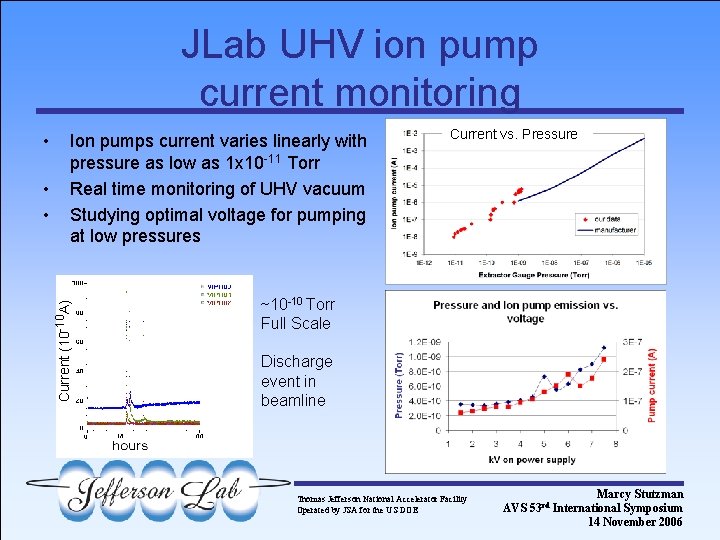
JLab UHV ion pump current monitoring • • Ion pumps current varies linearly with pressure as low as 1 x 10 -11 Torr Real time monitoring of UHV vacuum Studying optimal voltage for pumping at low pressures Current (10 -10 A) • Current vs. Pressure ~10 -10 Torr Full Scale Discharge event in beamline Thomas Jefferson National Accelerator Facility Operated by JSA for the US DOE Marcy Stutzman AVS 53 rd International Symposium 14 November 2006
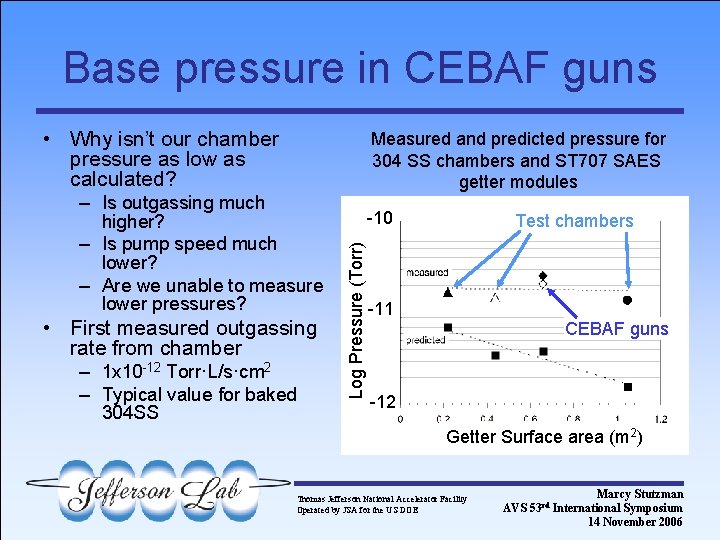
Base pressure in CEBAF guns • Why isn’t our chamber pressure as low as calculated? • First measured outgassing rate from chamber – 1 x 10 -12 Torr·L/s·cm 2 – Typical value for baked 304 SS -10 Log Pressure (Torr) – Is outgassing much higher? – Is pump speed much lower? – Are we unable to measure lower pressures? Measured and predicted pressure for 304 SS chambers and ST 707 SAES getter modules Test chambers -11 CEBAF guns -12 Getter Surface area (m 2) Thomas Jefferson National Accelerator Facility Operated by JSA for the US DOE Marcy Stutzman AVS 53 rd International Symposium 14 November 2006
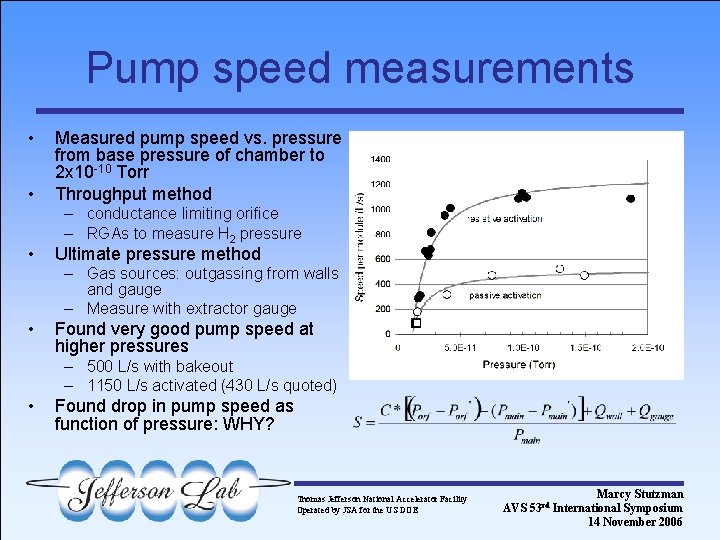
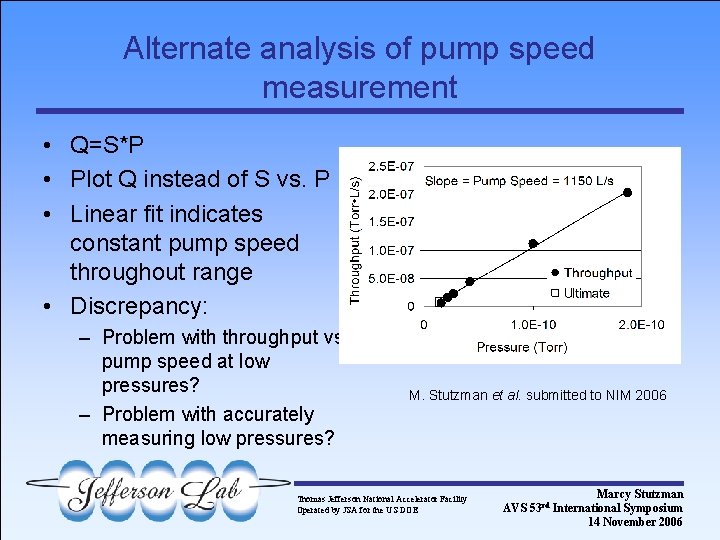
Pump speed measurements • • • Measured pump speed vs. pressure from base pressure of chamber to 2 x 10 -10 Torr Throughput method – conductance limiting orifice – RGAs to measure H 2 pressure Ultimate pressure method – Gas sources: outgassing from walls and gauge – Measure with extractor gauge • Found very good pump speed at higher pressures – 500 L/s with bakeout – 1150 L/s activated (430 L/s quoted) • Found drop in pump speed as function of pressure: WHY? Thomas Jefferson National Accelerator Facility Operated by JSA for the US DOE Marcy Stutzman AVS 53 rd International Symposium 14 November 2006
Alternate analysis of pump speed measurement • Q=S*P • Plot Q instead of S vs. P • Linear fit indicates constant pump speed throughout range • Discrepancy: – Problem with throughput vs. pump speed at low pressures? – Problem with accurately measuring low pressures? M. Stutzman et al. submitted to NIM 2006 Thomas Jefferson National Accelerator Facility Operated by JSA for the US DOE Marcy Stutzman AVS 53 rd International Symposium 14 November 2006
XHV Pressure Measurement • Ionization Gauges – Hot Cathode: Extractor, Improved Helmer, Axtran, Modulated BA, spectroscopy and bent beam gauges – Cold Cathode: Magnetron, inverted magnetron, double inverted magnetron – Laser ionization gauges • X-ray limits • Electron stimulated desorption limits • Gauge outgassing Thomas Jefferson National Accelerator Facility Operated by JSA for the US DOE Marcy Stutzman AVS 53 rd International Symposium 14 November 2006
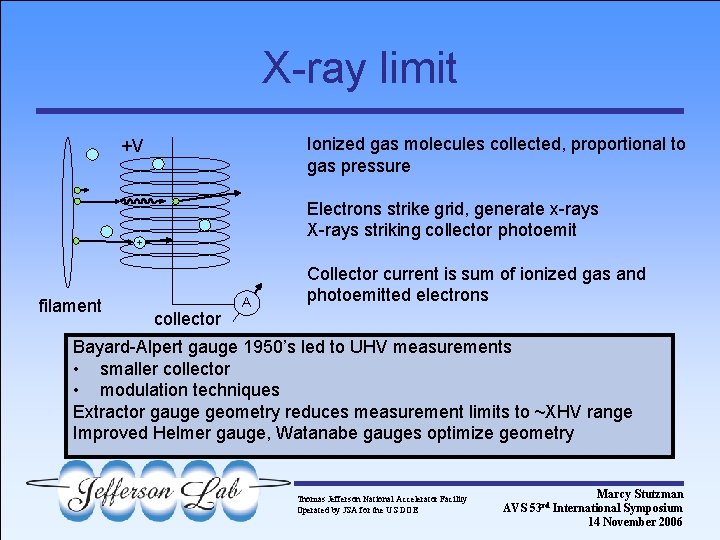
X-ray limit Ionized gas molecules collected, proportional to gas pressure +V Electrons strike grid, generate x-rays X-rays striking collector photoemit + filament collector A Collector current is sum of ionized gas and photoemitted electrons Bayard-Alpert gauge 1950’s led to UHV measurements • smaller collector • modulation techniques Extractor gauge geometry reduces measurement limits to ~XHV range Improved Helmer gauge, Watanabe gauges optimize geometry Thomas Jefferson National Accelerator Facility Operated by JSA for the US DOE Marcy Stutzman AVS 53 rd International Symposium 14 November 2006
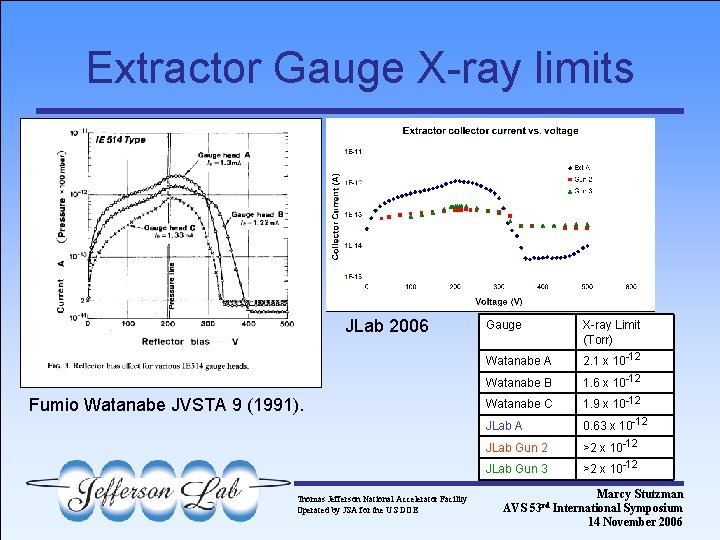
Extractor Gauge X-ray limits JLab 2006 Fumio Watanabe JVSTA 9 (1991). Thomas Jefferson National Accelerator Facility Operated by JSA for the US DOE Gauge X-ray Limit (Torr) Watanabe A 2. 1 x 10 -12 Watanabe B 1. 6 x 10 -12 Watanabe C 1. 9 x 10 -12 JLab A 0. 63 x 10 -12 JLab Gun 2 >2 x 10 -12 JLab Gun 3 >2 x 10 -12 Marcy Stutzman AVS 53 rd International Symposium 14 November 2006
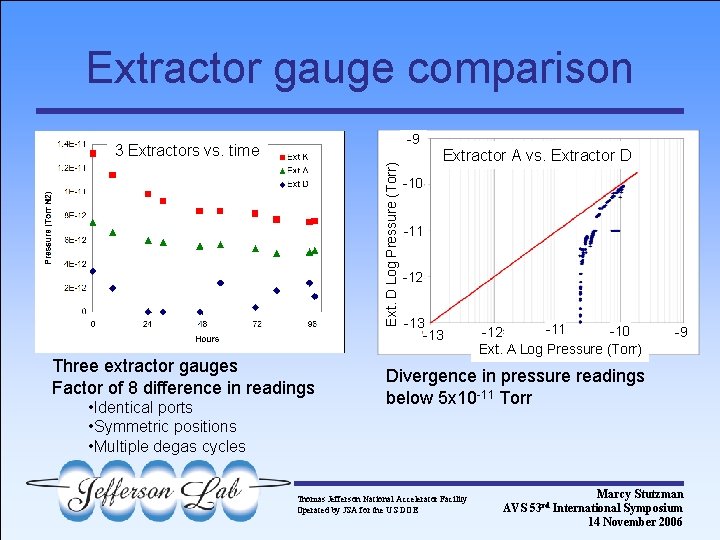
Extractor gauge comparison -9 Ext. D Log Pressure (Torr) 3 Extractors vs. time Three extractor gauges Factor of 8 difference in readings • Identical ports • Symmetric positions • Multiple degas cycles Extractor A vs. Extractor D -10 -11 -12 -13 -11 -10 -12 Ext. A Log Pressure (Torr) -9 Divergence in pressure readings below 5 x 10 -11 Torr Thomas Jefferson National Accelerator Facility Operated by JSA for the US DOE Marcy Stutzman AVS 53 rd International Symposium 14 November 2006
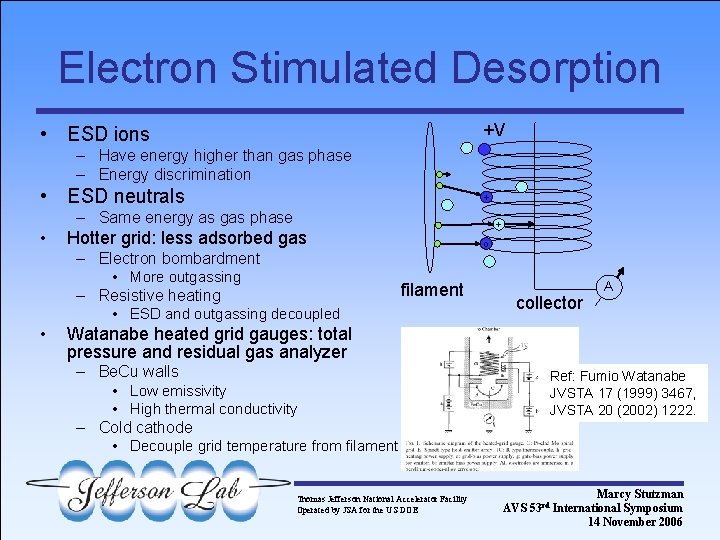
Electron Stimulated Desorption +V • ESD ions – Have energy higher than gas phase – Energy discrimination • ESD neutrals + – Same energy as gas phase • + Hotter grid: less adsorbed gas o – Electron bombardment • More outgassing – Resistive heating • ESD and outgassing decoupled • filament collector A Watanabe heated grid gauges: total pressure and residual gas analyzer – Be. Cu walls • Low emissivity • High thermal conductivity – Cold cathode • Decouple grid temperature from filament Thomas Jefferson National Accelerator Facility Operated by JSA for the US DOE Ref: Fumio Watanabe JVSTA 17 (1999) 3467, JVSTA 20 (2002) 1222. Marcy Stutzman AVS 53 rd International Symposium 14 November 2006
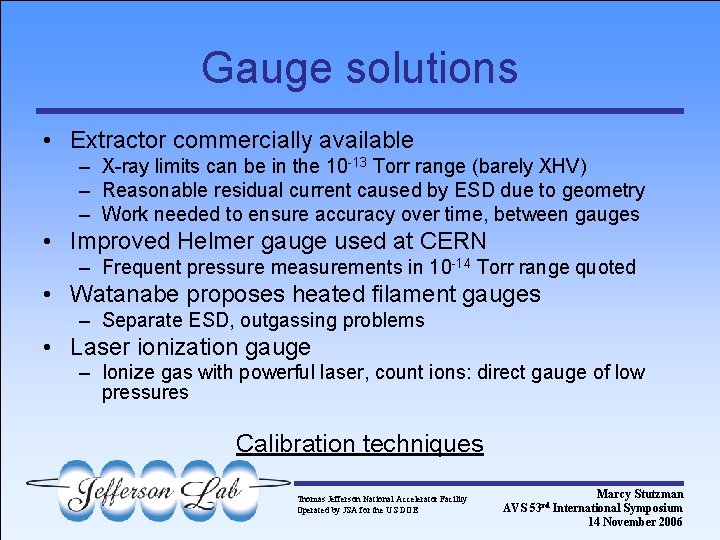
Gauge solutions • Extractor commercially available – X-ray limits can be in the 10 -13 Torr range (barely XHV) – Reasonable residual current caused by ESD due to geometry – Work needed to ensure accuracy over time, between gauges • Improved Helmer gauge used at CERN – Frequent pressure measurements in 10 -14 Torr range quoted • Watanabe proposes heated filament gauges – Separate ESD, outgassing problems • Laser ionization gauge – Ionize gas with powerful laser, count ions: direct gauge of low pressures Calibration techniques Thomas Jefferson National Accelerator Facility Operated by JSA for the US DOE Marcy Stutzman AVS 53 rd International Symposium 14 November 2006
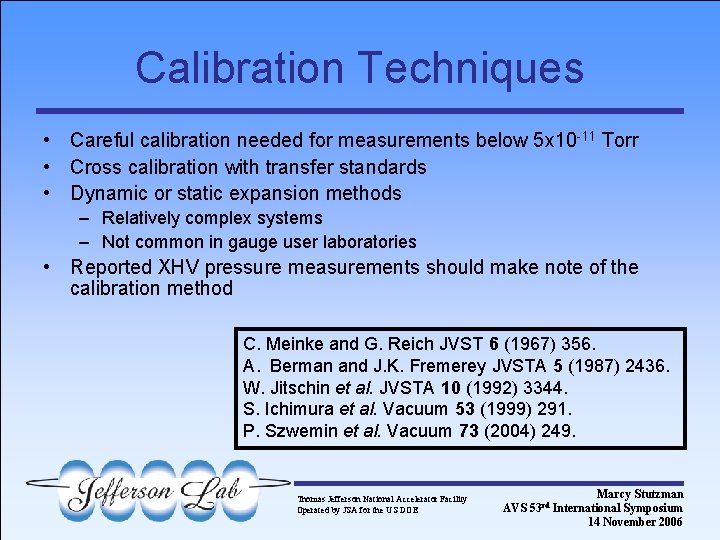
Calibration Techniques • Careful calibration needed for measurements below 5 x 10 -11 Torr • Cross calibration with transfer standards • Dynamic or static expansion methods – Relatively complex systems – Not common in gauge user laboratories • Reported XHV pressure measurements should make note of the calibration method C. Meinke and G. Reich JVST 6 (1967) 356. A. Berman and J. K. Fremerey JVSTA 5 (1987) 2436. W. Jitschin et al. JVSTA 10 (1992) 3344. S. Ichimura et al. Vacuum 53 (1999) 291. P. Szwemin et al. Vacuum 73 (2004) 249. Thomas Jefferson National Accelerator Facility Operated by JSA for the US DOE Marcy Stutzman AVS 53 rd International Symposium 14 November 2006
Future work at JLab • Get best available material • Polish, vacuum fire after welding • Optimize and calibrate extractor gauges, or • Replace extractor gauges with better XHV gauge • UHV ion pump supplies NEW OLD – Optimize voltage, geometry for pressure – Investigate NEG coatings in ion pumps • Use cathode lifetime as a relative gauge • Gauge exchange / cross calibration at different facilities Thomas Jefferson National Accelerator Facility Operated by JSA for the US DOE Marcy Stutzman AVS 53 rd International Symposium 14 November 2006
Future of XHV – existing technologies can achieve XHV – room for improvement and study • When XHV becomes routine, high current electron guns, surface science, accelerators, semiconductor industry, and others will benefit Ultimate Vacuum (Torr) • Gauging issues are coming along, but still an art, calibration critical • Materials exist – many different “recipes” to get very good outgassing rates • NEG, Ti. N coatings becoming widespread • Pumping technologies 10 -6 10 -8 10 -10 10 -12 10 -14 Thomas Jefferson National Accelerator Facility Operated by JSA for the US DOE Marcy Stutzman AVS 53 rd International Symposium 14 November 2006