
Extremal Graph Theory Ajit A Diwan Department of

- Slides: 33
Extremal Graph Theory Ajit A. Diwan Department of Computer Science and Engineering, I. I. T. Bombay. Email: aad@cse. iitb. ac. in
Basic Question • Let H be a fixed graph. • What is the maximum number of edges in a graph G with n vertices that does not contain H as a subgraph? • This number is denoted ex(n, H). • A graph G with n vertices and ex(n, H) edges that does not contain H is called an extremal graph for H.
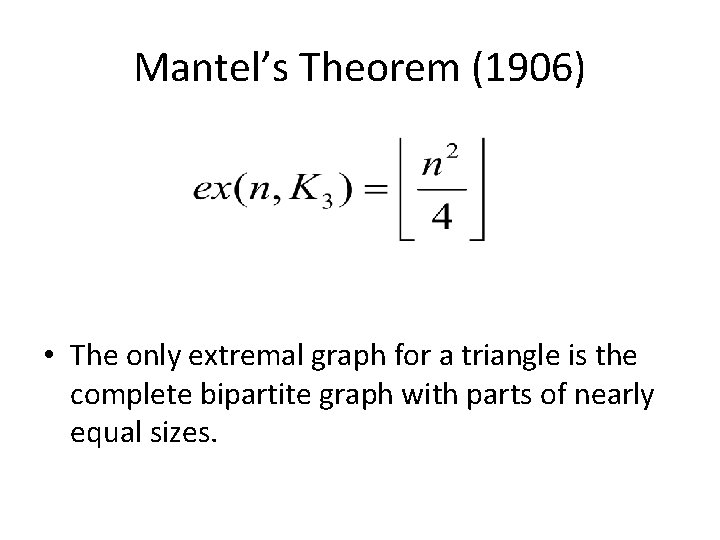
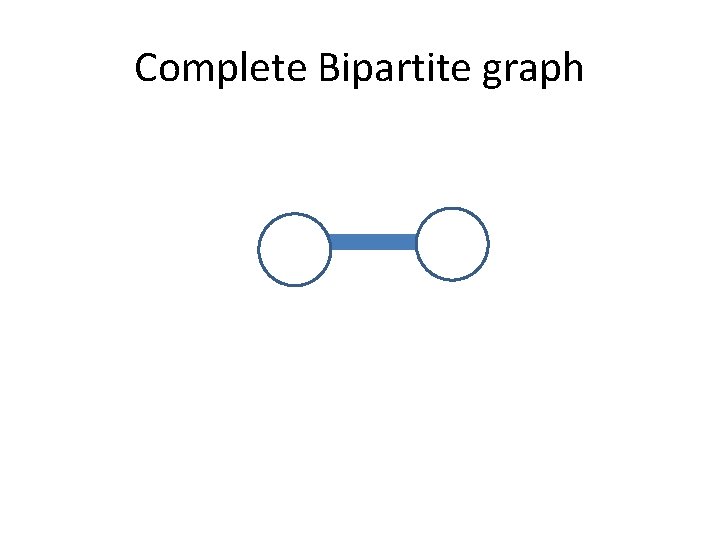
Mantel’s Theorem (1906) • The only extremal graph for a triangle is the complete bipartite graph with parts of nearly equal sizes.
Complete Bipartite graph
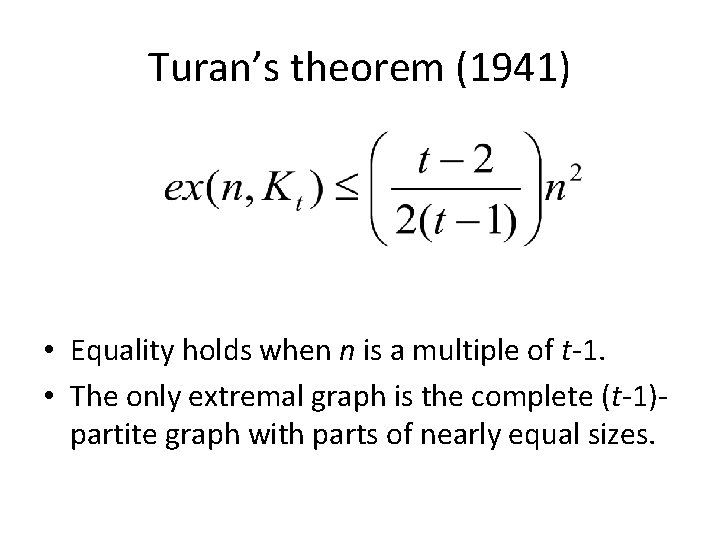
Turan’s theorem (1941) • Equality holds when n is a multiple of t-1. • The only extremal graph is the complete (t-1)partite graph with parts of nearly equal sizes.
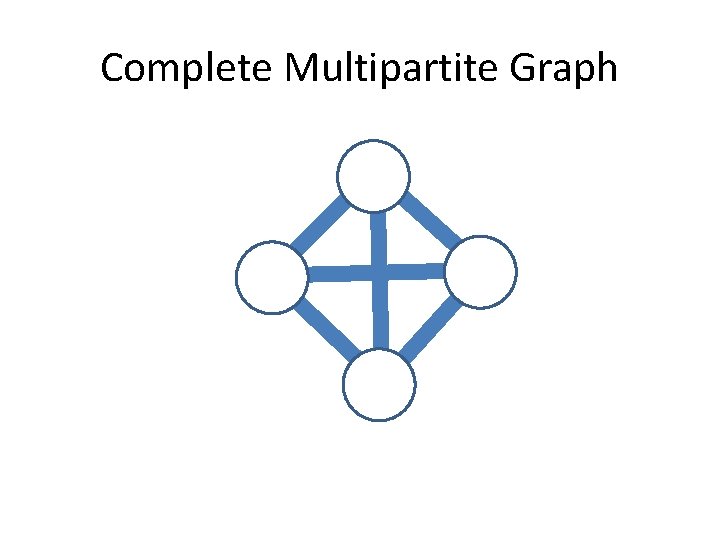
Complete Multipartite Graph
Proofs of Turan’s theorem • • • Many different proofs. Use different techniques. Techniques useful in proving other results. Algorithmic applications. “BOOK” proofs.
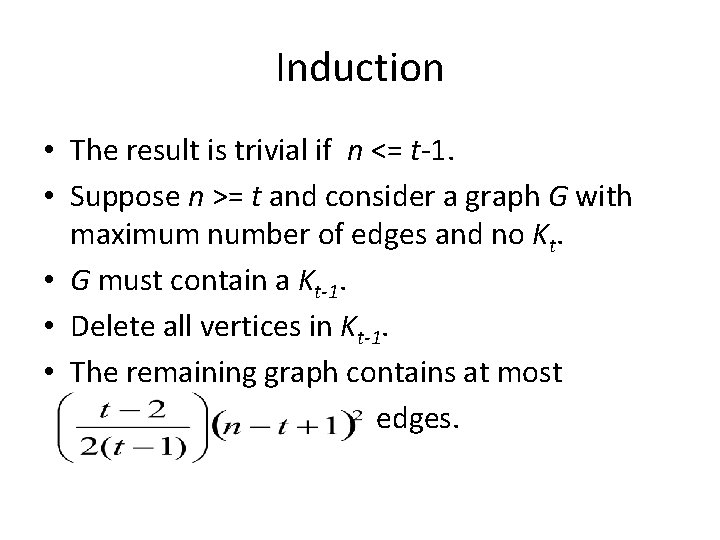
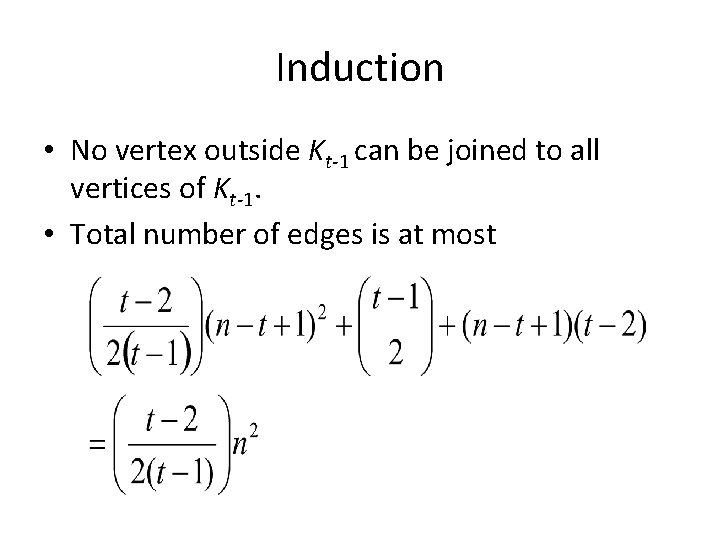
Induction • The result is trivial if n <= t-1. • Suppose n >= t and consider a graph G with maximum number of edges and no Kt. • G must contain a Kt-1. • Delete all vertices in Kt-1. • The remaining graph contains at most edges.
Induction • No vertex outside Kt-1 can be joined to all vertices of Kt-1. • Total number of edges is at most
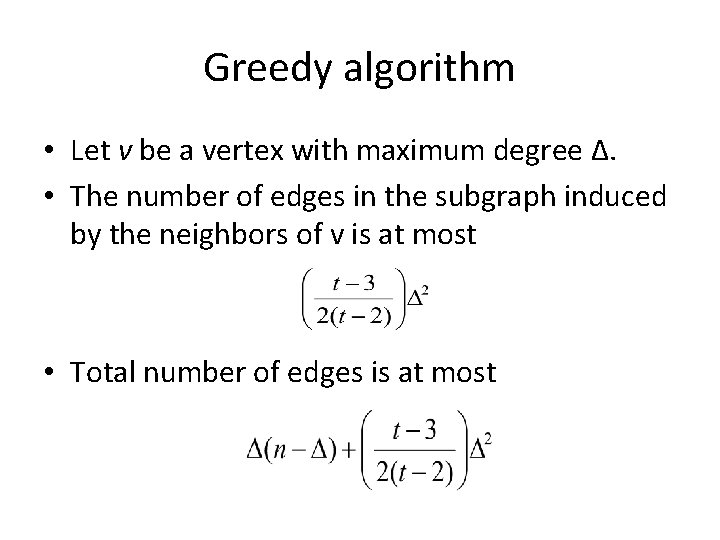
Greedy algorithm • Let v be a vertex with maximum degree ∆. • The number of edges in the subgraph induced by the neighbors of v is at most • Total number of edges is at most
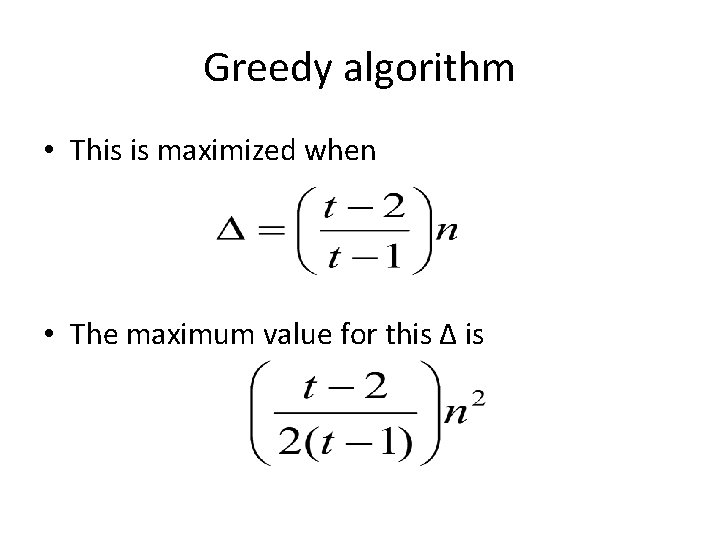
Greedy algorithm • This is maximized when • The maximum value for this ∆ is
Another Greedy Algorithm • Consider any graph that does not contain Kt. • Duplicating a vertex cannot create a Kt. • If the graph is not a complete multipartite graph, we can increase the number of edges without creating a Kt. • A graph is multipartite if and only if nonadjacency is an equivalence relation.
Another Greedy Algorithm • Suppose u, v, w are distinct vertices such that vw is an edge but u is not adjacent to both v and w. • If degree(u) < degree (v), duplicating v and deleting u increases number of edges, without creating a Kt. • Same holds if degree(u) < degree(w). • If degree(u) >= degree(v) and degree(w), then duplicate u twice and delete v and w.
Another Greedy Algorithm • So the graph with maximum number of edges and not containing Kt must be a complete multipartite graph. • Amongst all such graphs, the complete (t-1)partite graph with nearly equal part sizes has the maximum number of edges. • This is the only extremal graph.
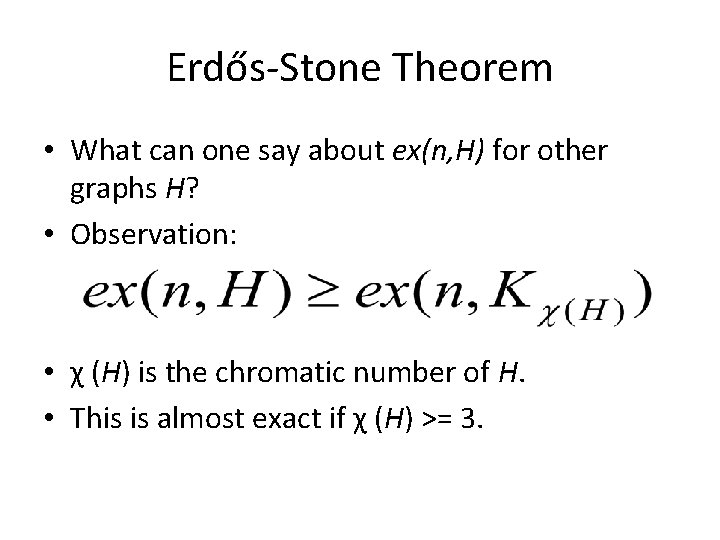
Erdős-Stone Theorem • What can one say about ex(n, H) for other graphs H? • Observation: • χ (H) is the chromatic number of H. • This is almost exact if χ (H) >= 3.
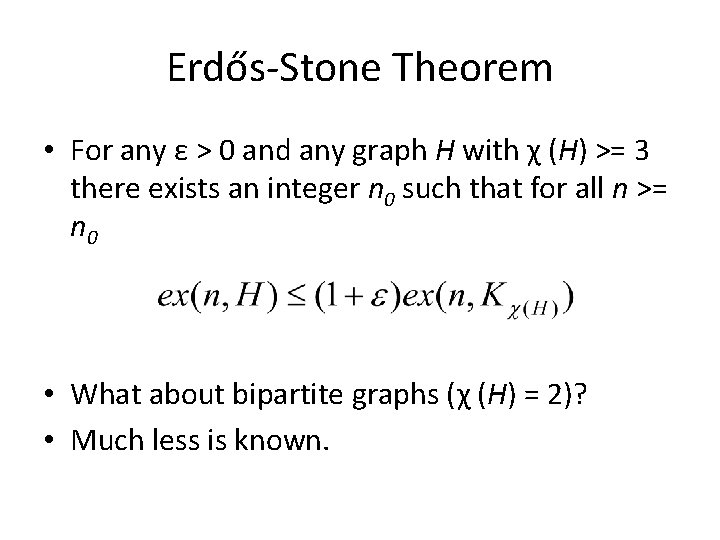
Erdős-Stone Theorem • For any ε > 0 and any graph H with χ (H) >= 3 there exists an integer n 0 such that for all n >= n 0 • What about bipartite graphs (χ (H) = 2)? • Much less is known.
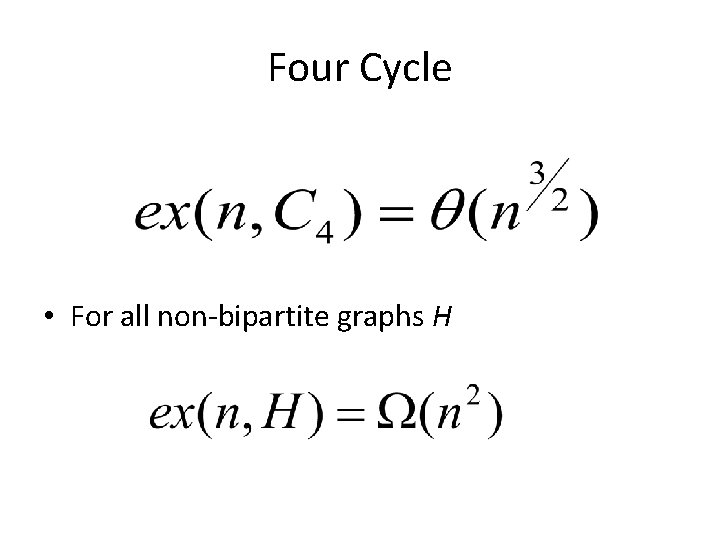
Four Cycle • For all non-bipartite graphs H
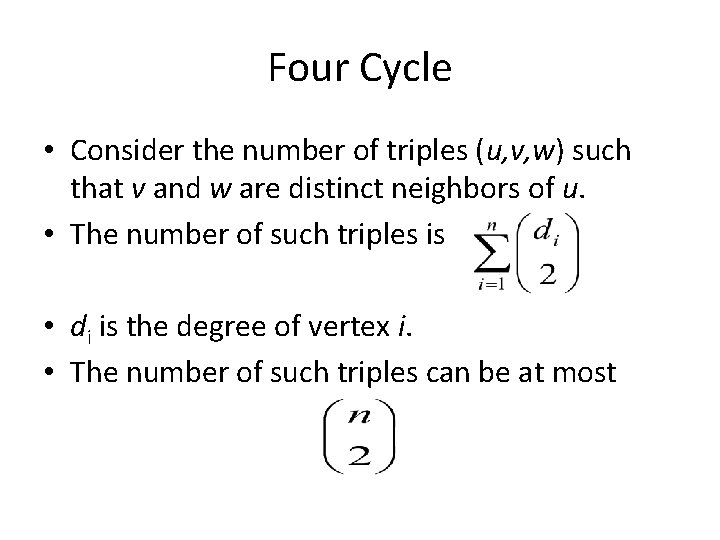
Four Cycle • Consider the number of triples (u, v, w) such that v and w are distinct neighbors of u. • The number of such triples is • di is the degree of vertex i. • The number of such triples can be at most
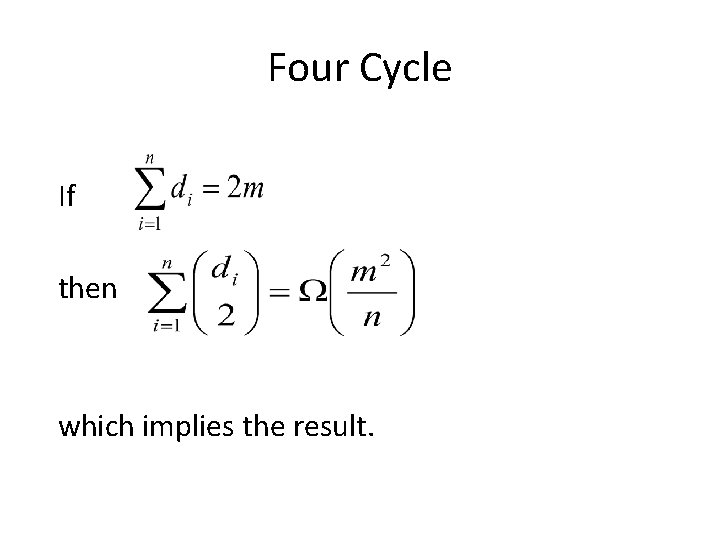
Four Cycle If then which implies the result.
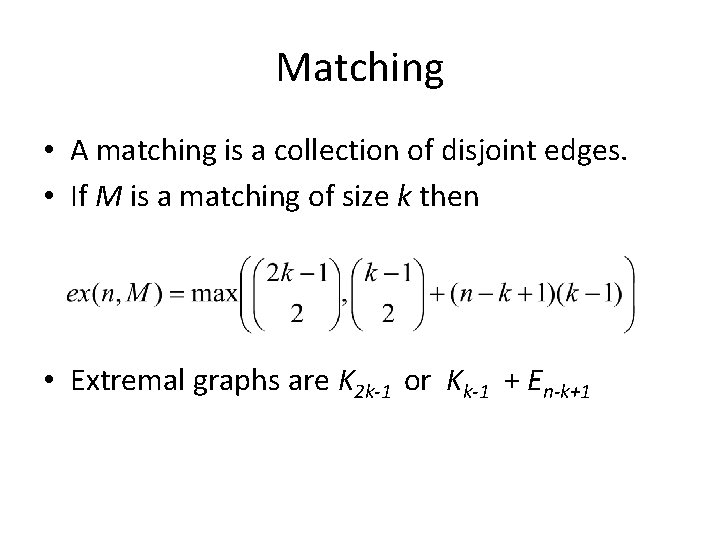
Matching • A matching is a collection of disjoint edges. • If M is a matching of size k then • Extremal graphs are K 2 k-1 or Kk-1 + En-k+1
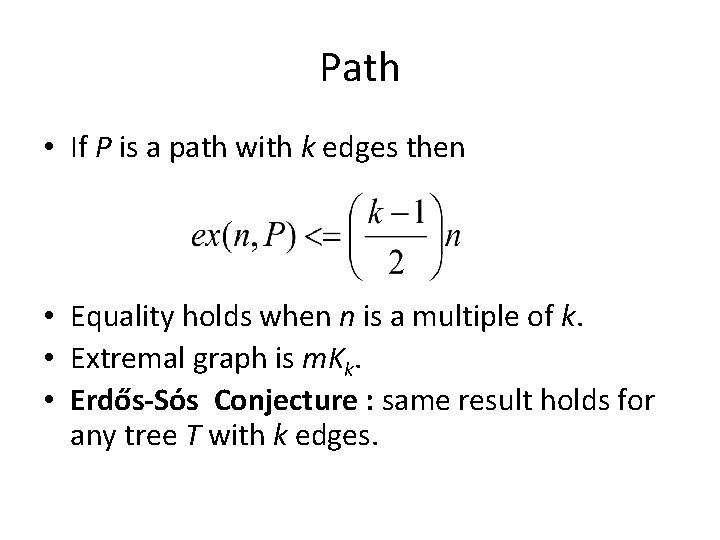
Path • If P is a path with k edges then • Equality holds when n is a multiple of k. • Extremal graph is m. Kk. • Erdős-Sós Conjecture : same result holds for any tree T with k edges.
Colored Edges • Extremal graph theory for edge-colored graphs. • Suppose edges have an associated color. • Edges of different color can be parallel to each other (join same pair of vertices). • Edges of the same color form a simple graph. • Maximize the number of edges of each color avoiding a given colored subgraph.
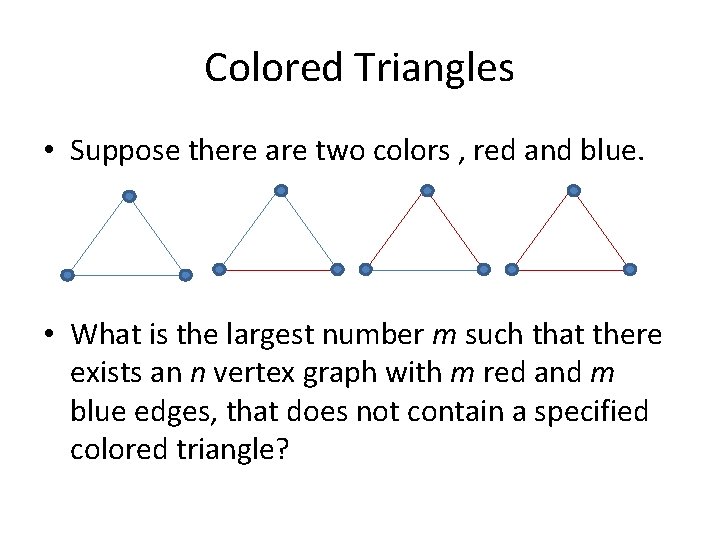
Colored Triangles • Suppose there are two colors , red and blue. • What is the largest number m such that there exists an n vertex graph with m red and m blue edges, that does not contain a specified colored triangle?
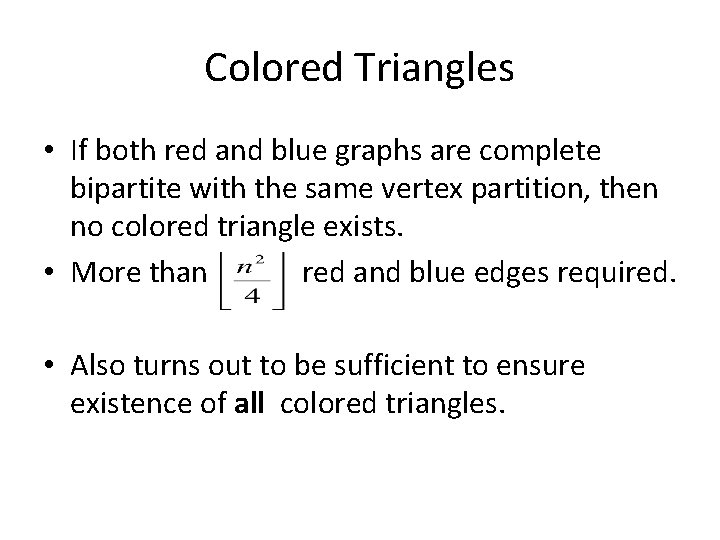
Colored Triangles • If both red and blue graphs are complete bipartite with the same vertex partition, then no colored triangle exists. • More than red and blue edges required. • Also turns out to be sufficient to ensure existence of all colored triangles.
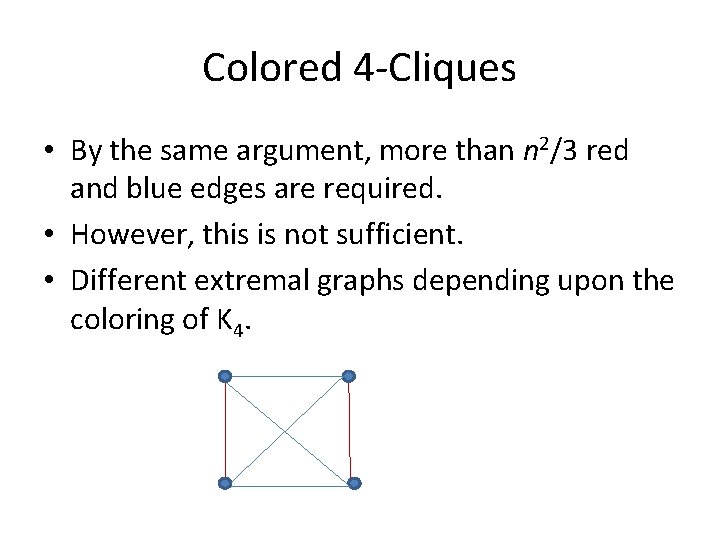
Colored 4 -Cliques • By the same argument, more than n 2/3 red and blue edges are required. • However, this is not sufficient. • Different extremal graphs depending upon the coloring of K 4.
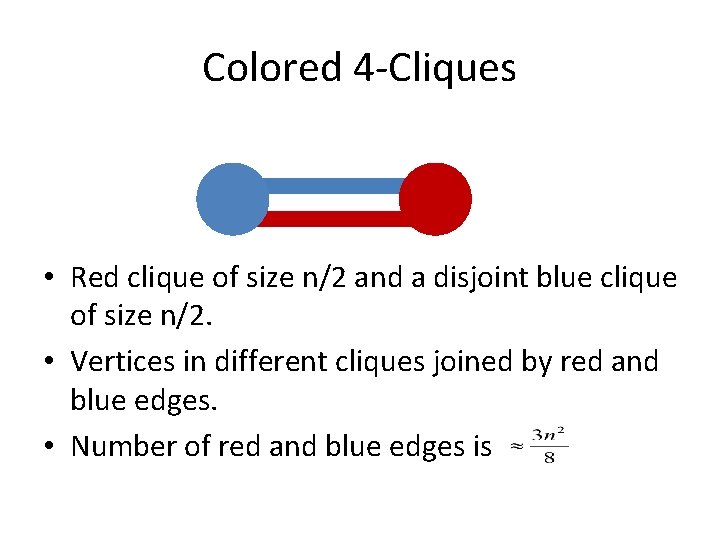
Colored 4 -Cliques • Red clique of size n/2 and a disjoint blue clique of size n/2. • Vertices in different cliques joined by red and blue edges. • Number of red and blue edges is
General Case • Such colorings, for which the number of edges required is more than the Turan bound exist for k = 4, 6, 8. • We do not know any others. • Conjecture: In all other cases, the Turan bound is sufficient! • Proved it for k = 3 and 5.
Colored Turan’s Theorem • Instead of requiring m edges of each color, only require that the total number of edges is cm, where c is the number of colors. • How large should m be to ensure existence of a particular colored k-clique? • For what colorings is the Turan bound sufficient?
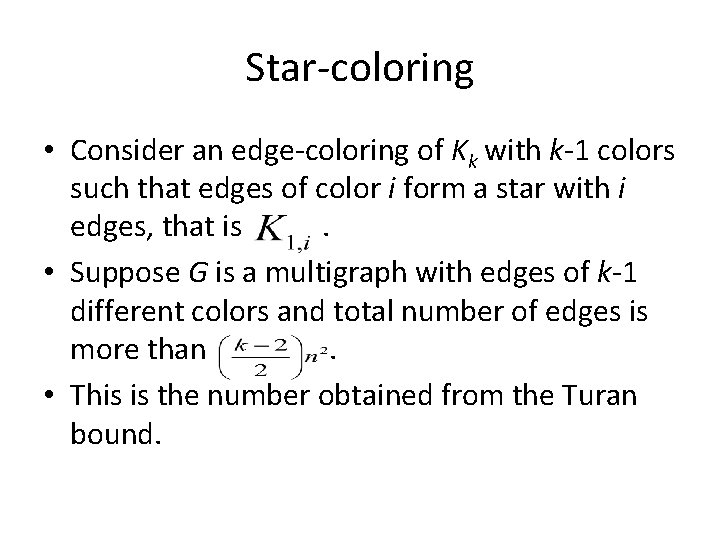
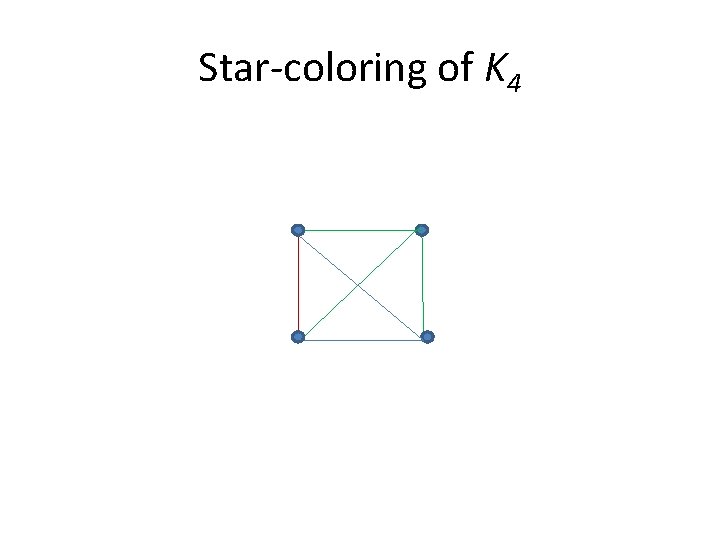
Star-coloring • Consider an edge-coloring of Kk with k-1 colors such that edges of color i form a star with i edges, that is. • Suppose G is a multigraph with edges of k-1 different colors and total number of edges is more than. • This is the number obtained from the Turan bound.
Star-coloring of K 4
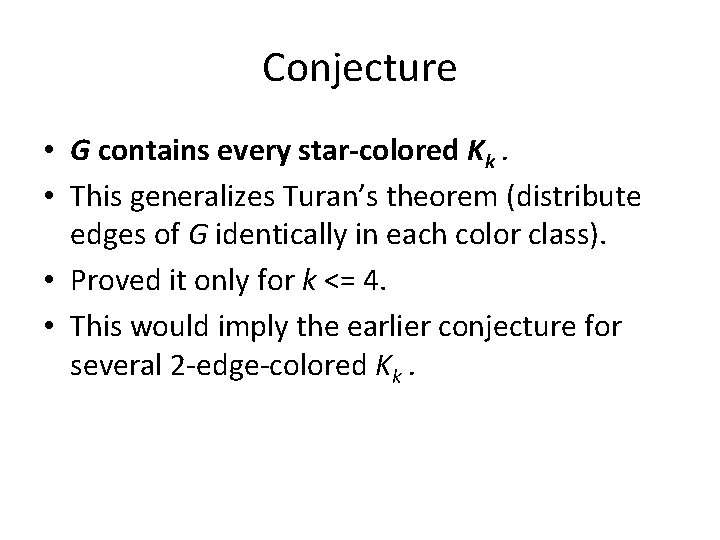
Conjecture • G contains every star-colored Kk. • This generalizes Turan’s theorem (distribute edges of G identically in each color class). • Proved it only for k <= 4. • This would imply the earlier conjecture for several 2 -edge-colored Kk.
References 1. M. Aigner and G. M. Ziegler, Proofs from the BOOK, 4 th Edition, Chapter 36 (Turan’s Graph Theorem). 2. B. Bollóbas, Extremal Graph Theory, Academic Press, 1978. 3. R. Diestel, Graph Theory, 3 rd edition, Chapter 7 (Extremal Graph Theory), Springer 2005. 4. A. A. Diwan and D. Mubayi, Turan’s theorem with colors, manuscript, (available on Citeseer).
Thank You