
Extragalactic Astronomy and Cosmology at If A Edinburgh

Extragalactic Astronomy and Cosmology at If. A Edinburgh

Timetable for the day · 11: 00 Closed Panel session · 11: 30 Presentations Part-1 · 12: 50 Lunch · 13: 40 Presentations Part-2 · 14: 50 Q & A session · 15: 50 Closed Panel Session · 17: 00 End
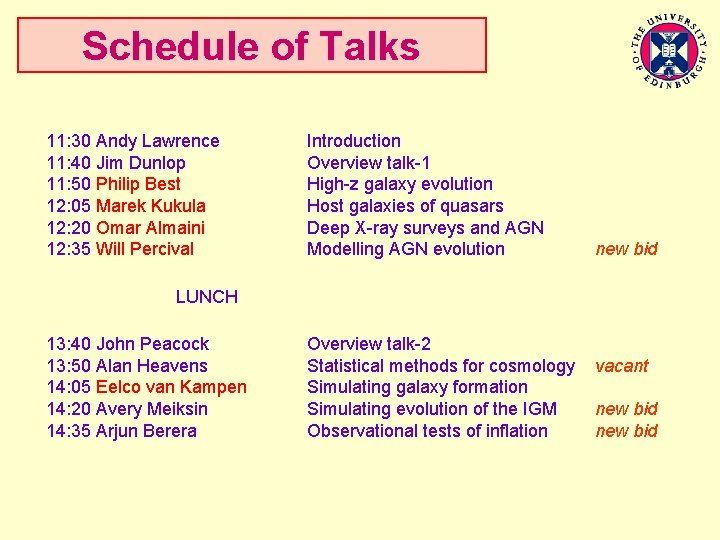
Schedule of Talks 11: 30 Andy Lawrence 11: 40 Jim Dunlop 11: 50 Philip Best 12: 05 Marek Kukula 12: 20 Omar Almaini 12: 35 Will Percival Introduction Overview talk-1 High-z galaxy evolution Host galaxies of quasars Deep X-ray surveys and AGN Modelling AGN evolution new bid LUNCH 13: 40 John Peacock 13: 50 Alan Heavens 14: 05 Eelco van Kampen 14: 20 Avery Meiksin 14: 35 Arjun Berera Overview talk-2 Statistical methods for cosmology Simulating galaxy formation Simulating evolution of the IGM Observational tests of inflation vacant new bid
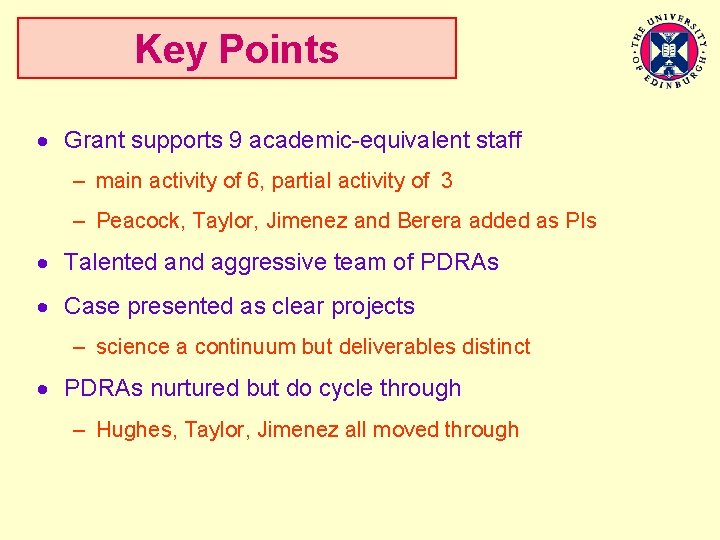
Key Points · Grant supports 9 academic-equivalent staff – main activity of 6, partial activity of 3 – Peacock, Taylor, Jimenez and Berera added as PIs · Talented and aggressive team of PDRAs · Case presented as clear projects – science a continuum but deliverables distinct · PDRAs nurtured but do cycle through – Hughes, Taylor, Jimenez all moved through
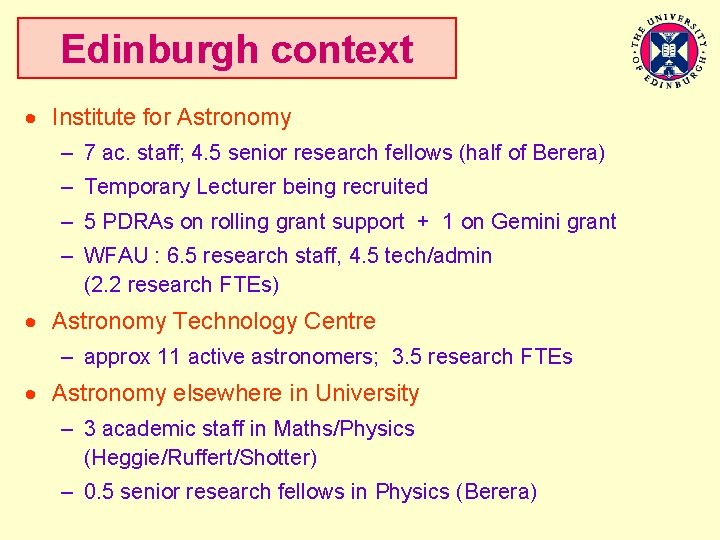
Edinburgh context · Institute for Astronomy – 7 ac. staff; 4. 5 senior research fellows (half of Berera) – Temporary Lecturer being recruited – 5 PDRAs on rolling grant support + 1 on Gemini grant – WFAU : 6. 5 research staff, 4. 5 tech/admin (2. 2 research FTEs) · Astronomy Technology Centre – approx 11 active astronomers; 3. 5 research FTEs · Astronomy elsewhere in University – 3 academic staff in Maths/Physics (Heggie/Ruffert/Shotter) – 0. 5 senior research fellows in Physics (Berera)
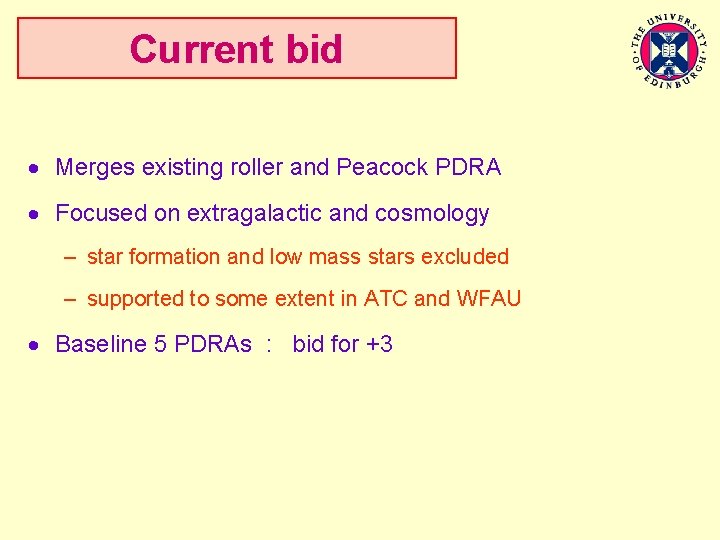
Current bid · Merges existing roller and Peacock PDRA · Focused on extragalactic and cosmology – star formation and low mass stars excluded – supported to some extent in ATC and WFAU · Baseline 5 PDRAs : bid for +3
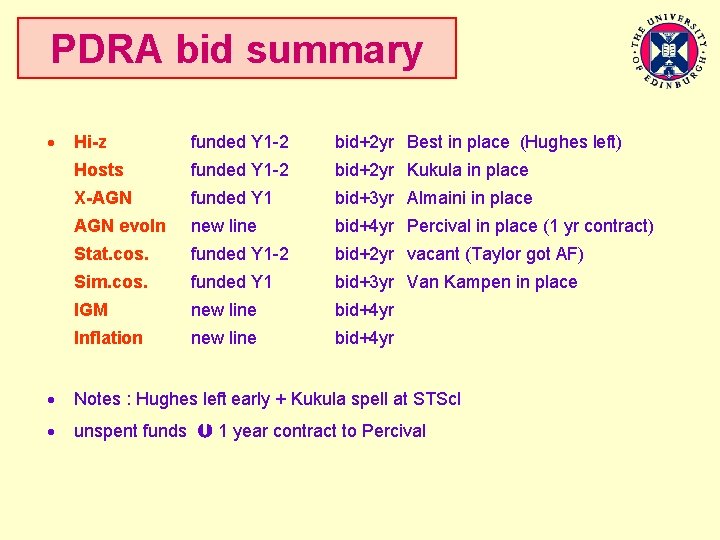
PDRA bid summary · Hi-z funded Y 1 -2 bid+2 yr Best in place (Hughes left) Hosts funded Y 1 -2 bid+2 yr Kukula in place X-AGN funded Y 1 bid+3 yr Almaini in place AGN evoln new line bid+4 yr Percival in place (1 yr contract) Stat. cos. funded Y 1 -2 bid+2 yr vacant (Taylor got AF) Sim. cos. funded Y 1 bid+3 yr Van Kampen in place IGM new line bid+4 yr Inflation new line bid+4 yr · Notes : Hughes left early + Kukula spell at STSc. I · unspent funds 1 year contract to Percival
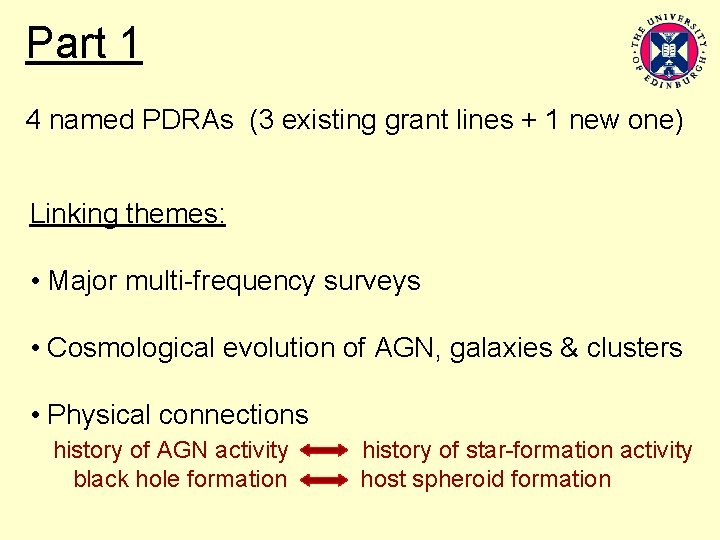
Part 1 4 named PDRAs (3 existing grant lines + 1 new one) Linking themes: • Major multi-frequency surveys • Cosmological evolution of AGN, galaxies & clusters • Physical connections history of AGN activity black hole formation history of star-formation activity host spheroid formation
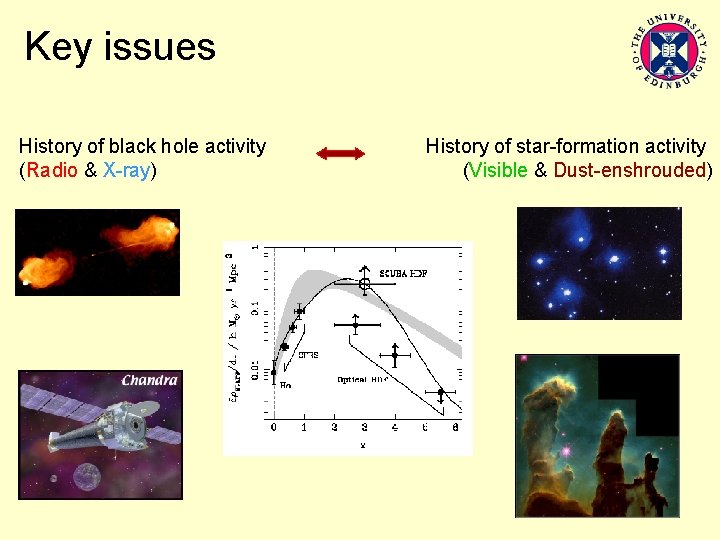
Key issues History of black hole activity (Radio & X-ray) History of star-formation activity (Visible & Dust-enshrouded)
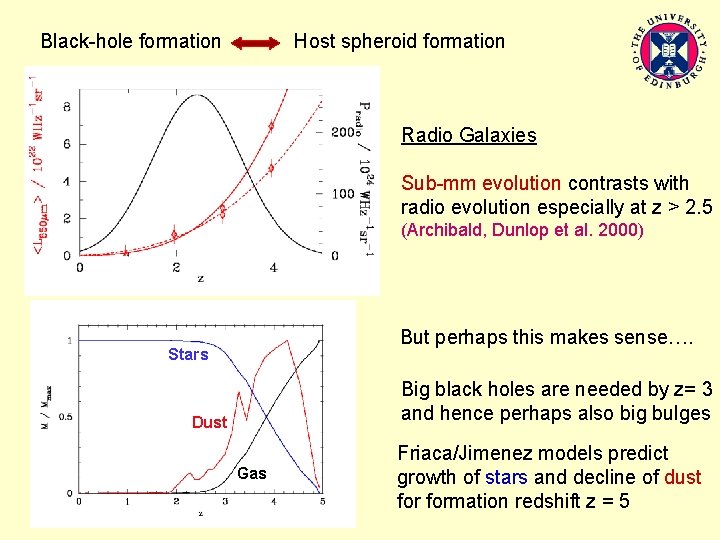
Black-hole formation Host spheroid formation Radio Galaxies Sub-mm evolution contrasts with radio evolution especially at z > 2. 5 (Archibald, Dunlop et al. 2000) But perhaps this makes sense…. Stars Big black holes are needed by z= 3 and hence perhaps also big bulges Dust Gas Friaca/Jimenez models predict growth of stars and decline of dust formation redshift z = 5
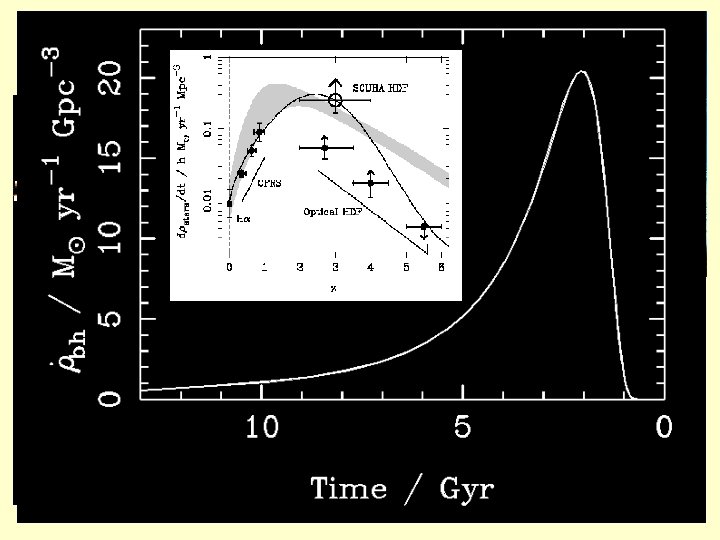
Philip Best • z distribution of the field sub-mm population • sub-mm - optical studies of radio galaxies and high z clusters Marek Kukula • HST/Gemini/VLT studies of the hosts of quasars, z = 0 - 5 • VLA/Merlin studies probing the origin of radio loudness Omar Almaini • Major X-ray surveys: - resolving the X-ray background, new hard X-ray populations, AGN to z = 8, X-ray/sub-mm link Will Percival • Analytical theory - evolution of compact activity in a cosmological context • The black-hole galaxy-formation link
Philip Best High z Galaxy Evolution Marek Kukula Quasar Host Galaxies Omar Almaini Deep X-ray Surveys Will Percival Modelling Evolution
High Redshift Galaxy Evolution Observational and theoretical study of the evolution of massive galaxies. Main themes: • Dust enshrouded starbursts at high redshift – SCUBA surveys & follow-up – HDF, 8 m. Jy, cluster surveys • Galaxy evolution in clusters • Deep spectroscopic studies of Hz. RG’s • Age dating of stellar populations
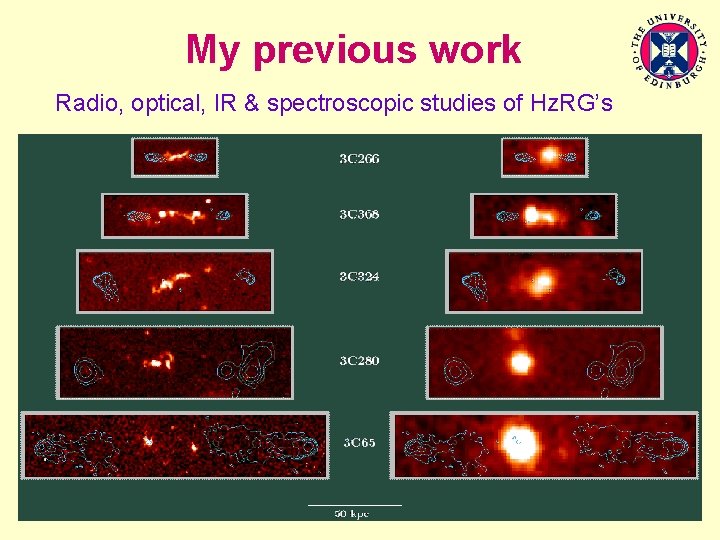
My previous work Radio, optical, IR & spectroscopic studies of Hz. RG’s
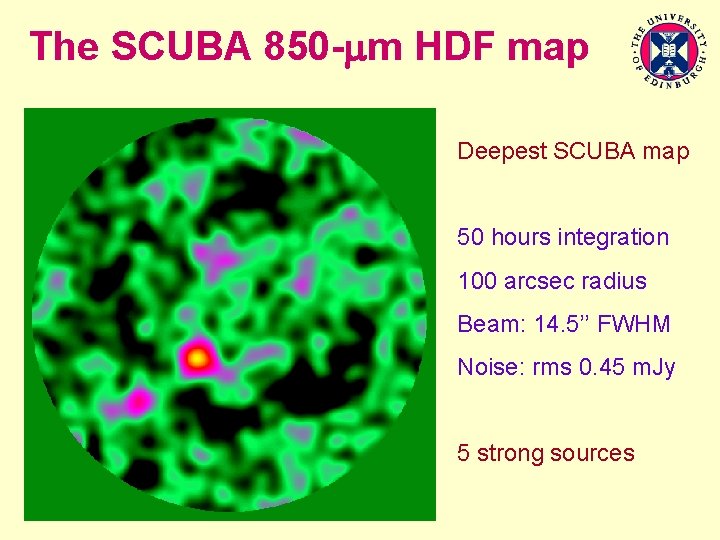
The SCUBA 850 - m HDF map Deepest SCUBA map 50 hours integration 100 arcsec radius Beam: 14. 5’’ FWHM Noise: rms 0. 45 m. Jy 5 strong sources
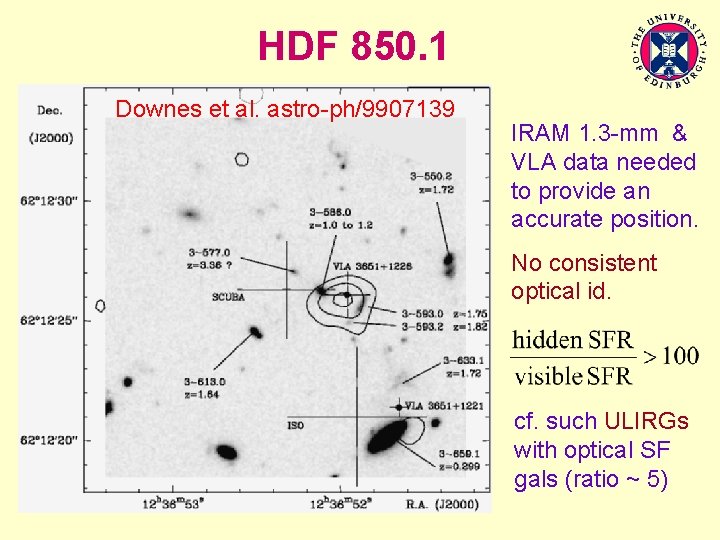
HDF 850. 1 Downes et al. astro-ph/9907139 IRAM 1. 3 -mm & VLA data needed to provide an accurate position. No consistent optical id. cf. such ULIRGs with optical SF gals (ratio ~ 5)
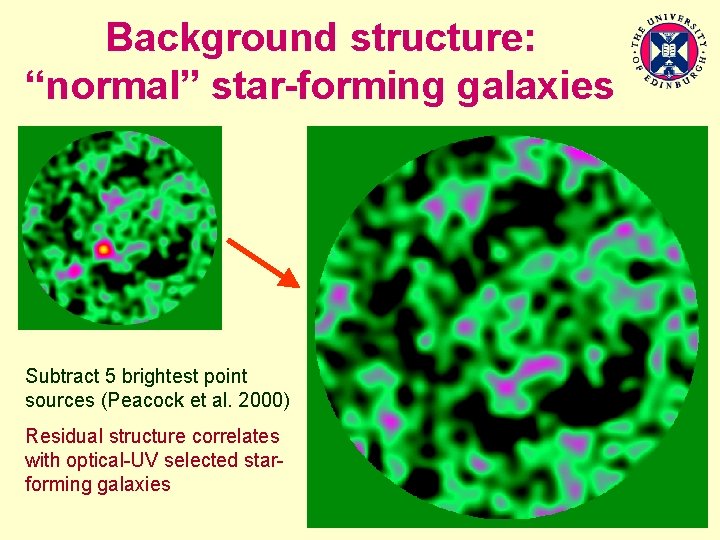
Background structure: “normal” star-forming galaxies Subtract 5 brightest point sources (Peacock et al. 2000) Residual structure correlates with optical-UV selected starforming galaxies
8 m. Jy survey Collaboration with Imperial College, Cambridge and UCL • • • Shallow wide-field survey to complement HDF 400 sq. arcmins to S 850 mm= 8 m. Jy (3 - ) 8 SCUBA shifts allocated; 24 more long-term z and T constraints from deep 175 m ISO data New Ph. D student (Suzie Scott) working on data reduction & source extraction
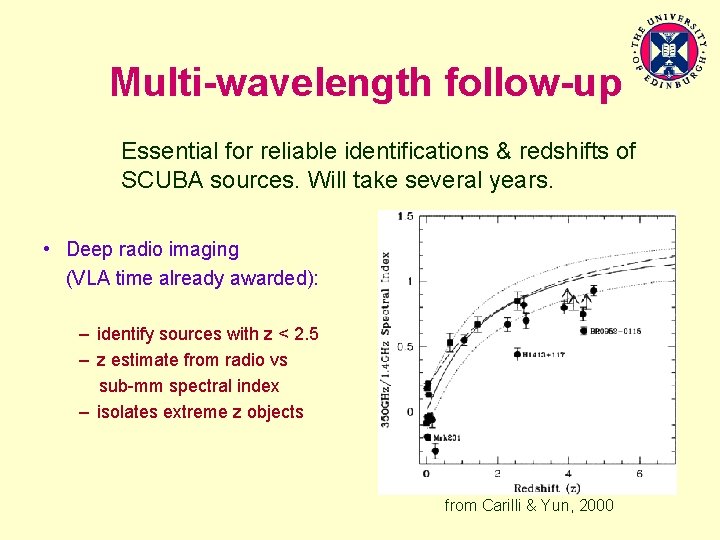
Multi-wavelength follow-up Essential for reliable identifications & redshifts of SCUBA sources. Will take several years. • Deep radio imaging (VLA time already awarded): – identify sources with z < 2. 5 – z estimate from radio vs sub-mm spectral index – isolates extreme z objects from Carilli & Yun, 2000
• mm interferometry, IRAM Pd. B – time awarded (collaboration, Dieter Lutz) – reliable positions for radio empty fields – brightest SCUBA source in Lockman hole region has been detected - but no optical/IR id • Deep optical - IR imaging – UKIRT time allocated – some sources will need Gemini • Spectroscopy – obtaining redshifts clearly requires 8 m class telescopes
High redshift cluster studies Why carry out deep radio / sub-mm studies of high redshift clusters? • SCUBA observes different population of star-forming objects than those from optical studies • Clusters at high z: – are young, possibly still forming – have high galaxy merger rates – are ideal testbeds of galaxy evolution • Good complement to field surveys / low-z clusters
2 projects: • Deep SCUBA and VLA studies of z~1 clusters – 8 shifts start-up SCUBA time allocated – 30 hrs VLA data on MS 1054 taken in April – Initially targeting clusters with much optical-IR data • Imaging around z>3 radio galaxies – known regions of high overdensity (protoclusters? ) – positive results from pilot study (4 C 41. 17) – long-term status awarded for an extended study Both projects will require considerable follow-up.
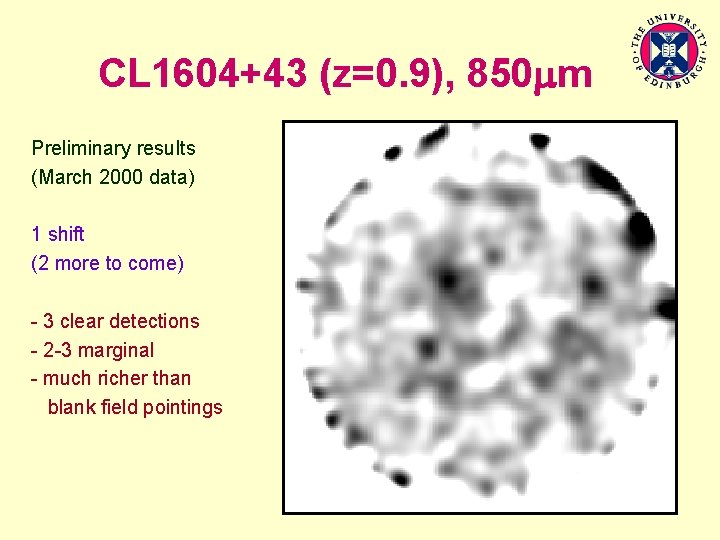
CL 1604+43 (z=0. 9), 850 m Preliminary results (March 2000 data) 1 shift (2 more to come) - 3 clear detections - 2 -3 marginal - much richer than blank field pointings
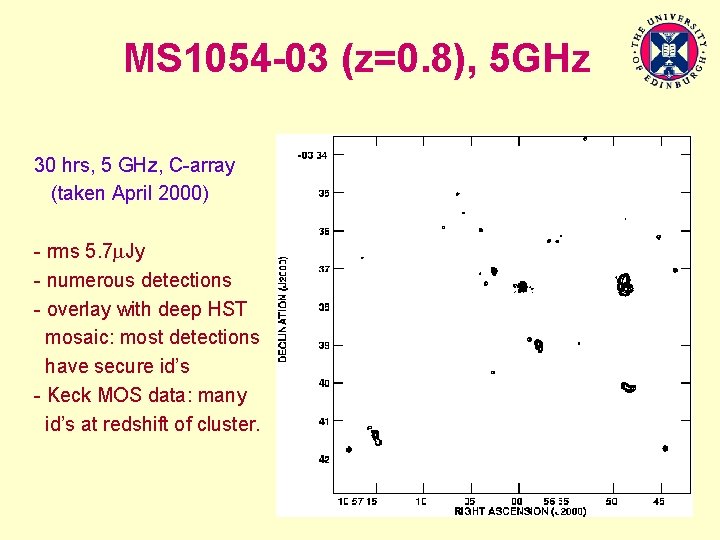
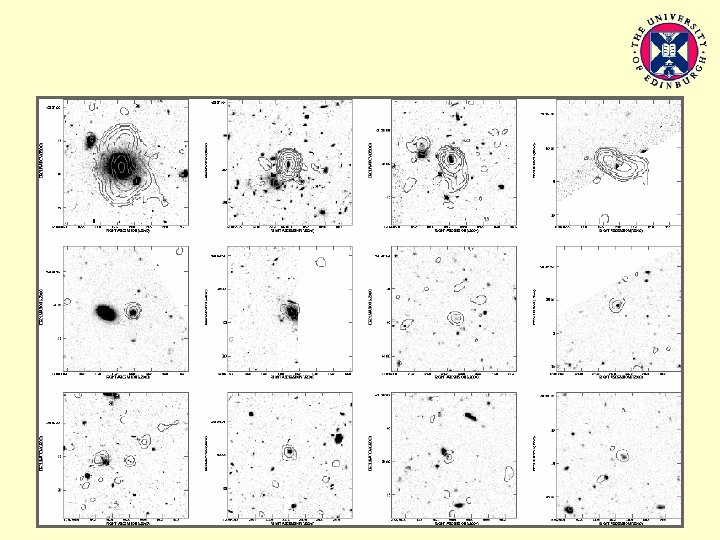
MS 1054 -03 (z=0. 8), 5 GHz 30 hrs, 5 GHz, C-array (taken April 2000) - rms 5. 7 Jy - numerous detections - overlay with deep HST mosaic: most detections have secure id’s - Keck MOS data: many id’s at redshift of cluster.
Galaxy evolution in clusters In addition to studies of cluster star formation, aim to push back cluster studies to earlier epochs • very deep optical / IR imaging around z>1. 5 RGs – cross-correlation statistics – colour-magnitude diagrams – photometric redshifts • follow-up multi-object spectroscopy (Gemini) – evolution of cluster environments – age-dating of evolved elliptical galaxies (Jimenez) Just one massive cluster at this redshift has severe consequences for LSS and cosmological models.
Conclusions Studies of SCUBA sources are rapidly advancing and provide key information about SF history of the Universe. Much follow-up work is required. Long-term goal is to couple this work with that on • Galaxy evolution in clusters • Deep spectroscopic studies of Hz. RGs • Age dating of stellar populations to obtain a consistent view of the evolution of “activity” in the Universe
Philip Best High z Galaxy Evolution Marek Kukula Quasar Host Galaxies Omar Almaini Deep X-ray Surveys Will Percival Modelling Evolution
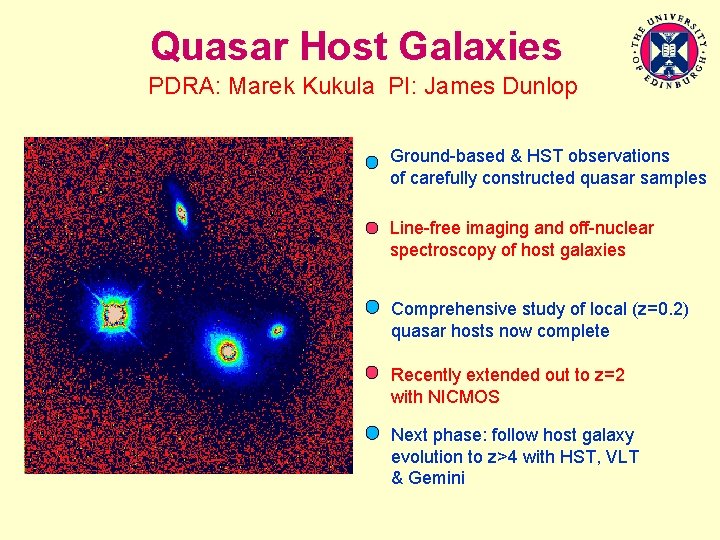
Quasar Host Galaxies PDRA: Marek Kukula PI: James Dunlop Ground-based & HST observations of carefully constructed quasar samples Line-free imaging and off-nuclear spectroscopy of host galaxies Comprehensive study of local (z=0. 2) quasar hosts now complete Recently extended out to z=2 with NICMOS Next phase: follow host galaxy evolution to z>4 with HST, VLT & Gemini
Why study quasar hosts? HST studies of local (z < 0. 3) quasars show that their hosts tend to be dominated by a massive spheroidal component. Very likely all large elliptical galaxies contain massive black holes and are potential quasar hosts. At z = 2. 5 a significant fraction of all massive black holes were active. Quasar evolution and the starformation history of the universe share similar properties growth & fuelling of black holes is closely linked to the evolution of large-scale structure.
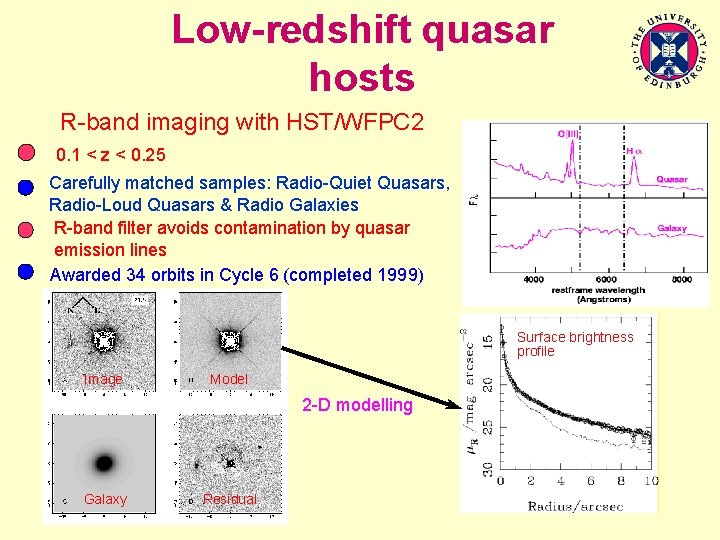
Low-redshift quasar hosts R-band imaging with HST/WFPC 2 0. 1 < z < 0. 25 Carefully matched samples: Radio-Quiet Quasars, Radio-Loud Quasars & Radio Galaxies R-band filter avoids contamination by quasar emission lines Awarded 34 orbits in Cycle 6 (completed 1999) Surface brightness profile Image Model 2 -D modelling Galaxy Residual
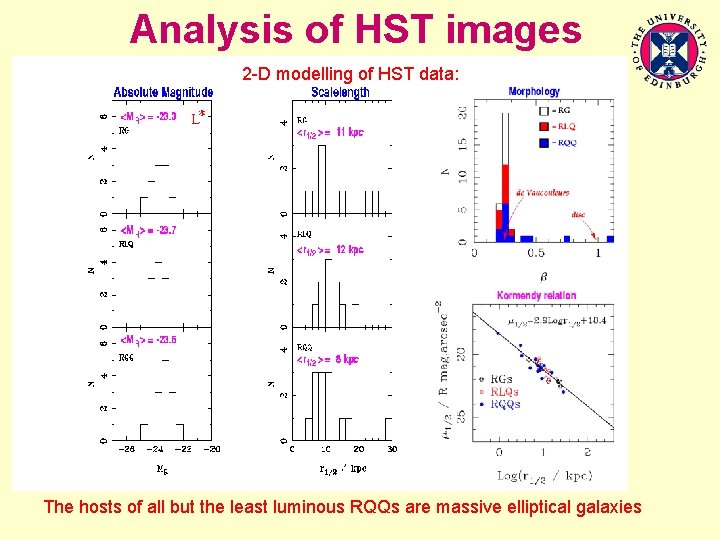
Analysis of HST images 2 -D modelling of HST data: The hosts of all but the least luminous RQQs are massive elliptical galaxies
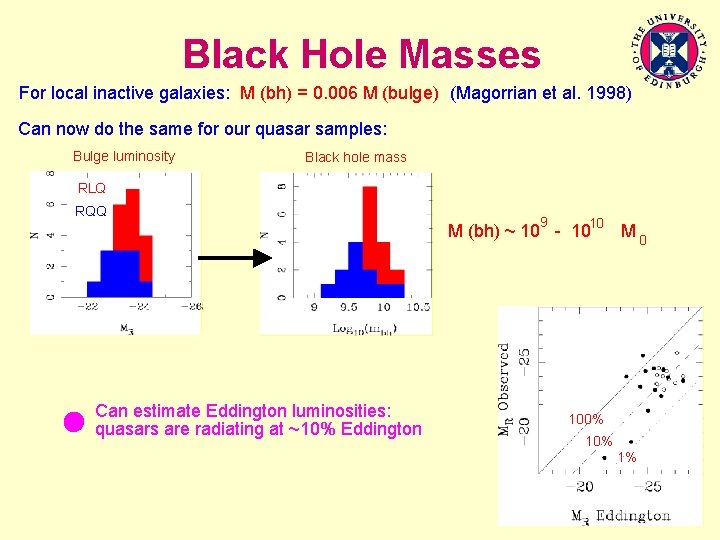
Black Hole Masses For local inactive galaxies: M (bh) = 0. 006 M (bulge) (Magorrian et al. 1998) Can now do the same for our quasar samples: Bulge luminosity Black hole mass RLQ RQQ 9 10 M (bh) ~ 10 - 10 Can estimate Eddington luminosities: quasars are radiating at ~10% Eddington M 0 100% 1%
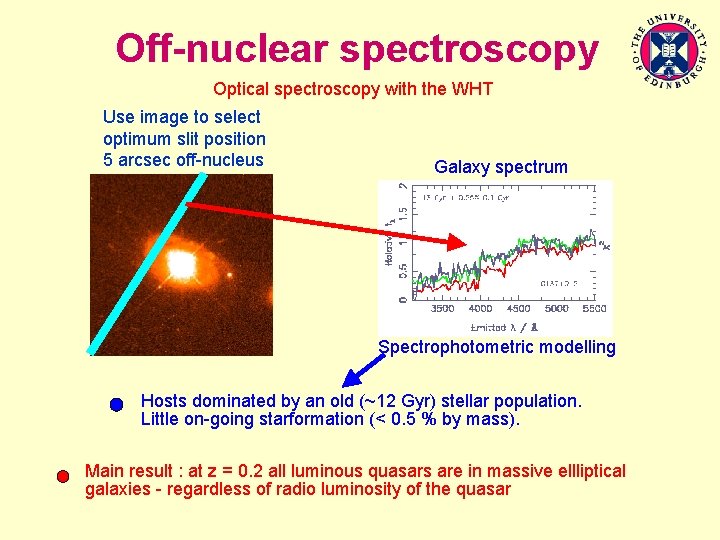
Off-nuclear spectroscopy Optical spectroscopy with the WHT Use image to select optimum slit position 5 arcsec off-nucleus Galaxy spectrum Spectrophotometric modelling Hosts dominated by an old (~12 Gyr) stellar population. Little on-going starformation (< 0. 5 % by mass). Main result : at z = 0. 2 all luminous quasars are in massive ellliptical galaxies - regardless of radio luminosity of the quasar
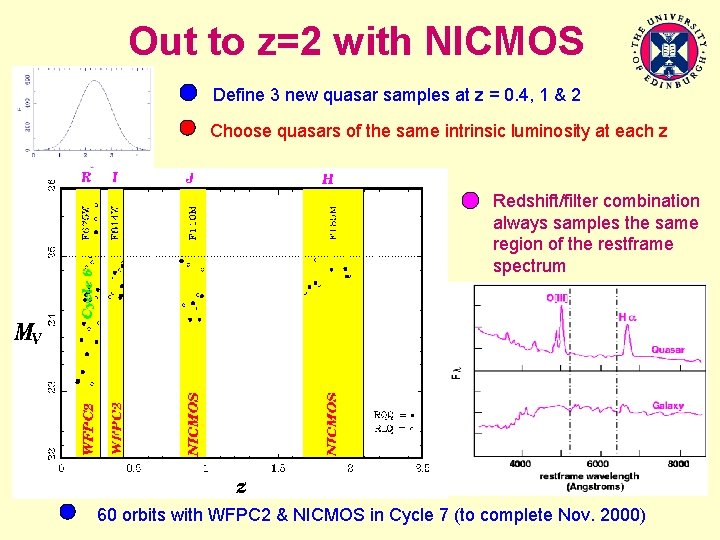
Out to z=2 with NICMOS Define 3 new quasar samples at z = 0. 4, 1 & 2 Choose quasars of the same intrinsic luminosity at each z Redshift/filter combination always samples the same region of the restframe spectrum 60 orbits with WFPC 2 & NICMOS in Cycle 7 (to complete Nov. 2000)
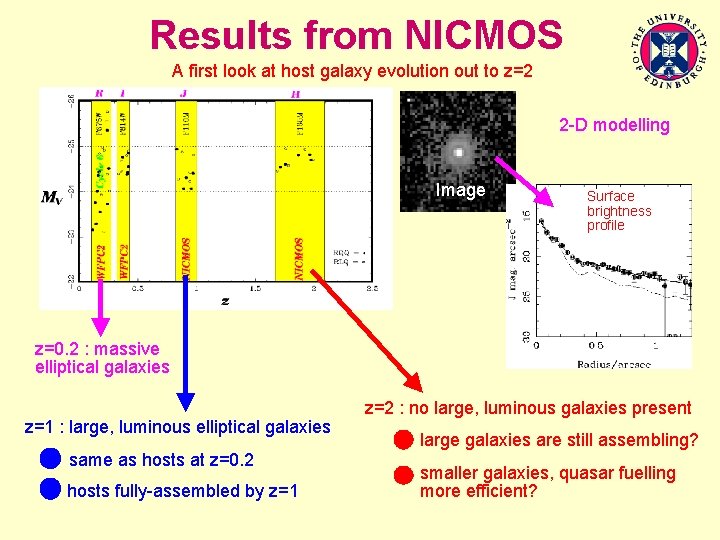
Results from NICMOS A first look at host galaxy evolution out to z=2 2 -D modelling Image Surface brightness profile z=0. 2 : massive elliptical galaxies z=1 : large, luminous elliptical galaxies same as hosts at z=0. 2 hosts fully-assembled by z=1 z=2 : no large, luminous galaxies present large galaxies are still assembling? smaller galaxies, quasar fuelling more efficient?
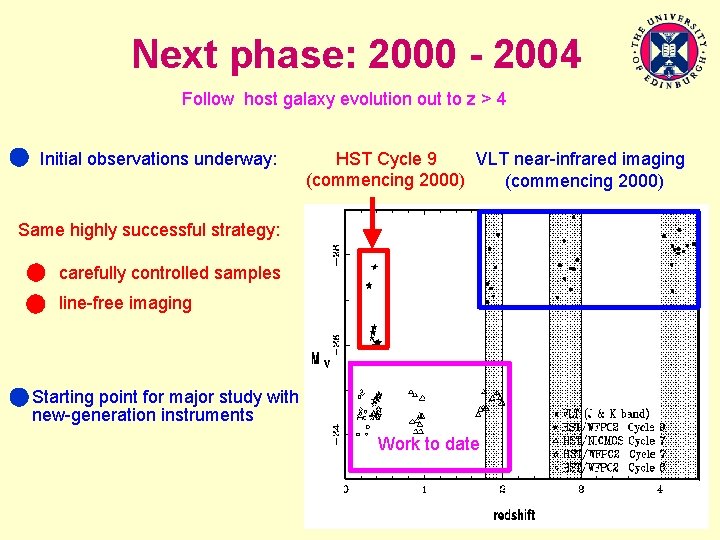
Next phase: 2000 - 2004 Follow host galaxy evolution out to z > 4 Initial observations underway: HST Cycle 9 VLT near-infrared imaging (commencing 2000) Same highly successful strategy: carefully controlled samples line-free imaging Starting point for major study with new-generation instruments Work to date
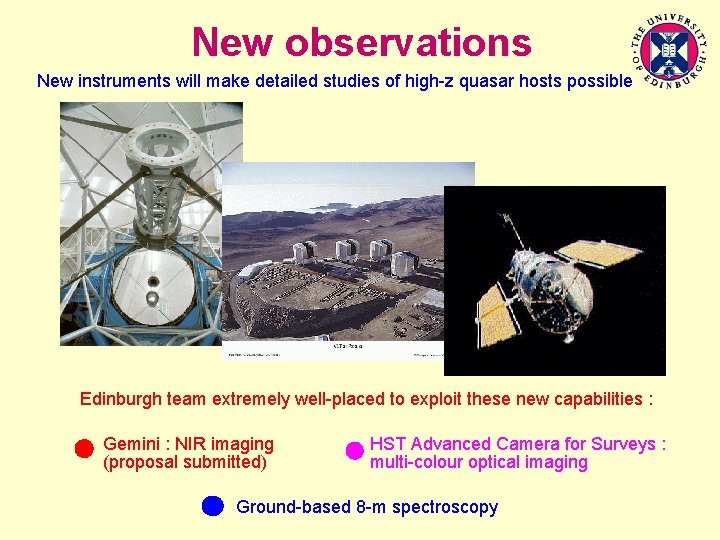
New observations New instruments will make detailed studies of high-z quasar hosts possible Edinburgh team extremely well-placed to exploit these new capabilities : Gemini : NIR imaging (proposal submitted) HST Advanced Camera for Surveys : multi-colour optical imaging Ground-based 8 -m spectroscopy
Philip Best High z Galaxy Evolution Marek Kukula Quasar Host Galaxies Omar Almaini Deep X-ray Surveys Will Percival Modelling Evolution
Deep X-ray Surveys Omar Almaini Andy Lawrence, Jim Dunlop XMM
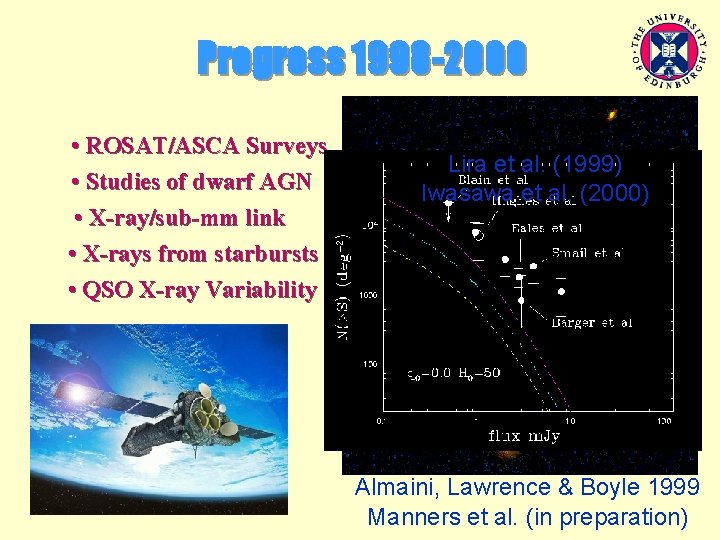
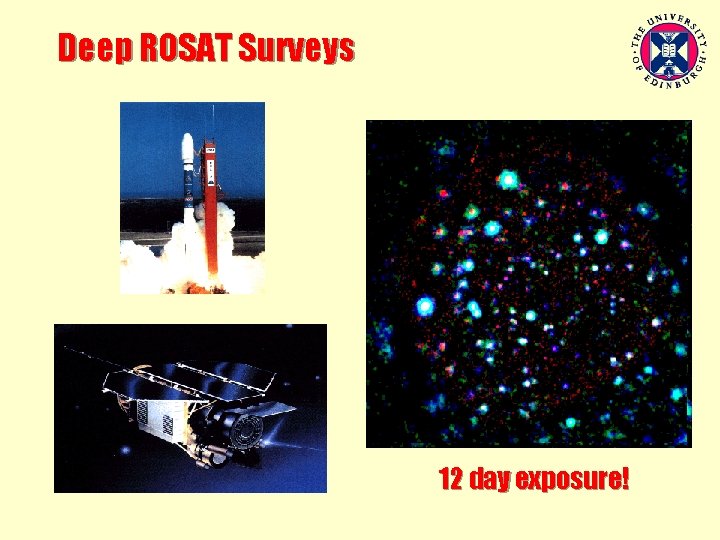
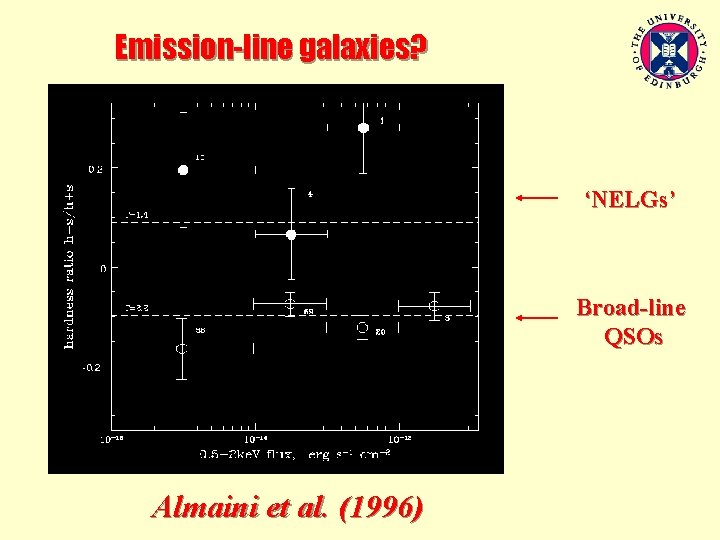
Progress 1998 -2000 • ROSAT/ASCA Surveys • Studies of dwarf AGN • X-ray/sub-mm link • X-rays from starbursts • QSO X-ray Variability Almaini et al 1998 Lira et al. (1999) Fabian et Iwasawa et al al. 1998 (2000) Georgantopoulos et al 1998 Natarajan & Almaini 2000 Boyle et al 1998 Blair et al 1999 Almaini, Gunn & Shanks 2000 Almaini et al. 2000 Almaini, Lawrence & Boyle 1999 Manners et al. (in preparation)
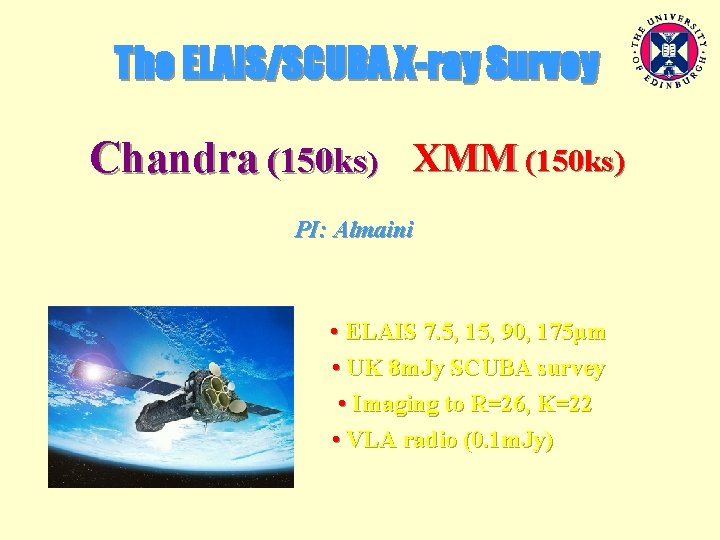
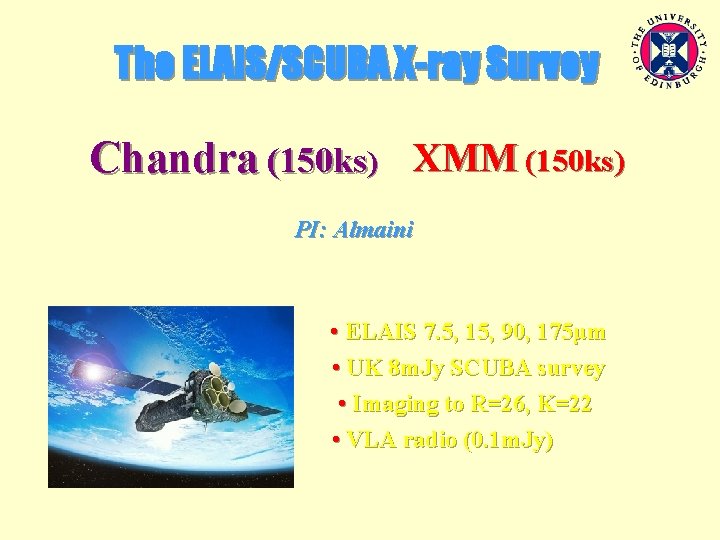
The ELAIS/SCUBA X-ray Survey Chandra (150 ks) XMM (150 ks) PI: Almaini • ELAIS 7. 5, 15, 90, 175µm • UK 8 m. Jy SCUBA survey • Imaging to R=26, K=22 • VLA radio (0. 1 m. Jy)
The Puzzle Of The X-ray Background
Deep ROSAT Surveys 12 day exposure!
Emission-line galaxies? ‘NELGs’ Broad-line QSOs Almaini et al. (1996)

July 23, 1999
The ELAIS/SCUBA X-ray Survey Chandra (150 ks) XMM (150 ks) PI: Almaini • ELAIS 7. 5, 15, 90, 175µm • UK 8 m. Jy SCUBA survey • Imaging to R=26, K=22 • VLA radio (0. 1 m. Jy)
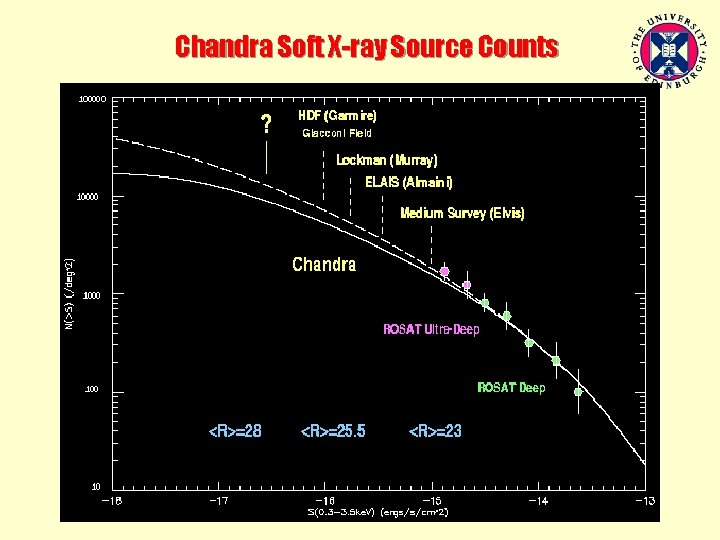
Chandra Soft X-ray Source Counts
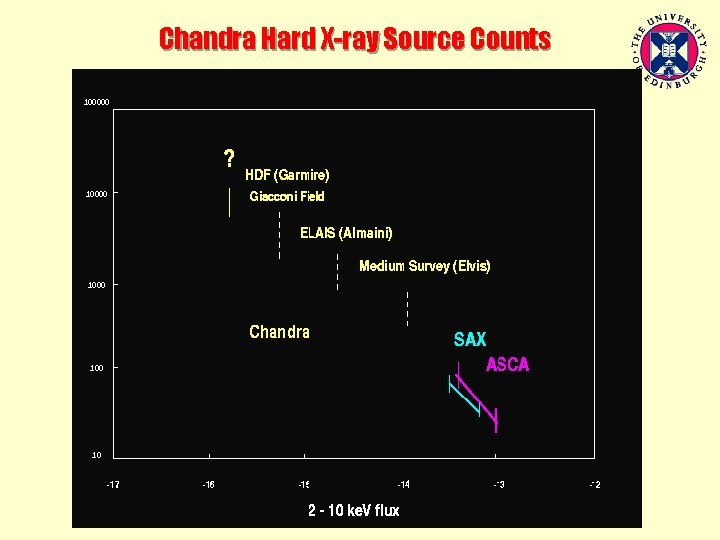
Chandra Hard X-ray Source Counts
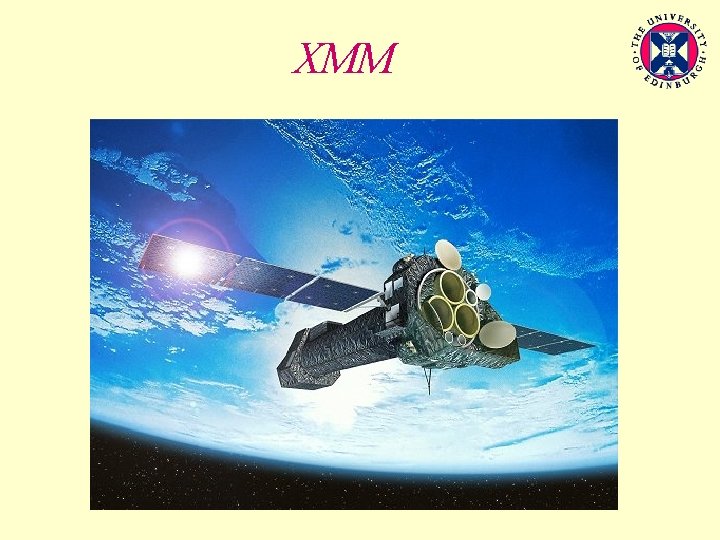
XMM

The XMM Mirror Assembly
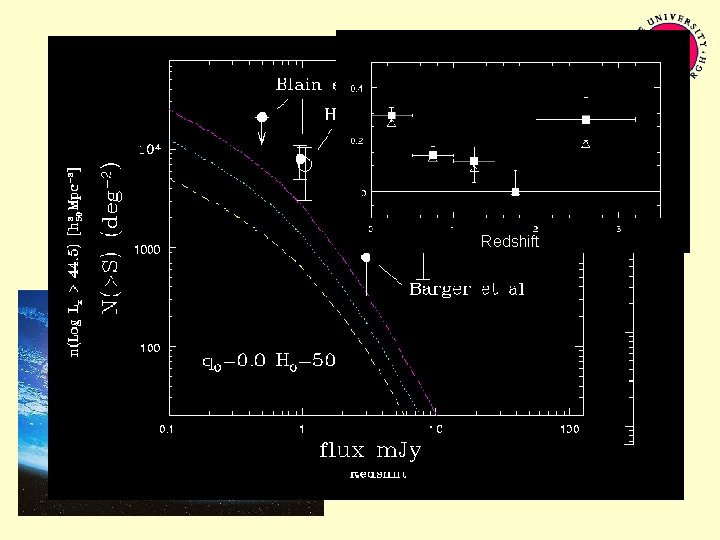
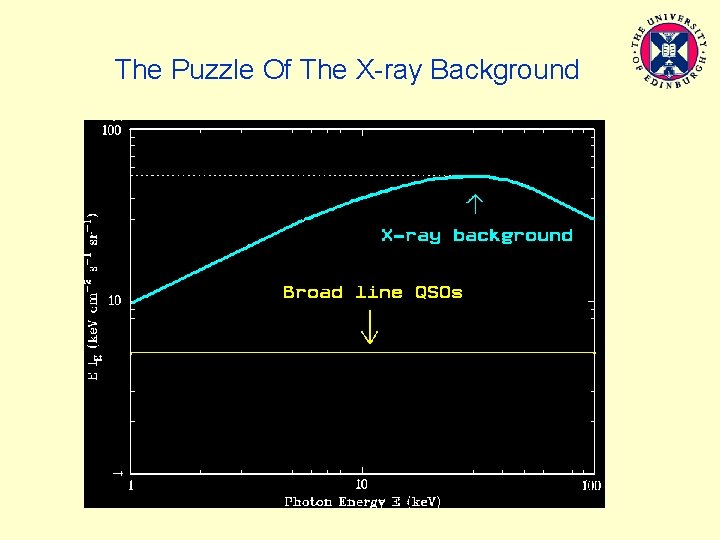
Scientific Objectives • Resolve X-ray background • Study new, hard X-ray populations • Detect very high redshift AGN (z~8) Redshift • Measure AGN fraction in submm surveys Detailed Astrophysics Multi-wavelength studies AGN/galaxy connection Variability of high z QSOs
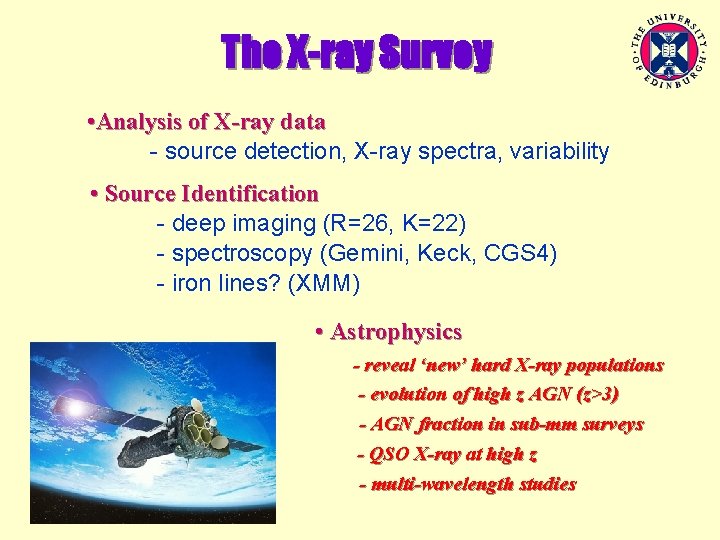
The X-ray Survey • Analysis of X-ray data - source detection, X-ray spectra, variability • Source Identification - deep imaging (R=26, K=22) - spectroscopy (Gemini, Keck, CGS 4) - iron lines? (XMM) • Astrophysics - reveal ‘new’ hard X-ray populations - evolution of high z AGN (z>3) - AGN fraction in sub-mm surveys - QSO X-ray at high z - multi-wavelength studies
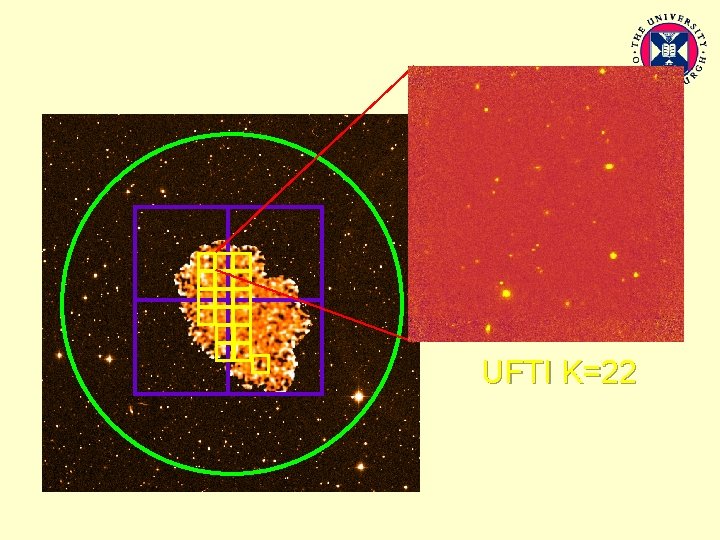
Chandra XMM SCUBA UFTI K=22
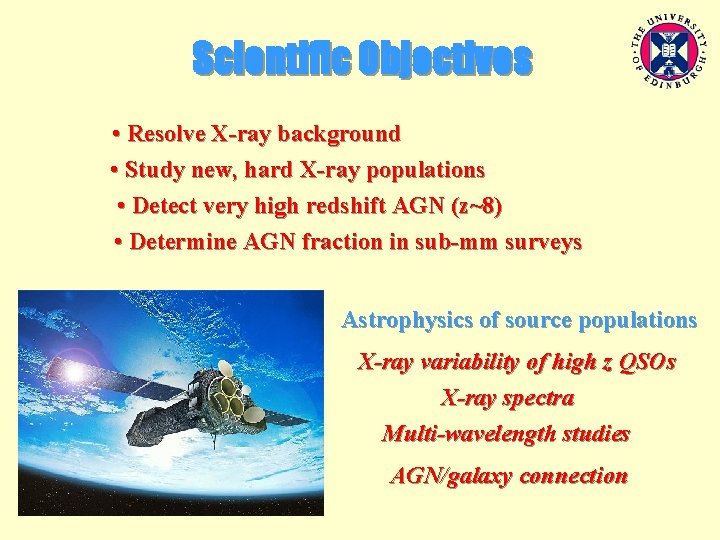
Scientific Objectives • Resolve X-ray background • Study new, hard X-ray populations • Detect very high redshift AGN (z~8) • Determine AGN fraction in sub-mm surveys Astrophysics of source populations X-ray variability of high z QSOs X-ray spectra Multi-wavelength studies AGN/galaxy connection
Philip Best High z Galaxy Evolution Marek Kukula Quasar Host Galaxies Omar Almaini Deep X-ray Surveys Will Percival Modelling Evolution
Modelling cosmological AGN evolution PDRA: Will Percival Investigators: J. A. Peacock, J. S. Dunlop, A. Lawrence & A. F. Heavens
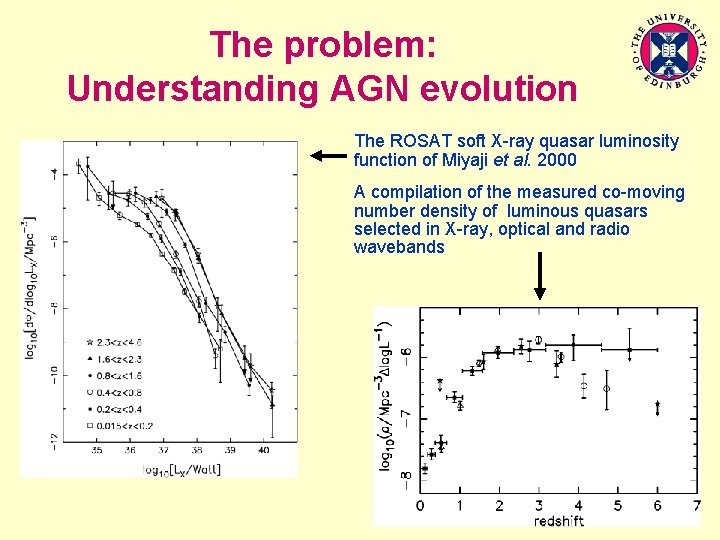
The problem: Understanding AGN evolution The ROSAT soft X-ray quasar luminosity function of Miyaji et al. 2000 A compilation of the measured co-moving number density of luminous quasars selected in X-ray, optical and radio wavebands
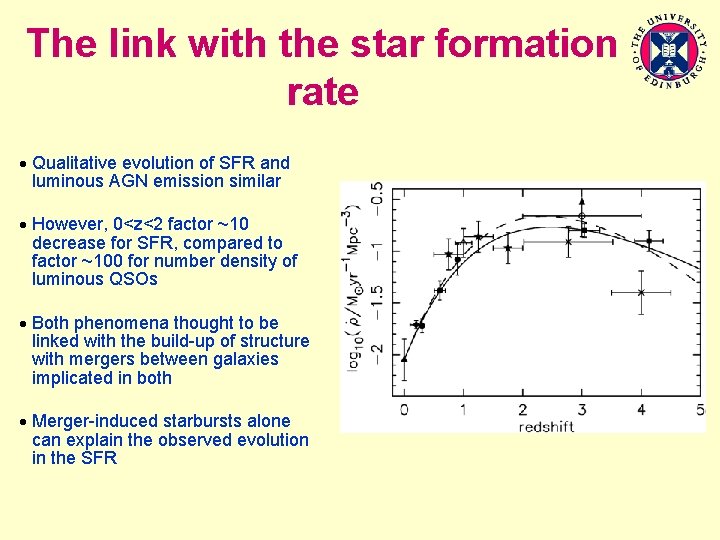
The link with the star formation rate · Qualitative evolution of SFR and luminous AGN emission similar · However, 0<z<2 factor ~10 decrease for SFR, compared to factor ~100 for number density of luminous QSOs · Both phenomena thought to be linked with the build-up of structure with mergers between galaxies implicated in both · Merger-induced starbursts alone can explain the observed evolution in the SFR
Why do we need analytic models? · The scale of AGN engines lies far below any feasible numerical resolution · Output from numerical simulation has to occur sequentially at fixed times · Analytic models are usually more versatile than numerical techniques · Analytic models often provide more insight into the physics behind modelled phenomena
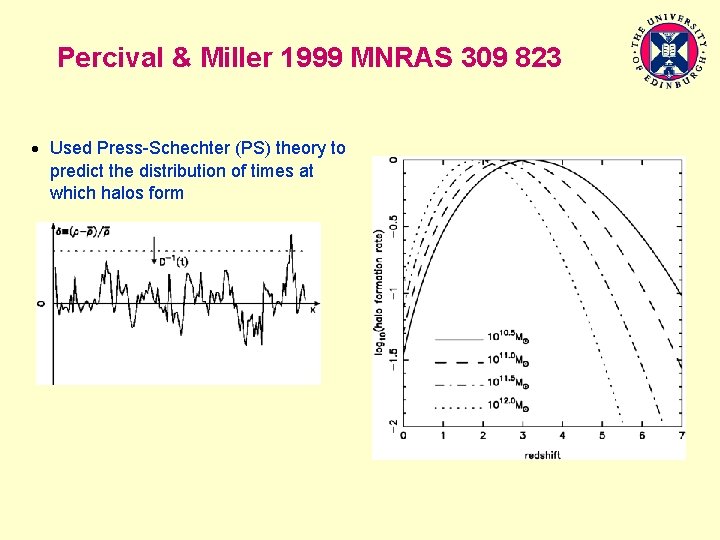
Percival & Miller 1999 MNRAS 309 823 · Used Press-Schechter (PS) theory to predict the distribution of times at which halos form
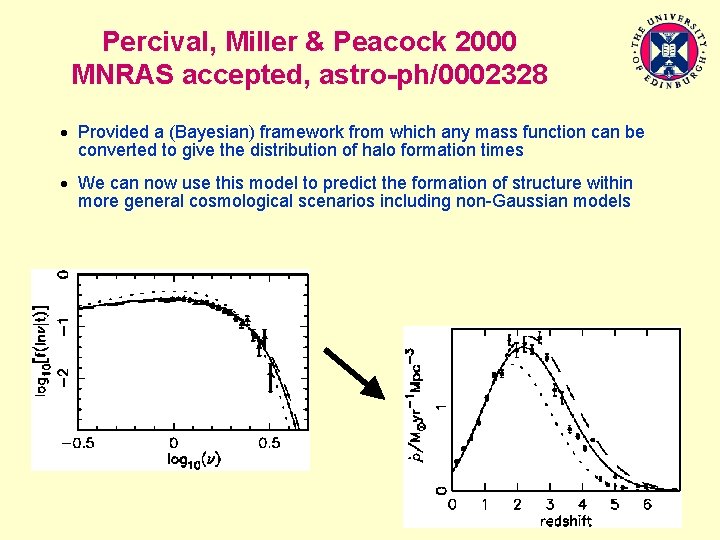
Percival, Miller & Peacock 2000 MNRAS accepted, astro-ph/0002328 · Provided a (Bayesian) framework from which any mass function can be converted to give the distribution of halo formation times · We can now use this model to predict the formation of structure within more general cosmological scenarios including non-Gaussian models
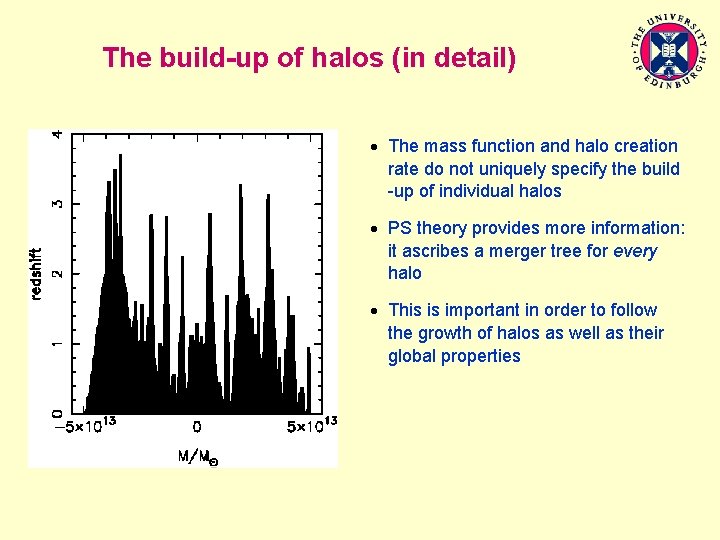
The build-up of halos (in detail) · The mass function and halo creation rate do not uniquely specify the build -up of individual halos · PS theory provides more information: it ascribes a merger tree for every halo · This is important in order to follow the growth of halos as well as their global properties
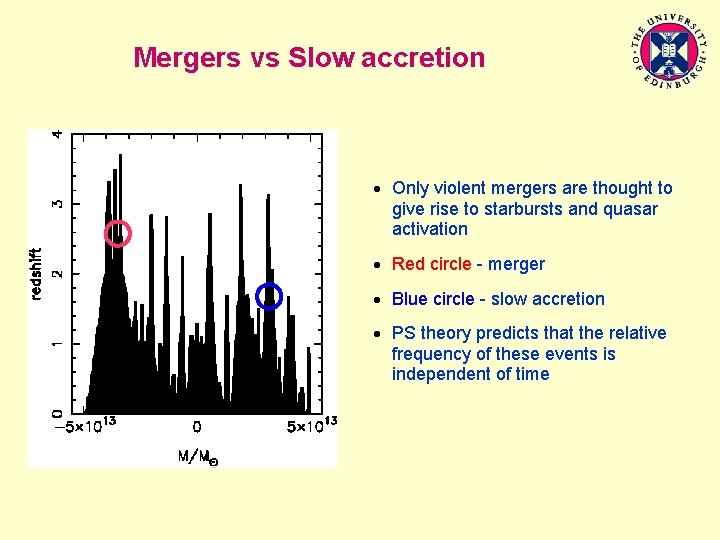
Mergers vs Slow accretion · Only violent mergers are thought to give rise to starbursts and quasar activation · Red circle - merger · Blue circle - slow accretion · PS theory predicts that the relative frequency of these events is independent of time
Future directions of analytic work · Analysis of the detailed way in which halos are predicted to form within PS theory - new algorithm for predicting halo merger trees - determine relative importance of mergers vs slow accretion - Importance of PS parameters: particularly filter - Comparison with numerical simulations · Use previous results to link non-Gaussian contributions to the density field with the epoch of structure formation
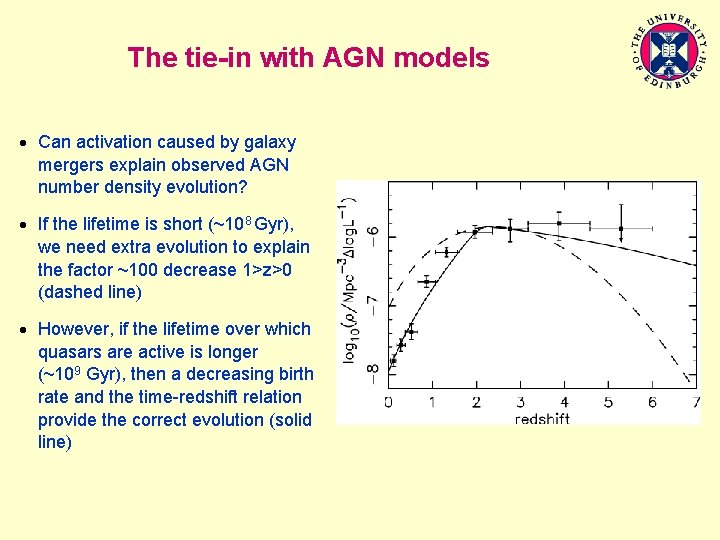
The tie-in with AGN models · Can activation caused by galaxy mergers explain observed AGN number density evolution? · If the lifetime is short (~108 Gyr), we need extra evolution to explain the factor ~100 decrease 1>z>0 (dashed line) · However, if the lifetime over which quasars are active is longer (~109 Gyr), then a decreasing birth rate and the time-redshift relation provide the correct evolution (solid line)
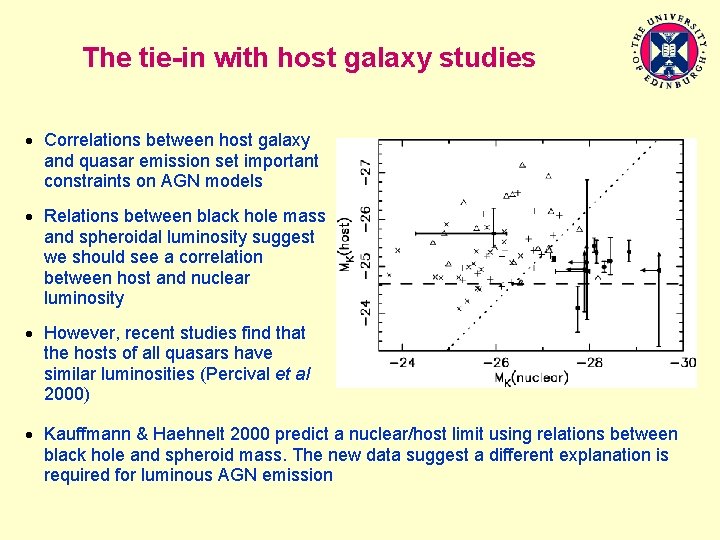
The tie-in with host galaxy studies · Correlations between host galaxy and quasar emission set important constraints on AGN models · Relations between black hole mass and spheroidal luminosity suggest we should see a correlation between host and nuclear luminosity · However, recent studies find that the hosts of all quasars have similar luminosities (Percival et al 2000) · Kauffmann & Haehnelt 2000 predict a nuclear/host limit using relations between black hole and spheroid mass. The new data suggest a different explanation is required for luminous AGN emission
Summary · Over the next four years, studies of AGN based in Edinburgh will provide important clues for understanding the evolution of AGN · Our current understanding of the build-up of structure is insufficient to fully exploit the results of these observational studies · The aims of this line of the grant are therefore: 1. To provide the required theoretical background in structure formation leading to galaxy and AGN formation 2. To combine this theoretical work with the results of observational studies to produce and constrain plausible models of AGN
Structure formation overview Aims: • Understanding the sequence of structure formation • Connecting ab initio theories to observations V f f
Major programmes: observation • 2 d. FGRS (Peacock, Sutherland) • SDSS (Meiksin) • Planck (Heavens) - Plus high-z galaxy work
The 2 d. F Galaxy Redshift Survey May 2000: 100, 000 redshifts to B=19. 45 (target 250 k by 2002) First precision data on spatial distribution of different classes of galaxy - analysis is manpower limited
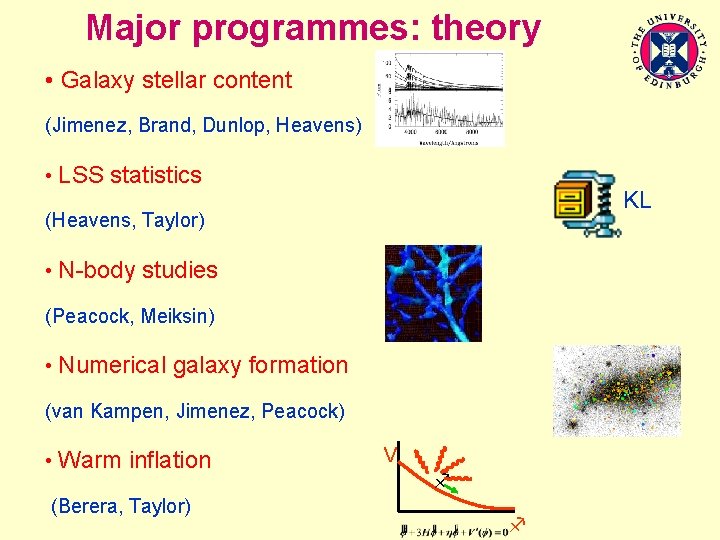
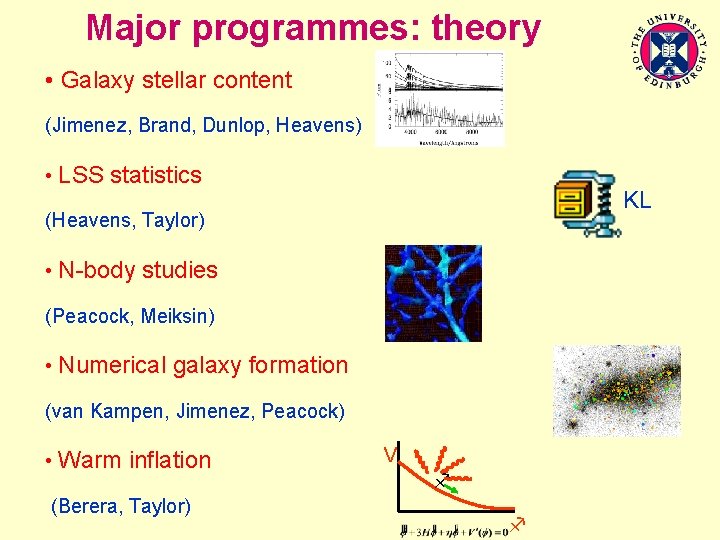
Major programmes: theory • Galaxy stellar content (Jimenez, Brand, Dunlop, Heavens) • LSS statistics KL (Heavens, Taylor) • N-body studies (Peacock, Meiksin) • Numerical galaxy formation (van Kampen, Jimenez, Peacock) • Warm inflation (Berera, Taylor) V f f
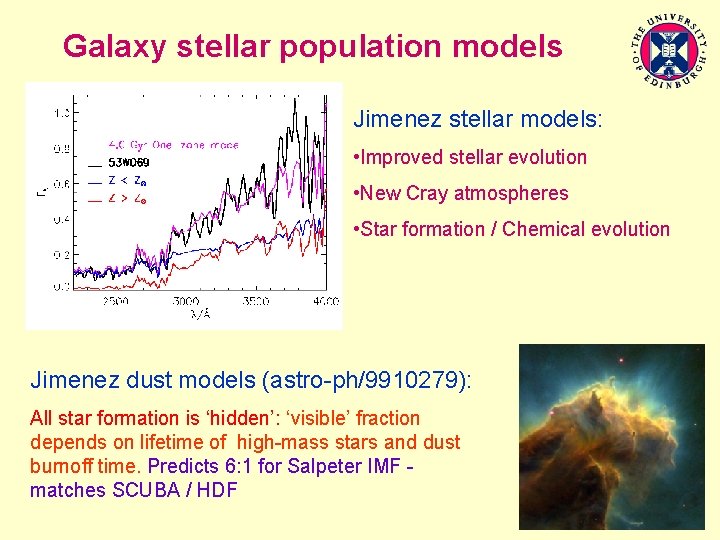
Galaxy stellar population models Jimenez stellar models: • Improved stellar evolution • New Cray atmospheres • Star formation / Chemical evolution Jimenez dust models (astro-ph/9910279): All star formation is ‘hidden’: ‘visible’ fraction depends on lifetime of high-mass stars and dust burnoff time. Predicts 6: 1 for Salpeter IMF matches SCUBA / HDF
Major programmes: theory • Galaxy stellar content (Jimenez, Brand, Dunlop, Heavens) • LSS statistics KL (Heavens, Taylor) • N-body studies (Peacock, Meiksin) • Numerical galaxy formation (van Kampen, Jimenez, Peacock) • Warm inflation (Berera, Taylor) V f f
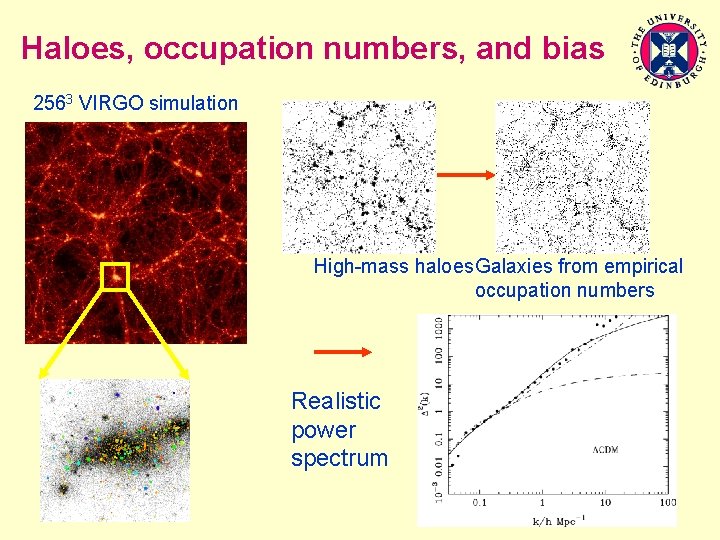
Haloes, occupation numbers, and bias 2563 VIRGO simulation High-mass haloes. Galaxies from empirical occupation numbers Realistic power spectrum
Major programmes: theory • Galaxy stellar content (Jimenez, Brand, Dunlop, Heavens) • LSS statistics KL (Heavens, Taylor) • N-body studies (Peacock, Meiksin) • Numerical galaxy formation (van Kampen, Jimenez, Peacock) • Warm inflation (Berera, Taylor) V f f
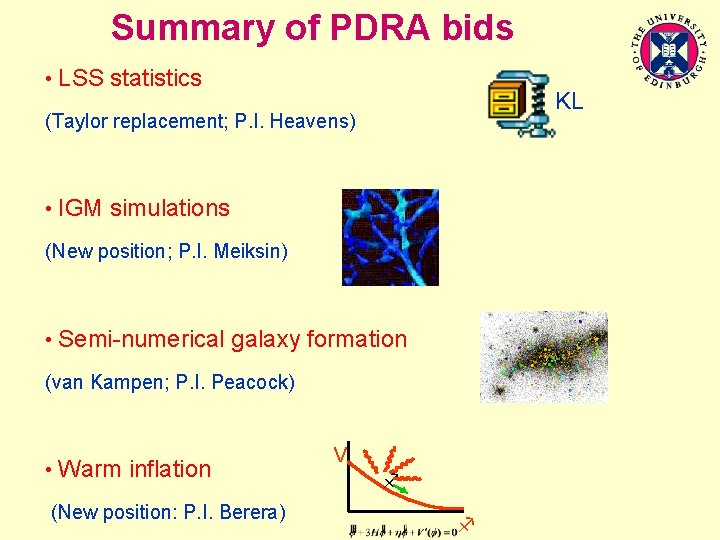
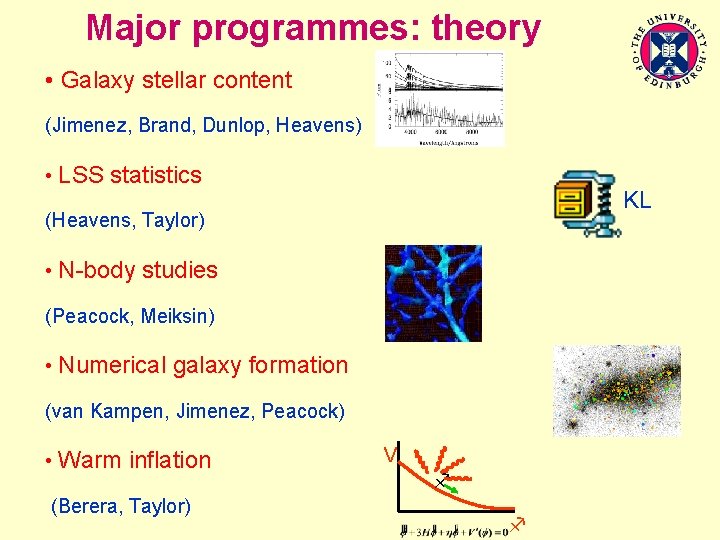
Summary of PDRA bids • LSS statistics KL (Taylor replacement; P. I. Heavens) • IGM simulations (New position; P. I. Meiksin) • Semi-numerical galaxy formation (van Kampen; P. I. Peacock) • Warm inflation (New position: P. I. Berera) V f f
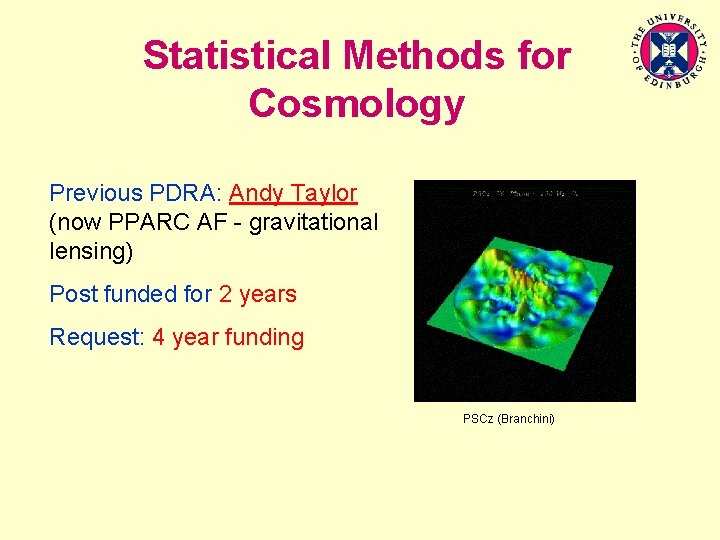
Statistical Methods for Cosmology Previous PDRA: Andy Taylor (now PPARC AF - gravitational lensing) Post funded for 2 years Request: 4 year funding PSCz (Branchini)
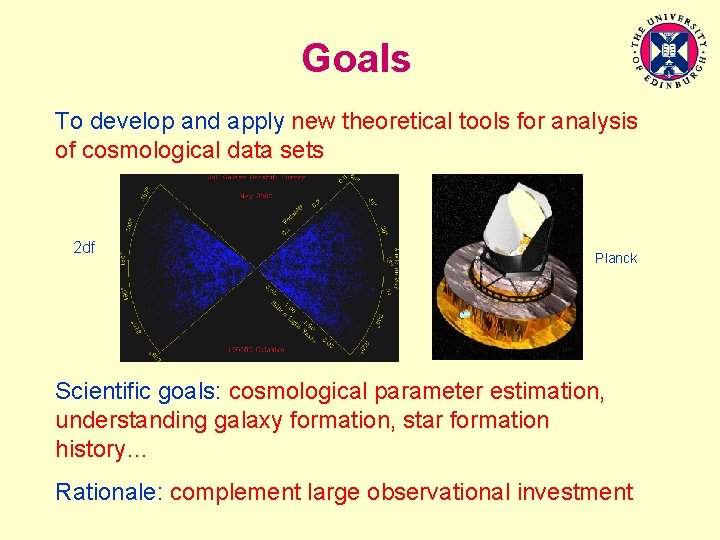
Goals To develop and apply new theoretical tools for analysis of cosmological data sets 2 df Planck Scientific goals: cosmological parameter estimation, understanding galaxy formation, star formation history… Rationale: complement large observational investment
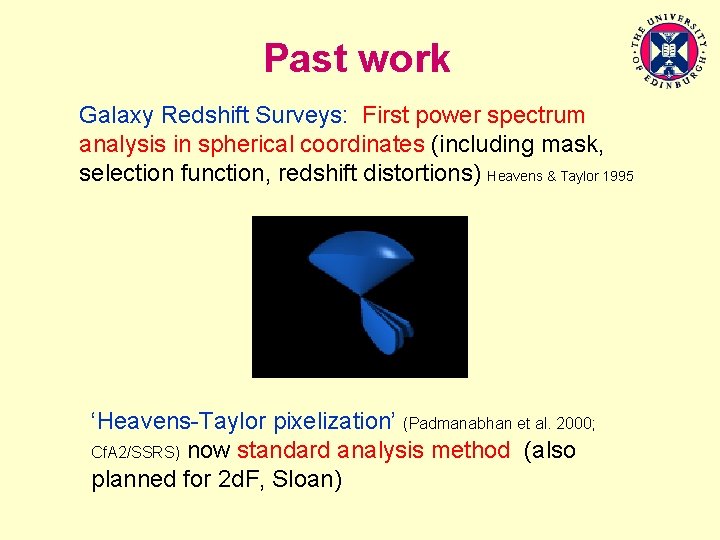
Past work Galaxy Redshift Surveys: First power spectrum analysis in spherical coordinates (including mask, selection function, redshift distortions) Heavens & Taylor 1995 ‘Heavens-Taylor pixelization’ (Padmanabhan et al. 2000; Cf. A 2/SSRS) now standard analysis method (also planned for 2 d. F, Sloan)
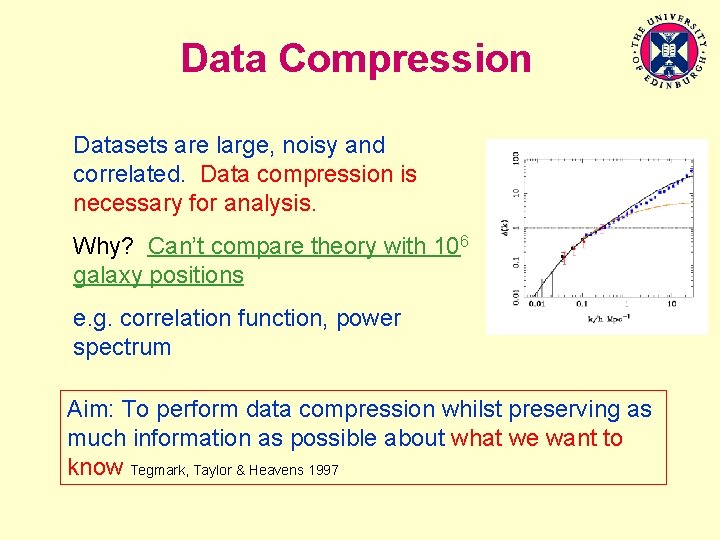
Data Compression Datasets are large, noisy and correlated. Data compression is necessary for analysis. Why? Can’t compare theory with 106 galaxy positions e. g. correlation function, power spectrum Aim: To perform data compression whilst preserving as much information as possible about what we want to know Tegmark, Taylor & Heavens 1997
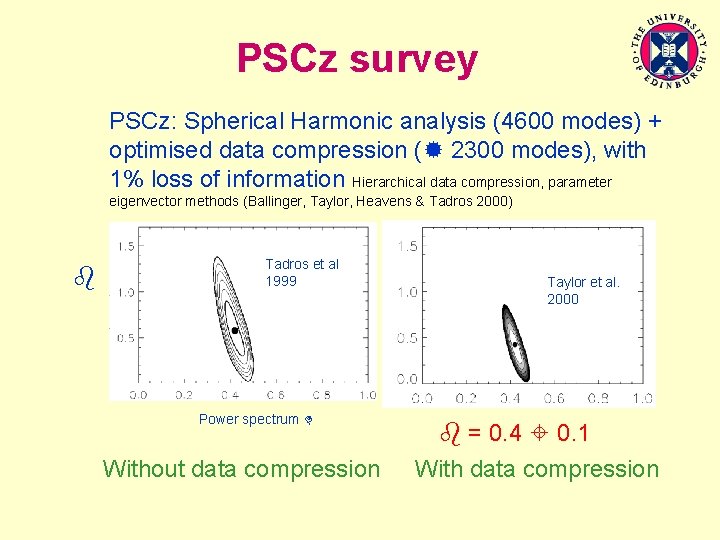
PSCz survey PSCz: Spherical Harmonic analysis (4600 modes) + optimised data compression ( 2300 modes), with 1% loss of information Hierarchical data compression, parameter eigenvector methods (Ballinger, Taylor, Heavens & Tadros 2000) Tadros et al 1999 Power spectrum Without data compression Taylor et al. 2000 = 0. 4 0. 1 With data compression
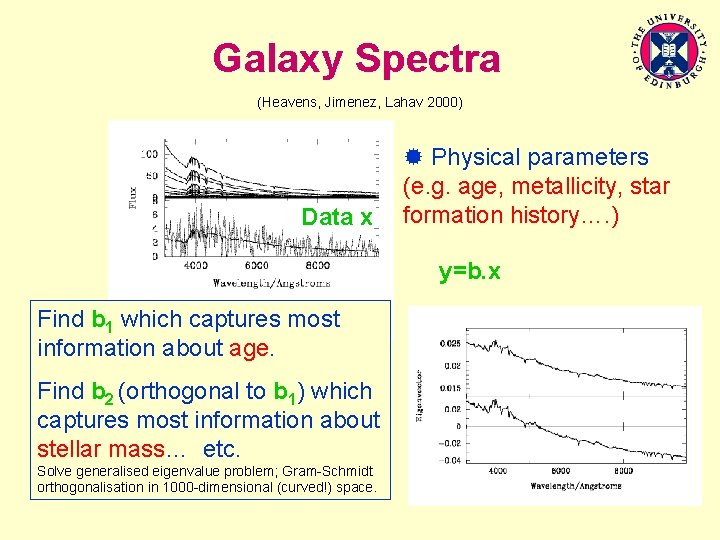
Galaxy Spectra (Heavens, Jimenez, Lahav 2000) Data x Physical parameters (e. g. age, metallicity, star formation history…. ) y=b. x Find b 1 which captures most information about age. Find b 2 (orthogonal to b 1) which captures most information about stellar mass… etc. Solve generalised eigenvalue problem; Gram-Schmidt orthogonalisation in 1000 -dimensional (curved!) space.
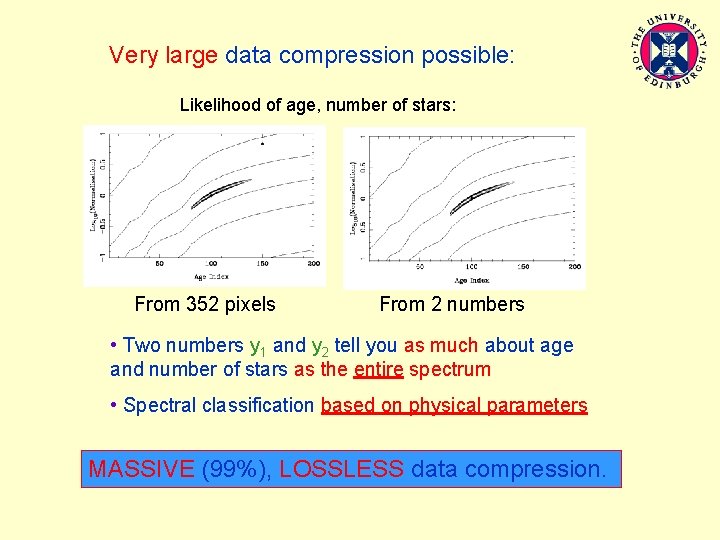
Very large data compression possible: Likelihood of age, number of stars: From 352 pixels From 2 numbers • Two numbers y 1 and y 2 tell you as much about age and number of stars as the entire spectrum • Spectral classification based on physical parameters MASSIVE (99%), LOSSLESS data compression.
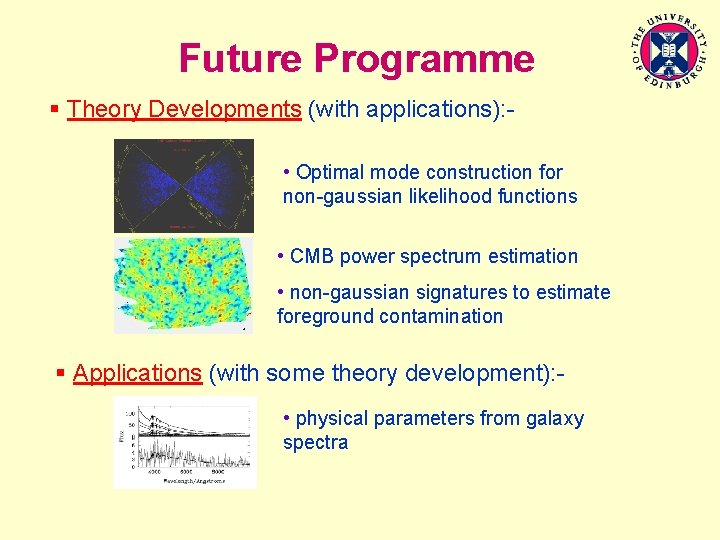
Future Programme § Theory Developments (with applications): • Optimal mode construction for non-gaussian likelihood functions • CMB power spectrum estimation • non-gaussian signatures to estimate foreground contamination § Applications (with some theory development): • physical parameters from galaxy spectra
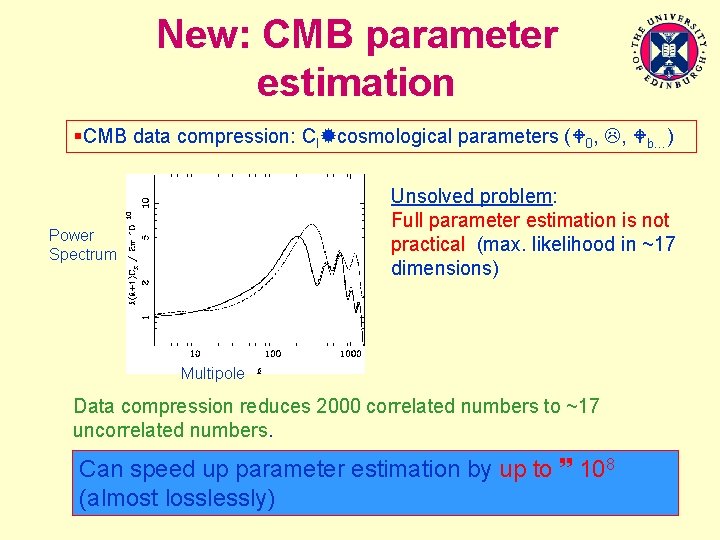
New: CMB parameter estimation §CMB data compression: Cl cosmological parameters ( 0, , b…) Unsolved problem: Full parameter estimation is not practical (max. likelihood in ~17 dimensions) Power Spectrum Multipole Data compression reduces 2000 correlated numbers to ~17 uncorrelated numbers. Can speed up parameter estimation by up to 108 (almost losslessly)
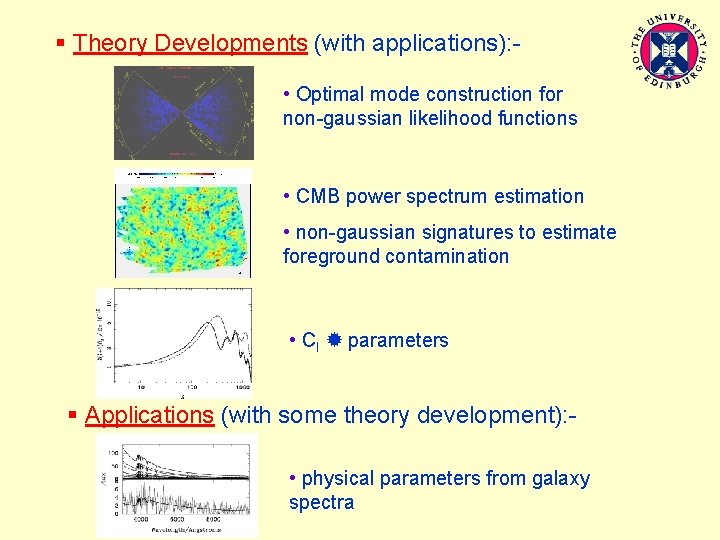
§ Theory Developments (with applications): • Optimal mode construction for non-gaussian likelihood functions • CMB power spectrum estimation • non-gaussian signatures to estimate foreground contamination • Cl parameters § Applications (with some theory development): • physical parameters from galaxy spectra
Simulating Galaxy Formation and Evolution Eelco van Kampen PPARC rolling grant review, May 2000
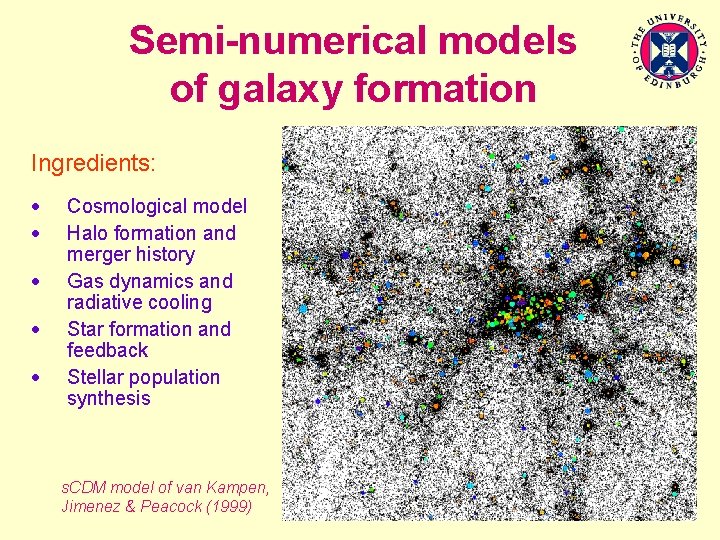
Semi-numerical models of galaxy formation Ingredients: · · · Cosmological model Halo formation and merger history Gas dynamics and radiative cooling Star formation and feedback Stellar population synthesis s. CDM model of van Kampen, Jimenez & Peacock (1999)
Research goals 2000 -2004 · Understanding all ingredients for a model of galaxy formation and evolution · Assessing the robustness and uniqueness of such a model · Applying the model to solve specific problems: – galaxy occupation number – the abundance of dwarf satellites – structures of local galaxies – interpreting high-redshift galaxy data
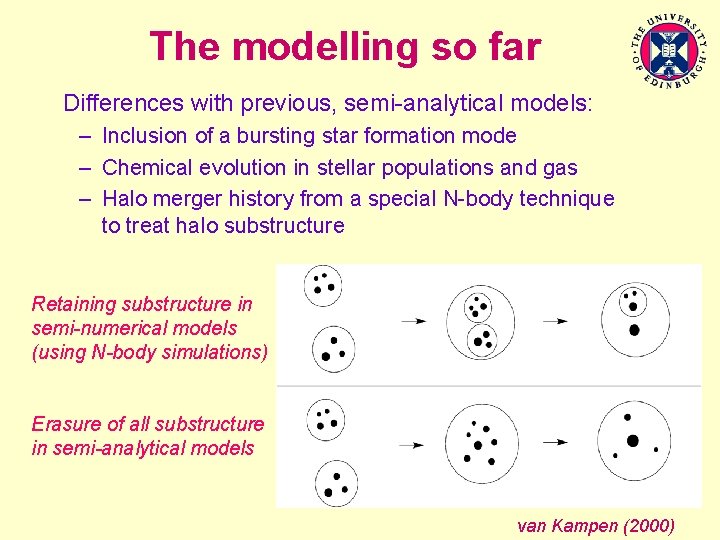
The modelling so far Differences with previous, semi-analytical models: – Inclusion of a bursting star formation mode – Chemical evolution in stellar populations and gas – Halo merger history from a special N-body technique to treat halo substructure Retaining substructure in semi-numerical models (using N-body simulations) Erasure of all substructure in semi-analytical models van Kampen (2000)
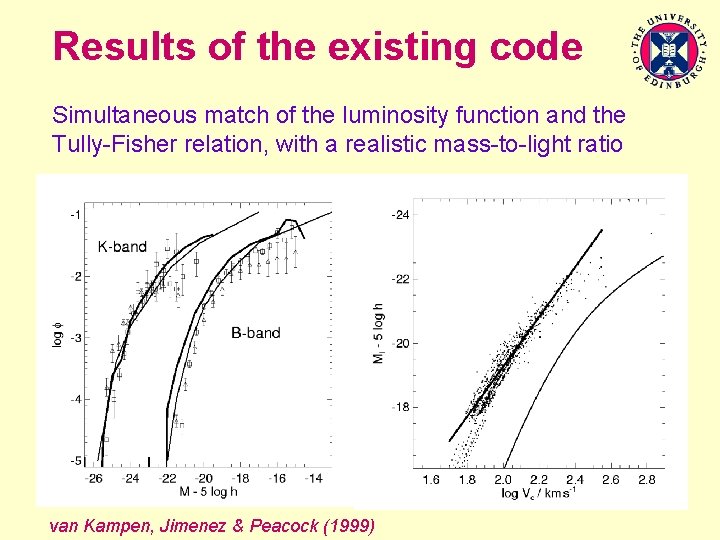
Results of the existing code Simultaneous match of the luminosity function and the Tully-Fisher relation, with a realistic mass-to-light ratio van Kampen, Jimenez & Peacock (1999)
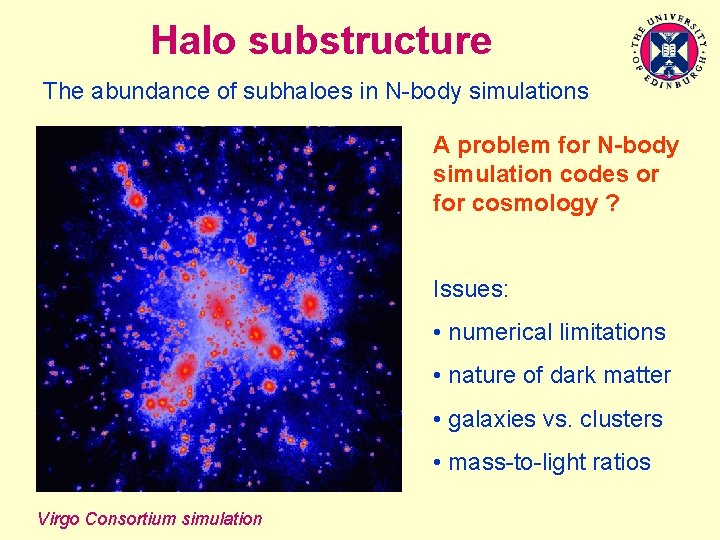
Halo substructure The abundance of subhaloes in N-body simulations A problem for N-body simulation codes or for cosmology ? Issues: • numerical limitations • nature of dark matter • galaxies vs. clusters • mass-to-light ratios Virgo Consortium simulation
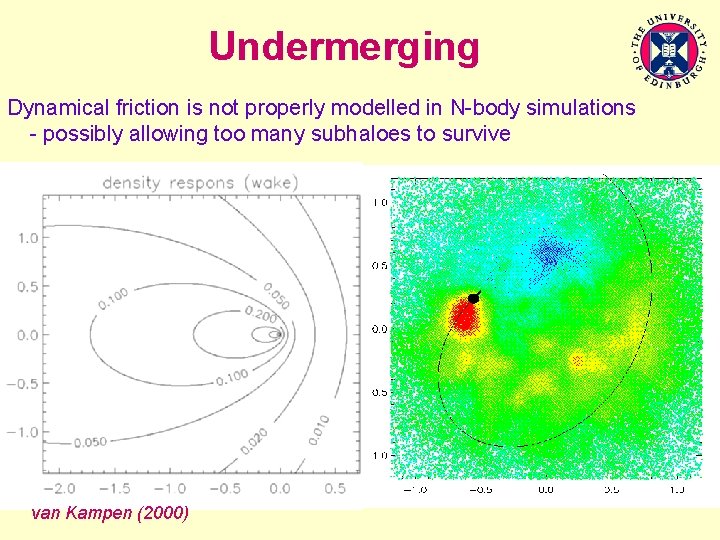
Undermerging Dynamical friction is not properly modelled in N-body simulations - possibly allowing too many subhaloes to survive van Kampen (2000)
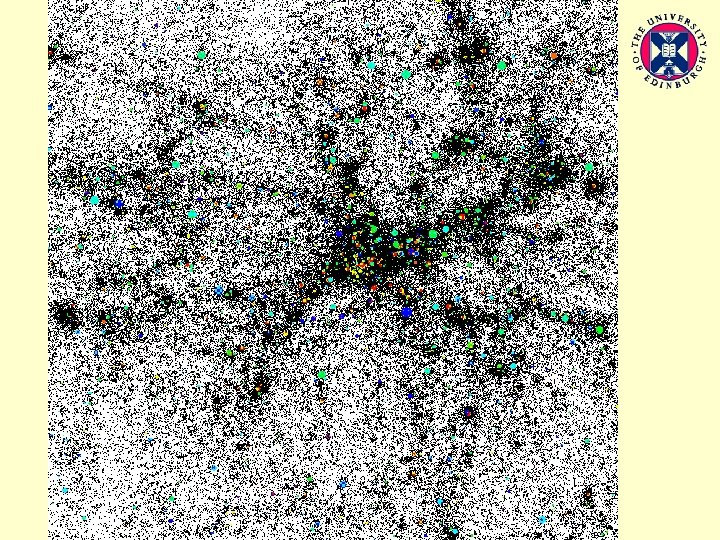
Exploiting the existing code · Extend van Kampen, Jimenez & Peacock (1999) to a LCDM Universe and a WDM Universe · Interpreting data from the 2 d. F survey: surface brightness function and limit, angular and redshift space correlation functions · Statistics of the galaxy ‘occupation number’, the number of galaxies within a dark matter halo
Structures of local galaxies Prediction of morphology and surface brightness Needed: · modelling disks and bulges · galaxy cluster physics: ram-pressure stripping and tidal processes transforms galaxies Specific goals: · morphological fractions · surface brightness function and limits · morphology-density relation
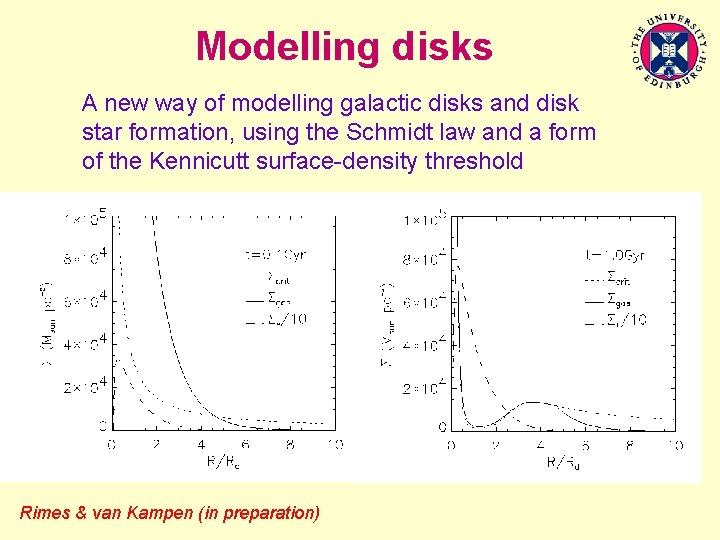
Modelling disks A new way of modelling galactic disks and disk star formation, using the Schmidt law and a form of the Kennicutt surface-density threshold Rimes & van Kampen (in preparation)
High-redshift galaxies Constraints on galaxy formation models and uniqueness tests for models that work for local galaxies. Needed: · dust model (Jimenez et al. 1999) · higher numerical resolution Specific goals: · sub-mm maps · galaxy clustering at high redshift · high redshift starburst activity
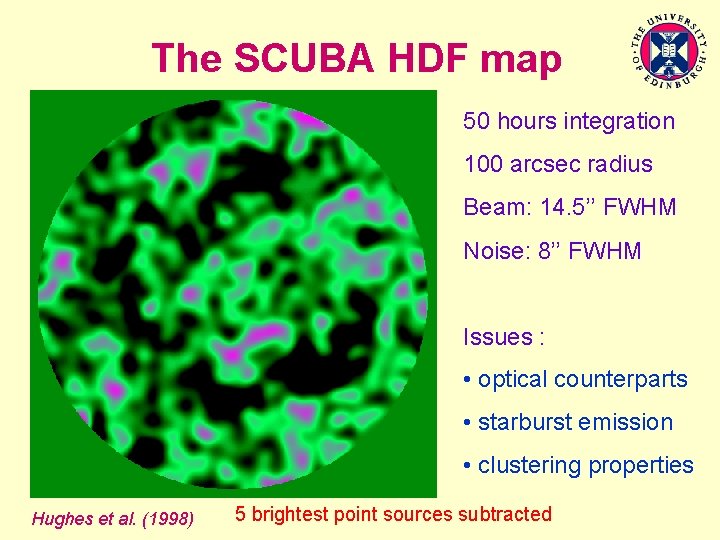
The SCUBA HDF map 50 hours integration 100 arcsec radius Beam: 14. 5’’ FWHM Noise: 8’’ FWHM Issues : • optical counterparts • starburst emission • clustering properties Hughes et al. (1998) 5 brightest point sources subtracted
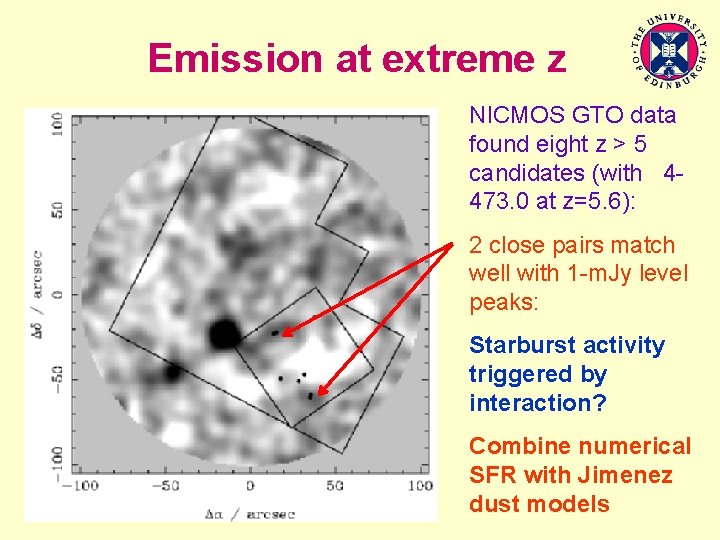
Emission at extreme z NICMOS GTO data found eight z > 5 candidates (with 4473. 0 at z=5. 6): 2 close pairs match well with 1 -m. Jy level peaks: Starburst activity triggered by interaction? Combine numerical SFR with Jimenez dust models
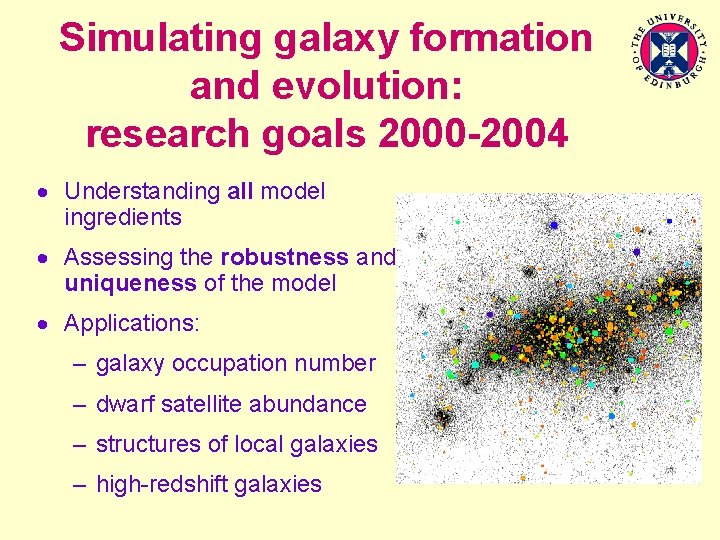
Simulating galaxy formation and evolution: research goals 2000 -2004 · Understanding all model ingredients · Assessing the robustness and uniqueness of the model · Applications: – galaxy occupation number – dwarf satellite abundance – structures of local galaxies – high-redshift galaxies
Hydrodynamical simulations of the intergalactic medium Avery Meiksin (bid for new position)
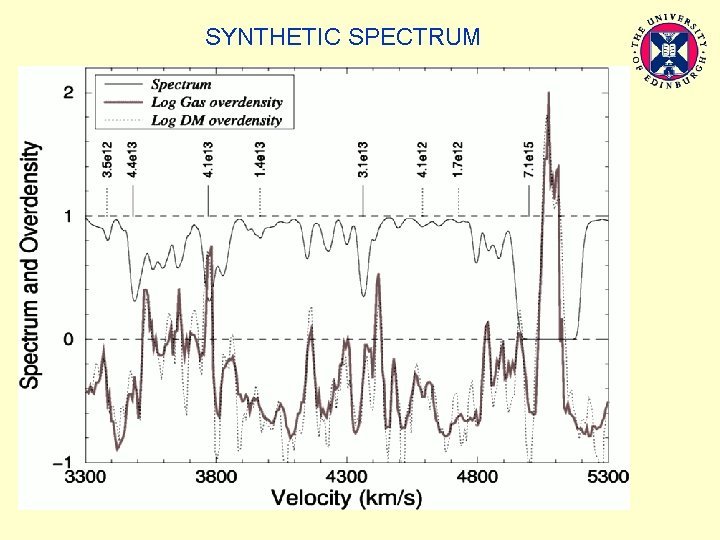
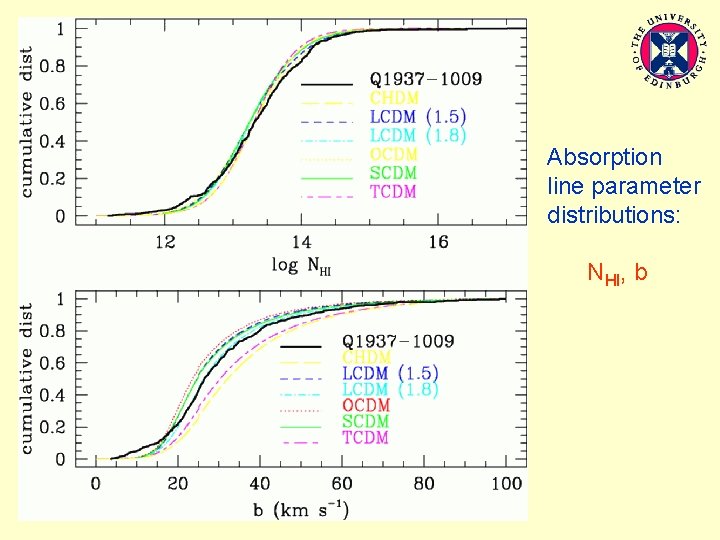
Purpose: to simulate the formation and evolution of the intergalactic medium Key questions: • What is the origin of structure in the IGM? • What is the physical nature of the Lyman-alpha forest? • What is the metal content of the IGM, and how has it evolved? Cold Dark Matter models (s. CDM, t. CDM, OCDM, CHDM) PM (gravity) + Eulerian finite difference (hydro) In collaboration with M. Norman (NCSA)
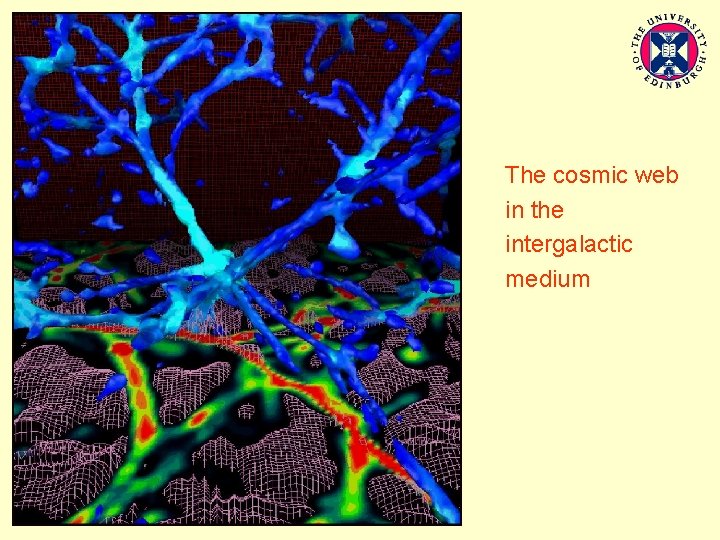
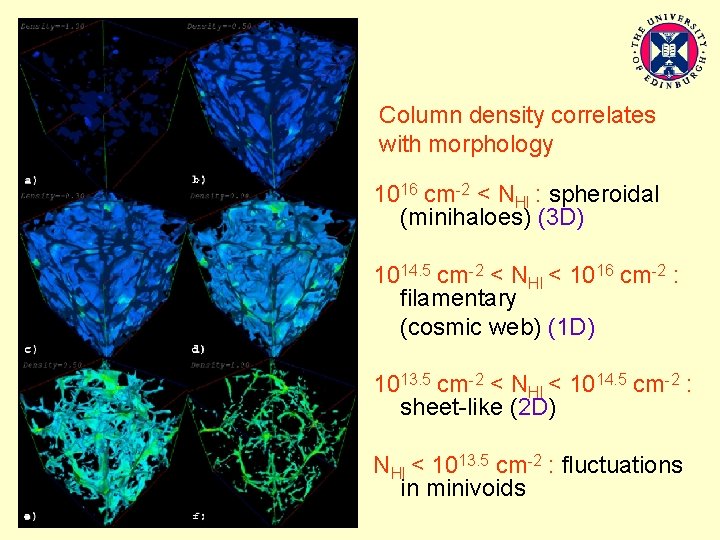
The cosmic web in the intergalactic medium
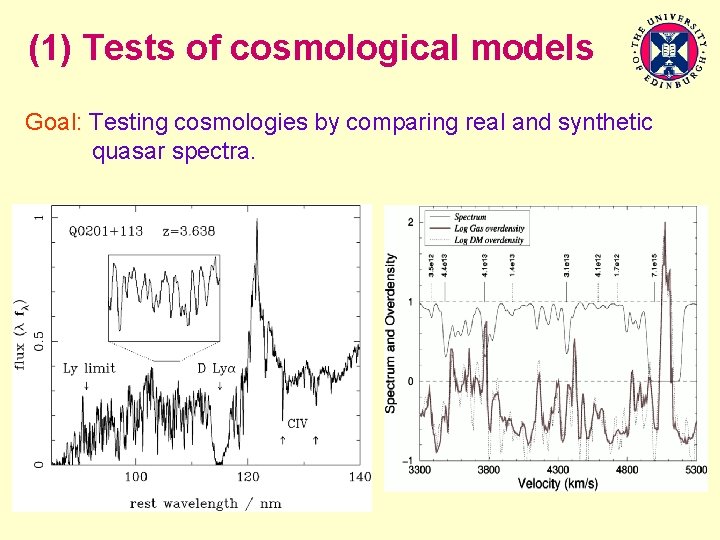
Projects (1) Tests of cosmological models (2) Multiple line-of-sight statistics (3) Metal ions in the Lyman-alpha forest
SYNTHETIC SPECTRUM
flux distribution wavelet transform
Wavelet coefficients Comparison between Keck spectrum and 6 cosmological models
Absorption line parameter distributions: NHI, b
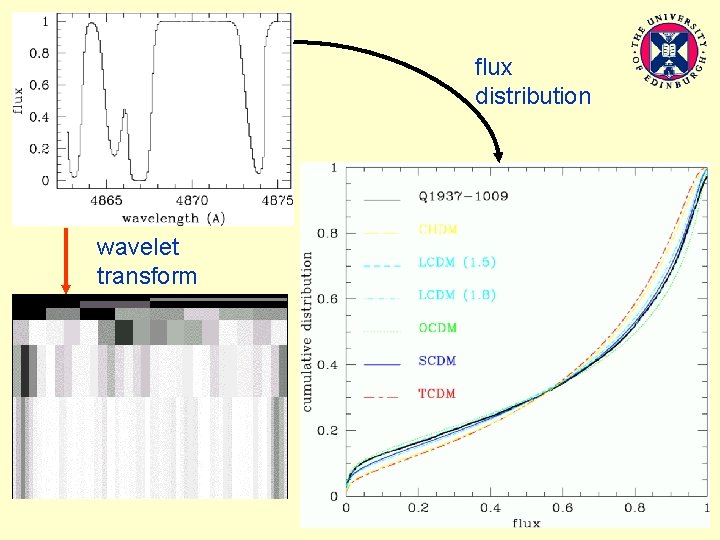
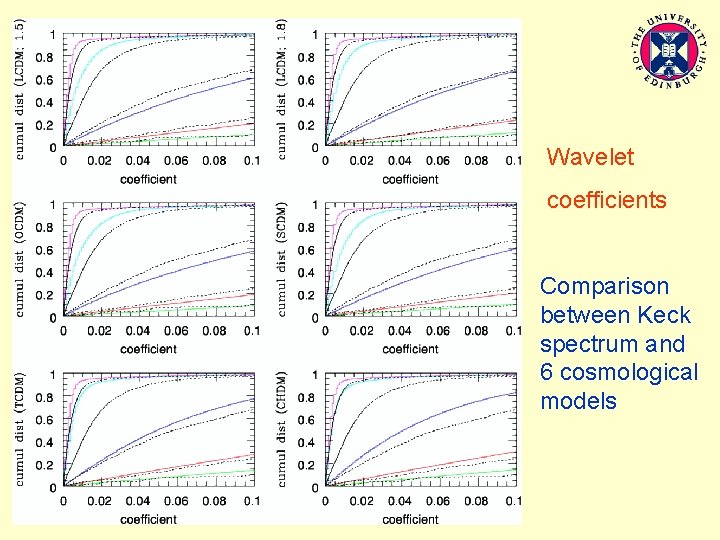
(1) Tests of cosmological models Goal: Testing cosmologies by comparing real and synthetic quasar spectra.
(2) Multiple line-of-sight statistics Goal: Shape and amplitude of P(k) HI column density correlates with gas morphology Expect different line-of-sight statistics for different morphological structures, corresponding to different HI column densities
Column density correlates with morphology 1016 cm-2 < NHI : spheroidal (minihaloes) (3 D) 1014. 5 cm-2 < NHI < 1016 cm-2 : filamentary (cosmic web) (1 D) 1013. 5 cm-2 < NHI < 1014. 5 cm-2 : sheet-like (2 D) NHI < 1013. 5 cm-2 : fluctuations in minivoids
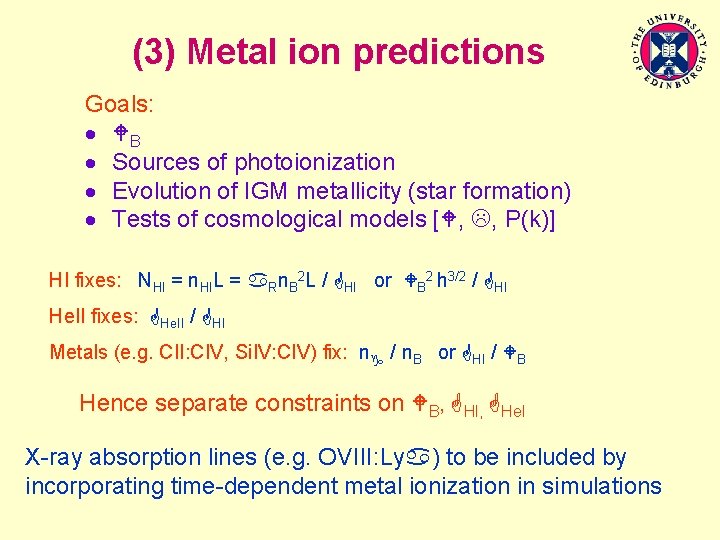
(3) Metal ion predictions Goals: · B · Sources of photoionization · Evolution of IGM metallicity (star formation) · Tests of cosmological models [ , , P(k)] HI fixes: NHI = n. HIL = a. Rn. B 2 L / GHI or B 2 h 3/2 / GHI He. II fixes: GHe. II / GHI Metals (e. g. CII: CIV, Si. IV: CIV) fix: ng / n. B or GHI / B Hence separate constraints on B, GHI, GHe. I X-ray absorption lines (e. g. OVIII: Lya) to be included by incorporating time-dependent metal ionization in simulations

Observational tests of inflation A. Berera, A. Taylor, J. Peacock, A. Heavens
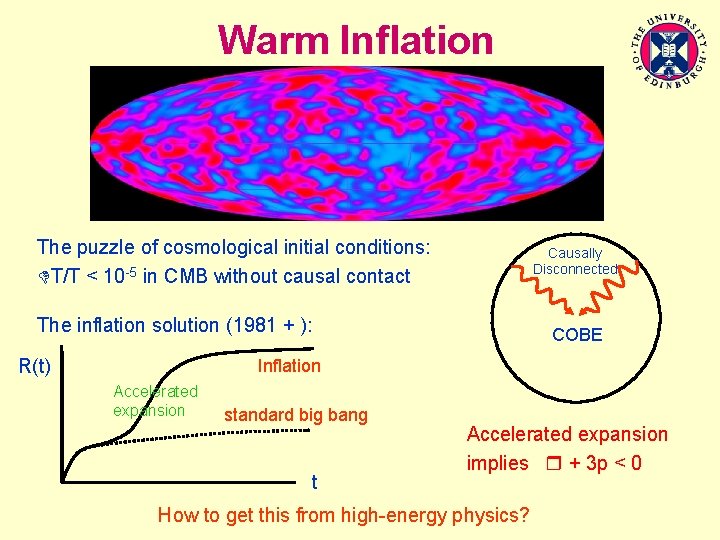
Warm Inflation The puzzle of cosmological initial conditions: T/T < 10 -5 in CMB without causal contact Causally Disconnected The inflation solution (1981 + ): R(t) COBE Inflation Accelerated expansion standard big bang t Accelerated expansion implies r + 3 p < 0 How to get this from high-energy physics?
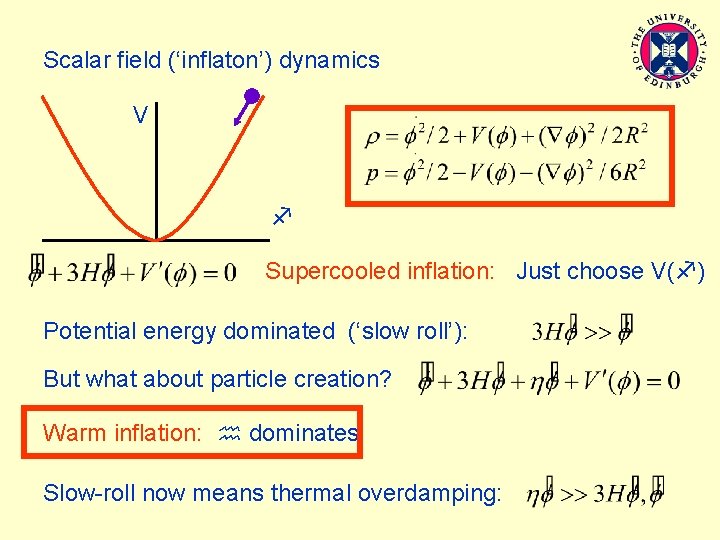
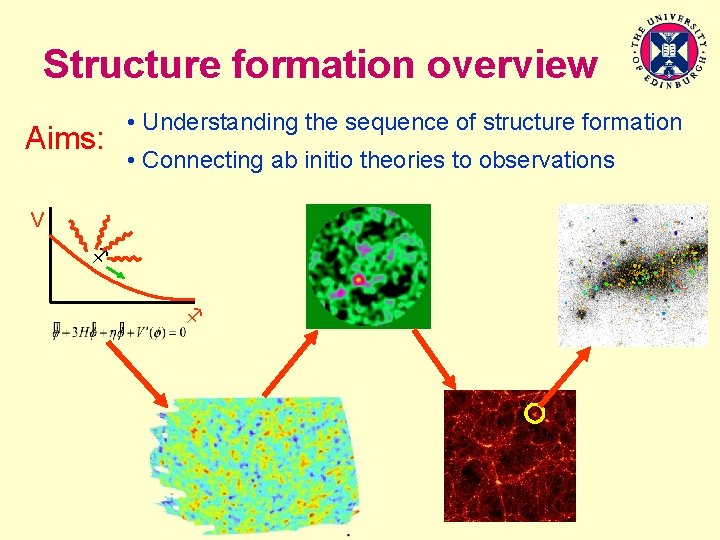
Scalar field (‘inflaton’) dynamics V f Supercooled inflation: Just choose V(f) Potential energy dominated (‘slow roll’): But what about particle creation? Warm inflation: h dominates Slow-roll now means thermal overdamping:
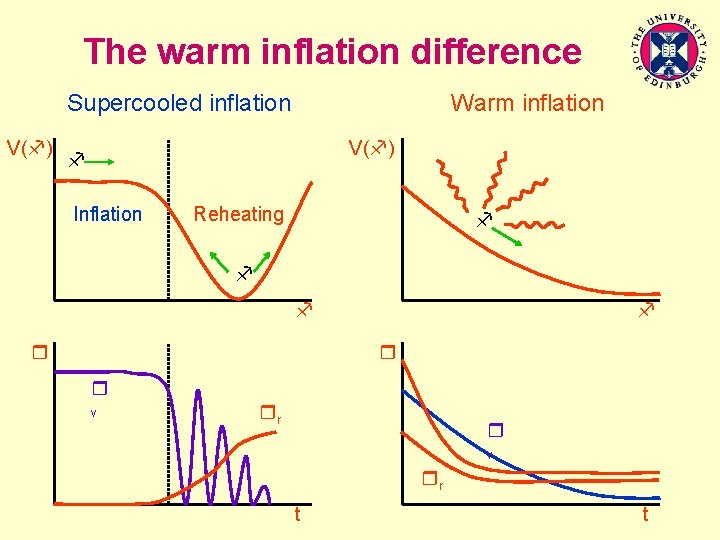
The warm inflation difference Supercooled inflation V(f) Warm inflation V(f) f Inflation Reheating f f f r r v rr t t
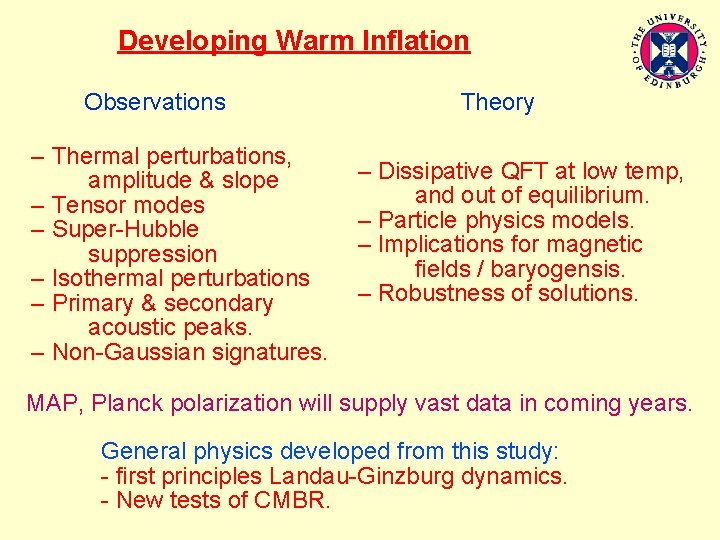
Developing Warm Inflation Observations – Thermal perturbations, amplitude & slope – Tensor modes – Super-Hubble suppression – Isothermal perturbations – Primary & secondary acoustic peaks. – Non-Gaussian signatures. Theory – Dissipative QFT at low temp, and out of equilibrium. – Particle physics models. – Implications for magnetic fields / baryogensis. – Robustness of solutions. MAP, Planck polarization will supply vast data in coming years. General physics developed from this study: - first principles Landau-Ginzburg dynamics. - New tests of CMBR.
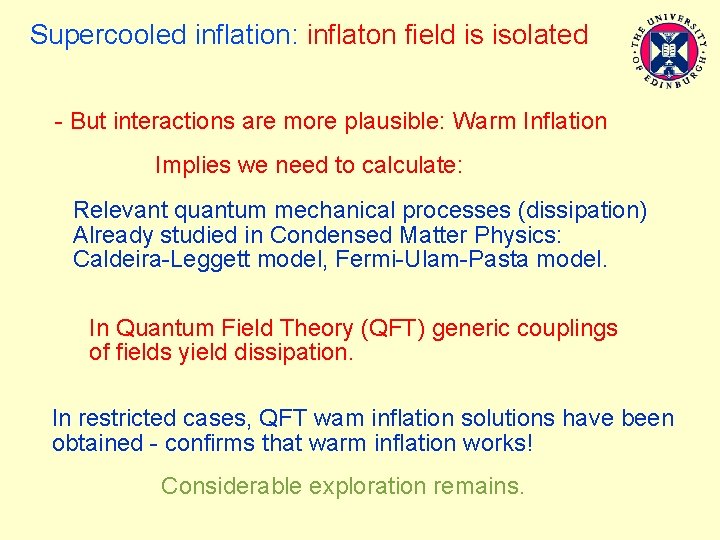
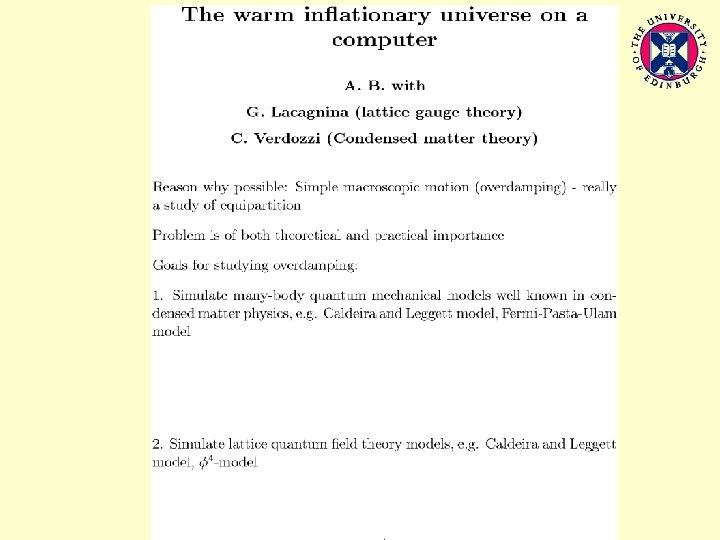
Supercooled inflation: inflaton field is isolated - But interactions are more plausible: Warm Inflation Implies we need to calculate: Relevant quantum mechanical processes (dissipation) Already studied in Condensed Matter Physics: Caldeira-Leggett model, Fermi-Ulam-Pasta model. In Quantum Field Theory (QFT) generic couplings of fields yield dissipation. In restricted cases, QFT wam inflation solutions have been obtained - confirms that warm inflation works! Considerable exploration remains.
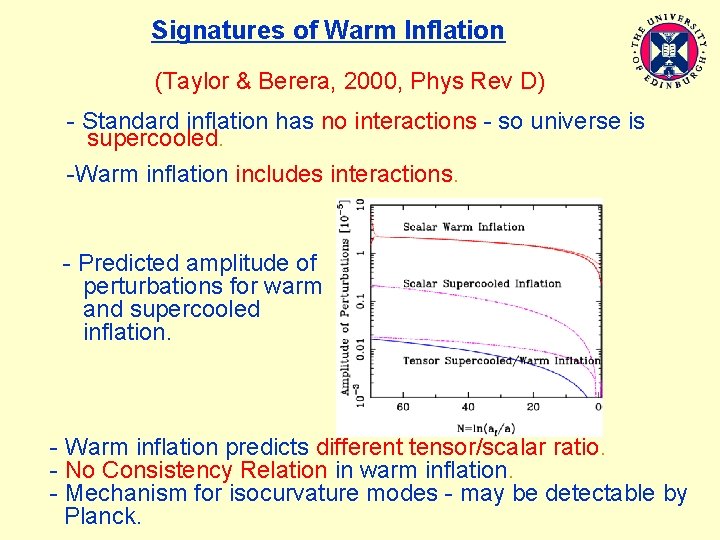
Signatures of Warm Inflation (Taylor & Berera, 2000, Phys Rev D) - Standard inflation has no interactions - so universe is supercooled. -Warm inflation includes interactions. - Predicted amplitude of perturbations for warm and supercooled inflation. - Warm inflation predicts different tensor/scalar ratio. - No Consistency Relation in warm inflation. - Mechanism for isocurvature modes - may be detectable by Planck.
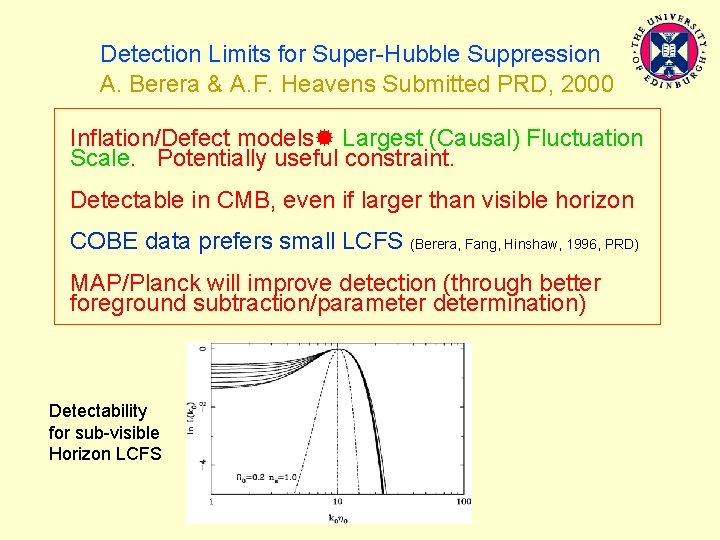
Detection Limits for Super-Hubble Suppression A. Berera & A. F. Heavens Submitted PRD, 2000 Inflation/Defect models Largest (Causal) Fluctuation Scale. Potentially useful constraint. Detectable in CMB, even if larger than visible horizon COBE data prefers small LCFS (Berera, Fang, Hinshaw, 1996, PRD) MAP/Planck will improve detection (through better foreground subtraction/parameter determination) Detectability for sub-visible Horizon LCFS
Future Work: Basic Theory Derive Linearized General Relativistic Perturbation Equations for Warm Inflation Conditions: - Effects of homogeneous radiation component - change in background evolution - themally induced density fluctuations - Isocurvature fluctuations - suppression scale - comprehensive identification of mechanisms - General evolution of adiabatic and isocurvature fluctuations - feedback effects of entropic pressure.
The Goal: Tests to Distinguish Between Warm and Supercooled Inflation Cosmic Microwave Background: - Generalise CMBFast for Warm Inflation: - remove conditions specific to supercooled inflation (T/S, account for dissipation term, etc). - account for super-Hubble suppression scale. - Include isocurvature modes. - Non. Gaussian signatures. - Simulate MAP & Planck maps. Optimal tests for temperature and polarization data: - Primary: tensor-scalar ratio, - Secondary: include isocurvature.
- Slides: 124