
Extraction of the EKV model parameters selected aspects

- Slides: 21
Extraction of the EKV model parameters: selected aspects of the underlying optimization task Jarosław Arabas 1, Łukasz Bartnik 1, Sławomir Szostak 2, Daniel Tomaszewski 3 1 2 3 Warsaw University of Technology: Institute of Electronic Systems http: //www. ise. pw. edu. pl Institute of Microelectronics and Optoelectronics http: //www. imio. pw. edu. pl Institute of Electron Technology MOS-AK meeting http: //www. ite. waw. pl IHP, Frankfurt(Oder), 3 rd April 2009
Outline 1. Task specification 2. Comparison of parameter extraction methods a) Random sampling b) Local minimization starting from randomly selected point c) Evolutionary algorithm d) Evolutionary algorithm & local minimization 3. Comparison of results 4. Evolutionary algorithm & local minimization for disturbed I-V data 5. Summary 6. Future work MOS-AK meeting IHP, Frankfurt(Oder), 3 rd April 2009
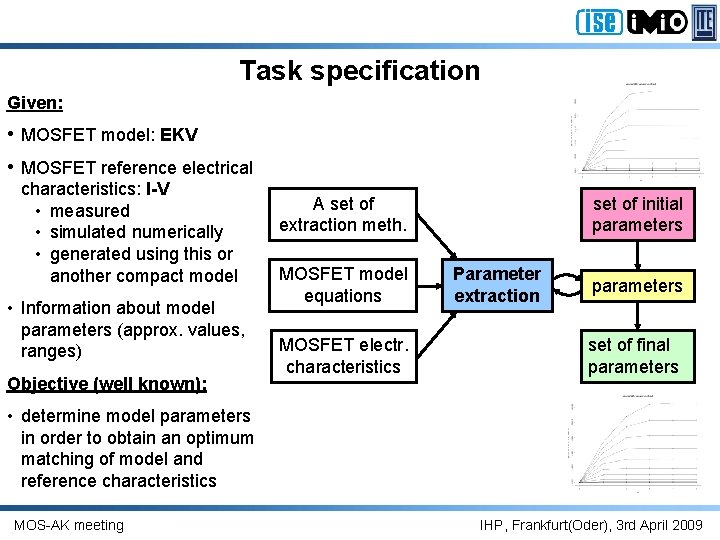
Task specification Given: • MOSFET model: EKV • MOSFET reference electrical characteristics: I-V • measured • simulated numerically • generated using this or another compact model • Information about model parameters (approx. values, ranges) Objective (well known): A set of extraction meth. MOSFET model equations MOSFET electr. characteristics set of initial parameters Parameter extraction parameters set of final parameters • determine model parameters in order to obtain an optimum matching of model and reference characteristics MOS-AK meeting IHP, Frankfurt(Oder), 3 rd April 2009
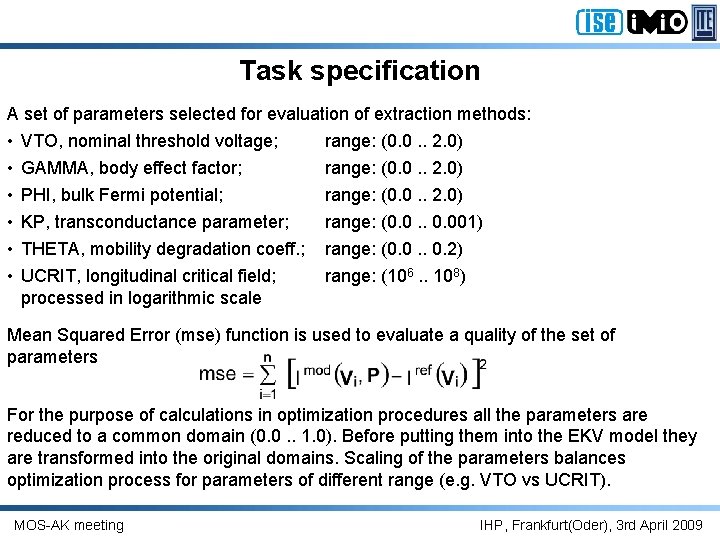
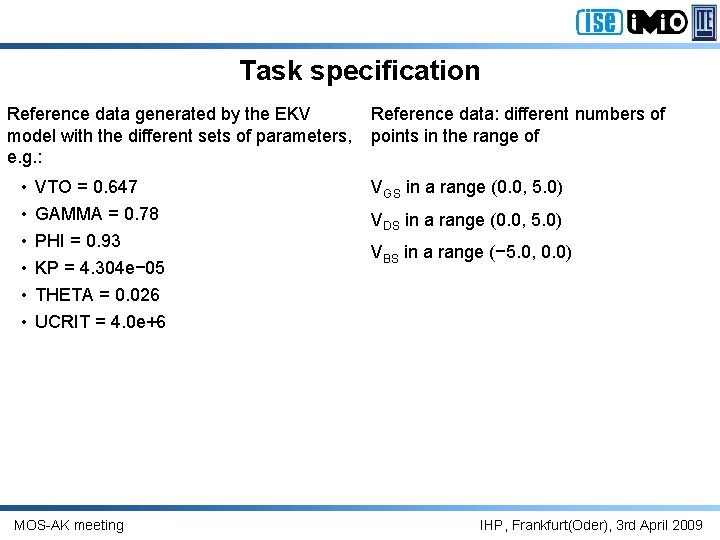
Task specification A set of parameters selected for evaluation of extraction methods: • • • VTO, nominal threshold voltage; GAMMA, body effect factor; range: (0. 0. . 2. 0) PHI, bulk Fermi potential; range: (0. 0. . 2. 0) KP, transconductance parameter; THETA, mobility degradation coeff. ; UCRIT, longitudinal critical field; processed in logarithmic scale range: (0. 0. 001) range: (0. 0. 2) range: (106. . 108) Mean Squared Error (mse) function is used to evaluate a quality of the set of parameters For the purpose of calculations in optimization procedures all the parameters are reduced to a common domain (0. 0. . 1. 0). Before putting them into the EKV model they are transformed into the original domains. Scaling of the parameters balances optimization process for parameters of different range (e. g. VTO vs UCRIT). MOS-AK meeting IHP, Frankfurt(Oder), 3 rd April 2009
Task specification Reference data generated by the EKV model with the different sets of parameters, e. g. : • • • Reference data: different numbers of points in the range of VTO = 0. 647 VGS in a range (0. 0, 5. 0) GAMMA = 0. 78 PHI = 0. 93 VDS in a range (0. 0, 5. 0) KP = 4. 304 e− 05 VBS in a range (− 5. 0, 0. 0) THETA = 0. 026 UCRIT = 4. 0 e+6 MOS-AK meeting IHP, Frankfurt(Oder), 3 rd April 2009
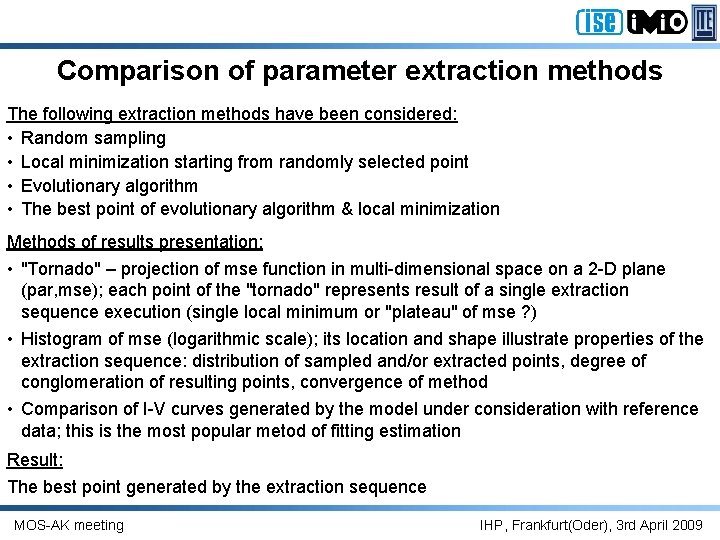
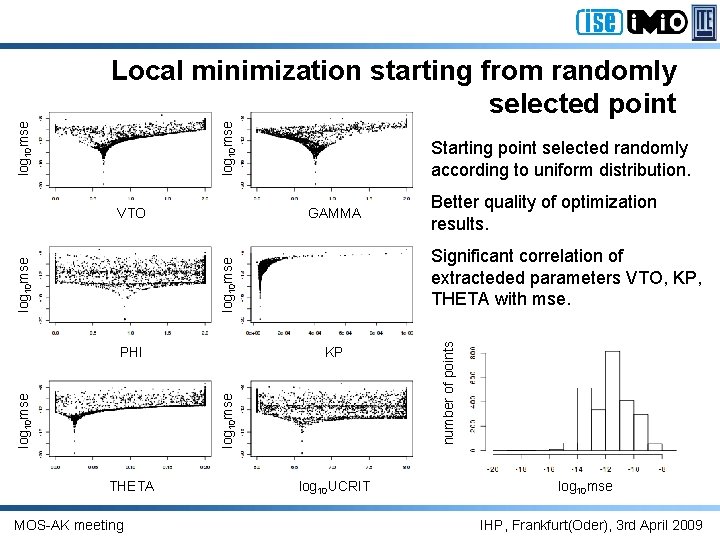
Comparison of parameter extraction methods The following extraction methods have been considered: • Random sampling • Local minimization starting from randomly selected point • Evolutionary algorithm • The best point of evolutionary algorithm & local minimization Methods of results presentation: • "Tornado" – projection of mse function in multi-dimensional space on a 2 -D plane (par, mse); each point of the "tornado" represents result of a single extraction sequence execution (single local minimum or "plateau" of mse ? ) • Histogram of mse (logarithmic scale); its location and shape illustrate properties of the extraction sequence: distribution of sampled and/or extracted points, degree of conglomeration of resulting points, convergence of method • Comparison of I-V curves generated by the model under consideration with reference data; this is the most popular metod of fitting estimation Result: The best point generated by the extraction sequence MOS-AK meeting IHP, Frankfurt(Oder), 3 rd April 2009
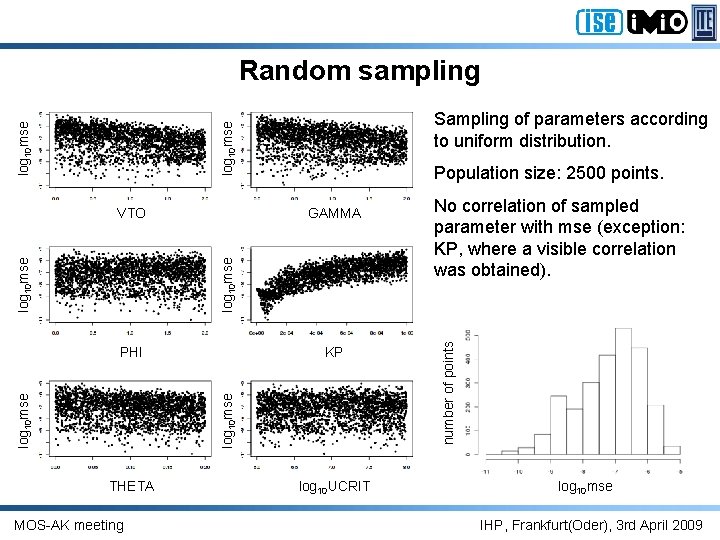
Sampling of parameters according to uniform distribution. log 10 mse GAMMA log 10 mse VTO Population size: 2500 points. KP log 10 mse PHI THETA MOS-AK meeting log 10 UCRIT No correlation of sampled parameter with mse (exception: KP, where a visible correlation was obtained). number of points log 10 mse Random sampling log 10 mse IHP, Frankfurt(Oder), 3 rd April 2009
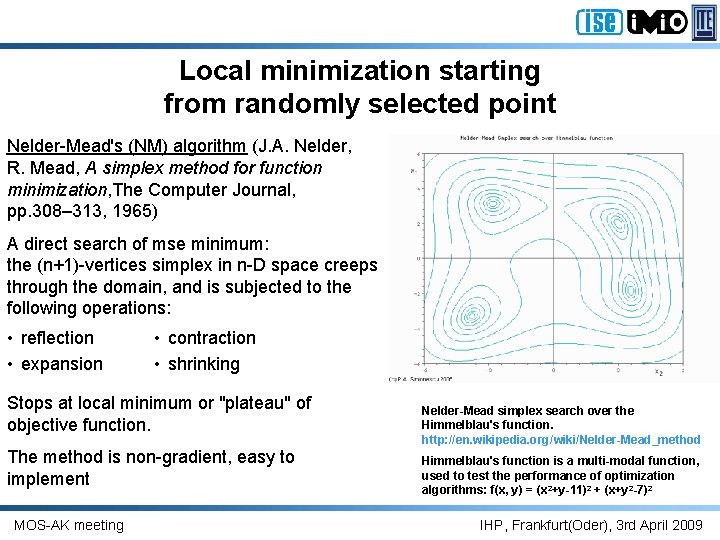
Local minimization starting from randomly selected point Nelder-Mead's (NM) algorithm (J. A. Nelder, R. Mead, A simplex method for function minimization, The Computer Journal, pp. 308– 313, 1965) A direct search of mse minimum: the (n+1)-vertices simplex in n-D space creeps through the domain, and is subjected to the following operations: • reflection • expansion • contraction • shrinking Stops at local minimum or "plateau" of objective function. The method is non-gradient, easy to implement MOS-AK meeting Nelder-Mead simplex search over the Himmelblau's function. http: //en. wikipedia. org/wiki/Nelder-Mead_method Himmelblau's function is a multi-modal function, used to test the performance of optimization algorithms: f(x, y) = (x 2+y-11)2 + (x+y 2 -7)2 IHP, Frankfurt(Oder), 3 rd April 2009
log 10 mse GAMMA KP log 10 mse PHI THETA MOS-AK meeting Better quality of optimization results. Significant correlation of extracteded parameters VTO, KP, THETA with mse. log 10 mse VTO Starting point selected randomly according to uniform distribution. log 10 UCRIT number of points log 10 mse Local minimization starting from randomly selected point log 10 mse IHP, Frankfurt(Oder), 3 rd April 2009
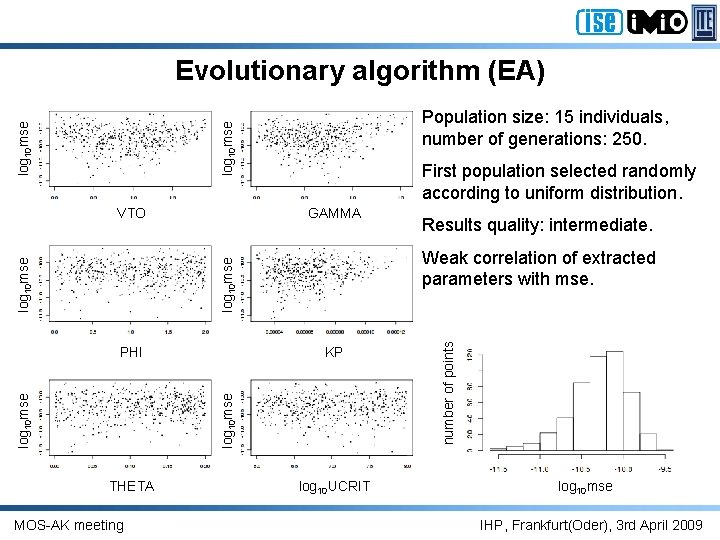
Evolutionary algorithm (EA) Evolutionary algorithm Def. Evolutionary algorithms (EAs) are population-based metaheuristic optimization algorithms that use biology-inspired mechanisms in order to refine a set of solution candidates iteratively, namely mutation, crossover, natural selection, and the fact, that individuals of better fitness have more children. The advantage of evolutionary algorithms compared to other optimization methods is their “black box” character that makes only few assumptions about the underlying objective functions. Furthermore, the definition of objective functions usually requires lesser insight to the structure of the problem space than the manual construction of an admissible heuristic. EAs therefore perform consistently well in many different problem categories. Thomas Weise, "Global Optimization Algorithms – Theory and Application", 2 nd ed. , http: //www. it-weise. de/projects/book. pdf Jarosław Arabas, "Lecture notes on evolutionary computation", 2 nd ed. , WNT, Warszawa, 2004 (in Polish) MOS-AK meeting IHP, Frankfurt(Oder), 3 rd April 2009
Population size: 15 individuals, number of generations: 250. log 10 mse GAMMA KP log 10 mse PHI THETA MOS-AK meeting Results quality: intermediate. Weak correlation of extracted parameters with mse. log 10 mse VTO First population selected randomly according to uniform distribution. log 10 UCRIT number of points log 10 mse Evolutionary algorithm (EA) log 10 mse IHP, Frankfurt(Oder), 3 rd April 2009
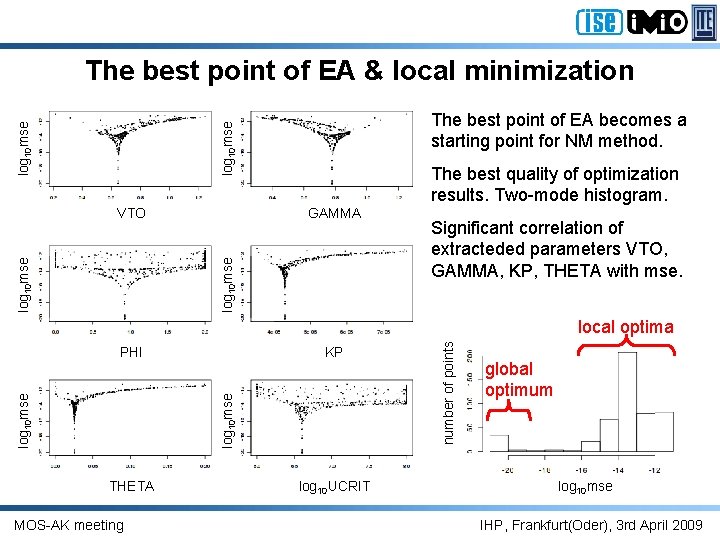
The best point of EA becomes a starting point for NM method. log 10 mse The best point of EA & local minimization GAMMA log 10 mse VTO The best quality of optimization results. Two-mode histogram. Significant correlation of extracteded parameters VTO, GAMMA, KP, THETA with mse. KP log 10 mse PHI THETA MOS-AK meeting log 10 UCRIT number of points local optima global optimum log 10 mse IHP, Frankfurt(Oder), 3 rd April 2009
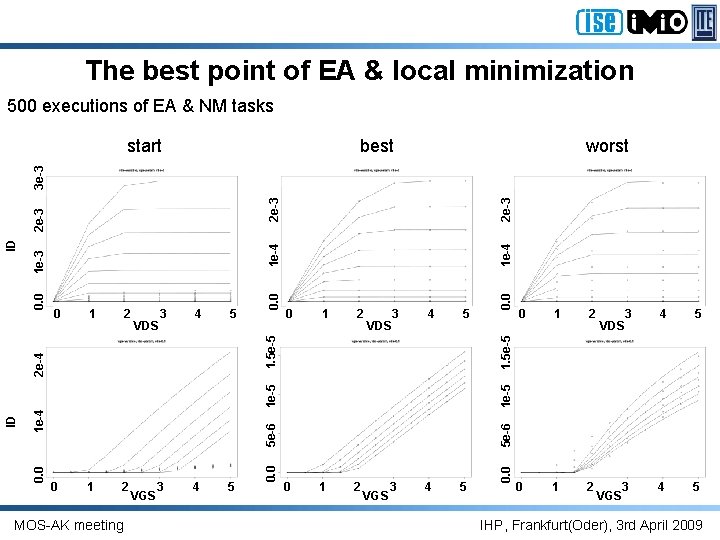
The best point of EA & local minimization 500 executions of EA & NM tasks best worst 1 2 4 5 3 4 5 0 1 2 3 4 5 VDS 1 2 0 1 2 3 VDS 4 5 3 4 5 1. 5 e-5 0 1 e-5 0. 0 5 e-6 1 e-4 0. 0 ID MOS-AK meeting VGS 0. 0 0 3 VDS 0. 0 1 e-4 2 e-3 2 1. 5 e-5 1 0. 0 1 e-4 2 e-3 1 e-3 0 2 e-4 0. 0 ID 2 e-3 3 e-3 start VGS IHP, Frankfurt(Oder), 3 rd April 2009
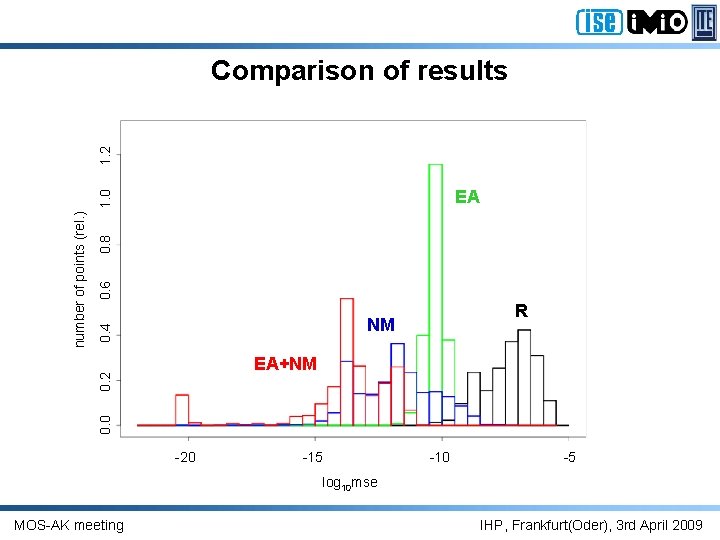
1. 2 Comparison of results 0. 8 0. 4 0. 6 Evolutionary algorithm Nelder-Mead NM EA + NM EA+NM random R 0. 0 0. 2 number of points (rel. ) 1. 0 EA -20 -15 -10 -5 log 10 mse MOS-AK meeting IHP, Frankfurt(Oder), 3 rd April 2009
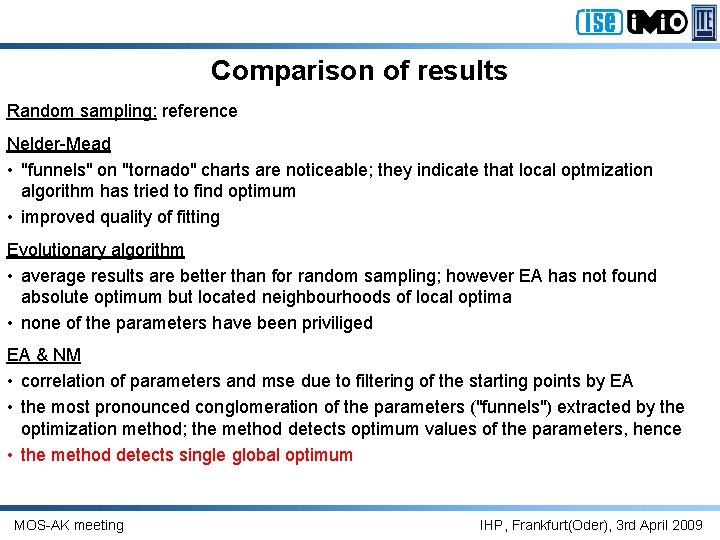
Comparison of results Random sampling: reference Nelder-Mead • "funnels" on "tornado" charts are noticeable; they indicate that local optmization algorithm has tried to find optimum • improved quality of fitting Evolutionary algorithm • average results are better than for random sampling; however EA has not found absolute optimum but located neighbourhoods of local optima • none of the parameters have been priviliged EA & NM • correlation of parameters and mse due to filtering of the starting points by EA • the most pronounced conglomeration of the parameters ("funnels") extracted by the optimization method; the method detects optimum values of the parameters, hence • the method detects single global optimum MOS-AK meeting IHP, Frankfurt(Oder), 3 rd April 2009
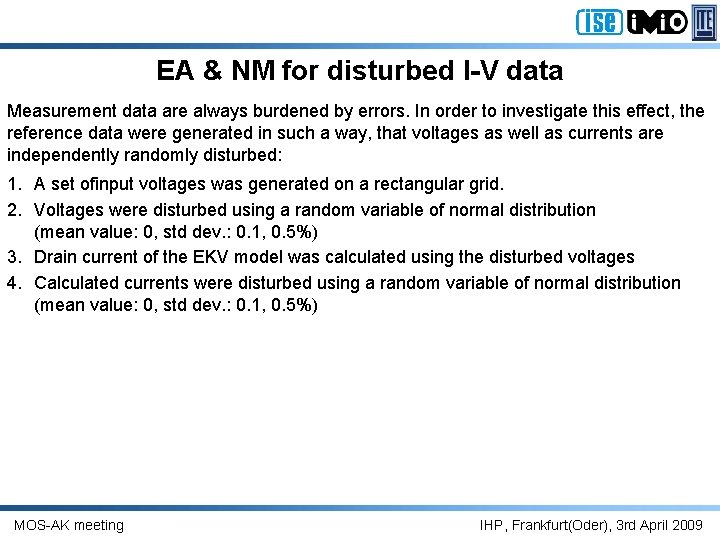
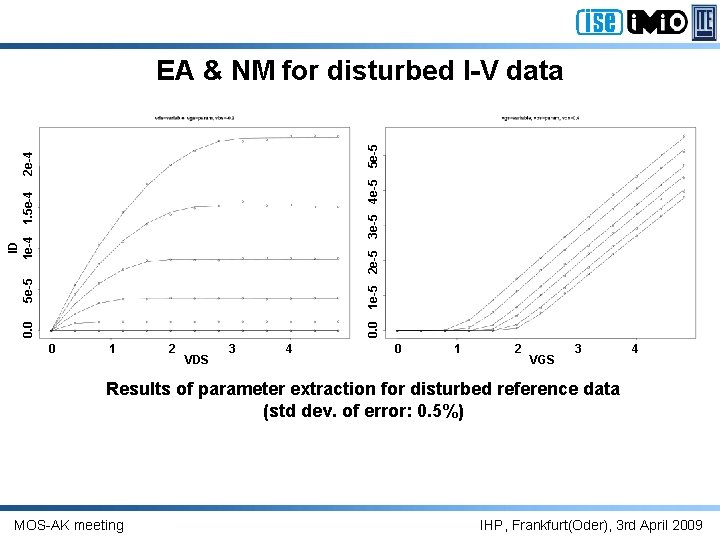
EA & NM for disturbed I-V data Measurement data are always burdened by errors. In order to investigate this effect, the reference data were generated in such a way, that voltages as well as currents are independently randomly disturbed: 1. A set ofinput voltages was generated on a rectangular grid. 2. Voltages were disturbed using a random variable of normal distribution (mean value: 0, std dev. : 0. 1, 0. 5%) 3. Drain current of the EKV model was calculated using the disturbed voltages 4. Calculated currents were disturbed using a random variable of normal distribution (mean value: 0, std dev. : 0. 1, 0. 5%) MOS-AK meeting IHP, Frankfurt(Oder), 3 rd April 2009
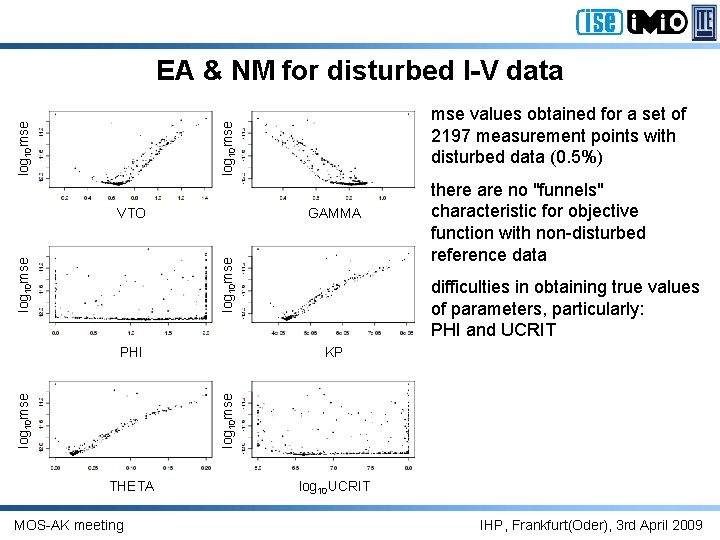
mse values obtained for a set of 2197 measurement points with disturbed data (0. 5%) log 10 mse EA & NM for disturbed I-V data GAMMA log 10 mse VTO difficulties in obtaining true values of parameters, particularly: PHI and UCRIT KP log 10 mse PHI there are no "funnels" characteristic for objective function with non-disturbed reference data THETA MOS-AK meeting log 10 UCRIT IHP, Frankfurt(Oder), 3 rd April 2009
0. 0 5 e-5 ID 1 e-4 1. 5 e-4 2 e-4 0. 0 1 e-5 2 e-5 3 e-5 4 e-5 5 e-5 EA & NM for disturbed I-V data 0 1 2 VDS 3 4 0 1 2 VGS 3 4 Results of parameter extraction for disturbed reference data (std dev. of error: 0. 5%) MOS-AK meeting IHP, Frankfurt(Oder), 3 rd April 2009
Summary • A combination of the search method in the multi-dimensional space of parameters (e. g. EA algorithm) with the local optimization method (e. g. NM) seems to be the reliable and efficient way to find the unique set of the EKV model parameters minimizing the misfit between the experimental (disturbed ? ) and model I-V data • The approach is supposed to overcome the problem of mutual dependence of parameters, which makes questionable the task of their extraction by means of optimization • The proposed approach allows to evaluate any set of parameter extraction methods 1, 2; particularly important is a question: Where is the extracted point located in the enabled space of parameters ? • The approach allows to evaluate a shape of objective function and acceptable boundaries of parameter ranges • The approach is valid for a wide class of models and objective functions 1 2 M. Bucher, C. Lallement, C. C. Enz, An Efficient Parameter Extraction Methodology for the EKV MOST Model, Proc. 1996 IEEE International Conference on Microelectronic Test Structures, Vol. 9, pp. 145 -150, 1996 C. C. Enz, F. Krummenacher, E. A. Vittoz, An Analytical MOS Model Valid in All Regions of Operation and Dedicated to Low-Voltage and Low-Current Applications, Analog Integrated Circuits and Signal Processing, 8, pp. 83 -114 (1995) MOS-AK meeting IHP, Frankfurt(Oder), 3 rd April 2009
Future work • Implementation of a set of local methods for fitting of experimental/simulated and model I-V characteristics • Analysis of a "quality" of a starting approximation generated by the set of local methods • Project "Extraction of semicondutor devices parameters based on global optimization methods and compact models" submitted for financing by Polish Ministry of Science and Higher Education • Implementation of EKV 3. 0 (other MOSFET models ? ) • Implementation of BJT model MOS-AK meeting IHP, Frankfurt(Oder), 3 rd April 2009
Acknowledgments The authors would like to express a gratitude to Dr. Wladek Grabinski and to Prof. Matthias Bucher for a code of the EKV model as well as for support and interest in this work. Thank you Jarosław Arabas Łukasz Bartnik Sławomir Szostak Daniel Tomaszewski MOS-AK meeting J. Arabas@ise. pw. edu. pl lbartnik@elka. pw. edu. pl S. Szostak@imio. pw. edu. pl dtomasz@ite. waw. pl IHP, Frankfurt(Oder), 3 rd April 2009