
Extraction of Conditional Statements for Understanding Business Rules
Extraction of Conditional Statements for Understanding Business Rules Tomomi Hatano 1 Takashi Ishio 1 Joji Okada 2 Yuji Sakata 2 Katsuro Inoue 1 1 Osaka University 2 NTT DATA Corporation 1 Software Engineering Laboratory, Department of Computer Science, Graduate School of Information Science and Technology, Osaka University
![Maintenance of a business system • Developers must understand computational business rules [1] –](http://slidetodoc.com/presentation_image/393a72157cac71e460c143ff1e07fc24/image-2.jpg "Maintenance of a business system • Developers must understand computational business rules [1] –")
Maintenance of a business system • Developers must understand computational business rules [1] – The rules define how the output of a feature is computed from inputs. – The rules are implemented in the source code. void action(int early) { int fee; if (early == 1) { fee = 3000; } else { fee = 4500; } set. Fee(fee); } Rule for fee: The registration fee is 3, 000 yen if an application is early received and 4, 500 yen otherwise. [1] K. Wiegers and J. Beatty, Software Requirements, 3 rd ed. Microsoft press, 2013. Department of Computer Science, Graduate School of Information Science and Technology, Osaka University 2
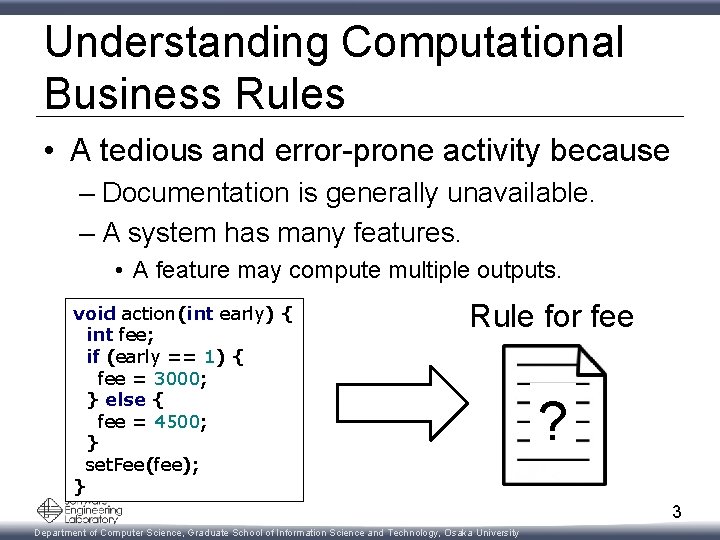
Understanding Computational Business Rules • A tedious and error-prone activity because – Documentation is generally unavailable. – A system has many features. • A feature may compute multiple outputs. void action(int early) { int fee; if (early == 1) { fee = 3000; } else { fee = 4500; } set. Fee(fee); } Rule for fee ? 3 Department of Computer Science, Graduate School of Information Science and Technology, Osaka University
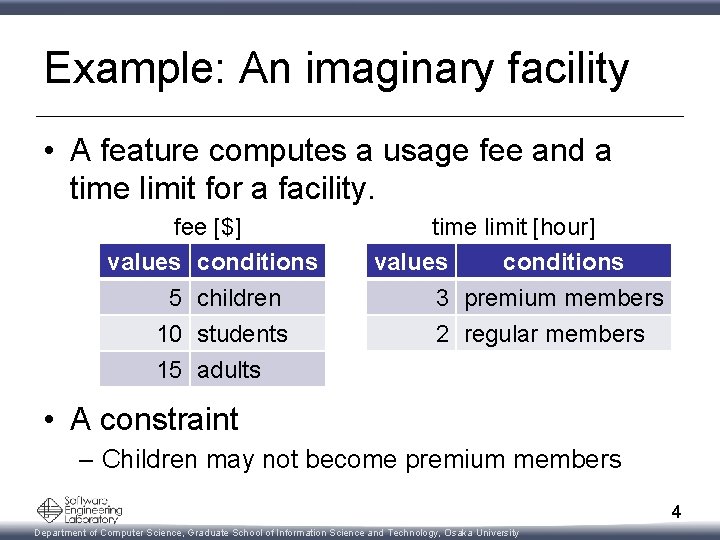
Example: An imaginary facility • A feature computes a usage fee and a time limit for a facility. fee [$] values conditions 5 children 10 students 15 adults time limit [hour] values conditions 3 premium members 2 regular members • A constraint – Children may not become premium members 4 Department of Computer Science, Graduate School of Information Science and Technology, Osaka University
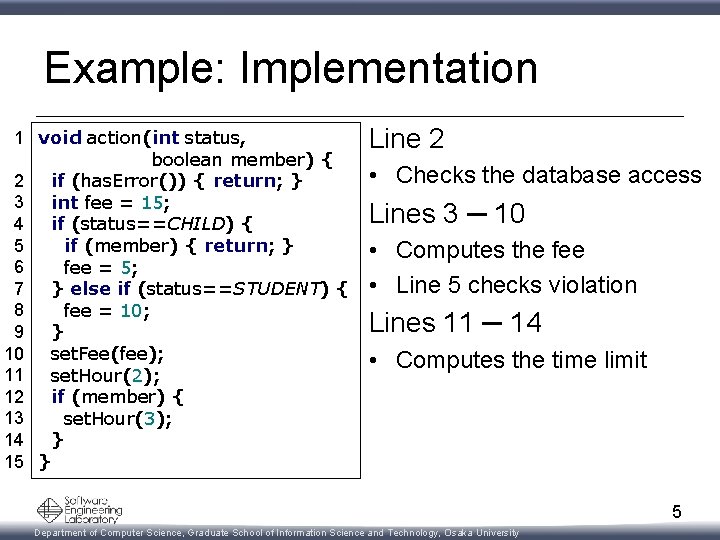
Example: Implementation 1 void action(int status, boolean member) { 2 if (has. Error()) { return; } 3 int fee = 15; 4 if (status==CHILD) { 5 if (member) { return; } 6 fee = 5; 7 } else if (status==STUDENT) { 8 fee = 10; 9 } 10 set. Fee(fee); 11 set. Hour(2); 12 if (member) { 13 set. Hour(3); 14 } 15 } Line 2 • Checks the database access Lines 3 ─ 10 • Computes the fee • Line 5 checks violation Lines 11 ─ 14 • Computes the time limit 5 Department of Computer Science, Graduate School of Information Science and Technology, Osaka University
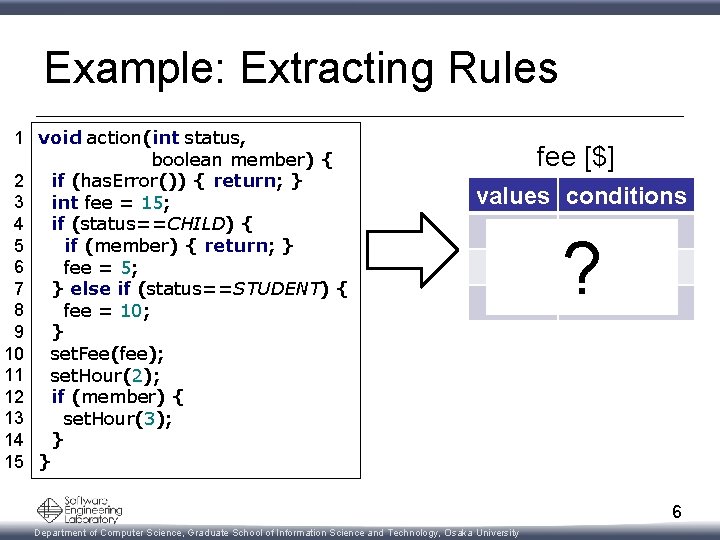
Example: Extracting Rules 1 void action(int status, boolean member) { 2 if (has. Error()) { return; } 3 int fee = 15; 4 if (status==CHILD) { 5 if (member) { return; } 6 fee = 5; 7 } else if (status==STUDENT) { 8 fee = 10; 9 } 10 set. Fee(fee); 11 set. Hour(2); 12 if (member) { 13 set. Hour(3); 14 } 15 } fee [$] values 5 10 15 conditions children students adults ? 6 Department of Computer Science, Graduate School of Information Science and Technology, Osaka University
![Example: Extracting Relevant Statements 1 void action(int status, fee [$] boolean member) { values](http://slidetodoc.com/presentation_image/393a72157cac71e460c143ff1e07fc24/image-7.jpg "Example: Extracting Relevant Statements 1 void action(int status, fee [$] boolean member) { values")
Example: Extracting Relevant Statements 1 void action(int status, fee [$] boolean member) { values conditions 2 if (has. Error()) { return; } 3 int fee = 15; 5 status==CHILD 4 if (status==CHILD) { 5 if (member) { return; } 10 status==STUDENT 6 fee = 5; 15 !(status==CHILD) && 7 } else if (status==STUDENT) { 8 fee = 10; !(status==STUDENT) 9 } 10 set. Fee(fee); 11 set. Hour(2); 12 Relevant if (member) { statements are conditional statements 13 that represent “conditions” of computational business rules. set. Hour(3); 14 } 15 } 7 Department of Computer Science, Graduate School of Information Science and Technology, Osaka University
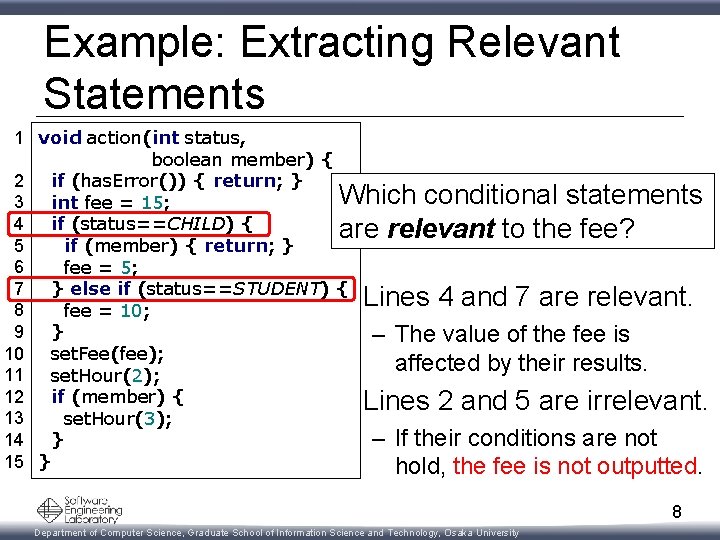
Example: Extracting Relevant Statements 1 void action(int status, boolean member) { 2 if (has. Error()) { return; } Which conditional statements 3 int fee = 15; 4 if (status==CHILD) { are relevant to the fee? 5 if (member) { return; } 6 fee = 5; 7 } else if (status==STUDENT) { • Lines 4 and 7 are relevant. 8 fee = 10; 9 } – The value of the fee is 10 set. Fee(fee); affected by their results. 11 set. Hour(2); 12 if (member) { • Lines 2 and 5 are irrelevant. 13 set. Hour(3); – If their conditions are not 14 } 15 } hold, the fee is not outputted. 8 Department of Computer Science, Graduate School of Information Science and Technology, Osaka University
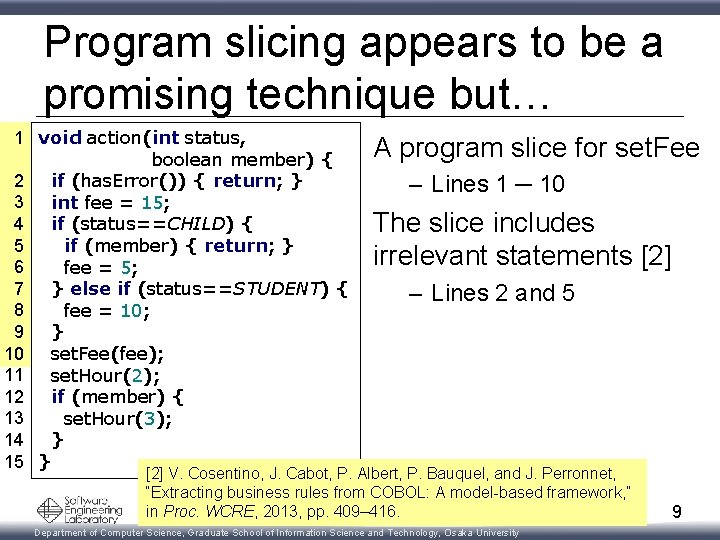
Program slicing appears to be a promising technique but… 1 void action(int status, boolean member) { 2 if (has. Error()) { return; } 3 int fee = 15; 4 if (status==CHILD) { 5 if (member) { return; } 6 fee = 5; 7 } else if (status==STUDENT) { 8 fee = 10; 9 } 10 set. Fee(fee); 11 set. Hour(2); 12 if (member) { 13 set. Hour(3); 14 } 15 } A program slice for set. Fee – Lines 1 ─ 10 The slice includes irrelevant statements [2] – Lines 2 and 5 [2] V. Cosentino, J. Cabot, P. Albert, P. Bauquel, and J. Perronnet, “Extracting business rules from COBOL: A model-based framework, ” in Proc. WCRE, 2013, pp. 409– 416. Department of Computer Science, Graduate School of Information Science and Technology, Osaka University 9
Why Program Slicing Includes Irrelevant Statements? • Because program slicing extracts two types of conditional statements without distinction – a statement which decides whether the computation is executed ⇒ irrelevant – a statement which affects the output value ⇒ relevant We focus on a control-flow graph to exclude irrelevant statements. 10 Department of Computer Science, Graduate School of Information Science and Technology, Osaka University
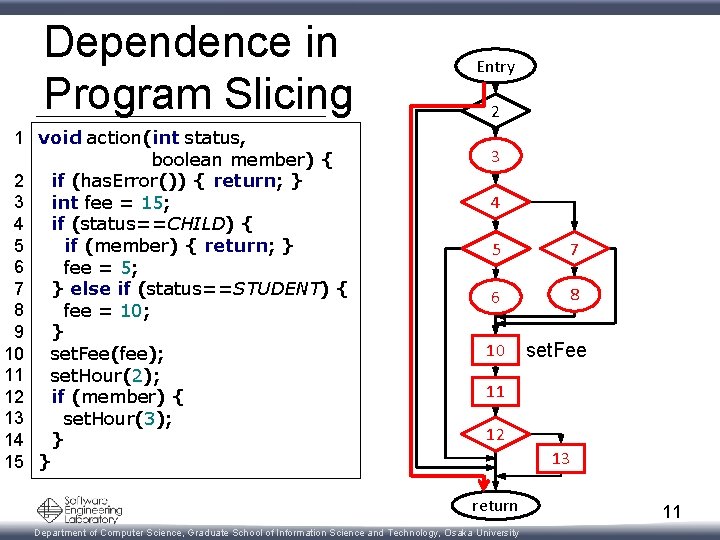
Dependence in Program Slicing 1 void action(int status, boolean member) { 2 if (has. Error()) { return; } 3 int fee = 15; 4 if (status==CHILD) { 5 if (member) { return; } 6 fee = 5; 7 } else if (status==STUDENT) { 8 fee = 10; 9 } 10 set. Fee(fee); 11 set. Hour(2); 12 if (member) { 13 set. Hour(3); 14 } 15 } Entry 2 3 4 5 7 6 8 10 set. Fee 11 12 13 return Department of Computer Science, Graduate School of Information Science and Technology, Osaka University 11
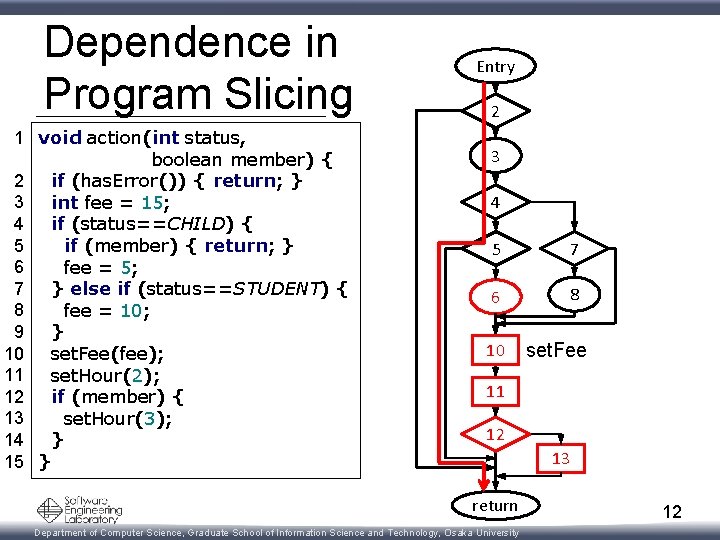
Dependence in Program Slicing 1 void action(int status, boolean member) { 2 if (has. Error()) { return; } 3 int fee = 15; 4 if (status==CHILD) { 5 if (member) { return; } 6 fee = 5; 7 } else if (status==STUDENT) { 8 fee = 10; 9 } 10 set. Fee(fee); 11 set. Hour(2); 12 if (member) { 13 set. Hour(3); 14 } 15 } Entry 2 3 4 5 7 6 8 10 set. Fee 11 12 13 return Department of Computer Science, Graduate School of Information Science and Technology, Osaka University 12
Our Key Idea • Extract a partial control-flow graph, every path of which must output the value. • Extract relevant statements from the graph in a similar way to program slicing. 13 Department of Computer Science, Graduate School of Information Science and Technology, Osaka University
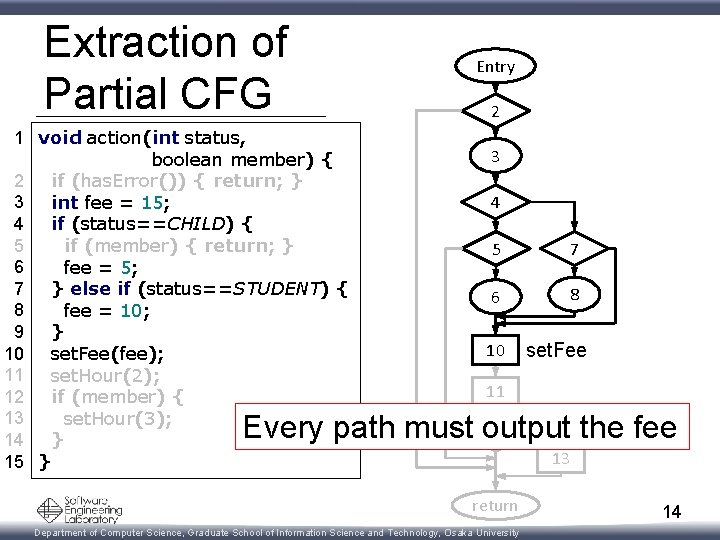
Extraction of Partial CFG 1 void action(int status, boolean member) { 2 if (has. Error()) { return; } 3 int fee = 15; 4 if (status==CHILD) { 5 if (member) { return; } 6 fee = 5; 7 } else if (status==STUDENT) { 8 fee = 10; 9 } 10 set. Fee(fee); 11 set. Hour(2); 12 if (member) { 13 set. Hour(3); 14 } 15 } Entry 2 3 4 5 7 6 8 10 set. Fee 11 Every path must output the fee 12 13 return Department of Computer Science, Graduate School of Information Science and Technology, Osaka University 14
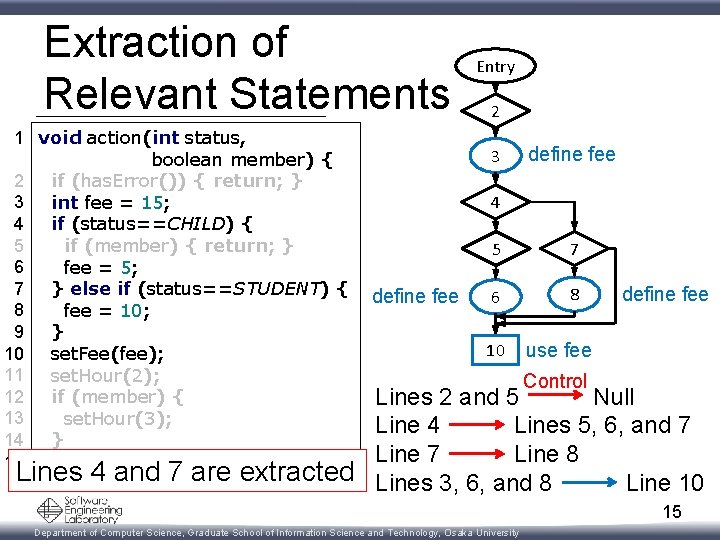
Extraction of Relevant Statements 1 void action(int status, boolean member) { 2 if (has. Error()) { return; } 3 int fee = 15; 4 if (status==CHILD) { 5 if (member) { return; } 6 fee = 5; 7 } else if (status==STUDENT) { 8 fee = 10; 9 } 10 set. Fee(fee); 11 set. Hour(2); 12 if (member) { 13 set. Hour(3); 14 } 15 } Entry 2 3 define fee 4 define fee 5 7 6 8 10 define fee use fee Control Lines 2 and 5 Null Line 4 Lines 5, 6, and 7 Line 7 Line 8 Lines 4 and 7 are extracted Lines 3, 6, and 8 Line 10 15 Department of Computer Science, Graduate School of Information Science and Technology, Osaka University
Evaluation Q 1. Does our technique help developers aa_accurately identify relevant statements? Q 2. Does our technique affect the time aa_needed to identify relevant statements? Q 3. Is our technique accurate? 16 Department of Computer Science, Graduate School of Information Science and Technology, Osaka University
Controlled Experiment • 8 developers in NTT DATA Corporation • Each developer analyzed two Java methods – one method with our technique – the other method without our technique • Process of the analysis – The developers classify each conditional statement as either relevant or irrelevant – They create a table of the computational business rules using the classification results 17 Department of Computer Science, Graduate School of Information Science and Technology, Osaka University
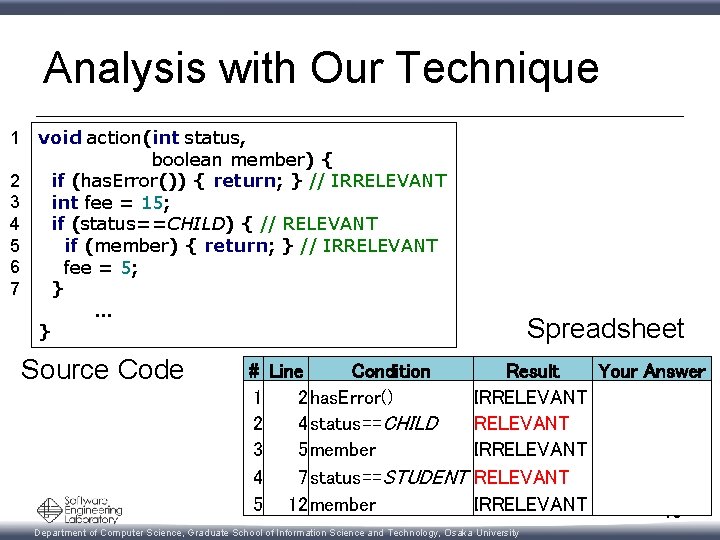
Analysis with Our Technique 1 2 3 4 5 6 7 void action(int status, boolean member) { if (has. Error()) { return; } // IRRELEVANT int fee = 15; if (status==CHILD) { // RELEVANT if (member) { return; } // IRRELEVANT fee = 5; } … } Source Code # Line Condition 1 2 has. Error() 2 4 status==CHILD 3 5 member 4 7 status==STUDENT 5 12 member Spreadsheet Result Your Answer IRRELEVANT IRRELEVANT 18 Department of Computer Science, Graduate School of Information Science and Technology, Osaka University
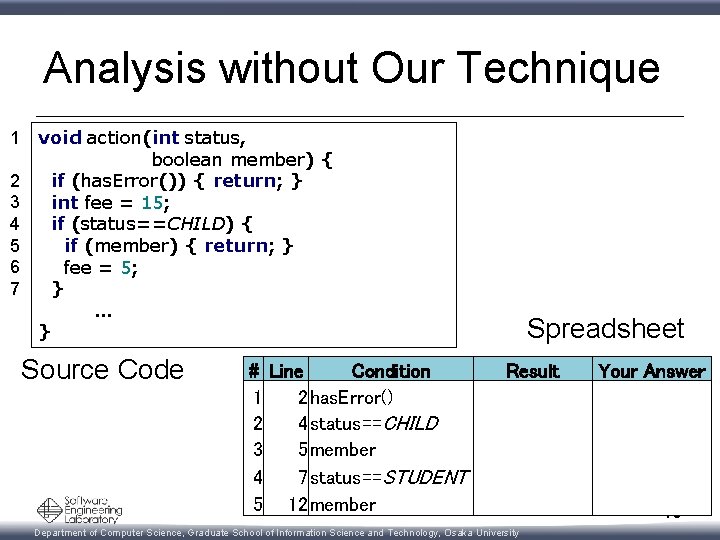
Analysis without Our Technique 1 2 3 4 5 6 7 void action(int status, boolean member) { if (has. Error()) { return; } int fee = 15; if (status==CHILD) { if (member) { return; } fee = 5; } … } Source Code # Line Condition 1 2 has. Error() 2 4 status==CHILD 3 5 member 4 7 status==STUDENT 5 12 member Spreadsheet Result Department of Computer Science, Graduate School of Information Science and Technology, Osaka University Your Answer 19
Decision of the Correct Answer • The 8 developers and the third author discussed the correct answer of classification • They used the table of computational business rules to review the classification results. 20 Department of Computer Science, Graduate School of Information Science and Technology, Osaka University
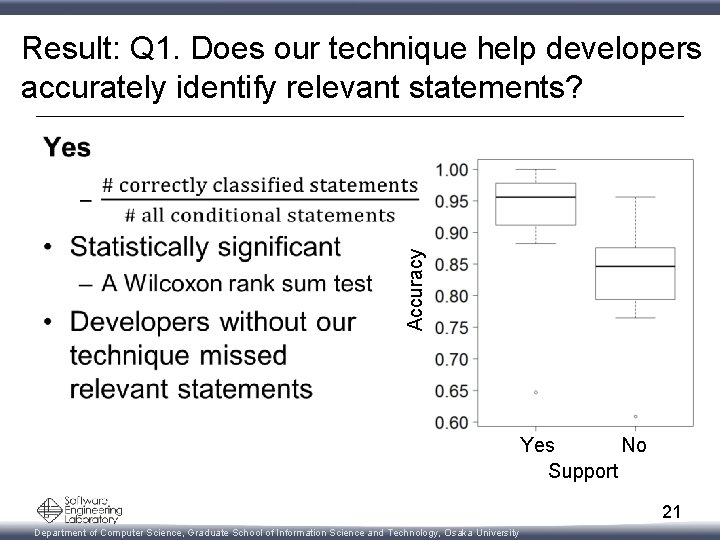
Result: Q 1. Does our technique help developers accurately identify relevant statements? Accuracy Yes No Support 21 Department of Computer Science, Graduate School of Information Science and Technology, Osaka University
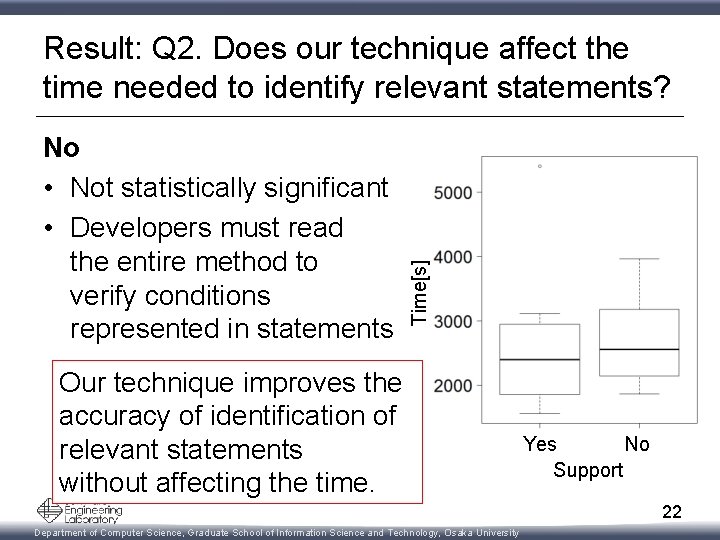
Result: Q 2. Does our technique affect the time needed to identify relevant statements? Time[s] No • Not statistically significant • Developers must read the entire method to verify conditions represented in statements Our technique improves the accuracy of identification of relevant statements without affecting the time. Yes No Support 22 Department of Computer Science, Graduate School of Information Science and Technology, Osaka University
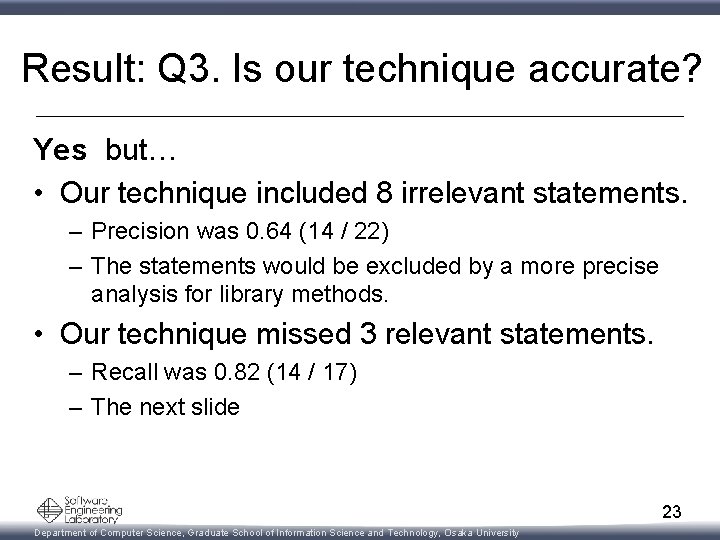
Result: Q 3. Is our technique accurate? Yes but… • Our technique included 8 irrelevant statements. – Precision was 0. 64 (14 / 22) – The statements would be excluded by a more precise analysis for library methods. • Our technique missed 3 relevant statements. – Recall was 0. 82 (14 / 17) – The next slide 23 Department of Computer Science, Graduate School of Information Science and Technology, Osaka University
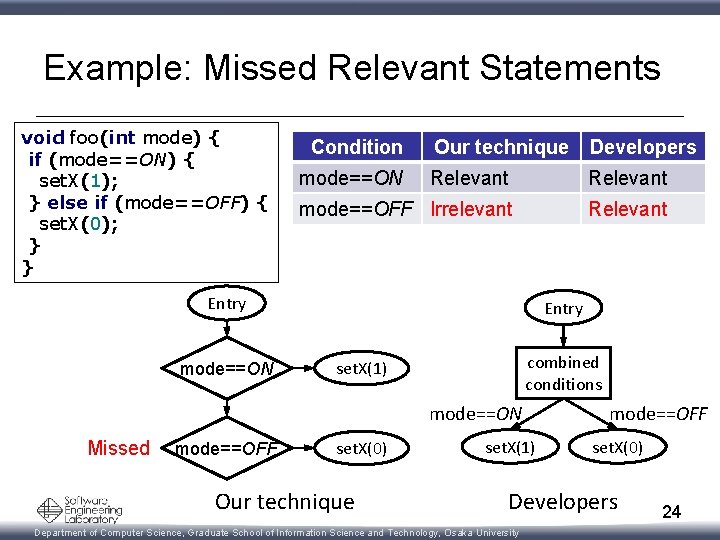
Example: Missed Relevant Statements void foo(int mode) { if (mode==ON) { set. X(1); } else if (mode==OFF) { set. X(0); } } Condition Our technique Developers Relevant mode==OFF Irrelevant Relevant mode==ON Entry combined conditions set. X(1) mode==ON Missed mode==OFF set. X(0) Our technique set. X(1) mode==OFF set. X(0) Developers Department of Computer Science, Graduate School of Information Science and Technology, Osaka University 24
Conclusion • We proposed a program dependence analysis technique to understand computational business rules. • Our technique improved the accuracy of identification of relevant statements. • We plan to apply our technique to reengineering processes in practical projects. 25 Department of Computer Science, Graduate School of Information Science and Technology, Osaka University
- Slides: 25