
ExtraCorporeal Membrane Oxygenation ECMO Cooper University Hospital Michael
Extra-Corporeal Membrane Oxygenation (ECMO) Cooper University Hospital Michael F. Hancock, CCP
2 Types of ECMO • Type of ECMO chosen is based upon the patients cardiac function • V-V ECMO (veno-venous) • Used for isolated respiratory failure • V-A ECMO (veno-arterial) • Used for both cardiac and respiratory failure
Indications- acute and reversible condition • Adult • Acute Pulmonary Failure • Caused by pulmonary embolism • Acute Respiratory Distress • Can be caused by infection • Traumatic lung injury • Post-cardiac surgery with pulmonary and/or cardiac failure • Cardiac Failure • Acute • MI • Unable to wean off CPB • Cardiogenic Shock • CHF • Bridge to transplant • Lung or Heart • Sepsis
Indications: • Pediatric • Persistant Pulmonary HTN in Newborn- not seen much • • • Happens if fetal shunts don’t close Cardiac problems causing pulm. HTN, and pulm edema Hypoxia or acidosis causing pulm constriction Born with small lungs Treatment • • Ventilation • High Flow Ventilation- fast in/out breaths Nitric Oxide- pulmonary vessel vasodilator Alkalosis- dilates pulmonary vessels ECMO- last resort • Meconium Aspiration- green poop gets in babies lungs (MOST COMMON) • Baby pre-mature pooping in fetus, then inhales poop • Can detect by testing amniotic fluid when water breaks • Causes inflammation and edema • Meconium blocks the airways and constricts them • Treatment- suction out poop, give O 2 until poop clears out, HFV, NO, ECMO • Sepsis- infection, bacterial or viral • Premature babies get infections commonly
ECMO Contraindications • • Sepsis Severe multi-organ failure Uncontrolled bleeding Malignancy Severe old age Brain dead Dead gut No chance of survival…
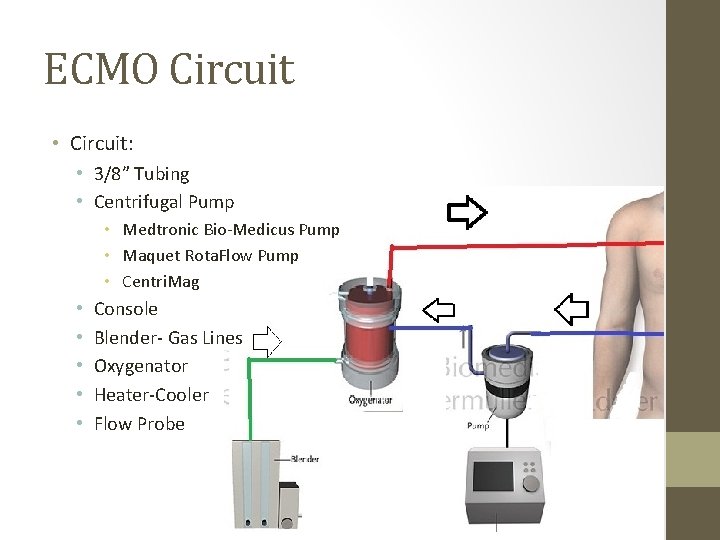
ECMO Circuit • Circuit: • 3/8” Tubing • Centrifugal Pump • Medtronic Bio-Medicus Pump • Maquet Rota. Flow Pump • Centri. Mag • • • Console Blender- Gas Lines Oxygenator Heater-Cooler Flow Probe
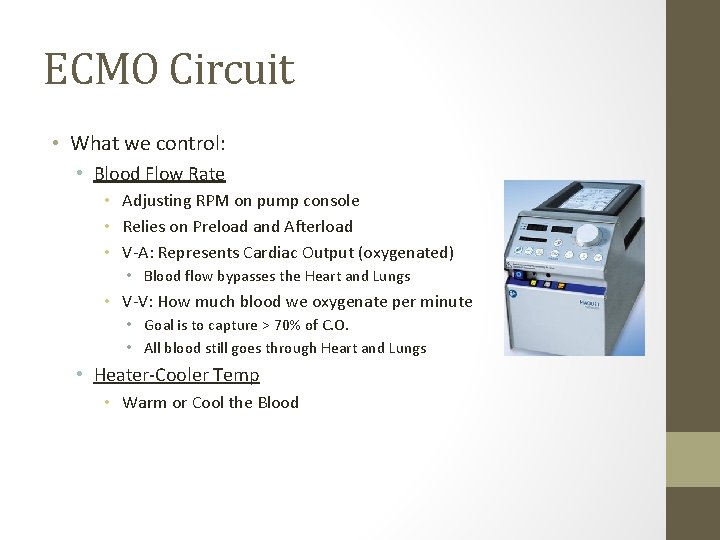
ECMO Circuit • What we control: • Blood Flow Rate • Adjusting RPM on pump console • Relies on Preload and Afterload • V-A: Represents Cardiac Output (oxygenated) • Blood flow bypasses the Heart and Lungs • V-V: How much blood we oxygenate per minute • Goal is to capture > 70% of C. O. • All blood still goes through Heart and Lungs • Heater-Cooler Temp • Warm or Cool the Blood
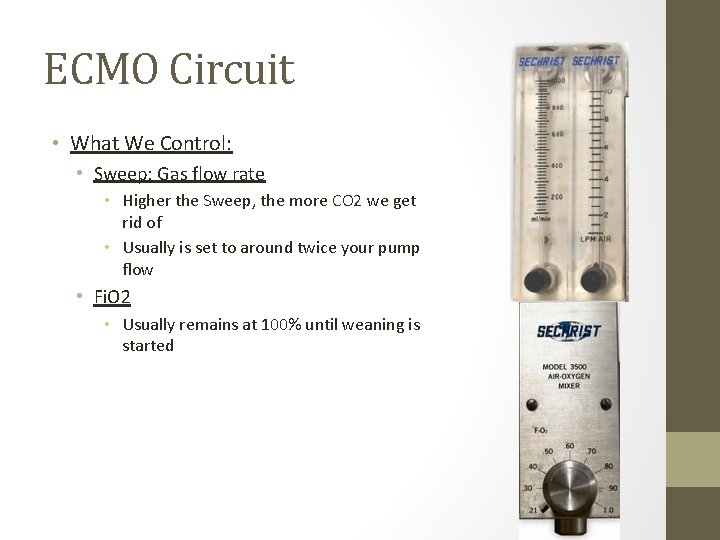
ECMO Circuit • What We Control: • Sweep: Gas flow rate • Higher the Sweep, the more CO 2 we get rid of • Usually is set to around twice your pump flow • Fi. O 2 • Usually remains at 100% until weaning is started
V-V ECMO • Utilize the ECMO circuit to oxygenate the blood and reduce the level of ventilator support • Provides oxygenation and CO 2 removal while reducing ventilatorinduced lung injury • Allow the lungs to “rest and heal” • Offers NO cardiac support, no effect on BP or CO • Function: • Steals venous blood at a given rate • Oxygenates it • Returns the oxygenated blood to a vein near the RA • Goal: • Capture > 70% of C. O. • The rest will rely on the lungs for oxygenation • Leads to Sp. O 2 of <100% if lungs are bad
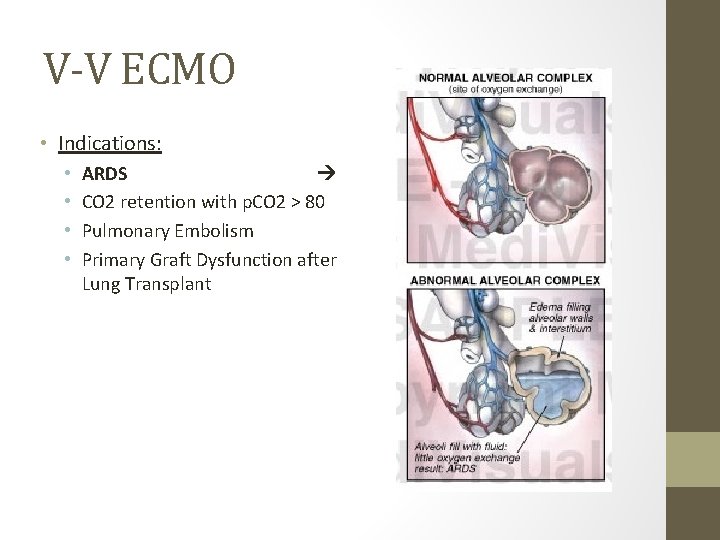
V-V ECMO • Indications: • • ARDS CO 2 retention with p. CO 2 > 80 Pulmonary Embolism Primary Graft Dysfunction after Lung Transplant
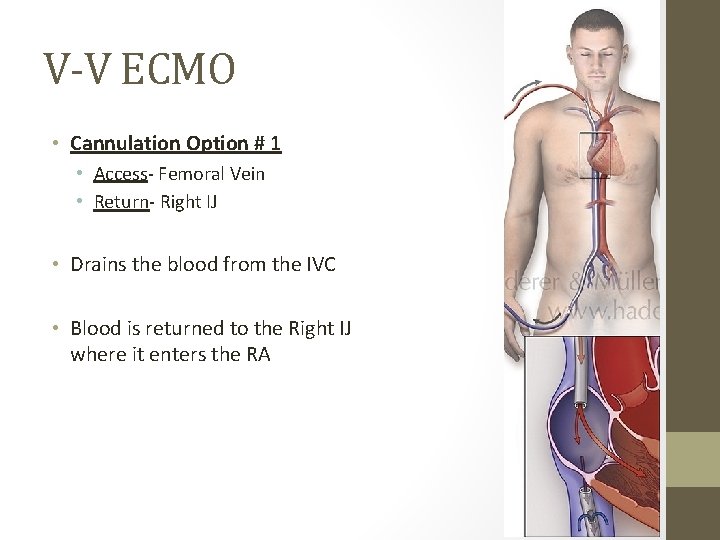
V-V ECMO • Cannulation Option # 1 • Access- Femoral Vein • Return- Right IJ • Drains the blood from the IVC • Blood is returned to the Right IJ where it enters the RA
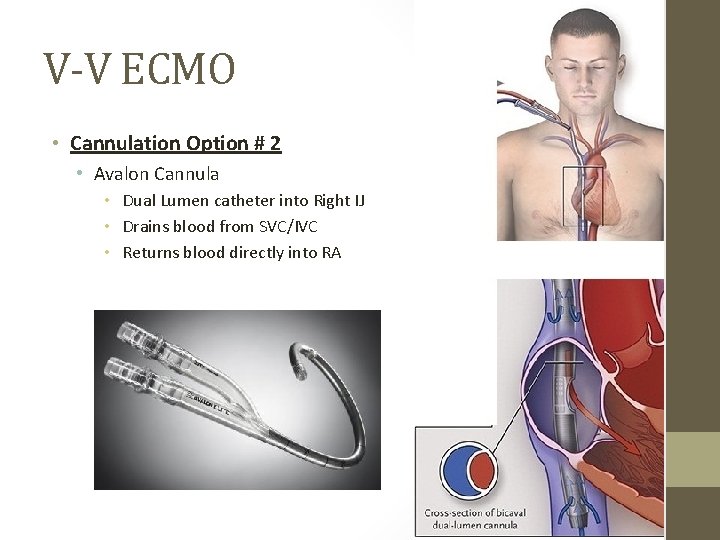
V-V ECMO • Cannulation Option # 2 • Avalon Cannula • Dual Lumen catheter into Right IJ • Drains blood from SVC/IVC • Returns blood directly into RA
V-A ECMO • Responsible for full Cardiac and Respiratory support • Flow going through the ECMO will completely bypass the heart and the lungs • Allows the heart and the lungs to rest and recover, or as a bridge to transplant • Function: • Steals venous blood at a given rate • Oxygenates it • Returns the blood to a major artery for systemic perfusion • Goal: • Provide an adequate C. O. in the setting of native cardiac failure • Flow should be 70 -100% of C. O. • Native heart’s contribution to C. O. will depend of severity of injury • Whatever the ECMO does not capture, will go into the heart
V-A ECMO • Cannulation: • Access- Femoral Vein • Return- Femoral Artery • Drain venous blood from Femoral Vein • Return oxygenated blood to Descending Aorta via Femoral Artery • Blood flows retrograde up the aorta to perfuse the body
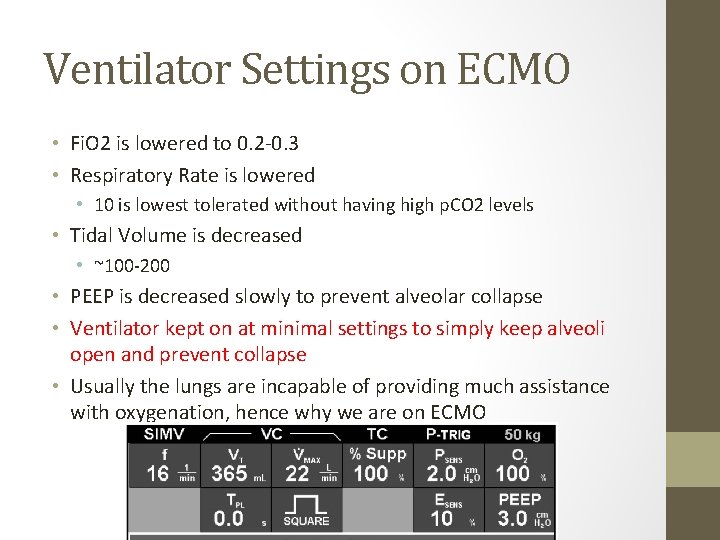
Ventilator Settings on ECMO • Fi. O 2 is lowered to 0. 2 -0. 3 • Respiratory Rate is lowered • 10 is lowest tolerated without having high p. CO 2 levels • Tidal Volume is decreased • ~100 -200 • PEEP is decreased slowly to prevent alveolar collapse • Ventilator kept on at minimal settings to simply keep alveoli open and prevent collapse • Usually the lungs are incapable of providing much assistance with oxygenation, hence why we are on ECMO
Anticoagulation for ECMO • ACT / PTT- • 180 -220 is the ideal range for ACTs • 40 -60 for PTTs • PTT is thought of as a more accurate test at low Heparin levels • Administer Heparin via continuous drip to achieve desired ACT • Drip will be around 500 -2000 units/hr (patient dependent) • Nurses will usually drip via IV pump • Some places do not start Heparin for the first 24 hours • If clots present in oxygenator, consider starting earlier • If Bleeding is excessive • Run lower ACTs or shut off Heparin for 60 -90 minutes then assess bleeding • Keep flows high if Heparin drip is lowered or shut off • Run ACTs higher if flows are reduced • When attempting to wean off of ECMO • Check ACTs every hour • Check PTTs every 4 -6 hours when values are in desired ranges
Sedation on ECMO • Heavy sedation and paralytics are given for initiation of ECMO • Stopped once ECMO is underway to evaluate neurologic function • Provide minimal sedation with morphine or versed to provide patient comfort • Paralytics given if patient’s SVO 2 drops • Some ECMO patients need heavy paralyzing and sedation if they are moving too much or bucking the vent causing the venous cannula to chug • • • Fentanyl Versed Propofol Ativan Paralytic • Pancuronium • Rocuronium • Nimbex
Fluid Balance • Many ECMO patients present with massive fluid overload • Primary Goal is to “Dry Them Out” • Promote fluid removal to rid the lungs and interstitium from edema, allowing them to heal • Lasix is usually used to stimulate urine output • If kidneys are working, let them concentrate themselves • Helps prevent hepatic congestion due to volume overload • Keep CVP < 25 mm Hg • CVVHD- Continuous Veno-Venous Hemodialysis • Dialysis using patient access • Optimal Choice • Hemoconcentrators are used to provide hemultrafiltration to avoid excessive diuretic use • Not optimal to hook up to a closed ECMO circuit • X-Rays taken daily to assess fluid buildup in the lungs • “White-Out”
Blood Product Management • Bleeding will cause issues with volume depletion • HCT will decrease, clotting factors decrease, platelet count decreases • Blood pressure will fall due to hypovolemia • Use a combination of Donor RBCs, 5% Albumin, 0. 9% Na. Cl to fix hypovolemia due to bleeding • Depending on the HCT, keep it around 30% • If blood loss is bad and RBC transfusions are necessary, be aware that FFP, Platelet, and Cryoprecipitate transfusion should be considered pending the results of lab tests such as INR and Platelet count • FFP given to correct PTT • Platelets given when Platelet count < 200 • Platelet Destruction on ECMO • Cryoprecipitate is given when Fibrinogen levels < 150
- Slides: 19