
EXTERNALIZING DISORDERS Chapter D 1 Attention Deficit Hyperactivity
- Slides: 39
EXTERNALIZING DISORDERS Chapter D. 1 Attention Deficit Hyperactivity Disorder Tais S Moriyama, Aline C M Cho, Rachel E Verin, Joaquín Fuentes & Guilherme Polanczyk Companion Power. Point Presentation Adapted by Henrikje Klasen & Julie Chilton
The “IACAPAP Textbook of Child and Adolescent Mental Health” is available at the IACAPAP website http: //iacapap. org/iacapap-textbook-of-child-and-adolescentmental-health Please note that this book and its companion powerpoint are: · Free and no registration is required to read or download it · This is an open-access publication under the Creative Commons Attribution Noncommercial License. According to this, use, distribution and reproduction in any medium are allowed without prior permission provided the original work is properly cited and the use is non-commercial.
ADHD Learning O bjectives • Differentiate and diagnose – Mild or marked ADHD – Other related mental/physical health problems • Treat or manage through: – Psycho-education – Basic psycho-social interventions – Pharmacotherapy • Know when to refer patient to a specialist
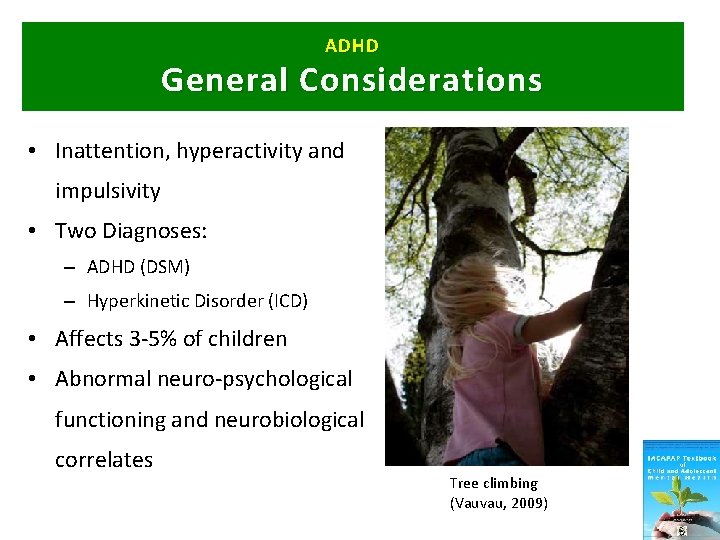
ADHD General C onsiderations • Inattention, hyperactivity and impulsivity • Two Diagnoses: – ADHD (DSM) – Hyperkinetic Disorder (ICD) • Affects 3 -5% of children • Abnormal neuro-psychological functioning and neurobiological correlates Tree climbing (Vauvau, 2009)
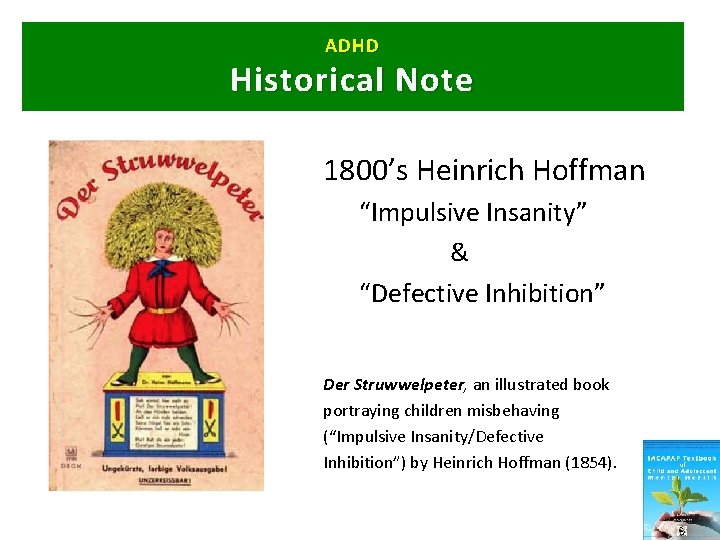
ADHD Historical Note 1800’s Heinrich Hoffman “Impulsive Insanity” & “Defective Inhibition” Der Struwwelpeter, an illustrated book portraying children misbehaving (“Impulsive Insanity/Defective Inhibition”) by Heinrich Hoffman (1854).
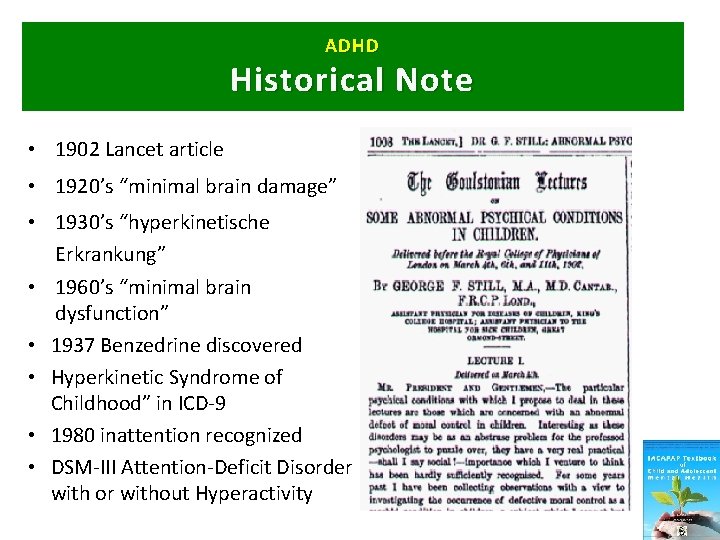
ADHD Historical Note • 1902 Lancet article • 1920’s “minimal brain damage” • 1930’s “hyperkinetische Erkrankung” • 1960’s “minimal brain dysfunction” • 1937 Benzedrine discovered • Hyperkinetic Syndrome of Childhood” in ICD-9 • 1980 inattention recognized • DSM-III Attention-Deficit Disorder with or without Hyperactivity
ADHD In Your World • • • Relevance in your country? Tell us about your cases Do local people recognize ADHD? Is ADHD more of a problem in high income countries (HIC)? Are there any other points to discuss?
ADHD Impact of ADHD in LAMIC vs. HIC Ahmed and Peter are both 7 years old and both have ADHD, combined type… listen to their story • Ahmed lives in a small village in Africa. He goes to school in the mornings and plays or herds his father’s goats afterwards. • Peter lives in a medium size town in Western Europe. He goes to school until 3 pm then usually plays football with his friends. How does ADHD impact their lives?
ADHD Impact of ADHD: Education Listen to Ahmed and Peter’s experience at school. . . What will happen to Peter and Ahmed’s education after they have been expelled from 2 nd year primary school?
ADHD Impact of ADHD: Impulsivity/Distractibility Listen what happens when Ahmed and Peter get impulsive… Children with ADHD are accident prone. How will the broken leg impact on the lives of Peter and Ahmed? How long will it take to get help? What if an operation is needed?
ADHD Impact of ADHD: Inattention/Forgetfulness Listen what happens, if Ahmed and Peter fail to pay attention and become forgetful… Children with ADHD are forgetful. How does the loss of something expensive impact on the lives of Peter and Ahmed? Will they be punished? How? Will it affect the family as a whole?
ADHD Why Do Y ou N eed to Know? ADHD: • Is common • Can be serious • Can persist • Is stigmatizing • Is treatable
ADHD The Basics • Core symptoms – Inattention, hyperactivity, impulsivity – Present in more than one context – Leading to functional impairment • Subtypes – In DSM: combined, predominantly hyperactive, predominantly inattentive – In ICD: Hyperkinetic disorder https: //www. youtube. co m/watch? v=GR 1 IZJXc 6 d 8 &feature=related
ADHD Epidemiology • Prevalence – 6% for children – 3% for adolescents • Male>Female • ADHD (DSM definition) > HKS (ICD definition)
ADHD Differences According to Age • Pre-school: play < 3 mins, not listening, no sense of danger • Primary school: activities < 10 mins, forgetful, distracted, restless, intrusive, disruptive • Adolescence: attention< 30 mins, no focus/planning, fidgety, reckless • Adult: incomplete details, restless, forgetful, impatient, accidents
ADHD Course • Some chronic • Unclear persistence (Faraone 2006) – 15% full persistence – 40 -60% partial remission • Severe cases more persistent
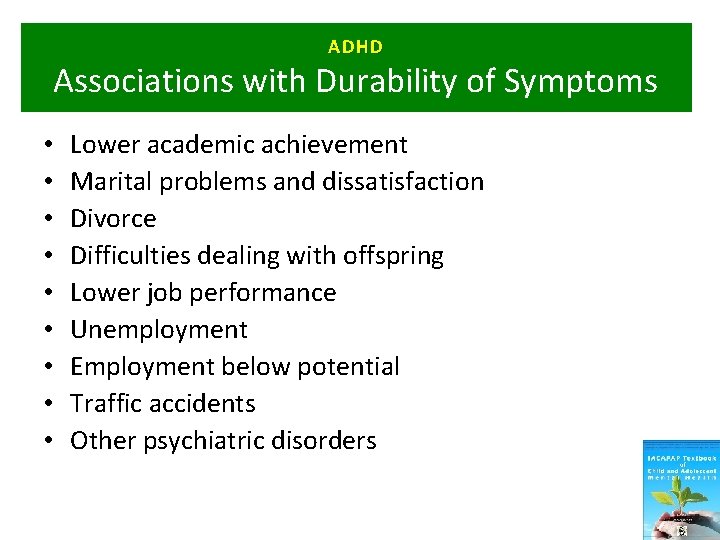
ADHD Associations with Durability of Symptoms • • • Lower academic achievement Marital problems and dissatisfaction Divorce Difficulties dealing with offspring Lower job performance Unemployment Employment below potential Traffic accidents Other psychiatric disorders
ADHD Etiology & Risk Factors Strong genetic component (76%) Perinatal factors – some evidence Neurobiological deficits – growing evidence Deprivation and family factors – important for course and outcome • Discuss: • • – popular explanations in your cultural context?
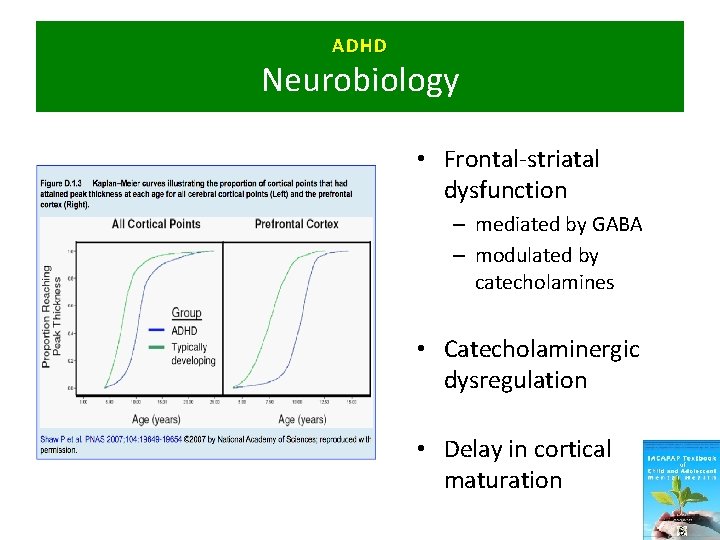
ADHD Neurobiology • Frontal-striatal dysfunction – mediated by GABA – modulated by catecholamines • Catecholaminergic dysregulation • Delay in cortical maturation
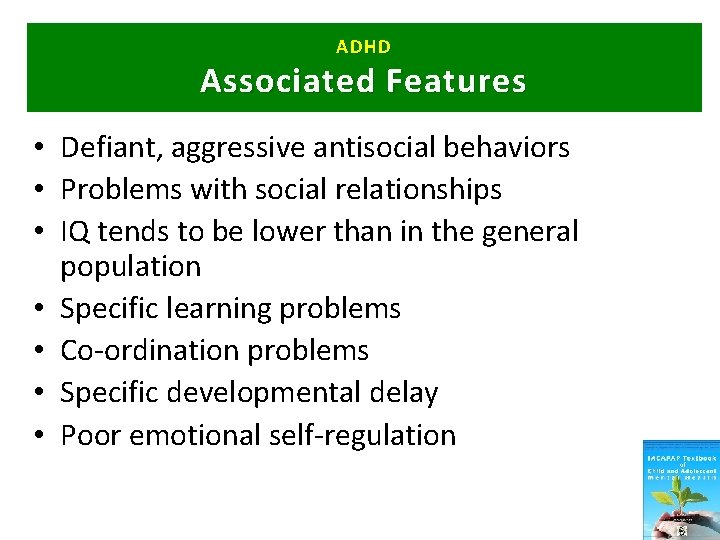
ADHD Associated Features • Defiant, aggressive antisocial behaviors • Problems with social relationships • IQ tends to be lower than in the general population • Specific learning problems • Co-ordination problems • Specific developmental delay • Poor emotional self-regulation
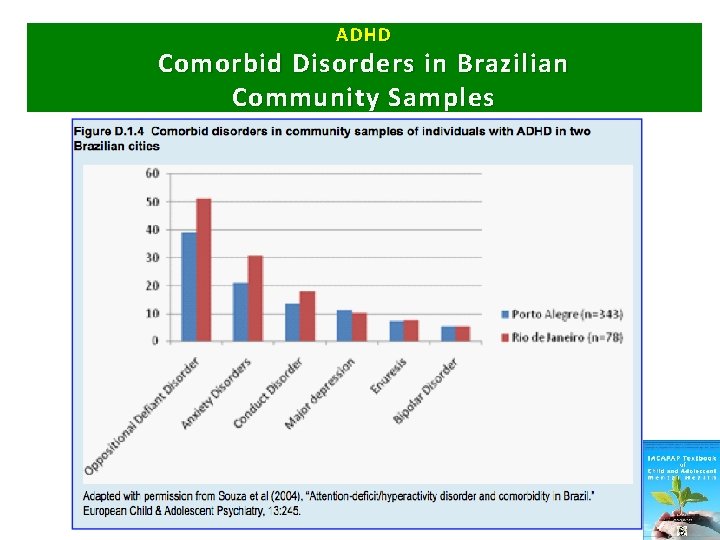
ADHD Comorbid Disorders in Brazilian Community Samples
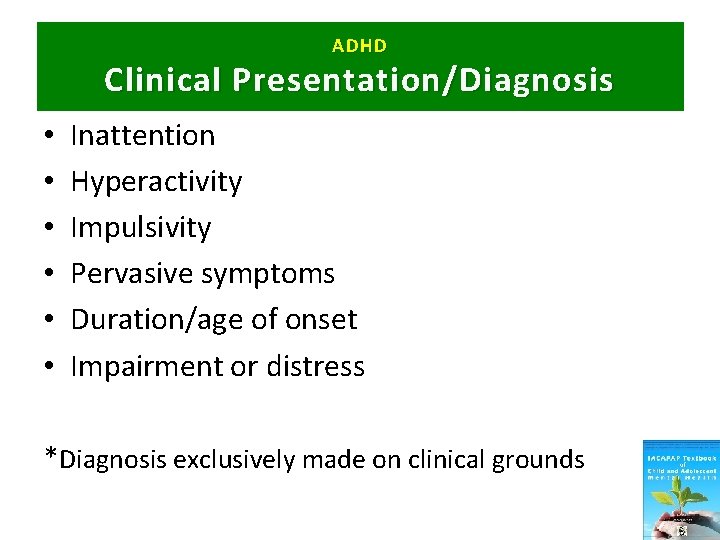
ADHD Clinical Presentation/Diagnosis • • • Inattention Hyperactivity Impulsivity Pervasive symptoms Duration/age of onset Impairment or distress *Diagnosis exclusively made on clinical grounds
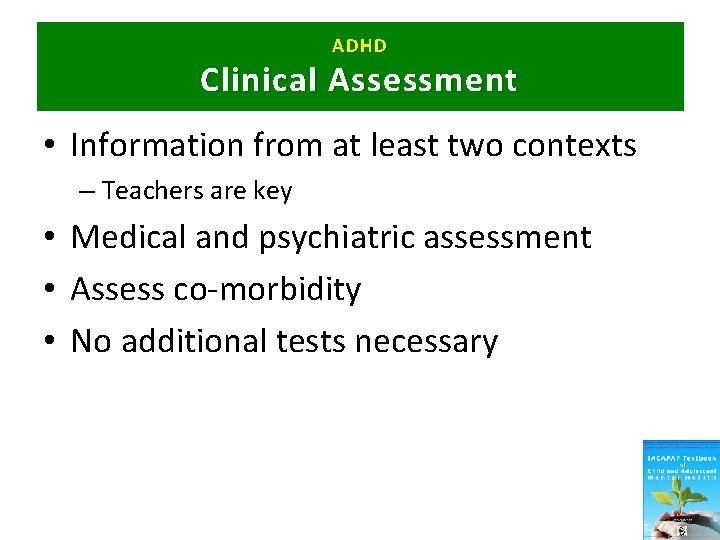
ADHD Clinical Assessment • Information from at least two contexts – Teachers are key • Medical and psychiatric assessment • Assess co-morbidity • No additional tests necessary
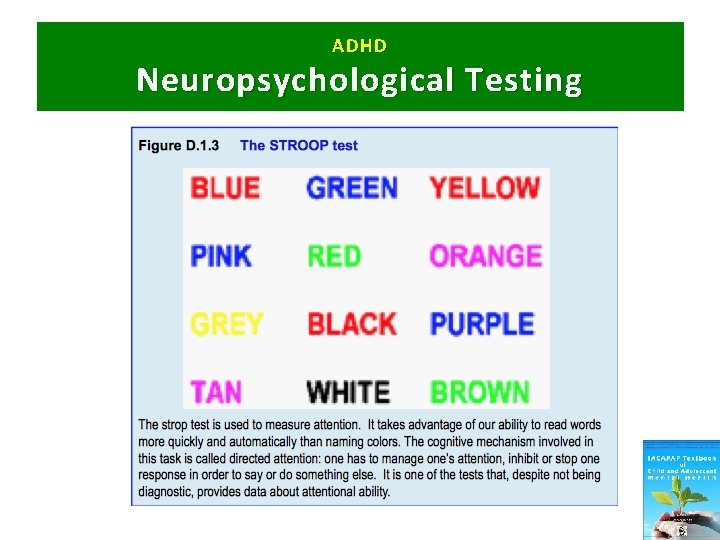
ADHD Neuropsychological Testing
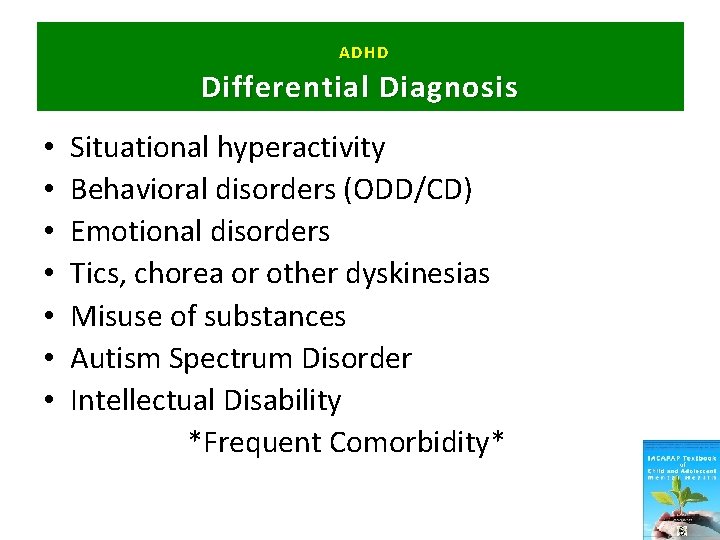
ADHD Differential Diagnosis • • Situational hyperactivity Behavioral disorders (ODD/CD) Emotional disorders Tics, chorea or other dyskinesias Misuse of substances Autism Spectrum Disorder Intellectual Disability *Frequent Comorbidity*
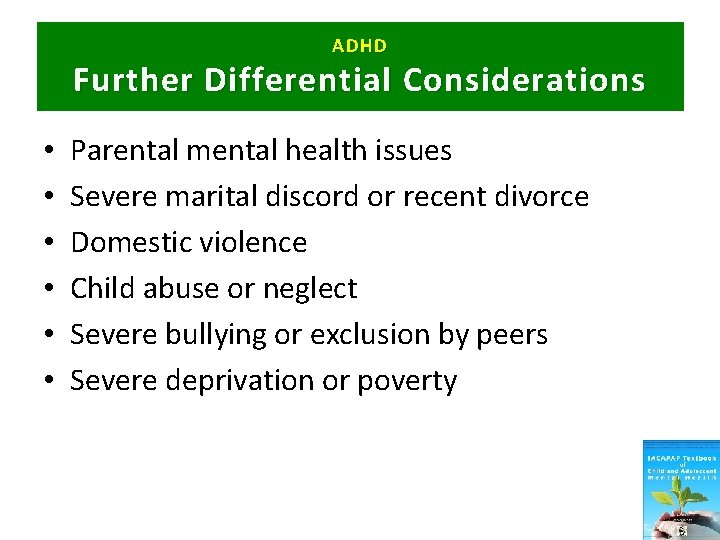
ADHD Further Differential C onsiderations • • • Parental mental health issues Severe marital discord or recent divorce Domestic violence Child abuse or neglect Severe bullying or exclusion by peers Severe deprivation or poverty
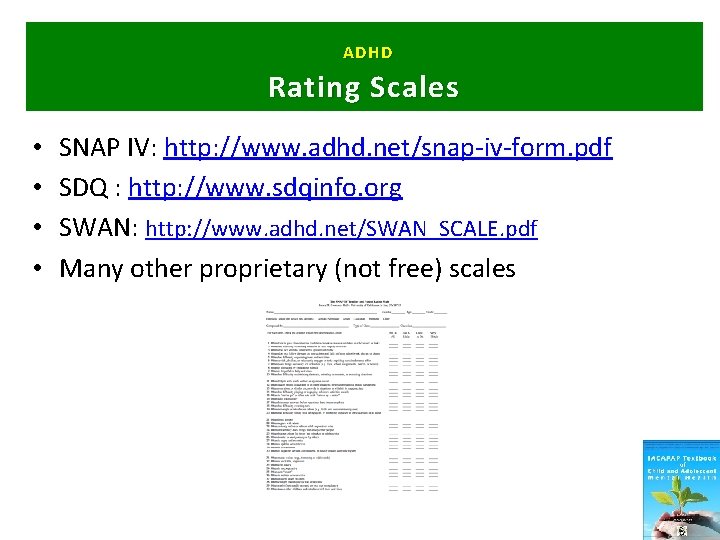
ADHD Rating Scales • • SNAP IV: http: //www. adhd. net/snap-iv-form. pdf SDQ : http: //www. sdqinfo. org SWAN: http: //www. adhd. net/SWAN_SCALE. pdf Many other proprietary (not free) scales
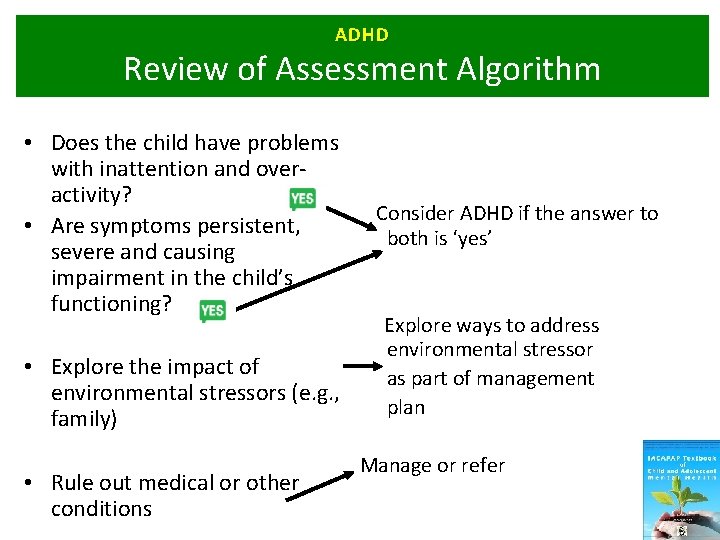
ADHD Review of Assessment Algorithm • Does the child have problems with inattention and overactivity? Consider ADHD if the answer to • Are symptoms persistent, both is ‘yes’ severe and causing impairment in the child’s functioning? Explore ways to address environmental stressor • Explore the impact of as part of management environmental stressors (e. g. , plan family) Manage or refer • Rule out medical or other conditions 28
ADHD Aims of Treatment • • Individually tailored Reduce symptoms Improve educational outcomes Reduce family and school-based problems
ADHD What works? Evidence Based Treatments: • Best evidence for stimulant medication • Behaviour treatments also effective in mild to moderate cases • Psycho-education for parents and school 30
ADHD Psychosocial Treatments • Behavior therapy – Individual, not always generalize – Parent management training: particularly useful in younger children and for associated behavior problems – School based: child in front of class, short tasks etc. • Generally effective, but smaller effect size than medication • First line treatment in younger children or milder cases
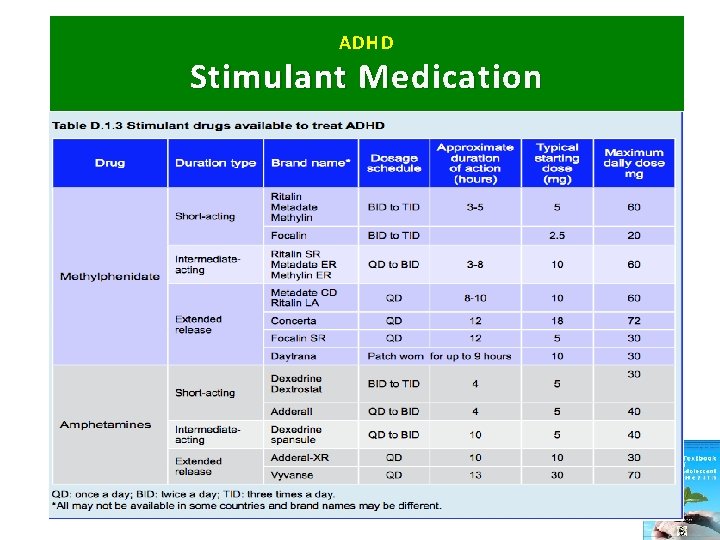
ADHD Stimulant Medication Methylphenidate or Amphetamines – Efficacy and safety well established – ES 0. 8 -1. 1; clinical response in 70% – Dose: titrate for optimum response – Short/long acting (sustained release) available – NOT on WHO list of essential medicines • Common side effects: nausea, weight loss, insomnia, agitation • More serious side effects: tics, psychotic symptoms, raised blood pressure, growth retardation
ADHD Stimulant Medication
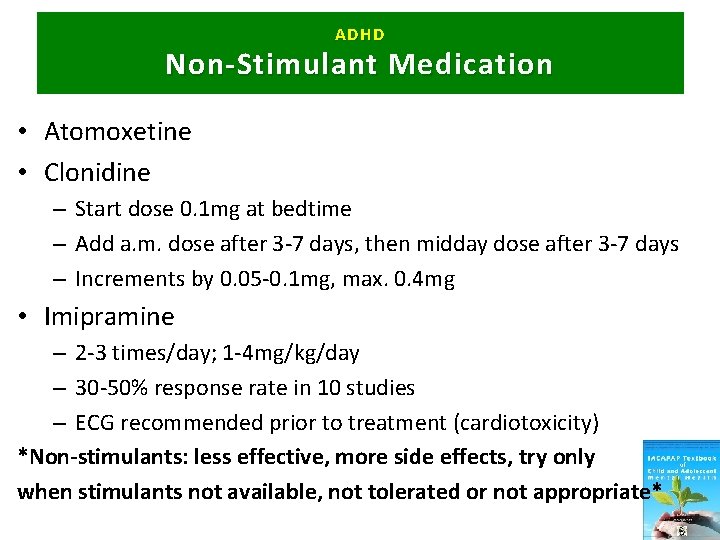
ADHD Non-Stimulant Medication • Atomoxetine • Clonidine – Start dose 0. 1 mg at bedtime – Add a. m. dose after 3 -7 days, then midday dose after 3 -7 days – Increments by 0. 05 -0. 1 mg, max. 0. 4 mg • Imipramine – 2 -3 times/day; 1 -4 mg/kg/day – 30 -50% response rate in 10 studies – ECG recommended prior to treatment (cardiotoxicity) *Non-stimulants: less effective, more side effects, try only when stimulants not available, not tolerated or not appropriate*
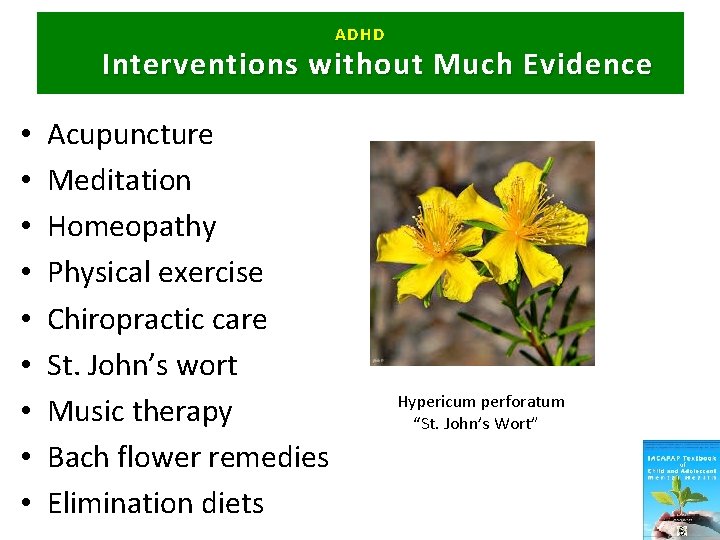
ADHD Interventions without Much Evidence • • • Acupuncture Meditation Homeopathy Physical exercise Chiropractic care St. John’s wort Music therapy Bach flower remedies Elimination diets Hypericum perforatum “St. John’s Wort”
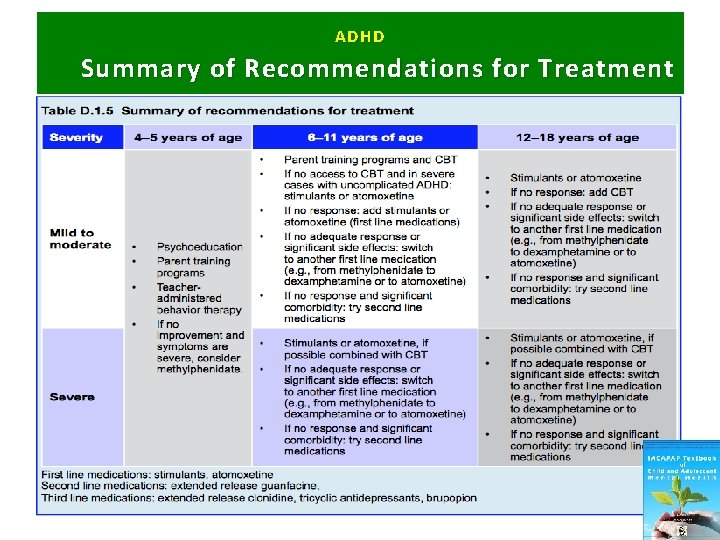
ADHD Summary of Recommendations for Treatment
Medication: ADHD When. ADHD to R efer? • If no response and severe impairment after pharmacological treatment combined with behavioral approaches – Re-evaluate diagnosis and co-morbidity – Check for undetected social adversity or abuse • If still no response after 6 months consult with specialist
Medication: ADHD Further. ADHD Resources • AACAP ADHD Resource Center http: //www. aacap. org/AACAP/Families_and_Youth/Resource Centers/ADHD_Resource_Center/Home. aspx • NICE Guideline, Tools, and Resources http: //www. nice. org. uk/guidance/cg 72/resources
Medication: ADHD Thank You! ADHD