
Externalities Externalities External costs and benefits are known
Externalities

Externalities External costs and benefits are known as externalities. An external cost is an uncompensated cost that an individual or firm imposes on others. Since it endangers people not involved in the decision to use them, cell phone use while driving imposes an external cost on other drivers.
What is an Externality? This arises when a person or firm engages in an activity that influences the well-being of others and yet neither pays nor receives compensation for that effect Factoring in externalities shows the true costs and benefits to society, They are either positive (benefit society) or negative (harm society) Externalities lead to inefficient market outcomes. Market failure occurs when the outcome in a market is inefficient.
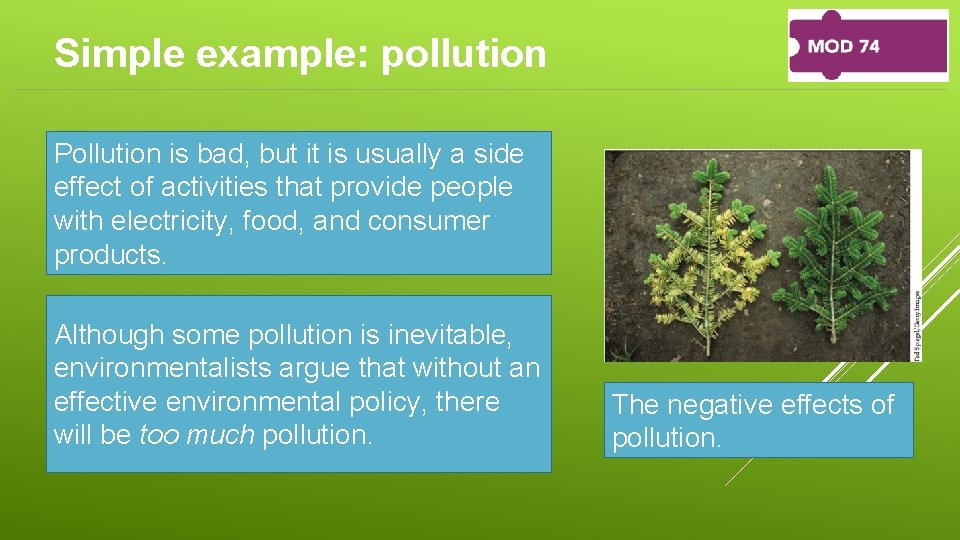
Simple example: pollution Pollution is bad, but it is usually a side effect of activities that provide people with electricity, food, and consumer products. Although some pollution is inevitable, environmentalists argue that without an effective environmental policy, there will be too much pollution. The negative effects of pollution.
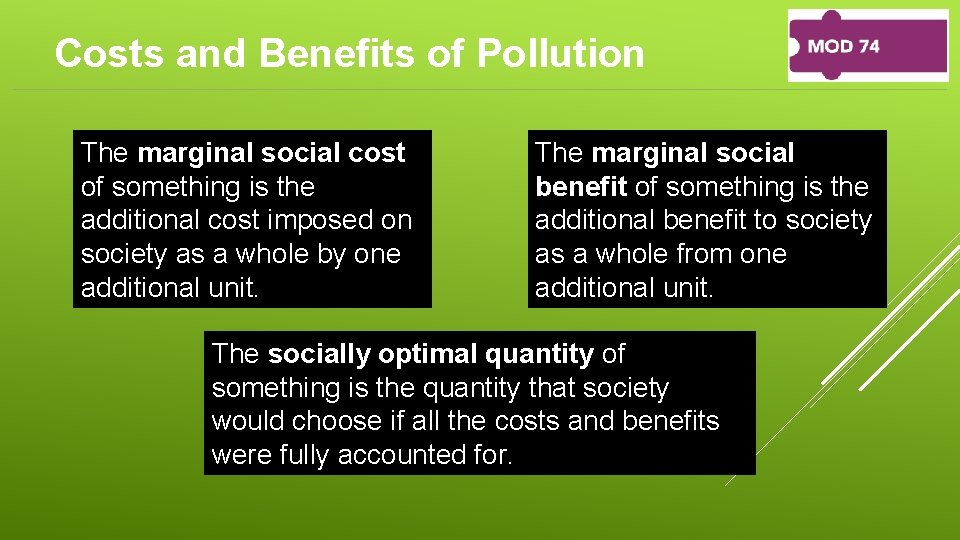
Costs and Benefits of Pollution The marginal social cost of something is the additional cost imposed on society as a whole by one additional unit. The marginal social benefit of something is the additional benefit to society as a whole from one additional unit. The socially optimal quantity of something is the quantity that society would choose if all the costs and benefits were fully accounted for.
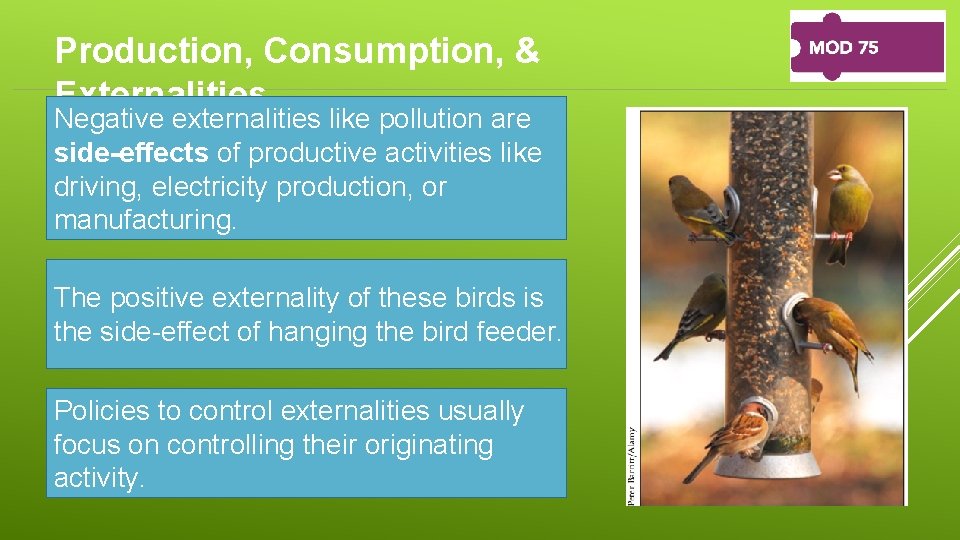
Production, Consumption, & Externalities Negative externalities like pollution are side-effects of productive activities like driving, electricity production, or manufacturing. The positive externality of these birds is the side-effect of hanging the bird feeder. Policies to control externalities usually focus on controlling their originating activity.
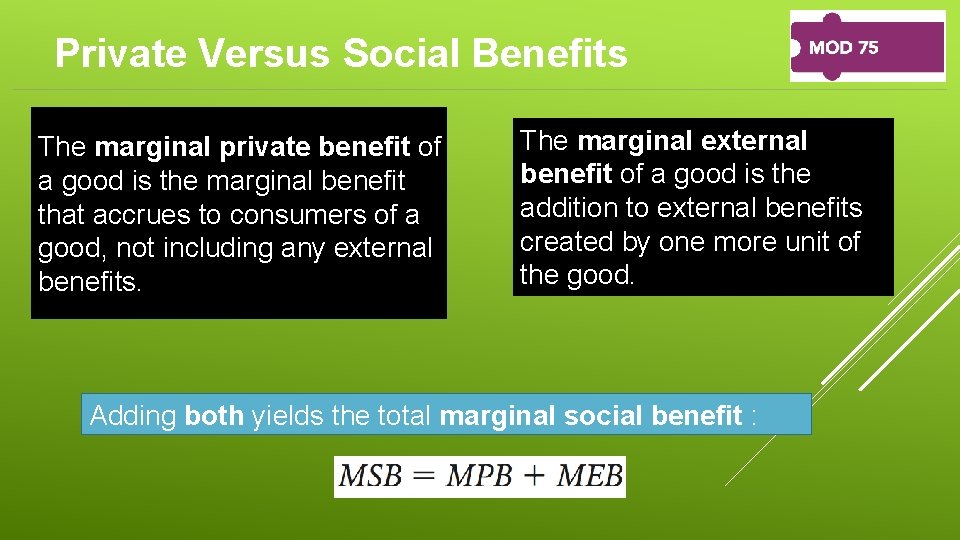
Private Versus Social Benefits The marginal private benefit of a good is the marginal benefit that accrues to consumers of a good, not including any external benefits. The marginal external benefit of a good is the addition to external benefits created by one more unit of the good. Adding both yields the total marginal social benefit :

Timbers & Sherlocks MPB when being a dingus is Barbers enjoyment of their shenanigans

The MSB of Timber & Sherlock being a dingus for Barbers enjoyment of shenanigans AND the happiness they brings from majestic derpiness
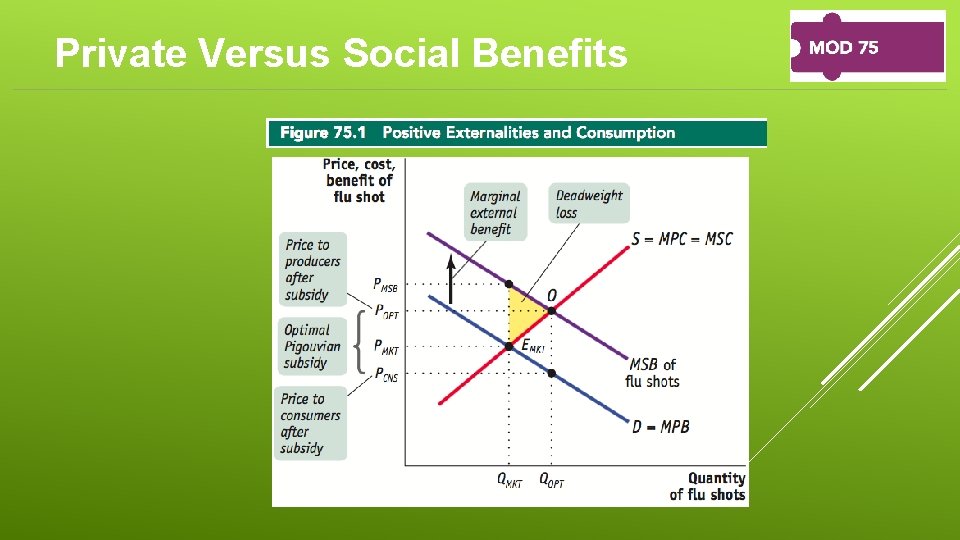
Private Versus Social Benefits
Private Versus Social Benefits A Pigouvian subsidy is a payment designed to correct for the effects of external benefits. In the case of flu shots, reducing the cost to consumers can help boost the quantity demanded to the socially optimal level. A technology spillover is an external benefit that results when new technological knowledge spreads among firms. The internet allows useful knowledge to disseminate rapidly among firms, so one firm’s innovation can yield a positive externality as others quickly adopt it.
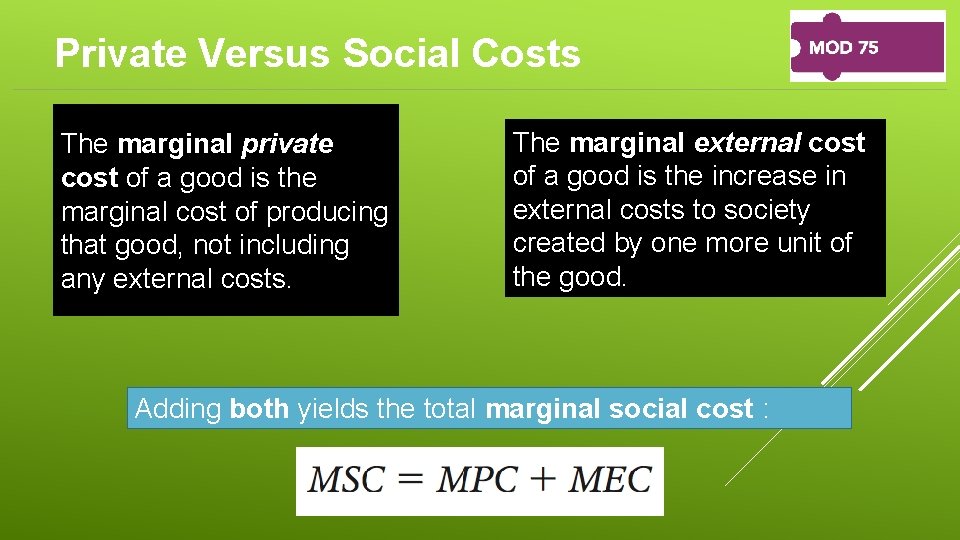
Private Versus Social Costs The marginal private cost of a good is the marginal cost of producing that good, not including any external costs. The marginal external cost of a good is the increase in external costs to society created by one more unit of the good. Adding both yields the total marginal social cost :

The MPC of Timber and Sherlock being a dingus could be $50 (for the food, toys, etc. )

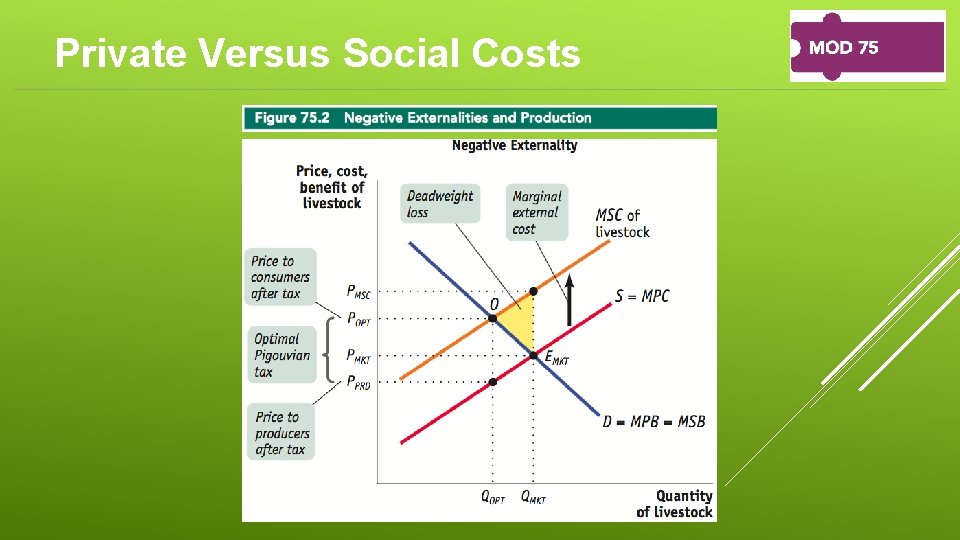
The MSC of Timber and Sherlock being a dingus is $50 AND the damage done to public grounds from there shedding and pooping
Private Versus Social Costs
Private Versus Social Costs Taxes designed to correct for the effects of external costs are known as Pigouvian taxes. In the case of livestock, raising the cost to producers can internalize the external costs of livestock production and lower quantity supplied to the socially optimal output level.
Private Solutions to Externality Problems Private negotiations are the key to Coase’s solution to externality problems. If the following transactions costs are too high, negotiations can break down: 1) Costs of communication among the interested parties. 2) Costs of making legally binding agreements. 3) Costly delays involved in bargaining.
Summary and Review 1) What is equation for finding the marginal social benefit of producing one more unit of a good? Marginal Private Benefit + Marginal External Benefit = Marginal Social Benefit (MPB + MEB = MSB) 2) Is the calculation the same when considering costs instead of benefits? Yes. 3) If a good has a positive externality, does too much or too little tend to be produced? Too little.
Summary and Review 4) How does a Pigouvian subsidy help society produce the socially optimal quantity of a good with a positive externality? A Pigouvian subsidy can lower the cost of a good for consumers until the socially optimal quantity is purchased. 5) What is a technology spillover? An external benefit resulting from new technological knowledge spreading among firms.
Summary and Review 6) How do Pigouvian taxes work, and what is their function? Pigouvian taxes raise the cost of a good with a negative externality until the quantity falls to the socially optimal level. 7) What type of externality exists when a good’s value depends on the number of people who use it? A network externality.
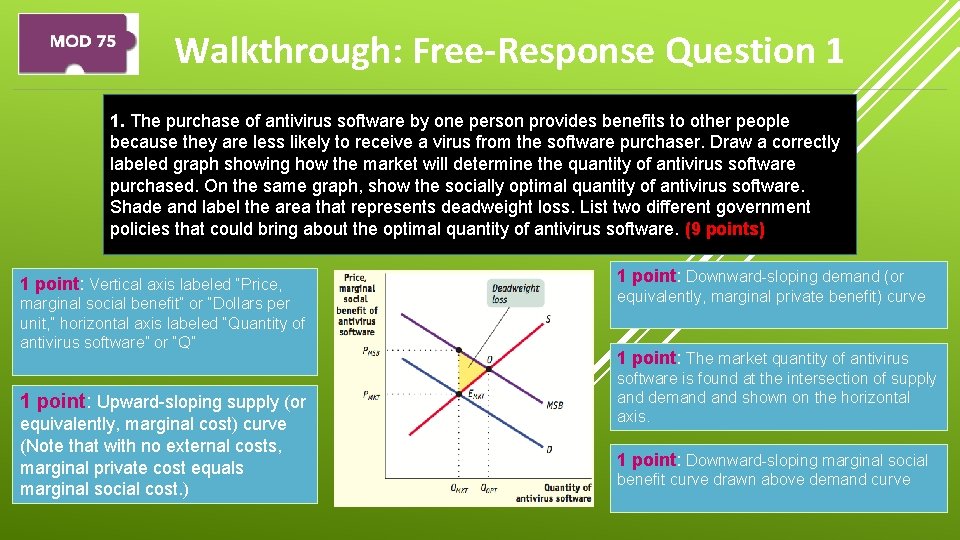
Walkthrough: Free-Response Question 1 1. The purchase of antivirus software by one person provides benefits to other people because they are less likely to receive a virus from the software purchaser. Draw a correctly labeled graph showing how the market will determine the quantity of antivirus software purchased. On the same graph, show the socially optimal quantity of antivirus software. Shade and label the area that represents deadweight loss. List two different government policies that could bring about the optimal quantity of antivirus software. (9 points) 1 point: Vertical axis labeled “Price, marginal social benefit” or “Dollars per unit, ” horizontal axis labeled “Quantity of antivirus software” or “Q” 1 point: Upward-sloping supply (or equivalently, marginal cost) curve (Note that with no external costs, marginal private cost equals marginal social cost. ) 1 point: Downward-sloping demand (or equivalently, marginal private benefit) curve 1 point: The market quantity of antivirus software is found at the intersection of supply and demand shown on the horizontal axis. 1 point: Downward-sloping marginal social benefit curve drawn above demand curve
Summary and Review 1) What is an uncompensated cost that an individual or firm imposes on others called? Negative externality. 2) What is an uncompensated benefit that an individual or firm generates for others called? Positive externality. 3) What is market failure, and what causes it? Externalities lead to inefficient market outcomes, and market failure occurs when a market outcome is inefficient.
Summary and Review 4) What is marginal social cost? For goods that generate a negative externality, marginal social cost is he additional cost imposed on society by one more unit of production. 5) What is marginal social benefit? For goods that generate a positive externality, marginal social cost is he additional benefit accrued to society by one more unit of production.
Summary and Review 6) The _____ quantity of something is the quantity that society would choose if all costs and benefits were fully accounted for. 7) Individuals who take external costs or benefits into account, _____ the externalities. socially optimal internalize 8) What does the Coase theorem assert? As long as transaction costs are low, private parties can negotiate efficient solutions to externality problems.
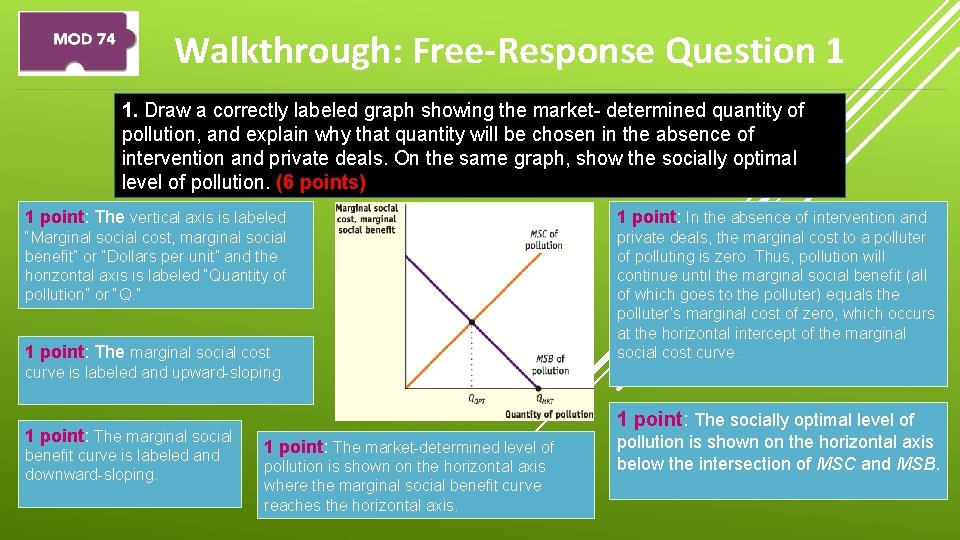
Walkthrough: Free-Response Question 1 1. Draw a correctly labeled graph showing the market- determined quantity of pollution, and explain why that quantity will be chosen in the absence of intervention and private deals. On the same graph, show the socially optimal level of pollution. (6 points) 1 point: The vertical axis is labeled 1 point: In the absence of intervention and “Marginal social cost, marginal social benefit” or “Dollars per unit” and the horizontal axis is labeled “Quantity of pollution” or “Q. ” private deals, the marginal cost to a polluter of polluting is zero. Thus, pollution will continue until the marginal social benefit (all of which goes to the polluter) equals the polluter’s marginal cost of zero, which occurs at the horizontal intercept of the marginal social cost curve. 1 point: The marginal social cost curve is labeled and upward-sloping. 1 point: The marginal social benefit curve is labeled and downward-sloping. 1 point: The socially optimal level of 1 point: The market-determined level of pollution is shown on the horizontal axis where the marginal social benefit curve reaches the horizontal axis. pollution is shown on the horizontal axis below the intersection of MSC and MSB.
- Slides: 26