
EXTERNALITIES Chapter 5 Externalities Externality An activity of

- Slides: 23
EXTERNALITIES Chapter 5
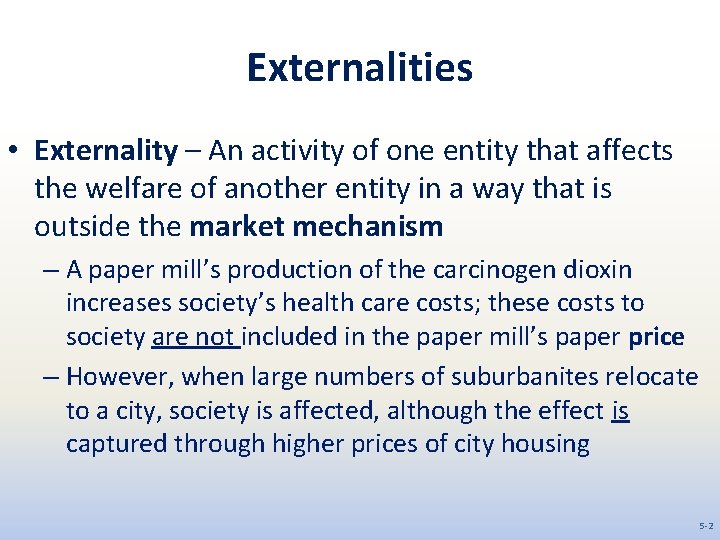
Externalities • Externality – An activity of one entity that affects the welfare of another entity in a way that is outside the market mechanism – A paper mill’s production of the carcinogen dioxin increases society’s health care costs; these costs to society are not included in the paper mill’s paper price – However, when large numbers of suburbanites relocate to a city, society is affected, although the effect is captured through higher prices of city housing 5 -2
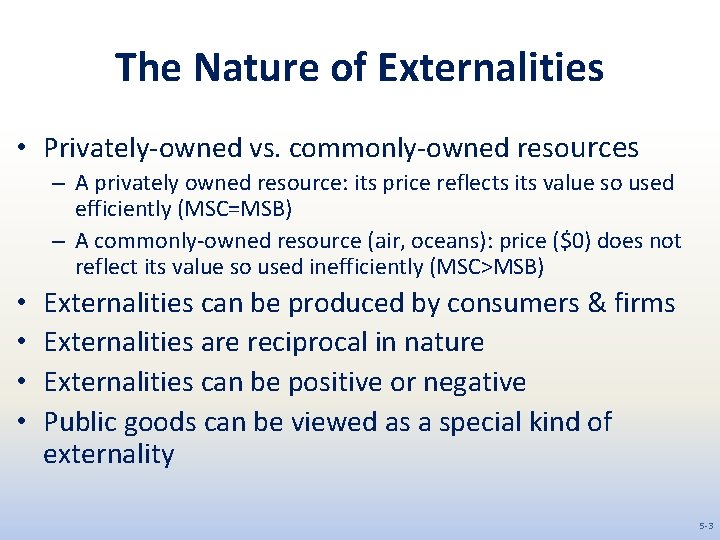
The Nature of Externalities • Privately-owned vs. commonly-owned resources – A privately owned resource: its price reflects its value so used efficiently (MSC=MSB) – A commonly-owned resource (air, oceans): price ($0) does not reflect its value so used inefficiently (MSC>MSB) • • Externalities can be produced by consumers & firms Externalities are reciprocal in nature Externalities can be positive or negative Public goods can be viewed as a special kind of externality 5 -3
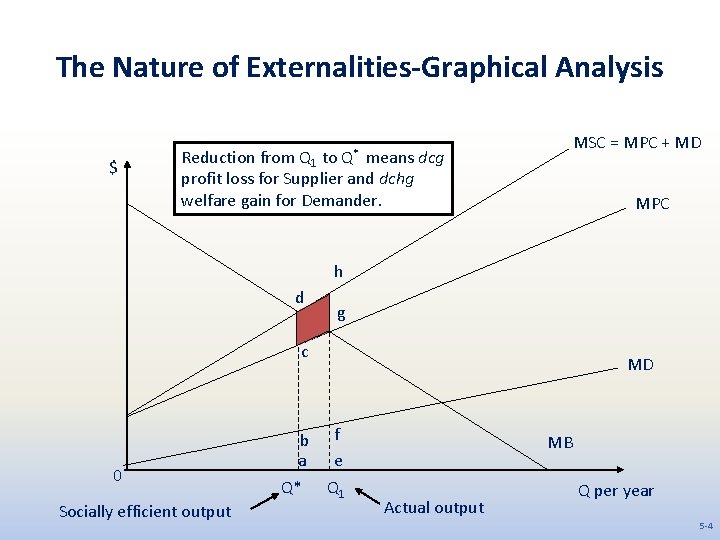
The Nature of Externalities-Graphical Analysis $ MSC = MPC + MD Reduction from Q 1 to Q* means dcg profit loss for Supplier and dchg welfare gain for Demander. MPC h d g c 0 Socially efficient output b a Q* MD f e Q 1 MB Actual output Q per year 5 -4
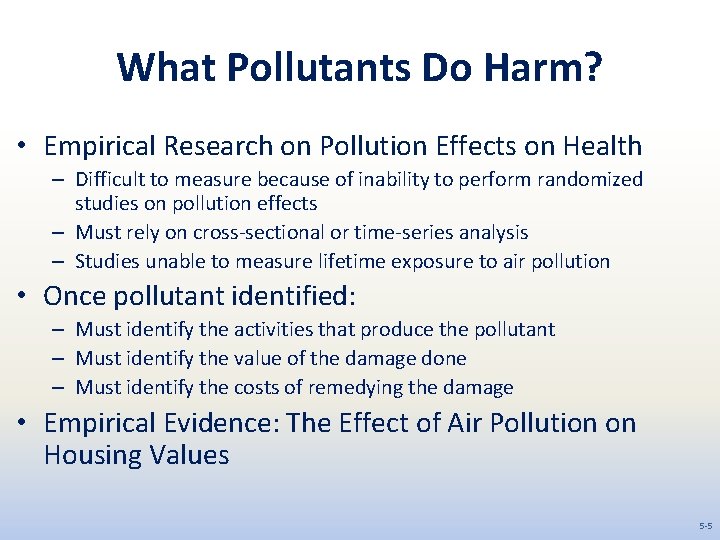
What Pollutants Do Harm? • Empirical Research on Pollution Effects on Health – Difficult to measure because of inability to perform randomized studies on pollution effects – Must rely on cross-sectional or time-series analysis – Studies unable to measure lifetime exposure to air pollution • Once pollutant identified: – Must identify the activities that produce the pollutant – Must identify the value of the damage done – Must identify the costs of remedying the damage • Empirical Evidence: The Effect of Air Pollution on Housing Values 5 -5
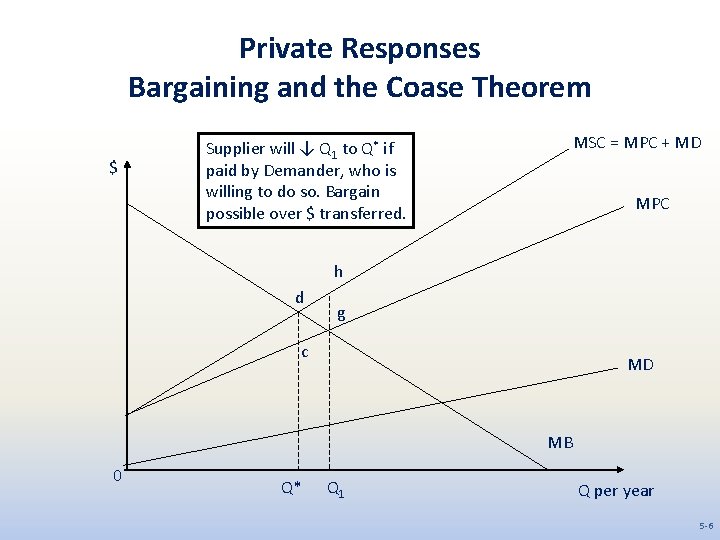
Private Responses Bargaining and the Coase Theorem $ MSC = MPC + MD Supplier will ↓ Q 1 to Q* if paid by Demander, who is willing to do so. Bargain possible over $ transferred. MPC h d g c MD MB 0 Q* Q 1 Q per year 5 -6
The Coase Theorem • Coase Theorem – Given: – Low transaction costs – Clear assignment of property rights An efficient solution to an externality problem can be achieved • Assumptions necessary for Coase Theorem to work – The costs to the parties of bargaining are low – The owners of resources can identify the source of damages to their property and legally prevent damages 5 -7
Other Private Solutions • Mergers – way to internalize the externality – The externality transmitter and recipient become one company. • Social conventions/Morals – For example: “Littering” is wrong. 5 -8
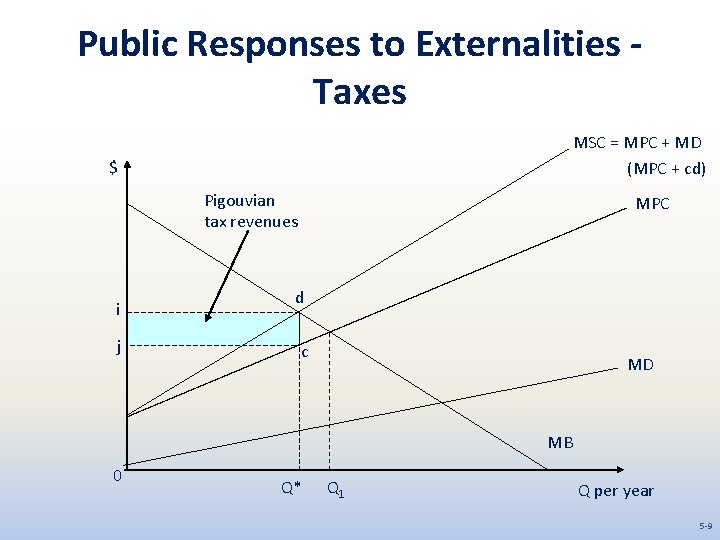
Public Responses to Externalities Taxes MSC = MPC + MD (MPC + cd) $ Pigouvian tax revenues i j MPC d c MD MB 0 Q* Q 1 Q per year 5 -9
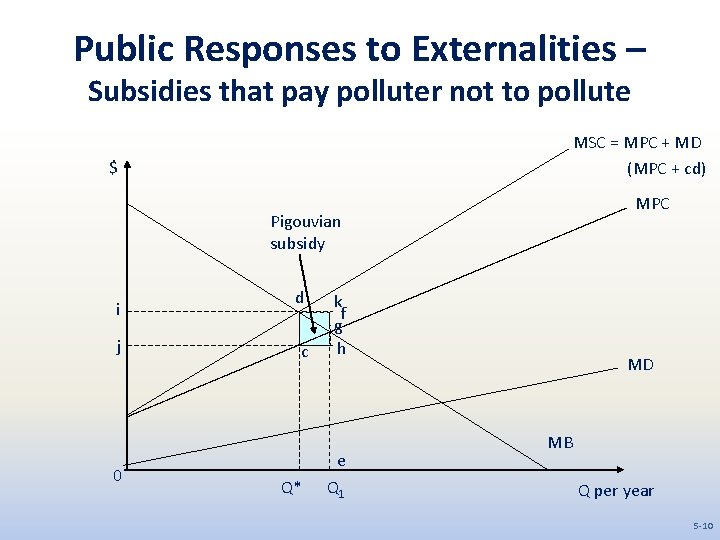
Public Responses to Externalities – Subsidies that pay polluter not to pollute MSC = MPC + MD (MPC + cd) $ MPC Pigouvian subsidy i j 0 d c k f g h e Q* Q 1 MD MB Q per year 5 -10
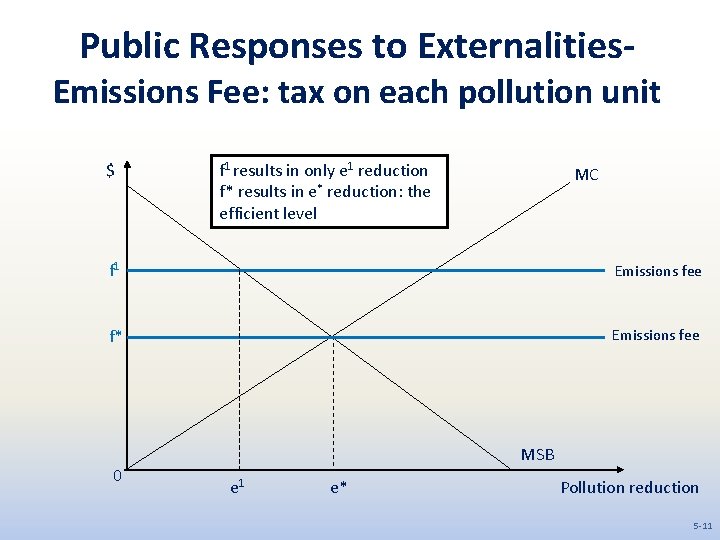
Public Responses to Externalities- Emissions Fee: tax on each pollution unit $ f 1 results in only e 1 reduction f* results in e* reduction: the efficient level MC f 1 Emissions fee f* Emissions fee 0 MSB e 1 e* Pollution reduction 5 -11
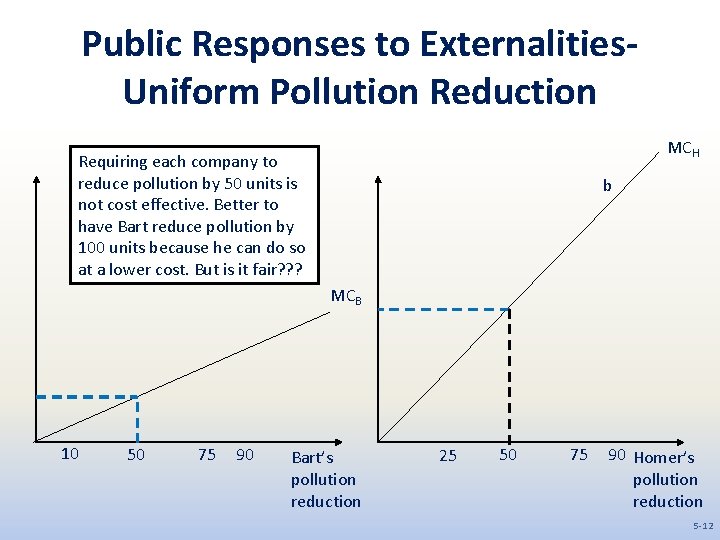
Public Responses to Externalities. Uniform Pollution Reduction MCH Requiring each company to reduce pollution by 50 units is not cost effective. Better to have Bart reduce pollution by 100 units because he can do so at a lower cost. But is it fair? ? ? b MCB 10 50 75 90 Bart’s pollution reduction 25 50 75 90 Homer’s pollution reduction 5 -12
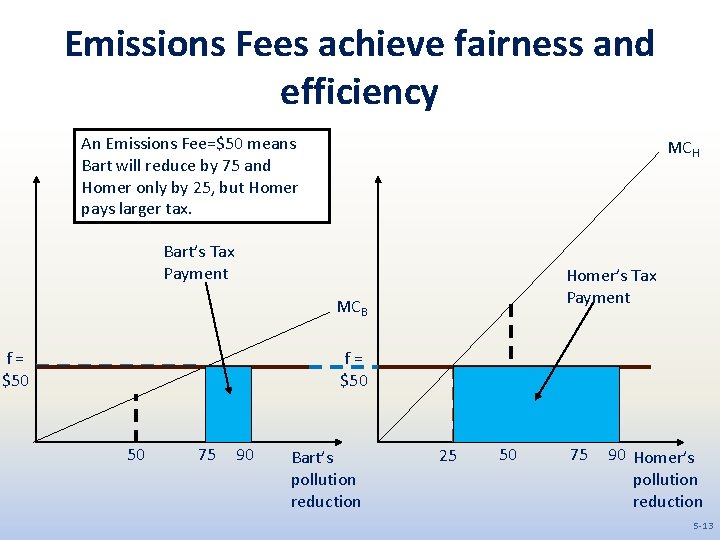
Emissions Fees achieve fairness and efficiency An Emissions Fee=$50 means Bart will reduce by 75 and Homer only by 25, but Homer pays larger tax. MCH Bart’s Tax Payment Homer’s Tax Payment MCB f= $50 50 75 90 Bart’s pollution reduction 25 50 75 90 Homer’s pollution reduction 5 -13
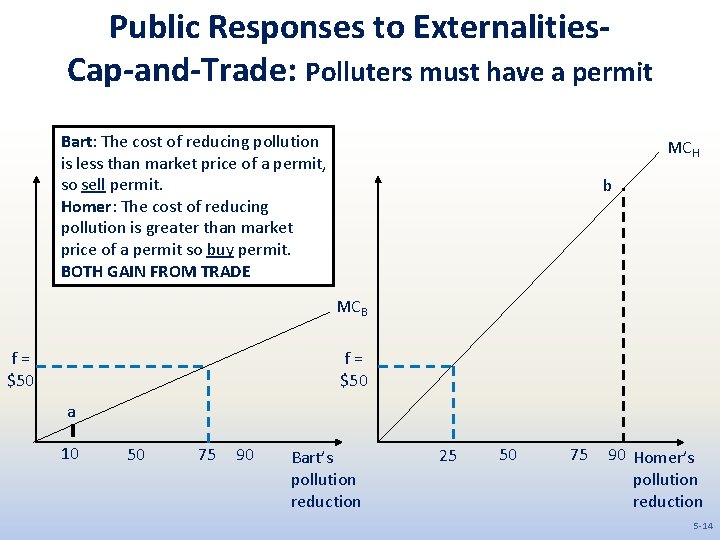
Public Responses to Externalities. Cap-and-Trade: Polluters must have a permit Bart: The cost of reducing pollution is less than market price of a permit, so sell permit. Homer: The cost of reducing pollution is greater than market price of a permit so buy permit. BOTH GAIN FROM TRADE MCH b MCB f= $50 a 10 50 75 90 Bart’s pollution reduction 25 50 75 90 Homer’s pollution reduction 5 -14
Emissions Fee v Cap-and-Trade • • Responsiveness to Inflation Responsiveness to Cost Changes Distributional Effects Responsiveness to Uncertainty of Costs of reducing pollution (cont on next slides) 5 -15
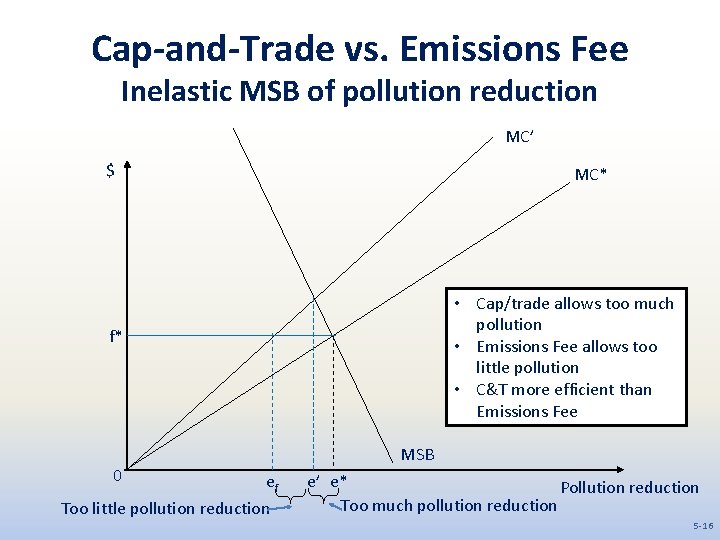
Cap-and-Trade vs. Emissions Fee Inelastic MSB of pollution reduction MC’ $ MC* • Cap/trade allows too much pollution • Emissions Fee allows too little pollution • C&T more efficient than Emissions Fee f* 0 MSB ef Too little pollution reduction e’ e* Pollution reduction Too much pollution reduction 5 -16
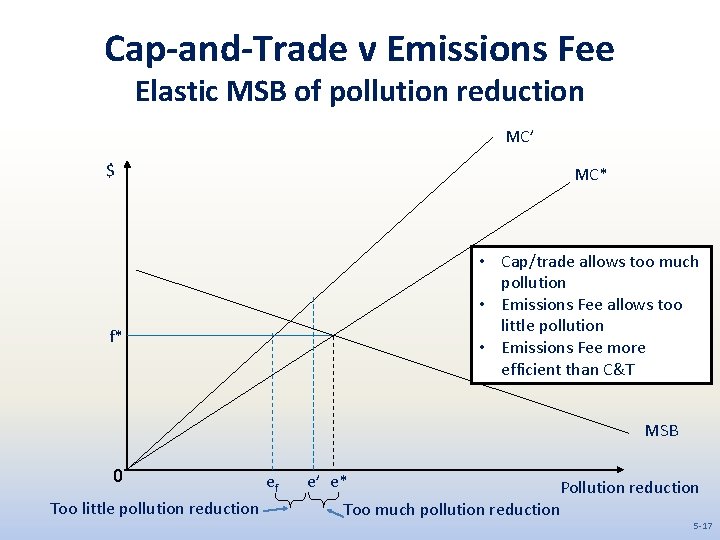
Cap-and-Trade v Emissions Fee Elastic MSB of pollution reduction MC’ $ MC* • Cap/trade allows too much pollution • Emissions Fee allows too little pollution • Emissions Fee more efficient than C&T f* MSB 0 Too little pollution reduction ef e’ e* Pollution reduction Too much pollution reduction 5 -17
Command-Control Regulation • Command-control regulations require a given amount of pollution reduction with limited or no flexibility on how to achieve reduction – Technology requirements – Performance requirements • Is command-control ever better? – Hot spots: Areas with relatively high concentrations of emissions 5 -18
The U. S. Response • Clean Air Act – 1970 amendments – Command-control in the 70 s – How well did it work? • Policy Perspective: Cap-and-Trade for Sulfur Dioxide 5 -19
Implications for Income Distribution • Who Benefits? – Low- or High-Income Individuals? • Who Bears the Cost? – Workers of firms who must reduce output – Buyers of firms’ output 5 -20
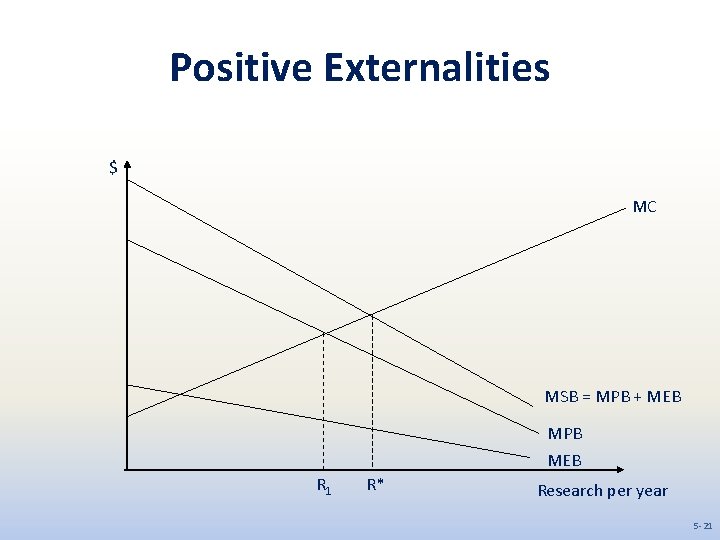
Positive Externalities $ MC MSB = MPB + MEB MPB MEB R 1 R* Research per year 5 -21
Positive Externalities: A Cautionary Note on Requests for Subsidies • Subsidies must come from taxpayers • Market does not always fail: the fact that an activity is beneficial does not always mean that a subsidy is required for efficiency • Policy Perspective: Owner-Occupied Housing 5 -22
Chapter 5 Summary • Externalities occurs when the activity of one person or firm positively or negatively affects another person/group/firm outside the market mechanism • An inefficient allocation of resources results because the market price does not reflect the external costs or benefits • The Coase Theorem indicates that private solutions through bargaining can achieve the efficient outcome under certain circumstances • Public solutions to externalities designed to achieve efficiency include taxes/subsidies; emissions fees; and command-andcontrol regulations • A market-based, cost-effective, public solution is cap-and-trade where pollution permits – the right to pollute – are traded 5 -23