
External Quality Assurance EQA and apprenticeships what you



- Slides: 37
External Quality Assurance (EQA) and apprenticeships: what you need to know Steve Walker – Senior Manager, Standards for Design and Development of Vocational & Technical Qualifications February 2017
1. EQA landscape 2. Ofqual’s approach to EQA 3. Regulation and end-point assessment (EPAs) 4. Working with other EQA providers
1. The External Quality Assurance (EQA) landscape
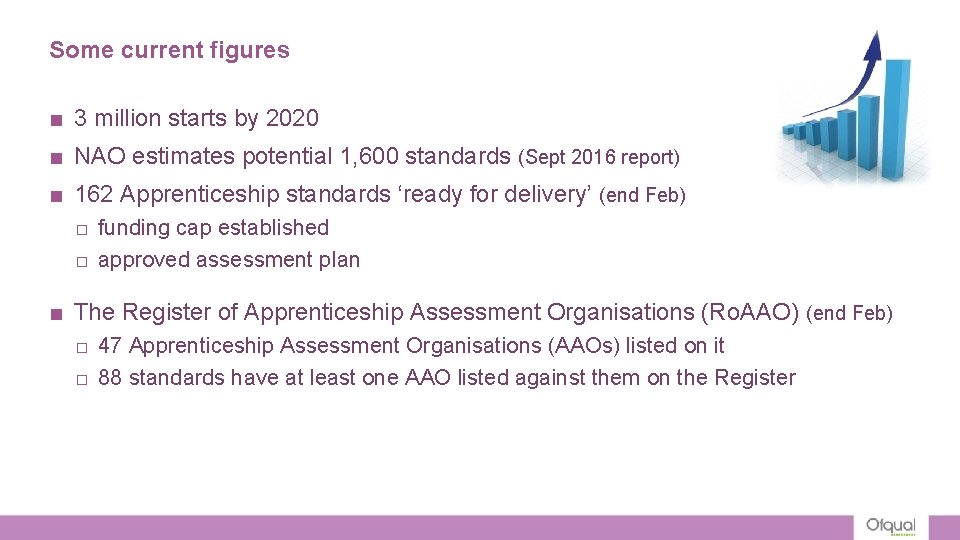
Some current figures ■ 3 million starts by 2020 ■ NAO estimates potential 1, 600 standards (Sept 2016 report) ■ 162 Apprenticeship standards ‘ready for delivery’ (end Feb) □ funding cap established □ approved assessment plan ■ The Register of Apprenticeship Assessment Organisations (Ro. AAO) (end Feb) □ 47 Apprenticeship Assessment Organisations (AAOs) listed on it □ 88 standards have at least one AAO listed against them on the Register
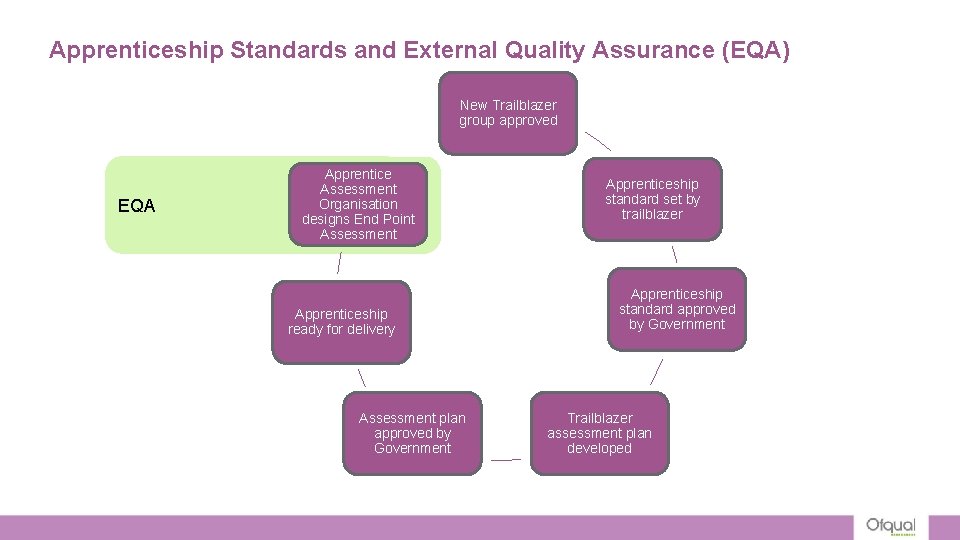
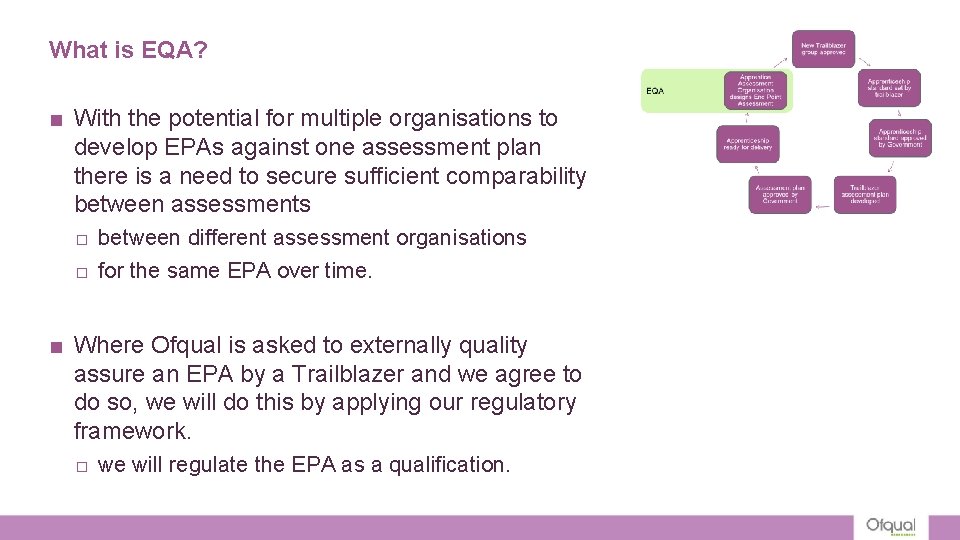
Apprenticeship Standards and External Quality Assurance (EQA) New Trailblazer group approved EQA Apprentice Assessment Organisation designs End Point Assessment Apprenticeship ready for delivery Assessment plan approved by Government Apprenticeship standard set by trailblazer Apprenticeship standard approved by Government Trailblazer assessment plan developed
What is EQA? ■ With the potential for multiple organisations to develop EPAs against one assessment plan there is a need to secure sufficient comparability between assessments □ between different assessment organisations □ for the same EPA over time. ■ Where Ofqual is asked to externally quality assure an EPA by a Trailblazer and we agree to do so, we will do this by applying our regulatory framework. □ we will regulate the EPA as a qualification.
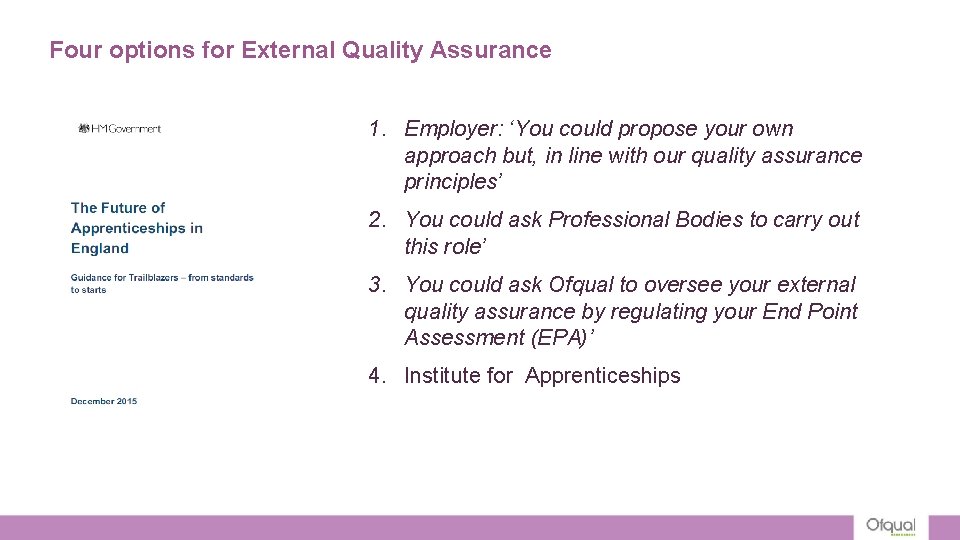
Four options for External Quality Assurance 1. Employer: ‘You could propose your own approach but, in line with our quality assurance principles’ 2. You could ask Professional Bodies to carry out this role’ 3. You could ask Ofqual to oversee your external quality assurance by regulating your End Point Assessment (EPA)’ 4. Institute for Apprenticeships
The EQA Landscape Of the 162 standards published and ready for delivery… ■ 97 have an External Quality Assurance route defined □ 32 employer-defined □ 28 Institute for Apprenticeships □ 20 professional body □ 11 Ofqual □ 6 other ■ 65 have no EQA route defined
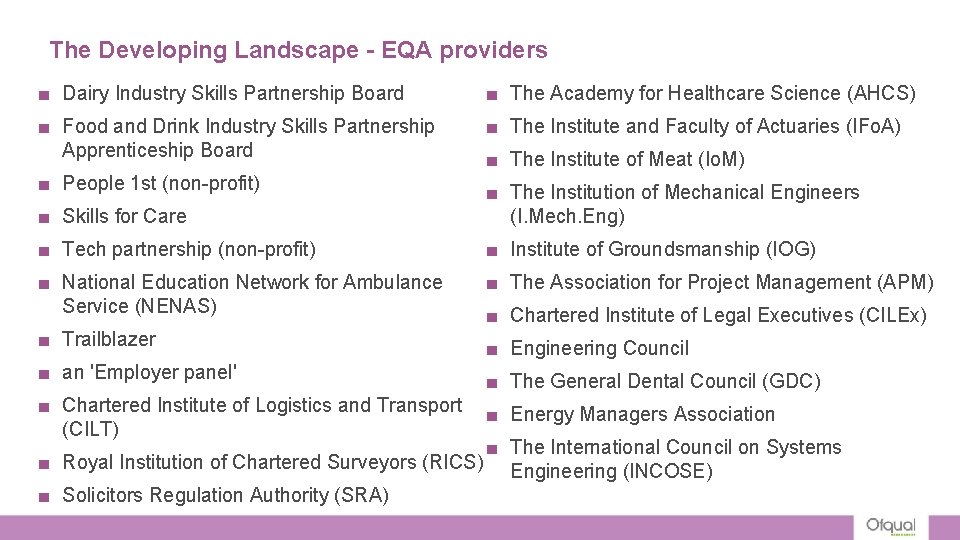
The Developing Landscape - EQA providers ■ Dairy Industry Skills Partnership Board ■ The Academy for Healthcare Science (AHCS) ■ Food and Drink Industry Skills Partnership Apprenticeship Board ■ The Institute and Faculty of Actuaries (IFo. A) ■ People 1 st (non-profit) ■ Skills for Care ■ The Institution of Mechanical Engineers (I. Mech. Eng) ■ Tech partnership (non-profit) ■ Institute of Groundsmanship (IOG) ■ National Education Network for Ambulance Service (NENAS) ■ The Association for Project Management (APM) ■ Trailblazer ■ Engineering Council ■ an 'Employer panel' ■ The General Dental Council (GDC) ■ The Institute of Meat (Io. M) ■ Chartered Institute of Legal Executives (CILEx) ■ Chartered Institute of Logistics and Transport ■ Energy Managers Association (CILT) ■ The International Council on Systems ■ Royal Institution of Chartered Surveyors (RICS) Engineering (INCOSE) ■ Solicitors Regulation Authority (SRA)
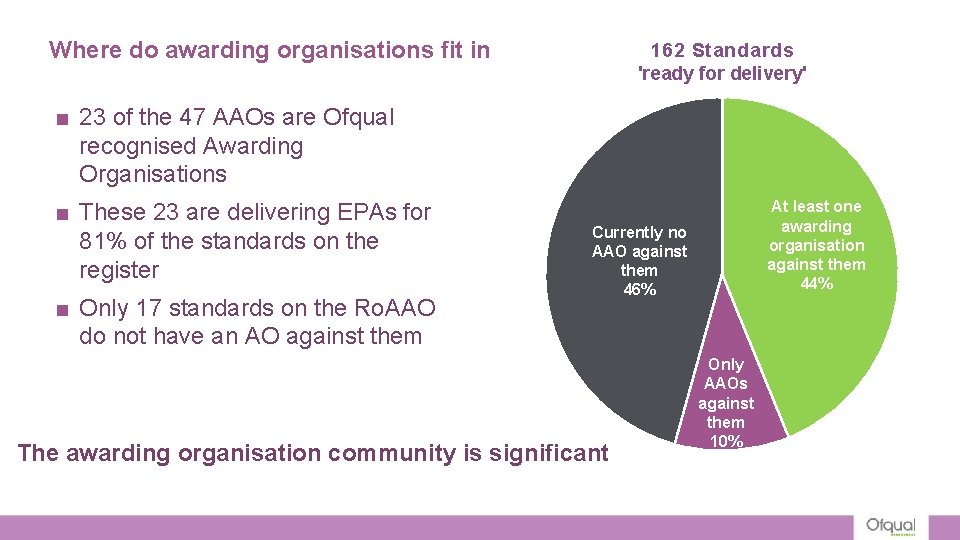
Where do awarding organisations fit in 162 Standards 'ready for delivery' ■ 23 of the 47 AAOs are Ofqual recognised Awarding Organisations ■ These 23 are delivering EPAs for 81% of the standards on the register ■ Only 17 standards on the Ro. AAO do not have an AO against them At least one awarding organisation against them 44% Currently no AAO against them 46% The awarding organisation community is significant Only AAOs against them 10%
2. Ofqual’s approach to EQA
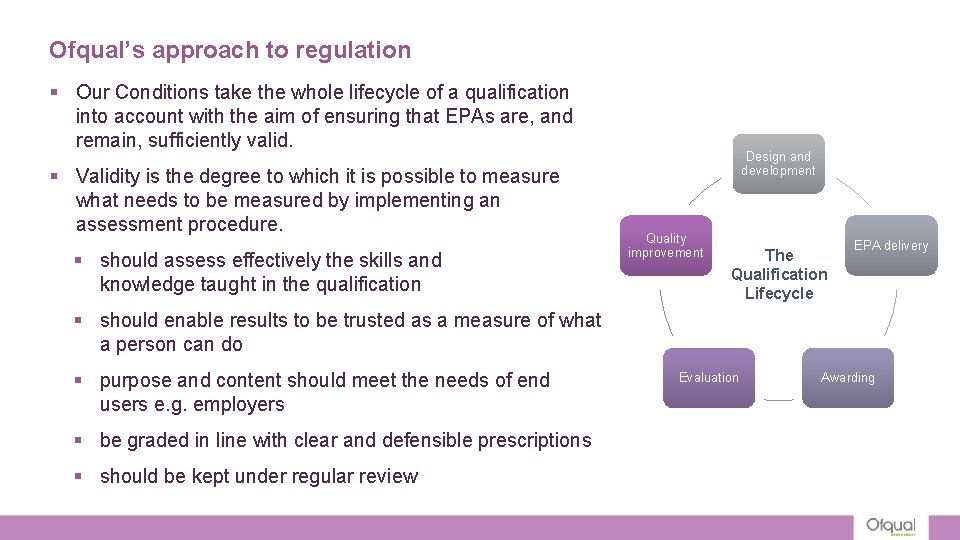
Ofqual’s approach to regulation § Our Conditions take the whole lifecycle of a qualification into account with the aim of ensuring that EPAs are, and remain, sufficiently valid. § Validity is the degree to which it is possible to measure what needs to be measured by implementing an assessment procedure. § should assess effectively the skills and knowledge taught in the qualification Design and development Quality improvement The Qualification Lifecycle EPA delivery § should enable results to be trusted as a measure of what a person can do § purpose and content should meet the needs of end users e. g. employers § be graded in line with clear and defensible prescriptions § should be kept under regular review Evaluation Awarding
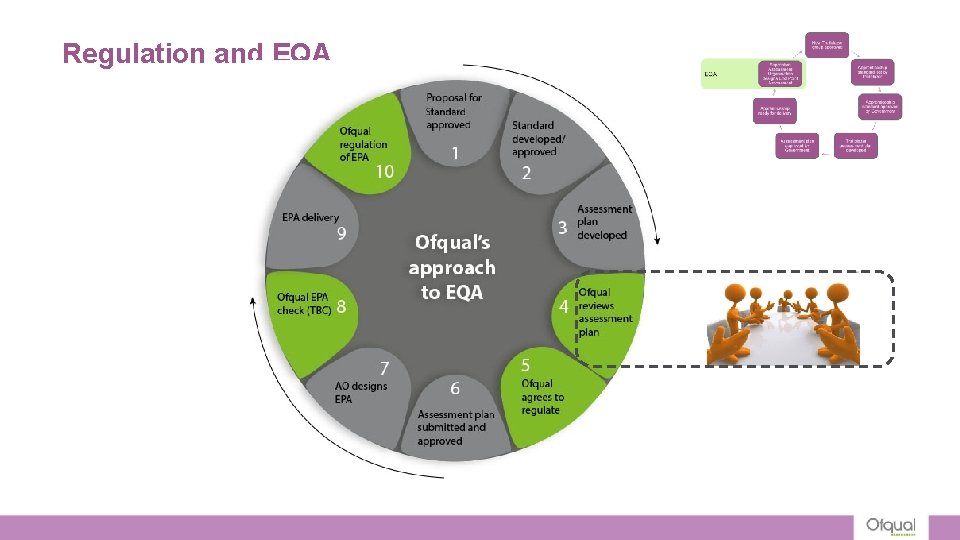
Regulation and EQA
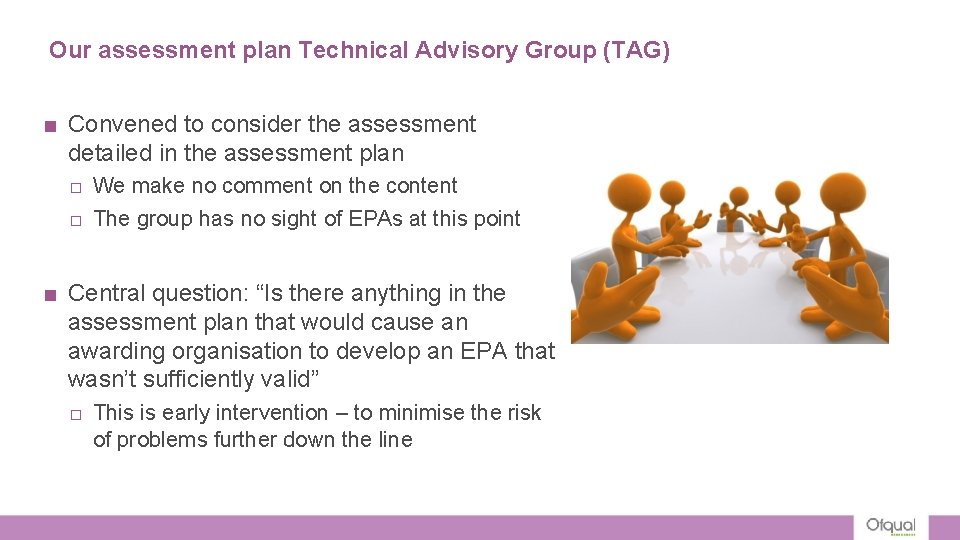
Our assessment plan Technical Advisory Group (TAG) ■ Convened to consider the assessment detailed in the assessment plan □ We make no comment on the content □ The group has no sight of EPAs at this point ■ Central question: “Is there anything in the assessment plan that would cause an awarding organisation to develop an EPA that wasn’t sufficiently valid” □ This is early intervention – to minimise the risk of problems further down the line
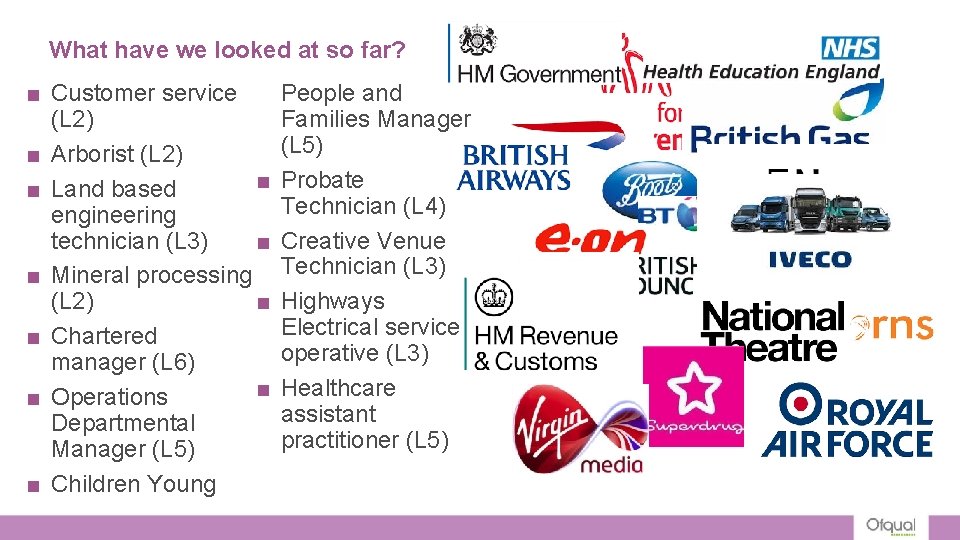
What have we looked at so far? ■ Customer service (L 2) ■ Arborist (L 2) ■ ■ Land based engineering ■ technician (L 3) ■ Mineral processing ■ (L 2) ■ Chartered manager (L 6) ■ ■ Operations Departmental Manager (L 5) ■ Children Young People and Families Manager (L 5) Probate Technician (L 4) Creative Venue Technician (L 3) Highways Electrical service operative (L 3) Healthcare assistant practitioner (L 5)
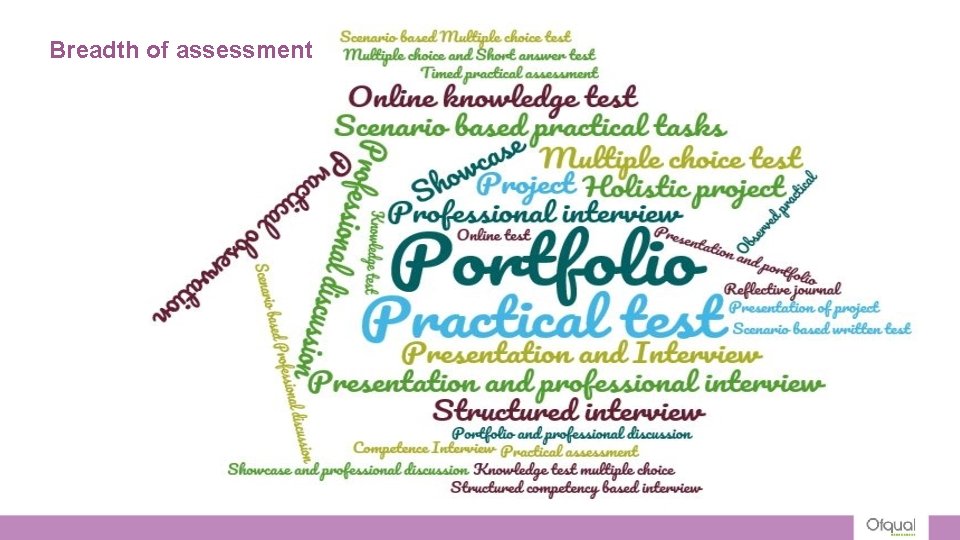
Breadth of assessment § Knowledge test § Scenario based practical tasks(multiple choice) § Showcase § Portfolio § Practical testbased written § Presentation and professional § Scenario § Practical observation § Competence Interview test § Professional interview § Portfolio § Multiple choice §and. Professional discussion Portfolio § Project Short answer test §§ Project § Multiple choice test Showcase and § Presentation and professional discussion § Reflective journal § Presentation and § Practical test Interview § Online test§ Showcase § Observed practicalinterview § Structured § Scenario based Multiple choice test § Online knowledge test § Presentation and portfolio § Practical § Knowledge test observation § Practical assessment § Holistic project § Portfolio § Scenario based practical § choice) Professional discussion (multiple § Scenario-based § Portfolio and tasks § Presentation of project Professional discussion § Practical test professional discussion § Presentation and § Structured competency based § Timed practical § Professional interview professional interview assessment § Online knowledge test
Breadth of assessment
Issues we’ve identified ■ Lack of criteria for differentiation □ Nothing to differentiate between pass and higher grades ▪ Either in terms of level descriptors, or ▪ where marks are implied or a percentage boundary applied, no division of marks is stipulated □ Criteria supplied for one form of assessment and not for others ▪ Practical exercise for example may have a description of expectations for a ‘pass’, but none are supplied for the professional discussion element ■ Efficacy of criteria □ Weak lexicon in differentiation criteria □ Criteria which are very subjective ▪ ‘personal accountability’, ‘professionalism’, ‘team working’, ‘customer interactions’ – sometimes stipulated without provision for the evidence of those things in the assessment
■ Grading calculations and aggregation □ Grades differentiated on very small parts of assessment □ Confusing grade calculations, between different methods of assessment □ Weighting and compensation confusing the grade intent ■ Security, predictability and manageability □ On-line assessments, and knowledge tests required, with little information on mitigating predictability □ Manageability issues - Large amounts of multiple choice assessment requiring significant development from assessment organisations
Types of assessment □ Showcase □ Professional discussion/ Interview □ knowledge test (often multiple choice) □ Practical test □ Project □ Portfolio Assessment issues □ □ Marking reliability Classification reliability Aggregation Assurance of competence vs compensatory models □ Ensuring comparability vs mitigating predictability □ Sufficient levels of detail to facilitate intended and consistent interpretation. □ Manageability
In the opinion of Ofqual’s Technical Advisory Group… ■ The assessment issues do not generally appear to be unique to apprenticeships, however the number of standards, and the role and expertise of parties involved may exacerbate their likelihood and impact. ■ The assessment methods employed are familiar and guidance for trailblazers could mitigate some of the risks and issues associated with them: e. g. □ what different assessment methods are particularly suited to assessing and the limitations, and challenges of each □ a common lexicon in relation to assessment methods □ principles (and perhaps examples) to address specific assessment issues. □ the minimum amount/type of information necessary to support the effective review of assessment plans and the effective development of EPAs.
Table discussion: 10 minutes ■ Do you agree? ■ In your opinion how do you think we should/could go about mitigating the risks and issues highlighted?
3. End-point assessments and our regulatory framework
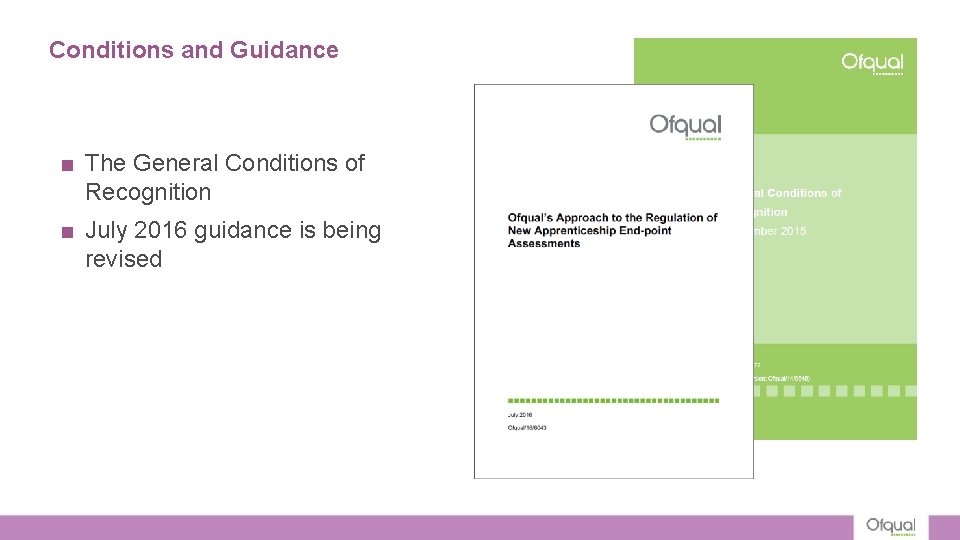
Conditions and Guidance ■ The General Conditions of Recognition ■ July 2016 guidance is being revised
Recognition
EPAs and the portal ■ Will EPAs be put through the Portal? If yes, how will EPA/EPA components have to appear on the register? Would the entire EPA appear as single unit qualifications or would each assessment component appear separately as units within a qualification? Will there be the facility to set-up pathways in the portal for an EPA? ■ EPAs must be entered on the register through the portal. EPAs placed on the portal should be a single entry with the constituent methods of assessment indicated. Where optional pathways to complete the EPA exist these can be indicated under 'optional routes to complete qualification'
■ Will operational start date relate to the first offer of the EPA or start date of apprenticeship? ■ Given the differing states of readiness of apprenticeships, EPAs we would suggest the operational start should mirror the regulation start date and reflect the date the EPA was placed on the register. ■ What are the requirements for titling an EPA? Will titling include any indications of size and level? ■ The title of an EPA needs to be in line with our Conditions and could follow a similar format to the example below. ■ (AO) Level (x) end-point assessment for (name of apprenticeship standard)
■ Will the TQT criteria (Condition E 7) be applied to EPAs? If yes, how should this be applied? ■ Awarding organisations should apply TQT criteria (Condition E 7) to EPAs being mindful both of our guidance for the general conditions of recognition and, any stipulations in the relevant assessment plan. We are considering expanding our current guidance on the application of TQT. ■ What are the requirements for certification of EPAs? What information/data do awarding organisations need to capture around certification. ■ Condition H 6 requires awarding organisations to issue results. There are no additional requirements on awarding organisations to capture information beyond what is currently required in the General Conditions.
Table discussion: 10 minutes ■ How can we further clarify for you as awarding organisations our requirements for EPAs? □ Guidance? □ Conditions? □ Exemplification?
4. External Quality assurance partnerships
The Developing Landscape - EQA providers ■ Dairy Industry Skills Partnership Board ■ The Academy for Healthcare Science (AHCS) ■ Food and Drink Industry Skills Partnership Apprenticeship Board ■ The Institute and Faculty of Actuaries (IFo. A) ■ People 1 st (non-profit) ■ Skills for Care ■ The Institution of Mechanical Engineers (I. Mech. Eng) ■ Tech partnership (non-profit) ■ Institute of Groundsmanship (IOG) ■ National Education Network for Ambulance Service (NENAS) ■ The Association for Project Management (APM) ■ Trailblazer ■ Engineering Council ■ an 'Employer panel' ■ The General Dental Council (GDC) ■ The Institute of Meat (Io. M) ■ Chartered Institute of Legal Executives (CILEx) ■ Chartered Institute of Logistics and Transport ■ Energy Managers Association (CILT) ■ The International Council on Systems ■ Royal Institution of Chartered Surveyors (RICS) Engineering (INCOSE) ■ Solicitors Regulation Authority (SRA)
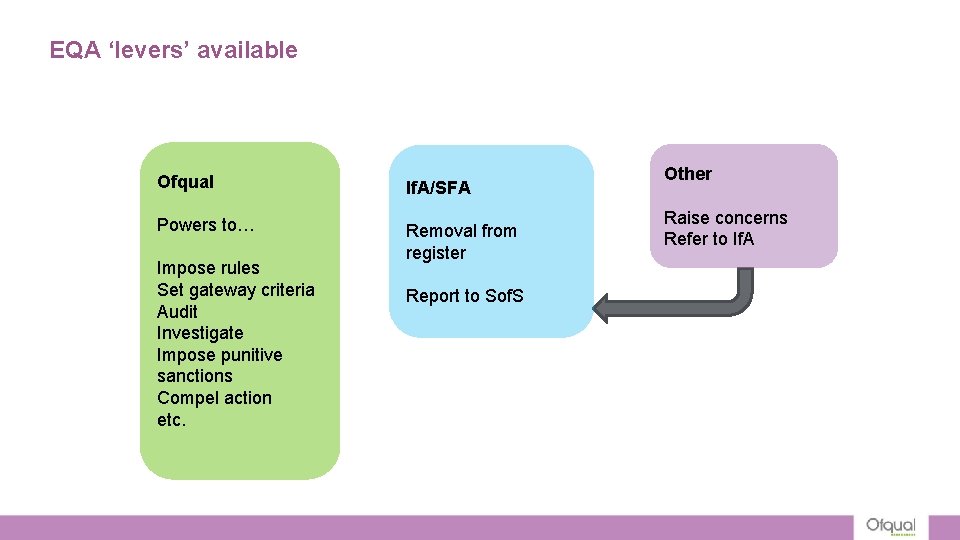
EQA ‘levers’ available Ofqual Powers to… Impose rules Set gateway criteria Audit Investigate Impose punitive sanctions Compel action etc. If. A/SFA Removal from register Report to Sof. S Other Raise concerns Refer to If. A
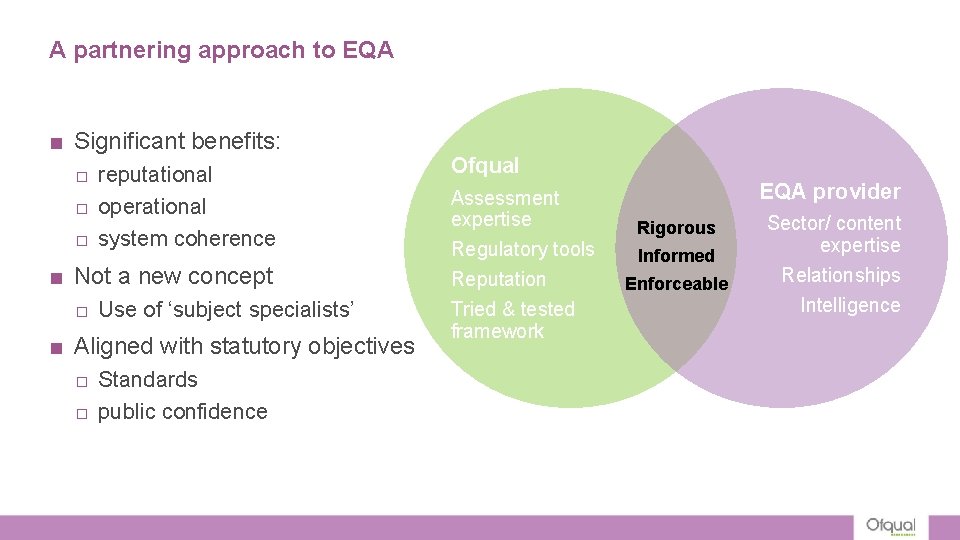
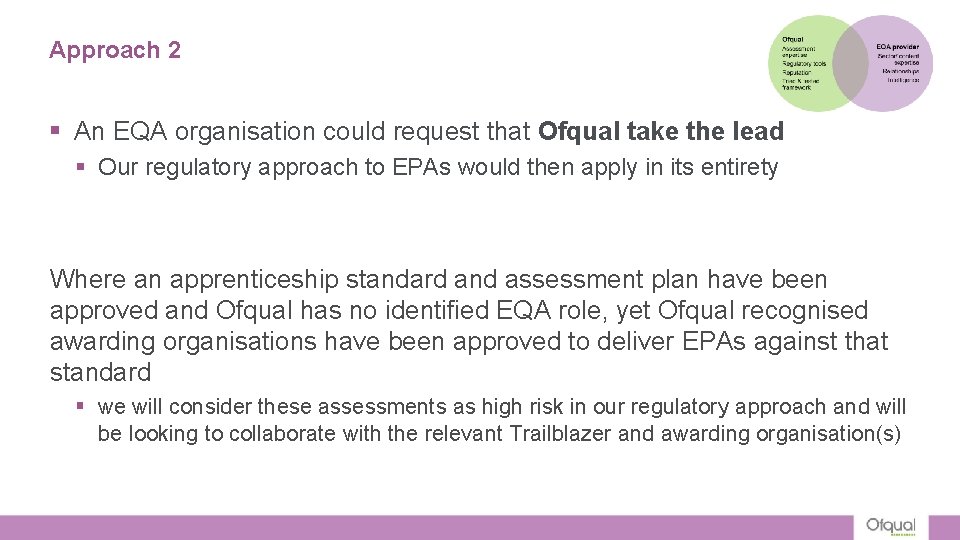
A partnering approach to EQA ■ Significant benefits: □ reputational □ operational □ system coherence ■ Not a new concept □ Use of ‘subject specialists’ ■ Aligned with statutory objectives □ Standards □ public confidence Ofqual Assessment expertise Regulatory tools Reputation Tried & tested framework EQA provider Rigorous Informed Enforceable Sector/ content expertise Relationships Intelligence
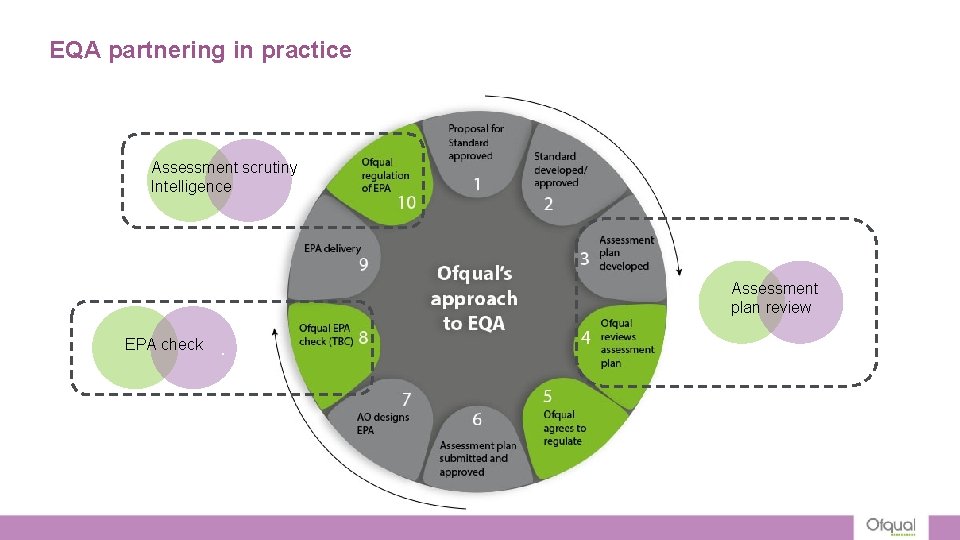
EQA partnering in practice Assessment scrutiny Intelligence Assessment plan review EPA check .
Approach 1 § An EQA organisation could remain the EQA lead § Ofqual would then partner with that organisation in aspects of an external quality assurance process. Specifically, Ofqual would; ▪ require sight of the assessment plan prior to its final submission to the IFA ▪ partner with the EQA provider in the sampling of EPAs ▪ once EPAs are in delivery, partner with the EQA provider in assessment scrutiny ▪ expect any relevant intelligence from the sector to be passed through to our standards team § Implications § the partner organisation would be named as the EQA provider on the assessment plan, § we would require that the EQA provider stipulate that any AAO who delivered EPAs against these standards would need to be Ofqual recognised.
Approach 2 § An EQA organisation could request that Ofqual take the lead § Our regulatory approach to EPAs would then apply in its entirety Where an apprenticeship standard and assessment plan have been approved and Ofqual has no identified EQA role, yet Ofqual recognised awarding organisations have been approved to deliver EPAs against that standard § we will consider these assessments as high risk in our regulatory approach and will be looking to collaborate with the relevant Trailblazer and awarding organisation(s)
Thank you Please send comments or feedback to apprenticeships@ofqual. gov. uk